Writing, Wandering, Wondering, and World Peace

I dream of being a better writer and artist. Of being a lyricist or maybe even librettist. Of taking many of my designs for furniture, clothing, sets and costumes, building materials, architectural elements, jewelry, inventions, and any number of the other concepts that constantly float around in my skull into the realm of actual production and use. Oh, yeah, and I dream of World Peace, too. Really.

Some people dream of simply having a healthy child with the average odds of survival and success in an average-length life. That was not my dream, but I know that it’s one shared by millions, not least of all by the author of an outstanding blog, The Hartley Hooligans. Gwen is always a superb writer and a tremendously insightful amateur sociologist-cum-psychologist with a wicked sense of humor. She outdid herself in one recent post. It’s a spectacularly beautiful meditation on how, in general, to live life boldly, fully, and richly. The article is ostensibly aimed at mothers or parents of special needs children (the author is mother to two profoundly ‘challenged’ kids and one who’s not), but I realized as I was reading it that it’s perfect advice for anyone, anywhere. (Note: Unless you’re a self-employed home-dude like me, reading The Hartley Hooligans may occasionally prove NSFW! But never, never dull.)

I don’t ordinarily publish anything that I didn’t write or illustrate myself, but in writing, supposedly, to the parents of special needs kids, Gwen offers insights so universally applicable to any of us who find ourselves with different realities than we had fantasized or expected in life, I think others should hear her uniquely graceful, bracing, hilarious, and touching take on the how-to and why-not of holding fast to our hopes and keeping up with the business-busywork tasks that make them possible.

For myself, I just substitute for her discussion of [special needs children] with the concept of any deeply felt, long-held dreams that I’ve felt unable to achieve or too intimidated or ill-equipped to accomplish, or have thought would be forever out of my reach for any reason.  I replace her talk about [doctors and caregivers] with those advisors and companions of any kind whom I assemble to support me in my life. The advice this wonderful, earthy, real woman gives on how to make the most of any situation; to give myself permission to be human, not superhuman; to credit myself with what I do accomplish and build on it; to surround myself with real, two-way relationships of love, respect, challenge, and support; and to make the most of everything I have with gratitude, is inspiring and pretty priceless.

I’m not one for sharing others’ work on my blog often, but this really spoke to me in a direct way that I think is far more broadly applicable than the already impressive comfort and wisdom of its intended point. I suspect we can all learn from it, so I feel compelled to share it here. Enjoy.

Many heartfelt thanks to Gwen for permission to share this epically useful, sane, marvelous insight of hers with my friends here in Bloglandia!

Digital illo from a photo: Everyday Superheroes

What do superheroes look like? Ordinary people who believe, and persist. No masks and capes required. Halos optional.

Colorful Language

Photo: A Constellation of Mysteries

Color is just one of the infinite constellation of mysteries that make up my world, my life. What looks like nothing but the fabric of my black corduroy pants has a surprising amount of what looks like non-black color in it when I look very closely. A bit of digital exaggeration and enhancement to bring out the colors I see either heightens the illusion or tells me, once again, that color is far more than meets the eye!

I’ve been taught that color, or at least our perceptions of it, might be manageable. As an artist, I try my best to take advantage of that possibility. But I know my limitations. Even rather experienced and advanced color theorists in this day and age come up against problems with explaining and understanding precisely what color is and how it acts, despite knowing the differences between additive and subtractive mixing, knowing how the retina and brain perceive and communicate color ideas to us, or knowing how the environment and context of what we see affects our perceptions of color.

What does it really mean if I say that Black is a construct that represents the absence of color and White, one representing all colors combined? Or if I tell you that an orange is, well, orange, but in deep shadow it might appear brown or black, or light yellow? Or that humans have white or black or red skin! What gives a single one of these concepts any credence at all? Color, it seems to me, is a matter of faith as much as of science—like so many things we think of as immutable Fact in our little universe. What both science and faith seek to explain, it seems to me, is beyond the scope of human understanding no matter how brilliantly we study and how majestic and divine our inspiration would appear. What is all around us is supremely complex and beautiful and, to my mind, needs no understandable explanation to be so glorious.

No matter what color it is.

Toddler Etymology

Digital illo: Just Swissin'Ever wonder where little children get their surprisingly sophisticated or apropos neologisms from when they pop up with those odd comments seemingly out of the blue? I know I do. I’ve spent enough time pondering the verbal magicks of the offspring sprung from sisters, friends, and relatives, to think that there is something more than mere chance at work some of the time…but, what? Sheer serendipity seems inadequate to explain how logical or fitting or uniquely unlike what one ought to expect from these kids such prodigious pronouncements can be. From what ineffable sources does infant etymology spring?

There’s one goofy expression long used in my family that makes a fine example, I think; I hadn’t even thought about the oddity of the word and concept in ever so long, but when it came to mind as suited to an occasion arising just the other day, I pondered yet again how such things can arise. The story behind the word/idea is that my youngest uncle, at the time still sleeping in a crib but definitely speaking—as the youngest of six children in a not-very-wealthy household, I can imagine this was a useful space-saving device as much as anything else—was heard to be stirring one morning but hadn’t clambered out of the crib. So his mama, my grandmother, made her way in to see whether her boy was actually up and about or had merely made a sound in his sleep.

It seems he was in an intermediate state, still not fully ready to get up and attack the day, but not deep in dreams anymore either. When asked what he was doing, his response was that he was “just Swissin’.” That seemed to require a bit of clarification. “What?” His response: “I’m not asleep and I’m not awake; I’m just Swissin’.” For the longest time, I thought of this invention as being the equivalent of behaving like the Swiss—existing at neither extreme but in a neutral space between the two. But later, it seemed to me that if he’d had the slightest contact with a real Swiss person, he could well have had a different reason for coining the word. In German, the similar-sounding word “zwischen” means “between,” and what could possibly be a better way to describe the state in which one is neither waking nor sleeping, but in that suspended animation reaching from one state toward the other?

The problem with this delightful theory’s seeming perfection is that if that little boy who became my uncle was hearing anything other than English spoken around him in his American home, it was most likely Norwegian spoken between his parents or other older relatives and friends, given their roots. So how did he invent and name that neat little idea of his? I can’t begin to fathom. But after having made that unexpected connection myself, long after the fact, I relish all the more our continued family use of the word Swissin’, and I thoroughly enjoy knowing that it is even better suited to the status of being neither-here-nor-there than any other single word I can recall. Is it the work of a brilliant linguist or the most excellent of accidents in speech? Neither; it’s just Swissin’.

Foodie Tuesday: When Baking Gives You Lemons…

You should find it dazzlingly obvious by now, if you’ve been visiting here for more than a week, that I am not a Baker. Exactitude is a form of patience that I lack, so much so that following a recipe to the letter—an important characteristic of baking’s central processes, whereby the necessary chemical and physical elements are able to perform their required duties and make the food do the particular tricks it’s supposed to do—is impossible for me, or close enough to it. As a consequence, I have made many, many baked goods that were not entirely, well…good. So many dishes that should have been light and fluffy come out more suited to supporting a truck while a mechanic fiddles about underneath it. What could and should have been moist and dense is instead frequently crumbly and dry and better designed in texture to use as kitty litter than as dessert, despite pleasant enough flavors. [Disclaimer: if you think this is an admission that I have eaten actual kitty litter, you have either greater faith in my scientific daring or even less in my common sense than I deserve.] Disappointing, these results, but enlightening, if I pay enough attention. Sometimes even remediable. There may be hope for me yet.

Maybe that’s why I don’t stop meddling with what should be fairly straightforward recipes. I trust that, at least some of the time, what doesn’t turn out best on first effort might be rescued by a further experiment or two.

This winter I was given a gorgeous, huge, tree-ripened lemon. My friend hand-carried it from her mother’s garden a couple thousand miles from here, and it was so big and juicy and magic-laden and perfect that I wouldn’t dream of letting it go to waste as a mere additional squeeze on dinner’s salad or a piece of fish. I sliced it thinly; not very evenly, because as I have surely mentioned before, my knife skills are less than impressive, but I gave it a go, and I did slice it fairly thinly. Then I layered those slices with cane sugar in a tight-fitting jar and filled all of the remaining space with plain, high-octane white alcohol (vodka, probably) and let it sit for a couple of months, just giving it a shake or tip once in a while to get the sugar to melt in and absorb and the lemon flavor to be intensified. When I opened the jar last week: Elysium! A rush of deeply floral, lightly sweet and highly lemony perfume bursting from the jar with the reassembled fruit in it. A whiff made for fainting over, if one breathed it in long enough. A liqueur not to be spent lightly, either.

I’d had this fancy, for a while, to try my hand at making some sort of citrus-cornmeal torte. I’ve read recipes for various kinds, particularly olive oil enriched ones from Sicily that sounded uniquely tempting, and decided to give my own version a try. Oranges and/or lemons, olive oil, corn meal. Not too sweet, not too bland. Just honest and refreshing. Sigh. None of the recipes I found was precisely what I thought I was salivating for at the moment, though. I still wanted moist and slightly dense texture, almost a steamed pudding character. What to do, what to do…. Of course: experiment, again. Knowing that baking still requires some commitment to precision, I did as I always do and turned to a tried-and-true basic recipe of somewhat similar character and substituted this for that and these for those. What resulted was not precisely what I’d had in mind, but not too shabby, either.

Photo: Lemon Cornmeal Torte

When I inverted the torte out of the springform pan, I broiled it briefly to finish coloring and caramelizing the lemon slices. If you have one of those dandy little brûlée torches, have fun with it. I don’t recommend an acetylene welder, however, unless you’re baking in your foundry.

Lemon Cornmeal Torte (Take One)

Preheat oven to 450°F/232°C (or whatever approximates those temps in your oven). Mine, as I’ve mentioned numerous times, is old and unreliable, so I must needs watch it like the vultures watch I-35.

I decided to use my springform pan. I lined it, inside and out, with heavy aluminum foil because, given the experimental nature of all of this, I was a little worried about leaks and other non-ingredient surprises. Not to mention that that uppity oven of mine might explode in a fireball or something. Probably wasn’t necessary, in the event, but still. On with the recipe:

I mixed about 3-4 T melted butter with an equal amount of cane sugar and spread it in the bottom of the pan, and then laid the lemon slices out across that syrup base.

Combine dry ingredients with a fork or whisk: 3 cups cornmeal, 1 tsp baking powder, 1 tsp baking soda, 1-1/2 tsp salt, 1-2 tsp ground cardamom, 1 T citrus zest. Since I’d macerated the Queen Lemon, her zest wasn’t fit for the task anymore, so I grated the peel from a couple of the clementines I had on hand.

In a separate bowl, beat together the wet ingredients. [These are where I think I would have done well to go a slightly different path.] I combined about 2-3 Tablespoons’-worth of flavorings from the following: liqueur from the preserved lemon, fresh lemon juice, and ginger syrup. I added enough buttermilk to the flavor mix to equal 2 cups total. [In retrospect, I would have bumped the flavorings’ amount to a full half cup and used 1-1/2 cups of the buttermilk.] Whatever the eventual “design” of the recipe, on this occasion I rounded the wet ingredient list with 1 cup orange juice, 2 large eggs, and 2/3 cup fine extra-virgin olive oil. I suspect I could well have added another egg at the time with good success, too, but I didn’t. We shall see!

Combine the wet ingredients with the dry and stir until mixed. Pour the batter in the pan over the lemon slices, set it in the oven, and bake just until set, the center not quite visibly moving anymore when you bump the pan, somewhere around 35-40 minutes.

Served with a very lightly sweetened whipped cream, it was pleasant and tasted of spring. But it wasn’t quite what I was craving, just yet. I wanted brighter, juicier lemon flavor and yes, this torte was still on the fragile, crumbly side. Onward, I say! The next day was good enough for reevaluating and rethinking. And rebuilding. That night we’d had a table-full of guests, but there was also another cake, so both desserts stretched beyond our needs. That left me, on the next day, with half a torte, or more accurately, a big quart bowl brimming with lemon-ish torte remnants. Make a trifle with the remaining whipped cream? Perhaps. But it wouldn’t fulfill my fancy, still, of that zingy, moist dessert I was imagining. Instead, I made:

Photo: My Pudding ReTorte

Even a tasty steamed pudding is often not so much to thrill the eye, so I served this little dish of mine with a puree of fresh strawberries in orange juice and a sprinkling of black sesame seeds just for the jazz of it. Less elegant looking than the original version, more zingy to eat.

Steamed Lemon Pudding (My Re-Torte)

I put the torte crumbles, sliced lemon topping and all, into my food processor with not only the almost-equal amount of leftover whipped cream but also a very hefty splash of lemon juice and three large eggs, and blended everything into a new, thicker batter. I poured it into a greased, covered casserole and steamed it until, again, it was just set. [It could easily steam in your oven or pudding steamer in the traditional way, but with my oven being so recalcitrant, I opted to steam it, covered, in the microwave instead.]

Photo: Rose Explosion

Roses *and* primroses: those pale tissue-pink sweethearts on the lower right are my first real crop of the dainty wildflowers since I seeded them two years ago in my backyard mini-meadow. Yay!

When I let it cool to room temperature, that iteration of lemon-cornmeal dessert proved to be more what I’d had in mind all along. It was just about the texture of a good Christmas pudding, but of course more seasonally fit in both color and flavor for what we did when my visiting friends returned for our afternoon coffee: we sat on the patio and spooned it up while sipping, chatting, gazing at the explosion of roses, and enjoying one of the nicest bits of outdoor-friendly weather we ever get in these parts.
Musings

Don’t worry, my friends. When I muse upon anything, it’s not expected to change the world. Nor change my mind. Least of all, change me.

Though I can’t guarantee any of that. Most of the changes, of course, are fairly insignificant since most of my musings are mighty silly. Whether the changes are for the better or worse, given my goofiness, time and my critics will undoubtedly tell.

What’s on my tiny mind today? Tiny thoughts.

Like: If policy-makers are serious when they say we should reduce waste, then why are the bags for collecting rubbish and taking it to be heaped in the landfill mostly touted by manufacturers as being more desirable because they’re nearly indestructible? And as a corollary question, how many policy-makers can fit into one of those indestructo-bags? Oops, I said that out loud, didn’t I. Just one of life’s little conundrums.

Should that be ‘conundra’? Conundrae? I had to look it up and absolutely hooted with joy when I saw the responses to a Guardian (Thank You, British linguistic pugilists! Thank you!) inquiry on the topic. Yet more delightful musings spring forth from the very thought of these brainiacs tussling humorously over the proper plural, whether there is one, and whether anyone ought to give a fig about it.

I also muse on things like: If I always dreaded and hated pressing clothes at laundry time, so much so that I got rid of the requisite appliance many years ago, yet I am now slightly obsessive about folding clothes so that they seem, possibly, neatly pressed…is that ironic? I would be hard pressed to say.

Like: If “Youth is wasted on the young,” why do the people who say so think that by recapturing the privileges and advantages of youth, they would remain mature enough to give the lie to their assertion? I guess they’re too busy being self-congratulatory on having a George Bernard Shaw quotation up their sleeves to consider any other delusions. Unless they’re too busy checking to see whether Shaw was restating (“Youth is a wonderful thing. What a crime to waste it on children.”) Oscar Wilde—and who wouldn’t? Wilde was the bonniest of mot-smiths.

All I can think in response to it, in fact, is: Why leave it to young people to act like children anyhow? It’s only in my latter years that I have gained a deeper appreciation for my natural talent and efforts combining to keep me so wonderfully immature.

With that, I will say that it’s probably past my bedtime (one of the catalysts for my current state of fuzzy thinking, perhaps, but surely not the only one), and whether that’s because I’m such a child or because I’m such an old lady is kind of irrelevant, isn’t it. Good night, then, and may all of your dreams come true. As long as they’re full of Wilde brilliance.

Photo: Deep Thoughts

Ta-ta, toodle-oo, and a good nighty-night to you all!


Careening toward Excellence

Digital illo from photos: Psycho-Zydeco 1There is no chance, however infinitesimally remote, that I will ever be perfect in any way. Olympic scores of 10 notwithstanding, I suspect that quantifiable perfection is beyond human reach altogether. My reach, however, I can guarantee unequivocally will remain ever short of the absolute.

And I make no apologies for it. Argue the possibility for human outliers if you will, I am no such exemplar.

This doesn’t excuse a perpetual state of lying down on the job. Corpses are already better at that task than we are while still alive, no matter how expertly lazy. And you know that I do speak as a highly skilled practitioner of that art. Not being a corpse, just yet, thank you. Laziness.

I also know, however, that from play, serendipity, accident, and even out of the occasional non-life-threatening disaster can come growth and inspiration. We improve more by learning from our mistakes than from thinking, “Nailed it!” and settling comfortably into what we hope is an easy formula for repeating the success. This, however counterintuitive it may seem, gives me hope.

Perhaps as I go bouncing through life in my random, attention-deficit-slanted, cheerily inefficient way, I may well stumble upon my better self, eventually. Don’t look for me in the Hall of Fame, let alone among the stars. But if my fine intentions and a healthy dose of good fortune should, like mythic planets, align at some heroically splendid place and time, you can certainly find me in the shining company of the wonderfully, luckily contented.Digital illo from photos: Psycho-Zydeco 2

All Kinds of Music

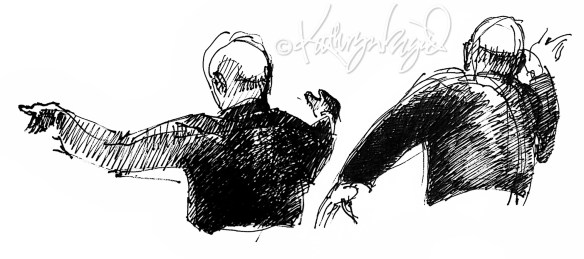
Drawing/painting illo: Three ComposersIn my head, there is music. Mostly, it’s a rambling, meandering thing without much form or direction, just a little ditty that my subconscious seems to hum to itself along the journey of the day. Once in a while, it’s an earworm, some tune or phrase caught in the soundtrack of my brain and put on long-term Repeat because I heard it or remembered it recently and didn’t have another thing to replace it with soon enough. Often, when I’m drifting off to sleep or marking time while I wait for something to happen, there’s a sort of internal theme song of mine, a mere snippet of a melody that might be a simple part of a Bach invention or might just as well be something of my own invention inspired by Bach or some similar composer, a line that becomes more or less complicated, turns from something slightly Baroque to a more Classical seeming style for a bit and then becomes a very plain little row-your-boat kind of canon before returning to its silent corner to wait for my next moment of internal quiet. On rare occasions, there might be words attached or an obvious external source of whatever song seems to have sneaked and snaked its way into my frontal lobe for a lope or two around my one-track mind.

Yet I have not the gift of composition. When I think about it in a more determined and purposeful way, I have all sorts of ideas about how I would probably set a particular poem or story text of mine if I did have compositional skills, how I might voice the piece or what instrumentation I think would be just right for the words and ideas therein. But it would be helpful, if I really intended to do any such a thing, if I had the slightest notion whatsoever of music theory or how to read a score (let alone write one), of what certain instruments can and cannot do, and whether the human voice is actually capable of making the sounds that might be required of such a project.

I am ever so glad that there are composers in the world capable of carrying a musical idea to magnificent, magical fruition. I sincerely doubt that any of them would set any text, mine or another’s, in just the way that my moseying mind seems to believe it would—for good or ill—and that is the way the universe operates. Each of us has skill sets and desires and training and passions that make us better, or worse, fitted for the tasks and arts that we imagine to be useful or pleasurable, and each has limitations even on our own abilities to recognize where we will excel and when we might fall short. What a wonderful thing it is that, though I’m not a composer myself, there are excellent composers who can and will set my words to their own music, because after all, choral music is one of the most clearly collaborative of activities anyway.

What a wonderful thing it is that, though I will most likely never master bringing what rings inside my skull out of it in an intelligible way, let alone anything like the one I imagine in its internal incubator, somebody out there is busy penning loveliness and longing, drama and dreams, that will carry their music forth into the hearts, minds, and ears of a waiting world’s humming silence.

Transitory or Transitional

Pen & ink drawing: Transitory or TransitionalMy spouse, in his combined capacities as a natural-born teacher and a lifelong curious learner himself, is constantly reading, studying, talking shop with others both in and out of his field of music, and cogitating inwardly and through his writing about ways to grow and improve. I am neither a born teacher nor as dedicated and skillful a learner as he is, but I have, I think, grown a fair amount in my appreciation of what quantities and depth of effort it takes to improve oneself, let alone help others to improve themselves, in any chosen course of study. One of the things that intrigues me is that, as in so many areas of life’s experiences, the macro and the micro aspects of learning and, in turn, teaching, always ebb and flow: it takes a multitude of tiny pieces of knowledge and/or effort to make any significant larger ones, and the large ones must generally be reduced to smaller and more manageable parts in order to be changed, eliminated, or simply learned, as well.

In a day’s rehearsal for an upcoming concert, it’s marvelous to see and hear what occurs as a major composition is broken down into its component parts and those parts studied and practiced and rehearsed in detail, bit by bit, but also to realize that the individual parts have no beauty or meaning unless also studied in the context of the whole. Fixing one small phrase or chord at a time can be a portion of the improvement process, but if that’s all that happens, then the performance will never have any cohesion or sense of drama but will forever remain a collation of essentially separate and unrelated atoms that happened to be sounded in the same room on the same night. Playing or singing through transitions—the places where one phrase or larger idea in a composition ends and the next begins—is a way in which my conductor husband helps his choirs, orchestras, and other performers to experience and express the whole of the story more convincingly themselves, and thus bring an audience into the flow of the work as well.

Music is a wonderful vehicle for individual experience of the aesthetic, emotional, artistic, and ephemeral aspects of existence, and as such is a grand gift. But when it becomes a communal, communicative experience rather than only an isolated solo, it has incredible power for building relationships between people, ideas, cultures, lives. When it is a bit of a song, hummed or played on the street, in the car, at work in the kitchen, it can cheer or soothe, feed or please; when it is a performance of a major musical work in concert, in a musical or opera, an oratorio or a middle school end-of-year concert that has many participants and has been labored over with passion by all of them through a string of intense rehearsals, its power is magnified and resonates for a long, long time to come. It’s as though the practice of singing or playing through the transitions from one passage to another of that single composition has expanded into life, letting the dissonances and harmonies, the threads of meaning and the ecstatic shimmer of aural beauty, all remain in the air and in our spirits long after the last notes have gone silent, carrying us through the transition from art into life with renewed depth and purpose.

Foodie Tuesday: Up to My Elbows in It

Photo: Fat, Glorious FatYou already know that of my many edible obsessions, fats are among the most prized. Butter in virtually any form is the glistening Sun of my oblations when it brings its sleek graces to the sweet and the savory alike. Meat fats, vegetable-derived fats: yea verily, I can’t imagine how I would find culinary happiness if it weren’t for the kind kisses of olive oil, duck fat, tallow, avocado oil, sweet and mild nut oils, leaf lard, coconut oil, and all of their slick cohort bringing the foods I eat to their most well-rounded state. Barbecue of the highest order doesn’t even exist, in my book, unless I have to scrub like a surgeon after eating it to clean up the goodness that ran up my arms before getting to my mouth. The mere sheen of the translucent butcher paper sticking to the smokehouse table is enough to start a Pavlovian response in me.Photo: Brisket, Burnt Ends, Ribs, & Sausage

The thing is, I’ve learned over a long and avid career as an eater, that it’s not fats, per se, that make me rounder, but which fats I eat, and when, and how much. I am well aware that food is faddish, and you know I’ve posted about such things on many a Tuesday of yore, but I pay better attention to my own body’s definition of what works and what doesn’t than I used to do, and by now I’ve seen that while it’s not very helpful to me in terms of my physical fitness or comfort to indulge as much as I wish in eating like a ruminant or like a three-year-old with a credit card, I can be more generous with my desire for fat. You can cringe if you like; I know it’s not for every body, and Fat has been made a dirty word for generations not only because it’s been considered unhealthy, unseemly or both but because it’s been considered dangerous and therefore ugly on people.

But I’ve known folk who lived long, happy, productive lives without ever being particularly svelte, let alone stick-figure thin like fashion models are wont (and expected) to be. I’ve known of dietary health or fitness fanatics who died young of health-related causes. They aren’t the supposed norm, no, but then most of us aren’t, one way or another. When I get my medical checkups I have consistently high cholesterol levels, enough so the doctor sends me off for sophisticated coronary calcium tests, and I come home with a chart that could just as well have a grade school star sticker or happy face on it to go with its perfect Zero score; it defies not only the odds but logic, yet there it is. My blood pressure remains on the low-moderate side, my heart keeps ticking, and the amount of cholesterol in my pipes seems to be irrelevant to my general health thus far in life.

On the other end of the scale, for me, is the unfortunate truth that two things I adore eating, wheat (breads, cookies, pasta, and the like) and uncultured dairy products (ice cream, ice cream, ice cream, and a few other items), almost instantaneously expand my gut and make me feel logy and uncomfortable. I would love to be that grass-eating goat who can munch on wheat-based goodies endlessly without consequence, or that toddler with a bank account running amok in a forty-flavors ice cream parlor, but I’m learning to face the reality that I’m not one of those for whom that’s a good or even fun choice.

One way I am learning to deal with the profound sense of loss that not indulging those wicked-tasty urges very often, if at all, is of course by simply substituting temptations that I like as well and that like me back a little more kindly. Fats. As my spouse just read to me from a newsmagazine, pretty much anything can be improved with a drizzle of browned butter, and who am I to argue with printed infotainment? I suspect there are few foods that, if listed on two menus with one touting Beurre Noisette as an ingredient and the other not, wouldn’t sucker me right in for the sale with the former version. And don’t even get me started on low-fat and nonfat foods being offered as supposed temptations to my fat-loving palate. If they were low-fat or nonfat in the beginning, say, leafy greens, I’m quite happy to eat them, but I promise you I’ll dive in so much the faster if you cook ’em and offer me a good dollop of butter melted on top.

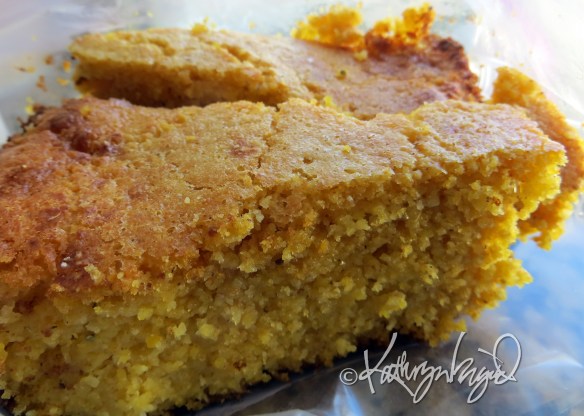
Inspired by Emeril Lagasse‘s skillet cornbread recipe, I merely added a little seasoning, slightly more fat and Voila! It got even better. See how easily that works?!Photo: Slightly Fatter Cornbread

Slightly Fatter Skillet Cornbread

Preheat oven to 450°F/232°C (or whatever approximates those temps in your oven), with your well-seasoned cast iron skillet in it.

Combine dry ingredients with a fork or whisk in a large measuring pitcher (I like my 64 oz pitcher, because it makes ingredient transfers so easy) or bowl: 3 cups cornmeal, 1 tsp baking powder, 1 tsp baking soda, 2 tsp salt, 1 tsp smoked paprika, 1/4-1/2 tsp cayenne pepper. In a separate measuring pitcher or bowl, beat together the wet ingredients: 3 cups buttermilk (or my on-hand substitute of 1 cup heavy cream, 2-3 T lemon juice, and enough whole milk to bring the total to 3 cups—which combination I think I might like even better than the buttermilk), 3 large eggs, and 2/3 cup of melted [salted] butter. Pour the wet ingredients into the dry and stir just until mixed.

When the oven’s temp is right, pull out the skillet, melt 2 T bacon fat in it and tip the pan to coat it thoroughly. Pour in the cornbread mixture, pop the skillet back in the oven, and bake until a rich, russety golden brown, somewhere around 30 minutes. In a household of two, I find it’s useful to cut the cornbread into 12 wedges, and as soon as it’s cool enough to handle, package two at a time in bags or parchment wraps and seal them in a big zipper bag in the freezer, where the residual steam will help keep them moist and manageable for thawing for later meals.

But I do keep a couple of pieces handy for the day’s lunch or dinner straight from the oven, preferably slathered with yet more [browned] butter and topped, perhaps, with some sweet honey, molasses, jam, fresh fruit…or more butter. Don’t tell anybody. They’ll know when they see the shine on my lips, anyhow.

My Portfolio

I’ll leave it to others, preferably sometime after I’m dead and even less likely to be concerned about it that I am now, to determine whether I’m a real artist or writer. No doubt there are, and will be, many who are dubious that I am a real person, for that matter. But it’s of little consequence, as long as I believe I exist. There’s room enough in my delusion for a number of delightful companions, and as long as I am happy in my imaginary world, all is well. But I will stake a small claim that, whether as a real artist or writer or a mere fantasist, I’ve been making art and writing stuff for as long as I can remember.
Photo: Portfolio 1

I think it unlikely that much of either kind of output will ever be considered especially valuable by others. I don’t flatter myself so far as to think that a large quantity of my work in visual or verbal invention is more than a passing amusement even to me, so there’s no reason to believe that the rest of the viewing and reading world will be so moved by my thrilling creations as to consider it important. And I don’t worry about that.

After all, I am as ephemeral as all persons of the human persuasion are, and thus unlikely to be troubled by anything lasting after I’m dead. I’m not one to concern myself with my epitaph (although I’ve written dozens of silly couplets and quatrains that would more than suffice in summing me up for a headstone, so that’s taken care of already if it worries you) or my legacy. The latter, I hope, will be to not have left too much of a mark on the world when I’m gone, but rather have trod on it fairly lightly, as these things go.

But because I am alive in an era when a veteran introvert like me can now also easily ‘go public’ without the great anxiety-production that comes from real world interaction with other humanoids, and in order to keep myself motivated to enjoy my practice of art and writing as much and as long as I can, why then: I am; therefore, I blog. Inevitably, others will feel it incumbent upon them to critique. Thankfully, the most succinct and practical form of critique in the digital age is first, to ignore, and then, Delete. So if anyone finds my work offensive or ugly, or just plain tedious and tiresome, their best defense of their tender eyebulbs and precious time is to run away from my website and never darken its portals again. I take the grand liberty of assuming that anyone who comes here does so unforced, and is free to go galumphing off in a cloud of huffiness when and if that suits them, and has therefore no cause to chastise me with wasting their life-energy here.

Photo: Portfolio 2

Meanwhile, having this platform for self-training and/or self-amusement, I go on producing new posts, new drawings and photos and poems and fictions and musings and digital collages daily and to my heart’s content.

But I consider that my portfolio is more than just a blog. It’s more than all of the art and writing and publications and stashed-away unshared works of my lifetime thus far and to the end of my days, whenever that will be. My true portfolio is all of the inspirations and ideas and inventions from the alpha to the omega of my lifespan, plus every experience and dream, study and accident, fear and hope and longing that led to those works of my brain and hands. And most of all, it is the collected community of friends, teachers, icons, playmates, correspondents, counselors, and loved ones who have moved, and continue to move, me to pour out this satchel of tricks and treats by which I will leave what little mark I do make upon the universe before I go.