Eldest Child

It isn’t easy being the eldest child. You tend to be expected to carry the world on your shoulders for any kids that come after you. My older sister certainly had her hands (and shoulders) full when it came to the other three of us. Following her lead was the logical thing I expected to do from Day One, and she undoubtedly knew that her every word and act would be scrutinized and grasped as tightly as any life’s-mystery-solving clue could be.
Photo: The World on Her Shoulders

Unlike many, my elder sibling was neither empty-headed nor empty-handed when leading or hauling me through the years, however. I must assume that she was generally more conscious of what she led me toward or away from than I ever was, and whether there was a particular purpose regarding its effect on me or it was simply what she needed to do in her own life was as irrelevant as if I’d been a duckling following a duck, since after all, our parents didn’t go to school with me, play in the yard with me, or otherwise have anything like the minute-to-minute impact a sibling could have. I apologize, here and now, for whatever time and energy I stole away from my big sister that she ought to have been spending on herself alone! Strangely, she still likes me, though, so I take the liberty at the same time of assuming her forgiveness on that front.
Photo: Show Me the World

I certainly didn’t quit the hero-worshiping dependence when we were young, either. It was my sister who gave me the world. Our parents saw to it that we learned to read, and that is an enormous gift that can only be repaid in kind by handing it on to younger people as they come along, but it was and continues to be my older sister who blazes the path down every library aisle on earth (and a few in the ether, too) and inspired me to try to better my reading and writing. She always had astonishing verbal skills and a voracious appetite for all sorts of books, so she set the benchmark in reading and writing that I will always lag behind but continue to pursue.

If that cracking open of the world in the pages of books weren’t enough, there was always the lure of the tangible world as well. There, too, our parents paved the way for our ventures beyond home borders, both financially and with the encouragement to broaden our horizons beyond anything they were privileged to experience at our young ages. But again, it was at big sister’s beckoning that I took up the challenge given by Mom and Dad to take a semester off from my university studies, spending both the time and the money I’d have devoted to those on traveling Europe, instead, with my sibling. It was more education than I could possibly have crammed into the other three-and-a-half years of my undergraduate studies altogether, utterly worth all of the angst and expense it terrified my twenty-something soul to expend, and all happened under the tutelage of my sister, my intimidatingly fearless guide and hilarious friend.
Photo: I Wish You Ten Candy Stores

There’s nothing a sister can say or do to make up for all of the times I was a pain in the neck—or anatomical regions south thereof—to my older sister. Despite her admiration for all things chocolate, no amount of truffles and cakes and French Silk Pies will do. But I am grateful, and I do thank her, and I certainly wish her a wonderful birthday today and many more of them to come. I’ll just have to watch and see what she does in times ahead, so as to get inspired for how to handle the next such conundrum as they always do come along in life. That’s what elder siblings are for, it seems.

Foodie Tuesday: For Which I’m Very Thankful

Photo: Thanksgiving in New BraunfelsI enjoy cooking. Not as much as I enjoy eating, or I’d probably bother to get chef training and go to work as a cook somehow, but I do enjoy time well spent in the kitchen. Still, I am ever so glad to let other, and very often better, cooks feed me. I was delighted, for example, to let the hotel staff in New Braunfels (Texas hill country) put together the meal my darling spouse and I shared with a ballroom-full of senior citizens and a small handful of their child and grandchild youngsters on Thanksgiving day. The food wasn’t especially gourmet, being an all-day buffet of extremely familiar and generally uncomplicated dishes long associated here with the holiday, but it was satisfying and traditional, and I didn’t lift a finger to help in its preparation, unless you count buttering my own bread. And I loved that—especially at the end of a long no-breaks haul for my hardworking husband, and in the throes of freshly hatched holiday colds for both of us—we could pay someone else to feed us. I’m grateful every day that I can afford to eat, and nearly always whatever I want to eat, and that sometimes others will do the fixing for me.

I’m also pleased to have access to foods that are, when I do want to cook, easy to make into something nice to eat. Vegetables almost never miss the mark in that realm for me, even though the aforementioned darling isn’t quite so hot on so many of them as I might be. It still fascinates me that he has, thanks to being a supertaster, an arguably restricted palate, but likes some foods that one might never expect a picky eater to like. He is an avowed avoider of things garlicky and onion-heavy, yet numbers among his joys when choosing a meal such famously garlic and onion friendly cuisines as Italian, Thai, Mexican, Indian, and of course, Tex-Mex. It’s all about how the ingredients are prepared, integrated, and combined, isn’t it. This guy who despises Weird Foods (and to him, they are myriad) will happily eat raw fish—not so familiar at all in America until recent decades—if it’s in the form of well-made sushi. As we draw near to the two-decade mark of marriage ourselves, I still do not presume to read his mind, culinarily speaking, accurately at all times. Not that this assures I can’t or won’t eat what I please, when it pleases me, but it’s easier to accomplish when dining out than when I’d have to prepare separate dishes for us, a thing I’m willing to do only occasionally. Another reason to appreciate visits to restaurants and friends’ tables.Photo: Fresh Onions

While I’m on the subject of vegetal delights, let us then ponder some specifics. And why not start with garlic and onions? The flagrantly fragrant lily relatives are amazingly versatile, able to range from hot and spicy to mellow, even to sweet; in texture, they can be soft, chewy or crispy, depending on their preparation. They can add color and pattern to a dish with their concentric layers, their bulbs and leaves, or they can melt right in and disappear, leaving only their flavor to remind of their presence. Thanks to my partner’s tastes, it’s rare that I’ll indulge in any of the more potent forms myself unless he’s out of town for a length of time, but I still remember how to use them in gentler ways when I’m in the mood. For example, two very different kinds of soup starring alliums: French-style Soupe a l’Oignon, and a Creamy Leek & Potato Soup.

The Creamy Leek & Potato Soup is simple enough to make, but should be done rather slowly to get the best out of the ingredients gently. Leeks must be cleaned very thoroughly to get the sandy dirt and grit out of their layers, and an aggressive approach to the cleaning is fine when they’ll be pureed anyway. So start by trimming the leeks’ green ends well and removing their root ends, then split them in half lengthwise and soak them in a basin or sink filled with cool water before hand-checking them for any remaining dirt. Meanwhile, clean, chop and boil an equal amount of potatoes (skin on or off, depending on the variety and your wish) in water with a couple of bay leaves and a dash of salt. Drain the rinsed leeks, reserve a small handful, then chop the rest into pieces about an inch/2 cm long, and soften them until they’re melting with a slow sauté in lots of good butter. Slice the reserved leek pieces as thinly as possible and fry them until crisp for use as garnish when the soup’s ready. When the potatoes are fully cooked, remove the bay leaves from the water, pour in the buttery leeks, and puree the water, leeks, butter, and potatoes into a thick soup, thinning it to your preference with cream or half-and-half. Season to taste with salt and pepper, top with a spoonful of sour cream or creme fraiche, and sprinkle some of the frizzled leeks over that before serving.

Soupe à l’Oignon is delicious when made with a chicken broth base. I know, I know: many traditionalists insist that beef broth is the proper foundation for French onion soup. But I always found chicken broth (especially my own homemade stuff) the best fit for the soup’s overall flavor profile. I might even go strictly vegetarian rather than use beef broth in it, knowing how I tend, and if so I would definitely opt for adding some powdered Cremini mushrooms and a splash of Tamari to the roasted mirepoix mix in my veg broth simmer to make it a little more robust before straining it. But my basic recipe always started with the onions. I like plain yellow onions, and slice them into about 1/2″ (1 cm) thick slices after cleaning them. If I’m making the broth on the occasion of the soup itself, I’ll throw the onion skins into it for the beautiful amber color they lend. A nice big pot (even a half-full slow cooker) full of sliced onions with a pinch of salt and a lot of sweet butter can cook slowly and beautifully into a smooth, jammy confit, and that can be used in any number of dishes later, if you save some by vacuum-packing or freezing it.

Last-minute prep of this beauty is simple. Heat the number of desired 1-cup (or so) servings in a heavy pan, and when the onions are just about to stick to the pan, deglaze it with a good splash of dry sherry, broth, or water. Spoon each helping into a heavy bowl, mug, or ramekin. Barely submerge the onions with a helping of broth, whichever kind you have in mind. Top each helping with a slice of well grilled dense, chewy peasant bread. Top the bread with a hefty slice of Gruyère cheese, broil until bubbling and golden-brown, and it’s ready to serve. Not quite ready to sip, though. Try to wait until you won’t get broiled by the hot cheese yourself. Worth the wait. It’s kind of like growing the vegetables in the first place. Patience pays in deep flavor.Photo: Fennel & Carrots

In this regard, there’s a whole range of marvels in the vegetable world that are only made more lovely by roasting the veg. Take fennel. The homely bulb is somewhat celery textured and mildly licorice flavored in its garden-fresh state. Generally speaking, I hate licorice. But with a light roasting in a bit of oil (preferably olive or avocado) or butter, fennel becomes an ethereal and delicate variant of its former self that I really do enjoy in small amounts. Swell in a combined vegetable roast; fabulous in a bouillabaisse or cioppino. Throw some herbs, carrots, and onions, along with masses of seafood, in the tomato-based broth, and with that whisper of perfumy fennel as a top-note, you have some magical brew.Photo: Radishes

Beetroot is a master of flexibility, whether as the star of the moment or as a sweet and sultry mystery ingredient in a dish. Even the homely radish raises the possibility of delicious dining, when kindly handled. The old standby of a radish sandwich (just thinly sliced, lightly peppery radishes served open-faced on sturdy but refined white sandwich loaf slices, heavily buttered and lightly salted) is a fine place to start. An icy-spicy salad of sliced radishes, fresh mint chiffonade, and sliced sweet apples (something like Fuji, Jazz, or Pink Lady) in a light dressing of rice vinegar, macadamia oil, sugar, a grind of black pepper, and a pinch of salt. Of course, I can’t give you actual recipes for my foods, being almost constitutionally incapable of replicating the quantities and combinations of any dish I’ve made. I vary what I’m preparing based on what’s on hand, and I’m awful at following existing recipes, so you should take what say with a pinch of salt, too. Something that rarely hurts the preparation of a fine vegetable, by the way, a pinch of salt.

The other instructive clue I’m happy to share with you about vegetable preparation today is, of course, the efficacy and beauty of somebody else doing the work. Works for me!
PessimOptimism

Graphite drawing: Self-Inflicted“Prepare for the worst but hope for the best.” It’s part of my credo, I guess, and may well have been aided in its development by doing those hilariously futile duck-and-cover atomic bomb drills of the Cold War era. And the air raid drills—we lived in a Ground Zero area near several military bases, strategic coast, and a handful of Nike missile sites in those days—fire drills, earthquake drills, tsunami drills, and later when we lived in the midwest, tornado drills. You’d think we’d all have grown up incredibly paranoid after such stuff in childhood. But I think that besides being remarkably resilient, kids use logic on such daily puzzles far better than they remember how to do when they hit adulthood and have been taught their prejudices, and are much more easily distracted and blinded by grey areas.

I don’t remember ever believing that crouching under a flimsy little wood-and-steel desk would save me even from the shrapnel of shattering windows and imploding walls in the event of an attack or large-scale disaster, particularly since I imagined the desk itself would become shrapnel along with everything else in the atomizing roar of a bombing. Little and naïve though we were, we had gleaned hints of the enormity of such things from our beginning school studies of the world history of war (skewed to our own culture’s view, of course); no matter how grownups think they’re shielding kids by sanitizing and limiting the information the wee ones are allowed to see and hear, children are quick to notice the blank spaces where redacted information interrupts the flow of facts, and no adult is more curious than a child to hunt for clues as to what was redacted. Frankly, if there really is any use for an institution like the CIA in this day and age when practically anyone can find out practically anything with the aid of easily accessible tools like the internet, cellular phone, and, apparently, privately owned drones, along with all of the more traditional tools of spy-craft, I suggest that the crew best equipped to uncover any facts not in evidence would probably be a band of children all under the age of about twelve.

Meanwhile, we still have large numbers of people who think it prudent to withhold or skew the information passed along to not only kids but even fellow adults, giving out misguided or even malevolent half-truths or remaining stubbornly silent and in full denial about things considered too dark for others’ knowledge. And what do we gain from this? Are there truly adults among us who still think that even smallish tots can’t quickly discern the differences between a fable or fairytale, no matter how brutish and gory it may be, and the dangers and trials of real-world trouble? Does delusion or deception serve any purpose, in the long run, other than to steer us all off course in search of firmer, more reliable realities?

As I just wrote to my dear friend Desi, it seems to me that the majority of humans always assume a fight-or-flight stance in new or unfamiliar circumstances before allowing that these might be mere puzzles to decipher, and more importantly, we assume the obvious solution to be that whatever is most quickly discernible as different from self IS the problem. Therefore, if I’m white, then non-white is the problem; if I’m female, then male. Ad infinitum. And we’re generally not satisfied with identifying differentness as problematic until we define it as threatening or evil. This, of course, only scratches the surface—quite literally, as the moment we get past visible differences we hunt for the non-visible ones like sexual orientation, religious or political beliefs, and so on.

Unless and until we can change this horribly wrongheaded approach on a large scale, we’ll always have these awful problems, from petty playground scuffles right into the middle of the final mushroom cloud. The so-called justice systems of the world are set up and operated by the same flawed humans who make individual judgements, so the cycle is reinforced at all levels. Sometimes it truly makes me wonder how we’ve lasted this long.

Can we learn from kids? The younger the person, the more likely to blurt out the truth, whether it’s welcome or not. The subtleties of subterfuge are mostly wasted on children, who unless they’re engaged in happy storytelling for purposes of amusement and amazement, would rather be actively puzzling out the wonders of life than mucking about in search of evasive answers and duck-and-cover maneuvers. We might gain a great deal by reverting a little to a more innocent and simplistic view of the universe, one that blithely assumes that others are not always out to get us, that direness and doom aren’t lying open-jawed around every blind corner, and that the great powers of the internet and cell phones might just as well bear cheery tidings of goodness and kindness, and drones be removed from deployment as spies and weapons to work instead at delivering birthday presents to friends and packets of food to hungry strangers.

I’m not fooled into thinking any of this is easy to do, any more than any savvy kid would be, but I’m willing to believe it’s possible if more and more of us will commit to such ideals.

FutuRetro

One of the things I so love about travel and touring is getting a much more powerful sense of history; standing in and on the places where events and lives long past have happened, whether grand or insignificant, utterly changes my understanding of those people and occurrences. My first trip overseas, that Grand Tour I was so privileged to take in college with my older sister, was an awakening I never expected. I hoped the trip would be a cure for my sophomore blues, and indeed it was, beyond anything I could have planned or dreamt before, but more than that I was startled by how connected I felt to history.

The drizzly and cold autumn day when we visited Canterbury Cathedral was atmospheric enough in its way, but I remember standing on stone steps worn into a soft bowl by the thousands of footsteps that had passed over them in the centuries of its existence, looking up into a palely gold ray from a lamp, seeing the motes of dust whirling in it, and feeling that time itself was floating down around me in delicate pieces, that the spirit of every person who had ever set foot on that same smooth hollow in the stone was present there with me in that very moment. It was almost as though I could hear their voices and see the scenes of the past play out in the faint gloom around me, all overlapping and yet perfectly present. I felt my own place in the whole of the human timeline in an entirely different way than I ever expected, tinier than ever, yet surprisingly more concrete and tangible.

This was reinforced later in the same journey many times, as we passed through or visited (not necessarily in this order) England, Italy, France, the Netherlands, Switzerland, Austria, Germany, Denmark, Sweden, Norway, Wales, Scotland, and Ireland and stood in the very footprints of many a person, going down the winding passages and cobbled side-streets that had seen multitudes of significant moments long since fled. As this was the first time I visited Norway, the rooting ground of my ancestors from every branch of my family tree, it is no surprise in retrospect that many of those potent realizations came to me in that place—but as usual, hindsight is ever so much clearer than was my youthful wisdom in those days. It was moving, more meaningful than I can express, to get to know the relatives in Norway with whom my family had maintained contact: my maternal grandfather’s sisters and brother-in-law, nieces and nephew. These were days before cheap telephonic long distance, let alone email and internet communiqués, so we had only briefly even met most of these people when they visited America once in my younger years, yet they not only took us in as visitors, Tante Anna and Onkel Alf kept my sister and me with them for a full month and took us to see the family’s two longtime farms, the graves where many of our ancestors were sleeping underfoot. This was incredibly touching, a genealogical history lesson, but the more so because it was taught by the eldest of our remaining family there.

What moved me the most, in fact, was when on arriving in Oslo at our mother’s cousin’s home before we even came down south to be with his parents, we explored the great city a little on our own during the days, while he was at work and his wife and children off having their own day of adventures. It was all so humbling and so magical to feel for the first time that I understood a tiny bit more of my own family lineage and how our people fit into the larger world. We did visit many of the obligatory and famous tourist sites, knowing that there was no direct link to our ancestors, only cultural ones. So I was quite stunned when we visited the Viking Ship Museum and, standing before these ancient vessels, I was absolutely electrified with a sense of shared history coursing through my veins. My forebears were undoubtedly humble subsistence farmers, not the bold and violent and adventurous Viking strain we know through film and television, never mind through the great Sagas—but I felt for the first time something connecting me to those long-gone people all the same.
Photo: Enter the Time Machine

By now I have traveled a fair amount more. I have been on this planet more than twice as long, and I think I might even be a little bit wiser through my experiences in that life than I was back then. But I approach every narrow stone passageway, every weathered door, every window with its rippling antique panes presenting everything that’s beyond them like a warped post-impressionist fiction of itself, I expect to learn something not only about what is there in front of me and around me, but what is inside me. And I know that I will learn something, too, about how I fit into that larger, and ever so mysterious, world if I am wise and patient and alert enough to notice it. So much has gone by. So much remains ahead, yet unknown.

Ever Heard of Foodie Thursday?

Well, now you have.

It’s been a busy autumn chez Sparks. No excuses: in the flurry, I flat-out forgot to put up my food post on Tuesday. Sigh. I didn’t stop being food-obsessed, just being on schedule. So here we go, better late than never. I would give you a big silly grin, but yeah, my mouth is full again. Photo: Blue Bouquet

What I meant to say on that long-ago-seeming-day-which-was-Tuesday, was that I do like this time of year in particular for its masses of officially sanctioned excuses for partying. There are of course the big national and international celebrations of things spanning from Halloween/All Saints/Dia de los Muertos to Thanksgiving, Diwali, Christmas, Hanukkah, and the various New Years; in my family, five out of the six of us have winter birthdays as well. It’s not that my family and I are in any way averse to celebrating with a good meal, a party, or any other excuse for eating and drinking good stuff at the drop of a hat, but it’s extra nice when nobody else questions the need for such an occasion either.

My parents upped the ante this winter by both entering the glorious ranks of octogenarian excellence, so since my three sisters and I don’t all live close to them anymore, we’d long since all agreed it made sense to look toward next summer (2015) for a family get-together to mark their ascensions to this great new height. All the same, nobody in our clan has any respect for leaving an excuse for a party just lying there unused. So Sisters 1 and 3, who do live near Mom and Dad in Seattle, helped them plan a big party on Mom’s birthday weekend so that our parents could have their local siblings, nieces and nephews, and a few special friends together. I made up the digital invitations, since I could do that from my remote location, and because I’ve long done such design tidbits for family events as a way to be involved when I couldn’t otherwise be on hand to participate. But our Seattle sisters did the yeoman’s work on the whole thing.

We kids did up the ante a little, though. Sister 4 and her husband sent an email to the other three of us a couple of months ago, announcing that they had bought plane tickets to fly over from Norway for the November party and surprise Mom and Dad. We sisters were surprised, too! My husband, with three concerts and more rehearsals to conduct on either immediate side of the party date, couldn’t get away, but with a batch of saved air miles, I could, so I planned to fly up from Texas and join in the fun. Once all of our tickets were bought and the wheels set in motion, the real challenge was not only to see if there were any small things 4 and I could do from our bases of operation but to see if we and our partners could keep a secret for seven or eight weeks, a dubious probability at the best of times with our talkative bunch.Photo: Pink and Green Bouquet

We did. We let one of Mom’s sisters in on the secret so that she could help get our parents in the right place at the right time when the day arrived, and my spouse’s parents knew, because they were invited too, but despite a couple of close calls, nobody slipped up irrevocably. Part of the larger plan, once we’d decided to add in this surprise element, was that there would be an immediate-family-only lunch on Mom’s actual birthday at Sister 3’s house. Dad, Mom, Auntie and Uncle, and sisters 1 and 3 were to have a nice, low-key luncheon date to mark the day and wrap up any last-minute details for the bigger open house party the next day.

Sister 4 and her husband and I flew into Seattle on Thursday the 6th. It was wonderful to have a reunion of the four sisters, our first in at least a couple of years, and to convene a few other members of the immediate family—3’s husband and one son, with the other son flying in from college on Friday—that night and to laugh up our collective sleeves over our plot. In keeping with the family tradition of combining food with fun, this first evening was spent at 3’s house, slurping bowls of a beautiful, creamy winter sweet potato, kale, pasta, and sausage soup (based on Martha Stewart’s recipe) while taste-testing a couple of good single-malts the Norwegian contingent had picked up on a duty-free spree en route.

On the 7th, Mom’s birthday, we got lunch ready and in the oven and fridge and then spent a little while nervously skulking past curtained windows to escape any unexpectedly early arrivals’ discovery, and as the parental entourage at last approached, three of us ducked into the back bedroom, where we giggled like little kids and perched on the bed to avoid making the creaky hardwood floor give away our presence. Auntie got Mom settled into her favorite armchair so we wouldn’t have to explain her absence at the next day’s party as the result of an aneurism, and we finally strolled out to say Hello to our startled parents. Their faces remained in virtually the same blankly surprised expressions for a fairly lengthy, attenuated moment.Photo: Mom's 80th Birthday Lunch

Lunch broke that spell. We feasted on marvelously simple steak, lemon-dill oven-roasted salmon, salt-baked potatoes, green salad with a fresh blend of herbs and creamy lemony dressing, green beans, and buttered peasant bread. Classic, delicious, and with a handful of their kids on hand to help, an easy way to feed our parents well on a meaningful day. We worked a bit more on the details of Saturday’s open house event, but 1 and 3 had covered all bases so thoroughly that we were all able to make an early evening of it and rest up for the main event.

Sister 3 had found a wonderful venue, a community center run by the parks service in a beautifully renovated vintage power station right next door to the church where our dad had grown up. All five of Mom’s siblings and Dad’s only sib, his brother, and all of their partners, were on tap to come. So did some of the sibs’ kids, and even a handful of grandkids joined the gang; with the friends who came, we totaled just over fifty in attendance. We saw many relatives we’d not seen in years, many of them as surprised as our parents at seeing us there like long-distance apparitions. I think I can safely say that the party was everything Mom had wanted, that Dad was also happy, and that we all felt pretty chuffed at pulling off a great success, especially at not blowing the surprise.Photo: Birthday Buffet

But again, food was central to the grandness of the day, and once more, that was thanks to the wise planning and [literally] tasteful choices made by our Seattle sisters. The buffet spread’s main dish stars were ginger beef and sweet walnut prawns from our favorite local  Chinese restaurant, accompanied by a wide range of finger foods and sweets, many of them bought ready-made from various shops and stores. We had just about enough food on hand to feed 250 guests. So we kept up that family tradition, too. And we all left the tables full and fulfilled.

Who knows what we’ll get up to next summer. Only sure that it will include much eating and drinking. And probably lots of childish giggling and telling secrets, which I think are a mighty nice lagniappe for the whole meal, whatever it is.

The Great-Greats

Naming things is an endlessly fascinating and complicated way of creating and better understanding our relationships with them. Different cultures have even devised quite distinct ways of classifying and identifying the kinships within them, to the extent that families and relations in the different cultures affect the very ways people interact and consider themselves connected, responsible for each other, and much more.Photo: Great Great Grandparents

One of the appealing (or appalling) quirks, depending upon one’s view, of the American traditions of familial identification and the names given them in English is the way we use the word Great to specify layers of distance from ourselves. This photo, for example, is of one of my sets of great- and/or great-great grandparents (my maternal grandfather’s forebears), if I am not mistaken, and there is much to pique my curiosity in this image.

First, of course, is the question of whether I have identified them correctly at all. But then, in what ways—besides the nominal—were they great? Clearly, being among my ancestors is an easy in to that category. [Ba-dum-tsssssssshhhhhh!]*

Seriously, though, what distinguished these people? Safe to assume, from what little I do know of my relatives in Norway, these two lived on a small farm, and they worked hard. I mean, incredibly hard, by my standards. I’m inclined, actually, to think that the gent is my great grandpa and the lady next to him is his mummified mum, but having seen many a portrait from that era whose subject I was shocked to discover was eons younger than I’d have imagined, I can’t be sure. If this is a couple, I am extra, extra glad I have such a lazy and comfortable life. I may be no spring chicken, but I like to think that people will be able to tell whether or not I’ve already died, and when it does occur, won’t be able to make work boots out of my hide without tanning it further.

This could be the great-grandfather who was a tinsmith. A pretty skilled one, at that. The hands I see here could easily be tough enough to have put metal in its place. As for the farming, what little I’ve gleaned [enough with the shtick! I’ll try to behave myself]* from the various family stories and photos indicates that my family were subsistence farmers, growing what produce would feed their own households or be swapped with neighbors for  further goods, and raising enough sheep and goats, chickens and cattle to keep them in meat, eggs, hides and bones as needed. Agrarian life, until more recent decades, was generally a far more solitary and jack of all trades kind of existence. My grandmothers, great and otherwise (and I can only assume all of the neighbor women of this ancestress’ approximate vintage) did such work as probably made them all look equally leathery.

I would like to think that the sober, if not condemnatory, expressions in the photo sprang from the typical problem of holding still for the interminable exposure time a photograph required in those days, not to mention doing so while squinting in the sunlight. But I also suspect that a combination of that hardscrabble life of theirs and the grimly perdition-obsessed brand of religion to which many of my relatives have subscribed means that these two generally took life mighty seriously as well. They probably didn’t see so much to joke about or room for fun and games in their daily lives.

What I can safely assume about my relatives still gives me some hope. Obviously, they knew enough about how to survive and yes, thankfully, to procreate, that I am here generations later to tell the tale. I consider my existence a fine thing. Although they weren’t either wealthy or showy, they are dressed in well made, tidily kept clothing and lo, my mustachioed male relative even sports a watch chain, so theirs was not, even from the perspective of my privileged and cushy life, a torturous life of pure privation. So I don’t feel enormous existential guilt for their suffering. But I’m not inclined that way like they might have been, anyhow.

My late Norwegian relatives lived and labored in a landscape and climate rather like where I grew up in the American northwest, so I know that even if their daily work was hard they did it surrounded by beauty and nurtured in a mostly benevolent natural environment. They raised children who were able to go out in turn into the wider world and make their ways, eventually finding own their paths, making their own livings, and raising their own families, and eventually crossing many mountains, borders, and seas. I think all of this a fine, if modest, sampler of human existence with [dang it, I just can’t help it!]* relatively little grand tragedy or overblown drama. Most of all, I am glad that the long-gone beings who posed for this rather inscrutable image contributed to the production of a line of pretty good folk, culminating in my immediate family. That’s greatness enough for me, and makes me very thankful indeed. Happy Thanksgiving, my friends.

To My Mother on Her Birthday

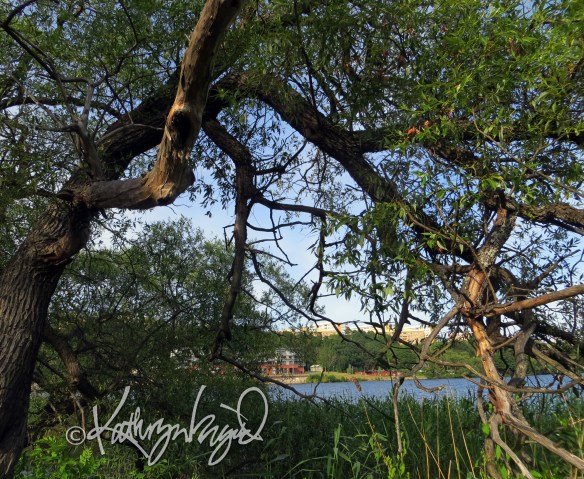
Photo: Under the Willow Tree 1Under the Willow Tree

Under the willow tree, her shade my calm,

I see so bent by storms her trunk, how far

The winds have twisted every limb, each scar

Where lightning struck; yet there’s a quiet psalm

Of gratitude that whispers in her leaves

Each time another rainfall comes to spend

Its quenching kindness on her and to send

New hope down deep—for anyone who grieves

Or wonders how to pass through life’s travail

Finds shelter in her shadow—knows the limbs

That seem to weep are only singing hymns,

Embracing in their gentle sway the frail.

                    So one fine sapling, tended with such care,

                    Becomes the home for all who shelter there.

And now her roots are deep, her branches wide

Enough to draw more birds to them to nest,

Assured, secure and loved, and full at rest,

No matter what the world is like outside—

Just as I am, beneath the willow’s arm

Of graceful comfort, grateful for her wise,

Kind lesson to look upward to the skies

For blessed rain, and sun to keep us warm,

For sweet reminders of the Gardener

Who made the willow grow, and gave her strength

To nurture others in her shade, at length,

Upon the graces planted there in her:

                    So one fine sapling, tended with such care,

                    Becomes the home for all who shelter there.

Photo: Under the Willow Tree 2Thank you, Mom, for the nurturing, the love, and the will to live as an example of bending but not breaking in the storms. Happy 80th Birthday!

Dirty Jobs, but Never Done Dirt Cheap

The world is truly full of overlooked and underpaid laborers.
Photo: Housekeeping Cart

This is a story as old as human community, and yet it’s notable how little it’s changed. The ugliest, dirtiest, the most physically demanding and unpleasant tasks, the ones that no one in his or her right mind would usually choose to do, let alone without any recognition or reasonable pay, these jobs don’t cease to exist because nobody likes them. They simply get done by people who have no other choice. And do we thank them for it? Do we give them public honor and paychecks commensurate with the knowledge and patience and back-breaking effort and yes, specialized skills that are required of them?

You know the answer. In this country, we spend more time and energy on vilifying the working poor as nuisances and a weight around the necks of their higher-taxpaying richer neighbors, at best. At worst, we accuse them of criminality, many of coming into the country illegally—which they may well have done—to snatch bread from the very lips of our own better educated and better protected children through their stealing jobs from the local citizenry. Which, of course, they rarely do, considering that neither we nor said children are willing and able to do without the jobs that the working poor do for us, let alone perform those tasks ourselves. Never mind that those we abhor for daring to come across the nation’s borders unseen are doing precisely what the vast majority of our own ancestors did, and out of the same desperation for survival, but now with the additional barrier of laws designed more out of fear and hatred than out of specific plans to better the safety and welfare of any of the parties involved.

If immigrants could remotely afford the risky business of taking a national day of “working poor flu,” the way that unionized workers go on strike or recognized organizations march in protest, just imagine what that day would look like across the United States. I don’t begin to think that there’s an easy solution to the problems of regulating this country, protecting individuals and the nation from the very real danger of criminal activity and the bane of individualism gone rogue. The latter being, in my opinion, a far larger risk to the rest of us from among native-born citizens who take their American privileges as the right to do as they please, even by force and against US governmental “interference” with their personal sovereignty. But I can’t believe that the draconian and targeted proposals many suggest these days are the right solution, either.

Let our internal renegades, our legal complainants against immigrants, and all foes of the “lazy” or “problematic” working poor themselves take up the labor and care required to ensure that every one of their fellow Americans has enough food to eat, education to navigate life and progress beyond restrictive ignorance, health care to prevent the spread of diseases and unnecessary pain or early death, and a safe, clean place to sleep without fear of exposure to the elements, destruction of their environment, or unfriendly intruders. Then I might start thinking we can narrow the gates to allow in only primly approved new neighbors able to contribute equally to the cause. Or would anybody out there like to see what happens on that imagined Flu Day, when all of the orderlies, cooks, construction workers, landscape maintenance crews, sanitation workers, child- and elder-caregivers, and all of their fellow underpaid workers lay down their tools and lie down on the job for even 24 hours?

I surely don’t know the solution to any, let alone all, of the problems that roll up into this one massive puzzle we have sitting on our doorstep. But I know that I will try to do better at giving proper respect and thanks, and a hand up when possible, to anyone who does what I can’t or won’t do myself. My life depends upon it.

Keeping Watch with Love

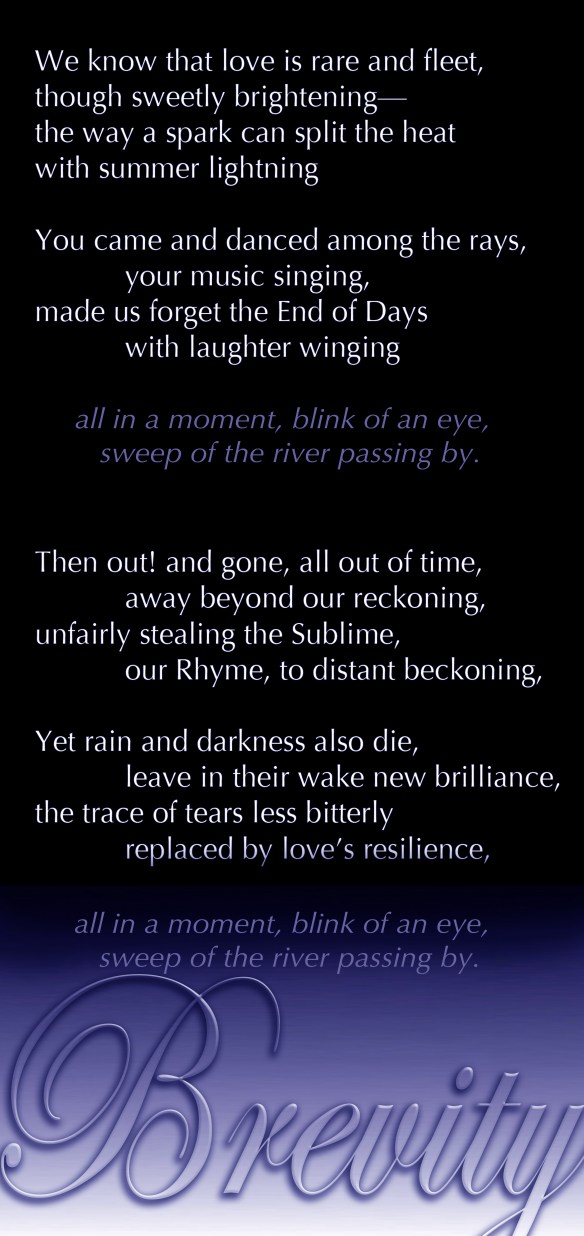
Text: BrevityJust because there are designated days (All Saints, Memorial Day, Defence Day, Anzac Day, Volkstrauertag, Poppy Day) for recalling those we’ve lost doesn’t mean in any way that we restrict our respectful, loving and admiring remembrances to those days. Those whom we hold in our hearts remain there, living or not, forever. That’s our path to peace.Digital illustration from a drawing + text: May We All Rest in Peace

The guarantee that we will die, and that all of those we hold dear will die too, means we will do best by finding ways to embrace and recall, most of all, the good and the uplifting things from their lives and ours, and expand on such things for the sake of our finest predecessors’ honor, if not our own.

Calling All Saints

This is a day designated by the Christian church for the remembrance of all the good, fine people who have lived, illuminated our lives, led the way for the rest of us, and now are also gone before us in death. Recollection, commemoration and admiration of those who have lived as great-hearted souls on the earth and set an example, large or small, of excellence for those of us who follow is, I think, a practice that anyone of any stripe, religious or not, can embrace; we are certainly all made better by such meditations, especially if and when we are made stronger by their guidance to follow in our honored loves’ radiant footsteps.Photos + text: How Sweet the Moment

Spending a day in remembrance of loves lost is bound to be bittersweet, of course. When the bond has been close in life, it remains so in death, and however the pangs of loss may subside over time, on a day devoted to thoughtful recognition of our trusted and beloved friends, mentors and avatars of all things great and good, the pain can be as sharply new again as in the first sweep of sorrow. But if I am genuinely mindful and respectful of their gifts in life, I think that this can be transformational and healing and comforting, too.Photos + text: Bittersweet

Can I live as a reflection of my most-admired angels? It’s too tall an order for any ordinary mortal, I know. But that’s exactly why I think we have these living and loving models among us: to show that in community and mutual, loving support and with determined and patient growth on our own, greater things can happen than if we try to do significant and meaningful things independently. We are raised up by the waves of support around us. How can I not be grateful for that! This realization sweetens the day perceptibly. Do I wish that I could have my lost loves back again? Who would not! But I wouldn’t trade one tear, one iota of the hurt and anger and grief I’ve felt over any of their losses, to miss out on recognizing the beauty and joy and brilliance that they brought to this world in their too-short tenure here, and I know that some lights seem so bright in life that they can blind me at close range to what’s more easily discerned, when seen from this greater distance, as having the distinctive shape of an excellent soul.Photos + text: Last Lullaby