What Wounds can Teach Us

Cut

Skin, though as taut as rawhide, and as strong,

Still splits under a jagged, cruel knife,

Opens its jaws to scream a gout of life

As blood that would atone and end the wrong—

But wounds, no matter what the cause or source,

Cannot withhold their sorrows or their rage;

Injustice must be shouted off the stage,

So bleed they without pity or remorse—

Break, then, both skin and soul, and sear the heart

Of any who is cognizant of pain;

Who cries for justice and can’t sleep again

‘Til order is restored as at the start—

What’s done cannot be undone should a scar

Reveal the fragile creatures that we are.Digital illustration from a photo: What Wounds can Teach Us

Uncertainty and Hope

Beloved, let us sit down together in the shadow of the oaks; let us take deep draughts of fresh water from the clear, swift stream. In the scorching heat of the middle of day, let us take refreshment like the dragonflies that skim the water’s edge, and be restored by the caroling of birds in the distant shade.Digital illustration from a photo: By the Cooling Stream

The days are long and our work makes wearying and seemingly infinite demands, and we know that this will not soon change. There is change of many sorts ahead, this we know too, but what it will be is yet beyond our imagining. Thus it has been, and so shall it ever be: we travel our paths, seldom knowing quite where they lead, and we labor in darkness the while. Some days, the destination is sparkling joy, and on others it is marred by sorrow and strife; at times, the mists of uncertainty part and the way ahead becomes clear, and at others it remains quite fully obscure.

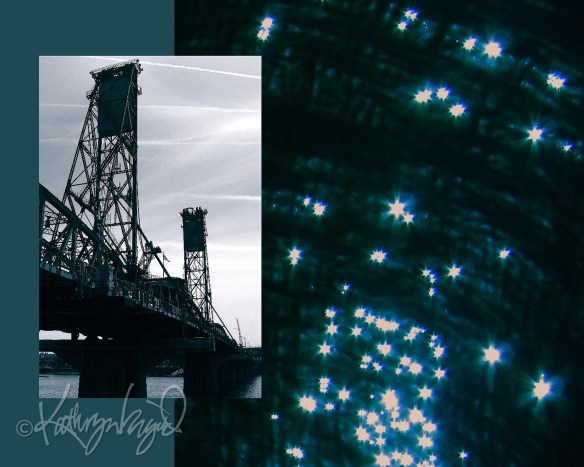
Photo montage: Beloved, Let Us Sit

What I know, Beloved, is this—that no matter how hard or easeful is the road and no matter what the destination holds for us, we walk our way together, you and I. We may long for clarity and even for the strength to wait for it, but in the meantime we will take our stops for breath along the way, sitting in shade when we may and drinking deeply from the icy stream, traveling always hand in hand no matter what the journey brings.

Keeping Watch with Love

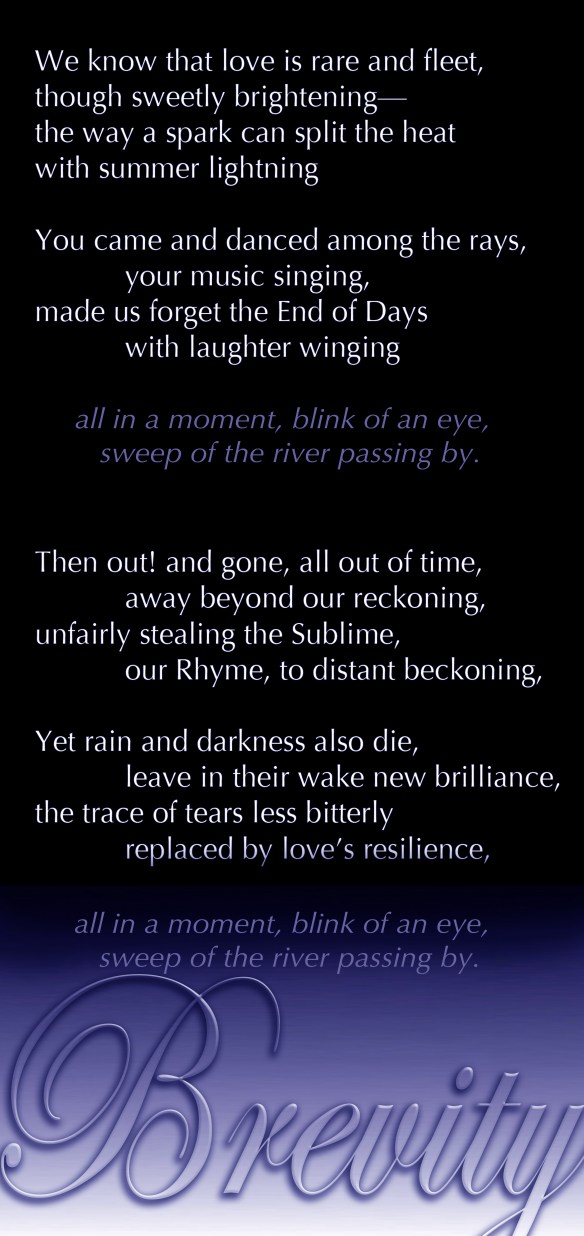
Text: BrevityJust because there are designated days (All Saints, Memorial Day, Defence Day, Anzac Day, Volkstrauertag, Poppy Day) for recalling those we’ve lost doesn’t mean in any way that we restrict our respectful, loving and admiring remembrances to those days. Those whom we hold in our hearts remain there, living or not, forever. That’s our path to peace.Digital illustration from a drawing + text: May We All Rest in Peace

The guarantee that we will die, and that all of those we hold dear will die too, means we will do best by finding ways to embrace and recall, most of all, the good and the uplifting things from their lives and ours, and expand on such things for the sake of our finest predecessors’ honor, if not our own.

Calling All Saints

This is a day designated by the Christian church for the remembrance of all the good, fine people who have lived, illuminated our lives, led the way for the rest of us, and now are also gone before us in death. Recollection, commemoration and admiration of those who have lived as great-hearted souls on the earth and set an example, large or small, of excellence for those of us who follow is, I think, a practice that anyone of any stripe, religious or not, can embrace; we are certainly all made better by such meditations, especially if and when we are made stronger by their guidance to follow in our honored loves’ radiant footsteps.Photos + text: How Sweet the Moment

Spending a day in remembrance of loves lost is bound to be bittersweet, of course. When the bond has been close in life, it remains so in death, and however the pangs of loss may subside over time, on a day devoted to thoughtful recognition of our trusted and beloved friends, mentors and avatars of all things great and good, the pain can be as sharply new again as in the first sweep of sorrow. But if I am genuinely mindful and respectful of their gifts in life, I think that this can be transformational and healing and comforting, too.Photos + text: Bittersweet

Can I live as a reflection of my most-admired angels? It’s too tall an order for any ordinary mortal, I know. But that’s exactly why I think we have these living and loving models among us: to show that in community and mutual, loving support and with determined and patient growth on our own, greater things can happen than if we try to do significant and meaningful things independently. We are raised up by the waves of support around us. How can I not be grateful for that! This realization sweetens the day perceptibly. Do I wish that I could have my lost loves back again? Who would not! But I wouldn’t trade one tear, one iota of the hurt and anger and grief I’ve felt over any of their losses, to miss out on recognizing the beauty and joy and brilliance that they brought to this world in their too-short tenure here, and I know that some lights seem so bright in life that they can blind me at close range to what’s more easily discerned, when seen from this greater distance, as having the distinctive shape of an excellent soul.Photos + text: Last Lullaby

Stars Everywhere

Photo montage: Stars in the DarknessThis world is a dark place. War and strife, fear, hunger, hatred, greed, self-righteousness, and poverty gnaw the bones of suffering people on every continent at every hour. And all of these menaces are, in accordance with early expressions of the idea of Tragedy, nearly entirely the making of our own species.

Little hope, at least in my mind, of that sorrowful truth changing as long as our species continues to dominate the planet. We are deeply flawed. Even the finest among us tend to forget themselves and their mortal limits at time; regardless of how educated, high-minded and genuinely well-meant their attitudes and actions may be, it’s sadly true that underlying those attitudes and actions is a firm belief in their rightness. Only natural that it’s hard, from that perspective, to allow that others might have an equal possibility of being right, or at least as wise and well-meaning, as they themselves are, and to show them the full respect of that acceptance.

What, then, of accepting life among my fellow flawed beings in this imperfect world? No comfort is found in denial or in persistently, aggressively resisting what may not have the possibility of ever changing. But to accept this grimness as an eternal truth and let it lie like lead on my soul is no help, either.

I look to the stars.

Physical stars exist in a surprising number of places, many lower and commoner than the depths of the sky, and I look to them and rally as I realize that they stand, every one, as beacons reminding me of what is good not only in the nature in which we imperfect beings live, but what is good within us as well. Small as our fineness may seem, individually and corporately, at times, it does exist, and if there is to be any hope of overcoming the dark, it must come from the nurturing of every little glint seen starring that darkness.

I look to the stars in the indigo distance of the sky, sparkling like promises of better things as they look back at me. I look to the lesser stars of reflected light that dazzle on earth, the  diamond dashes on every body of water and glimmering in every eye, never mind among real gems and the many things made expressly to be beautiful and good and positive. I look, more than anywhere else, at the multitude of stars that shine from the hearts of good and true people, people who are thoughtful and generous, merciful and hardworking, and kind and loving, sometimes despite and against the dark things of this world, and often, wonderfully, for the sole reason that they were made to be such earthly stars.

Pessimism is Its Own Reward

—or recompense, at least!Digital illustration from photos: Gloom = Doom

Pessimism is Its Own Reward

To Whom Much is Given

For unto whomsoever much is given, of him shall much be required.

That’s a passage from Christian scripture, but it’s a precept that I’ve read, heard and seen in the texts and teachings of other religions, and it’s commonly enough reflected in social policy and proposals for humane and ethical action in all sorts of places that it deserves more general notice and attention, I think. There seems to be an underlying assumption amongst many people of all kinds and cultures that if one of us has more than another and that other is in need, one ought to take some responsibility for her neighbor’s well-being and share the resources. It’s arguably a foundational principle of civility and hospitality everywhere.

Yet it’s practiced so much less often than is possible. For all of my love of time with friends and family, I also crave quiet and reclusive time, shutting out the world and curling into my own self, and that applies to all parts of my life. And I think that’s probably more common than not. Who does not prefer the company of her own self or her very small circle of kin and kind, especially when the workaday world has seemed particularly demanding and rest and retreat as hard to come by as clear water in the swamp? Who doesn’t covet the privileges she feels she’s chosen and earned for herself?

I was reminded of this particularly when we were in Hungary this summer and I had the privilege of going with a number of the touring choir members and my husband to visit the ancestral home of a hereditary Count and his wife the Countess. The Count himself made only a brief appearance at the end of our visit, his wife having participated with staff and supporters in the greeting of our group, speechmaking about their work with orphans and special needs children in the family-sponsored home on the grounds of the residence, and a small but lovely reception in the main public-room of the place, a large parlor filled with art and artifacts passed down through the lineage. The Count was charming and rather cheery when he did appear, but I sensed that he preferred his privacy as well.

The Countess, on the other hand, had a rather regal bearing and while she was generous in hosting us and very willing to share her home and thoughts with the group, I heard some quiet comments aside that she seemed a touch condescending or even a bit put out by our visit. I had been at the back of the room during her parlor commentary about the family history and the work of the orphanage, not able to see her over the number of people in the room, and her tone was very subdued, so I got the gist of the story, but didn’t see any of the expressions that might have influenced the commenters.

What I did hear was probably a fairly common tale among the nobility in Europe during the previous centuries: a privileged kinship, whether by their own efforts or honors conferred upon them by royalty, this family had done as they were both able and expected to do with their wealth, which was to live quite elegantly and surround themselves with art and beautiful landscaping and magnificent homes. At the same time, they saw themselves very much as caretakers of the larger community, responsible for the well-being not only of the people who staffed their private holdings but those living in proximity as well. This is of course the story of noblesse oblige, a practice of good that may have been at its core a defensive move but served the purpose in any event. Like many noble families, the one we visited had essentially founded a town around themselves over the generations, supporting educational or healthcare or other needed resources and, in this instance, building a magnificent basilica where the town could worship and where, not coincidentally, the touring choir were performing on the evening of our visit in a benefit concert for the children’s home.

Also like so many other noble families, this one had gradually seen its fortunes decline in the years between the World Wars, and on advent of German action in the region in World War II, was ousted from their land and holdings and fled for safer places. Their palatial home first became military headquarters during that war (in which the Hungarians quickly and brutally learned that their alliance with Germany was a general pretext for annexation and Nazi rule), and then was used for Communist offices in the years after. It wasn’t until just a few decades ago that the Count and Countess were able to return to his family property and renew their residence in the place. The good news was that there had been no interest on the occupying military’s part in redesigning the buildings, nor any money for the Communists to do so, so the architecture remained for the most part intact. The bad news was born of the same circumstances, though: the military’s disinterest in redesign and the Communists’ lack of funds extended to any concern for maintenance. Naturally, the park in which the palace stood, the palace and outbuildings all fell into a state that even in their heyday the real owners could probably have scarce afforded to mend, and it all added to the sorrow that the art and fabulous book collections had been heavily looted.

This is a long way of saying so, but on the day we visited there, I stayed after the others had left that once-elegant parlor, pausing to thank the Countess and to ask her a couple of questions about what I understood were the Count’s and her attempts to resurrect some of the property, if only for the appreciation of the locals and the young wards and their caregivers now living in closer quarters with these two owners. Her tone, perhaps because she was no longer addressing a whole roomful of people, or maybe because she felt she didn’t have to represent her husband’s whole heritage anymore, not acting in any official capacity at the moment, softened greatly, and I sensed mostly melancholy. There was sorrow for what had been lost, yes, but after we spoke about that and the enormity of the restoration needs for a moment or two, I simply asked her in the middle of that once-glamorous hall if she had a personal favorite artwork in there.

It was almost as if she became for a moment the young bride who had come there with the Count before the war, a little in awe of his family and the wealth that surrounded them, the power and the weight of the name upon her shoulders seeming rather immense even in the midst of her happiness. I can’t say she became suddenly shy, though it seemed to me that there was the slightest hint of it as she walked across the room and, instead of choosing one of the showy ancestral treasures or superb museum-quality portraits but this moderate-sized, unrestored and slightly bleary, painting of peasant girls dancing around in an Impressionistic meadow, and said simply, “This one.” I asked her what made it so, and she did little more than offer a soft comment that it was pretty and it made her happy.

Digital artwork from a photo: The Countess's Favorite

This is my digitally painted version of the Countess’s beloved artwork, which besides being in great need of restoration was under glass and hard to see without much maneuvering. But even in its retouched state here, I think you can catch a glimpse of what filled her with such longing: a sense of sweetly carefree innocence that must seem now like a distant, faded dream.

And I thought that perhaps what had been asked of her, she who had had quite a lot at one time and might even be seen in town nowadays as a bit of a remnant of things past, was her innocence. It must have been a long, sorrowful journey from being a young lady inducted into the nobility by marriage and impressed, if not overwhelmed, by the lavish life and the heavy weight of what was expected of her in her new role, to the life she knows now. However she and her husband might work to regain a place in the community through their labor and largesse, the world has changed, and they with it.

What must it have been like, as she moved through the war and later years in exile, knowing that everything tangible she had known at home might well be gone? On returning long after, though she saw that it wasn’t demolished, her happy ease was clearly broken and irretrievably changed. Finally, settling into her new role as figurehead of a still somewhat nebulous but ambitious attempt to find a way to make all that was left have real meaning again, looking into that painting must have become rather like looking into a mirror at her past self, not as a dancing peasant girl but as a naïf who thought the world was simple and clean and kindly and that all she had to do was make the best of what had been given to her in order to be happy in it.
The Last Rose of Summer

The Thomas Moore poem that gives this post its name has lent its melancholia to many a song and story to follow it in the years since Moore first honed the image into such an iconic form in 1805. He wasn’t the first to recognize the symbolic substance of decaying, wilting blossoms at the end of the growing season, or to apply it to tales of longing and sorrow, not by many long and mournful years. And the idea is so ready and apt that I can only assume there will be endless instances of such fading bloom representing the grief and sadness of life.

When I see real roses at the end of summer, though, I tend to see another kind of meaning in them myself. For what could stand better as an emblem of perseverance and strength than a fragile, delicate tissue of a flower that clings boldly to life when all of its companions have given up the ghost, when the elements conspire to kill it, when all of the art of Nature dictates that it should not be able to survive? Is there an image more fitting for resilience and bravery and the hope of beating all odds? Certainly there are few representatives more perfectly suited that appear in as beautiful a guise as the rose.

The idea of being that kind of a last rose of summer appeals to me. I would like to defy the expectations of the world that I should cower in the face of death and its precedent cruel disintegration, and instead age gracefully into an ever stronger, wiser and more beautiful being. This is impossible if I depend wholly on myself and my own resources. But having chosen to surround myself with the generous gardeners whose kind tending can nourish and enrich me along the way, I think I might have a chance of flowering over time, too.Rose in Bloom

Cat & Rabbit Go to Town

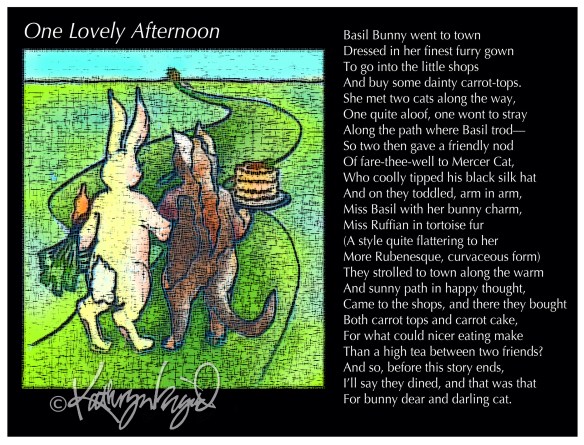
My sister’s cat Mercer has been sick and suffering for a while lately with some mystery malady, and his symptoms have thus far refused to explain themselves to his faithful veterinarian, so we’re in a watching, waiting and hoping phase. It’s sad and frustrating, and poor Mercer needs some serious respite from his ailments. I’m afraid I haven’t the skill to give him anything more palliative than the occasional pettings he allowed me to give him while we shared living quarters this summer. So I send out this little ditty to bring him good vibes of well-wishing long distance, as it stars the two most faithful fellow fur-babies who live or visit in his home, Ruffian the cat and Basil bunny.

Digital illustration + text: One Lovely Afternoon

Sing Comfort to Me

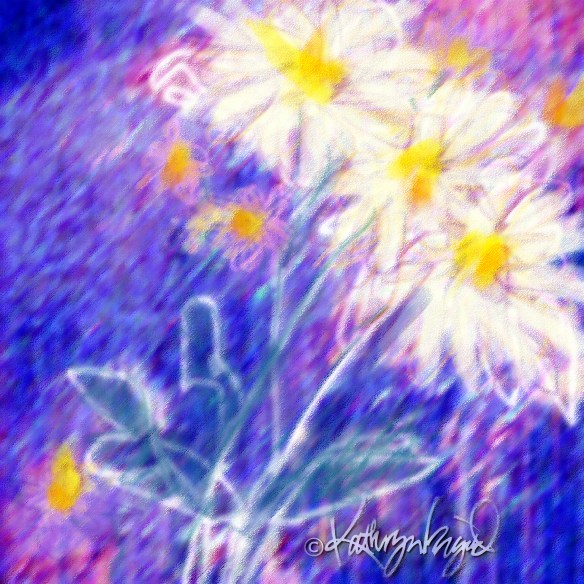
Digital illustration: Wild Daisies 1Sweet is the Song

However cold and sharp the wind may be,

As wild and deep as darkness ever falls,

From utmost edges of the storm still calls

A song that stills, that draws and comforts me—

Though battles rage, the world in sorrow drowns,

And trials threaten life and hope and light,

That gracious call still guides me through the night

As long as I will listen to its sounds—

No danger is so great, no ill so dire,

Nor pestilence and terror so extreme,

That it cannot be mended by the stream

Of melody from that angelic choir—

Now when amid the depths of dark and pain,

I’ll listen for that heavenly refrain.Digital illustration: Wild Daisies 2