I Am Not Alone (Part 3 of a 3-part series)

Disclaimer: I’m no doctor, therapist, counselor, or genius. If this post about hope in the midst of depression and anxiety and related mental-health experiences is in any way true for you, know that it might be uncomfortable to read in the first place, but much more importantly, that reading it will not, cannot save you from your troubles. What you need is not a word of empathetic support from a fellow mortal with related experiences but genuine professional help, just as it’s what I needed first. Come back and visit me if and when you’re ready. If you don’t have any such problems, hurray for you! And read on anyway, because you might be able to help another person if you know better how she or he is living. Everyone’s truth matters, even when we don’t agree with or share it.

I’ve said it before, and I’ll shout it again and again from the rooftops: ♥♥♥♥♥♥♥♥♥♥♥♥♥♥♥♥♥     ASK FOR THE HELP YOU NEED!     ♥♥♥♥♥♥♥♥♥♥♥♥♥♥♥♥♥

When you’re feeling strong enough to do it, fellow struggler, I want you to ask for, and find, the help you need. A friend wrote me after reading the previous two parts of this post series, quite rightly asking: “As someone foreign to what you describe here, I’m wondering whether you’ve ever found it beneficial for two people who are both despondent to work together. Can the shared despondency do some good, like two negatives making a positive?” My short answer (strictly my opinion, of course) is, Yes and No. Feeling alone in sorrow is, ironically, almost universal, but the feeling ignores the reality. Being reminded we’re ‘all in it together’ can help. Mutuality of support and dependence can be useful, but only if genuinely committed on both sides to the wellness and well-being of self and other, and only in partnership with those qualified to help. Wallowing and giving up hope together is no better than doing so alone. Find the counseling, student resources center or person at your school, workplace, or community services center, and get in contact. Do a little research to find out what’s affordable or free, and accredited, in your area. Make an appointment, and be sure to tell the person with whom you make the appointment that your need is anxiety and depression related and therefore time sensitive.

Stand up for yourself enough to insist on getting the help you need. I was really, really lucky that the counseling center my doctor sent me to visit had trained ‘triage’ telephone operators who could determine how urgent it was that we patients get in and guaranteed an appointment within a week or even 24 hours, depending on the situation. We all know that for anyone who is suicidal, only genuine emergency care will do: a suicide prevention hotline, phoning 911 [the American universal emergency phone number], or heading to the hospital is essential. But knowing that the assessing operators at my local mental health center were trained to spot the differences gave me a little needed comfort and the strength to wait 24 hours more.

Meeting with this counselor won’t be an instant solution for you, though, honestly, getting through the first step of making the contact was for me by far the hardest, bravest thing I ever did, so everything after that seemed progressively easier! I cried and sniffled and howled through the phone call, through the days (weeks) leading up to the appointment, through the drive to the appointment—wondering if I could go through with it, though I’m delighted, if that’s the right word, that I was too afraid and embarrassed to cancel and inconvenience the stranger I was going to see—and I wept through the majority of the first appointment, too, even though I had little that I believed was so urgently, impressively scary or important-seeming to say or do. That’s the nature of the beast, isn’t it. I think it’s useful, when you decide you’re in need of help, regardless of feeling ready or courageous enough to seek it, to have a few little strategies for taking the starting steps. A checklist, if you will, can make the attempt at something so large ever so slightly less daunting. From my own perspective I can offer some possible options.

Think of others. The world shrinks incredibly when one is depressed and anxious. It’s all I can do, in the midst of it, to consider that I’m not the lone creature in the entire miserable universe. But realizing that my misery spreads invisibly to others, like any kind of infection, helped me, albeit incrementally, to decide I had to make a change somehow. I could at least drag myself to strive toward health for others’ sake when I couldn’t muster it for my own sake. The one ‘trick’ that still helps me the most often is one I suggest you try even before you manage to go out and get professional help: Focus your energy, however infinitesimal it may seem, on doing whatever itty-bitty-teensy-weensy thing you can do to help someone else through a struggle. I wrote about this technique that my mom taught me in a previous blog post, and it still regularly saves my shaky hold on sanity in stressful situations where I’m not actually alone, especially at social events, which are big stressors for me. Give it a shot a couple of times, and give yourself permission to ‘play the part’ of somebody cool and confident (at least cool enough to admit to a stranger that you totally lack confidence) and you’ll be amazed, almost invariably, how much it can help you. I’ve managed to get through events crowded with intimidatingly high-powered, celebrated politicians, artists, and social giants, in countries where I spoke little or none of the local language, by doing this. I’ve also learned along the way that many of the aforementioned intimidatingly powerful persons turn out to be just as needy and insecure as I am, merely better disguised!

Build a DIY support network. It’s a network only if you think of it going out as well as flowing in: you’re not only asking for help but offering it, and though you don’t believe you have enough resources for your own puny self, working to give some to others will show you better what you can do. It’ll be a hard slog, since so many depressives, like me, also fight social anxiety, and either (let alone both) can make it mighty hard to openly discuss deeply personal things like our mental health. Doesn’t even sound possible, does it? But it is. Dare to test the theory; you already know that you’ve got nothing to lose.

Commit to wellness. Sit down with at least one supportive person, preferably a loved and trusted one if you have any such thing. A fellow struggler, a professional, even a total stranger whom you deem trustworthy, might offer support, and that can be useful, too. Find one, or make one. Say to your supporters how much it means to have them on your side and that you will do whatever you’re capable of doing to help each other go through this process, knowing that you’ll all fall down on the job but you will not quit trying, because you owe it to each other as much as to yourself. You might not believe that fully yet, but I promise you it’s true. Even those who think themselves insignificant and invisible aren’t; what affects them for worse or better affects all of the lives around them similarly. If you can’t seek health and happiness for your own sake, try to do it with the idea that you can aim to improve the lives of those around you by being happier, healthier, and better able to assist them through their own difficulties. Imagine your improved health and well-being first as a fantastic, romantic ideal, then as a remote possibility, and then as a goal, and you’ll have a better shot at accomplishing this amazing thing than you might guess.

Take a first step. Make the first appointment you need, even if you don’t yet know how deeply you do, with the mental health counselor or resource person. GO. If this is someone who can see you and your supportive companion together, it might make it easier for you to approach at least the first meeting if you’re there to encourage each other. The first session or two will likely be little more than figuring out your current state of being and understanding your “baseline” in any case. Be bold, and assume that you will be helped by this process, even though it might not seem so at all times, and persist doggedly. Fight for your life. Ask your professional helpers straightaway: Please tell me about all of the FREE resources you can share with me [us], refer or recommend for my needs, so I won’t have the added anxiety and depression of finding something that helps, only to be denied it for financial reasons thereafter.

Commit to continuity. Follow up, whether it’s with this same person/center, or someone/where else that’s recommended. Do your homework. A counselor should be teaching you how to assess your own situation and what you can do to have a positive effect on it, whether it’s through making lists, keeping a simple journal (your blog or diary will certainly qualify, in many instances), doing some reading, learning to meditate, doing a small amount of exercise, adjusting your diet, listening to music, or something else entirely. Do the work. It might be laborious or even painful, but every bit you get through will be something you can cross off your list of struggles.

Reward yourself with your healthiest and most affordable pleasures every single time you feel you’ve made one atom’s-worth of progress. Don’t worry about falling down on the job again tomorrow, because you will. Know that when you’ve rewarded yourself with an honest “hey, I didn’t think I could manage that until now, but I DID IT!!!!” followed, perhaps, by doing the Snoopy Dance or wallowing in an hour of reading from that really trashy, sappy book that always makes you feel like hugging the universe a little, you will be more inclined to get back up and do the work again as soon as you’re able. Keep hunting for your Happy Place among your matrix of matrices. [Have I just coined a phrase?]

If all else fails, take the time to look at your reflection in a window or mirror on occasion and practice smiling ever more genuinely and convincingly, while saying to yourself in your silliest Stuart Smalley impression: “Kathryn Sparks thinks I’m cool. And she’s really amazing, so who am I to argue with her?” Because I really do know how tough it is to be one’s best self and I truly admire all who manage to do the hard work it can take to move in that direction in difficult times.

You do matter. Your well-being matters. Your relationships with fine people (me, for example) matter. Peace and joy to all of us.

♥♥♥♥♥♥♥♥♥♥♥♥♥♥♥♥♥♥♥♥♥♥♥♥♥♥♥♥♥♥♥♥♥♥♥♥♥♥♥♥♥♥♥♥♥♥♥♥♥♥♥♥♥♥♥♥♥♥♥♥♥♥♥♥♥

Photo: I'm Only Human

I’m in the Support Group for “I Can’t Help being Human” (Part 2 of a 3-part series)

Disclaimer: I’m no doctor, therapist, counselor, or genius. If this post about hope in the midst of depression and anxiety and related mental-health experiences is in any way true for you, know that it might be uncomfortable to read in the first place, but much more importantly, that reading it will not, cannot save you from your troubles. What you need is not a word of empathetic support from a fellow mortal with related experiences but genuine professional help, just as its what I needed first. Come back and visit me if and when you’re ready. If you don’t have any such problems, hurray for you! And read on anyway, because you might be able to help another person if you know better how she or he is living. Everyone’s truth matters, even when we don’t agree with or share it.

♥♥♥♥♥♥♥♥♥♥♥♥♥♥♥♥♥♥♥♥♥♥♥♥♥♥♥♥♥♥♥♥♥♥♥♥♥♥♥♥♥♥♥♥♥♥♥♥♥♥♥♥♥♥♥♥♥♥♥♥♥♥♥♥♥

Digital illo from a photo: Depression & Anxiety Cloaked the GardenI’ve recently met a new friend who is dealing with levels of anxiety and depression that sound like where I stood about a decade ago. It makes me both sorry for her struggles and incredibly glad I don’t have that same weight to carry consistently anymore myself. Depression and anxiety, especially the kind of chronic or recurring stuff, both work differently for everybody I know who deals with them, but one characteristic that I see pretty universally is that they can’t be cured or solved purely by smart practices. Real anxiety and clinical depression are inherently opposed to logic. They flatly refuse to listen to reason, and that is what makes us feel afraid, angry, useless, and without options.

It doesn’t help that some people who have never dealt with similar things can be ignorantly dismissive and believe that if we just shut up, pull up our socks, and get over ourselves all will be right in the world. I may know a perfect solution to my mental health problems, or a whole slew of solutions, and be able to imagine myself accomplishing the rescue flawlessly in my mind, but even if the means to that end is sitting less than an arm’s length from me I don’t have the clarity, will, or energy to make like a Nike commercial and Just Do It, not even if I sit staring at the conveniently available means all week long. Another classic and frustrating aspect of deep depression is that it saps us of energy, strength, and will to such a degree that we’re robbed of both clarity and the drive to do what we long most to do, even for the sake of those we love most dearly. It’s no wonder depressed people feel useless—they have been robbed of all of their power and hope, and worst of all, the culprit lurks right inside and can’t seem to be evicted.

When one’s brain or biochemistry can’t process the facts of the situation in sensible ways, the natural instinct is to curl up in a fetal position and hide from everything/one, including oneself. For me, when I’m in the middle of an acute anxiety attack or even a period of general anxiety, my rational brain can still assess the present situation quite neatly and spell out all of the logical explanations—what I could do to solve what’s making me anxious, and why I would be perfectly safe to just let go all of that discomfort—but I’m immobilized by anxiety instead and only feel more afraid, sick, confused, and as a bonus, tremendously guilty for “not taking my own good advice.”

It sounds, frankly, ridiculous to anyone who’s never experienced it, and even to me when I’m not stuck in an attack. But it’s the reality, and it’s awful. It has absolutely nothing to do with whether your life is good, with whether you’re smart, lovable, or desirable, or are surrounded by supportive people or wealth or any other grand resource you can imagine; you can have all of those things in abundance and still fight depression and anxiety. I have had a great life, with very few major causes for even normal kinds of sadness (you know, those well-known major stressors like the death of a loved one, changing jobs, moving to a new home, and so forth), yet when I finally ‘crashed’ with clinical depression in my 40s, I learned that I had probably had not only previous periods of severe depression in my life but also chronic anxiety all of my life. The lack of obvious causes or catalysts for the existing state in an otherwise pretty charmed life only further confirmed my doctor and therapist’s diagnoses—in my case, of an inherent chemical imbalance that various “triggers” simply helped bring to the surface periodically and that, over time, became harder to manage without both counseling and medication.

This may all be TMI for a non-sufferer or casual passerby, but I think it helps explain a few rather useful things. Again, these are my own thoughts and experiences, not yours. Only you can find your way through them.

Those who do experience various forms of mental illness are far from alone. I happen to believe that mental health, along with all sorts of other aspects of personal health and identity, is not merely a ‘spectrum’ of states or conditions, but a cloud of them, a thick and rich matrix in which each of us is created. That in any one person, his, her, or my place in all of the matrices of physical and mental health, skills and interests, sex identification, attitudes and beliefs, and the many other aspects of humanity that make us our individual selves shifts gradually but constantly, however the pace may vary from one time or characteristic to another. If I multiply all of the changes within one such self-identity matrix by how many different matrices of personality can make up the whole and how much they are likely to shift their Me point of intersection over a lifespan, it seems entirely probable that everybody hits the occasional crossroads of whatever for them qualifies as less than prime mental health and well-being.

I’m a firm believer in daring to ask for help, whenever/wherever you possibly can, starting with your counselor and/or doctor; find better suited ones, if the ones you have aren’t helpful! I know as well as anybody how near-to-impossible it is to ask for help, and it doesn’t matter if the reason is insecurity or lack of self-worth or sheer tiredness. It’s just that I also know that my life and sanity have been saved more than once by those little moments of supreme effort it took for me to humble myself and crawl toward help. I could sit around singing infinite maudlin verses of ‘Nobody Knows the Trouble I’ve Seen‘ or, as I always tended to do, wear a mask of pretension that everything was just spiffy, but no matter how much anybody else loved or cared about me, they couldn’t read my mind—how I expected them to when I couldn’t read it myself, I don’t know—so nothing would have happened if I hadn’t just let go of all my ‘should’ ideas and asked.

Treatments vary just as much as bodies’ and minds’ uniqueness differentiates us. It’s hard work to find strategies that help us individually, but it’s the only path I’ve seen whose light at the end of the tunnel isn’t that of an oncoming train. Somebody else’s quick fix or longterm “cure” isn’t necessarily what will serve my needs. I love life in a whole different way nowadays than in my earlier years, thanks to stumbling into and muddling through the process of finding what was best for my situation.

It is a lifelong process, make no mistake. For me, it means I will probably always be on medications in addition to checking in with my doctors occasionally. One of my doctors opened my eyes about this, first overcoming my resistance to medicinal intervention by explaining to me how much the current varieties differ from earlier forms of antidepressants and their ilk in terms of long-term safety and efficacy, and then keeping close watch to insure a good ‘fit’ for me.

On one visit, I asked the doctor whether, feeling so much healthier and better, I should start weaning myself from the medication. “How do you feel?” she asked. “Great!” “Do you want to feel different from ‘great’?” [Me, grinning and shaking my head NO.] “Then why would you stop taking your medication?” Duh. “Come and see me if things change for the worse.” Ten years later, I noticed I was slipping and feeling the old, familiarly dark fears and discomforts creeping in on me and suffusing my sense of self. My current doctor—we’d moved to another state, meanwhile—agreed I could add incrementally to my current dose. Barely ten days later, back to my New Normal. My sense is that depression and anxiety, like alcoholism, are states of imbalance that aren’t curable but can and may be managed over time with consistent care.

I understand very well the resistance to meds that comes from feeling like one has lost a certain amount of emotional depth or dulled some personal distinction when medicated. Yes, I have experienced deep, and superb, lasting joys from my earliest years when not in the abyss, and sometimes I do think that my emotions since ‘entering recovery’ might be slightly duller in general than before, but I would not trade a single second of what I have now as a healthier person for that tiny, shiny bit of edge, if it really is gone. Once the right meds kicked in for me, and it wasn’t instantaneous, I knew that I was my REAL self in ways that I had never, ever experienced before: able to feel normal pain, fear, sadness, or worry without the absolutely constant sense that they would never pass or that each one meant sure disaster.

I could ride in a car without the conviction that every other car approaching mine was aimed directly for me. I’d always known, objectively, that they weren’t, but I couldn’t stop that irrational inner sense from warning me endlessly that they were. I could now plan to meet a new person and not have to spend a number of days before it feeling physically ill and crying and being sulky and short-tempered because I was so terrified of meeting her. If I tried to learn or do a new thing and didn’t get it perfectly on the first try, it wasn’t an indictment of me as a human but a teachable moment of setback.

Now, when I shed tears, they’re not in the uncontrollable flow of incurable grief but born of a sadness that even in its midst I know will abate in time. Or, thank goodness, they’re sometimes tears of joy. Because not only is my life still good, now I can genuinely feel it. I wish the same for all people. It’s why, as an avowed non-expert, I still feel responsible, compelled, to answer when asked out of the darkness, ‘Is there anyone who knows me?

More tomorrow, friends…

Foodie Tuesday: Up to My Elbows in It

Photo: Fat, Glorious FatYou already know that of my many edible obsessions, fats are among the most prized. Butter in virtually any form is the glistening Sun of my oblations when it brings its sleek graces to the sweet and the savory alike. Meat fats, vegetable-derived fats: yea verily, I can’t imagine how I would find culinary happiness if it weren’t for the kind kisses of olive oil, duck fat, tallow, avocado oil, sweet and mild nut oils, leaf lard, coconut oil, and all of their slick cohort bringing the foods I eat to their most well-rounded state. Barbecue of the highest order doesn’t even exist, in my book, unless I have to scrub like a surgeon after eating it to clean up the goodness that ran up my arms before getting to my mouth. The mere sheen of the translucent butcher paper sticking to the smokehouse table is enough to start a Pavlovian response in me.Photo: Brisket, Burnt Ends, Ribs, & Sausage

The thing is, I’ve learned over a long and avid career as an eater, that it’s not fats, per se, that make me rounder, but which fats I eat, and when, and how much. I am well aware that food is faddish, and you know I’ve posted about such things on many a Tuesday of yore, but I pay better attention to my own body’s definition of what works and what doesn’t than I used to do, and by now I’ve seen that while it’s not very helpful to me in terms of my physical fitness or comfort to indulge as much as I wish in eating like a ruminant or like a three-year-old with a credit card, I can be more generous with my desire for fat. You can cringe if you like; I know it’s not for every body, and Fat has been made a dirty word for generations not only because it’s been considered unhealthy, unseemly or both but because it’s been considered dangerous and therefore ugly on people.

But I’ve known folk who lived long, happy, productive lives without ever being particularly svelte, let alone stick-figure thin like fashion models are wont (and expected) to be. I’ve known of dietary health or fitness fanatics who died young of health-related causes. They aren’t the supposed norm, no, but then most of us aren’t, one way or another. When I get my medical checkups I have consistently high cholesterol levels, enough so the doctor sends me off for sophisticated coronary calcium tests, and I come home with a chart that could just as well have a grade school star sticker or happy face on it to go with its perfect Zero score; it defies not only the odds but logic, yet there it is. My blood pressure remains on the low-moderate side, my heart keeps ticking, and the amount of cholesterol in my pipes seems to be irrelevant to my general health thus far in life.

On the other end of the scale, for me, is the unfortunate truth that two things I adore eating, wheat (breads, cookies, pasta, and the like) and uncultured dairy products (ice cream, ice cream, ice cream, and a few other items), almost instantaneously expand my gut and make me feel logy and uncomfortable. I would love to be that grass-eating goat who can munch on wheat-based goodies endlessly without consequence, or that toddler with a bank account running amok in a forty-flavors ice cream parlor, but I’m learning to face the reality that I’m not one of those for whom that’s a good or even fun choice.

One way I am learning to deal with the profound sense of loss that not indulging those wicked-tasty urges very often, if at all, is of course by simply substituting temptations that I like as well and that like me back a little more kindly. Fats. As my spouse just read to me from a newsmagazine, pretty much anything can be improved with a drizzle of browned butter, and who am I to argue with printed infotainment? I suspect there are few foods that, if listed on two menus with one touting Beurre Noisette as an ingredient and the other not, wouldn’t sucker me right in for the sale with the former version. And don’t even get me started on low-fat and nonfat foods being offered as supposed temptations to my fat-loving palate. If they were low-fat or nonfat in the beginning, say, leafy greens, I’m quite happy to eat them, but I promise you I’ll dive in so much the faster if you cook ’em and offer me a good dollop of butter melted on top.

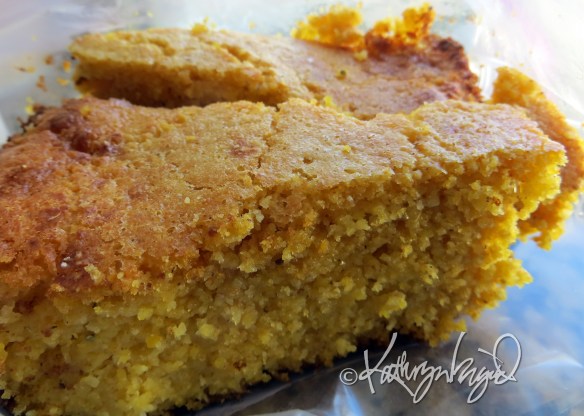
Inspired by Emeril Lagasse‘s skillet cornbread recipe, I merely added a little seasoning, slightly more fat and Voila! It got even better. See how easily that works?!Photo: Slightly Fatter Cornbread

Slightly Fatter Skillet Cornbread

Preheat oven to 450°F/232°C (or whatever approximates those temps in your oven), with your well-seasoned cast iron skillet in it.

Combine dry ingredients with a fork or whisk in a large measuring pitcher (I like my 64 oz pitcher, because it makes ingredient transfers so easy) or bowl: 3 cups cornmeal, 1 tsp baking powder, 1 tsp baking soda, 2 tsp salt, 1 tsp smoked paprika, 1/4-1/2 tsp cayenne pepper. In a separate measuring pitcher or bowl, beat together the wet ingredients: 3 cups buttermilk (or my on-hand substitute of 1 cup heavy cream, 2-3 T lemon juice, and enough whole milk to bring the total to 3 cups—which combination I think I might like even better than the buttermilk), 3 large eggs, and 2/3 cup of melted [salted] butter. Pour the wet ingredients into the dry and stir just until mixed.

When the oven’s temp is right, pull out the skillet, melt 2 T bacon fat in it and tip the pan to coat it thoroughly. Pour in the cornbread mixture, pop the skillet back in the oven, and bake until a rich, russety golden brown, somewhere around 30 minutes. In a household of two, I find it’s useful to cut the cornbread into 12 wedges, and as soon as it’s cool enough to handle, package two at a time in bags or parchment wraps and seal them in a big zipper bag in the freezer, where the residual steam will help keep them moist and manageable for thawing for later meals.

But I do keep a couple of pieces handy for the day’s lunch or dinner straight from the oven, preferably slathered with yet more [browned] butter and topped, perhaps, with some sweet honey, molasses, jam, fresh fruit…or more butter. Don’t tell anybody. They’ll know when they see the shine on my lips, anyhow.

Sometimes It’s Better to Part Ways with One’s Parts

When something goes wrong inside, for most of us it’s no big deal; just an off day in the old innards, whether physically or emotionally, and it’ll pass. But when something goes wrong in a more complicated way, I tend to think it’s pretty good luck if “all” one has to do to get well is remove a malfunctioning part and either replace it or live without. Modern life makes that possible: a swift appendectomy with a tiny scar to show for it, a manufactured hip here, a transplanted kidney there. Lots of things that, if not chronic, are reparable and survivable when they used to lead to long, slow, miserable declines or instant death.

There’s still plenty of the latter kind of illness and injury to keep doctors busy and patients unhappy and money funneling from the latter to the former in ever-widening streams, and that’s no joke. But I think it remarkably good that I live in an era when far less stuff is fatal by default. I was especially glad that when my poor brother-in-law was violently attacked by his own gallbladder recently and it tried to stone him to death, there was adequate artillery to fight back and win. What did he ever do to it, to deserve such lousy treatment! I can tell you from (supposed) experience that gallbladder pain is horrendous. I can’t tell you what it’s like to have the offending organ removed, or even have the stones destroyed and extracted, because either I don’t have a gallbladder at all or it is an expat living in a foreign part of my body from where they are normally located: the doctor and ultrasound technician spent a lot of time hunting and could never find the little hunk of meanness before the pain, thankfully, dissipated on its own.

Photo: Plumbing

Don’t you just hate it when something goes wrong with your plumbing?

My BIL was not such a fortunate escapee, and the pain persisted and worsened until he ended up with several exceedingly un-fun procedures to zap the stones and remove the offending organ, which if you ask me did have a heck of a lot of gall to treat him like that. I am ever so glad he has already begun a full recovery! I wrote him a silly poem, ’cause I love him.

Parting with Parts

is Such Sweet Sorrow

Can anything be worse, or sadder,

Than to give up one’s gallbladder?

Well, perhaps one worser quirk:

Still having one that doesn’t work…

And one worse yet: the wails and groans

Induced by one that’s filled with stones.

So I’ll amend Assertion One:

Having a gallbladder’s no fun.

But then again, I must concede

That surgery is bad indeed.

It all comes down, if I should guess

To what will save my happiness

More fruitfully: intact gallbladder?

None? Can’t say: it doesn’t matter,

Since the choice will not be mine—

‘Til then, I s’pose I’ll be just fine—

I hope. Of course, I still don’t know

Whether I even have one, though.

Another Boulevardier

The pace of our usual life, the sense that we’re always Doing Important Stuff (or at least called to be doing so) sometimes makes me think we’ve all forgotten how to just take a little aimless stroll. Perhaps it does feel like a forbidden pleasure when I know a project’s been lying there waiting for my attention. All the better, then, for its seeming truancy.Digital illustration: Along the Boulevard

I’m happy to take the medical advice against sedentary death as a validation of my going for regular meanders off the normal path, if it takes me away from my current tasks, however directionless my saunters may appear. The mere physical reset is practically guaranteed to get my brain working a little better, and that alone is never a bad thing. The bits and bytes of information that slip into my mind both consciously and subconsciously act to refresh me for the work in hand and to remind me of other things I might have missed or laid aside.

I shan’t dissemble about it, though: when I get up and move, it’s mostly because I can feed my infatuation with observation. I’m just another, albeit less smooth, flâneur slouching about the avenue in search of stories to be filed under Little Adventures. No matter if they’re mine or—more likely—entirely imagined scenarios built around the lives happening all around me, to restock this collection is to refuel myself and find purpose again in both my work and my play. Then I can stroll on back to the real task at hand, and if the street has quieted or the hall emptied by then, I’ve populated my imaginings with enough enlivening Important Stuff to keep me going until my next outing.

Going Ahead Blindly

Digital illustration from a photo: Blurred LinesWhat if my eyesight should fail? Could I ever have enough insight to compensate for eyesight? Others do it all the time, both those blind from birth and those who lose their eyesight. I’m visually oriented, if not obsessed. Does that mean that as a visually impaired or blind person I’d be lost? Ruined? Hopeless? Other people manage to navigate a rich, full world without ever seeing it, and to have a deep, powerful sensory life without relying on eyesight.

One of the real questions here is how I live with change. Do I roll with it, or roll over and capitulate? The other underlying query is, from what do I derive my sense of self? Is it dependent on what I can see, and what I can do with it, or does my inner vision determine much more usefully who I am and what I value, and perhaps even what of value I can still bring to the rest of the world? If others have so beautifully managed to see the great and good whether they had functional eyes or not, I like to think—I hope—that I too will successfully adjust and adapt no matter what my life brings. May it be so. May it always be so.Digital illustration from photos: Vegetal Vision

Quieting My Heart

Graphite drawing + text: Needful Quiet


Namaste.

Foodie Tuesday: Worth Getting Out of Bed

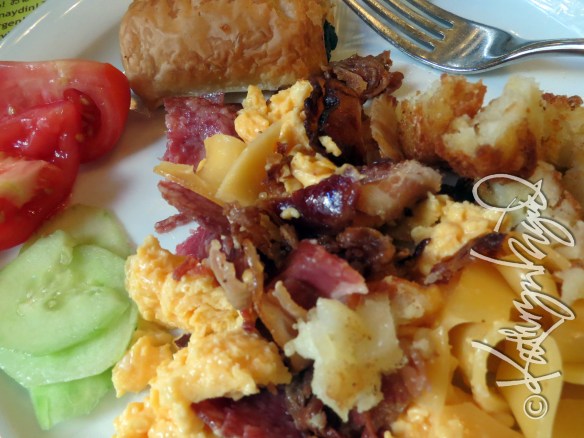
On some rare occasions, it’s actually worth getting out of bed before noon-ish. When the breakfast is that good, you know you’ve accomplished something, because I have no intention of cracking my eyelids open any earlier than I absolutely must. Sleep is the one thing I crave more deeply and often than food, and you all know how much I covet good eating, so it takes the prospect of great culinary splendor to drag me from the comfort of my bed one minute before I am good and ready to do so on my own.Photo: Breakfast in Budapest

Since I’m generally the one responsible for putting breakfast, if any, on my own plate, you can guess how often I’m likely to spring into action to see such a meal prepared and presented. I may have some lovely dreams about breakfast, but I prefer to enjoy them while still firmly ensconced in bed. When I do break my fast, it’s far more likely to be with brunch or even lunch than anything earlier, given my druthers.
Photo: Bulle med Kardemumma

I tend to make exceptions when I’m traveling. Often, the causes for the expeditions are beyond my hourly control, so if I have to be up before my internal alarm is interested in my arising, I will generally take advantage of any good food being offered by my hosts, whether they’re homeowners hospitably letting me invade their personal space or hotels with in-house breakfast accommodations. These pictures, for example, come from the summer’s travels and represent foods that went a long way toward ameliorating the agony of having to get out of bed before it seemed the rational thing to do. If anyone is to have half a hope of maneuvering me out of a comfy sleep any time before my body would grudgingly agree to that negotiation, it had better be, at the very least, with a magnificent cardamom roll (bottom photo, from Sandhamn, Sweden). Or perhaps the mind-bendingly gorgeous and seemingly endless spread offered in the palatial breakfast room (top photo) of our hotel in Budapest this summer. Otherwise, you can trust me when I tell you that it’s advisable to let sleeping dogs lie.

Contagion vs. Compassion

“One bad apple spoils the lot.” That creaky aphorism is based on equally venerable experience. Rot is contagious.

Bad company makes bad behavior seem the norm, and we adjust our own standards ever lower accordingly. One or two disheveled houses bring down the values of the others in the neighborhood, and those, in turn, fall into neglect and decay as their owners lose the courage and determination to resist the incredible pull of entropy. What isn’t growth is death.

What leads otherwise good and sane people to fall apart like that? Doubt; fear; despair. These are the hallmarks of contagion: the plague succeeds in felling us not only through its own virulence but because rather than seek its cure with full courage and determination we flee with it hot pursuit, and when it eventually catches up with us, we topple, curl up in the fetal position, and succumb.

The fall of one member of the world community—like Mr. Duncan, who was felled by Ebola in Texas—is a very real and terrible loss for all. The loss of thousands—those dying in West Africa—is indeed a plague and a thousand-fold grief we all must recognize and bear. The response, though, cannot be equally contagious doubt, fear, and despair. That can only make us choose unconstructive, even destructive, responses like blame, xenophobia, retreat, and the neglect of our fellow citizens of the earth. Then, no matter how many or few have been overtaken by disease and disaster, the contagion will have won.Photo: Snakebit

Name that Malady!

Photo: Something in My Eye

Do I have Onchocerca volvulus, or is there just an eyelash stuck in my eye?

All Other Martyrdom is Naught before Mine

This harsh, persistent pain I have, O Doctor, tell me, please,
Can it be cured by some cheap salve, Or have I some disease
Beyond the scope of modern meds And pessaries and pills,
Like something Biblical in scope, One of those icky ills
You read about in magazines, See movies-of-the-week
About so frightful that you Realize that you’re a freak
To have such creepy plague, To be afflicted so, withal,
That even specialists will cringe And dash off down the hall
To hide behind their file Cabinets until you leave
Because they’re overwhelmed by the Bizarreness they perceive
Upon your person when they see Disturbingly displayed
Such malicious malady It makes them sore afraid.
What say, Sir Doctor? You detect My source of agony?
Who suffers worse than martyrs who Have papercuts, like me!

Photo: Open Wide!

Well, shut my mouth! Maybe that nasty odor wasn’t Trimethylaminuria, but don’t just give me the brush-off.