The Ordinary Romantic

I’ve not re-posted anything from my own blogging before that I can recall, but happened upon this (admittedly lengthy) piece I wrote a number of years before I even started this present blog and was reminded of a few things I’ve said here but in quite different ways. So I share it with you now, lightly edited to update it, just because it piqued my own interest once again. Cheer up, my friends: I love that this is written from something like an outsider’s view of the experiences of depression and deep melancholy, after all these years!digital illustration from a photoI highly recommend reading the book I just finished reading [when I originally wrote this post], Peter D. Kramer’s ‘Against Depression‘. He’s the author who wrote ‘Listening to Prozac‘ – a book that, surprisingly, wasn’t really about depression or even Prozac, per se, but due to its bestselling status raised those two specters so frequently that he finally had to respond with this book. He has some sections in it dealing specifically with the effects of depression on arts and creativity, intellect and education, and vice versa. But there’s also a ton about the physiology and pathology of depression, the affect and effect and the impact on self and others. Very thought-provoking for me.

If you want a really scary companion-piece before, during or after the reading of that book, one that for me confirmed the urgency of wellness by any–no pun intended–sane means, look up ‘My Lobotomy‘ – it was a presentation on NPR that horrified me more than umpteen war- and disaster-stories (including true ones) and makes stories by Edgar Allan Poe and Stephen King sound like skipping through a copse picking violets. ‘Lobotomy’ is the harrowing memoir of a lobotomized man who, at 56, finally got up the courage to investigate and explore what happened to him when he was operated on at 12, why it happened, who else was affected, and much that followed. Incredible. Terrifying. I can barely even think about it. But it did make me feel all the more intensely that I want to stay in charge of my own mental health just as much as I should my physical health.

For the moment, since I’ve so often been asked, I will say that when I call myself Ordinary, what “ordinary” means to me is wide-ranging and a bit variable, but in the sense I’m using here in the land of my blog, it covers all of what seems possible, believable, normal or otherwise expected in the universe of human experience. More significant, perhaps, is defining what it doesn’t mean for me: things found at the extremity of experience: brilliance or genius or unearthly, once-in-a-lifetime skills, talents, and insights. Me, I’m not interested in being a supernova. They tend to burn out fast anyway.

What I really pride myself on is taking the simple raw material of being a middle-of-the-road mortal and managing to pull out of that clay my own few moments of dazzle – an outstanding artwork here, a worthy kindness there, and a few sprinkled bon mots or glorious deeds in between – these shine all the more in the setting of my ordinariness. People take note of them precisely because they are deserving of note–because coming from a typical luminary or wunderkind they would be the expected thing, no matter how exciting, and from me they are not. There’s no intrinsic negative value to ‘ordinariness’ for me, no implication of self-abnegation or false modesty, just the sense that only a few in history are genuinely set apart as spectacular examples of either desirable or undesirable traits and gifts, and we in the main herd can still go on and live rich, full, complete lives just as we are. With maybe a little less pressure to perform, too, so that anything extraordinary we do actually shines that much the brighter. Surprise! Aren’t I fabulous!

Why do we see ten tortured geniuses for every happy one? I think it’s primarily a function of taste: the culture that covets over-the-top emotion isn’t interested in supporting and reporting anything that doesn’t have that dangerous gleam. Good news is no news. If the artwork is upbeat, it must be tacky and shallow. If the artist is happy, she must be an air-headed clown. Prettiness and simplicity and everything that pleases the mainstream must, by definition, be playing to the lowest common denominator.

I’m actually a dyed-in-the-wool Romantic myself, but I have been contemplating that old adage “write what you know” and decided that it lends itself to far too tiny a concept of possibility. In the first place, if taken strictly it would mean that we should automatically dismiss as useless falsehood any attempts at empirical or even historical writing, because practically everything that has been once believed absolute has taken on different shadings over our cultural lifetime, if not been disproved. Never mind how we should treat the authors of murder mysteries and crime novels! The aphorism may be a needless dictum or even a myth: one doesn’t necessarily have to BE suffering to appreciate what suffering is. And perhaps anyone who has suffered in the past can be considered to have earned the stripes of exactitude anyway and can rely on recollection rather than continuing to wallow.

There is certainly a bit of truth when people insist that others can’t know what they’re going through; in its most complete sense, I’m sure that’s accurate. But anyone with a little life-experience and the ability to sympathize or even–if imperfectly–empathize, can puzzle out in his or her own way an approximation that makes communication of it possible in art. And, frankly (this goes back to that idea of an Ordinary person doing something Extraordinary), if I can make someone slap his palm to his forehead and go, “YES! That’s what I’m talking about!” when they recognize a shared feeling or insight, then I think it’s all the more memorable and impressive, not the predicted brilliance of some savant.

So thanks to the perpetual discussions of such topics with colleagues and friends and given my understandable interest in depression and its effects as well as more strictly Romantic artistic concepts, focus on the impressive influence and hold of Romanticism on all our lives, I continue to search. If Romantic ideals glorify and sympathize with a dark world-view, with sorrow, cynicism, pain, suffering, and so on, and if arts and beliefs that support those ideals are valued, then how can we respond to things that defy or fail to uphold them? How can we wish to be happy and healthy if what we love is, really, decidedly neither? Since the prevalent taste for Romantic qualities has been in vogue for a number of generations, and cultural memory is dangerously short, few recollect that being In Love with Darkness is a relatively new trend in recorded human history; an externally imposed one at that. As with so many of our beliefs that we take not only for granted but as eternal, immutable fact, all is not necessarily as it always has been or will be. There are larger patterns in the life and development of art, history, healthcare, personal experience, politics, and religion that act and cycle broadly, often inducing in each other significant change as they intersect along the way.

As Dr. Kramer notes in his excellent polemic against depression, even tuberculosis used to be idealized. People who had Consumption were presumably consumed by the unusual intensity of their inner being: larger than life passions, intellects, artistry, love and spiritual astuteness were all attributed to these dramatic sufferers. When it was finally seen that that oh-so-sexy tuberculosis was in fact not only a genuine physiological disease but also a degenerative, communicable, and difficult to treat pathology, and that it would not only kill the patient eventually but also deprive the rest of us of those idols, the tide began to turn toward the desire for palliative care and cure. Depression, also arguably a disease of at least equally destructive dimensions, and demonstrably damaging to such physical attributes as brain tissue and adrenal glands, not to mention to social structures surrounding the patient, is certainly deserving of the same considerations.

So what do we do with our Gothic worldview? Give up our love for the dark? Hardly. Strip it of its value and depth? Not likely. Perhaps, though, we can rebalance the scales a little and say that it’s no longer chic, let alone necessarily accurate, to assume that all things pretty and pleasant and uncomplicated and cheerful are stupid, dull, vacuous, or shallow. Realistically, we’ve all seen attempts at art that cling to the Romantic ideal and yet manage to be stupid, dull, vacuous, and/or shallow. And, as I constantly remind[ed] my beginning art students, one of the hardest things to accomplish well is simplicity. When you take on the task of making a work that appears simple, you make yourself vulnerable to every would-be critic who can find the tiniest flaw as it stands out against that backdrop. Because you have tackled the familiar, it takes far more sophistication and subtlety and inner resource to make the work distinct and worthy, not just a good imitation of what has been done before. Anything can be badly executed, art or otherwise. Anything has the potential to be scintillating and brilliant.

The difference should lie not in one element alone, especially not some preset element like whether the theme is Dark or Light, but in the miraculous confluence achieved of content and intent, medium, methods, and moment. Is it beautiful? Is it successful, deep, lasting, influential, meaningful? We will, and should, continue to make value judgments and assessments and be willing to revisit them from time to time. Because beauty and meaning, whether you believe they’re strictly in the eye of the beholder or not, can change as the beholder’s eyes are changed by a life full of adventures, by time and tide and every nuance of history that washes over us. It should be equally visible in full, bright Light or in cavernous Romantic darkness.
Foodie Tuesday: You Eat What You Like, and I’ll Eat What I Like

Besides being a wise quote from my perennial hero, Yukon Cornelius, the title of today’s post is pretty great advice for eaters at all times, most particularly so during the holidays. If I’m going to go to the expense and effort to do anything special for a Special Occasion, it matters far more to me that I want to eat the results than that they meet anybody else’s standard for tradition, impressiveness, or perfection. You won’t find me dining on dainties of glorious extravagance and beauty on a holiday or birthday or any other notable date if I’m the designated cook, because spending exhausting and exacting hours in the scullery before the blessed event is not my idea of a great way to arrive at it rested and ready to enjoy its importance in my life with good cheer and an even temperament.

photo

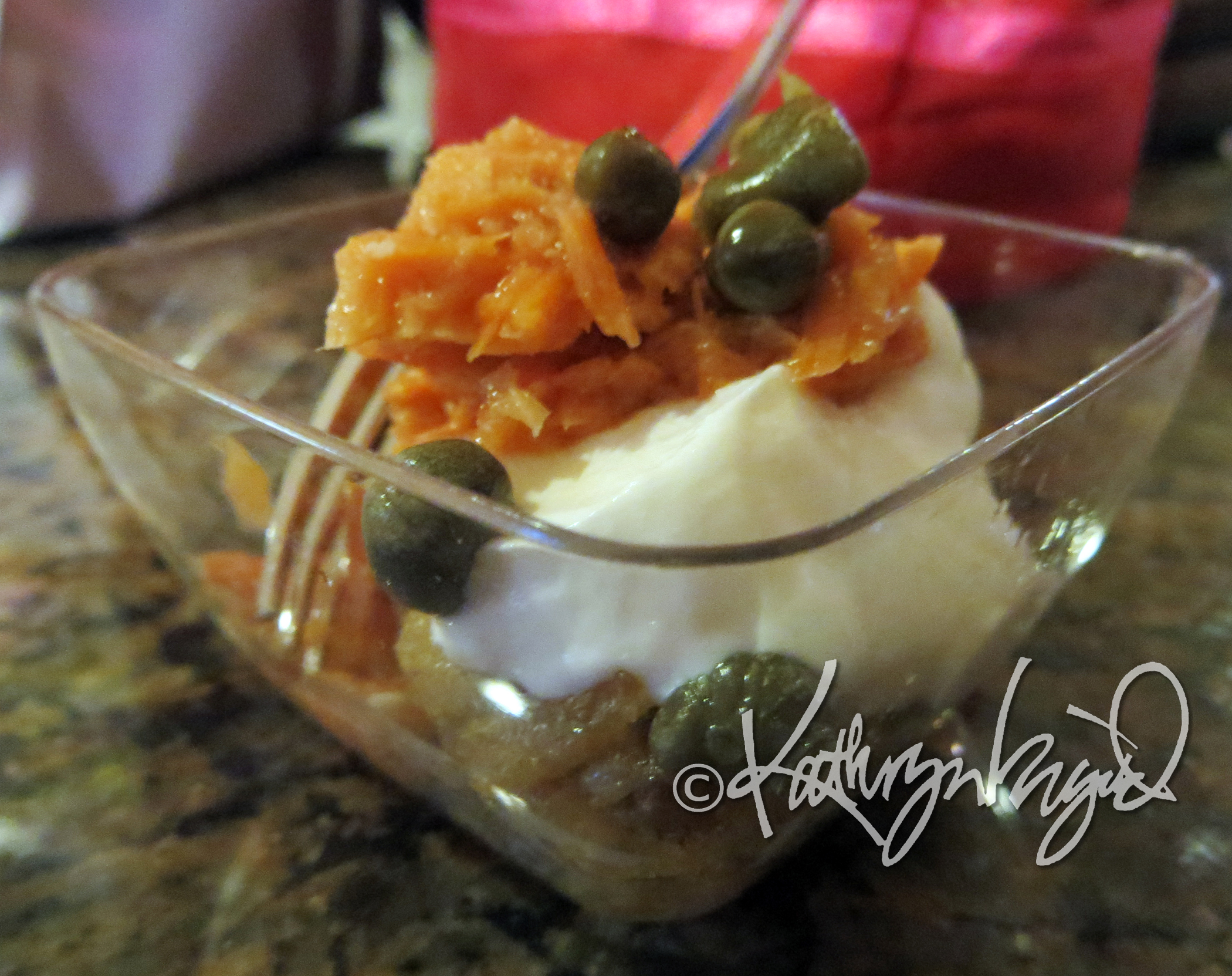
Appetizer parfait: hash browns (I made these with Gouda and smoked paprika), sour cream, hot smoked wild Pacific salmon and capers. Or, in the alternative version I offered on the same day–another easy to prepare ahead topping for the hash browns–smoked sausage pieces simmered in Pinot Noir BBQ sauce. The sauce was a sticky reduction of equal amounts of red wine and homemade bone broth with brown sugar, tomato passata, chili powder, cinnamon, cloves and cayenne to taste. Guests could assemble the tiny dishes with any combination they liked, and I didn’t have to wrestle with the hors-d’oeuvres at all on the day of the party.

So while I adore Dungeness crab, I will not likely be preparing one fresh and mucking about with the tedious chore of meticulously picking the meat out of the shell–if I can find fresh Dungeness already picked and packed in a neat little carton, it’ll be on the menu; otherwise, not. My fondness for elaborate baked goods will likely be fed by an outstanding bakery, not by my slavish efforts right before a party. I’ll happily dine on a perfectly frenched rack of lamb or a miraculously flaky and tender kulebiaka or bistilla, but only if someone else is going to all of the effort it takes to prepare it.

photo

Homemade macaroni and cheese can be just as easy to fix as pre-packaged. Here, I blended shredded Gouda, cheddar and Parmesan cheeses in about equal amounts and added melted butter, eggs, smoked paprika, powdered mustard, a little grated nutmeg, and a tiny dash of liquid smoke (no additives, please) before stirring the cooked pasta in with a bit of cream and baking it to melt and meld it all together.

That’s how, when Christmas dining is at home, it may go so far as to be a roast beef that can be cooked sous vide and requires only a quick browning in the oven before carving, but it might also be a made-ahead, very down-to-earth macaroni and cheese. Or even a tuna salad sandwich, a perpetual favorite that, while it’s hardly what anyone I know would consider Fancy, is gladly eaten with a handful of good potato chips and a juicy apple on nearly any occasion chez nous. I want to eat delicious food on Christmas, but it doesn’t have to be unusual or expensive or showy in any way to be delicious, and if its simplicity of preparation means that it’s eaten in a very comfortably relaxed state, that makes it all the more appealing and enhances its flavor remarkably.

photo

Homemade mac-&-cheese is, in fact, also easy to customize for any number of tastes and occasions, as when I change out the elbow macaroni with some fresh fettuccine and toss in a batch of Langostino tails. Voila! ‘Poor man’s’ lobster fettuccine.

I hope that everyone who is celebrating around now–whether it’s Christmas, the Dongzhi festival, Hanukkah, the Winter Solstice, the New Year, Kwanzaa, a birthday, or something entirely different–has the wealth and freedom to take the same approach. It’s satisfying to arrive at happy events relaxed and, well, happy. And eating what you love to eat is always better than eating what you think you should eat, only because you think you should. I wish you all great food, simply prepared, great company when you want it and quiet time away when you need it. That’ll make the food taste all the better when it comes. Cheers! Bon appetit! Joy!

photo

Who says plain salt-and-pepper roasted chicken isn’t fancy enough for a special occasion? If you enjoy it, indulge. Even with the most common of accompaniments, it can be satisfying and tasteful (clockwise from the ruby-colored jellied cranberry sauce at left): pickles (here, okra, green tomatoes and green beans); sweet corn; coleslaw; apple sauce (freshly made brandied maple sauce); mashed baked potatoes with beurre noisette, fried sage leaves and optional red wine/broth reduction sauce; and a spoonful of tiny, tasty green peas. And if you’re a vegetarian, you can always eat the whole rest of the meal and be content. Peas to all the earth, I say!

Even desserts–maybe especially desserts, come to think of it–can get treated like such elaborate Fabergé egg-like constructions that they are too precious for ordinary mortals to eat and far too tiring for me to slave over preparing. I’ve hardly ever seen anyone turn up his nose at store-bought ice cream or refuse if I offered her a nice piece of chocolate straight out of the wrapper. A bowl of perfect fresh strawberries, a moist pound cake made the other day, and a quick batch of whipped cream with vanilla give instant summer cachet to the end of a meal. Banana pudding needn’t even be a fuss, and doesn’t look really like much (hence the lack of a photo), but it’s unpretentious and tasty enough that everyone right down to the toddlers will happily eat that old comfort favorite.

Banana Pudding to Make You Go Ape

Don’t bother with cheap, phony tasting artificially flavored instant banana pudding, either, despite a short timeline for the treat (unless you get all nostalgic over it for some reason). All you actually need is some really ripe bananas and a handful of other ingredients, and away you go…

Blend together until smooth (I use the stick blender for this): 5 overripe bananas (too mushy for eating plain), a pinch of salt, the juice and grated rind of 1 large lemon, a generous teaspoon of vanilla, a couple of tablespoons each of raw honey and butter, and about a cup of heavy cream. Chill until thickened. What do you taste? Bananas. What will you do? Go bananas over it. Why work harder than that for your food and fun? Enjoy your holidays and happy days instead!

Oh, and I must add (since what goes without saying may not entirely go without saying for everybody!) that this kind of banana pudding will, of course, oxidize–unlike the aforementioned imitation stuff–so it’s best eaten right when you’ve made it unless you’re like me and don’t care if it’s a little beige in color. And it’s not super thick, so if you like it thicker, I recommend whipping the cream separately and then folding it into the blended banana mash, to which you’ve already added the other ingredients. No matter how you choose to make it, it’s still pretty tasty. And, as Marie has suggested in the comments and I’ve already tested, it makes a dandy breakfast!

photo

Happy New Year!

Death is Never Out of Season

photoDid I worry you for a second? Never fear, friends; I’m not going to be a big old humbug, let alone a grand tragedian, here. It’s just that, living where I live, I’m always in the shadow of some circling or perching vulture sussing out his or her next all-you-can-eat buffet. I’m pretty sure that I too would look fairly delish if I just had the kindness to croak somewhere out in the open within a vulture’s purview, yet they don’t turn up their beaks in disdain at smaller game. So I can get a regular reminder of my mortality just by looking over in the tall grass next to the road, where there is often a vulture or two munching on someone else’s gnarly remains, any time I need said reminder.

I am, as you’ve seen if you’ve spent any time around this blog, of the school that still has an appreciation for a good memento mori as a reminder of the fine and great and joyful things that being Not Dead can have to offer. It’s just about time for the biggest holidays of the year in many cultures, and as workers in the life-supporting jobs that include medicine and law enforcement and social services will tell you, depression, health crises (both physical and mental), family violence, crime and all sorts of other terrible social ills tend to peak. Unreasonable schedules and outsized expectations of delirious happiness around holidays and other celebrations are practically doomed to failure, and even those who are fairly realistic about their expectations may have actually built in a sort of assumption of disaster that only adds to their stress.

Letting go of a lot of this overwhelming and impractical perfectionism and most of the silly entitled assumptions that the world owes me satisfaction and pleasure has greatly simplified my life. It has certainly lightened the load of worry and wishing. And every time I walk under the perch of a local vulture and look up at it as a fellow living creature, I am thrilled to pieces that I have the greatest way of all to celebrate whatever holidays and special occasions I want to enjoy: alive. Not particularly wanting, not overburdened with Stuff and needs and promises I can’t keep, and simply, happily Alive. Just having one of those massive birds circle over my head without interest in me as an entree reminds me that death is close at hand, since the avian beast is clearly keeping a keen eye on something nearby that is already deliciously deceased, yet also says that I am not quite yet on that side of the equation and can go on to enjoy my holidays. Kind of makes every day seem more worth the celebrating.

Watching the World as It Passes

The day after Christmas has a long history in the western world as a day of strangely battle-weary living for many. All of the wildness and extravagance people can conjure has been devoted to getting to and through the 25th of December, and little thought or energy or resources remain for anything that follows, least of all the day immediately on the heels of the Christmas holiday. That’s okay. Everyone has his or her way of celebrating, or avoiding what they see as the excesses of others’ celebrations, no matter what the holiday and Christmas, with its western prevalence and pervasiveness culturally, has expanded into something astonishingly complicated even for those who have no connection to the origins of Christmas at all.

I have experienced Christmas in a multitude of ways myself. I grew up in the Christmas tradition of church and family, gift-giving and observance intermingling and filling all of the days around the date, but as an adult no longer living in my parents’ home, and especially as the spouse of a professional musician, I have spent many subsequent Christmastides attending concerts and services not in the same place and with the same people, some of the occasions entirely secular and some fastidiously and formally religious, and often have felt myself simultaneously immersed and somewhat removed–an observer of this strange phenomenon that is Christmas in the modern world.

What I feel now also changes and flickers like a candle flame. Part of me is moved and absorbed to the degree that I hardly notice my immersion, and part remains surprised, mortified, mystified and/or delighted at the lengths, depths and heights to which people go in pursuit of their own understanding and expectations of the holidays. As I grow older I am also more aware of the plethora of significant events and holidays meaningful in so many other religions, cultures and personal realms, and these often change my view of the practices related to Christmas in and around my life, too. Even the most hermit-like must be so affected in this day and age, it seems, and that’s not entirely a bad thing. If we live in the context of all of this, we should certainly be conscious of how these differences and nuances and variations inform and even influence our experiences in this life.

All of that aside, one of the least spiritually driven aspects of the winter’s holidays that gives me a certain amount of real pleasure is knowing that on the 26th of December a fairly large percentage of people in the western world are frantically rushing around in the pursuit of shopping exchanges and returns, after-Christmas sale bargains and last-minute, end of the year party preparations, and another portion of the population is collapsed in utter exhaustion from the foregoing revelry–and I am in that most enviable state of being and doing neither of those. Preferring as I do a quieter, less frenetic and far less shopping-oriented way of celebrating important occasions in my life, I find the rebound from them equally reduced in intensity and stress. That, to me, is the gift that does keep on giving.

digital illustration

As you were! You feel free to go about your business and do your celebrating as you like, and I’ll happily wait right here for you in my royal lassitude. Happy holidays to all!

Seasonal Allergies

Can political correctness kill a holiday spirit? Oh, yes, it can. We’ve all seen it. There are times and places when and where we have to tread so lightly around people’s tender feelings regarding their special holiday or occasion–or someone else’s–that it’s hard to believe that any of us retain those passions and beliefs after a while. It’s as though we’re allergic to each other’s seasonal happiness. All the same, I do understand that we ought to show reasonable forbearance regarding others’ dearly held views, no matter how far from our own they may be, so long as those views aren’t harming anyone else. And so very, very few of them are, to be fair.

photo

Remember to tread lightly on others’ ground!

But if others want to celebrate things I’m not so attached or attracted to myself, who am I to stand in the way?  I like holidays, parties and celebrations very well. I may have even occasionally co-opted others’ holidays just because I think they’re wonderful excuses for enjoying the great things about life and history and happiness. Whether I do or not, I am happy to see my own holiday leanings in any odd spot that inspires me at any moment.

photo

Ho-ho-ho, happy people, whoever you are!

I’m from a pretty common kind of American, Protestant, middle class background myself, so it won’t surprise anyone that I grew up surrounded by the trappings of the middle class, Protestant American version of Christmas. Won’t even shock anyone that after my decades of being surrounded by it, I grew more than a little jaded at the horrendously fat, greedy, commercialized version it morphed into in the public eye and felt shy of celebrating Christmas in that atmosphere. But there’s that sense of tradition and family tied into it as well, and the knowledge that the origins of the holiday and the celebration of it are worlds removed from those crass retail versions of it that irritate me so. So when I see the famed color combination so associated with Christmas in this my home culture, I think I am in a more forgiving mood toward the genuinely human and sometimes very foolish ways that others spend their celebratory energies, and maybe even toward my own.

I wish you all a happy holiday season, whether you celebrate any particular occasion or just enjoy seeing others revel in theirs. There should be plenty of pleasure to go around!

Just a Different Stripe, or a Horse of a Different Color Altogether?

Does it really matter whether our differences make us varied members of the same family or citizens of separate countries entirely? At the bottom of it all, we remain genetically bound to each other as disparate parts of the same species. What we choose to do with and in response to that simple truth is what really defines us as individuals and as parts of the human family, not how different we are from one another.

Working for respect, kindness and peace toward and among all the people whose paths cross mine in life seem to me like perfectly viable ways to respond. That’s the choice I’m going with, and I hope that it will be seen as defining my true colors always.

digital illustration

Our differences may be subtle or they may be tremendous, but they’re still contained in remarkably similar packages.

photo

It’s a gift and a privilege to see the beauty in those of a different stripe than ourselves.

photo

What, are you really so concerned about the cut of my hair or the color of my hide?

photo

I should always try to get a leg up on what challenges my expectations, whether it’s my nearest neighbor or someone from worlds away.

photo

After all, some of my best friends are zorses….

Things I Used to Know

In olden times, when I was young and Apatosaurs snacked on the treetops, I knew stuff. I’ve forgotten more since then than most sentient beings learn in a lifetime, although in fairness to them and to my own addled and limited brain capacity, much of that was only memorized and not really understood or applied. And what little I have learned or known has mostly long since been reduced to dribbles and scribbles and other forms of rubble.

digital illustrationI once knew how to ice skate and roller skate. Not particularly well, mind, but I could stay upright and toddle around a rink or lake without breaking ice or ankles, which for a person of limited grace and less skill is good enough. I could ride a bike, row a boat and climb a tree. I read books intended to make me smarter and ones intended only to amuse me, and a fair bunch that had the possibility of doing both simultaneously. I sang in every section of a choir that would let me in, played the piano poorly but enthusiastically, and learned about four chords on the guitar from Dad.

Much of this is gone, forgotten or so rusty that it would be somewhere between horrifying and laughable, or possibly both, if I were to try my hand at any of it now. And I’m not proud of that. But I’m not too worried about it, either, nor am I ashamed. I’m probably not all that different from most people when it comes to such things. I wouldn’t mind, though, if the opportunity arose to revisit any of those things and I discovered that (a) it’s true what they say about bike riding coming right back as though I’d never left off the practice, and (b) everything else I’d ever once loved doing would come back as easily as zipping around on a long-neglected bike. Before all the rest of me freezes over, as it were.

I also used to know how to leave the house without much thought of what lay outside its doors or worry over what I was to avoid and/or accomplish before returning to its safety. I had a firm grasp of many, many things that didn’t matter in the slightest in keeping the earth rotating properly or making my part of consumerism fully sustainable, let alone in achieving and maintaining world peace. As a supposed grownup, I learned to worry and fuss a great deal over that sort of stuff, even (or especially) when I knew full well I hadn’t any hope of challenging my born impotence in these matters.

But one thing I have learned as an adult that is remarkably useful–assuming I can keep it in mind, an increasingly slippery endeavor as I age–is that no individual human ever did really have any control over anything of this great importance. Occasionally, one of our kind manages to break through the barriers or even simply to fall into a solution by being in the right-or-wrong place at the right-or-wrong moment, but most of us are not able, alone, to learn or do anything much more complicated and meaningful than reading or singing or ice skating. And most wonderful of all, I’ve learned that that’s okay. It’s important to care, and to do and be the best that I can, but it may be equally needful that I grow wise enough to stop banging my head against any brick wall that practice has taught me will never actually budge and, yes, be content that I made the effort, not carry around pointless guilt that I’m not killing myself with further useless striving and angst.

As much as I loved ice skating when I was young and owned skates, and lived near a park where I could use them in winter, I don’t feel terribly cheated that decades later I’m fairly certain I couldn’t even remember how to skate. I’m happy to hang up those old blades and let someone newer and nimbler learn how to ice skate, and finally to get old enough to forget it too, in turn. The world itself will probably continue turning, with or without us.digital illustration

I Dance on Their Graves

digital illustration

Epic Epitaph


Let’s just keep this

Short and snappy:

Yes, I’m dead;

Some folks is happy.

Yes, I had

The plague. Ahem,

They’re all infected.

Joke’s on them.photo

Her Misbehavior, as Seen in a Slightly Foxed Mirror

Oops! I outfoxed myself. I was so distracted by the odd weather we’ve been having here lately and all of the ways it’s unexpectedly altered our calendar and our plans (though my birthday came today right on schedule, wink-wink) that I completely forgot last night to put up the day’s post. So I did it today. A two-fer. Just to remind all of you how much I love you. Thank you for your patience. I may be getting a little absent-minded in my old age, but I still think the world of y’all. Happy two-post day!

Vulpine

The vixen, when she deigns to leave her den,

May have designs on other vixens’ men,

For, little as I know the ways of foxes,

I know they don’t like being kept in boxes

But rather like the freedom just to roam

To any den, if it should look like home,

And any male they’d like to have as mate–

Beware the vixen’s wiles, ere it’s too late!digital illustration


A Musical Tradition

The office where my esteemed spouse performs many of the studies and administrative duties comprising his workload outside of the conducting element at the church where he’s now interim chancel choir director hasn’t got a lot of stuff in it other than a big desk, a small piano and a couple of bookshelves. Most of the books that had filled the shelves went away with their owner, the previous director; a few that go with the office itself remain on the shelves, and all by themselves they tell quite a story. That’s the way of books in general, isn’t it.

It’s all the more so in this instance, by virtue of the books’ being vintage hymnals. The history of the United Methodist Church at large is in their pages. The history of this specific congregation within the UMC is there, too. And there’s a great deal of Protestant church history, Wesleyan history, English and American folk music and even larger and older parts of the musical tradition. All right there in the pages of some rather small, rather worn books that just happen to be full of hymns.

There are libraries; there are Protestant theological resources; there are music collections; there are history books. All of them are in this one room, in a handful of little old books. And that, in itself, is the nature and long-lived tradition of printed music in general. So much has been passed down in the oral traditions of so many cultures and religions and peoples, but there’s an enormous amount that lives on and grows and inspires because of those amazing repositories that exist in the written music that survives everyday use, one generation after another. I only hope that all such traditions can be preserved and enjoyed far beyond our lifetimes, whether in temples or towns, religions or regions, families or foundations, schools or individual choirs. Beyond inspiration or even enjoyment, these are great containers of food for thought.digital collage