What Wounds can Teach Us

Cut

Skin, though as taut as rawhide, and as strong,

Still splits under a jagged, cruel knife,

Opens its jaws to scream a gout of life

As blood that would atone and end the wrong—

But wounds, no matter what the cause or source,

Cannot withhold their sorrows or their rage;

Injustice must be shouted off the stage,

So bleed they without pity or remorse—

Break, then, both skin and soul, and sear the heart

Of any who is cognizant of pain;

Who cries for justice and can’t sleep again

‘Til order is restored as at the start—

What’s done cannot be undone should a scar

Reveal the fragile creatures that we are.Digital illustration from a photo: What Wounds can Teach Us

Early Music for Breakfast

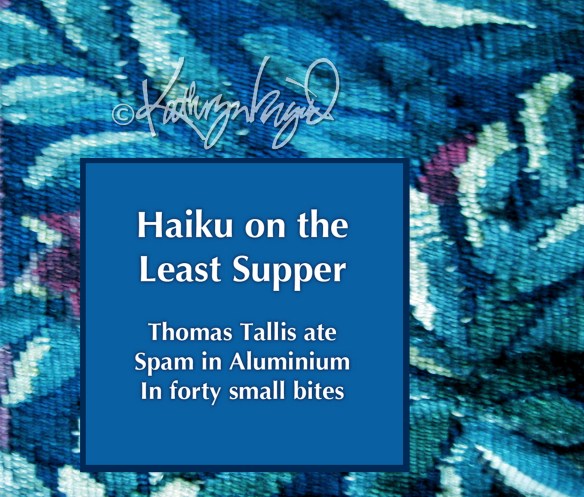
Digital illustration + text: Haiku on the Least Supper

If you haven’t already crossed paths with Thomas Tallis‘s landmark Renaissance motet Spem in alium, I highly recommend it. It’s a truly astounding piece of European music history, representing the confluence of the political and artistic competition for primacy in that time period; it’s believed to have been composed as England’s answer to Italy’s Alessandro Striggio‘s own, earlier 40-part motet, or possibly to Striggio’s 40-60 voice mass. I’m no musician, but I’ve learned, mostly through witnessing a few performances of the Tallis by different groups led by my husband and his colleagues, just what a feat this piece really represents.

While the creation of Striggio’s works for 40 and more independent voices is amazing in its own right, the 40-part motet he wrote specified that the voices be doubled instrumentally. That is impressive enough. For my fellow non-musicians, think of it this way: a typical piece of music for a mixed choir requires singers to perform different notes and lines of music, often at the same time, so that what is heard is not one single series of notes, one after the other the way we sing by ourselves, but layers of notes that become deeper and more distinctive expressions of the words being sung. Instrumental doubling means that some or all of the vocal parts are supported by one or more instruments “singing” the same notes at the same time. This can intensify the effect of that singer or section’s line, and it can sometimes also help a less skilled singer or choir stay on target with the line.

In any event, the more typical choral works tend to have soprano, alto, tenor and bass voice parts, or singing lines, (or some combination of those) and generally, not more than eight or perhaps twelve different lines intermingling at once. Anything more than that means that every singer in a moderate-sized choir is responsible for knowing and performing his or her own notes, on pitch, at the right moments, and with exactly the right loud-soft dynamics and flow at every point throughout the piece. Being in a choir is a thrill; being in a good choir is a real intellectual and artistic and even physical challenge.

What makes the Tallis Spem so incredible is that it comprises not only forty individual, fully independent singers’ voices all singing their own distinct parts of the song, but indeed, doing so entirely unaccompanied. Every one of the singers has to be spot-on at all times without the support of either a fellow singer or any kind of instrumental doubling. If one singer goes off the rails, there’s the possibility that others will be thrown off of their pitch, timing, or even their place in the whole work. It could well lead to a musical train wreck. Think you’d be intimidated by doing this? I think any sane person should be!

But it’s powerful stuff, when it’s well done. I’ve had the privilege of hearing this feat beautifully accomplished by singers surrounding me in a cavernous cathedral space, and by singers standing onstage in a modern performance hall with a carefully engineered acoustic. I’ve experienced it in art galleries where Janet Cardiff‘s intriguing installation of forty high fidelity speakers on stands are placed in a circle in the otherwise rather bare room, each playing in synchrony the recording of one of the singers in a performance of the Tallis, so that one can stand outside the circle or in the center of it surrounded by the speakers, or can move to stand at one individual speaker at a time, getting entirely different effects depending upon which part of the score is being performed and where one stands in relation to the speaker playing that part.

No matter how it’s done, once you’ve gotten a little of the idea how this piece of music intertwines voices that seem at first to be operating without a clear relationship but then, more and more, to be converging into a meditative, chant-like, layered song, it is quite mesmerizing. There are some recordings and performances out there on CD, iTunes, and YouTube worth a listen, and if you get the chance to visit the Cardiff installation, called simply Forty-Part Motet, do it. Best of all, of course, is if some fine choir nearby offers a live performance that you can attend. It’s rather haunting and ethereal, and made all the more impressive by the knowledge of its complex origins.

Meanwhile, I have given you this bite-sized humorous meditation on the work. A haiku seemed the ideal vehicle for acting as either commentary on or antidote to a choral masterpiece so complicated and virtuosic. And I sort of wonder if, in the process of composing this grand work, Mr. Tallis had any chance to stop for rest or was so deep in concentration that he barely had time to do the Renaissance equivalent of opening a tin of luncheon meat and dining directly from it, pen and parchment in one hand and dripping Spam juice on the other. Thankfully, it doesn’t appear that this effort of his was entirely detrimental, let alone leading to his personal version of the Last Supper, since he went on to compose other fine works up until nearer his death some fifteen years later.

The Great-Greats

Naming things is an endlessly fascinating and complicated way of creating and better understanding our relationships with them. Different cultures have even devised quite distinct ways of classifying and identifying the kinships within them, to the extent that families and relations in the different cultures affect the very ways people interact and consider themselves connected, responsible for each other, and much more.Photo: Great Great Grandparents

One of the appealing (or appalling) quirks, depending upon one’s view, of the American traditions of familial identification and the names given them in English is the way we use the word Great to specify layers of distance from ourselves. This photo, for example, is of one of my sets of great- and/or great-great grandparents (my maternal grandfather’s forebears), if I am not mistaken, and there is much to pique my curiosity in this image.

First, of course, is the question of whether I have identified them correctly at all. But then, in what ways—besides the nominal—were they great? Clearly, being among my ancestors is an easy in to that category. [Ba-dum-tsssssssshhhhhh!]*

Seriously, though, what distinguished these people? Safe to assume, from what little I do know of my relatives in Norway, these two lived on a small farm, and they worked hard. I mean, incredibly hard, by my standards. I’m inclined, actually, to think that the gent is my great grandpa and the lady next to him is his mummified mum, but having seen many a portrait from that era whose subject I was shocked to discover was eons younger than I’d have imagined, I can’t be sure. If this is a couple, I am extra, extra glad I have such a lazy and comfortable life. I may be no spring chicken, but I like to think that people will be able to tell whether or not I’ve already died, and when it does occur, won’t be able to make work boots out of my hide without tanning it further.

This could be the great-grandfather who was a tinsmith. A pretty skilled one, at that. The hands I see here could easily be tough enough to have put metal in its place. As for the farming, what little I’ve gleaned [enough with the shtick! I’ll try to behave myself]* from the various family stories and photos indicates that my family were subsistence farmers, growing what produce would feed their own households or be swapped with neighbors for  further goods, and raising enough sheep and goats, chickens and cattle to keep them in meat, eggs, hides and bones as needed. Agrarian life, until more recent decades, was generally a far more solitary and jack of all trades kind of existence. My grandmothers, great and otherwise (and I can only assume all of the neighbor women of this ancestress’ approximate vintage) did such work as probably made them all look equally leathery.

I would like to think that the sober, if not condemnatory, expressions in the photo sprang from the typical problem of holding still for the interminable exposure time a photograph required in those days, not to mention doing so while squinting in the sunlight. But I also suspect that a combination of that hardscrabble life of theirs and the grimly perdition-obsessed brand of religion to which many of my relatives have subscribed means that these two generally took life mighty seriously as well. They probably didn’t see so much to joke about or room for fun and games in their daily lives.

What I can safely assume about my relatives still gives me some hope. Obviously, they knew enough about how to survive and yes, thankfully, to procreate, that I am here generations later to tell the tale. I consider my existence a fine thing. Although they weren’t either wealthy or showy, they are dressed in well made, tidily kept clothing and lo, my mustachioed male relative even sports a watch chain, so theirs was not, even from the perspective of my privileged and cushy life, a torturous life of pure privation. So I don’t feel enormous existential guilt for their suffering. But I’m not inclined that way like they might have been, anyhow.

My late Norwegian relatives lived and labored in a landscape and climate rather like where I grew up in the American northwest, so I know that even if their daily work was hard they did it surrounded by beauty and nurtured in a mostly benevolent natural environment. They raised children who were able to go out in turn into the wider world and make their ways, eventually finding own their paths, making their own livings, and raising their own families, and eventually crossing many mountains, borders, and seas. I think all of this a fine, if modest, sampler of human existence with [dang it, I just can’t help it!]* relatively little grand tragedy or overblown drama. Most of all, I am glad that the long-gone beings who posed for this rather inscrutable image contributed to the production of a line of pretty good folk, culminating in my immediate family. That’s greatness enough for me, and makes me very thankful indeed. Happy Thanksgiving, my friends.

Dirty Jobs, but Never Done Dirt Cheap

The world is truly full of overlooked and underpaid laborers.
Photo: Housekeeping Cart

This is a story as old as human community, and yet it’s notable how little it’s changed. The ugliest, dirtiest, the most physically demanding and unpleasant tasks, the ones that no one in his or her right mind would usually choose to do, let alone without any recognition or reasonable pay, these jobs don’t cease to exist because nobody likes them. They simply get done by people who have no other choice. And do we thank them for it? Do we give them public honor and paychecks commensurate with the knowledge and patience and back-breaking effort and yes, specialized skills that are required of them?

You know the answer. In this country, we spend more time and energy on vilifying the working poor as nuisances and a weight around the necks of their higher-taxpaying richer neighbors, at best. At worst, we accuse them of criminality, many of coming into the country illegally—which they may well have done—to snatch bread from the very lips of our own better educated and better protected children through their stealing jobs from the local citizenry. Which, of course, they rarely do, considering that neither we nor said children are willing and able to do without the jobs that the working poor do for us, let alone perform those tasks ourselves. Never mind that those we abhor for daring to come across the nation’s borders unseen are doing precisely what the vast majority of our own ancestors did, and out of the same desperation for survival, but now with the additional barrier of laws designed more out of fear and hatred than out of specific plans to better the safety and welfare of any of the parties involved.

If immigrants could remotely afford the risky business of taking a national day of “working poor flu,” the way that unionized workers go on strike or recognized organizations march in protest, just imagine what that day would look like across the United States. I don’t begin to think that there’s an easy solution to the problems of regulating this country, protecting individuals and the nation from the very real danger of criminal activity and the bane of individualism gone rogue. The latter being, in my opinion, a far larger risk to the rest of us from among native-born citizens who take their American privileges as the right to do as they please, even by force and against US governmental “interference” with their personal sovereignty. But I can’t believe that the draconian and targeted proposals many suggest these days are the right solution, either.

Let our internal renegades, our legal complainants against immigrants, and all foes of the “lazy” or “problematic” working poor themselves take up the labor and care required to ensure that every one of their fellow Americans has enough food to eat, education to navigate life and progress beyond restrictive ignorance, health care to prevent the spread of diseases and unnecessary pain or early death, and a safe, clean place to sleep without fear of exposure to the elements, destruction of their environment, or unfriendly intruders. Then I might start thinking we can narrow the gates to allow in only primly approved new neighbors able to contribute equally to the cause. Or would anybody out there like to see what happens on that imagined Flu Day, when all of the orderlies, cooks, construction workers, landscape maintenance crews, sanitation workers, child- and elder-caregivers, and all of their fellow underpaid workers lay down their tools and lie down on the job for even 24 hours?

I surely don’t know the solution to any, let alone all, of the problems that roll up into this one massive puzzle we have sitting on our doorstep. But I know that I will try to do better at giving proper respect and thanks, and a hand up when possible, to anyone who does what I can’t or won’t do myself. My life depends upon it.

Rasputin Whispers & We All Succumb

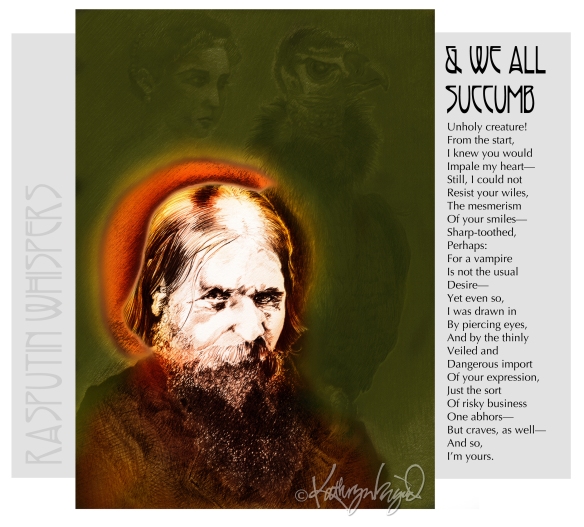
The spookiest thing about Halloween? That its frights and frissons are based on a simple and scary truth: we humans are the source of the villainies that pose the gravest dangers to us, as well as being the easiest mark for them. Be very afraid!Digital illustration + text: And We All Succumb

Hot Flash Fiction 13: Eternity Beckons

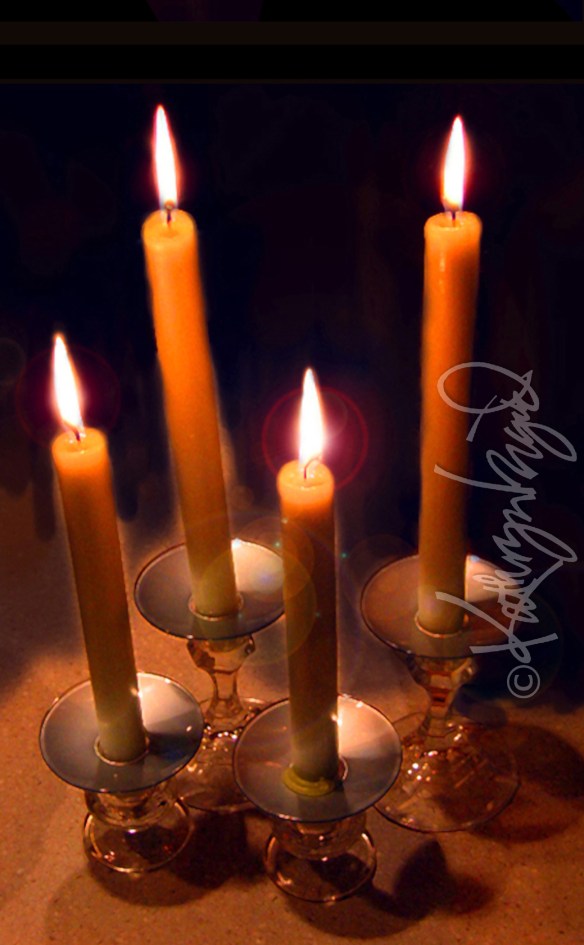
Photo: Science by CandlelightEternal life has always been the masters’ magnificent goal; no wonder that great magister and alchemist Osteodaimon was also determined to solve this elusive mystery himself, to plumb the Stygian depths of knowledge collected by the most piercing minds and intrepid souls ever to walk this dangerous earth. He began with years of reading, apprenticeship, exploration, privation, and experimentation. What Osteodaimon learned most quickly was that the process of becoming immortal was in fact incremental; it was a long series of tiny steps and grand leaps, of fallings-backward and soaring upward, all of which took him through both his long and arduous life of study and also a few strange periods of stasis, in which, all told, he began this mystical transformation of his into one truly able to transcend death. Many and terrifying were the missteps and passages, rites and elixirs, incantations, and the heart-shaking, wrenching feats of bravery and agility required of his profound intellect and the ever-disintegrating body that sought answers from that abyss.

One winter’s night, when he had traversed the grueling routes both between his birth and the ninety-two cycles of the seasons that already marked him as uniquely time-defying by his ancient era’s reckoning, and between the smoothly un-furrowed innocence of youth and his avidly acquired brilliance, he recognized in the ice crystals forming along his lashes the last increment required to complete his journey. Carrying the tinctures and potions that would preserve his last bits of mental and physical strength for the ritual, he set forth in the falling snow and moonlight to go farther into the frozen wilderness than he, or anyone, had ever plunged before. He began to notice as he went forward that the slower he moved, the faster the vastness of ice seemed to recede before him, until it was clear that his pace of progress was directly opposed by the increasingly swift passage of time. He knew that his own final breath was hardly a hairbreadth ahead of him, racing both toward him and away, and that only by letting the speed of it catch up with the glacial slowness he himself was approaching, at exactly the right juncture, and by taking the last dram of his precious medicine at exactly the same instant, could he affect the perfect circumstances for his final transformation.

Osteodaimon finally marked the spot. He lay down on the bottomless swath of blue-black ice, took the last draught of his alchemical magic into his gaunt grey mouth, and stopped. He became fused to the ice there instantly, his eyes made into a pair of wide, dull mirrors for the relentless moon and faded stars of perpetual polar night.

When he returned to himself and forced his eyes to focus again, his vision was oddly fragmented, and he sensed that he had drifted from his last stopping place far more than he had imagined he would have done. But the new place, also moonlit and cold, was pleasant enough, and he knew that soon his vision would clear and the slight buzzing in his ears would pass as he regained his strength. His sense of physical power, indeed, astonished him immediately as it returned; it was not only as though he were young again but as though he had new and exhilarating powers that would easily surpass those of his remembered early years, when he had labored so mightily in his pursuit of conquering death. This new Osteodaimon was a super-being to be reckoned with, and he took off at great speed to see what he could now accomplish in this next passage of his life.

It startled him how quickly he was able to go from place to place, how he seemed now to see things from so many new perspectives and rarely wearied of dashing about, looking, stopping to sup cold water or wine, or have a little food when he chose, but endlessly pursuing the delights of his renewed life. We cannot be sure, for history has failed to record all of the details perfectly, but it may be that it was only a matter of days, or at most weeks, before he realized that he could no longer read.

This proved a surprising disappointment that he would attempt to address soon enough. Not quite soon enough, perhaps, that he was ever able to learn the story of how, in A.D. 1867, a small group of botanists on the steppe discovered a perfectly preserved man encased in ice at the edge of a receding glacier. How the intrepid scientists chiseled their magnificent find out of his tomb in a manageable block and labored to drag it back to their fledgling university by sledge and wagon and train. How they built an ice-house museum room for the express purpose of preserving and examining this amazingly lifelike ancient man. How, one awful night in 1871, the city and that little-known museum in it were consumed by fire. How the ice-entombed mystery man had been spared cremation himself only because the conflagration had taken so long to melt his ice block that he remained weirdly, wonderfully intact, his eyes dully mirroring the moon once again.

Surely Osteodaimon could not have learned how to read again even in time to make sense of the tale that followed, of the chaos after the city’s destruction that prevented anyone from having further sightings of this miraculous time-traveler that had so clearly been the earthly form of the great magister and alchemist himself. Even if he had been able to read again, there would be no document to explain that his ultimate disappearance meant neither that he had finally ceased to exist nor that his old ideas of perpetual life being possible were entirely incorrect, for in the days and weeks immediately following the Great Fire, there was far more concern for removal of dangerous debris and rescue of injured and homeless known victims than for tidying up the remnants of an obscure museum. Had there been a witness to record it, there might have been something that Osteodaimon could hope to learn to read, something telling him that his thawed remains had rotted in the post-apocalyptic drear of an abandoned building, showing no more activity than the usual decay and natural recycling would show.

He might also, of course—had he been able to read it—thought that perhaps the early philosophers and proto-scientists were not entirely wrong but only slightly misdirected in their belief in spontaneous generation. For he would have found in the documentation of the ice-man’s progress that feeding on his mortal remains had been the usual generation or two of avid creatures that led to his emergence, eventually, as revivified carbon in the form of a blowfly. Once alive, always alive, but not, perhaps in precisely the way he had long imagined it.Digital illustration from photos: From Here to Eternity. Maybe.

A Plague on All Our Houses

Even the most steadfastly unquestioning among believers in various versions of mainline religions will allow that, if their deity cares for them as a shepherd cares for sheep, their own religions, yes, even their own temples, mosques, and churches, sometimes harbor wolves in sheep’s clothing. Partisans of every political and philosophical school of thought have seen the unmasking of many such monsters that have hidden behind the guise of goodness and faithfulness, selflessness and judiciousness, or at least experienced the dire effects those have on the lives of the truly committed. There are reasons most languages have such large inventories of words like heretic and traitor, infidel, apostate, renegade, impostor, infiltrator, double agent, betrayer, and hypocrite.
Digital illustration: A Pox on Both Your Houses!

So it astounds me every day that such experienced, otherwise reasonable people are either afraid, or simply refuse, to regularly and thoroughly question and examine the sources of their information, whether they are people or inanimate forms of evidence. Even among the most dedicated, wise, and well-meaning persons the human flaws we all bear cause mistakes and missteps. The most widely accepted proofs of truth may have come about by means of equally imperfect human study and the telephonic accidents of human transcription and translation. No matter how inspired the origin of the wisdom, it can’t be guaranteed to get to the page and from hand to hand, meeting to meeting, one end of the surprisingly not flat earth to the other, without sometimes being misinterpreted or co-opted, whether it’s by the false sheep in the flock or by our own good intentions.

All I can say is that if such stubbornness against rigorously examining our beliefs and every source of them is at its roots a terror of self-examination, we are doomed. We will forever repeat the grim side of human history, by acting out of doubt, cowardice, and ignorance, assumptions that have as much chance of being incorrect as not, and hidebound inability to see the wolves in our very midst for fear of discovering our own culpability. Circling each other with rapiers drawn and fighting to uphold traditions or beliefs or codes that we have so ingrained that they are unquestioned no matter how wrong, we will only deserve the curse of Shakespeare’s Mercutio—who, by the way, may or may not have said “A plague a’ both your houses,” in the original text, but various scholars over the years have guessed at such a reconstruction of it. Even Shakespeare, that demigod of English literature, is only as reliable a source as the many readers and interpreters since his time can determine, assuming that there was one playwright and poet of that name and not, as some believe, some cadre of the great literary minds of that era. Don’t get me started.

I will say right out that I know full well that I am guilty of being poorly or misinformed on a host of topics, and a stubbornly slow learner on top of that. I am trying, however I may stumble along the way, to grow beyond such ossified thinking. If only we could all begin with the premise that the fault might be not in our stars but in our selves, I think we might discover that our reliance on incomplete or incorrect information puts us constantly at risk for inner and outer conflicts we ought to have laid aside or, better yet, avoided altogether. The Other Guy might in fact deserve a listen, and acting first, asking questions later is not a conversation but is likely instead to end in swords crossed and lives lost. Acting in haste or acting in hate, the result may be the same because we were ill prepared to ask the right questions, let alone come to a wise and humane conclusion as a result. There are, sadly and unquestionably, baddies among us. But even so, if we all insist on clinging to our own versions of the truth without regularly and rigorously questioning their verity, then the attack we are all under begins inside, not from any external enemy, real or imagined.

Foodie Tuesday: A Balanced Diet

Photo montage: Fun with Fruit & VegetablesI appreciate good health and all of the dietary elements that can determine whether I’m healthy, and if so, just how healthy I am. I know that diet includes not only the things I eat but how I combine them, when I eat, how much I eat, and many more factors that interact to create the ever-changing state of good health I seek. I realize, too, that nutritionists and scientists and other dietary mavens are always learning new things, and nearly always getting new ideas, too, some of which they can prove and others, not so much. That doesn’t stop tons of people, including me, from becoming obsessed, however temporarily, with the latest dietary trends and tweaking our diets without always considering whether those new, however ingenious seeming, ideas have anything to do with how our own bodies operate best.

Huh.

Yeah, I’m always thinking of new and better ways to make my diet more seemingly ideal for me, and I have some goofy thoughts on the subject at the best of times, and that’s the truth. What I can say in my defense is that among the relatively few things I have managed to learn in my lifetime thus far is that there is a whole lot more involved in my health and well-being than food.

I love when I can find the balance I need in any day by eating when I’m hungry, stopping when I’m no longer hungry, and focusing on getting not only a reasonable apportionment between protein and fat and carbs and vitamins and minerals and all of that dandy stuff. I love when it’s satisfying to my taste buds as well. Most of all, I love when that’s all fitted into a balanced diet of being with loved ones, going wonderful places, learning new fun things, and not least of all, of making art. There are always going to be theories, guides, charts, Rules and expectations about what constitutes the ideal way to eat, from the old spa cures that had people eating nothing but blandness or drinking rather large quantities of vinegary-dry white wine to the FDA-approved Food Pyramid, to the various independent dietary regimes from Scarsdale to South Beach, from Paleo to the Perfect Health Diet. I’ll outlive some of them, and many more will follow me. My budget and schedule, my taste preferences of the moment, and the company I keep, will continue to change my dietary wants and needs as well.

As long as I can keep listening to music, writing and drawing, and surrounding myself with great and interesting people, I will feel well fed.

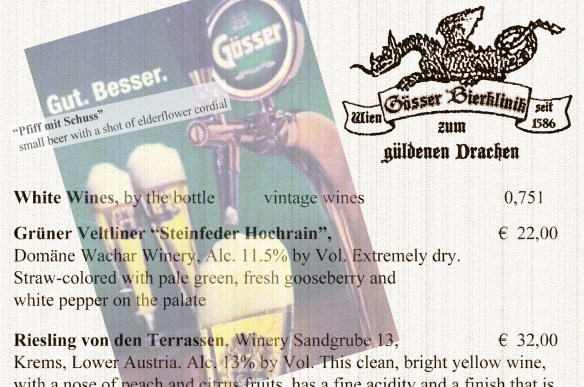
Photo montage: Another Balanced DietI need to tell you that there’s one sure way to have just the right diet, at least if you happen to be me and visiting Vienna. You just wend your way down a couple of funny little narrow byways and find the welcome that waits for you behind the door of the Gösser Bierklinik. That’s right: a clinic dedicated to beer. If that doesn’t make you feel better, you don’t know a healthy diet at all, wink-wink. Hail, Austria! It’s really a lovely old, old restaurant—don’t miss the neatly labeled Türkenkugel, the cannonball reputed to have been shot into the place in 1683 and still enjoying the pride of place where it sticks out of, or into, the wall.Digital illustration: Bierklinik Highlights

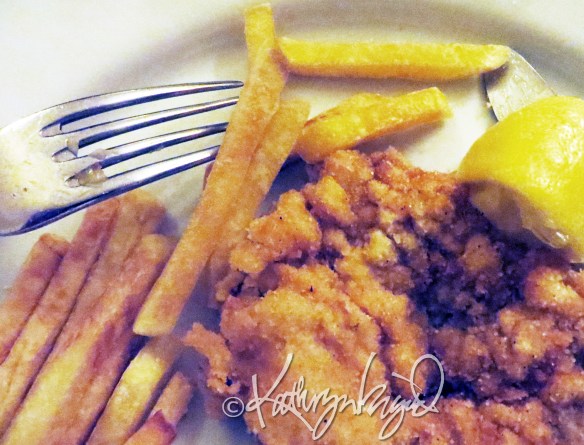
But don’t get hung up on ancient history too much, or you will miss out on one of the best Wienerschnitzeln I’ve had anywhere, and I am a fan, so I’ve enjoyed a few. The Bierklinik’s is tender inside, lightly seasoned, crispy on the outside, and unadulterated with anything other than the requisite lemon wedge for squeezing a drop or two of extra sunshine on it. Fabulous. Combine that with some ordinary but blazing hot fries and a bracing drink of anything from water to the titular beer, to what our server assured me was the ‘ladylike’ way to have a beer, a Pfiff mit Schuss, or beer spiked with elderflower cordial—I can’t speak to the waiter’s assertion, not being so incredibly ladylike myself, but it was a light and sprightly accompaniment to the Schnitzel, and given the perfectly convivial group with whom we were dining on the evening I tried it out (my husband and I were with three delightful friends, but also joined eventually in conversation with the marvelous German couple and his parents who were sitting at the next table), it was no more, and no less, effervescent than the conversation. Schnitzel, fries, a good drink and excellent company. Sounds like a perfectly balanced diet to me!Photo: Gösser's Schnitzel


Enemies Within

Digital illustration from a mixed-media drawing: The Enemy WithinThe problem is not entirely what you have so keenly observed, my pretentiousness, my overblown supply of self-esteem; it’s not my ignorance, grand in scale yet constantly masked (I think) with all sorts of follies and falsehoods. It isn’t merely my innate streak of meanness or my cowardice or my determined inability to be truthful. All of these, I can’t deny it, appear so often as assets in unworthy hands these days that I’m drawn to them like a desert wanderer to a well of eternally cold water.

So little do I care for the consequences of any act that I never consider Whether or Not to do it, only How Much. What effects it may have on anyone else are as nothing to me, when after all, no one else exists on my plane. If this world can be a wicked place at times, full of sins and flaws that are rebranded as business acumen and charismatic charm, don’t blame me that they’re beginning to seem admirable.

What is nagging at you as the problem, really? That these iniquities have a certain appeal to you as well? That they might not be considered dangerous until there’s no civility left to compare them to, perhaps? Or that they may finally not even be considered at all?

Stars Everywhere

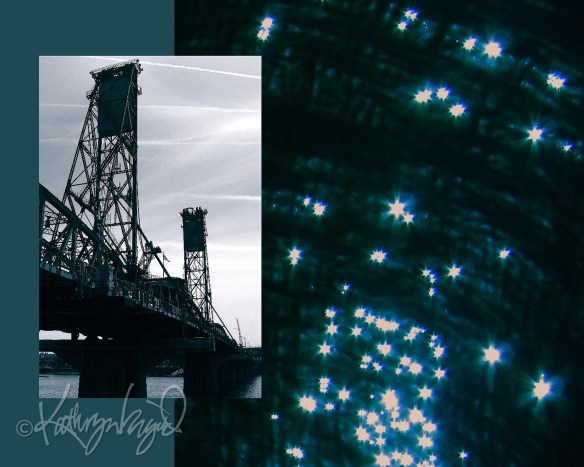
Photo montage: Stars in the DarknessThis world is a dark place. War and strife, fear, hunger, hatred, greed, self-righteousness, and poverty gnaw the bones of suffering people on every continent at every hour. And all of these menaces are, in accordance with early expressions of the idea of Tragedy, nearly entirely the making of our own species.

Little hope, at least in my mind, of that sorrowful truth changing as long as our species continues to dominate the planet. We are deeply flawed. Even the finest among us tend to forget themselves and their mortal limits at time; regardless of how educated, high-minded and genuinely well-meant their attitudes and actions may be, it’s sadly true that underlying those attitudes and actions is a firm belief in their rightness. Only natural that it’s hard, from that perspective, to allow that others might have an equal possibility of being right, or at least as wise and well-meaning, as they themselves are, and to show them the full respect of that acceptance.

What, then, of accepting life among my fellow flawed beings in this imperfect world? No comfort is found in denial or in persistently, aggressively resisting what may not have the possibility of ever changing. But to accept this grimness as an eternal truth and let it lie like lead on my soul is no help, either.

I look to the stars.

Physical stars exist in a surprising number of places, many lower and commoner than the depths of the sky, and I look to them and rally as I realize that they stand, every one, as beacons reminding me of what is good not only in the nature in which we imperfect beings live, but what is good within us as well. Small as our fineness may seem, individually and corporately, at times, it does exist, and if there is to be any hope of overcoming the dark, it must come from the nurturing of every little glint seen starring that darkness.

I look to the stars in the indigo distance of the sky, sparkling like promises of better things as they look back at me. I look to the lesser stars of reflected light that dazzle on earth, the  diamond dashes on every body of water and glimmering in every eye, never mind among real gems and the many things made expressly to be beautiful and good and positive. I look, more than anywhere else, at the multitude of stars that shine from the hearts of good and true people, people who are thoughtful and generous, merciful and hardworking, and kind and loving, sometimes despite and against the dark things of this world, and often, wonderfully, for the sole reason that they were made to be such earthly stars.