
Namaste.
Namaste.
Christmas day means nothing at all to a whole lot of the world. Even some fairly devoted Christians are either skeptical about the accuracy of modern guesstimates of when the historical person Jesus appeared on earth or, in some cases, just plain weary of the commercial kidnaping of Christmas as a secular holiday. Beyond that, there are innumerable people and nations so impoverished or endangered as individuals, as communities, or as entire regions of the world that the last thing they can afford to pay attention to is an arbitrarily set date for recognizing anything as a reason for joy and revelry.
There are no gladly clashing cymbals, no brass choirs trumpeting their huzzahs to the skies, no parades or packages, masses or meditations that can fill the void in hearts and homes oppressed by war, famine, disease, hatred, or inner turmoil. The very thought of happiness and reverential bliss, if it can even pierce the noise and violence, the stress and terror holding such people hostage, seems hollow and artificial. Goodness and light are as distant and unimaginable as the most ridiculous fiction.

These sufferers deserve to have their sorrows and their pains lifted from them, obliterated by any and all who dare to change history. No one knows better than I that not everyone has the strength and wherewithal to be so bold in action. But if we cannot do so with our physical labors, we must do so with our hearts and minds, our words, our plans, and our constancy in spirit. One voice at a time, one solitary note sung by a tiny, quavering voice, is the only way to begin moving toward a day when others, also one by one, will join and build to a worldwide song of peace. Only when we direct our every breath toward healing, harmony, and hope will the song come fully alive. Every atom of our being will whisper, speak, sing, and shout until the whole of humanity rings with echoing gladness.

One moment’s pause, one hour of cease-fire, one hospital patient or lost child or elderly neighbor rescued for one single part of a day at a time makes space for the sound to bloom. We need to make room, and lest the horrors should return to fill the void, we must fill it up instead with songs of hope and joy and celebrate any way we possibly can. The other voices will someday, if we sing for long enough, follow.
 One person who hates is a Weapon of Mass Destruction. One who cares and shares? Perhaps the only antidote.
As I recently said to my friend Maryam: poverty—both of concrete, material resources like food and shelter, and of intellectual and ephemeral resources (education, spiritual enrichment, the arts, community engagement, etc)—seems to me to be perpetrated and perpetuated more by selfishness than by an actual shortage of any of those resources. The rich and powerful always want more riches and power, and what they do have makes them able to afford and acquire more and to keep their feet firmly on the backs of the have-nots. Plenty is never enough. The resulting imbalance is as old as history, and rotten as ever. Only those who will speak up and resist entrenched inequities and injustices will have any hope of making change.
The badger and the wolverine have a reputation for being among the most tenaciously savage brutes of all the mammals. Yeah, Honey Badger even has his own meme to show for it. But let’s be honest: no beast of earth, air, or sea has a capacity for vile, rapacious cruelty rivaling that of the human animal. Even creatures of the natural enmity of predator and prey compete, fight, kill, and are sated. They have little apparent ideation of hatred and war to match people’s. A wolverine or badger will fight to defend, or to kill for food, but unlike the human, doesn’t seem inclined to attack indiscriminately outside of its primal needs for safety, shelter, and food; when the skirmish is done as efficiently as possible and the need assuaged, the sharpest of tooth and reddest of claw among them doesn’t do an end-zone dance to celebrate its pleasure in winning but will usually depart the scene or go to rest for the next time of need. The remaining food and shelter and other resources stay in place for whatever creature comes next, hunter or hunted, cousin or not.
Can we humans not learn from such a thing? I’m pretty sure that if we destroy each other and ourselves in our constant self-righteous, self-congratulatory belief that we deserve everything we can get our hands on, Honey Badger won’t be the only creature that doesn’t care.
 “Prepare for the worst but hope for the best.” It’s part of my credo, I guess, and may well have been aided in its development by doing those hilariously futile duck-and-cover atomic bomb drills of the Cold War era. And the air raid drills—we lived in a Ground Zero area near several military bases, strategic coast, and a handful of Nike missile sites in those days—fire drills, earthquake drills, tsunami drills, and later when we lived in the midwest, tornado drills. You’d think we’d all have grown up incredibly paranoid after such stuff in childhood. But I think that besides being remarkably resilient, kids use logic on such daily puzzles far better than they remember how to do when they hit adulthood and have been taught their prejudices, and are much more easily distracted and blinded by grey areas.
I don’t remember ever believing that crouching under a flimsy little wood-and-steel desk would save me even from the shrapnel of shattering windows and imploding walls in the event of an attack or large-scale disaster, particularly since I imagined the desk itself would become shrapnel along with everything else in the atomizing roar of a bombing. Little and naïve though we were, we had gleaned hints of the enormity of such things from our beginning school studies of the world history of war (skewed to our own culture’s view, of course); no matter how grownups think they’re shielding kids by sanitizing and limiting the information the wee ones are allowed to see and hear, children are quick to notice the blank spaces where redacted information interrupts the flow of facts, and no adult is more curious than a child to hunt for clues as to what was redacted. Frankly, if there really is any use for an institution like the CIA in this day and age when practically anyone can find out practically anything with the aid of easily accessible tools like the internet, cellular phone, and, apparently, privately owned drones, along with all of the more traditional tools of spy-craft, I suggest that the crew best equipped to uncover any facts not in evidence would probably be a band of children all under the age of about twelve.
Meanwhile, we still have large numbers of people who think it prudent to withhold or skew the information passed along to not only kids but even fellow adults, giving out misguided or even malevolent half-truths or remaining stubbornly silent and in full denial about things considered too dark for others’ knowledge. And what do we gain from this? Are there truly adults among us who still think that even smallish tots can’t quickly discern the differences between a fable or fairytale, no matter how brutish and gory it may be, and the dangers and trials of real-world trouble? Does delusion or deception serve any purpose, in the long run, other than to steer us all off course in search of firmer, more reliable realities?
As I just wrote to my dear friend Desi, it seems to me that the majority of humans always assume a fight-or-flight stance in new or unfamiliar circumstances before allowing that these might be mere puzzles to decipher, and more importantly, we assume the obvious solution to be that whatever is most quickly discernible as different from self IS the problem. Therefore, if I’m white, then non-white is the problem; if I’m female, then male. Ad infinitum. And we’re generally not satisfied with identifying differentness as problematic until we define it as threatening or evil. This, of course, only scratches the surface—quite literally, as the moment we get past visible differences we hunt for the non-visible ones like sexual orientation, religious or political beliefs, and so on.
Unless and until we can change this horribly wrongheaded approach on a large scale, we’ll always have these awful problems, from petty playground scuffles right into the middle of the final mushroom cloud. The so-called justice systems of the world are set up and operated by the same flawed humans who make individual judgements, so the cycle is reinforced at all levels. Sometimes it truly makes me wonder how we’ve lasted this long.
Can we learn from kids? The younger the person, the more likely to blurt out the truth, whether it’s welcome or not. The subtleties of subterfuge are mostly wasted on children, who unless they’re engaged in happy storytelling for purposes of amusement and amazement, would rather be actively puzzling out the wonders of life than mucking about in search of evasive answers and duck-and-cover maneuvers. We might gain a great deal by reverting a little to a more innocent and simplistic view of the universe, one that blithely assumes that others are not always out to get us, that direness and doom aren’t lying open-jawed around every blind corner, and that the great powers of the internet and cell phones might just as well bear cheery tidings of goodness and kindness, and drones be removed from deployment as spies and weapons to work instead at delivering birthday presents to friends and packets of food to hungry strangers.
I’m not fooled into thinking any of this is easy to do, any more than any savvy kid would be, but I’m willing to believe it’s possible if more and more of us will commit to such ideals.
The only time I’ve ever been on a sailboat was to sleep. There’s a great Tall Ship converted into a youth hostel in Stockholm where my sister and I bunked for a couple of nights on our college gallivant across western Europe. [Which hostel appears to have been recently renovated, and very nicely, if any of you should be interested.] While there may have been the faintest of motion rocking us to sleep in our on-board berths, I doubt it replicated very accurately the sensation of actual sailing. My next opportunity was during graduate school when I got a fan letter (one of the very few in my life, as you can imagine!) from a stranger who’d liked a gallery art installation I made so much that he offered to take me out sailing to the nearby islands. I don’t think there was anything predatory about him, but besides my still having a grandiose case of social anxiety in those days, there is the fact that the art show in question was entirely a walk-through, life-sized illustration of an espionage thriller; while I am doubtful that was his inspiration, I didn’t take him up on the offer.
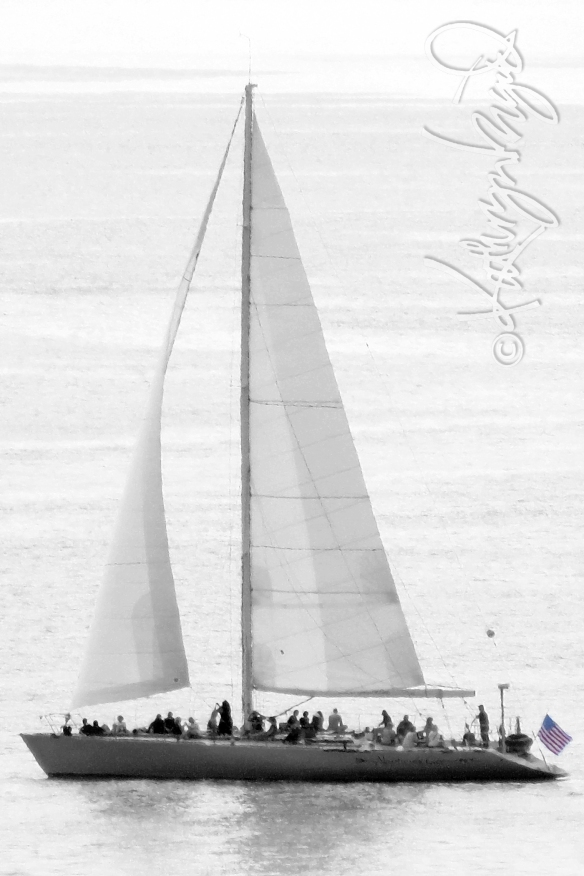
But whenever I see a sailboat, I do think it’s a beautiful representation of a genteel form of freedom that captivates my imagination all the same. Yes, I know plenty of tales of grueling trials on the high seas, no matter the size of the craft; even some of my close friends and relatives have such stories to tell, thankfully, having survived them. And I know, too, the old joke about testing one’s real interest in boat ownership by dressing up in a rain slicker and standing under an ice-cold shower for a couple of hours while flushing hundred-dollar bills down the toilet. But I also know that a vast number of people who could jolly well choose to spend their money and time on less demanding, safer, and far less expensive pastimes still choose boating. There’s clearly a strong pull to counterbalance any such negatives.
I, too, have spent some happy times on boats, just not sailboats. As a coastal kid, after all, I grew up thinking time spent on the ferries was as much pleasure and sightseeing as it was commuting or transport. I have been fairly miserable on a North Sea ferry in stormy seas while I was recovering from the stomach flu, but it did not so permanently scar either my psyche or my stomach lining that I didn’t look forward to the next time I got to be on a slow boat cruising along the shore, or perhaps best of all, in a rowboat or canoe, dipping the oars or paddle in with the rhythmic soft splashing that accompanies my reveries.
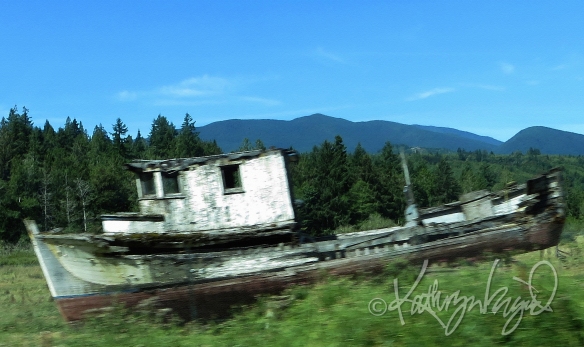
Living far from any natural body of water as I do these days, I am beached like an old craft whose hull is no longer seaworthy. But like those old boats I see, dry-docked on the beach or alongside the tumbledown barn or in a weedy field, I keep in my soul a firm and loving memory of every good time spent with the waves rocking me softly from below, telling me stories of their own and inviting me forward, ever forward, wherever that might take me.
Bravery is a rare commodity. Many people who think they’re being brave only dare to do so from within a like-minded group, however small in number, and when they are genuinely in the minority spend more energy on protesting that the majority from which they’re excluded is unfair and unjust than on doing anything useful to change it. It may be true—knowing human nature, often probably is true—that one’s opposition is no exemplar of justice and fair-mindedness. But we’re seldom willing or able, ourselves, to make a cleanly balanced assessment and especially, to act wisely and compassionately on it either. We’re generally convinced that anyone else having anything good means less goodness for ourselves, and that that is a terrible thing.
What impresses me more than bravery, real or imagined, is seeing anyone express real empathy for others through their own beliefs, lives, and actions. I tend to doubt that we’re capable of doing or even wanting very lofty things, but I also think that small doses of empathy will go ever so much further than any amount of derring-do and action-figure heroics in bettering the world and the human condition within it. Daring to let another person be richer or more privileged than me or to have the last word, even when I’m fairly sure I’m smarter, closer to correct, or more deserving requires quite a different sort of courage than running into danger in anyone’s defense or their stead.
But treating others with such respect seems to me far more likely than argument and defensiveness, self-protection and fear, to get anyone to trust and respect me in turn. So shines a good deed. The unselfish willingness to accept another person’s reality as valid even when it might cost me something significant is a kind of courage I dream of having, hope to learn.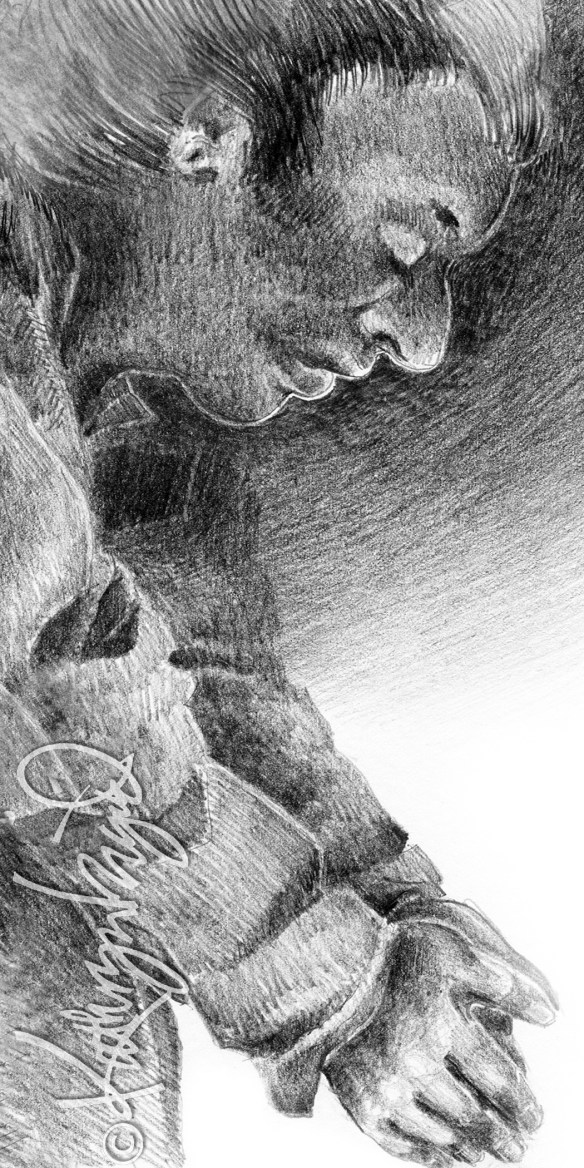
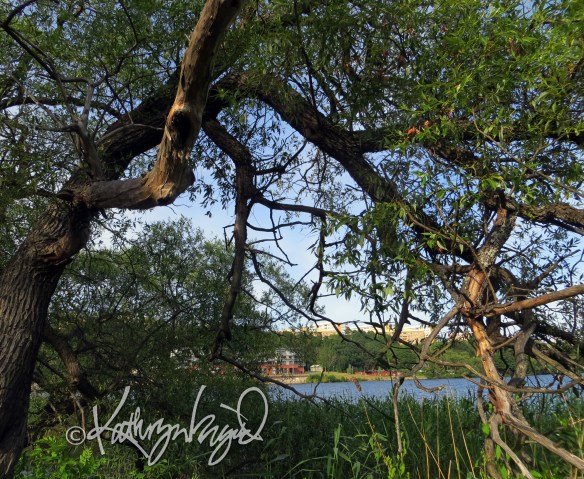 Under the Willow Tree
Under the willow tree, her shade my calm,
I see so bent by storms her trunk, how far
The winds have twisted every limb, each scar
Where lightning struck; yet there’s a quiet psalm
Of gratitude that whispers in her leaves
Each time another rainfall comes to spend
Its quenching kindness on her and to send
New hope down deep—for anyone who grieves
Or wonders how to pass through life’s travail
Finds shelter in her shadow—knows the limbs
That seem to weep are only singing hymns,
Embracing in their gentle sway the frail.
So one fine sapling, tended with such care,
Becomes the home for all who shelter there.
And now her roots are deep, her branches wide
Enough to draw more birds to them to nest,
Assured, secure and loved, and full at rest,
No matter what the world is like outside—
Just as I am, beneath the willow’s arm
Of graceful comfort, grateful for her wise,
Kind lesson to look upward to the skies
For blessed rain, and sun to keep us warm,
For sweet reminders of the Gardener
Who made the willow grow, and gave her strength
To nurture others in her shade, at length,
Upon the graces planted there in her:
So one fine sapling, tended with such care,
Becomes the home for all who shelter there.
 Thank you, Mom, for the nurturing, the love, and the will to live as an example of bending but not breaking in the storms. Happy 80th Birthday!
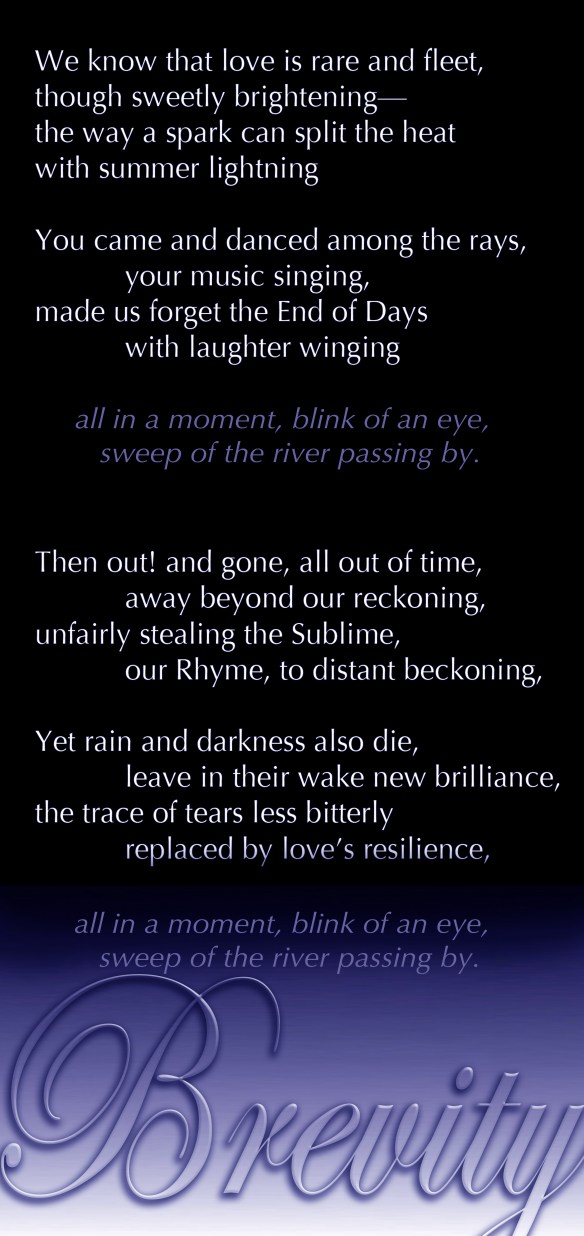 Just because there are designated days (All Saints, Memorial Day, Defence Day, Anzac Day, Volkstrauertag, Poppy Day) for recalling those we’ve lost doesn’t mean in any way that we restrict our respectful, loving and admiring remembrances to those days. Those whom we hold in our hearts remain there, living or not, forever. That’s our path to peace.
The guarantee that we will die, and that all of those we hold dear will die too, means we will do best by finding ways to embrace and recall, most of all, the good and the uplifting things from their lives and ours, and expand on such things for the sake of our finest predecessors’ honor, if not our own.
This is a day designated by the Christian church for the remembrance of all the good, fine people who have lived, illuminated our lives, led the way for the rest of us, and now are also gone before us in death. Recollection, commemoration and admiration of those who have lived as great-hearted souls on the earth and set an example, large or small, of excellence for those of us who follow is, I think, a practice that anyone of any stripe, religious or not, can embrace; we are certainly all made better by such meditations, especially if and when we are made stronger by their guidance to follow in our honored loves’ radiant footsteps.
Spending a day in remembrance of loves lost is bound to be bittersweet, of course. When the bond has been close in life, it remains so in death, and however the pangs of loss may subside over time, on a day devoted to thoughtful recognition of our trusted and beloved friends, mentors and avatars of all things great and good, the pain can be as sharply new again as in the first sweep of sorrow. But if I am genuinely mindful and respectful of their gifts in life, I think that this can be transformational and healing and comforting, too.
Can I live as a reflection of my most-admired angels? It’s too tall an order for any ordinary mortal, I know. But that’s exactly why I think we have these living and loving models among us: to show that in community and mutual, loving support and with determined and patient growth on our own, greater things can happen than if we try to do significant and meaningful things independently. We are raised up by the waves of support around us. How can I not be grateful for that! This realization sweetens the day perceptibly. Do I wish that I could have my lost loves back again? Who would not! But I wouldn’t trade one tear, one iota of the hurt and anger and grief I’ve felt over any of their losses, to miss out on recognizing the beauty and joy and brilliance that they brought to this world in their too-short tenure here, and I know that some lights seem so bright in life that they can blind me at close range to what’s more easily discerned, when seen from this greater distance, as having the distinctive shape of an excellent soul.
Even the most steadfastly unquestioning among believers in various versions of mainline religions will allow that, if their deity cares for them as a shepherd cares for sheep, their own religions, yes, even their own temples, mosques, and churches, sometimes harbor wolves in sheep’s clothing. Partisans of every political and philosophical school of thought have seen the unmasking of many such monsters that have hidden behind the guise of goodness and faithfulness, selflessness and judiciousness, or at least experienced the dire effects those have on the lives of the truly committed. There are reasons most languages have such large inventories of words like heretic and traitor, infidel, apostate, renegade, impostor, infiltrator, double agent, betrayer, and hypocrite.

So it astounds me every day that such experienced, otherwise reasonable people are either afraid, or simply refuse, to regularly and thoroughly question and examine the sources of their information, whether they are people or inanimate forms of evidence. Even among the most dedicated, wise, and well-meaning persons the human flaws we all bear cause mistakes and missteps. The most widely accepted proofs of truth may have come about by means of equally imperfect human study and the telephonic accidents of human transcription and translation. No matter how inspired the origin of the wisdom, it can’t be guaranteed to get to the page and from hand to hand, meeting to meeting, one end of the surprisingly not flat earth to the other, without sometimes being misinterpreted or co-opted, whether it’s by the false sheep in the flock or by our own good intentions.
All I can say is that if such stubbornness against rigorously examining our beliefs and every source of them is at its roots a terror of self-examination, we are doomed. We will forever repeat the grim side of human history, by acting out of doubt, cowardice, and ignorance, assumptions that have as much chance of being incorrect as not, and hidebound inability to see the wolves in our very midst for fear of discovering our own culpability. Circling each other with rapiers drawn and fighting to uphold traditions or beliefs or codes that we have so ingrained that they are unquestioned no matter how wrong, we will only deserve the curse of Shakespeare’s Mercutio—who, by the way, may or may not have said “A plague a’ both your houses,” in the original text, but various scholars over the years have guessed at such a reconstruction of it. Even Shakespeare, that demigod of English literature, is only as reliable a source as the many readers and interpreters since his time can determine, assuming that there was one playwright and poet of that name and not, as some believe, some cadre of the great literary minds of that era. Don’t get me started.
I will say right out that I know full well that I am guilty of being poorly or misinformed on a host of topics, and a stubbornly slow learner on top of that. I am trying, however I may stumble along the way, to grow beyond such ossified thinking. If only we could all begin with the premise that the fault might be not in our stars but in our selves, I think we might discover that our reliance on incomplete or incorrect information puts us constantly at risk for inner and outer conflicts we ought to have laid aside or, better yet, avoided altogether. The Other Guy might in fact deserve a listen, and acting first, asking questions later is not a conversation but is likely instead to end in swords crossed and lives lost. Acting in haste or acting in hate, the result may be the same because we were ill prepared to ask the right questions, let alone come to a wise and humane conclusion as a result. There are, sadly and unquestionably, baddies among us. But even so, if we all insist on clinging to our own versions of the truth without regularly and rigorously questioning their verity, then the attack we are all under begins inside, not from any external enemy, real or imagined.
 Art-Colored Glasses