The Bones of the Beach

I grew up pretty near the Pacific Ocean. It was a matter of a couple of hours to get to its shores from home, and mere minutes’ drive to Puget Sound, and I have always loved any chance to spend time along the water. At home in Texas, it’s not so easy: there are a few man-made lakes within a short drive, with a few public beach spots along the edges of each, most of the time too hot for strolling, and that’s about it. So that recent trip to Puerto Rico was a brief but lovely reminder of what pleasure I find in wandering the beach when I can, absorbing not only a bit of salt water through my happy bare feet and the tangy air through my expanding lungs but also the great sense of history and adventure inherent in all of the findings strewn along the tidal brink.Digital collage: Beachcomber's Trove

Despite being so much a water-baby at heart, I’ve never so much loved open water swimming—after all, my people are the pale, easily fried folk of Norway who transplanted to the familiarly brisk spank of the coastal waters to fish and farm and forest-hunt as they’d done back in the old country. But I’m drawn all the same to explore the tide-pools and comb through the heaps of hidden-and-revealed treasure that line the beach, sucking deep breaths of sea breeze happily right down to my soul. I love to see all of the bits of shell and bone and stone piled up and intermingled with molted feathers, ship detritus and the petrified lace of corals and seaweed. Every tiny piece seems to hold such a storied past that I can stare and sift and dream endlessly.Photos: Beach Bones

What caused that lone shoe to wash up here from unknown shores? Why are those pieces of sea-soaked driftwood burnt but not in the fire pit, rather appearing like a dragon-singed skeleton in a distant heap down the shore? How did so many colors of ghostly and sandblasted beach glass come to bejewel the line of the tide together? Who were the creatures that fished the shore and left bleached fish bones here, a crab shell there? When did the storms kick up such a foment of foam that the inland side of mean high tide has a gloss of it lacquered firmly across the surface of its sand? Where are the children whose sandcastle ruins are still tucked behind the biggest boulders on the beach, waving flags of leaf and kelp from their stunted battlements? And most importantly, when can I return to the beach to stroll and dream of such things again?

Litanies

I have a gift for complaining. I’m known to bemoan the unsatisfactory in any element of life that irks me at the moment, and seldom run out of topics. Why, I’ve been heard to complain about other people who complain too much.

One might almost assume I didn’t have a really excellent life. One would be wrong in that. I’m just curmudgeonly sometimes.

Digital illustration from a photo: The Fabric of My Life

You might think I’d carry my umbrella every single day, the way I can gripe about how imperfect life is, but when I leave my bumbershoot half-folded like this to dry after a real rain, I’m reminded that things are often better than they seem…

I like to think I’m not framing my dissatisfaction as criticism and fault-finding, believing myself too pious and generous for such finger-pointing when I know I’m imperfect myself, but of course, any notion of imperfection implies fault or blame at some level. Therein lies evidence of my fault in this insidious pastime.

So I’m working on letting my Pollyanna side dominate better. I can play my own version of her Glad Game and attempt to divine the positives in the situation and keep my attentions there instead of on the downside. I don’t think it healthy, overall, to put too Panglossian a gloss on things and lose touch with reality, but whatever their relative literary merits I suspect young Pollyanna is the more practical of my fictional companions. Instead of pretending that rotten stuff is good, she exhorts us to see what is good and use that to enlighten and change the rest.

Being grateful for what is fine and admirable and sweet is an invitation to imitate it and to use the power of such goodness to defeat the rest. Time spent in recitation and recognition of joys and strengths is never wasted.

Photo: A Tip of the Hat

…It’s much better to give a tip of the hat to what is actually fine and dandy in life, and be glad of it!

Remembering Them All

Memorial Day is a US holiday begun after the American Civil War to recognize and honor the service and sacrifices of soldiers killed in the line of duty.

I have an immeasurable horror of war and every single thing associated with it.Photo: Memorial Day 1

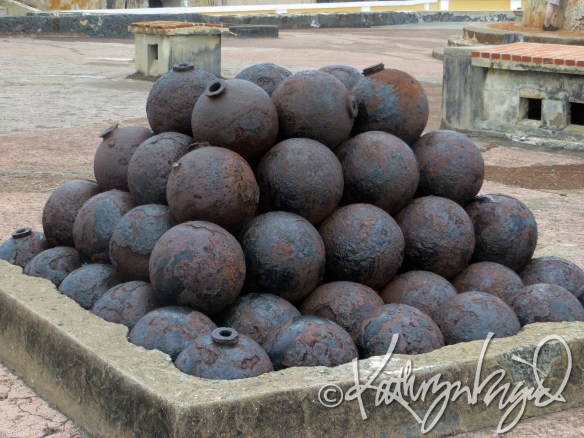
But on our recent visit to Puerto Rico, as we were walking around the museum ruins of  a fortress in San Juan, the Castillo San Felipe del Morro, looking at the remains of its heavy battlements, at its cannons and their tracks in the gunneries, at the sparse quarters of the soldiers who served there, and at the museum signs telling the stories of El Morro’s past, I remembered too that the vast majority of the people who are involved in wars hate them as much as I do. War is chosen and declared by a tiny minority in even those bands or nations that instigate the wars. The rest, soldiers included, pretty much have it thrust upon them, and I can’t imagine anyone who dies in battle had any desire to do anything other than to defend or capture whatever or whomever he or she was sent to defend or capture, and go home peacefully. Even some of those who declare the wars and enlist willingly to fight in them probably often have done so with a sense of rightness, if not righteousness, in the cause.Photo: Memorial Day 2

I looked around the Castillo and, for all of its historical interest and the beauty of its locale and weathered stone walls, the birds and iguanas and wildflowers decorating it quaintly, what I saw was a memorial to the many lives lost, soldiers and civilians, natives and outsiders, adults and children, the good and the bad alike. All because humans aren’t famously good at sharing their world with each other and resolving conflicts without violence. I will always have a horror of war and all the loss of life that it brings.Photo: Memorial Day 3

But I am, honestly, grateful to those who have—willingly or not—paid with their own lives for the lives and welfare of others, and I remember them not only on this designated day but every time I pause to reflect on the high cost of peace for our oxymoronically named species, man-kind. Seems to me that there’s no better way to honor soldiers for their service and sacrifice than to end the potential for any more such work and eliminate all wars forevermore.Photo: Memorial Day 4

Bring It On

There’s that old saying about how ‘it never rains but it pours,’ and while I often think it’s true that troubles and trials seem to come in number rather than singly, I also tend to think that’s the sense we get because everything subsequent event’s difficulty is magnified by the one that preceded it. And of course, in a more literal sense, since moving to Texas five years ago during a period of general drought in the region, I would be inclined to say that it seldom rains enough here, let alone pours. Much as I might find minor inconveniences and even annoyances brought on by a rainy day, the more so if it’s stormy, I am glad enough of the needed moisture that I don’t hang onto any grudges against nature’s outpourings. Even on that persistently blinding, bleary day of storms when I took my turn driving toward home at the end of last year’s summer road trip I was more grateful than hateful regarding the dousing we received, and that’s going some for a nervous driver like me.Photo: Rain Storm on the Road

I am reminded these days, though, of the original frustrated character of the proverb and am working not to get sucked down into such a mode myself. There have been little hints from my mind and body that perhaps the decade-plus of grand good health and wellness I’ve enjoyed upon being treated for and generally freed from depression and anxiety and the nasty physiological symptoms thereof may be, like the moon in a spooky campfire tale, on the wane. I’ve avoided thinking about it much not only because it’s an unpleasant prospect in itself but also for superstitious fear that just contemplating such a thing makes it more possibly true. And at first, it was just those little, nagging bits of something that I couldn’t quite define as backsliding: a hint more tension when riding in the car, a touch more touchy about unimportant problems in the day-to-day, a stomach-ache when I get worried about a deadline….

But when we were at the airport the other day, waiting to board a perfectly ordinary flight to go to the familiarity of our own home after ending a week of (for me) unfamiliar and exciting travel that should have been the tough part of the equation if there were any, I had the horrible experience of an emotional meltdown in a panic attack. It’s been so many years since I had one that I almost didn’t realize what was happening and thought I had simply gotten a sudden illness of a more ordinary kind, and that would be irritating enough in its own way, but when I did connect the dots and know that I was losing all sense of control and well-being, the drop down that well was swift and obliterating. I am relieved that it was a relatively short-lived event, and I doubt many around me knew anything untoward was happening, but inside, I was a morass of terror, unable even to speak in quiet gratitude to my spouse for his patience. In the end, I got on the plane and, once there, cocooned with my scarf and went to sleep as quickly as I could, and that was that.

The speed and intensity of the attack, however, were enough to convince me that it’s now time to see the doctor and discuss what to do before I fall as far, and for as long, as I had in the past. I have no use for being that powerless and miserable shadow of myself ever again. I hate feeling almost perpetually nauseated, often breathless or dizzy, ice-cold and then broiling hot and then ice-cold again. I loathe feeling like I will burst into absolutely unwarranted uncontrollable crying at any moment. I abhor feeling like a useless baby. I despise feeling so sick and enervated and exhausted that I can barely lift my arms, no, can hardly croak out a word without wanting to keel over. I reject that version of me!

During our lovely week in Puerto Rico, it rained one day in the intense and intimidating and glorious way that a tropical shower can do. It was pouring thoroughly enough that we waited until the hardest pounding let up a little, popped open our umbrellas, and headed out knowing we’d get good and wet. I was glad of wearing both quick-drying summery clothes and open, flow-through sandals, because even with our umbrellas in full bloom and the rain somewhat lessened, within about two blocks’ walk we were seeing rivers race down the street and right on up over our feet. By the time we stopped in a coffee shop not so many minutes later, we were pretty damp all over and soaked up over the ankles. It was warm weather, and the rain dried very quickly indeed, and of course we long for that sort of bounty for our Texas landscape, so we rather enjoyed the novelty of it all. But I’ll admit that even knowing that the rain’s a tiny price to pay for the generous greenery of the tropics, I was delighted to see the sun again as soon as it arrived.Photo: Rainfall in San Juan

I can’t say what is the benefit of going through the floods of depression and anxiety. I can only hope that at least it teaches me to be more mindful of the many blessings I do have and to fight my way back up and out toward them as quickly as I possibly can. Perhaps, if I’m lucky, I will also be more sensitive to others’ struggles when I have been reminded how hard it is to keep perspective when one’s own brain and body absolutely refuse to bow or to cooperate with the tiniest and simplest, most logical of requests. All I can say for certain is that I am not planning to lie back and take it. You’re gonna rain on me, eh? Bring it on. Getting out my umbrella, yes. Digging up every resource I can find or imagine, done and done. Climbing up the side of the well with my own fingernails if I have to, rather than falling farther into it, see ya on the other side, pal. Bring it on.

Foodie Tuesday: Drinks are on Me

CafeculturaWhy is it that it often takes getting together with friends to remind me what a welcome refreshment it is to spend even a short time sitting down for a break with a drink in good company? It matters little whether the liquid in question is a glass of water, a cup of tea or coffee or cocoa, icy soda or lemonade, vintage wine or a crisp cocktail. The venue isn’t the most important factor either, though I’ll readily admit that I think sitting in a gleaming Art Nouveau patisserie over cafe au lait et un petit morceau de gateau beats the Ouefs a la Neige out of drinking a cuppa Joe in the kitchen over a back issue of Home Plumber magazine. The length of the interval isn’t entirely the deciding factor, for that matter, though the stretchier it can be, the better the chance of full recovery from what ails me, whether it’s a minor moment of annoyance or full-on encroaching grouch-itude. Clearly, different occasions require different libations, too.

The primary determinant of the break’s quality and value, not to mention its memorability, is the company in which the break-with-a-sip is taken. No one I know would argue against the existence of occasions wherein the best (even the only acceptable) company is one’s own. But often, even when I think I desire nothing so much as to be alone, I discover that the finest of respite is found in the sharing of a drink in good company. So whenever you and I find ourselves coming together in the same place at the same time, let’s sit down for a moment or two and savor life over the liquid renewer of choice, if you please. Good for the corporeal fluid levels; better for the soul.Enjoy Cafecultura

Alive & Well

photoSing Now & Always

To celebrate at breaking of the dawn

Or close of evening, or the stroke of noon,

There is no sweeter pleasure than a tune

Well sung by everyone, an antiphon

To peace, to sorrow, or to happiness;

No matter what the poetry or text,

It truly matters most that what is next

Is choral concord to renew, redress,

Resound through all the unseen years ahead,

A clarion, an anthem or motet

Grander than any ear has heard as yet,

And run to distant history, a thread

Of melody and harmony so strong

That no one can resist joining in song

Gently into the Night

digital illustration from a photograph

Reparations

While the quiet of the evening draws its curtain on the noise

Day had clamored ’til its leaving, I will lie in calm and poise,

Gently as a bed of lilies bends in summer’s kindest breeze,

As the cat turns, curling, ’til he’s found his pose of greatest ease;

While the dusk falls, silent, deeper into night, my eyelids close

Heavily…I’m soon a sleeper in the stillest of repose…

Midnight finds me softly dreaming, all the day’s loud clatter gone,

‘Til birds chatter at the streaming light of the approaching dawn

While I lie in silent dozing where no sound comes breaking through,

All that shouted ceases, closing restive lips—and spirits, too,

Slip like shades and never flutter more than deepest sleeping sends

To the surface from the utter place of healing and amends;

I will rest here in the solace and the silence so supreme

It can quiet every call as I lie still and, gently, dream…digital illustration from a photograph

Talking at Cross Purposes

digital illustrationMy spouse and I have an intriguing way of discussing our disagreements, and I gather from what I see, hear and read that this is not such an unusual complication but probably more like the norm. We don’t fight about stuff that matters, remarkably, very often at all, being on the same page in our essential beliefs and concerns; if we differ there, we’re pretty comfortable having a rational conversation or two and agreeing, if necessary, to disagree. But the more inconsequential things are where we excel in having our weirdly, even hilariously, convoluted bouts of stubbornly wordy disagreement.

And the vast majority of the time, it’s because of the language barrier. We’re both native speakers-of-English, but it seems we are perfectly capable of saying virtually the same thing to each other in such different ways that each of us hears the other saying essentially the polar opposite. It’s quite miraculous, really. Two seemingly cogent adults, people who know each other rather well after being together for eighteen years and who both know inside that we share the deep core values that make eighteen years together possible, not to mention that we share so many experiences and tastes and interests—and we can’t reason our way out of a paper bag when one thinks the other is remembering something incorrectly or a question has been raised about some puzzling matter of fact.

Of course, I don’t think this is specific to being male-female, age-related, or any other such thing, this is a characteristic of our whole species. It’s a perfect example of how humans talk to each other a whole lot of the time. We think we’re having an epic battle over right and wrong, and both sides of the argument are  looking and hoping for exactly the same outcome, but each of us simply thinks we have put the correct names on the problems and resolutions and the other party is clearly an idiot or heretic until he/she/they will acquiesce and let us superior beings fix everything according to our righteous rightness. Happens in politics and religion and academia and relationships just about equally often. Whether weapons are involved has the most influence over how epic these battles really become, but the basis is hardly all that different.

My beloved and I get in the same ridiculous rut of circular conversation often enough, though neither of us takes it particularly personally or even necessarily sees it as a true argument let alone a danger to our relationship, and it’s easy enough to laugh it off when one or the other of us finally realizes that We’re Doing It Again. But it’s strange that we don’t spot the next episode from afar and simply have a straightforward, rational talk. If the goal or solution is nearly always identical or close enough to it, why do we have to wrestle around so determinedly before coming to that natural conclusion? I can’t guess why we mortal mugs are so quick to waste our energy and peace on pointless posturing, but it’s certainly a collective talent of ours.

I guess I’ll just have to take this opportunity to apologize to my partner for my part in the muddle, and hope I learn to listen—and hear—better. And if anyone with any power or aspirations to power (political, religious, academic, or other) happens to be reading this, would you do me a favor and do the same?digital illustration (B&W)

We All Wear Our Masks

digital illustration (B&W)It’s so much easier to hide behind convention and other convenient facades than to let our true selves be seen and known. Don’t we almost always prefer that sense of safe anonymity or at least ‘appropriateness’—however tenuous or specious it may be—to taking the chance that in our own skins we might not measure up to the occasion or to the  expectations of others?

It is, of course, a foolish conceit. One can rarely cozen anyone else, let alone oneself, by such a means. No matter how hard I may try to appear in the guise of what I think will qualify me for the In Group or make me richer-thinner-prettier or smarter than I really am, if it’s all show, the mask will like any faulty exterior prove too thin to cover my realities. It has always been so, and yet I am far from alone in continuing these futile attempts. I do believe that constant practice can transform us into a nearer semblance to the disguise, but that can work for ill as well as good.

Probably wiser is to recognize that the urge is age-old; that insecurity and an assumption that others will find me inadequate in my natural state are neither new problems nor absolutely decisive. The masks of the past remain, both in those symbolic and ceremonial concrete forms and in the records of our history books and art, to amuse, bemuse or warn us, if we will pay attention. And a close enough, thoughtful enough reading will remind any of us that no mask covers the truth forever—and yet, all the same, that we as a species continue (however astoundingly) to survive. Perhaps unmasking isn’t entirely as dangerous as any of us have feared.

I spent enough years acting the part of a brave, socially mature person, one who was more comfortable hosting a gathering, letting others see my art and writing, lecturing, teaching and doing so many other things that in truth absolutely terrified me to tearful agony behind the scenes that it turns out I am capable of doing all of those things after all. I still fuss and worry, yes, but nothing like the self-flaying horrors that I used to suffer just to get through what were apparently no-big-deal occurrences for most other people, and now I can experience them with fair equanimity. Funny how, when you’ve spent your whole remembered life in the grip of a belief that every second was one degree away from total disaster and death, any tiny bit less becomes magically huge.

And each of those instances becomes a step toward understanding that I have perhaps begun to grow into my mask of wishful improvement and become more like it underneath. Or better yet, that it never did matter as much as I feared, this different reality behind the convention. Best of all, I find that the more I let people see me as I really am, the more kindly they seem to look on me, and in turn, I begin to think the real me is perhaps pretty likable, respectable. Even lovable. Who knew.

digital illustration

Unique doesn’t inherently mean Alone.

Suicide without a Corpse

digital illustrationMichelle, a writer I greatly admire, just offered a post on her blog, wherein she details some of the characteristics of her daily experiences in life as a person with depression. As always, she makes me think. It’s not simply that I, too, am such a person—albeit one whose version of depression is as unique, individual as hers and everyone else’s—but that there are a few aspects of depression that, if not exactly universal, are amazingly common. First of these is that being sad is not depression. Sadness is to depression about like a paper cut is to getting an ice pick stuck in your eye.

I will not belittle the paper cut, real or metaphorical. Pain of the physical and the psychic sorts will always be relative to our own experiences and our own moments, and pain of any kind is inherently unpleasant and undesirable. That, I think, would be hard to argue.

But I might also say that it’s less accurate to equate sadness with depression than to call being sad, however jokingly, being “differently happy”. Sadness is a passing, ephemeral experience of the sort where the last scoop of one’s favorite ice cream flavor has been dished up and handed to the person just before her in the queue. Depression is when she has the dish of that flavor sitting right in front of her and not only doesn’t have the strength to reach over and take a spoonful of it to eat, she thinks she isn’t a good enough person to do so, if she can form such a solid thought at all, and if there were a super-powered sleeping pill that could put her peacefully to sleep forever sitting right next to the ice cream and she longed beyond words to die, she mightn’t have enough strength to reach over and take the pill either.

Suicide is a hideous thing, if you ask me. It’s tough enough that anyone would hate or fear her life and self to the degree that she sees no alternative but to end it, but of course she either knowingly accepts whatever horrible consequences her death will have on the entire rest of the universe, starting with the people who love her or she is no longer capable of recognizing that there are such people or consequences or caring about them. Beyond that, it inevitably is simply messy in the practical and logistical and legal senses. Someone will have to clean up after the fact, and the suicide doesn’t or can’t care that this will require others to deal with her corporeal remains, the legal messes she’s left behind, the tasks unfinished, and most of all, with the incurable suffering that follows when survivors realize that they couldn’t save her, might indeed have been utterly forgotten by her in the abysmal darkness of her depression.

Every individual’s best response to depression is as different as his or her version of the ailment. I am one of those whose unique combination of depression and other physical and emotional characteristics and components resisted all non-medical interventions until despite my vigorous resistance to the idea of chemical treatment I learned that that was the only useful method for me. Rather than diminishing my sense of self, it allowed me for the very first time in my four-plus decades to experience what I now believe is (and yes, probably always was) my true self. It still required being dedicated to a variety of other forms of non-chemical rehabilitation and therapy; talk therapy, meditation, and my practice of various arts and exercises mentally and physically that please and heal me all contribute to my wellness along with my meds.

I was fortunate in a way that many clinically depressed people are not: I never seriously contemplated committing suicide. I would go so far as to say that I considered it as a rather detached philosophical argument, inwardly, but I never reached the point where I so lost my will to oppose the idea of killing myself that I could let go of all the external reasons not to do so, those messy consequences others would have to undo or survive. If I valued myself so little as to want to be dead, I suppose it could be said that at least this made me think it would be that much worse of me to impose so terribly on those around me for something that wasn’t directly their problem. This sort of tautology clearly says to me that I wasn’t in imminent danger; I was busy arguing myself out of something that I didn’t really have the strength to do anyhow.

What I didn’t recognize in the midst of all of this soliloquizing was that I was committing a form of suicide, if an invisible one. True, there would be no stinking remains turning into human soap and sliming the rubber gloves of some poor janitor, no internecine paperwork to be sorted by attorneys and opportunists. But the burden on the world around me would have been just as heavy, the struggle of my loved ones just as inexorable, if I hadn’t rather literally stumbled into the intervening care that brought me to this lovely resolution where I find myself dwelling so comfortably today. Because, in my depressive brain fog and fear and self-loathing and ennui, I was rapidly forgetting how to be alive. It’s quite possible, I discovered, to die without stopping breathing, without even losing all conscious thought. A walking coma, an animate death is entirely possible in the midst of true depression.

And for that reason, I am all the more grateful that by virtue of being surrounded by people who helped to guide me in that direction, combined with being blessed, lucky, fortunate, or whatever combination thereof you prefer to name it, after my years in the dark I fell into the combination of elements that conferred a kind of wellness on me that I’d never known before. I am among you today not just as a happy and contented person, full of gratitude and amazement at what a good life I have, but also as a testament to the unfathomable differences and distances between existing and living, between something indescribably yet terribly akin to sleepwalking through life and waking up every day a little bit more…alive.