
Lounge Around the Jungle
Image
10
 I enjoy cooking. Not as much as I enjoy eating, or I’d probably bother to get chef training and go to work as a cook somehow, but I do enjoy time well spent in the kitchen. Still, I am ever so glad to let other, and very often better, cooks feed me. I was delighted, for example, to let the hotel staff in New Braunfels (Texas hill country) put together the meal my darling spouse and I shared with a ballroom-full of senior citizens and a small handful of their child and grandchild youngsters on Thanksgiving day. The food wasn’t especially gourmet, being an all-day buffet of extremely familiar and generally uncomplicated dishes long associated here with the holiday, but it was satisfying and traditional, and I didn’t lift a finger to help in its preparation, unless you count buttering my own bread. And I loved that—especially at the end of a long no-breaks haul for my hardworking husband, and in the throes of freshly hatched holiday colds for both of us—we could pay someone else to feed us. I’m grateful every day that I can afford to eat, and nearly always whatever I want to eat, and that sometimes others will do the fixing for me.
I’m also pleased to have access to foods that are, when I do want to cook, easy to make into something nice to eat. Vegetables almost never miss the mark in that realm for me, even though the aforementioned darling isn’t quite so hot on so many of them as I might be. It still fascinates me that he has, thanks to being a supertaster, an arguably restricted palate, but likes some foods that one might never expect a picky eater to like. He is an avowed avoider of things garlicky and onion-heavy, yet numbers among his joys when choosing a meal such famously garlic and onion friendly cuisines as Italian, Thai, Mexican, Indian, and of course, Tex-Mex. It’s all about how the ingredients are prepared, integrated, and combined, isn’t it. This guy who despises Weird Foods (and to him, they are myriad) will happily eat raw fish—not so familiar at all in America until recent decades—if it’s in the form of well-made sushi. As we draw near to the two-decade mark of marriage ourselves, I still do not presume to read his mind, culinarily speaking, accurately at all times. Not that this assures I can’t or won’t eat what I please, when it pleases me, but it’s easier to accomplish when dining out than when I’d have to prepare separate dishes for us, a thing I’m willing to do only occasionally. Another reason to appreciate visits to restaurants and friends’ tables.
While I’m on the subject of vegetal delights, let us then ponder some specifics. And why not start with garlic and onions? The flagrantly fragrant lily relatives are amazingly versatile, able to range from hot and spicy to mellow, even to sweet; in texture, they can be soft, chewy or crispy, depending on their preparation. They can add color and pattern to a dish with their concentric layers, their bulbs and leaves, or they can melt right in and disappear, leaving only their flavor to remind of their presence. Thanks to my partner’s tastes, it’s rare that I’ll indulge in any of the more potent forms myself unless he’s out of town for a length of time, but I still remember how to use them in gentler ways when I’m in the mood. For example, two very different kinds of soup starring alliums: French-style Soupe a l’Oignon, and a Creamy Leek & Potato Soup.
The Creamy Leek & Potato Soup is simple enough to make, but should be done rather slowly to get the best out of the ingredients gently. Leeks must be cleaned very thoroughly to get the sandy dirt and grit out of their layers, and an aggressive approach to the cleaning is fine when they’ll be pureed anyway. So start by trimming the leeks’ green ends well and removing their root ends, then split them in half lengthwise and soak them in a basin or sink filled with cool water before hand-checking them for any remaining dirt. Meanwhile, clean, chop and boil an equal amount of potatoes (skin on or off, depending on the variety and your wish) in water with a couple of bay leaves and a dash of salt. Drain the rinsed leeks, reserve a small handful, then chop the rest into pieces about an inch/2 cm long, and soften them until they’re melting with a slow sauté in lots of good butter. Slice the reserved leek pieces as thinly as possible and fry them until crisp for use as garnish when the soup’s ready. When the potatoes are fully cooked, remove the bay leaves from the water, pour in the buttery leeks, and puree the water, leeks, butter, and potatoes into a thick soup, thinning it to your preference with cream or half-and-half. Season to taste with salt and pepper, top with a spoonful of sour cream or creme fraiche, and sprinkle some of the frizzled leeks over that before serving.
Soupe à l’Oignon is delicious when made with a chicken broth base. I know, I know: many traditionalists insist that beef broth is the proper foundation for French onion soup. But I always found chicken broth (especially my own homemade stuff) the best fit for the soup’s overall flavor profile. I might even go strictly vegetarian rather than use beef broth in it, knowing how I tend, and if so I would definitely opt for adding some powdered Cremini mushrooms and a splash of Tamari to the roasted mirepoix mix in my veg broth simmer to make it a little more robust before straining it. But my basic recipe always started with the onions. I like plain yellow onions, and slice them into about 1/2″ (1 cm) thick slices after cleaning them. If I’m making the broth on the occasion of the soup itself, I’ll throw the onion skins into it for the beautiful amber color they lend. A nice big pot (even a half-full slow cooker) full of sliced onions with a pinch of salt and a lot of sweet butter can cook slowly and beautifully into a smooth, jammy confit, and that can be used in any number of dishes later, if you save some by vacuum-packing or freezing it.
Last-minute prep of this beauty is simple. Heat the number of desired 1-cup (or so) servings in a heavy pan, and when the onions are just about to stick to the pan, deglaze it with a good splash of dry sherry, broth, or water. Spoon each helping into a heavy bowl, mug, or ramekin. Barely submerge the onions with a helping of broth, whichever kind you have in mind. Top each helping with a slice of well grilled dense, chewy peasant bread. Top the bread with a hefty slice of Gruyère cheese, broil until bubbling and golden-brown, and it’s ready to serve. Not quite ready to sip, though. Try to wait until you won’t get broiled by the hot cheese yourself. Worth the wait. It’s kind of like growing the vegetables in the first place. Patience pays in deep flavor.
In this regard, there’s a whole range of marvels in the vegetable world that are only made more lovely by roasting the veg. Take fennel. The homely bulb is somewhat celery textured and mildly licorice flavored in its garden-fresh state. Generally speaking, I hate licorice. But with a light roasting in a bit of oil (preferably olive or avocado) or butter, fennel becomes an ethereal and delicate variant of its former self that I really do enjoy in small amounts. Swell in a combined vegetable roast; fabulous in a bouillabaisse or cioppino. Throw some herbs, carrots, and onions, along with masses of seafood, in the tomato-based broth, and with that whisper of perfumy fennel as a top-note, you have some magical brew.
Beetroot is a master of flexibility, whether as the star of the moment or as a sweet and sultry mystery ingredient in a dish. Even the homely radish raises the possibility of delicious dining, when kindly handled. The old standby of a radish sandwich (just thinly sliced, lightly peppery radishes served open-faced on sturdy but refined white sandwich loaf slices, heavily buttered and lightly salted) is a fine place to start. An icy-spicy salad of sliced radishes, fresh mint chiffonade, and sliced sweet apples (something like Fuji, Jazz, or Pink Lady) in a light dressing of rice vinegar, macadamia oil, sugar, a grind of black pepper, and a pinch of salt. Of course, I can’t give you actual recipes for my foods, being almost constitutionally incapable of replicating the quantities and combinations of any dish I’ve made. I vary what I’m preparing based on what’s on hand, and I’m awful at following existing recipes, so you should take what I say with a pinch of salt, too. Something that rarely hurts the preparation of a fine vegetable, by the way, a pinch of salt.
The other instructive clue I’m happy to share with you about vegetable preparation today is, of course, the efficacy and beauty of somebody else doing the work. Works for me!
 My Mind Wanders & So Shall I
I want to wander
To traipse and travel
Or else I wonder
If I’ll unravel
Make expeditions
I may
I must
Or my brain could bust
From Wanderlust
Let me sally swiftly
Flying forth
No matter whether
South
Or North
For I might implode
In irksome itches
The way my
Passport
Ticks and twitches
Can’t pause to ponder
What’s yon
Or yonder
My heart
Yells START!
And I want
To wander—

Those of us who are artists of any sort are mostly destined for one extreme or another: fame or invisibility. There are a fair number who manage to become something in between, of course, making enough money or garnering enough notoriety with their work to evade complete obscurity, but by virtue of that very existence in between, they too remain generally unknown by the broader world.
I have neither the skills nor the ambition to make myself successful in the business aspects of being an artist, so it’s a virtual lock that I’ll never be rich or famous, let alone both. That means, for me, that to be a success I must focus on working to please an audience of one. Even those who love and support and care about me have no obligation to admire and delight in my artistic output, and they can’t, without a large number of less-connected persons, make me a resounding financial success. My loved ones do seem to like my work, often enough, a fact that defies logic in its own special way, but that still doesn’t make those who adore me, singly or en masse, rich enough to make me rich, even if they sincerely wanted to own passels of my creative output, another reality which would not necessarily represent great intelligence or aesthetic taste on their part, even by my loose standards.
I can and do self-publish, and though that’s clearly an unnecessary and unbusinesslike indulgence, it makes the process of writing and drawing, painting and composing more entertaining for me and less of an invisible feeling enterprise. It doesn’t change the business end of the equation other than endorsing the probability that nobody in his right mind will pay me for things I’m giving away for free anyhow, but it motivates me to do something, anything, more than I might otherwise.
So where does that leave me? Knowing that I am working on my art, first and foremost, to please myself. I am and always will be heartily glad if and when others genuinely share my enjoyment and appreciation of what I consider my share-worthy artistic output. It’s a huge thrill when anyone deigns to spend actual, legitimate, government-recognized currency of virtually any national origin on the purchase of any of that work. But since the latter sort of happenings are rare as hens’ teeth, I will do best to enjoy my sporadic glimpses of small-scale fame when anyone expresses pleasure in my art, and the rest of the time, relish the process of production and any end products of it that I like, all as president, primary cheerleader, and sole permanent member of my own fan club, the way most of us artists are nature-made to be. Is that the sound of one hand clapping I hear, or did somebody just smack me to try to knock some sense into me?
If I started out without being very lithe and blithe and graceful—just ask my dance teacher from when I was in second grade—there’s little hope I would suddenly have become any more so in the years since unless I had been working assiduously to defeat my cloddish nature. But I haven’t. Your first clue, of course, should be that word “working,” as you all know so perfectly well that I am opposed to, if not utterly incapable of, being a worker bee and exerting energy. That is neither new nor likely to change radically with the passage of further years, in which I will naturally become more ossified and less willing and able to assimilate new knowledge, less flexible and worlds slower in my reflexes.
What I do have in my favor as I age is an ever-growing ego and ever-shrinking ability to be embarrassed by my evident weakness and silliness and fallibility. So as I go skipping my way through yet another birthday, I am not much troubled by my actually achieving this advance in age by, you know, getting older. As it’s always been said, it sure beats the alternative. And there really are a lot of great things about aging and the passage of time that tend to offset the cost.
So don’t mind me if I stumble and fumble around, making quite the fool of myself as usual and hardly managing to avoid absolute implosion. The occasional face plant isn’t nearly so hard to take as not being alive enough to fall on my kisser once in a while. Making plenty of mistakes and missteps keeps me interested in not only how to avoid the same pratfalls the next time or two around but also in how to enjoy the goofy glories of just being an extra in life’s always grand action. And you never know when I might manage a real, if awkward, pirouette or plié before collapsing in creaking and squeaking and laughter. Keep your eyes peeled.
It’s not always the case, but sometimes I find that I can lose track of time and self rather thoroughly when I’m deeply engrossed in making art. Writing even a simple email can take ages, if it’s about something or to someone I consider important; an essay or poem can take hours or days, if I get involved and forget where I am. It’s a bit like driving a familiar route; when I’ve been on the same track enough times, I am occasionally startled to realize that I don’t remember passing through the last number of miles, because my brain is so used to noting what is or isn’t as it’s expected and supposed to be that it operates nearly on autopilot, though thankfully if I examine my memory I can indeed recollect noticing real details along that ostensibly missing section of the trip. With making visual images, I can (and sometimes, I think, absolutely should) let go of and turn off my editorial mind for a good period of the work time. If I’ve practiced enough and prepared enough, inwardly, for a session of art-making, letting my attention take a back seat to my instincts and actions before returning to critical mode is at the very least going to produce some worthwhile, thought-provoking, challenging Stuff that will either lead directly to an artwork or, as a bit of not so fabulous yet earnestly glimmering potential, lead to something on the next try.
No matter how that part of the process goes, I’m quite sure that an easy 90% of what I do to make art, whether it’s textual or visual, happens internally and not externally, so it’s no wonder if I wander off at times.
Some of us are terrific at doing things the hard way. I can blame some of my peculiar talent for that on being dyslexic enough to consistently, persistently turn right when I should go left, push when I ought to pull, and stand up when I am expected to sit down. A bit of my wrong-way gift comes from being too intimidated to ask for help and too impatient to study the proper technique. Some share of the problem lies in my sheer stubbornness and iconoclastic eccentricities. Even when I ‘get it’ I can be resistant to sticking to the recipe or just plain forget what I know at precisely the wrong moment.
As I finished writing that last paragraph, in fact, I realized that I’ve been using my little notebook back-to-front and can’t remember why I started using it ‘in reverse’ in the first place.
The great thing about being and upside-down and inside-out sort of person is that most of us outlier sorts manage to muddle through anyhow. There’s a reminder in all of our strangely variant approaches that life offers us more options than we often think to use. Sometimes the sidelong slide into a task proves to lead through unexpectedly wonderful byways or to an unpredictably elegant end.
Falling headlong into life, it seems, is sometimes a happy and wholesome thing.
On some rare occasions, it’s actually worth getting out of bed before noon-ish. When the breakfast is that good, you know you’ve accomplished something, because I have no intention of cracking my eyelids open any earlier than I absolutely must. Sleep is the one thing I crave more deeply and often than food, and you all know how much I covet good eating, so it takes the prospect of great culinary splendor to drag me from the comfort of my bed one minute before I am good and ready to do so on my own.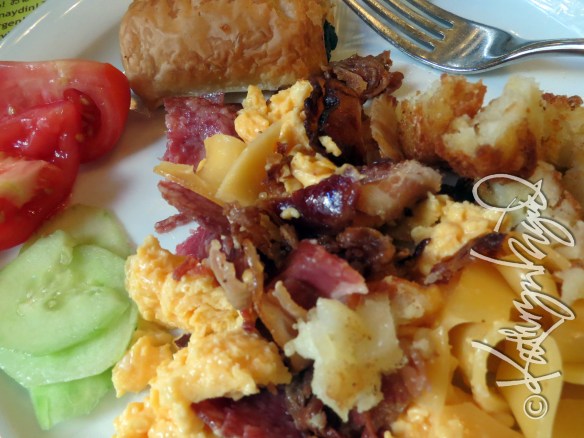
Since I’m generally the one responsible for putting breakfast, if any, on my own plate, you can guess how often I’m likely to spring into action to see such a meal prepared and presented. I may have some lovely dreams about breakfast, but I prefer to enjoy them while still firmly ensconced in bed. When I do break my fast, it’s far more likely to be with brunch or even lunch than anything earlier, given my druthers.

I tend to make exceptions when I’m traveling. Often, the causes for the expeditions are beyond my hourly control, so if I have to be up before my internal alarm is interested in my arising, I will generally take advantage of any good food being offered by my hosts, whether they’re homeowners hospitably letting me invade their personal space or hotels with in-house breakfast accommodations. These pictures, for example, come from the summer’s travels and represent foods that went a long way toward ameliorating the agony of having to get out of bed before it seemed the rational thing to do. If anyone is to have half a hope of maneuvering me out of a comfy sleep any time before my body would grudgingly agree to that negotiation, it had better be, at the very least, with a magnificent cardamom roll (bottom photo, from Sandhamn, Sweden). Or perhaps the mind-bendingly gorgeous and seemingly endless spread offered in the palatial breakfast room (top photo) of our hotel in Budapest this summer. Otherwise, you can trust me when I tell you that it’s advisable to let sleeping dogs lie.
 One person who hates is a Weapon of Mass Destruction. One who cares and shares? Perhaps the only antidote.
As I recently said to my friend Maryam: poverty—both of concrete, material resources like food and shelter, and of intellectual and ephemeral resources (education, spiritual enrichment, the arts, community engagement, etc)—seems to me to be perpetrated and perpetuated more by selfishness than by an actual shortage of any of those resources. The rich and powerful always want more riches and power, and what they do have makes them able to afford and acquire more and to keep their feet firmly on the backs of the have-nots. Plenty is never enough. The resulting imbalance is as old as history, and rotten as ever. Only those who will speak up and resist entrenched inequities and injustices will have any hope of making change.
The badger and the wolverine have a reputation for being among the most tenaciously savage brutes of all the mammals. Yeah, Honey Badger even has his own meme to show for it. But let’s be honest: no beast of earth, air, or sea has a capacity for vile, rapacious cruelty rivaling that of the human animal. Even creatures of the natural enmity of predator and prey compete, fight, kill, and are sated. They have little apparent ideation of hatred and war to match people’s. A wolverine or badger will fight to defend, or to kill for food, but unlike the human, doesn’t seem inclined to attack indiscriminately outside of its primal needs for safety, shelter, and food; when the skirmish is done as efficiently as possible and the need assuaged, the sharpest of tooth and reddest of claw among them doesn’t do an end-zone dance to celebrate its pleasure in winning but will usually depart the scene or go to rest for the next time of need. The remaining food and shelter and other resources stay in place for whatever creature comes next, hunter or hunted, cousin or not.
Can we humans not learn from such a thing? I’m pretty sure that if we destroy each other and ourselves in our constant self-righteous, self-congratulatory belief that we deserve everything we can get our hands on, Honey Badger won’t be the only creature that doesn’t care.
 Art-Colored Glasses