A Choral Symphony

Listening in on rehearsals for the new Jake Heggie Ahab Symphony a companion to his opera Moby-Dick), I wrote. Tonight (24 April 2013), if you’re not able to attend in person, you can watch and listen to the live streamed performance of the world premiere at 8 pm CST at this link, featuring tenor Richard Croft, the University of North Texas Symphony Orchestra and Grand Chorus and conductor David Itkin: http://recording.music.unt.edu/live. In the meantime, from me:digital artworkCharacteristic Frequencies

Light, to begin, as though it were the dawn,

And whispered voices breathed themselves awake,

And sentience would rise and fall and make

A storm, turn faint again, scarce moving on–

On lyric waves these messages were sent,

Foretelling danger and the pangs of grief,

Then, gentler, sing of comfort and relief,

Follow each graceful passage where it went–

This, while the song comes lapping up at me,

Comes pulling like the most insistent tide,

Whether the sound grows deep or thin and wide,

Draws me on deeper in this sonic sea–

Seek me no more, but let me run aground,

My soul sunk in these waves, and listening, drowned.digital artwork

My Baroque Gesture

The first time I heard Early Music performed in period-appropriate style I experienced, not surprisingly I suppose, a full mixture of amusement, bemusement, mild horror and deep curiosity. It was in a performance of Claudio Monteverdi’s seminal opera Orfeo at the English National Opera; I was a mere college stripling who had probably not even heard the phrase Early Music at the time let alone known what it might mean, and ‘performance practice’ was in something of a time of transition. Anthony Rolfe Johnson sang the title role with, if I remember properly, a rather nice overall sound, but a straight-tone and senza vibrato style and a strangely stuttering kind of ornamentation that might well have been an authentic recollection of the opera’s original character and an accurate and historically informed version of the way it would have been presented by its composer and first performers. I, having never been taught such things, merely heard sounds quite foreign not only to my ear but to my concept of skilled and artful performance, let alone prettiness. I do remember thinking that either this was all far over my head (entirely possible) or it was a pointless and poor imitation of what the ENO imagined the average amateurish opera company of Monteverdi’s day must have been capable of doing (less likely), or poor Mr. Johnson, who later went on to receive his OBE, just plain wasn’t up to the job despite a naturally pleasant voice.

Years later, I may not be much smarter than the young squirt of those days, but I’m far more experienced and have heard worlds more music, both the great and the terrible and, of course, a massive quantity in between. And I’ve been taught a thing or two about the fine points of what is beautiful and magical when it comes to singing or playing with any amount of vibrato–or none–and the many elements that combine to create tone and color and variety and character in a performance. I’ve learned some useful stuff that changes how I perceive both the level of virtuosity in playing or singing and its aesthetic appeal, two aspects that do not always coincide in my ear, mind and heart but when they do, that combine to create a kind of joy that is virtually unattainable in any other way.

When my husband conducted a production of Orfeo over a quarter century after the first one I’d heard, I had a whole different understanding and appreciation for what the many performers were doing and why the stage director would expect them to do so both from a visual standpoint–training them, along with other coaches, in appropriate ways of moving and posing and gesturing as well as in those of vocal ornamentation, since she is a superb and well-trained Early Music singer herself–and an historically suited musical one. Just as there are countless styles and types of music known to us nowadays, which you can multiply by the number of individual teachers, performers and audience members to get a rough sense of the variety you’ll encounter, there were historical strictures and structures and stylistic trends and ideas that shaped earlier generations (centuries) of music and musicians and listeners, and while some have perhaps remained relatively unchanged since their inception, many more evolved over the ages. Our expectations of music have certainly changed, and our guesses as to how it was first conceived and perceived are only as good as the lines of scholarly inquiry and oral tradition can attempt to make them.

In all, it makes rich fodder indeed for both the ear and the imagination, and I for one am mightily pleased that I have had the opportunity to live a life immersed in all kinds of music and to learn along the way. I still like much of what I heard, whether ignorantly or not, in my younger days, and much of what I like now I learned to love along the way. While my form may be far from historically accurate or artistically impressive, I will still happily bow and curtsey to all the musicians who have shared their gifts with me in my life, and to all of those who work and are inspired to play more, to sing onward.graphite drawing

‘Social Activist Art’ is *New*, You Say???

drawingA recent New York Times article reminded me that, no matter how I might classify myself as anything but an activist, I have always been one, of a sort. It’s true that I’ve always assiduously avoided conversation, let alone physical action, tied to politics, religion, social policy and pretty much any ‘hot topic’ you can name unless I sensed I was in the safest possible environment to do so–generally, amid a comfy flock of like-minded partisans. The article is chronicling the US uprising of a relatively new breed of American artists and their support systems dedicated to, as the title bluntly states, social activism; the author gives appropriate reference, of course, to the practice being a long-standing one in other parts of the world, but shares the view that it’s still rather fresh and new here on American turf.

I’ll grant that the forms and formats may well have changed, and that there might be a larger collective sense among those who would embrace this title of being dedicated to the purpose more specifically than others, but I will step right out on my own tiny soapbox now and assert that, insofar as art is seen as a form of communication–and this might well include virtually all art except that created and performed in private and without any wish or expectation than anyone other than its maker will know it exists–it is inherently activist. The decision to create something I intend to be art and allow it to be known to others says a whole lot of things about me, the subject of my work, and my general worldview, and if I am allowing others to experience these in the art, assumes that they will respond through and with their own worldviews to it, effectively in a social interaction, whether we converse directly about it somehow or those who have interacted with my art turn around and respond to it in the continuation of their lives.

Who knew I was such a rabble-rouser? But truthfully, even by making those ‘meaningless’ little doodles that don’t turn into full-blown drawings or paintings, I am making something of a statement, am I not? I scribble, therefore I am. By doodling, I am not only using my energy to do that rather than anything else, I am also creating a portal through which my thoughts can emerge; if they turn, via this scrawling, into a concrete idea it may lead to the completion of an artwork expressing it more openly. This, in turn, suggests that I have a thing or two to say and I’m willing for others to hear it, see it, feel it–to interpret it and respond to it, even. I never think of myself as daring, but I think it’s fair to say that letting my inmost thoughts and imaginings be seen and analyzed by others through their own filters is at least a little brazen, if not occasionally foolhardy.

One of my late mentors, Lawry Gold, wrestled with the supposed divide between art and function, and he was anything but shy about being an outspoken activist, albeit a very kindhearted and generous one. He was a boldly countercultural person in a great many ways, and yet he seemed to me to reach the peak of his own overt rebelliousness when he began working on a body of art that was deliberately and unabashedly functional (beautifully art-covered, distinctively designed tables, lamps, clocks and the like) for sale through his gallery agents. This was something I know he enjoyed at least a little as cheery cheekiness to tweak artist snobs who were apparently so benighted they couldn’t accept the marriage of form and function thus, or so rich they could afford to sit around waiting for other equally rich people to buy their non-functional work, no matter what the state of the economy. Besides that these were among his most gorgeous and sophisticated works, to me they spoke of the recognition that art, besides taking so many different forms, speaks to us in many different ways, and that breadth and depth has great value.

At the same time, my friend never stopped making ‘non-functional’ art, because he of all people also had a tremendous desire to communicate, whether it was by visual storytelling in his often humorous, whimsically imaginative artworks or by making a more specific point with his illustrative and symbolic works. And he never hesitated to engage in the discourse that followed anyone’s viewing of his work. He and I had a joint exhibition of our artwork once, and as I was curating and installing the show I objected to one of his pieces that he wanted included, thinking it was not in keeping with all of the others we had selected, and he patiently steered me toward a clearer understanding that it was indeed very well suited; even though I never liked that piece as much as the others, I found that it carried an important part of the ‘conversation’ made up by the whole of the exhibition, and in fact that one interaction changed the way I curated many an exhibition of others’ work in the years that followed.

Ultimately, I see in the creation of art–of any form–an act that if it isn’t in open defiance of the social norms, allows or even invites the examination of and discourse on them. So even though much art is not made, like Lawry’s, to function in an obviously practical way, it all serves a purpose; ‘merely’ being beautiful or compelling may be purpose enough in adding layers of pleasure or relief or catharsis, but many works go far beyond that in opening new vistas to our contemplation, influencing our beliefs and even challenging us to change our behavior. All art is potentially advertisement or propaganda, for good or ill. And if that isn’t social activism, I think my encyclopedia needs some new illustrations.

digital illustration from drawings

Is all art crowd-sourced?

The Seal of Approval

What shall I say when I am asked my opinion and I think it would be best not to give it? I feel a little like I should perform a circus act, give the impression of cheery appreciation while keeping the less charming truth to myself. Not a little, really–I think I’m actually quite the liar at heart when it comes to people asking for information I’m pretty sure they would not actually like to receive. There are indeed those who want an honest and purposeful breakdown of the situation in question, but they are in my experience rather few and far between. In real, day-to-day life, what people are generally seeking is reassurance and affirmation, encouragement and support, not really a critique, when they ask for opinions.

So excuse me if I put on my happy face and do a little tap-dance of diversionary niceness when asked. If it’s strictly entertainment you seek, I’m here for you and will do my little tricks as best I can, but I hope you won’t decide to ask me for any touchier information. The only thing I’ll willingly admit your pants make look big is my discomfiture on hearing the question.photo

Be a Good Sport

digital artworkIt only just occurred to me that the admonishment to ‘be a good sport’ has little to do with showing athletic prowess and a whole lot to do with someone cajoling someone else to do a thing that the other person has no desire to do. What a to-do!

Perhaps this little guilt trip was meant, if the person saying it to me had any thought about it at all, to encourage me to discover that I actually enjoyed those activities (sports or other) under consideration once I willingly participated. Maybe those who said it even thought I had a hope of becoming skillful, adept, if I just faked a bit of enthusiasm until I got more properly involved. Cynic that I am, I harbor some doubt as to the former and, let’s face it, find the latter somewhat laughable. I can’t think of anything anyone would trouble me to do by telling me to Be a Good Sport that would be necessary to my survival or the rest of the world’s well-being, so it seems pretty plain that I was being chided to do that thing in order to please the person who was scolding me.

If, by not wishing to participate in the present extravaganza (whatever it may be), I am not a Good Sport, then it seems to me a bit like when those demonstrators and activists and yes, politicians, who cheer on their personal causes by insulting and tearing down and attacking their opponents rather than by simply extolling the virtues of the cause and letting it win converts and participants by its own evident excellence, and said promoters are then utterly mystified and stunned that others don’t flock to the cause willingly. You may well surmise from this that I never did buy into the value of group-think much, and in turn, haven’t ever warmly embraced the ‘popular’ activities. You can call me a meanie, a wimp, a curmudgeon, whatever you like, but please don’t label me a Poor Sport for having different wishes and tastes than yours. It’s just not sporting!

Dream Dancers

digital artworkCountdown to Dreaming

What sprightly sprites, by noon and night, what fairies of the air

Dance in my dreams? To me, it seems there’s always someone there

To twist and twirl, to whiz and whirl, to pirouette, jeté,

To bow and bend and to transcend mortality this way.

No one can see this dance but me, and only when I slumber,

When forty winks or nap, methinks, begins to unencumber

The dancing denizens of sleep, my own replacements for mere sheep,

And I must count them, lest my deep repose should lose their number.

Sneaking Upward

Snaking Upward

I’m not a caterpillar, no,

I’m just a humble worm;

I have my aspirations, though

Ambitions make me squirm;

I like to keep a secret how

I wish for fame and wealth;

I know to climb’s not bad, I just

Prefer it done by stealth.

graphite drawing

Rattlesnake Wannabe

‘On Pouvait Dire . . . ‘

‘Ah! non! c’est un peu court, jeune homme!
On pouvait dire…Oh! Dieu!…bien des choses en somme…’

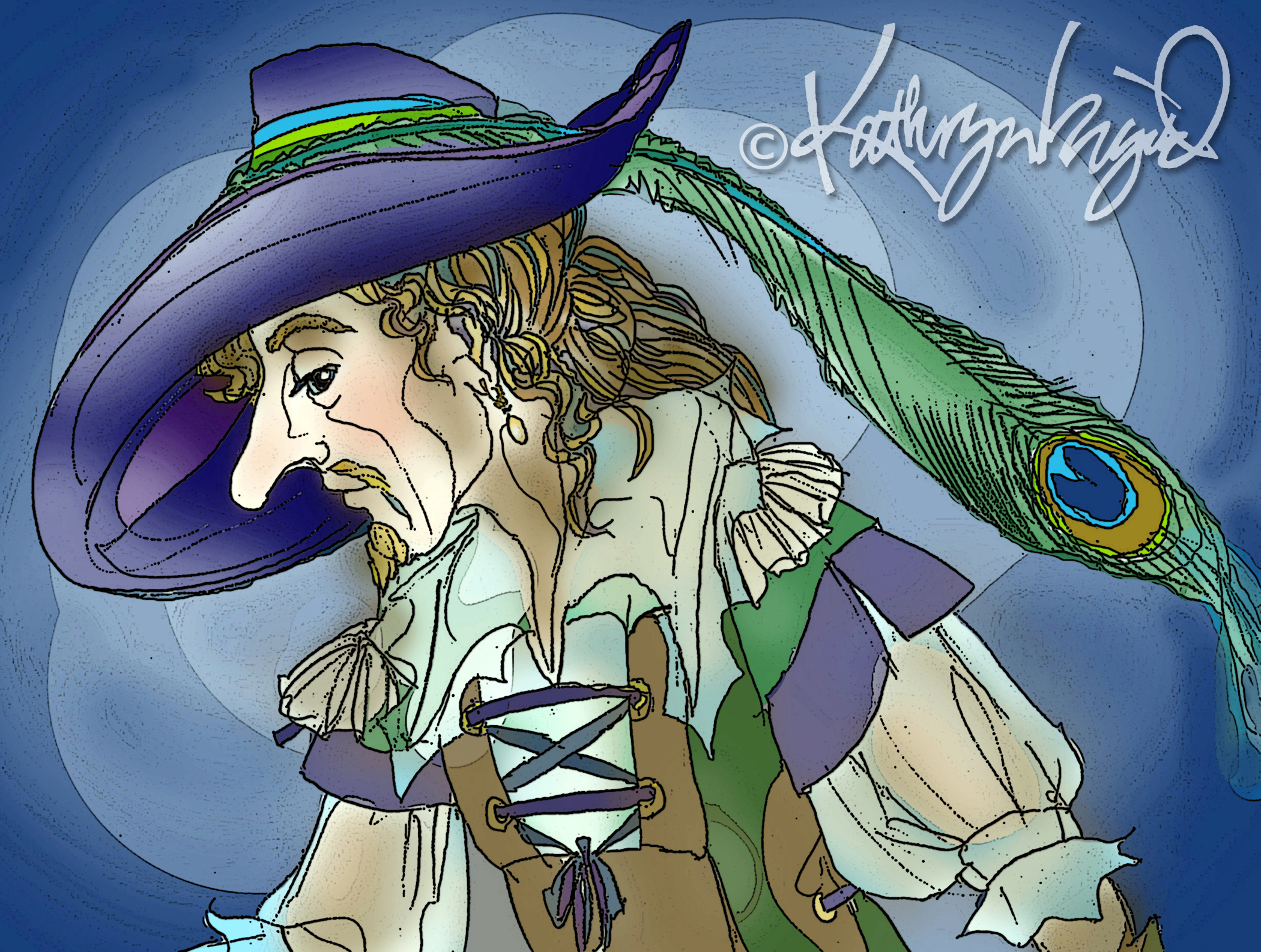
digital artworkWould that I had the miraculous gift of the silver tongue–it’s said that the genuine Cyrano de Bergerac, the writer and duelist enshrined in fiction as some sort of demigod of dramatic speech, was in life something quite near to it as well. As a youthful admirer of the romantic dream, I memorized Rostand‘s most famed soliloquy of Cyrano’s (in English, naturally), but what remains after so many years have passed is not so much the poetry of his slick speech; it is instead a deeper sense that for all my staring at his nose along with everyone else I managed to miss the point.

The story is told in fictional form to so exaggerate the majesty of his nasal promontory that all we see in most readings and performances onstage is a caricature or cartoon man, led by a nose of bowsprit proportions and foolish improvidence to oversized action and wildly improbable joys and sorrows as a result. These kinds of things do happen to real people in real life, of course; even the real man behind the character was larger-than-life in both nose and existence, according to what we know. He did, if his contemporary portraits are anything near the truth, have a substantial prow, and we have his writings–satirical pieces to classical tragedies–to prove that his wordplay was quite substantial too.

But what perhaps ought to be said of him–whether real or imaginary–is that he was a bit of an outsider by virtue of looking Different, and his response was to fight for respect, both with his rapier and his rapier wit. [Given the historical man and the possibility that he was (not surprisingly, given the era and culture and his reputed exploits) syphilitic, he may well have experienced life completely without a nose if he lived long enough.] It’s easier to label and classify others on the basis of unpopular appearance or differing from the currently decreed norms than it is to cultivate what we have in common. Yet we can learn from some of our outlier counterparts if we will stop, for a moment, being so mesmerized and distracted by what makes them seem unlike us, what it is that we have and value in common. Best if we do that before losing the duel.

Though at least, if the duel is purely verbal, there can be some entertainment inherent in getting taught a lesson. I can live with being the unarmed woman in a battle of wits, as long as I get to keep living long enough to laugh about it. I may not be a genius, but that, my friends: c’est mon panache!

Crazed Weasels and Other Objects of Affection

The Georgian era gave us, along with a whole raft of other creative gifts for sweethearts and mementos of important occasions, the piece of portraiture-cum-jewelry known as the Lover’s Eye. Something of an oddity, to those of us in the modern day who don’t happen to be of that individualistic bent that swallows capsules of a late wife’s ashes with daily vitamins, wears vials of a lover’s blood as a pendant or keeps the deceased boss’s body as a nice piece of taxidermy so that he continues to sit in on board meetings in perpetuity. Yes, all realities for some folk. Not so much for Average-Joan. Portraiture is generally so very much more socially acceptable.digital collageA portrait of a lover’s eye, even if it happens to be shown without reference to and other, presumably equally adorable, parts of said person, isn’t quite so unsettling and freaky then. Of course, that assumes that one’s dearest has eyes, at least one eye, that is pretty attractive in its way. I got to thinking about this whole little question when I had the allergic attack recently that made my eyes so distinctively disgusting. However, I was reminded by that very episode that love is genuinely, in its way, blind. My darling husband didn’t cease to treat me with the usual kindness and affection and sweet intimacy, and while I know there was for both of us an underlying hope, nay, assumption that this was a temporary appearance for me, the possibility of permanence existed as well.digital collageWhat did this prove? Nothing in and of itself, really. It did, though, remind me ultimately of the age-old truth that love makes us see the objects of our affections as good, desirable, as beautiful. That beauty is in the eye of the beholder. My spouse saw the Me he loved, without necessary reference to how I looked at the moment. And he does, after all, love me either despite knowing I’m a little bit weird and kooky, albeit (I hope) pleasantly so or, weirder and kookier yet, because I’m that way. Probably not especially hankering to wear around any new jewelry, my beloved. Least of all, jewelry with a little picture of my eye staring at him all of the time, as if my gawping at him in person, however admiringly, isn’t enough to send him up the wall. I’m not absolutely certain that a prettified version of my healthy eye would be markedly better than a silly and outrageous portrait of my eye in its bizarrely bloodshot wackiness, as jewelry goes. But my guy, he looks pretty fabulous no matter what he’s wearing. So there’s that. Wink, wink.

Mother & Child

graphite drawing + digital colorLullaby for Spring

Sleep, my sweet, my lovely one,

From dusk until the rising sun

Paints morning roses blushed with dew;

Let comfort bless the night, and you,

Awaking, bless with joy the ray

That, opalescent, breaks this day.digital image