
Early Music for Breakfast

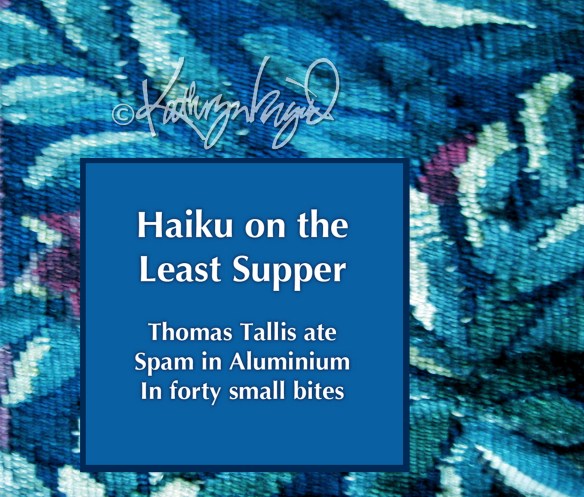
Digital illustration + text: Haiku on the Least Supper

If you haven’t already crossed paths with Thomas Tallis‘s landmark Renaissance motet Spem in alium, I highly recommend it. It’s a truly astounding piece of European music history, representing the confluence of the political and artistic competition for primacy in that time period; it’s believed to have been composed as England’s answer to Italy’s Alessandro Striggio‘s own, earlier 40-part motet, or possibly to Striggio’s 40-60 voice mass. I’m no musician, but I’ve learned, mostly through witnessing a few performances of the Tallis by different groups led by my husband and his colleagues, just what a feat this piece really represents.

While the creation of Striggio’s works for 40 and more independent voices is amazing in its own right, the 40-part motet he wrote specified that the voices be doubled instrumentally. That is impressive enough. For my fellow non-musicians, think of it this way: a typical piece of music for a mixed choir requires singers to perform different notes and lines of music, often at the same time, so that what is heard is not one single series of notes, one after the other the way we sing by ourselves, but layers of notes that become deeper and more distinctive expressions of the words being sung. Instrumental doubling means that some or all of the vocal parts are supported by one or more instruments “singing” the same notes at the same time. This can intensify the effect of that singer or section’s line, and it can sometimes also help a less skilled singer or choir stay on target with the line.

In any event, the more typical choral works tend to have soprano, alto, tenor and bass voice parts, or singing lines, (or some combination of those) and generally, not more than eight or perhaps twelve different lines intermingling at once. Anything more than that means that every singer in a moderate-sized choir is responsible for knowing and performing his or her own notes, on pitch, at the right moments, and with exactly the right loud-soft dynamics and flow at every point throughout the piece. Being in a choir is a thrill; being in a good choir is a real intellectual and artistic and even physical challenge.

What makes the Tallis Spem so incredible is that it comprises not only forty individual, fully independent singers’ voices all singing their own distinct parts of the song, but indeed, doing so entirely unaccompanied. Every one of the singers has to be spot-on at all times without the support of either a fellow singer or any kind of instrumental doubling. If one singer goes off the rails, there’s the possibility that others will be thrown off of their pitch, timing, or even their place in the whole work. It could well lead to a musical train wreck. Think you’d be intimidated by doing this? I think any sane person should be!

But it’s powerful stuff, when it’s well done. I’ve had the privilege of hearing this feat beautifully accomplished by singers surrounding me in a cavernous cathedral space, and by singers standing onstage in a modern performance hall with a carefully engineered acoustic. I’ve experienced it in art galleries where Janet Cardiff‘s intriguing installation of forty high fidelity speakers on stands are placed in a circle in the otherwise rather bare room, each playing in synchrony the recording of one of the singers in a performance of the Tallis, so that one can stand outside the circle or in the center of it surrounded by the speakers, or can move to stand at one individual speaker at a time, getting entirely different effects depending upon which part of the score is being performed and where one stands in relation to the speaker playing that part.

No matter how it’s done, once you’ve gotten a little of the idea how this piece of music intertwines voices that seem at first to be operating without a clear relationship but then, more and more, to be converging into a meditative, chant-like, layered song, it is quite mesmerizing. There are some recordings and performances out there on CD, iTunes, and YouTube worth a listen, and if you get the chance to visit the Cardiff installation, called simply Forty-Part Motet, do it. Best of all, of course, is if some fine choir nearby offers a live performance that you can attend. It’s rather haunting and ethereal, and made all the more impressive by the knowledge of its complex origins.

Meanwhile, I have given you this bite-sized humorous meditation on the work. A haiku seemed the ideal vehicle for acting as either commentary on or antidote to a choral masterpiece so complicated and virtuosic. And I sort of wonder if, in the process of composing this grand work, Mr. Tallis had any chance to stop for rest or was so deep in concentration that he barely had time to do the Renaissance equivalent of opening a tin of luncheon meat and dining directly from it, pen and parchment in one hand and dripping Spam juice on the other. Thankfully, it doesn’t appear that this effort of his was entirely detrimental, let alone leading to his personal version of the Last Supper, since he went on to compose other fine works up until nearer his death some fifteen years later.

Where are They Now?

In a couple of generations, so much change! It seems to me, at this point in my life and the tiny spot where that life sits in human history, that change grows ever speedier, as well, but I can only guess at that. I do know that within the memory of my own family and friends, what was common knowledge and something like a cultural vernacular at one time within those groups disappears with the rapidity of birdseed down a squirrel’s gullet.

When I was growing up, computers were still [refrigerated] room-sized and full of punch cards that represented their binary data in concrete form, and any private individual owning or knowing how to operate one was generally a subject for science fiction and fantasy. You might think the magnitude of the gap between then and today’s ubiquity of such techno-wonders as laptops and smartphones and their ilk would carbon date me, but no, I am still alive and kicking (though not nearly so high as, say, a Rockette), and I expect that today’s marvels will have become equally quotidian and us, equally blasé about them almost before I can blink my diode-wearied eyes.

One of the more obvious markers of the speed of our cultural shifts has been our costume, at least since we started wearing clothes. I can, to be fair, imagine that–once there were more than a couple of people around wearing leaves and animal skins–there was immediately somebody on hand checking out whether the prognathous brow next door was adorned with a groovier piece of saber-tooth fur than her own, and some other body busily rearranging his gunnera leaf cape because he’d noticed with some envy that the cave dweller across the way had added another leaf to his ensemble for a hat, giving him a little more screening from the notice of passing pteranodons.

So eventually, we arrive in the present day, when there are still a few ladies alive who can remember wearing middy blouses, and their granddaughters instead wore midi skirts. And in the course of my life, I remember a number of fashions and popular items of clothing that have ranged rather widely and sometimes even circled back to repeat a generation later, when the young and trendy are distant enough from their original appearances to be unaware of how ridiculously out of date the New Thing looks to the people who knew it as the New Thing thirty years earlier. This tautology of togs can be amusing, mystifying, a tad mortifying, or possibly just inspiring to those who kept the ‘offending’ garments in their attics for just such an occasion or at least out of laziness and apathy. In any case, we find ourselves seeing the past replayed despite our long-ago vows to never revisit such awful and embarrassing gaffes of taste, expense and/or comfort, and as much as we might revile them on their reappearance, it’s not entirely unknown for us to readopt them along with the crowd, when they’ve become familiar again.

Where are they now? Probably right where we left them, waiting to be picked up and worn once more. Much as it pains me to admit it, you will probably eventually find me wearing, again, such vintage garb as elephant pants, soap-and-water saddle shoes, paper dresses, bobby socks, a matching crocheted vest and tam, dickeys, or perhaps just a tasteful voile pinafore over my dress. Not sure if I’ll go as far as a bustle or a farthingale, but since everything old is eventually new again, I can’t say for certain that I won’t, either. Safe to say I think it highly unlikely you’ll ever see me wearing a girdle or V-boots or armor, even if those should become familiar personal accoutrements again anywhere during my life, but I rule nothing out–weirder things have happened. And I’d hate to get too out of sync with my fashionista neighbors, don’t you know.digital illustration

On Thin Ice (Advice to the Peewee Hockey Player)

With special love to all of my Canadian friends!digital image from a photo

Out Cold

Do not the hockey puck invite

Your flaxen brow to cleave

By wearing not your shining helm;

And do not tear your sleeve

Upon the blade of someone’s skate;

And don’t assay to test

Opponents’ blows, save if you wear

A Kevlar hockey vest;

Avoid, if you are able to,

A stick thrust at your sternum,

For whacks like this are undesired

Even by those who earn ‘em;

Above all things, I recommend

You not enrage the goalie:

Though wounds are bound to happen here,

Some risks are just unholy.digital image from a photo

Be a Good Sport

digital artworkIt only just occurred to me that the admonishment to ‘be a good sport’ has little to do with showing athletic prowess and a whole lot to do with someone cajoling someone else to do a thing that the other person has no desire to do. What a to-do!

Perhaps this little guilt trip was meant, if the person saying it to me had any thought about it at all, to encourage me to discover that I actually enjoyed those activities (sports or other) under consideration once I willingly participated. Maybe those who said it even thought I had a hope of becoming skillful, adept, if I just faked a bit of enthusiasm until I got more properly involved. Cynic that I am, I harbor some doubt as to the former and, let’s face it, find the latter somewhat laughable. I can’t think of anything anyone would trouble me to do by telling me to Be a Good Sport that would be necessary to my survival or the rest of the world’s well-being, so it seems pretty plain that I was being chided to do that thing in order to please the person who was scolding me.

If, by not wishing to participate in the present extravaganza (whatever it may be), I am not a Good Sport, then it seems to me a bit like when those demonstrators and activists and yes, politicians, who cheer on their personal causes by insulting and tearing down and attacking their opponents rather than by simply extolling the virtues of the cause and letting it win converts and participants by its own evident excellence, and said promoters are then utterly mystified and stunned that others don’t flock to the cause willingly. You may well surmise from this that I never did buy into the value of group-think much, and in turn, haven’t ever warmly embraced the ‘popular’ activities. You can call me a meanie, a wimp, a curmudgeon, whatever you like, but please don’t label me a Poor Sport for having different wishes and tastes than yours. It’s just not sporting!

What if I Never Grow Up?

digitally doctored photoAside from the fact that all of you know already that this is a given rather than a question, I can still pose it rhetorically and ask it of all people in general. See, I think about this a fair amount, and not just because of my own level of maturity at any given time or in any given category. It’s simply a question we all get asked in one way or another at some point, or should jolly well ask ourselves, at the least.

This marvelous Möbius loop of inquiry and insistence begins the first time we are told, as children, that we need to Grow Up, and it can be applied to any number of circumstances. The irony that this mandate is almost invariably handed down to us by a person or persons barely older and more grown than ourselves is of course lost on all of the parties involved, because we’re all too inexperienced and naive and, conversely, too full of ourselves to understand it. The bigger kid tells the littler kid to Grow Up mainly because the elder wants something that the younger has or has simply lost patience with her.

It doesn’t change. When we’re older, the toys and privileges may have changed to different brands of money and power, but as long as we think someone else has more of whichever kind we desire than we do, we’re just as inclined in adulthood to nit-pick at that someone for his supposedly lower maturity levels both as cover for our covetousness and in shallow hopes of shaming him into being more generous than we are ourselves. The failure of this silly system doesn’t change either, but it doesn’t stop the less magnanimous and less mature from nagging at those who are more so, no matter the age or the occasion.

There are perfectly good reasons to wish anybody, including ourselves, would think and act with maturity and keen sense and the wisdom of experience. Those things tend to lead to our being more level-headed in emergencies, more practical in the everyday, and more inclined to share those traits and all sorts of other things with other people–and that leads to better community. Who knows, even World Peace.

But isn’t it grand, all the same, to forever retain a large enough pinch of immaturity and, if not childishness, then at least the ability to be childlike, that we can still look at the wide world with the awe and wonder it requires. We should hang on, with youthful enthusiasm and gleeful tenaciousness, to innocence and hope, to curiosity and rambunctiousness, to unalloyed silliness whenever the moment permits. Maybe we should even be willing to get down there with the actual kids and roll around in the grass once in a while without batting an eye over how dirty it’ll get us or whether it might make our old joints sore tomorrow. If we can’t still do somersaults, then we’d better find other ways to regain and retain our not at all grown up point of view, because the world, especially while it’s still short of outright Peace, can really use a healthy splash of the ridiculous now and again.


Competitive Edginess

Who really wins or loses when there’s a competition of sorts in hand? Seems there’s usually ample opportunity for both sides to get the better of each other, and even more so, for both to end up battered and belittled by the ordeal. I’m all for battling against one’s own failings and worst characteristics, but by George, I’d rather not have anyone else taking advantage of my myriad weaknesses. I feel a certain–possibly smug–contentment right here on the sidelines, watching all of the other snarling and smirking dupes work themselves into a froth by attempting to best each other all the time, knowing as I do that as long as it is a competition, somebody’s bound to come out on the bottom of the stack.

graphite drawing

Join Me for Dinner

The beast that ate the hunting dogs

Was fatter than a hundred hogs

But oddly still was hungry when

The hunters chased him down again

So dinnertime—you’ll be delighted—

Found dogs and masters reunited.

digital painting from a drawing

Whistle a Happy Tune & Sit in the Catbird Seat

About six million starlings

Roosting on the overpass

May pass the evening pleasantly

By dumping on the grass

While singing chirpy little tunes

Of evening’s charming cheer,

But just remember their first task

If you should drive too near.

Their cat companions lie in wait,

Meanwhile, beneath your couch;

When you come home, they like to roam

Right in your path, then crouch,

Paws up, complaining with a scream

If you should chance to trip

Upon their fine reclining place;

They’ll fly right off to rip

That couch to ribbons, smithereens,

On this remote pretext,

And if you scold or turn them cold,

They’ll turn and rip you next.