Foodie Tuesday: Pretty as a Picture

photoThere’s an almost unbreakable rule when it comes to sensory perception and food: if it looks bad, it’ll taste bad. People will eat the most strange-smelling stuff–witness durian, any number of aged cheeses, fermented foods, and a large number of culture-specific items from around the world that, to anyone not either genetically inclined to be attracted to it or else remarkably brave and adventuresome, will yell at the lizard brainPOISON! POISON!’ The emetic reflex is, indeed a powerful thing when triggered by smells, but somehow a vast quantity of people have not only overcome that response but embraced the non-toxic results of the experiment. But things that look unpleasant are often a much harder sell. We humans respond intensely to appearances.

That’s not to say that we won’t eat things that look fairly nasty. The first person who looked at a monkfish probably didn’t say to himself, ‘gosh, that looks inviting,’ so much as something like ‘good thing I’m starving here!’ and the famously slimy strands of nattō (compounded, I’m told on good authority, by a perfume that’s fully its equal for off-putting qualities) were unlikely the source of its original appeal. In our household, the favorite rude comment if food has a notably unpalatable appearance is, ‘are ya gonna eat that or did ya?’–to which my response is generally to spoon up a big bite of it, because I’m almost always the one who eats Weird Things and I’m also a petulant show-off.

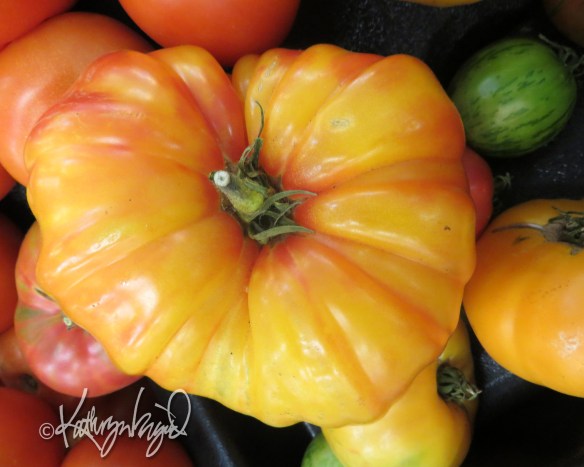
But for the most part, looks are terribly important, not only because in the rawest sense they can mean the difference between safe and unsafe eating but also because ultimately, we like food to stimulate our pleasure centers. So it’s not the worst rule of thumb to look around, when seeking ingredients and recipes, for things that have the inherent beauty we will respond to most happily, and that can sustain their loveliness throughout the prep and presentation arrangements.

Sometimes, of course, the best rule of thumb in the event is to simply eat the food as we found it, because if it looks pretty to start with it probably doesn’t need any plastic surgery from us ordinary non-chef mortals. See it, eat it. Pretty good recipe, pretty often.
photo

Foodie Tuesday: I’m Roasting! No, I’m Frying!


photoOh, I know, you all thought I was having hot flashes again. [Not that I wasn’t.]

But it’s Food Fun day again, and I’m referring to cooking edibles this time. Old broads still gotta eat.

And since much of the time I am thermostatically challenged myself, I generally try to find ways to make the hot foods I’m preparing require the least possible amount of time putting me in near contact with the oven or cooktop. Why risk further overheating, of either myself or my preparations, should I need to stray far afield from the heated zones of the kitchen.

One fairly easy solution, though it seems somewhat counterintuitive to me, is to roast or fry food. Yes, they’re relatively high heat methods of cookery. But by using them, I can usually evade the stand-and-stir duty: do all of the prep before even turning on the oven, then tuck the food into the would-be fiery furnace, set the temperature and timer, and head off to cooler climes until the alarm sounds for my triumphant return to check and/or finish the dish, and serve and/or eat it. Simple as that.

Roasted beetroot, for example, a nice way to enhance the flavors and textures of a cool late-summer salad, gets cleaned and quartered and then needs nothing more than a small amount of fat and perhaps a tiny bit of seasoning before it pops into the tanning booth. Goat cheese is delicious when lightly coated and shallow-fried, even if like me you’re not quite the culinary artist to present it with perfect Cordon Bleu pizzazz, and it takes no more than a couple of minutes, tops, at the cooker to brown that fine crumb crust.photo

Roasted Beetroot and Goat Cheese Salad

Scrub and quarter a handful of medium-sized beets. (Clean and save the greens and stems.) Toss the beetroot pieces with a little fat (oil or melted butter; I used coconut oil to keep its noticeable flavor to a minimum), salt and pepper and scatter them in or on a baking or roasting pan. Since I was making such a small (2-person) meal, I just made a pseudo-pan out of heavy aluminum foil to keep any juices from dripping around the oven. Roast the roots at 350°F just until tender–10-20 minutes, depending on your oven and the size of the beet pieces.

Meanwhile, pat 1/2-cup batches of cold chèvre (goat cheese) into patties and coat them with coarse almond flour, pressing it in on all sides. Quick-fry these in a little butter in a nonstick pan over medium heat. You can see from my photos that I am far from adept at this part, so mine look less like haute cuisine than like something unearthed at Herculaneum, but I assure you, they taste quite fine.

Using in tandem these two homely yet highly edible items plus a small assortment of others, you can quickly assemble a presentable version of some hotshot chef’s beetroot-and-goat-cheese concoction and your stomach will not be critiquing the view anyhow. My version, this time around, consisted of a few of the tenderer, prettier beet greens pared down to the leaf and laid on the plate, a bit of peeled cucumber slices arranged in a green frame around the rest of the plate, and all topped with the chèvre rounds and roasted roots and a sprig or two of fresh dill. I’m sure that roasting any sweet enough veg or tuber–sweet potato, carrot, pumpkin, parsnip for example–would make a similarly fine complement to the bright, fresh taste of the cheese, which in turn could be substituted for with any nice salty/sour cheese, undoubtedly.

Which of course leads me to another hot-weather or hot-mama advantage of this preparation: the leftovers (if any) lend themselves to innumerable variant cold, cool or room temperature dishes that can be popped out of fridge or freezer next time the climate or one’s overheated innards require such things. Behold tomorrow’s dish: minced beet greens and stems, steamed quickly in the microwave while the beetroot was roasting, and now blended with that remaining diced vegetal goodness, some leftover quinoa, some diced dried apricots, a few pine nuts, a little orange dressing . . . and the beet goes on . . .photo