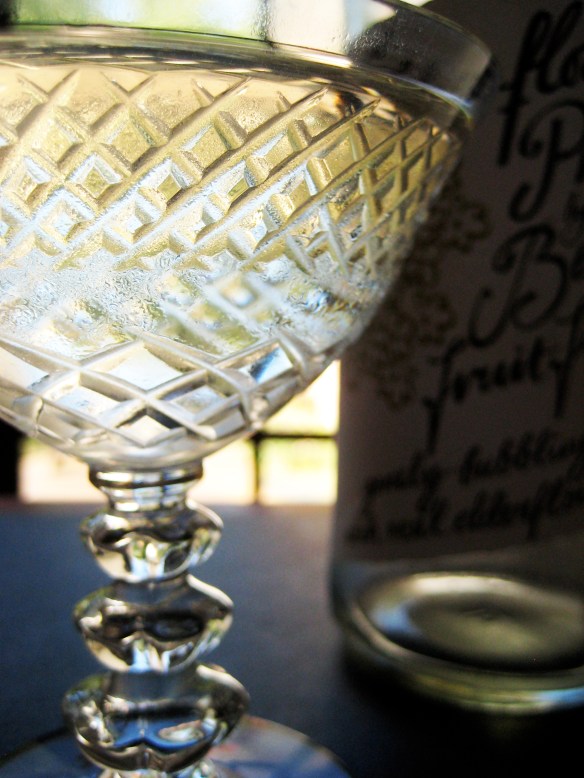
When you can't afford to drink stars, why not drink flowers?
Molecular gastronomists amaze me. Their mastery of elaborate concoctions and decoctions, deep-frozen and spherized and powdered and atomized into unprecedented works of art is impressive, often–I’m told–just as extravagantly delicious (though few can afford to find out), and almost always results in an astounding display of visual artistry of one sort or another. Many practitioners are also preparing and presenting highly refined acts of theatre. I stand in awe of and sometimes deeply moved by the concept of what the molecular gastronome does. And think that perhaps no kind of cook is as deserving of a “gnomic” title as the mad scientist of the kitchen.
Yet both because so few people can stretch our pockets to carry large enough quantities of that other essential dining ingredient, dough–in its vernacular definition as money–and because trendy palates are so easily jaded, the stage for molecular gastronomy’s expression is necessarily a very narrow niche apart from its conversational appeal. I hear that many of the most famed practitioners of this very art are indeed delving into a new branch of the kitchen sciences, or more accurately, going back to the attics and cellars of it, by reexamining antique cookery of all sorts. No matter how much we hybridize and transmogrify the ingredients or tweak, deconstruct and reassemble them, there is and always will be a relatively limited palette of possible foods we can use for the culinary practice. For every pallet of russet potatoes shipped to the kitchens of the world, there are only so many truly new things we’re likely to be able to do with them and still result in an edible item, let alone one we want to eat.
The beauty of revisiting and rethinking traditions and successes of the past is that there are so many forgotten treasures that deserve to be enjoyed yet again. But far more than that, it’s because it takes us back to where we came from as families, as cultures, as homo sapiens, and allows us to understand better how we fit in the world. Think, for example, of the people that first took up and swallowed a handful of their native clay, not knowing but evidently instinctively sensing that it offered essential minerals and nutrients that the plants and animals in their usual diet could not provide. Imagine being the very first person to taste a mint leaf, an oyster, a strawberry. To eat honey, of all things. These intrepid adventurers advanced human existence immeasurably. Imagine, even, your own first taste of any kind of food–what a revelation, a revolution, for good or ill that was!
And so much of the origin of any culture’s cuisine is full of wonders and delicious things that we should be loath to forget and lose. While I would never be one to turn down a good glass of champagne or sparkling wine, there have been many discoveries to equal the joys of Dom Pérignon‘s possibly apocryphal but nonetheless fitting sensation that in such a quaff he was tasting the stars. One of my own favorites is the drink that has been a standard from farm to fancy-dress for uncounted generations, an elderflower cordial. It’s like a light lemonade with great floral top-notes. A classic home brew in the British Isles and Scandinavia and probably elsewhere as well, it’s both delicate and distinctive in its light and heady sweetness. My sister, who lives in Norway and has nice elders growing near her house, makes fabulous elderflower cordial with the technique she learned there. I’m neither so skilled nor so patient, but am not ashamed to rely on well-made commercial cordial, whether in syrup form as in the kind I buy off the grocery shelf when in Stockholm or at IKEA when here, or as sparkling pressé like that produced by the charming Belvoir Fruit Farms (nope, not getting any sort of payment for sharing this personal endorsement with you! But you should go visit their humorous and quirky and refreshing website just for fun even if you think “flower soda” sounds appalling).
A mighty tasty lunch or supper treat that’s different from the usual for me but is extremely simple to prepare and satisfies both my sweet and savory hankerings is fried cheese with a dipping sauce. I love the crumb-crusted and deep fried cheese with a tzatziki-like sour cream dip that we get at Bistro Praha, a very favorite haunt in Edmonton for innumerable delectable and delightful reasons from the uniformly fabulous central-European cookery to the marvelous people running the place. But again, limited in resources to get to Edmonton whenever I wish or, barring that, to get quite the right ingredients and find time to bread and fry and sauce it all up properly, I can do a variant here that’s also wonderfully satisfying. I find a nice slab of Halloumi or Queso Ranchero or (as here) Juustoleipä or some similar “heatproof” cheese and fry it on medium heat in my cast iron skillet with just enough butter or olive oil to keep it from sticking (this time the skillet was conveniently still seasoned just fine with duck fat from last week’s lunch) and just warm it through until nicely browned on the outside, melty inside. I had this with a cup of last week’s beef bone broth on the side, so between the two savories, both a bit on the salty side as I prefer them, I wanted the dipping sauce for the cheese lusciousness to be sweet and a tiny bit spicy to offset that. I mixed plum jam and ginger preserves and warmed them with a little minced fresh mint, and that did the trick perfectly for my tastes. Jam, cheese, broth: all slow foods in their initial preparation, but once in the larder or fridge, they become almost instant throw-together happiness. And there is a decidedly old-fashioned appeal to such a meal that makes me glad so many of our illustrious ancestors were venturesome gastronauts in their own right.
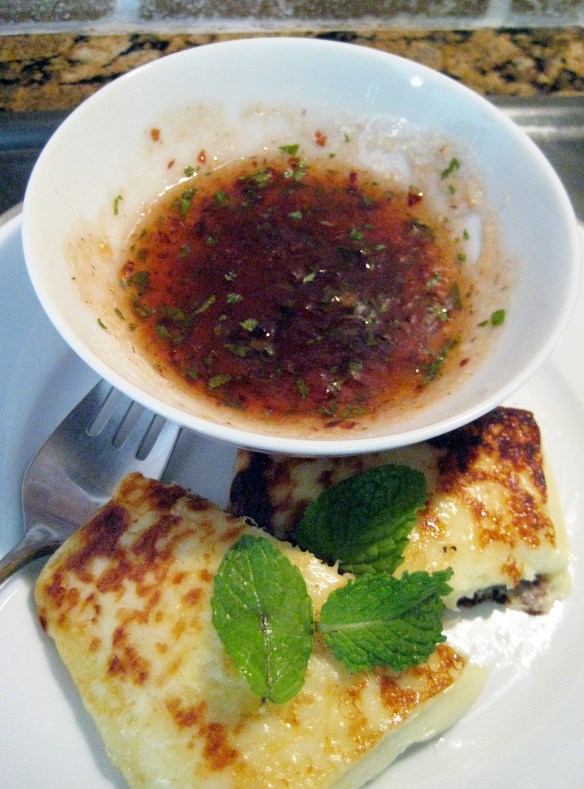
A simple repast is not a thing of the past, but it needn't be dull as dusty history either . . .


 But there are amazing and unexpected and even–gasp!–tiny details that also sparkle throughout the Lone Star State and help to make it far more varied and unpredictable than the image Texas has beyond its borders might lead anyone to believe. A spectacular water-lily park? Why, yes, that’s here. Masses of beautiful, delicate butterflies? Oh, yes, those too. I think it’s safe to say that not many people are likely to think of French food when Texas is mentioned, but not only does la cuisine Française exist in Texas, it’s even featured in an eatery in the also seemingly non-very-Texas named town of Humble. I mean it: Texas is full of surprises, and not all of them even Texas-big.
 See, that’s the thing about stereotypes, archetypes, assumptions and expectations. Generalizing about any place or culture may give us a handy entré to allow us the chance of learning to know it better, but it skims the surface of reality far too much to be dependable as a gauge for the whole of the thing. On my first trip overseas I was immediately struck by the odd conversations I overheard between the locals here and there and the American travelers. It’s not uncommon for natives to ask visitors what things are like where they live; what I found out is that it’s also pretty common for said visitors to pontificate as though their limited experience of life were the standard for all and sundry where they come from–not just all the folk in their house but all in their town, county, state, region–heck, I heard fellow US citizens abroad telling foreign nationals with utter nonchalance what ‘America’ was like. Just as though every part of America were completely homogenous, every US denizen interchangeable.
 I’m perfectly happy to state that not only is that a ridiculous barrel of hogwash but I have seen evidence very much to the contrary in places all over this country. Not to mention in the great state of Texas, in our county, in our town. Yes, in our own household. Texans do like their BBQ and their tall tales, their football and pecan pie and yes, their guns. The real secret, if you must know, is that no place is precisely, and only, like its image. No matter how small or grand that image happens to be.




 Art-Colored Glasses