I Find Respite in the Woods

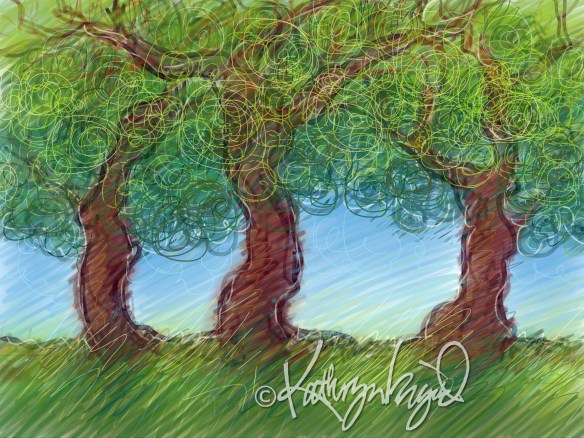
We all find our places of escape where we can. Having grown up in the Evergreen State and not far from both the vast forests of Mt. Rainier and the green refuge of the Olympic Peninsula’s rain forest, I have always found trees and wooded places a comfort and a place of safety and reassurance. No matter how deep the sorrow and pain, I have found strength returning to me and a gentling of the spirit poured on my woundedness in those times spent in the protective forest greenery. When I can spend time among the trees and relish their distinctive and individual beauties, I find myself rescued and my hope renewed.digital illustration

To the Woodland

Cedar, bless me with your resinous breath,

And oak, stretch down those knotted arms to me

And close me in, so others cannot see

My sorrow as I stand so near to death—

I come here to the woodland for relief

Among the leafy shadows of the glade,

Hoping to leave my sadness where I’ve laid

It here, a monument in shade to grief—

Sweet birches, bend your green to veil my tears

And weep with all the willows, as I do;

Great trees, for graces have I come to you

Each time that I grew mournful through the years—

I come here to the woodland for relief

And leave a monument, in shade, to grief.

This mottled darkness will give way to sun

Anon, as time flows on, and so shall I;

The dead still sleep, no matter how I cry,

And I must live, or my own death’s begun—

And I’ve much yet to live, and purpose find

In bringing others light who, too, repine

That have no pine-groves filled with peace like mine

As balm and rescue for a troubled mind—

Who know not aspens’ kindly whispered care—

Should all seek peace and comfort in the wood,

These mercies surely better us, their good

And healing gifts send us renewed from there—

So we’ll go to the woodland for relief

And leave in shade, as we emerge, our grief.digital illustration

Lesser Lights

digital illustration

The major stars are always more visible than those around them. It’s demonstrably true not only in the galaxies but in the more modest constellations of humanity. Our attentions are naturally drawn toward those who shine most impressively and dramatically—for good or ill; those more modestly gifted or less showy mostly find their own lights muddled or even eclipsed by the intensity nearby, and as a result we seldom spot and take note of them.

Even those of us who are not only accustomed to, but also aware of, being humbled and diminished by comparison to others’ flashier character can easily forget how this applies to others. Just because I might feel neglected doesn’t necessarily mean I notice others being equally shortchanged; indeed, it’s more likely that if I’m feeling under-appreciated I get too preoccupied with my longing to be Special and resentful navel-gazing to think that I’m probably in the majority rather than otherwise.

Still, there’s hope. Just as a supernova will someday burn to nothingness, human stars tend mostly to flash into the general notice, burn however brightly for however long, and be dimmed by eventual inattention or death. They, too, will eventually be outshone and/or replaced by other stars whose time has come.

And if I, or any other, should in the meantime feel unreasonably hidden from sight, we are still free to seek our own bit of gleam. For some folk, that seeking comes in ambitions for accomplishment and fame. For the rest of us, the surest way to kindle the blazing fire that gives off sufficient heat and light to be noted by anyone else is to turn our focus outward. Devoting energy, attention and love to causes and works outside of our petty selves, and especially to other persons, is the spark that, when kindled in their spirits, creates the steadiest, most lasting kind of light. Even the smallest and weakest among us shines brightly in this tiny act of selfless will.digital illustration

Psychedelic Psanity (an Orison to Orange)

digital illustration from a photoI’ve been known to be loud. I’ve worn bright colors, I’ve shouted, and I’ve been opinionated. Much of the time I’m more modest and even occasionally somewhat self-effacing, and more often than not I’d rather anyone else be the center of attention, but once in a while I do just let
‘er rip and enjoy the noise.

It’s possible that my sometime dislike of bright orange reflected my then predominant shy and introverted parts. When I was little and not yet worried about others’ opinions of me, I chose as my first self-selected garment a coat of the color in today’s illustration, and I wore it proudly and felt like a (miniature) queen in it. Now, ten years after beginning useful treatment for that nasty old anxiety-and-depression cocktail that had drizzled over me in the many subsequent years’ passing after that coat purchase, I appreciate bright orange again. But in that middle time I was a nervous and insecure type and orange was far too ebullient and exotic and full of uninhibited good cheer for me to even look upon it without a twinge.

You know what, though? ‘Orange’ and ‘twinge’ may end with the same sound, but they sure don’t rhyme, and I can’t think of much else they really have in common either, so why should I let the fact that I look awful in that color (never mind my generous childhood self-image) steer me away from delighting in the joy and sunshine that orange represents and just allowing that loud, reckless, gleeful color to shine all over me. Maybe even though I might not be able to be orange enough myself, I can reflect the joy and sunshine of orange a bit. Whee!

Leave the Lights On!

digital illustrationWhile I’m closing out an old notebook that I kept in blog form a number of years ago, I found yesterday’s post and this companion one. So what the hey, I’ll share this one with you, too.
It’s Thanksgiving Day [2005!] and I am particularly thankful this year for having celebrated a whole year of emergence from clinical depression. For anyone out there who has been mired in it, or still is, I send out a fiercely made wish for your recovery and new joy in life, along with this meditation I wrote after realizing not only how far and how long I had been away from my true self, but the cultural setting in which it is possible to get there without realizing it or even having others see it clearly.And with deep thankfulness that it is possible, with help, to be revived.* * * * * * * * * * * * * * * * * * * * * * * * * * * * * * * * * * * * * * * * * *

Let’s stop all this rubbish about Depression as a romantic notion.

The myth of suffering being necessary to ennoble the spirit or, more commonly, to shape creativity and artistry and the personalities that foster them, is an inaccurate and unhealthy construct that belies the potential power of sanity and contentment. The idea that much of the great art that has sprung from the work of troubled or diseased artists throughout history would have been impossible, or the artists Not Themselves, if they’d been well or happy is simply a gross assumption of the inflexibility of the human spirit at best, and an insult to mortal intelligence, invention, and character at worst.

In a telling moment of literal as well as figurative turning-on of the lights, participants in a 2004 Canadian study on Deep Brain Stimulation as a possible treatment for otherwise-untreatable depression noted that the world became a visibly, physically brighter place when “area 25”, or the central zone of depression response in their brains, was stimulated to relieve depression. Many of the patients described a distinctive, even poignant, instant of pleasurable shock when the electrode stimulation, suitably placed, flooded them not only with unaccustomed sensations of contentment and ‘rightness’ in their world but also a clearly discernible brightening of their visual perception. It was as though, one commented, he had suddenly remembered a whole range of colors and values and sensory impulses and emotions that had been locked away for decades.

Nowhere in this was there any indication that the participants in the study experienced a negative change in their self-concept when their depression was eased. No mention is made of the patients losing their creative impulses or intellectual depth. Not a note of regret or sense of personal diminution.

The breezy optimist, on the other hand, is not by definition dimwitted or shallow or uninspired. While cultures that have embraced a darkly Romantic mythos of the suffering genius tend to dismiss brilliance that emerges from happier sources as a fluke or as slick, glib cheapness that won’t withstand the value-test of time, many stars and their accomplishments defy those definitions.

Yes, depressed, manic, even twisted and tortured souls with the deepest of psychological, physiological, or chemical-addled warps and wounds have been the vessels and sources of high art and equally high drama, but they are far from alone in that. To say that they only achieved their greatness because of their damaged state is a cruelty, an insult, and a cop-out that says we all could not be greater than we are, if not equally “gifted” with darkness. If being let off the hook ourselves is what we seek, then let’s just be honest and say we don’t relish the burdens of effort and experimentation and get on with other things. I have a suspicion, as it is, that if there’s a notably higher percentage of mental illness among persons who could be classified as particularly ‘creative’, then the cause/effect relationship is one of persons being used to having to problem-solve their way out of unusually difficult circumstances on a regular basis, and so developing stronger problem-solving (read: creative) skills.

Meanwhile, cheer up! Look at the dazzle that being joyful brings. See the energy and wit that, when not wasted on grief and moroseness and morbidity, can be devoted to pursuing greatness instead, and run after it with childlike delight.

The Ordinary Romantic

I’ve not re-posted anything from my own blogging before that I can recall, but happened upon this (admittedly lengthy) piece I wrote a number of years before I even started this present blog and was reminded of a few things I’ve said here but in quite different ways. So I share it with you now, lightly edited to update it, just because it piqued my own interest once again. Cheer up, my friends: I love that this is written from something like an outsider’s view of the experiences of depression and deep melancholy, after all these years!digital illustration from a photoI highly recommend reading the book I just finished reading [when I originally wrote this post], Peter D. Kramer’s ‘Against Depression‘. He’s the author who wrote ‘Listening to Prozac‘ – a book that, surprisingly, wasn’t really about depression or even Prozac, per se, but due to its bestselling status raised those two specters so frequently that he finally had to respond with this book. He has some sections in it dealing specifically with the effects of depression on arts and creativity, intellect and education, and vice versa. But there’s also a ton about the physiology and pathology of depression, the affect and effect and the impact on self and others. Very thought-provoking for me.

If you want a really scary companion-piece before, during or after the reading of that book, one that for me confirmed the urgency of wellness by any–no pun intended–sane means, look up ‘My Lobotomy‘ – it was a presentation on NPR that horrified me more than umpteen war- and disaster-stories (including true ones) and makes stories by Edgar Allan Poe and Stephen King sound like skipping through a copse picking violets. ‘Lobotomy’ is the harrowing memoir of a lobotomized man who, at 56, finally got up the courage to investigate and explore what happened to him when he was operated on at 12, why it happened, who else was affected, and much that followed. Incredible. Terrifying. I can barely even think about it. But it did make me feel all the more intensely that I want to stay in charge of my own mental health just as much as I should my physical health.

For the moment, since I’ve so often been asked, I will say that when I call myself Ordinary, what “ordinary” means to me is wide-ranging and a bit variable, but in the sense I’m using here in the land of my blog, it covers all of what seems possible, believable, normal or otherwise expected in the universe of human experience. More significant, perhaps, is defining what it doesn’t mean for me: things found at the extremity of experience: brilliance or genius or unearthly, once-in-a-lifetime skills, talents, and insights. Me, I’m not interested in being a supernova. They tend to burn out fast anyway.

What I really pride myself on is taking the simple raw material of being a middle-of-the-road mortal and managing to pull out of that clay my own few moments of dazzle – an outstanding artwork here, a worthy kindness there, and a few sprinkled bon mots or glorious deeds in between – these shine all the more in the setting of my ordinariness. People take note of them precisely because they are deserving of note–because coming from a typical luminary or wunderkind they would be the expected thing, no matter how exciting, and from me they are not. There’s no intrinsic negative value to ‘ordinariness’ for me, no implication of self-abnegation or false modesty, just the sense that only a few in history are genuinely set apart as spectacular examples of either desirable or undesirable traits and gifts, and we in the main herd can still go on and live rich, full, complete lives just as we are. With maybe a little less pressure to perform, too, so that anything extraordinary we do actually shines that much the brighter. Surprise! Aren’t I fabulous!

Why do we see ten tortured geniuses for every happy one? I think it’s primarily a function of taste: the culture that covets over-the-top emotion isn’t interested in supporting and reporting anything that doesn’t have that dangerous gleam. Good news is no news. If the artwork is upbeat, it must be tacky and shallow. If the artist is happy, she must be an air-headed clown. Prettiness and simplicity and everything that pleases the mainstream must, by definition, be playing to the lowest common denominator.

I’m actually a dyed-in-the-wool Romantic myself, but I have been contemplating that old adage “write what you know” and decided that it lends itself to far too tiny a concept of possibility. In the first place, if taken strictly it would mean that we should automatically dismiss as useless falsehood any attempts at empirical or even historical writing, because practically everything that has been once believed absolute has taken on different shadings over our cultural lifetime, if not been disproved. Never mind how we should treat the authors of murder mysteries and crime novels! The aphorism may be a needless dictum or even a myth: one doesn’t necessarily have to BE suffering to appreciate what suffering is. And perhaps anyone who has suffered in the past can be considered to have earned the stripes of exactitude anyway and can rely on recollection rather than continuing to wallow.

There is certainly a bit of truth when people insist that others can’t know what they’re going through; in its most complete sense, I’m sure that’s accurate. But anyone with a little life-experience and the ability to sympathize or even–if imperfectly–empathize, can puzzle out in his or her own way an approximation that makes communication of it possible in art. And, frankly (this goes back to that idea of an Ordinary person doing something Extraordinary), if I can make someone slap his palm to his forehead and go, “YES! That’s what I’m talking about!” when they recognize a shared feeling or insight, then I think it’s all the more memorable and impressive, not the predicted brilliance of some savant.

So thanks to the perpetual discussions of such topics with colleagues and friends and given my understandable interest in depression and its effects as well as more strictly Romantic artistic concepts, focus on the impressive influence and hold of Romanticism on all our lives, I continue to search. If Romantic ideals glorify and sympathize with a dark world-view, with sorrow, cynicism, pain, suffering, and so on, and if arts and beliefs that support those ideals are valued, then how can we respond to things that defy or fail to uphold them? How can we wish to be happy and healthy if what we love is, really, decidedly neither? Since the prevalent taste for Romantic qualities has been in vogue for a number of generations, and cultural memory is dangerously short, few recollect that being In Love with Darkness is a relatively new trend in recorded human history; an externally imposed one at that. As with so many of our beliefs that we take not only for granted but as eternal, immutable fact, all is not necessarily as it always has been or will be. There are larger patterns in the life and development of art, history, healthcare, personal experience, politics, and religion that act and cycle broadly, often inducing in each other significant change as they intersect along the way.

As Dr. Kramer notes in his excellent polemic against depression, even tuberculosis used to be idealized. People who had Consumption were presumably consumed by the unusual intensity of their inner being: larger than life passions, intellects, artistry, love and spiritual astuteness were all attributed to these dramatic sufferers. When it was finally seen that that oh-so-sexy tuberculosis was in fact not only a genuine physiological disease but also a degenerative, communicable, and difficult to treat pathology, and that it would not only kill the patient eventually but also deprive the rest of us of those idols, the tide began to turn toward the desire for palliative care and cure. Depression, also arguably a disease of at least equally destructive dimensions, and demonstrably damaging to such physical attributes as brain tissue and adrenal glands, not to mention to social structures surrounding the patient, is certainly deserving of the same considerations.

So what do we do with our Gothic worldview? Give up our love for the dark? Hardly. Strip it of its value and depth? Not likely. Perhaps, though, we can rebalance the scales a little and say that it’s no longer chic, let alone necessarily accurate, to assume that all things pretty and pleasant and uncomplicated and cheerful are stupid, dull, vacuous, or shallow. Realistically, we’ve all seen attempts at art that cling to the Romantic ideal and yet manage to be stupid, dull, vacuous, and/or shallow. And, as I constantly remind[ed] my beginning art students, one of the hardest things to accomplish well is simplicity. When you take on the task of making a work that appears simple, you make yourself vulnerable to every would-be critic who can find the tiniest flaw as it stands out against that backdrop. Because you have tackled the familiar, it takes far more sophistication and subtlety and inner resource to make the work distinct and worthy, not just a good imitation of what has been done before. Anything can be badly executed, art or otherwise. Anything has the potential to be scintillating and brilliant.

The difference should lie not in one element alone, especially not some preset element like whether the theme is Dark or Light, but in the miraculous confluence achieved of content and intent, medium, methods, and moment. Is it beautiful? Is it successful, deep, lasting, influential, meaningful? We will, and should, continue to make value judgments and assessments and be willing to revisit them from time to time. Because beauty and meaning, whether you believe they’re strictly in the eye of the beholder or not, can change as the beholder’s eyes are changed by a life full of adventures, by time and tide and every nuance of history that washes over us. It should be equally visible in full, bright Light or in cavernous Romantic darkness.
Death is Never Out of Season

photoDid I worry you for a second? Never fear, friends; I’m not going to be a big old humbug, let alone a grand tragedian, here. It’s just that, living where I live, I’m always in the shadow of some circling or perching vulture sussing out his or her next all-you-can-eat buffet. I’m pretty sure that I too would look fairly delish if I just had the kindness to croak somewhere out in the open within a vulture’s purview, yet they don’t turn up their beaks in disdain at smaller game. So I can get a regular reminder of my mortality just by looking over in the tall grass next to the road, where there is often a vulture or two munching on someone else’s gnarly remains, any time I need said reminder.

I am, as you’ve seen if you’ve spent any time around this blog, of the school that still has an appreciation for a good memento mori as a reminder of the fine and great and joyful things that being Not Dead can have to offer. It’s just about time for the biggest holidays of the year in many cultures, and as workers in the life-supporting jobs that include medicine and law enforcement and social services will tell you, depression, health crises (both physical and mental), family violence, crime and all sorts of other terrible social ills tend to peak. Unreasonable schedules and outsized expectations of delirious happiness around holidays and other celebrations are practically doomed to failure, and even those who are fairly realistic about their expectations may have actually built in a sort of assumption of disaster that only adds to their stress.

Letting go of a lot of this overwhelming and impractical perfectionism and most of the silly entitled assumptions that the world owes me satisfaction and pleasure has greatly simplified my life. It has certainly lightened the load of worry and wishing. And every time I walk under the perch of a local vulture and look up at it as a fellow living creature, I am thrilled to pieces that I have the greatest way of all to celebrate whatever holidays and special occasions I want to enjoy: alive. Not particularly wanting, not overburdened with Stuff and needs and promises I can’t keep, and simply, happily Alive. Just having one of those massive birds circle over my head without interest in me as an entree reminds me that death is close at hand, since the avian beast is clearly keeping a keen eye on something nearby that is already deliciously deceased, yet also says that I am not quite yet on that side of the equation and can go on to enjoy my holidays. Kind of makes every day seem more worth the celebrating.

Another Totentanz

digital illustrationTo Rest in Peace

Alas! for shadows carve my collarbones

and misery is lapping at my heels;

Death’s machinations turn, wheels within wheels,

and grind me for its grist between cold stones–

And yet, as dust-dry as I turn, breath blooms

persistently, a torture to my soul

when I had rather be devoured whole

and go on into Peace’s empty rooms–

Still, here I stay, lie atomized, forlorn,

forgotten on the fringes of what life

and loves I knew once, when my days were rife

with possibility as a new morn–

Let me die now, not live without a chance

of altering this endless Totentanz.

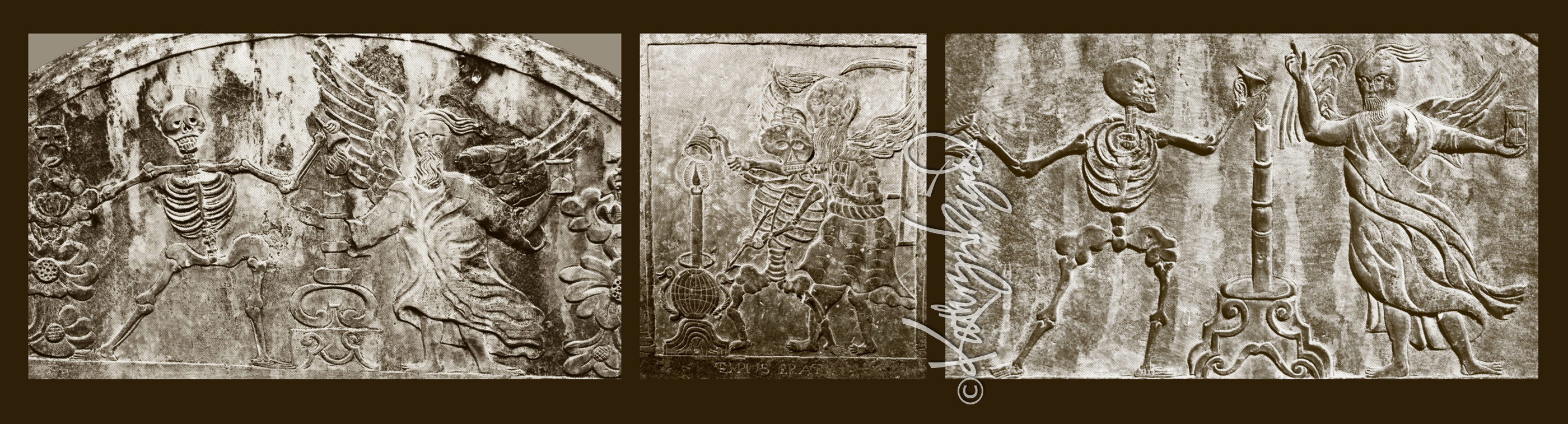
Lest you think me suffering myself, or pessimistic, I assure you I am alive and well. It’s just that I have seen many others struggle with prolonged and pitiful end-of-life dramas and was reminded this June when I saw the beautiful antique gravestones in Boston of how different things are now, when we have such nearly unbelievable powers to keep ourselves alive for tremendously long lives but have lost touch with when it’s acceptable or even desirable not to do so. If our skills for ensuring or encouraging genuine quality of life are far outstripped by our skills for lengthening it, what does that say about us? Generations removed from our forebears, whether in Boston or elsewhere, who knew much more primitive medicine, greater physical dangers, irreparable injuries and the concomitant shorter lifespans we have apparently long since forgotten, do we know how to accept death as a natural end to life and treat dying as a passage to be eased to the fullest extent instead of forbidden?

From Heavy as Lead to Light as a Feather

graphite drawingThere are places I go, whether on foot or by car–whether passing through or staying a while–that are like instant decompression chambers for me. Whatever has been weighing on my heart and mind seems to fade away into the distance with every step taken, every thousand feet traveled by car, bus, ferry or train. Flying used to be in that category too, but post-9-11 security hassles and the resultant grumpiness of the industry and travelers alike has meant that I need some of that other kind of travel just to recover from the flying days anymore. But that other kind, oh, it’s amazing how much it can do to change me.

I’ve had the sort of trip that was more like a descent into the maelstrom as well. The true recognition of my need for therapy and medication for my clinical depression didn’t happen for a long time over the years of sliding downward but rather in the few hours of being driven home from a long weekend getaway in a favorite decompression place to the place where my depression was gathering up a thunderhead over me at work, when I simply started crying and couldn’t stop. It was a dark, grim day for me (not to mention for my poor husband the driver), but it was at least purposeful in bringing out into the open what had been lying hidden in me for ages, and in leading directly to my finally seeking and getting the help I needed. What’s more, thereafter when I or we took off on any of those favorite walks or rides of renewal and anticipation and refreshment, it actually worked again, and the good wasn’t undone by the return lap of the journey.

It’s been a good long time since that ugly, interminable day of rain and tears. My life is inexpressibly happier; even though I had been able to find much happiness to paint over that swinish inner angst and agony, it was still only a pig in lipstick until I could remake myself rather than trying to remake the rest of the world to distract me from my own brokenness. That, in itself, was a journey of letting go of unwanted burdens and lightening my attitude and perspective. And it made me so much the better able to appreciate and regain that wonderful sense of freedom, the shedding of cares and escape from ordinary and tiresome things that comes when I take off on one of these expeditions. Short or long, real or imagined, they let me let go of what small troubles I might have, take a deep, strong breath or ten, hold still in awe and enjoy what is right around me, and then come back to the rest of life with a renewed ability to find beauty in them, too.

Back from the Brink

photoBurnout. Tension. Stress. Exhaustion. Doesn’t matter what I call it, the unfriendly truth of that state of being is the same. Distraction. Aching and malaise. Irritability, withdrawal, collapse. The dramatic drops in life participation and wholeness all come together in equally unpleasant responses.

What are the causes, catalysts and triggers? As many and varied as the moments of any lifetime, of a million lifetimes, can allow. How is it that I–or anyone else on this madly spinning globe–can survive such stuff assailing us, let alone prevail against it and win?

Why, in a number of ways, we all do it pretty much all of the time. That’s how our species can even continue to exist; if we didn’t have a whole arsenal of defenses and strategies for the cosmic battle, it would’ve taken little more than a moment’s stray breeze to blow us all to oblivion. But vulnerable and weak as we are, we do have our ways, and we survive.

Faith. Whether it’s the belief in something as grand and benevolent as a Supreme Being that will rescue me or in something as small and ephemeral as the offer of a stranger’s hand to grasp mine and pull me up, faith can overcome many an obstacle.

Hope, too. If not utterly confident of it, as long as I can summon a sense that there’s some probability or even possibility of better things ahead, I have a chance of mustering just enough strength, patience and will to wait for the good to come to me. I may not be able to reach for it myself any longer, but I can hang on, however thinly, to a promise of change and renewal. For the return of the light.

And love. When all other resources are at their lowest ebb, even faith and hope having withdrawn in the impenetrable distance, love can carry me through. I have a greater store than most, being surrounded as I am by not only the encouraging affection and support of spouse, family and friends but also the remarkably kind uplift I’ve received at the hands and words of a wide array of acquaintances and strangers buoying me in my life over every would-be catastrophic wave. Beyond even this, there is another love that serves me well, when I can remember it: the love inside me that, however pale and faint it’s grown in my weakened state, recognizes a need to care for and comfort others in their time of need. The moment I can step outside of my own need, my hunger, despair, anger, longing or sorrow, just enough to recollect the existence of anyone else, I tend to draw back, however slowly, from the brink myself.

I can look around again with eyes less inward-focused and with a heart more willing to keep living, hard as it may seem at the time, and crawl back toward more gracious and sanguine days. My fellow survivors show me how to do it all the time. In this, I am once again truly at peace.digitally enhanced photo

Nobody Loves Me, Everybody Hates Me . . . *

photo

. . . Think I’m Gonna Go Eat Worms! [Note: no actual worms were harmed in the making of this photograph.]

Yes, it may be true that no man is an island–we all depend on others far more than we even recognize or comprehend–but conversely, every one of us is his or her own unique and seemingly isolated version of Three Mile Island at times when it comes to having personal meltdowns. It starts right at birth, when most of us scream and complain at having been removed from that ever-so-pleasant resort and spa, Mom’s innards, and ejected unwittingly and unwillingly into the cold, cruel world, and it continues, however sporadically, throughout our lives. We are such fragile creatures.

The majority of humans, happily, are not subject to this dark reality for too large a percentage of our lives, but it’s more common than is commonly discussed that we have trials, tribulations and the varying degrees of inability to cope with them that make us question, if not our sanity, then certainly our ability to rise above what’s bad, get a grasp on the good, and move forward regardless of feeling worthy or curable. Depression truly sucks–not just in the vernacular, but in the sense of pulling one down into a bottomless abyss like an evil and irresistible vortex.

I’m not referring, of course, to ordinary grief or sadness. We all get hit by those monsters at times. We flounder, we suffer, we recover. It may be deep and painful and take a long time to rebound from sorrows of even the most normal sort, but we do, eventually, learn how to go on living and being and take part in the doings of the world. Generally, that sort of difficulty or tragedy even tends to gradually heighten the sense and appreciation of what is good and joyful once we’ve experienced and survived the dark and can see the shining contrast of even a modest pleasure with what appeared insurmountably grim from its midst. True clinical, chemical, physiological depression, well, that’s a different thing.

It resists the most persuasive and intelligent logic. It batters self-worth and love in the most brilliant, gifted and accomplished sufferers. It tears at relationships of any sort with other people or with action, with one’s wit and will to survive. If it doesn’t make one outright, actively suicidal, it can simply kill through atrophy and attrition: sufferers have described the state of longing intensely to kill themselves but having no strength or energy to do so.

Why would I talk of such dire and dreary and horrid stuff, even think of it at all? Because I am reminded sometimes of when I used to be there. My worst bout of depression was perhaps aided and abetted by various situational and temporal aggravations, including the typical catalysts and intensifiers of real-world health and happiness threats: the onset of my spasmodic dysphonia, job problems, the murder of our good friend. These were of course widely different in intensity and timing, but to someone like me, their interaction with my evidently wonky endocrine system or whatever combined forces of chemical and biological imbalance were building in me meant that when I hit bottom, no amount of thoughtful and heartfelt reasoning with myself could ‘fix’ me or my situation.

I am one of the true Lucky Ones. I finally felt so brain-fogged, so unable to resist the pull of that deadly sucking, enervating, soul-destroying feeling of pointlessness and ugliness and being unlovable and incapable of doing anything meaningful or good–well, I got so needy that I actually let others help me. That was it. The only way out of the hole was to grip the hands reaching in toward me and let them do all of the work of pulling me out. Part of it was accepting these helpers’ assurances that they did indeed believe in me and in how I felt, that they loved me and knew that I had worth and potential. Part was letting others lead me around and taking their advice and simply letting go of what little shreds of ego I had left enough to say that I would do better in following an educated and experienced prescription for improvement than I’d been doing on my ever-weakening own two feet. And a part that was essential for me was loosening my grip on my insistence that taking prescribed treatment–both psychological and chemical–without trying to create or control it myself was a sign of weakness or failure. It took, in fact, all of my strength and intelligence to recognize that any strength and intelligence I had couldn’t save me.

The luck involved is clearly that together we (my caregivers–medical and personal–and I) did find the combination of therapeutic treatments, behavioral changes and chemical re-balancing medication that not only unlocked my present emergency state of depressive existence but ultimately proved to let me feel fully, wholly myself for the first time in my life. I know that this is not a cure but an ongoing process for as long as I live. And, having lived both ways, I am more than happy to take on that responsibility. It’s a privilege.

What’s most beautiful of all, for me, is that when it happens (as it has in this last couple of weeks) that several occurrences and situations conspire to remind me of this my past and how it shaped my present life and self, it also reawakens in me the profound gratitude for all of those complex minutiae that converged so miraculously well as to make this life possible. To make my continued existence at all possible, perhaps, but particularly such a happy me. What seemed like the most disastrous and irreparable of confluences instead conspired to make just the right blend at the right moment that finally offered me a rescue.

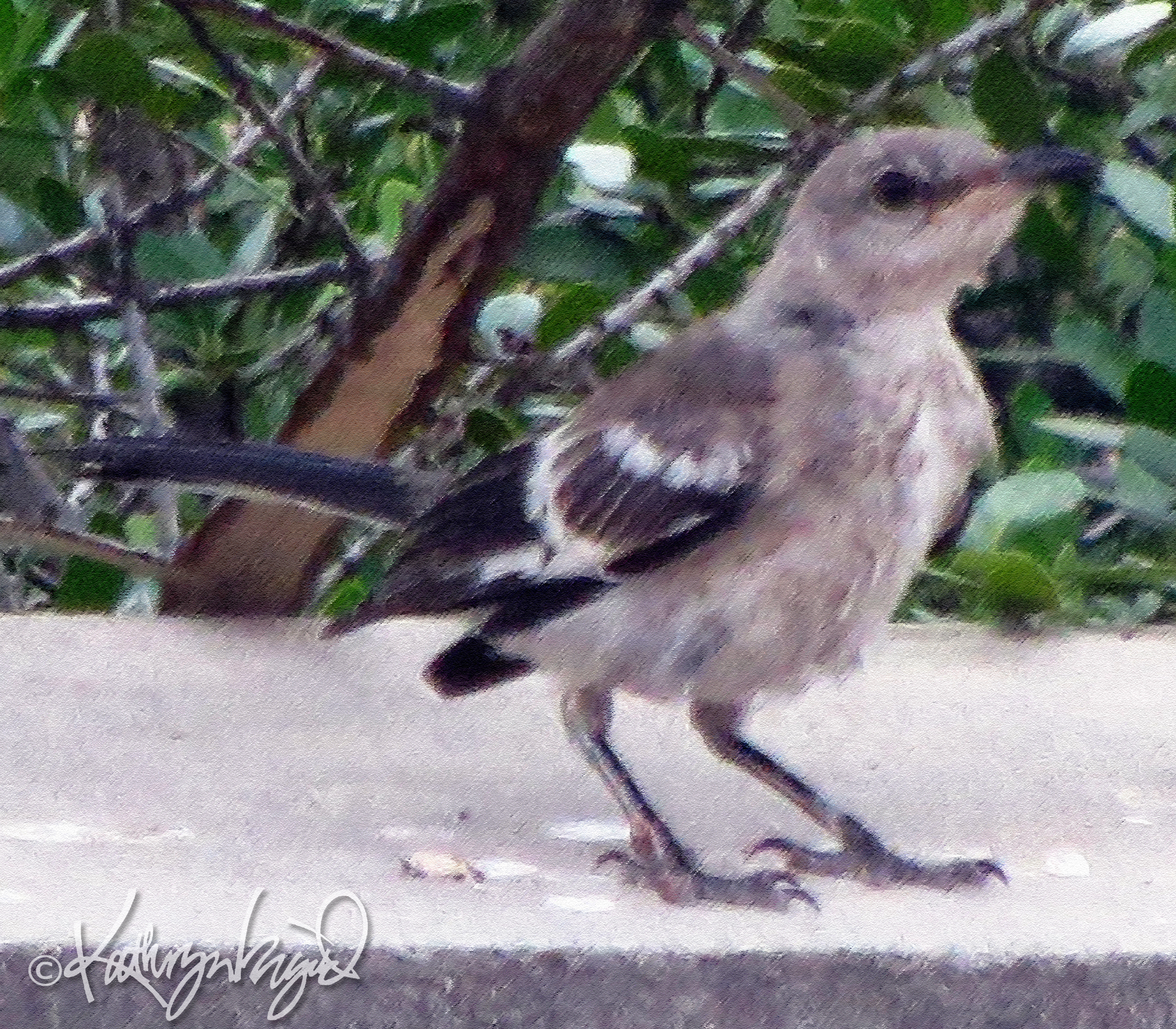
Turns out that eating worms is the very nourishment that makes some birds healthy enough to sing their hearts out with the pure delight of existing. Last week I was out walking and saw a ditch full of drowned worms, lured into and killed by stormy waters. This week I was walking the same route and the sky was filled with the most spectacular warbling, chirruping, musical bird songs I could hope to hear. Coincidence? Very possibly not.digital illustration from a photo

(* from the old campfire song Nobody Loves Me, Everybody Hates Me . . . )