


Life as we know it in the present day is characterized as a hurry-up-and-wait proposition. We tend to bemoan the pressures at both ends of the spectrum with something like a sense of martyrdom, thinking this push-pull unique to our era. But it’s always been so. One only has to study a smidgen of history to recognize the same complexities of speed and sluggishness, and note the same anxiety regarding both, in our predecessors.
Now, I’ve never been pregnant or had a child of my own, but I have it on reliable authority that that process is rife with opportunity to experience the perfect distillation of both forms of anxiety. I can say, from my years of babysitting and cousin-watching and then a couple of decades of teaching, that regardless of the legal or moral or biological relationship, the ties we have with those younger than ourselves bring out such parental fears, anticipation, dread and excitement with greater intensity than pretty much any other kind of connection can do. Terror and hope will always intermingle in the heart if we have any concern for the young, filling the stasis of Waiting from the moment of their first cellular appearance and well beyond into full adulthood. Life and safety and comfort are all such tenuous things, it’s a wonder we don’t all burst into spontaneous flame from the sheer tension of our worries and our desires. The only assurance we have is the history demonstrating that our forebears somehow survived their concerns over us, and theirs in turn for them, back into the far reaches of historic memory. The tipping away from apprehension and toward faith in what lies ahead is the gift that enables us to wait, no matter how illogical and impossible it may seem.
Heart’s Metronome I
Each breath I draw could cauterize my lungs,
The ice in it a straight geometry
Of arrows pointed, or a ladder’s rungs,
Down to the inmost shrinking core of me–
I fear, I fall–I, frightened, inly veer
To shy away from such an icy blast,
And slipping on its planes, so disappear
From my entire future and my past–
And hang suspended in this present cage,
Unstuck from time and yet stuck in it too,
As cold as winter, death, despair or rage,
And all for fear I’ll not be loved by you–
There is no deeper loneliness than this–
That I should feel unloved amidst your kiss.
Heart’s Metronome II
One moment in an icy terror’s grip,
And yet the next, I’m bathed in jeweled flame;
How can it be that I may swing and slip
Between two distant worlds whose blazoned name
Engraves in me with equal force and pow’r
Identical, yet attributes apart
Change me by seconds much as by the hour,
Into a whole or broken kind of heart–
Because unfounded did I find my dread
That when you kissed me, elsewhere was your love,
And when I feared it must be null or dead,
It was the spark that made our hearts both move–
So on the instant turn both life and death,
When love enlivens this one dazzling breath.
Moths have a potent duality of effects on me: they attract and repel with just about equal force. On the one hand, there is their Victorian opulence of velvet wings and ostrich-feathered antennae and their widely looping sweeps of flight as if borne effortlessly on air currents themselves rather than lofting on and above them under power. They can look like jewels tossed into the air or, as hawk moths can sometimes do, trick the unwary watcher into thinking they’re bright, buzzing hummingbirds on the wing.
On the other hand, that sort of squishy, bloated, heavy softness of moths’ bodies and their voracious appetites for things I’d rather have kept to myself (dry goods in the pantry, tender leaves in the garden, and favorite fine woolens) fills me with nervousness that makes the revulsion they inspire in horror stories utterly plausible to me. I can’t help but remember the sweltering summer night when I was young and my family, having been out for a happy holiday evening, stopped at the local gas station to refill the bottomless tank of our giant station wagon; since it was so sweltering, we all piled out of the car to go into the tiny, grubby cashier’s hut where an electric fan was humming and, having an uneasy sense of something untoward behind me, I turned around to see a veritable dust storm of fat moths, attracted by the shop’s fluorescent lights, throwing themselves in spongy, flapping frenzy at the glaring glass until it was almost opaque with their wing-scale dust. Oh, yes, and the fabulously nasty short story ‘The Cocoon’ (John B. L. Goodwin) has never quite left my subconscious mind (awake or asleep) once I read it a few decades ago.
On top of all this, I married a guy who had once had a small moth fly into his ear, get caught and frantic, and instead of finding its way out, worked its creepy, fluttering way right down to beat against his eardrum until a doctor could eventually get the creature out of there. Enough said. I can still look, at times, with a certain dispassionate interest and think of moths as intriguing bits of scientific wonder and visual astonishment, and then I must quickly look away again and reassure myself that there’s not something truly wrong with them. I did at least decide to write a little bit to see if, in the incident of the attack on my husband’s ear, I could imagine the experience from the moth’s point of view.
Labyrinth
I crawled the narrow halls in
Darkness ever deepening,
Thinking I might find some clear way through
But too tightly fitted in, too close,
No chance of going back or backing out,
No scent I could recognize to bring me
Back to the distant shore,
No vision, not a speck of spectral light to give
A guide around those curves crepuscular, those turns
Winding ever more toward claustrophobia, to where
The heat was growing more intense, the sound
Of a pulsing drum seeming to speak of waves, making
Me dream the ocean lay ahead—but behind me, in
The now impenetrable night, some Thing, a dragon
It seemed to me, began to drown the liquid lure
Of the drumbeat ahead with its own more frightful,
Louder noise, and then to scrabble wildly at me
With its terrifying claws, at which it seemed
The labyrinth must finally swallow me and
Draw me down into its fatal end—but then—
In a turn of events that was quite shockingly detached
From any turns my path had made
Thus far, the whole puzzling place tipped
Over on its side—there I lay, too fixed
In the halls’ constricting ways to turn and follow or
To roll, and the sea broke forth on me at last, a rush
Of saline waves tearing upon me, heaving me out
Of where I’d wedged, and in a cataract, sent me
Blasting right back through all the sightless turns
Of that preternatural dark, shot me with my sodden
Useless wings back into blazing day where I
Could lie, quivering faintly in my long-lost world,
Deciding whether it was time to die or time
To spread my fragile wings and see
If there was any life left in them.
Even though Halloween itself has never been a huge event in my life, you may, just possibly, have noticed a rather dark tinge to my humor (if such a thing exists) that pervades the year regardless of its official celebrations. So I’m hardly above taking advantage of the approach of a publicly sanctioned excuse for some of my own cheap brand of funereal jocularity. I plan to shower you with gloomy silliness as the holiday nears, so if you’ve any fearful tendencies, pull up the covers and plug your ears.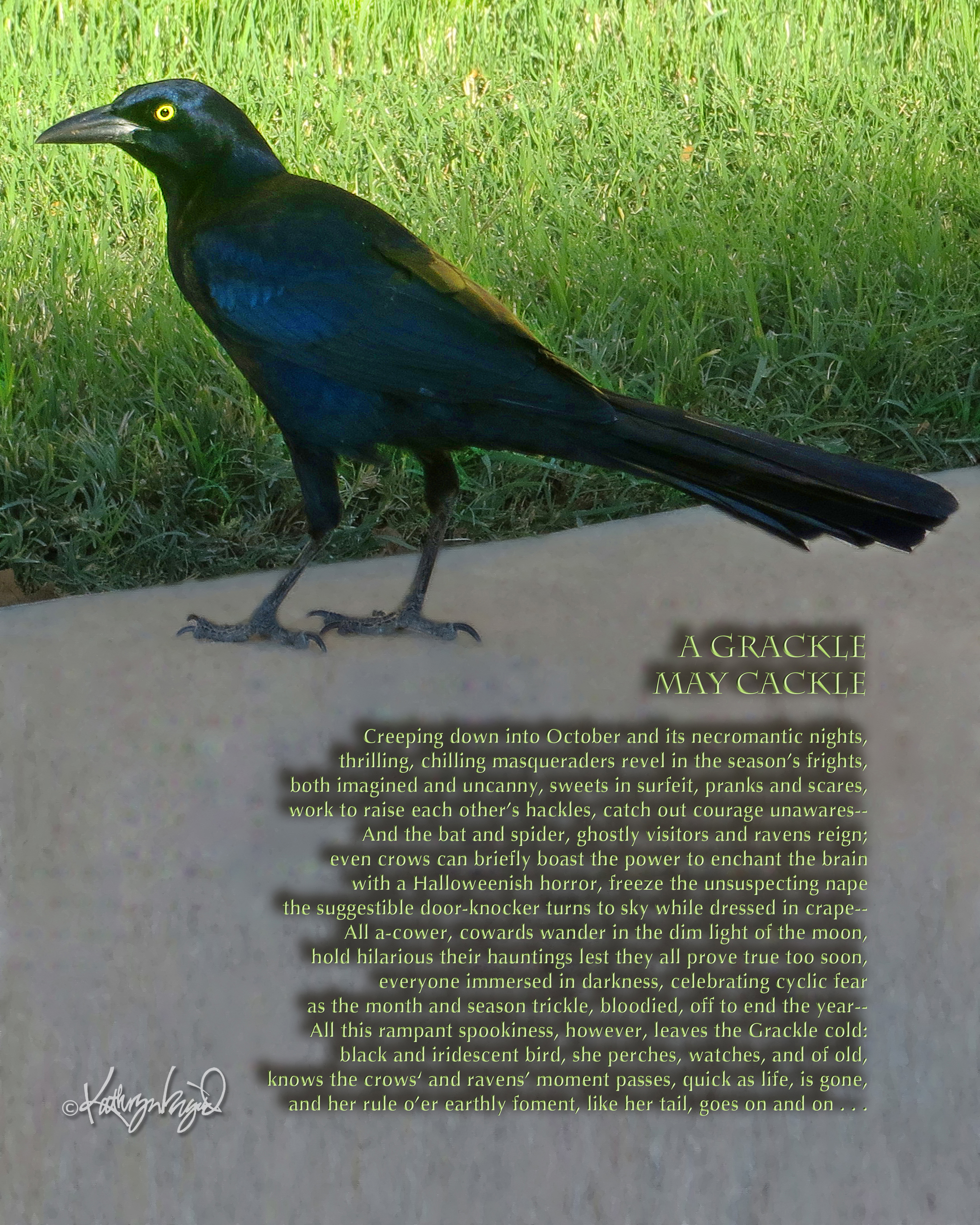
A Grackle
May cackle
Creeping down into October and its necromantic nights,
thrilling, chilling masqueraders revel in the season’s frights,
both imagined and uncanny, sweets in surfeit, pranks and scares,
work to raise each other’s hackles, catch out courage unawares–
And the bat and spider, ghostly visitors and ravens reign;
even crows can briefly boast the power to enchant the brain
with a Halloweenish horror, freeze the unsuspecting nape
the suggestible door-knocker turns to sky while dressed in crape–
All a-cower, cowards wander in the dim light of the moon,
hold hilarious their hauntings lest they all prove true too soon,
everyone immersed in darkness, celebrating cyclic fear
as the month and season trickle, bloodied, off to end the year–
All this rampant spookiness, however, leaves the Grackle cold:
black and iridescent bird, she perches, watches, and of old,
knows the crows‘ and ravens’ moment passes, quick as life, is gone,
and her rule o’er earthly foment, like her tail, goes on and on . . .
 Comfort and security, that’s what I want. And I think I’m hardly unusual in that urge. Aside from the rare adrenaline junkies whose craving for danger and life on the edge knows no bounds, most of us like to have at least one place in life, on earth or in mind where we can crawl in, curl up and feel like nothing and no one can assail us there.
While I adore travel and I treasure those people and experiences and grand-and-glorious places that it has brought to my acquaintance, there’s at least a small part of me that may always be leaning toward Home. I don’t think of myself as an adventurer by any means at all, but I’ve grown a bit more attracted to the happy mysteries of the unfamiliar or even the exotic as I’ve gotten older, and I can appreciate much better how much wealth and delight the new and unexpected can often bring into my purview. Now, what I must keep in mind instead of a constant combat against my natural urge to shun all movement outward from my safe, soft center is that my concept of that person-place-or-thing identifiable as Home has changed, and can change, and certainly will change, because that’s exactly the sort of surprising flexibility that an even minimally worldly human can experience, once the crying need for total security is breached satisfactorily.
So here goes: once more I shall leap outward in hope and expectant happiness, and all at the same time remain busily, constantly honing the cozy little hideaway that will shelter my spirit and, if need be, my self when the adventures get a little overwhelming. With a cheery wave, when I’m not too tightly coiled up with my security blanket there, I shall ever bid you all a fond goodbye, farewell, and goodnight–and see you in the morning.
While I’m on the subject of mystery stories (see yesterday’s post), there’s a true one that I hadn’t ever heard of until recently that almost defies imagination, even generations later. But that’s what true mystery stories do, isn’t it.
The story of a female immigrant serial killer/mass murderer, born in Norway but made in America, was a hideous and irreconcilable tale of horror and crime in the 19th Century and remains one today. Belle Gunness, who is believed to have killed all of her own children, two husbands and a handful of suitors, not to mention an accomplice or two of her own along the way–possibly executing as many as forty people in her lengthy crime spree–is surprisingly little known nowadays. I fear that this may be because we have so many other hideous and oversized monstrosities and real-life mystery stories handy to horrify and mesmerize us that many likely get pushed out of memory by the current ugly news. Undoubtedly the advent of World War I‘s dreadful specter was a factor in overshadowing a single murderer’s story rather immediately on its discovery.
All the same, once I knew of it, I found the woman a compellingly repellant subject for another mystery story illustration, being a subject worthy of an Edgar Allan Poe style drama or, yes, a true-crime cinematic epic. Though it was one of those news stories that ‘rocked the nation’ when uncovered a hundred years ago, the tale of Belle Gunness is relatively obscure nowadays. There have been a few generally tepid and mostly heavily fictionalized stories, books and movies based on the horrors wrought by this one woman’s apparent sociopathy and the trail of blood left in its wake, but it’s remarkable to me that such a grim, terrible story is scarcely known on a wider scale anymore.
Frightening, dark, and perhaps an indictment of the worst of human nature in general, yes–but I think perhaps part of the reason I find mystery stories so gripping is because I think they remind us–again in that somewhat ‘safe’ and detached format of past-history or fiction–that brilliance and the abyss are constantly in conflict in the human heart and only by understanding this and being willing to examine it in ourselves can we have a chance of rising to beauty and shunning the grotesque urges that we might have–and, if we’re truly fortunate, catching up the would-be wrongdoer in humane and forgiving and healing arms before she can ever fall so far. That’s my hopeful fiction, and I’m sticking to it.

La Belle Dame sans Merci of the prairies, Belle Gunness. What fearful horrors shaped this woman’s inner darkness?
Today, I present Belle Gunness, a truly fallen woman and black widow whose mystery may never be fully unraveled, for your contemplation. May we never see her like again.

Missing You
The kettle on the hob is hissing
Without cease, for Kettie’s missing—
She dashed out to check the door
And hasn’t come back anymore;
Although we saw a pair of shoes
And stockinged legs amid the ooze,
Heels up, in yon green murky swamp,
We dasn’t get our own shoes damp
By plunging toward her in the rough
Glutinous muck, and soon enough
The heels stopped kicking anyhow.
No one will come for coffee now,
For though ‘twas us stood at her door,
She slipped; shan’t visit anymore.

Slightly Bent
Emmylou and Louie went
To town together long ago—
They went to town, for all we know;
Although they both were slightly bent,
We think they just went off to town,
Not that they were bumped off, ambushed,
Stabbed, poisoned, or shot down;
But given they were slightly bent,
Our finding them quite stone cold dead
Was not a shock, it must be said,
So we’re not certain where they went
Or what they did or what it meant
Or whether in the town or out,
Or if some others were about
That had a slightly different bent,
But anyway, the two are dead,
Both of them, Emmylou and Louie,
And lest I should become all gooey,
That’s the whole that need be said.
 R.E.M.
Under a slab
Of cement I sleep,
Wilderness heavy,
Sorrow deep;
Sorrow deep,
Archaeology old,
Running through
Corridors untold—
Racing the hallways
Of my dreams,
Ankles shackled,
With muffled screams;
With throttled throat,
I strive to wake,
Covered in cobwebs
I cannot shake;
Cobweb-bound,
Imprisoned in doom,
Under concrete,
In the dreamer’s tomb.

 Art-Colored Glasses