Love, or Something, Conquers All

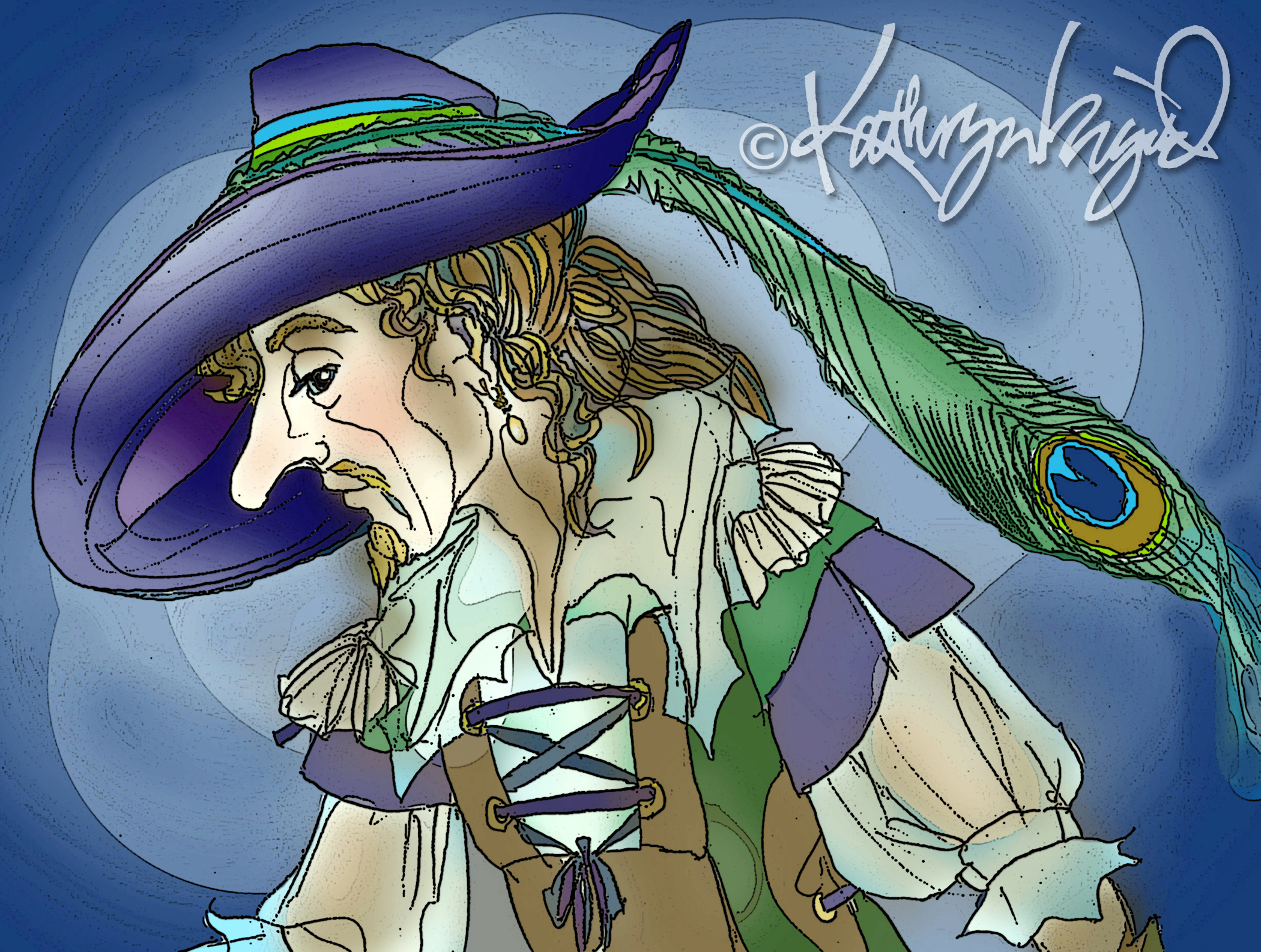
Is there something else you want to tell me, sir? You say you are a musician, yet I distinctly recall that on evenings around the campfire you’ve always strummed off-key and your songs are always unrecognizable to your fellow players. You tell me that you are a skilled horseman, but I have known you to fall off every mount you ever met and the way you’re always sneezing makes me pretty sure you’re more a specimen of the allergic type than a cowboy of any real sort. As for your claims of being a king of the romantics, they strike me as far more hopeful than strictly factual, considering that you cannot read, write or dance, never remember to comb your hair or wash your face, and are cowed into stammering and foot-shuffling when actually in the presence of anyone even slightly ladylike.

Forgive me, then, if I tend to take your claims with a certain jaded skepticism. I am fairly certain I do not want to listen to you bash away on your two-stringed guitar, to watch you topple out of the saddle the instant your horse makes a move, or to wait for you to wrestle up the courage to make small talk while I dream of my escape from your company. And if you should persist in attempting to convince me that you are the master of the Wild West, I shall be reduced to the expedient of dispatching you with a hefty branch of mesquite laid across your noggin, stuffing you into a handy gunny sack and slinging you over the back of a mule headed toward some terribly remote corner of the prairie.

Other than that, though, I suppose I don’t mind your company. A girl can’t be too choosy out here on the frontier if someone offers her his family fortune and she has her eye on a particular set of acres for ranching. Business is business, after all.digital illustrationOn Closer Examination

A fella whose flaws were prolific

And both manners and taste quite horrific

Filled my soul with alarm

But still had one great charm–

His inheritance, to be specific.

I’ve Always Counted on Good Transportation

photo

People have always remarked on the elegance of my carriage . . .

Road Tripping

On Friday I will hit the road by after-office evening light,

Hit it so hard it’ll snap up and roll like it’s a window shade,

Because a Friday evening is the sort of thing a road is made

For best—what else can put me in a frame of mind so near to right?—

And Saturday will likely see me tearing up the countryside

At speed, pretending I’ve no brakes except to let coyotes dash

Across (or ease me through the turns so I continue not to crash,

But rather, feel that sideways pull, the curve that makes my world so wide)—

And Sunday I’m still flying fast, and though turned homeward, yet a streak,

Because I must keep breathless joy searing my lungs, tearing my eyes,

Crowning my windy hair as though I’d won the biggest ever prize,

Since all this traveling is what will pull me through another week

photo

. . . but what I had in mind was always a hot set of wheels . . .

Hijacking Happiness

digital artwork from a drawingTrouble, as we all know, is highly contagious. I was reminded of this recently both by a television character and by a couple of real-life incidents involving real live people (who shall here remain nameless), and all of them, real and fictional, have a number of similarities, the chief one being their apparent unshakable belief that their suffering is greater than anyone else’s, is incurable, and is probably the fault of everyone else too.

My life is pretty fantastically good, when you get right down to it, so to people who don’t know me very well it might appear that I have no business criticizing anyone else’s way of handling sorrow and pain. But that’s just it: even the most wonderful of lives is touched by trials now and then, and struggle or strife isn’t fairly measurable in the moment. My paper cut seems as dire as your childbirth pangs when I’ve just gotten paint thinner on my hand. I know this to be logically ridiculous in the extreme, but don’t tell me the paper cut doesn’t hurt like boy-howdy at that moment. That would be tantamount to me telling you that since your labor pains will probably be over in short shrift, they don’t compare in any way to another’s battle-for-life with esophageal cancer, so you should just get over yourself. Whatever agony each of us is undergoing is more than enough and not to be belittled. And frankly, since each of us has a history that is tinged here and there with darkness, we do all have a sense, however small, of what it means to accept our griefs and cope with, live with, and go forward with them still present. Real sorrows never truly go away.

And for all of us who can feel empathy, or even more than that, can feel sympathy without having experienced the fulness of another’s troubles, life after infancy (when memory, like the lifespan thus far, is short) can be a perpetual bombardment of such troubles even when they’re not entirely our own.

I, of all people, will readily grant you that some people are far better equipped than others to find ways to survive pain and suffering and to continue living a full life without resorting to out-and-out acting. But that’s just it, isn’t it: barring full mental incapacity, don’t we owe it to ourselves, anyway, to try every possible avenue of becoming whole and happy (and of course I don’t mean that superficial kind of happiness that is either fully false or simply stupid); don’t we? When my personal apocalyptic horsemen appeared at the intersection of a group of the classic stressors (job-related problems, health challenges and the sudden death of a close friend converging on me at the same time) and plunged me into clinical depression, I was fortunate to not only have some of the significant tools (support from family and friends, a great doctor and a good therapist, and ultimately, medication that worked for me) for doing battle with those monsters but also the sense that there was no other acceptable option but to try to do that battle.

I won’t lie; there were times–and will probably be more of them over the years–when I did have to take the tack of that ‘fake it till you make it’ mode, when I simply wanted to quit and lie down and just hope it would all miraculously fix itself, or when I was as sulky and whiny and crotchety and pessimistic and tedious as unhappy people can be. We humans are good at all of that stuff, better than at being sunny and charming. But finally, even in my worst state I knew that was no way to live, and that the important people around me would suffer at least as much as I did, if not more. Thanks to the aforementioned helpers, I am here to tell the tale. More importantly, I don’t dwell in that darkness, even though there’s not much I could prevent or even fix about the troubles that led to such a state of existence. Things just happen. It’s how I deal with them that’ll likely make or break me.

That television character–and the many real-life imitators I referenced–stays so focused on how traumatized and maltreated she feels (albeit by genuinely distressing events and problems) that they become her one-note existence. She has a hard heart because it seems less trouble to close it to others than to be vulnerable to further hurt, but of course the actual effect is that she treats everyone around her like dirt, riding roughshod over their feelings and regarding any trauma or maltreatment they may suffer, often at her hands, as inferior or nonexistent. In turn, after being stomped on repeatedly by her seeming egotism, narrow-mindedness and refusal to set her hurt aside, the people around her disperse as speedily as that unlucky drop of water hitting a sizzling skillet explodes into mist. Those who tolerate her constant vituperation, impatience with their perceived stupidity or lack of sympathy, and her seeming wish to continue forever wallowing in her fury and self-pity, those characters ultimately become uninteresting or even unsympathetic themselves to me; after the ninety-ninth offense anyone sits back and takes without a fight, they tend to my eye to look like either enablers or equally fixed in victim mode.

I think we all have the power to steal others’ health and happiness, at least as much as the reasonably healthy among us should make every effort to take charge of our own. Doesn’t mean perfection is expected, but c’mon, people, if there’s really no going forward with life, perhaps a retreat to a very quiet hermitage would be more apropos than imposing our worst on the rest of the world. Yeah, I said it: get over yourself, Kathryn. Even if it might occasionally require brief periods of kindly deceit, times of returning to fighting off the dark singlehandedly, and the ordinary moments of being a jerk. It’ll mean equal demand on me for repentance, amends-making, and getting back on the wagon. There’s too much life left ahead, I hope, to spend it mired in a grim and terrible past, let alone impose it on others.

The upside of all this is that there is a possibility of turning this kind of thievery to good. Very simply, if I have to I can borrow my equilibrium and contentment from others. Put myself in proximity to saner, happier people than me until I can manufacture my own, and quietly absorb what I can of their good graces. I, at least, don’t want to be the one who steals the joy of anyone else; that only becomes the reason for new sorrows all ’round. Happiness and health can be contagious, too, if we let them. And so we all should, my friends. So we should.
Hot Flash Fiction 5

The Duchess was inordinately fond of animals. Though her courtiers would never dare say so to her face, they imagined she ought to have been born a zookeeper, or at the very least a farmer. This idea was strengthened, especially, by the fact that it always fell to the housekeepers and servants to make the palace tidy enough for Her Ladyship’s dainty passage through life and to freshen the air when the royal menagerie had pranced, prowled or otherwise paraded through its rooms and left unseemly gifts along the way. The Duke, who was as allergic to all things animal as the Duchess was attracted, considered for some time whether he oughtn’t to have a team of expert taxidermists and artisans solve this problem once and for all, creating a large display of preserved zoological beauty that might be both lower maintenance and less powerfully scented than the living creatures populating his estate indoors and out, day and night.digital collageUnfortunately, the Duchess’s sisters who lived in the east wing of the palace did not support the Duke’s enthusiasm for the design, making noises of disapprobation at least as loud as the Duchess’s favorite dogs’ barking or donkeys’ braying. Perhaps, the Duke thought, he had been a little incautious in discussing this artistic concept with his secretary while within earshot of the sisterly ladies-in-waiting, for they both appeared quite ready to dash off squealing with rage to their unsuspecting sibling, or at the least, to imitate the household fauna in some other impolite fashion.digital collageAs it fell out, the Duke, however incautious he may have been in heat of the moment, was not without the wit born of hard experience. Working swiftly with his retainers, was able to resolve the situation quickly and suitably merely by shifting the subject of the new art to a slightly different one featuring the Duchess and her sisters. As an added benison of this resolution, it was discovered that he wasn’t allergic to winged or four-legged pets after all. The palace staff found maintaining the menagerie surprisingly less onerous afterward as well, even with the added curatorial duties of dusting off the Duchess and polishing her sisters from time to time.

‘On Pouvait Dire . . . ‘

‘Ah! non! c’est un peu court, jeune homme!
On pouvait dire…Oh! Dieu!…bien des choses en somme…’

digital artworkWould that I had the miraculous gift of the silver tongue–it’s said that the genuine Cyrano de Bergerac, the writer and duelist enshrined in fiction as some sort of demigod of dramatic speech, was in life something quite near to it as well. As a youthful admirer of the romantic dream, I memorized Rostand‘s most famed soliloquy of Cyrano’s (in English, naturally), but what remains after so many years have passed is not so much the poetry of his slick speech; it is instead a deeper sense that for all my staring at his nose along with everyone else I managed to miss the point.

The story is told in fictional form to so exaggerate the majesty of his nasal promontory that all we see in most readings and performances onstage is a caricature or cartoon man, led by a nose of bowsprit proportions and foolish improvidence to oversized action and wildly improbable joys and sorrows as a result. These kinds of things do happen to real people in real life, of course; even the real man behind the character was larger-than-life in both nose and existence, according to what we know. He did, if his contemporary portraits are anything near the truth, have a substantial prow, and we have his writings–satirical pieces to classical tragedies–to prove that his wordplay was quite substantial too.

But what perhaps ought to be said of him–whether real or imaginary–is that he was a bit of an outsider by virtue of looking Different, and his response was to fight for respect, both with his rapier and his rapier wit. [Given the historical man and the possibility that he was (not surprisingly, given the era and culture and his reputed exploits) syphilitic, he may well have experienced life completely without a nose if he lived long enough.] It’s easier to label and classify others on the basis of unpopular appearance or differing from the currently decreed norms than it is to cultivate what we have in common. Yet we can learn from some of our outlier counterparts if we will stop, for a moment, being so mesmerized and distracted by what makes them seem unlike us, what it is that we have and value in common. Best if we do that before losing the duel.

Though at least, if the duel is purely verbal, there can be some entertainment inherent in getting taught a lesson. I can live with being the unarmed woman in a battle of wits, as long as I get to keep living long enough to laugh about it. I may not be a genius, but that, my friends: c’est mon panache!

Depends on Whom You Ask

What’s happening in any given scene? Everyone who answers the question is sure to have his own answer. Point of view is colored and skewed every which way by one’s position at the moment, by the context of experience, by taste and beliefs. Is this a drama? A comedy? Every actor in the event might well give you a different answer.

The other day when I was hearing a delightfully humorous arrangement of the old western song ‘Blood on the Saddle’ (arranged by Trent Worthington) I couldn’t resist adding a silly illustration of my own to the music. In my sketch, the horse whose saddle has presumably been bloodied stands still enough now to act as a comfortable perch for a vulture that stopped by to survey the fallen cowboy as a potential buffet–though as the vulture has just landed he’s more interested in a short rest first. The horse, now riderless and not forced to buck, has no particular remaining interest in the fellow who until recently expected him to lug around the cowpoke‘s weight and kick his heels in the rodeo arena for a living. The cowboy, now just a flat stain in the dust of the ring, is of no more interest to the horse and little yet to the buzzard (not ripe enough yet, presumably). In fact, when I cropped the cowboy out of the picture altogether, it struck me that the horse and bird looked pretty peacefully contented just lounging around together.graphite drawingSo, whose point of view matters here? The cowboy’s, not so much. Having croaked, he’s now short on both opinions and feelings, so we’ll leave him out of the equation. The bronc, of course, has got to be somewhat relieved at the current situation; while he did participate in the squashing of the aforementioned rider, it’s a pretty safe bet that having the guy pile on his back and goad him to buck was hardly the horse’s idea in the first place, so he can hardly be blamed for, well, bucking the buckaroo off into the dirt. Falling over the fallen fellow, I feel it’s safe to say, wasn’t the horse’s idea either, but just a natural consequence of being thrashed around unwillingly in a dirt arena for someone else’s amusement. Fictional or not, this poor horse deserves a break after all he’s been through.

The buzzard, on the other hand, is just a passing freeloader. Of course, that’s what vultures are designed by nature to be and do: the cleanup crew following food-related disasters. Some days, the sacrificial mammals are less human than in this instance, but regardless of the source, nice dead things are made to be Vulture Chow. And the upshot of the dining experience is that the buzzards will leave the scene a much spiffier one than when they arrived on it. Seems to me that this vulture, too, deserves his moment of happy contemplation and repose before hopping down to dine. I’m guessing, then, that his view of the whole scene is rather–if you’ll pardon the expression–sanguine. Unlikely he’d care how the meal arrived at his ‘table’ so long as it arrived. He sits on his equine throne and surveys what, to a carnivorous bird, is a royal feast indeed.

And what of me, the observer and, partly, inventor of this scenario? How am I to respond to it? I bring my own baggage to the occasion. I’m not a lifelong fan of vintage Western songs, having come to appreciate them as a piece of Americana and folk music culture later in life but still from the remove of something like an anthropological observer. This song itself has had a number of covers from the period-traditional to playful takes like Mr. Worthington’s above-mentioned arrangement, and each iteration adds new aspects to the folklore of the story, tingeing it further with tragedy or humor, history or fiction. The story of a cowboy riding a bucking bronco until thrown and crushed by the horse is swiftly told but can grow and change with each retelling. Do I feel sorry for the cowboy? Insofar as I get involved in the lives, loves and losses of fictional characters (and I do), I will admit his story has its sorrows. It’s arguably a tragedy in the classical sense, since it was through his own choices and actions and the consequences thereof–one could even conceivably see his fall as a direct result of hubris–but death of anything other than comfortable old age still strikes most of us humanoids as just plain sad.

I guess you can tell from my earlier remarks that my sympathies lie more with the horse in this equation. He was put into an untenable situation and responded in true horse fashion to the best of his ability. Too bad for the cowboy that horse logic says the correct response to being strapped into bucking gear is to buck, and that, as hard as you possibly can. The horse in this tale got lucky and knocked that unwelcome irritant off his back. Tough luck for the irritant. It really is all about perspective when it comes to assessing the situation. What it boils down to for me is a recognition that being the cowboy may appear more exciting and impressive, but sometimes it’s better to be the horse.digital image from a graphite drawingWho knows? I might even root for being the buzzard: none of the hassle, all of the free booty. Say, I might be a vulture already! And I’m okay with that. Stop by and find an already made idea for a drawing? Why, sure. I am a shameless scavenger. But I prefer the term ‘artist’, if you please. And all you others are free to agree or disagree, just as you wish.

Uniquely Me

graphite drawingBe Not Ill at Ease

Around my sprockets and my spleen lurk what no doctor’s ever seen,

a plethora of arcane ills impossible to treat with pills

or pessaries, with tinctures, teas, or magic potions for disease–

not curable by overhaul of engine, tune-up, electrol-

ysis, electric shock–it’s thought by some I will infect them; not

true, though, for what seems to be feared is not contagious–

I’m just weird.

Hot Flash Fiction 3

graphite drawingA Menopausal Mini-Mystery

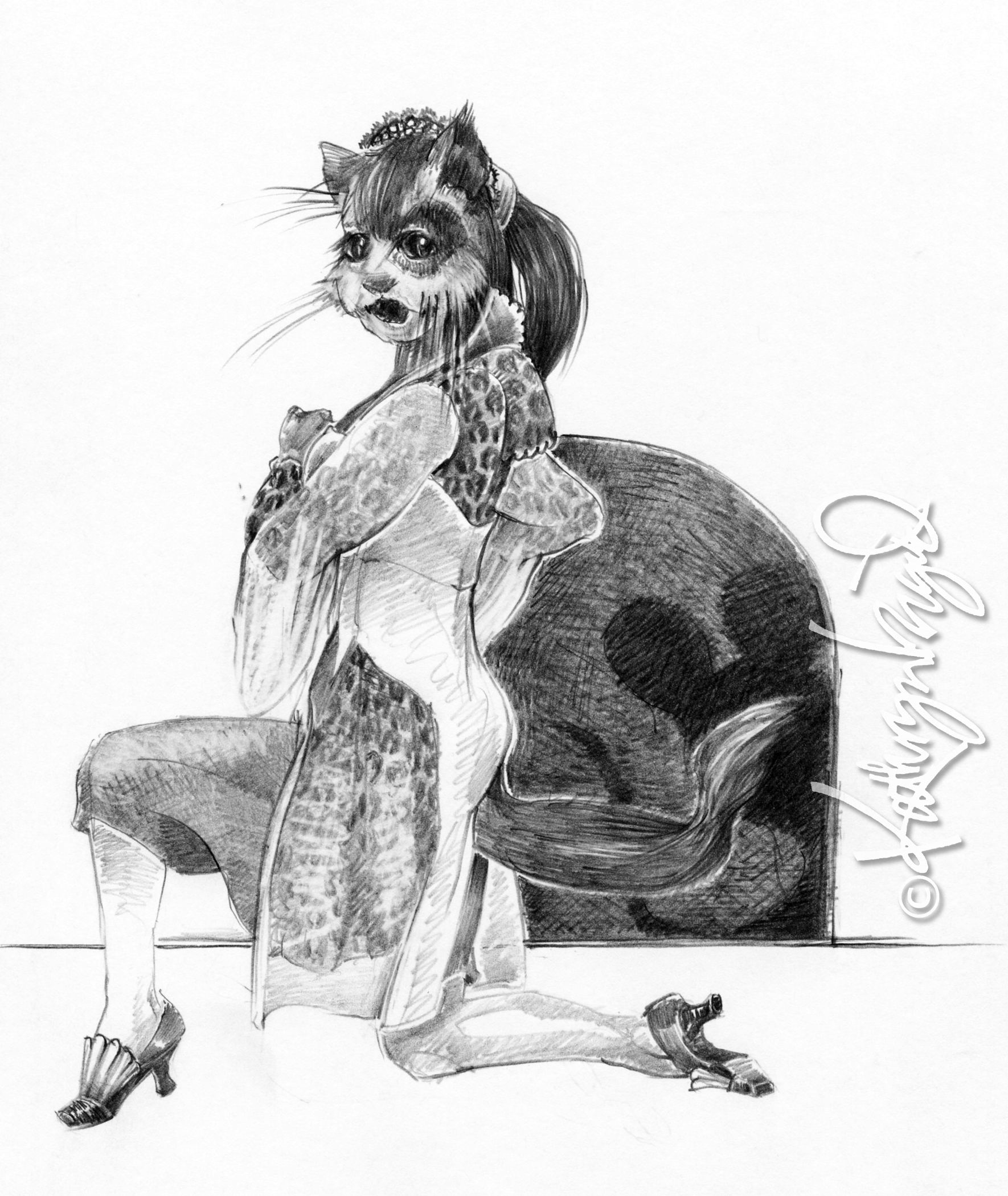
‘OutRRRRRageous!’ she purred, ‘I’m only a lady who has fallen prey to the sentimental desires of A Certain Age to visit my old acquaintance!’ Still, her counter-suit of police Profiling would have been more plausible if she hadn’t been spotted in that location and in such a compromising position. The acquaintance in question, quivering in the doorway behind Madame De Léopard, was still squeaking with shrill accusation as the neighbors began to gather and fling catty remarks back and forth like batted feather lures. When the arresting officer demanded a sobriety test and detected that an illegal quantity of West Country Farmhouse Cheddar had been dabbed behind the lady’s ears, pandemonium erupted and many of the surrounding crowd were convinced that there was a far more nefarious explanation for her appearance on the scene than middle-aged maundering.

Hot Flash Fiction 2

digital artwork from a photo

Though bleary, psychedelic and portentous dreams had haunted him into a knot by daylight it was neither dark nor stormy that morning. Tarryble Slye was in such a grim and grimy mood when he finally wrestled awake that he decided not to get out of bed until it was darker, for his business with Methden Gartinen was ugly enough to require at the very least a whiff of midnight, better yet a night gripped by a walloping storm. Whether the requisite pelting of rain and blasts of lightning came or not, Slye was determined to drag himself out of bed as late as he possibly could, and put off tonight’s assigned meeting as late as he could get away with it too. That rat Gartinen had made the whole thing sound as innocuous as he could and even offered to pick up the dinner tab beforehand, but there was no mistaking that once he was out of bed Slye was going to be sorely sorry he’d ever crawled out at all. He was already sorry he’d committed to showing up, and backing out of it wasn’t an option; maybe he ought to accept the proffered payoff: a paper-wrapped catch of fish and chips was probably the best thing he could hope to get out of this lousy, evil-tinged day.

Man, how he hated doing taxes.

digital artwork from a photo

Beware the Obsessive Joys of Scientific Exploration

And don’t ‘Do too much science‘! When it takes hold of you, there may be no escape . . .

digital illustration from an ink & graphite drawing

New Species, Same Old Story

Professor Bob Sponk and his lovely wife Myrtle

discovered a rare omnivorous turtle

and off to the swamp in the jungle’s dim inner-

most sanctum they tracked her, observing her dinner-

time habits, behaviors and preferences; then,

Bob sneezed.

It turns out she eats women and men.digital illustration from an ink & graphite drawing