What Wounds can Teach Us

Cut

Skin, though as taut as rawhide, and as strong,

Still splits under a jagged, cruel knife,

Opens its jaws to scream a gout of life

As blood that would atone and end the wrong—

But wounds, no matter what the cause or source,

Cannot withhold their sorrows or their rage;

Injustice must be shouted off the stage,

So bleed they without pity or remorse—

Break, then, both skin and soul, and sear the heart

Of any who is cognizant of pain;

Who cries for justice and can’t sleep again

‘Til order is restored as at the start—

What’s done cannot be undone should a scar

Reveal the fragile creatures that we are.Digital illustration from a photo: What Wounds can Teach Us

Eau de Toilette

Image

Digitally altered photo + text: Canned Applause

Mental Featherweight

Photo: Featherweight

Text: Ex nihilo ad nauseam


Digital illustration from a photo: I'm a Featherweight

Horsepower

Photo + text: Horsepower

Photo + text: Downtown Manners

They were Just Talking

Digital illustration from a photo: They were Just TalkingI listen to the mourning doves that coo and call in the shadows nearby and think that they do indeed sound ineffably sorrowful. The low, guttural sounds they make seem to my ear quite melancholy and, no matter how musical, to convey a kind of tragic news that makes me wonder just what it is that they say to one another. In my mind, they are exchanging the saddest of sad information, a litany of lachrymose lugubriousness.

In addition, I fear that I don’t give them enormous credit for wit and intellect, so if you’ll pardon the expression, I suspect that what conversation they do have is probably akin to what we American human-types sometimes call pidgin English—any actual content of worth being marred by the lack of intelligible vocabulary and syntax. But, to paraphrase what someone wiser than I has also said, if pigeons are the arbiters of intelligence in the same way that we humans are when we assume ourselves to be the wisest and brightest beings in creation, then all other creatures will by default be found wanting. No wonder the pigeons deign to unload their critiques on the heads of our celebrated effigies in the park.

The truth, I imagine, is that mourning-dove conversation is no less and no more wise and scintillating than our own, at least in the context of pigeon society. Heaven knows that anyone who translated my quotidian chitchat into ‘pigeon English’ would probably be violating the Columbiformian (I just made that up from their Latin name, thank-you-very-much) Geneva Conventions by boring them to death with my inanity and my extreme dull-wittedness when it comes to where to find the best yucky trash to eat, how to maintain the pecking order in the flock, or why one must always look for the shiniest surface on an automobile for proper deposition of one’s automotive excretions. So no matter how tragic the tone of the mourning-doves’ vocalizing sounds to a mere humanoid like me, it could be that they were just discussing their plans for world domination and the swell soirée with which they intend to celebrate it.Digital illustration from a photo: They were Just Talking 2

Lounging Around

There’s nothing like a long stretch with a too-busy schedule to remind me how important it is to slow down and do some meaningful Nothing once in a while, even if it makes me miss one or two seemingly crucial other things. Every time I remember to take that kind of break, I notice that no matter how much I think I was letting go of, leaving undone, and missing out on doing, the world has not once ceased to turn. Civilization has not only not ended while I was ‘off duty’ in a moment of relaxation, but has very likely been somewhat improved by having a little break from my ignorant interference in its progress.
Photo: Laid Back Loveliness

Sometimes it’s really useful to deliberately put my head in the clouds. Or to stare at the floor, for that matter. When I stop gazing exclusively at the stack of paperwork in front of me, thinking only of the next three items on my to-do list, or listening merely to the rattling of the voices on TV, telephone and in email correspondence that are all demanding my attention, I can notice that I’m walking across incredibly worn but still vibrant Majorcan tile in a room full of paneled walls and acres of ancestral portrait paintings, and that’s just en route to some other thing entirely. I might get to that Other Thing and find that it’s only a small courtyard, but one full of sunlight split into dazzling rays by a fretwork of wrought iron artistry that may very well have been behind deadline in its production because the artisan thought it was more important the work be done well and beautifully than that it arrive on time.
Photo: A Gathering Place

Why do we persist in making little things mean so little when they can make a great change in our perspective? Don’t we fuss enough when we think the universe is treating us so neglectfully and with such unwarranted disdain? I think it’s only fair that if I want to be treated with any sort of respect by the universe, perhaps I ought to give it some of the same attention and admiration as well. Far better than wasting my precious life resources on endless effortful chores that will only wait for my return anyway, is to spend a bit of that time instead on admiring the goodness of a threadbare Turkish rug and relishing the thrum of steady conversation about unimportant yet interesting details of the day’s quiet events, talk between real people who stand on that very same carpet at the very same moment and, amazingly enough, listen when I reply.

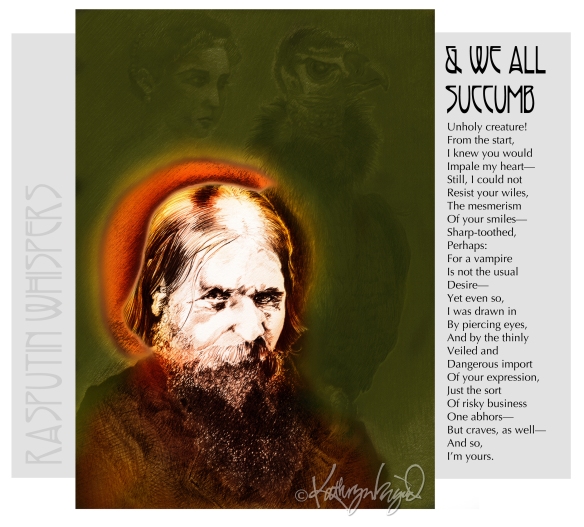
Rasputin Whispers & We All Succumb

The spookiest thing about Halloween? That its frights and frissons are based on a simple and scary truth: we humans are the source of the villainies that pose the gravest dangers to us, as well as being the easiest mark for them. Be very afraid!Digital illustration + text: And We All Succumb

Ethereal Amours Heating Up the Interwebs

Infernally Yours

Thou mak’st me hot, O swain of mine, afire with passion, sure,

and art my furnace, blazing beau, so flaming your allure;

What is it getteth in my groove that thou hast, O my heart?

How heat I up, so quickly broiled, as roasting from the start?

Mayhap, thou sneaky Devil, thou hast dropped affection’s bomb

When I misjudged it literal and went to Match.com!Photo: Infernally Yours

Name that Malady!

Photo: Something in My Eye

Do I have Onchocerca volvulus, or is there just an eyelash stuck in my eye?

All Other Martyrdom is Naught before Mine

This harsh, persistent pain I have, O Doctor, tell me, please,
Can it be cured by some cheap salve, Or have I some disease
Beyond the scope of modern meds And pessaries and pills,
Like something Biblical in scope, One of those icky ills
You read about in magazines, See movies-of-the-week
About so frightful that you Realize that you’re a freak
To have such creepy plague, To be afflicted so, withal,
That even specialists will cringe And dash off down the hall
To hide behind their file Cabinets until you leave
Because they’re overwhelmed by the Bizarreness they perceive
Upon your person when they see Disturbingly displayed
Such malicious malady It makes them sore afraid.
What say, Sir Doctor? You detect My source of agony?
Who suffers worse than martyrs who Have papercuts, like me!

Photo: Open Wide!

Well, shut my mouth! Maybe that nasty odor wasn’t Trimethylaminuria, but don’t just give me the brush-off.

A Plague on All Our Houses

Even the most steadfastly unquestioning among believers in various versions of mainline religions will allow that, if their deity cares for them as a shepherd cares for sheep, their own religions, yes, even their own temples, mosques, and churches, sometimes harbor wolves in sheep’s clothing. Partisans of every political and philosophical school of thought have seen the unmasking of many such monsters that have hidden behind the guise of goodness and faithfulness, selflessness and judiciousness, or at least experienced the dire effects those have on the lives of the truly committed. There are reasons most languages have such large inventories of words like heretic and traitor, infidel, apostate, renegade, impostor, infiltrator, double agent, betrayer, and hypocrite.
Digital illustration: A Pox on Both Your Houses!

So it astounds me every day that such experienced, otherwise reasonable people are either afraid, or simply refuse, to regularly and thoroughly question and examine the sources of their information, whether they are people or inanimate forms of evidence. Even among the most dedicated, wise, and well-meaning persons the human flaws we all bear cause mistakes and missteps. The most widely accepted proofs of truth may have come about by means of equally imperfect human study and the telephonic accidents of human transcription and translation. No matter how inspired the origin of the wisdom, it can’t be guaranteed to get to the page and from hand to hand, meeting to meeting, one end of the surprisingly not flat earth to the other, without sometimes being misinterpreted or co-opted, whether it’s by the false sheep in the flock or by our own good intentions.

All I can say is that if such stubbornness against rigorously examining our beliefs and every source of them is at its roots a terror of self-examination, we are doomed. We will forever repeat the grim side of human history, by acting out of doubt, cowardice, and ignorance, assumptions that have as much chance of being incorrect as not, and hidebound inability to see the wolves in our very midst for fear of discovering our own culpability. Circling each other with rapiers drawn and fighting to uphold traditions or beliefs or codes that we have so ingrained that they are unquestioned no matter how wrong, we will only deserve the curse of Shakespeare’s Mercutio—who, by the way, may or may not have said “A plague a’ both your houses,” in the original text, but various scholars over the years have guessed at such a reconstruction of it. Even Shakespeare, that demigod of English literature, is only as reliable a source as the many readers and interpreters since his time can determine, assuming that there was one playwright and poet of that name and not, as some believe, some cadre of the great literary minds of that era. Don’t get me started.

I will say right out that I know full well that I am guilty of being poorly or misinformed on a host of topics, and a stubbornly slow learner on top of that. I am trying, however I may stumble along the way, to grow beyond such ossified thinking. If only we could all begin with the premise that the fault might be not in our stars but in our selves, I think we might discover that our reliance on incomplete or incorrect information puts us constantly at risk for inner and outer conflicts we ought to have laid aside or, better yet, avoided altogether. The Other Guy might in fact deserve a listen, and acting first, asking questions later is not a conversation but is likely instead to end in swords crossed and lives lost. Acting in haste or acting in hate, the result may be the same because we were ill prepared to ask the right questions, let alone come to a wise and humane conclusion as a result. There are, sadly and unquestionably, baddies among us. But even so, if we all insist on clinging to our own versions of the truth without regularly and rigorously questioning their verity, then the attack we are all under begins inside, not from any external enemy, real or imagined.