One in a Million

digital illustration

Homage to Popularity

My Distinction

If I should need some camouflage, should want to truly blend,

I’d better watch my persiflage and learn not to offend

By wearing last week’s trendy style, my hair too short or long,

Or failing, yet, to reconcile which Party’s Right (or wrong)

To run the government; which church is favored most by God,

How not to leave you in the lurch when I have been a clod,

Appalling with my social gaffes, faux pas and frightful fouls;

I may accept I’m built for laughs, but using the wrong towels

Or forks or traffic lanes, That Word in company unfit—

I hope I don’t seem too absurd as-is, but that’s just it:

My imperfections, my unique design as Me, are such

As might make me appear a freak if I am Me too much.

But, truth be told, while I may work to fit in with the rest,

I hope you won’t think me a jerk for liking myself best!

I will blend in, keep pace, behave, up to a point, to please,

But lest you think me fashion’s slave, I think it a dis-ease

To seek conformity and bow to other people’s rules

When I’m quite nifty anyhow, and others may be fools.

digital illustration

Fingerprint Beats Homage

Make a Note of It

I do, and learn, new stuff all the time. I wish it’d stick with me! It seems my approach to learning is very much of the two-steps-forward-one-step-back variety, or possibly, one forward, two back, if I’m to be entirely truthful. So much seems like water flowing through a sieve in this ol’ brain of mine.

That is one of the prime forces that made me such an inveterate list-aholic. I fear that if I don’t have lists for every occasion and purpose, and lists of what those lists are, I am doomed to lose whatever motes of mindfulness I have collected in the course of my journeys. Not that lists aren’t perfectly able to be misplaced, forgotten and misinterpreted themselves.

There is probably no perfect solution to this problem. I end up thinking about my lists almost more than about the contents of them or what I might do with said contents, most especially avoiding the thought that if I spent the list-composing and writing time on simply doing what I am making notes to remind me to do, I might not even need the lists. Heresy.

What can I say. I am a pessimist: I don’t think I’ll ever find enough time in a day to get all that I want done accomplished. I am an optimist, too: I think that if I hold something so dearly important as to document its urgency on a list, surely I will someday get it done. Obviously, I am just a good old-fashioned, self-deluded fool. But I have a whole list of reasons that that’s okay and will still get me to my goals. Eventually.digital illustration

Everything is Rehearsal

photoIf we are willing to listen, learn, and practice, everything that happens can be rehearsal for a better performance the next time. Musicians know this. We should all recognize it.

Being perfect isn’t the goal. Even being exactly the same each time isn’t it. Mechanically identical reproduction of an event or a feeling or an occasion is for machines; life is messier and more complicated and more artful than that and means we have to be ready to use all that we’ve learned in all of our rehearsals, combined in whatever way gets us the best result in the present moment. It means, too, that what is the best solution for that moment may not be reproducible or even desirable next time. A CD is a lovely evocation of memory but the live performance takes hold of us down to the soul in a very different way.

I want to become better at whatever I am. Some of the betterment may come fairly easily as I recognize more clearly what I am, as I grow older and have more experiences and find my way through more of my life’s journey, picking up clews as I go. More of it will happen, if at all, because I work hard to improve myself in one way and another.

There’s no guarantee that any given moment or event will find me at my best, or even that I will become the best version of myself that I am capable of being no matter how long I live. But I’ll certainly have a better shot at any of that if I commit to practicing.photo

Talking at Cross Purposes

digital illustrationMy spouse and I have an intriguing way of discussing our disagreements, and I gather from what I see, hear and read that this is not such an unusual complication but probably more like the norm. We don’t fight about stuff that matters, remarkably, very often at all, being on the same page in our essential beliefs and concerns; if we differ there, we’re pretty comfortable having a rational conversation or two and agreeing, if necessary, to disagree. But the more inconsequential things are where we excel in having our weirdly, even hilariously, convoluted bouts of stubbornly wordy disagreement.

And the vast majority of the time, it’s because of the language barrier. We’re both native speakers-of-English, but it seems we are perfectly capable of saying virtually the same thing to each other in such different ways that each of us hears the other saying essentially the polar opposite. It’s quite miraculous, really. Two seemingly cogent adults, people who know each other rather well after being together for eighteen years and who both know inside that we share the deep core values that make eighteen years together possible, not to mention that we share so many experiences and tastes and interests—and we can’t reason our way out of a paper bag when one thinks the other is remembering something incorrectly or a question has been raised about some puzzling matter of fact.

Of course, I don’t think this is specific to being male-female, age-related, or any other such thing, this is a characteristic of our whole species. It’s a perfect example of how humans talk to each other a whole lot of the time. We think we’re having an epic battle over right and wrong, and both sides of the argument are  looking and hoping for exactly the same outcome, but each of us simply thinks we have put the correct names on the problems and resolutions and the other party is clearly an idiot or heretic until he/she/they will acquiesce and let us superior beings fix everything according to our righteous rightness. Happens in politics and religion and academia and relationships just about equally often. Whether weapons are involved has the most influence over how epic these battles really become, but the basis is hardly all that different.

My beloved and I get in the same ridiculous rut of circular conversation often enough, though neither of us takes it particularly personally or even necessarily sees it as a true argument let alone a danger to our relationship, and it’s easy enough to laugh it off when one or the other of us finally realizes that We’re Doing It Again. But it’s strange that we don’t spot the next episode from afar and simply have a straightforward, rational talk. If the goal or solution is nearly always identical or close enough to it, why do we have to wrestle around so determinedly before coming to that natural conclusion? I can’t guess why we mortal mugs are so quick to waste our energy and peace on pointless posturing, but it’s certainly a collective talent of ours.

I guess I’ll just have to take this opportunity to apologize to my partner for my part in the muddle, and hope I learn to listen—and hear—better. And if anyone with any power or aspirations to power (political, religious, academic, or other) happens to be reading this, would you do me a favor and do the same?digital illustration (B&W)

We All Wear Our Masks

digital illustration (B&W)It’s so much easier to hide behind convention and other convenient facades than to let our true selves be seen and known. Don’t we almost always prefer that sense of safe anonymity or at least ‘appropriateness’—however tenuous or specious it may be—to taking the chance that in our own skins we might not measure up to the occasion or to the  expectations of others?

It is, of course, a foolish conceit. One can rarely cozen anyone else, let alone oneself, by such a means. No matter how hard I may try to appear in the guise of what I think will qualify me for the In Group or make me richer-thinner-prettier or smarter than I really am, if it’s all show, the mask will like any faulty exterior prove too thin to cover my realities. It has always been so, and yet I am far from alone in continuing these futile attempts. I do believe that constant practice can transform us into a nearer semblance to the disguise, but that can work for ill as well as good.

Probably wiser is to recognize that the urge is age-old; that insecurity and an assumption that others will find me inadequate in my natural state are neither new problems nor absolutely decisive. The masks of the past remain, both in those symbolic and ceremonial concrete forms and in the records of our history books and art, to amuse, bemuse or warn us, if we will pay attention. And a close enough, thoughtful enough reading will remind any of us that no mask covers the truth forever—and yet, all the same, that we as a species continue (however astoundingly) to survive. Perhaps unmasking isn’t entirely as dangerous as any of us have feared.

I spent enough years acting the part of a brave, socially mature person, one who was more comfortable hosting a gathering, letting others see my art and writing, lecturing, teaching and doing so many other things that in truth absolutely terrified me to tearful agony behind the scenes that it turns out I am capable of doing all of those things after all. I still fuss and worry, yes, but nothing like the self-flaying horrors that I used to suffer just to get through what were apparently no-big-deal occurrences for most other people, and now I can experience them with fair equanimity. Funny how, when you’ve spent your whole remembered life in the grip of a belief that every second was one degree away from total disaster and death, any tiny bit less becomes magically huge.

And each of those instances becomes a step toward understanding that I have perhaps begun to grow into my mask of wishful improvement and become more like it underneath. Or better yet, that it never did matter as much as I feared, this different reality behind the convention. Best of all, I find that the more I let people see me as I really am, the more kindly they seem to look on me, and in turn, I begin to think the real me is perhaps pretty likable, respectable. Even lovable. Who knew.

digital illustration

Unique doesn’t inherently mean Alone.

Attention to Detail in All Things

digital illustrationI’m far from being the world’s best gardener. I may have the perfect skill set as a lazy dilettante, loving the design process and having a tremendous appreciation for all of the non-laborious joys of a garden, whether it’s well tended or not. A bark-boring beetle or a sculptural skeletonized leaf can be as beautiful as any spectacular, pristine lily or a lilac’s heady bloom. A moss-choked stone path is as glorious as a graceful fountain encircled by perfect tea roses and rosemary. And I have had quite the aversion to trench digging, rock picking and weeding ever since I was old enough to be conscripted by my parents for the purpose.

But I also know that if a garden is to have any hope of continuity and flourishing in flower, it needs occasional attention to such details, at the least, from Nature’s seemingly random hand. The gusts and waterings, composting and tillage performed by her weather and her handyman crew of creatures all do their parts in keeping the landscape in beautiful form. Even better chance of thriving if I do my part, too, having noticed what details might better prosper under my attentions, however slight they might be.

I was reminded of it recently as I watched a family make their valiant attempt at getting a group portrait. Flanked by grandparents, the parents stood holding their two little boys: Dad, in back, held the eight month old and Mom, ahead, wrangled the three-year-old. No one seemed able to get the normally placid toddler in front to hold still for even one quick photo, or to understand why he was so unusually squirmy, until someone finally noticed what I could see better from my side angle: that the baby was cheerily leaning forward at intervals and yanking his big brother’s hair. Detail noticed, problem solved. Had that adorable little scalawag been able to keep up the practice, I have little doubt there would’ve been need, eventually, for an expulsion from that particular little Eden.

I, meanwhile, must try to keep after my own gardens, the real and the metaphorical, and make sure the little buzzing creatures and weeds don’t get too far out of hand.digital illustration

Remind Me/Rewind Me

For a person who considers herself happily immature relative to her age, I am sometimes caught off guard when I realize how little of my youthful pleasures I’ve continued to pursue with appropriate enthusiasm into the present. Why on earth would I forego standing on a big plank swing, grasping the chains that hold it and me up, and pumping my legs until I feel like I could fly right on over the top steel bar of the swing set with the greatest of ease? Why not kick off my shoes and socks, abandon them in the dirt, and plunge into the cold river’s slippery, rock-strewn flow without regard for getting the legs of my pants all soaking wet? Is there any law that says a 52-year-old is no longer allowed to slurp her fruit punch noisily through a straw just because it’s so wonderfully refreshing and sugary?

Why, indeed, is the common phrase seemingly always about youthful enthusiasm, yet we tacitly agree to let only actual youths embrace it?

Remind me how being childlike and impulsively happy is so dangerous.photo

Despite being of an age where my childhood version of the high swing was of rock-hard rubber on a steel pipe frame and underlaid with gravel-strewn dirt, I am—well—still alive at this age. I never broke a single bone or chipped a tooth, and my only stitches derived from an indoor activity, a school game of floor hockey. Though I wandered recklessly through many a stream and ocean’s shallows, without regard for my pants or my tender soles, and even drank from the occasional icy mountain brook, the worst that ever came of it was a cut from beach glass, soon enough cleansed with stinging but healing salt water. No clothes were ruined, and I got bit by nothing bigger than a sand- or horse-fly or two. I failed to contract Giardia or E. coli from those wild rivulets I sipped. Even the vast quantities of evil cyclamates in my childhood fruit drink binges failed to kill me off.

So how is it that I lost my ability to plunge ahead without caution to where I seemed, nearly always, to find joyful things? Remind me how always being responsible and mature and playing it safe is better for me.

But write it in a note and slip it under my door. I feel the need to go out and look for a little happy trouble.

Signs of Things to Come

I’m so far from being clairvoyant that one could hardly accuse me of even knowing what’s happening right in front of me. I’m not even all that hot at figuring out my own history, let alone any that’s larger than me or mine. I’m just plain not very observant.

photo

Even familiar places can lead me astray.

I do have an interested and curious eye for colorful details, don’t get me wrong. Mostly, I’m intrigued by the arcane and eccentric, so it’s inherently unlikely that what catches my attention is useful, meaningful or significant. The reality of my frivolous and shallow frame of mind is that it is easily filled up with trivia and obscure oddities.

photo

If you walk a mile in *my* shoes, you just might get really, really lost.

So forgive me if I’m clueless about what is in my future, or anyone else’s. I can barely find my way from one end of my own house to the other without a map, and I sure as heck don’t have better skills for figuring out how to get from one point in my own history to the next, let alone the history of the larger world. Great reason for me to avoid messing around in history and just enjoy the smaller victories over my little reality. I mean, here I am in the den and I found my way here from the garage when we got home. And I enjoyed all sorts of details along the way, signs and all. See you around!

If You don’t Like the Weather, Wait a Minute

photoHave you ever seen a pigeon flying backward? I did today. This phenomenal occurrence was not because I spotted a mutant genius helicopter pigeon; that really might be a matter for tales of magic and fantasy, given the modern pigeon’s brain.

It was that windy. The pigeon was making a valiant effort to take off from the edge of a roof and, blown instead straight backward, finally saw the same edge directly under him and came right back in for a landing. What’re you gonna do?

The wind is giving us a good whack here in north Texas today. Two days ago, it was over 80°F/27°C, brilliantly sunny, and calm as a sleeping cat. Tonight, we’re told, we can expect freezing temperatures and should cover all of our tender plants in the garden. A couple of days before our balmy pseudo-summer day, we had a storm pass through. Parts of our town had a little thunder and lightning and a fair amount of rain with a little bit of hail mixed in it, but nothing extravagant by local standards. Our house was in that lucky sector, and so was our car while we drove home in The Weather. Just across town, others were not so fortunate: some had hail the size of golf balls or larger, and tornado-like gusts, and among the downed trees and limbs there were homes where the roofs were destroyed or caved in, cars were damaged or totaled by metal-dimpling all over and glass smashed through, and interiors soaked with the rain and debris thrown in through the broken windows.

We’re torn, in more ways than strictly the physical, around here.

We crave every drop of H2O that we can squeeze out of the sky; even after a relatively mild number of months, our lake levels continue to be well below their norms, some still fully in drought status. It’s not considered a plus if you can drive directly to where your boat is moored, in case anyone wondered. All the same, if the moisture is dumped all at once as though shot through giant firehoses, it doesn’t always stay where it’s needed but instead causes flash floods, undermines foundations, uproots vegetation and breaks down buildings and roads left and right.

Doesn’t matter what you call it—climate change, global warming, a thirty-year cycle, or evil pixies run amok—the weather all around this wonderful, messy planet is more extreme than it had been for much of recent history. The extremes are more extreme, the heat and cold, the wind and dead stillness, the flooding and droughts. Only the inconsistency of the weather seems to be more, well, consistent.

All somewhat amusing, if the worst one experiences is the occasional sighting of a pigeon flying backward. But of course, that’s the least of it. Ask our neighbors who sustained major damage to house, car and property all at once last week. Ask the people—the peoples—displaced by tornado and typhoon, those who have lost home and family to the floods and famines that massacre everyone in their paths throughout whole regions.

I don’t much care about whether we’re partly to blame for the seeming extra intensity of nature’s capriciousness and fury at this point. It’s not all that different, in my mind, from all of the displacements, distortions and destruction in history that we can absolutely attribute to human invasion, conquest, greed, prejudice, ignorance and evil. As horrible as that stuff all, genuinely, is, it is: it exists, already. What matters is what we do now in order not to perpetuate the ills, and better yet, to mitigate them as best we can. We can’t undo history, and we can’t control nature. But we can and should change our attitudes, practices and beliefs (and the governing processes needed to support those societal improvements appropriately) in whatever ways will support a far better world, one where wars, rape, murder, slavery, thievery, violence and all sorts of other horrible human actions are not only universally condemned but undesirable to enact.

And, since we expect that we, and those generations who succeed us, will continue to need to live on this specific planet and its resources, hadn’t we better think up some less selfish and more practical ways of easing the effects of nature just as much as our effects on it? We won’t likely figure out how to stop the wind from blowing with great intensity, floods from filling valleys, hail from pelting like rocks out of the sky, or lightning from searing and exploding whatever it can lay its fiery fingertip on, but if we put our minds to it, maybe we can think up some reasonable ways to protect more people, and care for those who are affected, better.

I didn’t really start out with the intent of rambling on about this stuff, but it’s on my mind. Probably not so different from the pigeon’s reaction when he discovered his original flight plan wasn’t viable. Can I fly backward? I don’t know. But I’ll bet it’s worth trying, if I find myself needing to make an emergency landing. No matter how the wind is blowing.photo

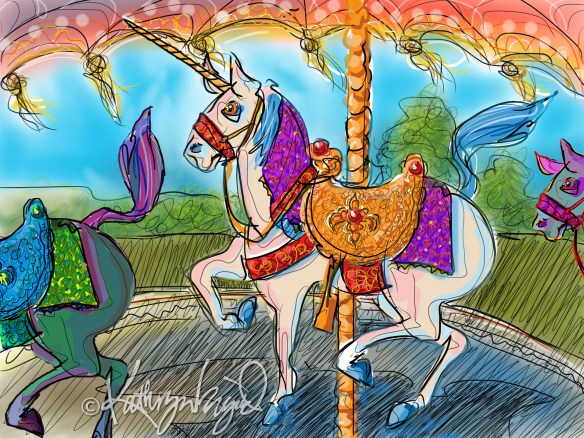
A Mythical Beast

I love James Thurber’s deviously funny little modern fable The Unicorn in the Garden. His way of being so blandly subversive gets me every time. But I also admire the tale, as I always have, primarily because in it, the dreamer wins out over the hard-nosed pragmatist who thinks she can crush his foolishness and browbeat the fantasy out of him. I would far rather be the silly imaginative kid, the one who remains boldly hopeful when all signs point to apocalypse, than live in a grim real world. In fact, if I had my druthers, I might just be not only the frivolous guy seeing the unicorn in the garden but the unicorn itself.

What’s Fact, after all, when faced with the Fantastic?

digital illustration

Would-be debunkers can chase me around all they want, but they’ll find I am galloping ahead of them on the track more steadily than they think!