Just a Second

Photo: Newness 1

What do you see? It’s not a trick question, only an invitation to look for the small and temporary delights right at hand. Newness and beauty are present all around us.

For all that we think of lives as finite and fleeting and time, constantly racing by, I don’t think we take it so seriously when we tell someone who’s waiting for us, “just a second.” After all, so much can happen in a second or less, yes, evening in a millisecond, as we can now measure it. Races are won and lost by the tiniest increments of time. On one side of the little mark signifying a clock’s second-long increments is the Now, and before the very thought of it is completed, Now already resides on the other side of the mark.

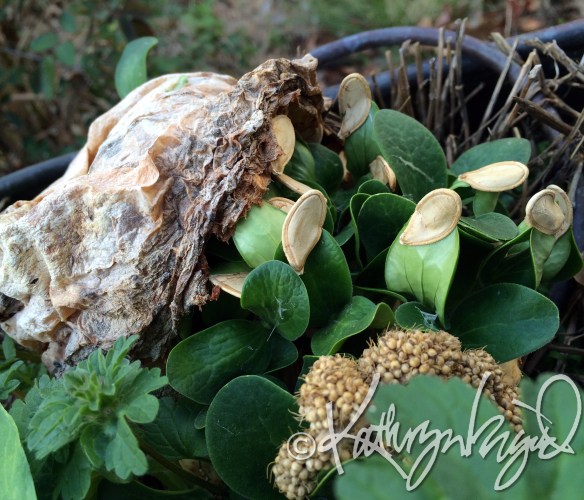
Photo: Newness 2

Dead stems of the past give birth to lively leaflets for the season to come…

No matter how protracted the process leading up to it, one nanosecond is the last one I will spend alive, and the next one will be the first one in which I’m dead. The thought has no moral value one way or another, and not much emotional value either, since as soon as it is likely to seem fully important to me in the most urgent of terms, it’ll be all done.

The only real value for me, in practical terms, is if I invest enough thought in this very moment of being still alive to commit to being wide awake as well: deeply present, and grateful for all of the good that is in my life at every piece of time I’m granted along the way. Whether it’s thanks to honoring spiritual values in the practice of mindfulness or it’s because I’m keenly aware of those lives that, however brightly they’ve burned, were far too short, it matters little unless I take advantage of the perspective these afford me and live my own life more richly because of it. Regardless of how I choose to spend this magnificent currency of breath and sentience and health and hope, even if it’s on sitting on a park bench and holding hands with my beloved (one of the highest and best things I know how to do, to be sure), making a conscious and committed choice is well worth the effort, and following through, all the better.

Just now, the value of mindful living in the present is particularly lovely because we are on the cusp of spring here in north Texas. And if you’ve read even a few of my locale-related posts, you can appreciate just how fleeting and tenuous is the very idea of springtime and how ephemeral its joys. I would be a fool to be so encumbered by longing for things past or worrying about things yet to come that I don’t pause, however briefly, to savor the wonder of what these treasured nano-joys can bring to my existence.

Photo: Newness 3

Out of death, life. The cheery pumpkins and gourds brightening the fading allure of the autumn garden have in turn rotted, dried, and decayed—but from their secretive hearts, the burst of seed and greenery returns to begin it all again…

There was a Time…

For everything in life, there might indeed be a season. When it comes to the normal and quite predictable shift in relative values or availability, of course, I’m as skilled as the next person in forgetting to renew, rearrange, or simply release that which is no longer fulfilling. It might be an object of utility or beauty I’ve treasured and utilized until it was worn or a new and better one supplanted it. It could be a handed-down family treasure whose receipt over the years went from being an honor to onerous. It is even, occasionally, a relationship with a person that was exactly the right thing at the right time but has either shifted as our personalities and needs grew apart or has been taken from me by death or distance. The question, after any of these, becomes how and when I am able to distance my own self from them without fear of losing what was wonderful in having had them.

I worried about this each time I moved from one home to another, despite knowing it was impractical to take every single thing I owned with me to my next locale every single time, and with no surety about what would fit the new place or how I lived in it. When my husbandly person and I decided to downsize some years ago from a house to an apartment and simplify a little by getting rid of lots of what was essentially unused stuff, even though we’d both collected and enjoyed much of it happily over the years, this question arose yet again. I’ve not once regretted the off-loading of so much, even many family heirlooms, in that process. As we sorted and packed it off to new lives/homes, I decided to photograph not only the house and garden as they were but also all of the best-loved Things, thinking that if I could look at the photos when I got wistful and nostalgic later I would be comforted by the stroll down memory lane.

In the end, I almost never even looked at the photos afterward; just knowing that I could was enough, and made it quite easy, really. The very process of ‘documenting’ the stuff helped me remember it and my feelings about it even better than having it still in hand. In practice, I found that much of what I do keep around is easily forgotten simply because it’s not in constant use, so why have it at all? Somebody in need of such a thing will love it all the better, and I’ll feel more contented that the right person and the right object came together and I’m relieved of caring for something I too rarely appreciate. Out of sight, out of mind, and better out of sight in someone else’s appreciative hands than in the back of some cobwebbed cupboard.Photo montage: Stuff & Things

Nobody Wants to Confess to being a Sneaky Snacker…

…but most of us are not only guilty of such misdemeanors but occasionally even get caught with our paws in the pasta. We’re not always major miscreants, but there are times when even the most proper of persons likes to break protocol just a bit. Ah, well, we do so love our naughty little secrets!Photo + text: Snack Sneaker

We are All Lost at Times

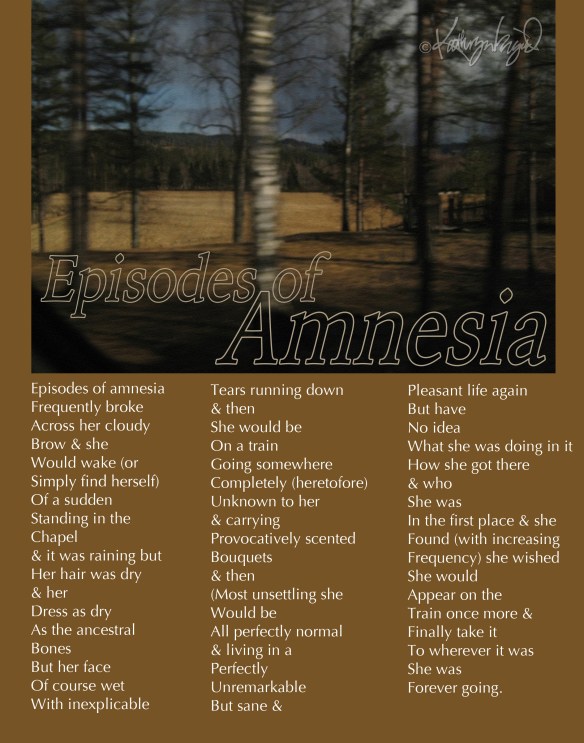
Awake or asleep, physically or only in spirit, we all have moments to wander. It may be that we do so with good reason, or without any sense of reason at all, but the roads we take can twist and turn unexpectedly. What we do with these surprises can be the crux of real meaning in our lives. Or it can lead onward, ever onward, the mystery never seeming to abate and its clews unravel intelligibly before us…Photo + text: Episodes of Amnesia

I Am Not Alone (Part 3 of a 3-part series)

Disclaimer: I’m no doctor, therapist, counselor, or genius. If this post about hope in the midst of depression and anxiety and related mental-health experiences is in any way true for you, know that it might be uncomfortable to read in the first place, but much more importantly, that reading it will not, cannot save you from your troubles. What you need is not a word of empathetic support from a fellow mortal with related experiences but genuine professional help, just as it’s what I needed first. Come back and visit me if and when you’re ready. If you don’t have any such problems, hurray for you! And read on anyway, because you might be able to help another person if you know better how she or he is living. Everyone’s truth matters, even when we don’t agree with or share it.

I’ve said it before, and I’ll shout it again and again from the rooftops: ♥♥♥♥♥♥♥♥♥♥♥♥♥♥♥♥♥     ASK FOR THE HELP YOU NEED!     ♥♥♥♥♥♥♥♥♥♥♥♥♥♥♥♥♥

When you’re feeling strong enough to do it, fellow struggler, I want you to ask for, and find, the help you need. A friend wrote me after reading the previous two parts of this post series, quite rightly asking: “As someone foreign to what you describe here, I’m wondering whether you’ve ever found it beneficial for two people who are both despondent to work together. Can the shared despondency do some good, like two negatives making a positive?” My short answer (strictly my opinion, of course) is, Yes and No. Feeling alone in sorrow is, ironically, almost universal, but the feeling ignores the reality. Being reminded we’re ‘all in it together’ can help. Mutuality of support and dependence can be useful, but only if genuinely committed on both sides to the wellness and well-being of self and other, and only in partnership with those qualified to help. Wallowing and giving up hope together is no better than doing so alone. Find the counseling, student resources center or person at your school, workplace, or community services center, and get in contact. Do a little research to find out what’s affordable or free, and accredited, in your area. Make an appointment, and be sure to tell the person with whom you make the appointment that your need is anxiety and depression related and therefore time sensitive.

Stand up for yourself enough to insist on getting the help you need. I was really, really lucky that the counseling center my doctor sent me to visit had trained ‘triage’ telephone operators who could determine how urgent it was that we patients get in and guaranteed an appointment within a week or even 24 hours, depending on the situation. We all know that for anyone who is suicidal, only genuine emergency care will do: a suicide prevention hotline, phoning 911 [the American universal emergency phone number], or heading to the hospital is essential. But knowing that the assessing operators at my local mental health center were trained to spot the differences gave me a little needed comfort and the strength to wait 24 hours more.

Meeting with this counselor won’t be an instant solution for you, though, honestly, getting through the first step of making the contact was for me by far the hardest, bravest thing I ever did, so everything after that seemed progressively easier! I cried and sniffled and howled through the phone call, through the days (weeks) leading up to the appointment, through the drive to the appointment—wondering if I could go through with it, though I’m delighted, if that’s the right word, that I was too afraid and embarrassed to cancel and inconvenience the stranger I was going to see—and I wept through the majority of the first appointment, too, even though I had little that I believed was so urgently, impressively scary or important-seeming to say or do. That’s the nature of the beast, isn’t it. I think it’s useful, when you decide you’re in need of help, regardless of feeling ready or courageous enough to seek it, to have a few little strategies for taking the starting steps. A checklist, if you will, can make the attempt at something so large ever so slightly less daunting. From my own perspective I can offer some possible options.

Think of others. The world shrinks incredibly when one is depressed and anxious. It’s all I can do, in the midst of it, to consider that I’m not the lone creature in the entire miserable universe. But realizing that my misery spreads invisibly to others, like any kind of infection, helped me, albeit incrementally, to decide I had to make a change somehow. I could at least drag myself to strive toward health for others’ sake when I couldn’t muster it for my own sake. The one ‘trick’ that still helps me the most often is one I suggest you try even before you manage to go out and get professional help: Focus your energy, however infinitesimal it may seem, on doing whatever itty-bitty-teensy-weensy thing you can do to help someone else through a struggle. I wrote about this technique that my mom taught me in a previous blog post, and it still regularly saves my shaky hold on sanity in stressful situations where I’m not actually alone, especially at social events, which are big stressors for me. Give it a shot a couple of times, and give yourself permission to ‘play the part’ of somebody cool and confident (at least cool enough to admit to a stranger that you totally lack confidence) and you’ll be amazed, almost invariably, how much it can help you. I’ve managed to get through events crowded with intimidatingly high-powered, celebrated politicians, artists, and social giants, in countries where I spoke little or none of the local language, by doing this. I’ve also learned along the way that many of the aforementioned intimidatingly powerful persons turn out to be just as needy and insecure as I am, merely better disguised!

Build a DIY support network. It’s a network only if you think of it going out as well as flowing in: you’re not only asking for help but offering it, and though you don’t believe you have enough resources for your own puny self, working to give some to others will show you better what you can do. It’ll be a hard slog, since so many depressives, like me, also fight social anxiety, and either (let alone both) can make it mighty hard to openly discuss deeply personal things like our mental health. Doesn’t even sound possible, does it? But it is. Dare to test the theory; you already know that you’ve got nothing to lose.

Commit to wellness. Sit down with at least one supportive person, preferably a loved and trusted one if you have any such thing. A fellow struggler, a professional, even a total stranger whom you deem trustworthy, might offer support, and that can be useful, too. Find one, or make one. Say to your supporters how much it means to have them on your side and that you will do whatever you’re capable of doing to help each other go through this process, knowing that you’ll all fall down on the job but you will not quit trying, because you owe it to each other as much as to yourself. You might not believe that fully yet, but I promise you it’s true. Even those who think themselves insignificant and invisible aren’t; what affects them for worse or better affects all of the lives around them similarly. If you can’t seek health and happiness for your own sake, try to do it with the idea that you can aim to improve the lives of those around you by being happier, healthier, and better able to assist them through their own difficulties. Imagine your improved health and well-being first as a fantastic, romantic ideal, then as a remote possibility, and then as a goal, and you’ll have a better shot at accomplishing this amazing thing than you might guess.

Take a first step. Make the first appointment you need, even if you don’t yet know how deeply you do, with the mental health counselor or resource person. GO. If this is someone who can see you and your supportive companion together, it might make it easier for you to approach at least the first meeting if you’re there to encourage each other. The first session or two will likely be little more than figuring out your current state of being and understanding your “baseline” in any case. Be bold, and assume that you will be helped by this process, even though it might not seem so at all times, and persist doggedly. Fight for your life. Ask your professional helpers straightaway: Please tell me about all of the FREE resources you can share with me [us], refer or recommend for my needs, so I won’t have the added anxiety and depression of finding something that helps, only to be denied it for financial reasons thereafter.

Commit to continuity. Follow up, whether it’s with this same person/center, or someone/where else that’s recommended. Do your homework. A counselor should be teaching you how to assess your own situation and what you can do to have a positive effect on it, whether it’s through making lists, keeping a simple journal (your blog or diary will certainly qualify, in many instances), doing some reading, learning to meditate, doing a small amount of exercise, adjusting your diet, listening to music, or something else entirely. Do the work. It might be laborious or even painful, but every bit you get through will be something you can cross off your list of struggles.

Reward yourself with your healthiest and most affordable pleasures every single time you feel you’ve made one atom’s-worth of progress. Don’t worry about falling down on the job again tomorrow, because you will. Know that when you’ve rewarded yourself with an honest “hey, I didn’t think I could manage that until now, but I DID IT!!!!” followed, perhaps, by doing the Snoopy Dance or wallowing in an hour of reading from that really trashy, sappy book that always makes you feel like hugging the universe a little, you will be more inclined to get back up and do the work again as soon as you’re able. Keep hunting for your Happy Place among your matrix of matrices. [Have I just coined a phrase?]

If all else fails, take the time to look at your reflection in a window or mirror on occasion and practice smiling ever more genuinely and convincingly, while saying to yourself in your silliest Stuart Smalley impression: “Kathryn Sparks thinks I’m cool. And she’s really amazing, so who am I to argue with her?” Because I really do know how tough it is to be one’s best self and I truly admire all who manage to do the hard work it can take to move in that direction in difficult times.

You do matter. Your well-being matters. Your relationships with fine people (me, for example) matter. Peace and joy to all of us.

♥♥♥♥♥♥♥♥♥♥♥♥♥♥♥♥♥♥♥♥♥♥♥♥♥♥♥♥♥♥♥♥♥♥♥♥♥♥♥♥♥♥♥♥♥♥♥♥♥♥♥♥♥♥♥♥♥♥♥♥♥♥♥♥♥
Photo: I'm Only Human

Is There Anyone Who Knows Me?

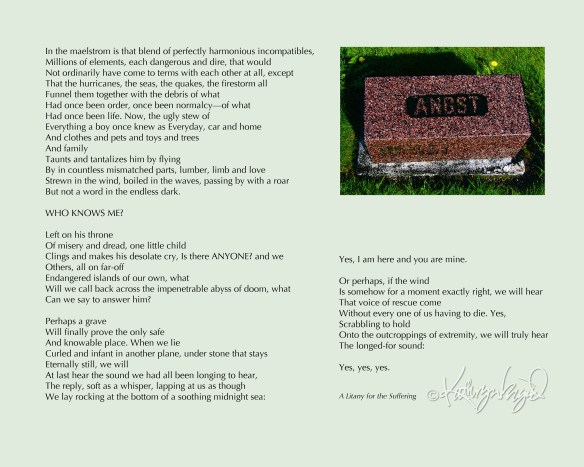
This is the first post of a three-part series on depression and anxiety, so if that’s an off-limits topic for you, I’ll see you again on the weekend! But it’s really intended as a series on hope from someone who has been-there-done-that and loves life in all of its complicated craziness as I know it now, on the other, generally sunnier, end of the tunnel. Today, for your contemplation, a meditation based on a true story of fear and loneliness and the possibility of triumph through one faint but persistent call for help.Photo + text: Under Sea, Under Stone 1

Photo + text: Under Sea, Under Stone 2

Best of Intentions

Mirrors, those revealers of the truth, are hated; that does not prevent them from being of use. -Victor Hugo, novelist and dramatist (26 Feb 1802-1885)Digital illo: Naughty but Nice?

What Fools, These Mortals

Hester the Jester was not a protester,

but every semester she stood

Proclaiming the truth, and she fought, nail and tooth,

for the right and the ruth and the good,

And I really should mention her kindly intention:

dissension and strife she eschewed,

While meaning to find ways to open the mind

and the eyes of the blind, not be rude—

But whatever she meant with her selfless intent,

there began to foment quite a storm

Of objection to this, her good aims gone amiss,

dissertation destroyed by the norm

Of assuming one’s thought was aright and was not

to be questioned or brought ridicule,

Called privilege, might—for the mighty, a Right

to be right, day and night, was the rule—

Her well-meaning japes made the men feel like apes

and the womenfolk’s napes itch with ire,

And the moment arose when a number of those

tweaked her nose, set her hairpiece on fire,

Bashed her quite black and blue with a strop and a shoe,

swapped her lip balm with glue, stole her hat

With its jingling bells, threw her in prison cells

with appalling bad smells—and with that,

They ended her reign, in despite of the brain

and the might and the main she had shown,

And, as Jester no more, she was only a boor

who got kicked out the door on her own.

The moral, you ask? Keep your thoughts in a cask,

in a secretive flask of great tact,

And instead of Truth, Charm will prevent much alarm

and protect you from harm, and in fact,

Diplomacy’s best, whether true or in jest,

and at Hester’s behest, you should wait,

Your opinions held fast, silently, to the last,

lest your presence be past, and you, Late.

Digital illo: Well-Meaning but Mean?

A Touch of Existentialism

Like most people, I suppose, I am an odd collection of contradictions. Having a pretty dandy education and good genes, I’m not entirely dimwitted, in fact, would say that I’m not only intelligent enough to have gotten good grades in school right on up through my graduate studies but even so much so that I get along rather well in my life. But everybody who knows me also knows that I am also almost supernaturally dyslexic, being unable to read with ease or tell left from right, up from down, forward from back, and a host of other handy life skills that others, as I’ve observed, seem to come by naturally. This is not a complaint or bragging, either one, just a statement of fact. I do well, when I do well, because I have found sidelong ways to get the job done, whether it’s by reading any text at least three times through before it falls into sensibility in my quirky brain or by traveling on trust and a fairly reliable eye for landmarks to keep me finding home base despite my utter lack of an inner compass.

I am by nature exceedingly shy and have had from early childhood what I only learned as an adult was an unusually high level of constant anxiety that, with serious therapy and a consistent supply of low-level medicine, turns out to be manageable. So even though it seems incredibly unlikely and counterintuitive to people who meet me now, I appear to be a lifelong social butterfly, an extrovert, and naturally fearless about interactions even though without the meds and training I would be wholly unable to function at this happy level. My vocal cords are irritatingly subpar for regular use thanks to my SD*, but when I’m with someone I really enjoy and trust, I can be counted on to chatter without stopping (*other than when forced to) for great lengths of time.

And I have no magical powers. Again, I think myself essentially ordinary in having no skills or talents, knowledge or gifts, of special note. I am not overly self-deprecating or sad on this account, merely noting that if you’re looking for the person who will end all wars, cure cancer or the common cold, or discover a way to stabilize the planet’s climate forever, you should jolly well be looking at almost anybody else imaginable as a better go-to heroine. Yet I really do think we all exist for some sort of reason or purpose. It might well be that mine is nothing more than to spend a lifetime figuring out what my purpose is, and die slightly more contented than otherwise if I should be so lucky as to solve that puzzle any time before I’m taking my last breath.

You know what? That’s good enough for me.Digital illo + text: Hovercraft

Sometimes It’s Better to Part Ways with One’s Parts

When something goes wrong inside, for most of us it’s no big deal; just an off day in the old innards, whether physically or emotionally, and it’ll pass. But when something goes wrong in a more complicated way, I tend to think it’s pretty good luck if “all” one has to do to get well is remove a malfunctioning part and either replace it or live without. Modern life makes that possible: a swift appendectomy with a tiny scar to show for it, a manufactured hip here, a transplanted kidney there. Lots of things that, if not chronic, are reparable and survivable when they used to lead to long, slow, miserable declines or instant death.

There’s still plenty of the latter kind of illness and injury to keep doctors busy and patients unhappy and money funneling from the latter to the former in ever-widening streams, and that’s no joke. But I think it remarkably good that I live in an era when far less stuff is fatal by default. I was especially glad that when my poor brother-in-law was violently attacked by his own gallbladder recently and it tried to stone him to death, there was adequate artillery to fight back and win. What did he ever do to it, to deserve such lousy treatment! I can tell you from (supposed) experience that gallbladder pain is horrendous. I can’t tell you what it’s like to have the offending organ removed, or even have the stones destroyed and extracted, because either I don’t have a gallbladder at all or it is an expat living in a foreign part of my body from where they are normally located: the doctor and ultrasound technician spent a lot of time hunting and could never find the little hunk of meanness before the pain, thankfully, dissipated on its own.

Photo: Plumbing

Don’t you just hate it when something goes wrong with your plumbing?

My BIL was not such a fortunate escapee, and the pain persisted and worsened until he ended up with several exceedingly un-fun procedures to zap the stones and remove the offending organ, which if you ask me did have a heck of a lot of gall to treat him like that. I am ever so glad he has already begun a full recovery! I wrote him a silly poem, ’cause I love him.

Parting with Parts

is Such Sweet Sorrow

Can anything be worse, or sadder,

Than to give up one’s gallbladder?

Well, perhaps one worser quirk:

Still having one that doesn’t work…

And one worse yet: the wails and groans

Induced by one that’s filled with stones.

So I’ll amend Assertion One:

Having a gallbladder’s no fun.

But then again, I must concede

That surgery is bad indeed.

It all comes down, if I should guess

To what will save my happiness

More fruitfully: intact gallbladder?

None? Can’t say: it doesn’t matter,

Since the choice will not be mine—

‘Til then, I s’pose I’ll be just fine—

I hope. Of course, I still don’t know

Whether I even have one, though.

The Façade isn’t Worth It

Ask for help. Short phrase, simple concept. Really, really hard to execute sometimes. We place such high value on ‘keeping face’ or seeming tough and cool and untouched by mere human foibles, trials, and concerns that many of us are perversely frightened at the idea of doing what should be the one easy thing. Ask for help.

It doesn’t pay to play the brave one or the willing martyr when your world is caving in on you, and even less so when you consider the ripples through the host of people who—though you may forget it at times—count on you, whether for equally small and simple things or for being the love and joy of their lives. It doesn’t do any good to sit and wait for help to come to you: remember how hard it is for you to know your own mind, let alone read anyone else’s, and know that they can’t read yours any better. Even if they realize how deeply in need you are, they may be fearful of offering their assistance because of that very mask of competence and courage you’re hiding behind, and you both lose.

There might not be help enough in the universe to fill your need, never mind your desire. But there’s no Maybe, if you ask that from yourself alone; you will fall. You will fail. When you feel you have nothing further to lose, there are really no such things as “acceptable losses.” Accept, instead, the handout, the hand up, whatever it is that anyone at all can offer you, and with it the hope of better things. It might mean nothing more significant than lightening your mood, and that is important enough. It might save your sanity, or your life. Ask.Digital illo from a photo: Nine, Ten, a Big Fat Hen