
Is it salad or crudites when it's deconstructed? Do I care, or am I just *really* hungry? Is salad so hard to eat unabashedly that it must be disguised as something else to pass muster? Is Vilma secretly seeing Ernesto at his nightclub El Gallo Llorón while she thinks Juan Maria is away on vineyard business?
Sometimes I think that Salad has a little bit of a stigma in the popular mind, even though ‘some of my best friends eat salads’. There’s just a hint that if one is too obviously fond of salads one must be (a) stuck in the 1970s–don’t get me started on alfalfa sprouts–(2) trying to lose weight and hopelessly clueless about all of the better miracle diets out there, or (lastly) some sort of chlorophyll-blooded alien. Despite the widespread knowledge that there are endless kinds and combinations of foods that can be classified as salads and that the vast majority of them are both rather tasty and potentially nutritious, there’s always some naysayer out there who thinks that there’s something just a tiny bit off about people who embrace frequent salad-eating.
I would find it seriously boring to eat salad often, too, if all salads were born alike, but that is far from the case. There are all sorts of recipes and inspirations available from every quarter, and definitions galore of what constitutes a salad. The origin of the salad construct is arguably that of a simple collation of a dish or meal, in antique times, consisting simply of raw, fresh vegetal matter seasoned with salt (the ‘sal‘ of salad), and occasionally, with vinegar and oil. The idea has expanded over the centuries gradually to include cheeses, meats, fish, eggs and nuts, and at some point probably around the latter nineteenth to regularly include mixtures of warm ingredients and often grains, legumes, and their offspring of breads and pastas as well. If you can’t figure out how to keep a salad interesting then you are as sadly unimaginative as the average politician and probably deserve to go hungry for a while to contemplate your sins.
All the same, I have no objection to a rather staid and standard sort of salad, a plain bit of greens or greens with a few ‘classic’ add-ins–juicy sweet tomato; a bit of diced avocado, perhaps–and maybe a splash of good dressing, either as a light meal or a side dish. The much-maligned ordinariness of even a wedge of supposedly flavorless iceberg lettuce can sometimes add an exceedingly welcome and refreshing bit of mild crunch and hydration to offset an otherwise heavy or over-the-top sort of meal. There’s a perfectly good reason the ‘Wedge Salad’ has remained wedged onto the menu of virtually every standard American steakhouse for so very long, in between the slabs of highly seasoned beef and the creamed This and butter-slathered That and deep-fried Other, all quite delicious indeed but occasionally in want of one coy kiss of contrast or brightness in some fashion.

In our hearts, we're all kind of plain, but is being ordinary a *bad* thing? Or is it mostly just comforting? Is a salad comprising only common uncooked vegetables and dressed abstemiously with a squeeze of lemon juice and a slurp of olive oil anathema, or can it be loved for its pure, taste-able simplicity? Honey, do deer eat salad in the woods? (Or just salal?)
I suppose I could be said to be more fond of or partial to salads that take the trouble to stand out from the crowd just a little bit, or at least less likely to become jaded by them since they vary the input on the palate. Why not jazz up the greens with a bit of roasted vegetable or bright fruit, with some shredded or crumbled cheese, some toasted nuts? Give the dressing a little boost of unexpected flavor. Make it a meal by putting some handsome protein in that invitingly verdant nest. But let’s not get crazy here! At some point, a concoction too complicated ceases to be a salad and becomes either a circus sideshow not very enticing as actual sustenance or more about ideas than about taste, and I find that tiresome in any part of a meal. If food is entertaining, great, but if entertainment is inedible, don’t try to tell me it’s dinner.
For that’s what it all means to me, finally: does what I’m serving genuinely satisfy hunger? Does it actually taste good? Does it express hospitality by being sensitive to the tastes and health of guests at the table? If it doesn’t meet those criteria, all of the artful towers of constructivist salad art and all of the impressive molecular gastronomist foams and gels and powders, the foodie-swooning truffles and caviar and smoked duck ravioli and balsamic-martini dressings in the world won’t save it from death-by-silliness. Let’s hear it instead for a thoughtful, pleasurable combination of flavor, texture, color, scent and sensibility that balances the needs of the diners and plays nicely with whatever else is brought to the feast.
Lately, my salads have been fairly basic again, combining the wonderfully homely base of romaine lettuce leaves or shredded cabbage with whatever array of old-fashioned but still tasty partners I happen to have on hand and be hungry to devour and topped with a lick of some complementary dressing for the big, if unsurprising, finish. I’ll be hungry soon enough for a hit of pizzazz in some part of the salad equation, whether it’s a whole new salad or just a garnish I’ve not enjoyed in a while. Because I’d hate for the old-familiar to become dull and unappealing. That is the very definition of being too far gone to recapture one’s salad days.
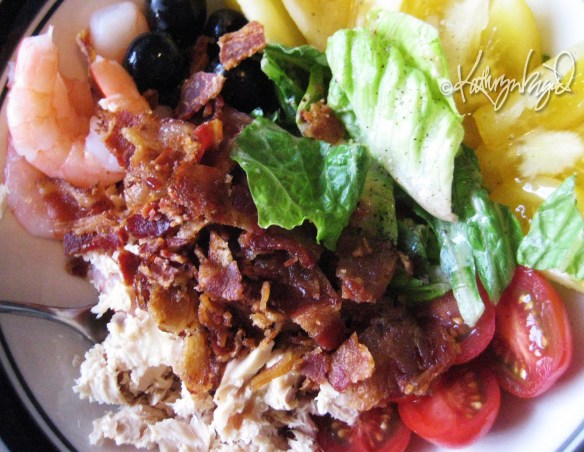
A salad certainly needn't be fussy, only friendly, to enhance the dining experience; it's more important to balance the other characteristics of the meal than to show off what wild and weird tricks a salad can be made to perform. Unless you happen to know how to, say, make yellow tomatoes turn into red tomatoes when you put the dressing on the salad or how to make origami swans out of butter lettuce leaves.
Being beautiful, after all, is more about attitude than pedigree, so I’m more concerned that my salads be composed of flavorful fresh ingredients, play a proper supporting role to the stars of the meal (the people, first, and then the entrée), and in true Coco Chanel style, always be appropriately dressed. Even Coco, I feel certain, would admit that certain occasions require tasteful nudity, but she would know better than anyone that most events are best served by a well-designed and appropriate ensemble and careful accessorizing. With that, I scratch out here a couple of my thoughts about salad dressings, which like salads themselves seldom require an actual recipe–if they need one, they may have gotten too complicated for their own good.
I think of salad dressing as a marvelous way to distinguish the beauties of a particular salad. Something astringent works better with salad than with nearly any other course of the typical meal, so if the meal needs a little flash, that’s a great place to create it. For milder needs, despite my love affair with heavy cream, I know that creaminess in salad dressings is rarely best accomplished by incorporating actual dairy cream. A better partner with salads is an emulsion, generally two liquids that want to hate each other being brought into détente by mechanical means. Typical examples would be an acid ingredient like vinegar or citrus juice and a fat-centric goodie like oil or egg yolk, the two ingredients being beaten into submission by gradually incorporating the fat into the acid with a vigorous, airy, steady whisking. Sort of like a cranky teacher putting the harsh reality of thoughts into my fat head by forceful means. Not that any of my own teachers was ever like that. (Cough! Mrs. Finley!) Once I have (or a persnickety teacher-like person has) made the dressing’s basic parts behave properly together, there are endless sorts of herbal, spicy or other flavors that can be invited to play along with them for individuation and to better suit all of the dinner’s other ingredients.
Here’s a little combination to try: 1 part ginger juice (freshly grated ginger root will do, if you don’t have bottled juice), 1 part soy sauce, 2 parts maple syrup or raw honey, 2-3 parts lime juice, 2-4 parts macadamia or coconut oil (or any mild flavored oil you like). Put them all together in a tightly lidded jar or bottle and shake vigorously. Adjust to taste. Dress the salad just before serving or let guests dress their own salads. Fitting add-ins or add-ons for this sort of dressing are toasted or black sesame seeds, ground black pepper, toasted sliced almonds or pine nuts. Well suited to mixed green salads with sweet orange segments, diced dried apricot, ripe avocado, grated myzithra cheese, kale, thinly sliced jicama or daikon or sweet radish, or . . .
What? You can’t hear me over the crunching? Well, then, grab your salad fork and join me. I won’t tell anyone you’re one of those, you know, salad eaters.




 Art-Colored Glasses