Kindred Spirits

line drawingEven when I meet them in places of common interest I am surprised to encounter like-minded creatures. I suppose that’s part of the human psyche, to imagine ourselves so individual as to be unique in all ways. What we really are is unique combinations of characteristics, so we might be better explained as having innumerable subsets in common with others, but not all with anyone else.

And that makes for practically infinite possible serendipitous discoveries of the shared traits, ideas, bits of history, likes, dislikes and curiosities. The potential for finding ways in which we are like others is probably greater, when it comes right down to it, than for finding differences.

Of course, having desires in common means that, like siblings, we still find our shared interests a reason–if not an excuse–to compete with each other, even to fight. We might get a bit too busy comparing ourselves with each other because of our commonalities as well, and whether we think ourselves superior or inferior the imbalance in the equation can lend itself to conflict. We are contentious beings, we humans.

But all told, the advantageous delights of finding others with whom we share views and loves and hopes and pleasures far outweigh the complications. Whether we are introverts or extroverts, worldly or otherworldly, there is great happiness to be found on discovering kindred spirits. It is possible to live our own fairytales when we find the right characters with whom to share them.digital artwork

Drawing on Your Beginner’s Luck

The nice blogger from Zara–A Writing Story stopped by recently and her post said she is working at starting to draw. I’m delighted to have another person join the ranks of happy visual artists via drawing–a collection of skills that come in quite handy (no pun intended, especially since there are artists who use their mouths or their feet to make artworks) for far more than strictly a pleasurable activity or visual entertainment. Drawing, a foundational skill in all sorts of visual art, is also a means of communication that differs from and can work in wonderful tandem with writing, singing, signing, and any number of other ways of personal interaction and transmission of information. In addition to the practical application of the end product of the process, the practice of drawing itself has great power as a mnemonic device, a tool for problem-solving, and the training of the brain in such useful skills as eye-hand coordination and (as I know from experience) the correlated motor control of working through tremors to achieve refined movements.

But beyond that, as I said to my blogger colleague, the act of drawing has elements of physical pleasure in the mere action of arm and hand and body that can be worth the pursuit, not to mention the mental and/or emotional pleasures possible. The act of drawing as a form of meditation, even without regard to any possible ‘product’, is quite desirable on its own.

As I said to my correspondent, she needn’t be intimidated in the least even if she’s a rank beginner: By even making the effort to learn, you’re worlds ahead of lots of others! A book I often referenced when teaching my beginner students in college was Betty Edwards’ classic Drawing on the Right Side of the Brain–it has exercises that aren’t too hard even for someone who’s never attempted to draw before, and because her focus is on how the brain works in visual activity, she offers insights into the process and possibilities that few others do. There are, of course, innumerable excellent how-to books for those who want to draw, many of them favorites of mine as well, but because of Dr. Edwards’ [then] ground-breaking work in recognizing the character of right-vs-left brain function and how it played out in drawing, I always found her work particularly helpful.

Because drawing can engage so many diverse cognitive processes like this, it can be complicated and overwhelming to know just where to start learning how to draw. As I remarked in my note to my fellow blogger, All of that aside, simply making marks on a surface is the beginning of drawing. Sometimes the least intimidating way to begin is to take a piece of paper, make some totally random marks on it, and then see where that takes you. Even if all it does is make you comfortable making the arm movements for a start, that’s helpful. If, as with most people, you look at it and think ‘that looks like . . . ‘ or ‘that doesn’t look quite right . . . ‘–well, then, you’re already making editorial decisions that can help you move toward drawing the way you want to draw.

The bottom line, if you will, for me is that I feel more alert, more attuned to potential solutions when everyday problems arise, and generally just plain happier when I draw. It’s not because every drawing turns into something fabulous–far from it–but because the process of drawing opens up my brain and spirits in useful and unexpected ways. Many times, my drawing produces nothing more than scratches that are shorthand for bigger and more complex and, I hope, better things to come. But the exercise itself is valuable to me, and a glance back through my sketches can often kick-start me into drawing a work that is more successful than the twenty previous ones.

line drawing

Exploring pattern in a sketch.

line drawing

Playing around with volume.

line drawing

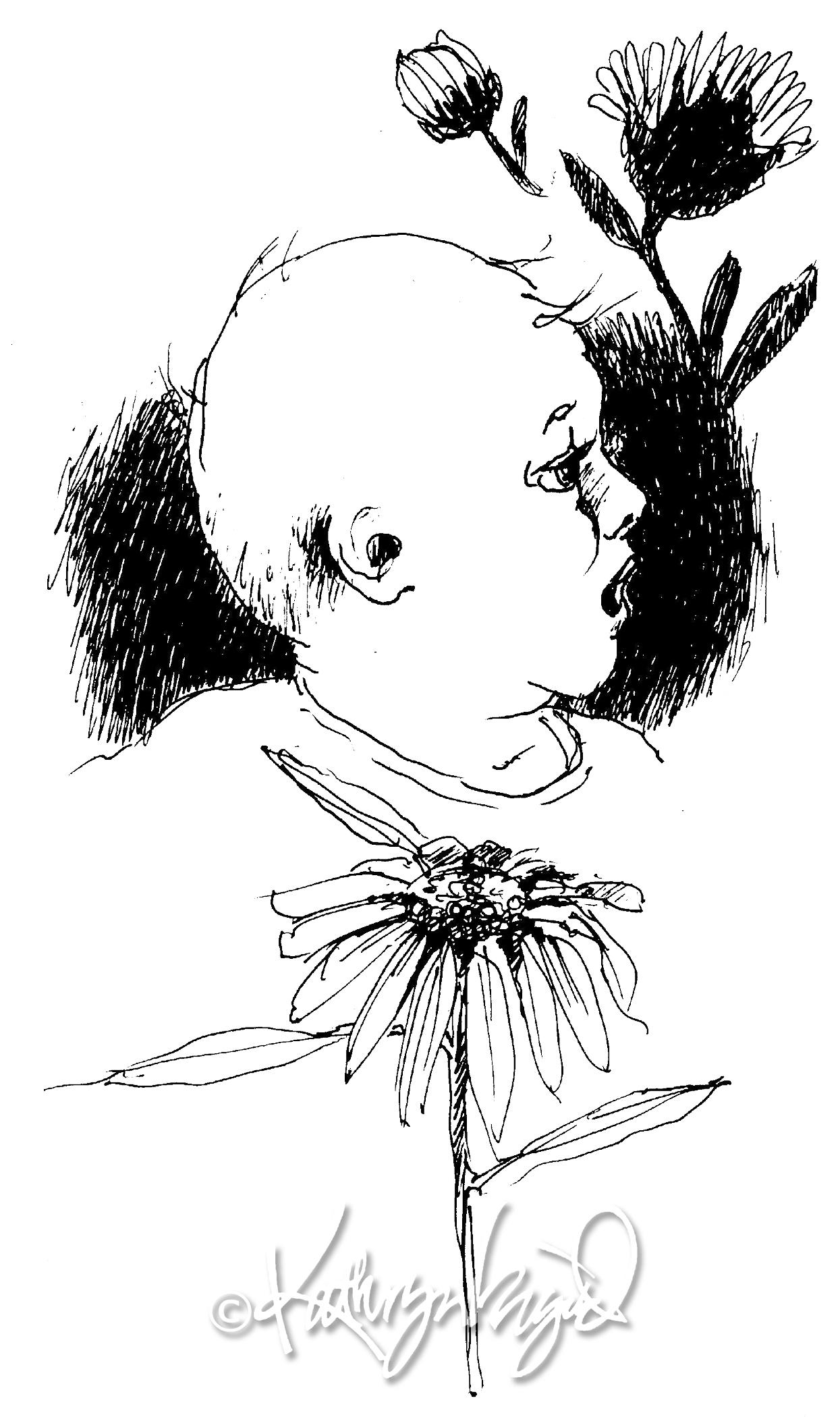
Faces and flowers show up often in my sketchbooks.

line drawing

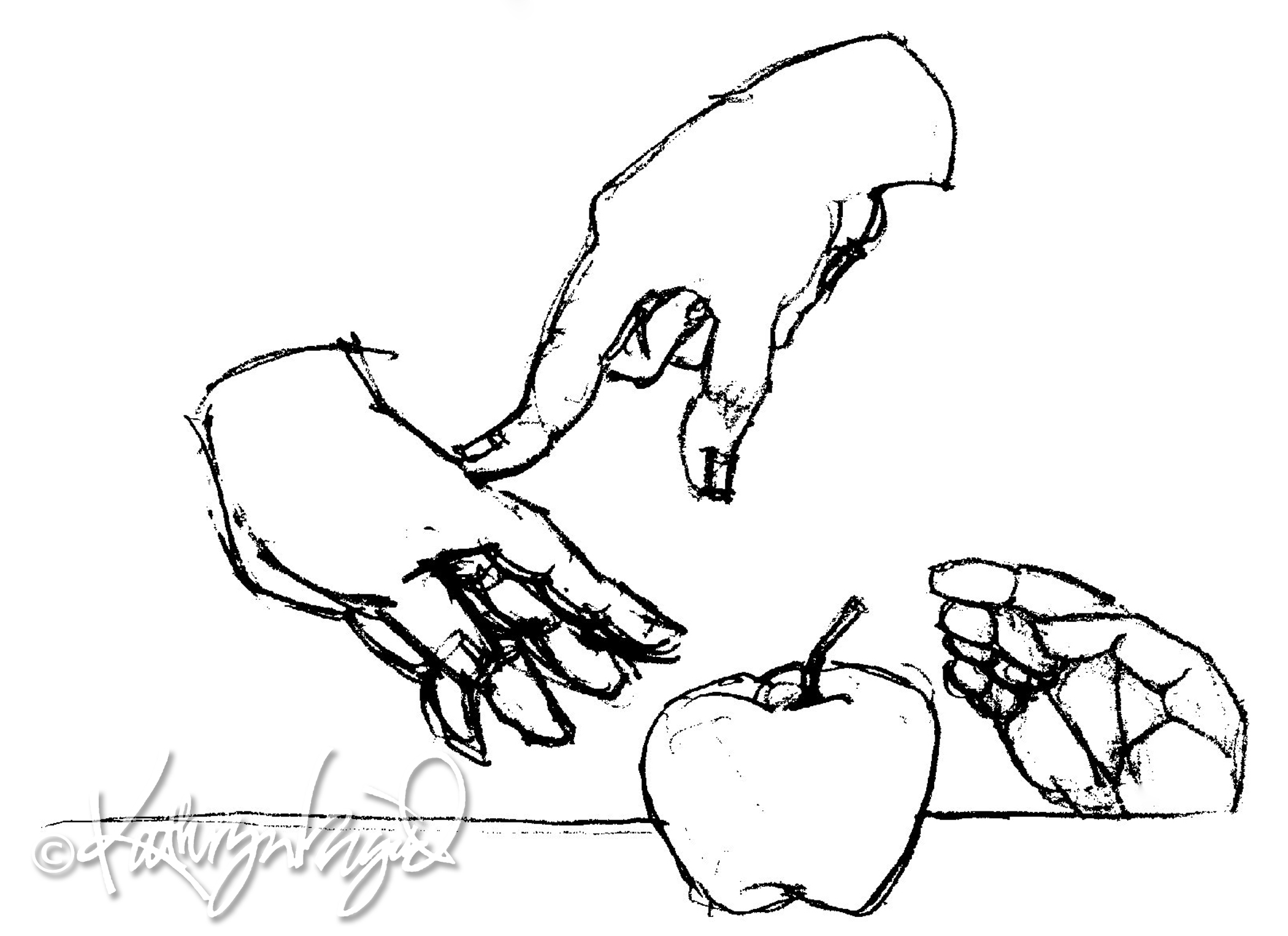
Hands can be pesky subjects, so I play with sketches of them frequently too.

line drawing

Any little vignette that pops into my mind is worth scribbling at least a few times.

Ultimately, whether I’m in gear for serious drawing or just fiddling with a pen or pencil to pass the time, it’s good practice and feels worthwhile. If nothing else happens, at least I have given my brain some thinking-room between the lines and I might figure out what to make for supper, how to cut through the piece of metal that is in the way of my completing a repair in the garage, or who knows–I might even remember where I set down that book I was reading days ago before it ‘disappeared’. It’s doubtful I’ll come up with any Nobel Prize-worthy inspirations while drawing, but then again, if I don’t draw, I’ll never find out!
Even a Big Dude can Sometimes Use a Little Makeover

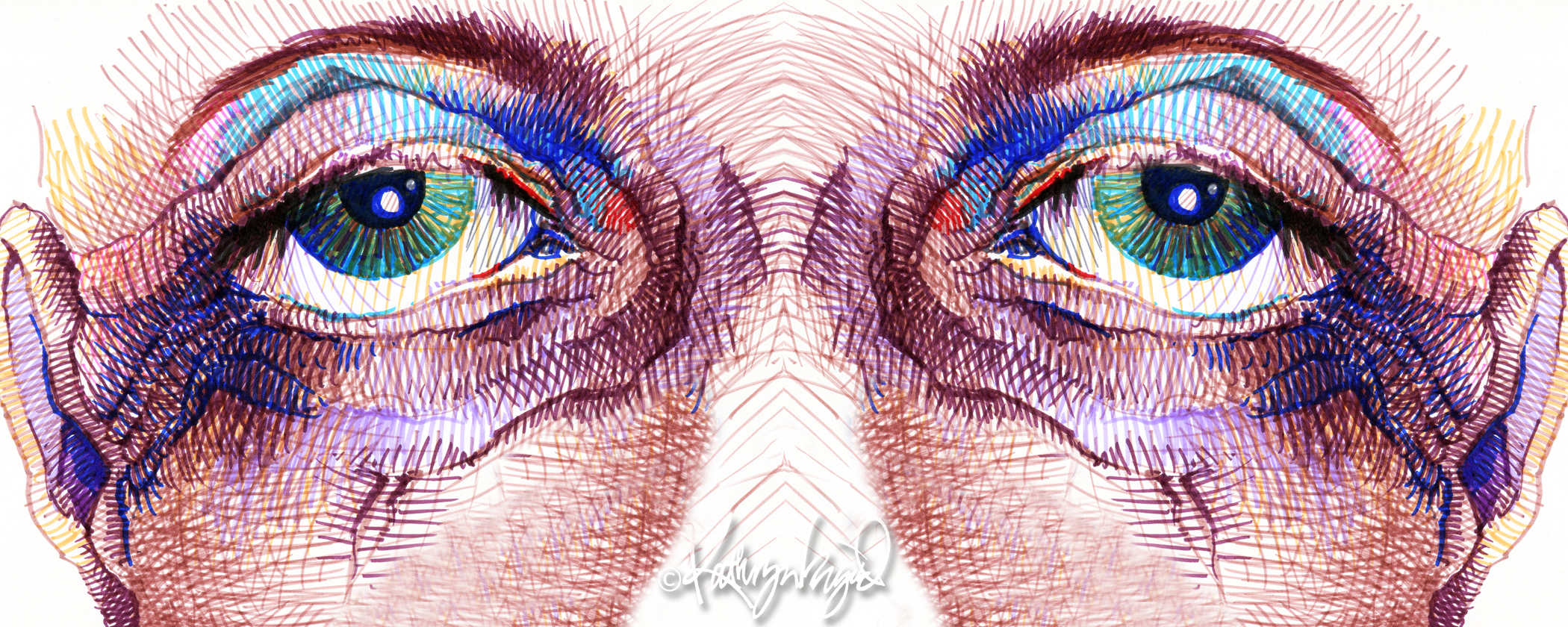
This guy just gets his update digitally, being a digital fella himself. Variations on my themes always give me food for thought and inspiration for further adventure. In this case, it’s the most painless form of male prettifying I know. Hmmm. Maybe I oughta consider this form of plastic surgery for myself. See you later–but you might not know you’re seeing me!

digital artwork

digital artwork

digital artwork

digital artwork

Art, Before & After

graphite and markers on wood panel

Today, another little glimpse of artful goofing to re-imagine an existing piece of my work. I almost never tire of reworking/revisiting my old artworks from time to time. In part, it’s a way to critique and edit my stuff and see how I can grow and change over time. Mostly, it’s just good technical practice–a little bit of re-training my eye and hand and, when I get lucky, learning a new skill or two. In this instance, I took another of my pipeshade designs done in 2007 in preparation for Martin Pasi’s carving the wooden screen panels for his Winnetka instrument and I did some Photoshop playing with it to turn a pair of the panel designs into a merged single image and then ‘hand coloring’ it digitally to redefine it as a wholly new looking picture.

The whole Winnetka project was based on the church’s part of the collaborative team’s desire to have their organ artwork reflect local character. Since Congregational churches don’t tend to wish to fill their worship spaces with traditional religious iconography but rather prefer a more generally meditative space, so it made sense to aim for a design more simply nature-based and reflective of regional beauty. I decided to incorporate some of the Illinois state symbols into the design. This pair of panels featured the state bird, Cardinalis cardinalis–the Northern Cardinal. Is a cardinal too religious a symbol? Oh, that’s right: not a Roman Catholic church. Okay, cut me some slack.

Not really necessary to elaborate, is it. I just decided to show you the Before and the After versions today, and dispense with the intermediate steps–they’re not entirely thrilling to see, being a series of steps mainly devoted to converting the graphite drawing to a crisp black ink-outline appearance (only moderately laborious with the help of Photoshop) and then using my digital ‘coloring crayons’ to fill in the blanks to create a full-color version. This time, I opted for something much more cleanly graphic than yesterday’s reworked image. Who knows what happens next time? That, in fact, is the fun of both making art in the first place and then, in having the option of revising it, maybe even more than once. Can you say, mercurial? Nahhh, we know that I’m still just a big kid with a short attention span. No need to dress it up. I’ll just spend the dress-up energy on the art, if you don’t mind too much.digital artwork from an original drawing on wood panel

Uninformed, or Old and Infirm?


Or just uniformly old?

Does it matter? Not much; never mind. As it happens, I was a little hazy to begin with, so there’s not much worry about the old marbles disappearing. Who really needs marbles anyway, except for a game-playing champ or, say, Michelangelo. For me, the touch of lunacy just adds a little color and a lively element of surprise to my everyday existence.pen & ink

Scaredy Coot

My fears are principally these:

Of sharks, the dark; of killer bees;

Of speeding cars and drunken louts

That race them through the roundabouts;

Bloodsucking leeches; of the kind

Of beasts that populate my mind

In doctors’ offices; of tests

That only earn me second-bests;

And most of all, I fall in tears

Lest someone should unmask my fears!


In Search of Tech-Know Progress


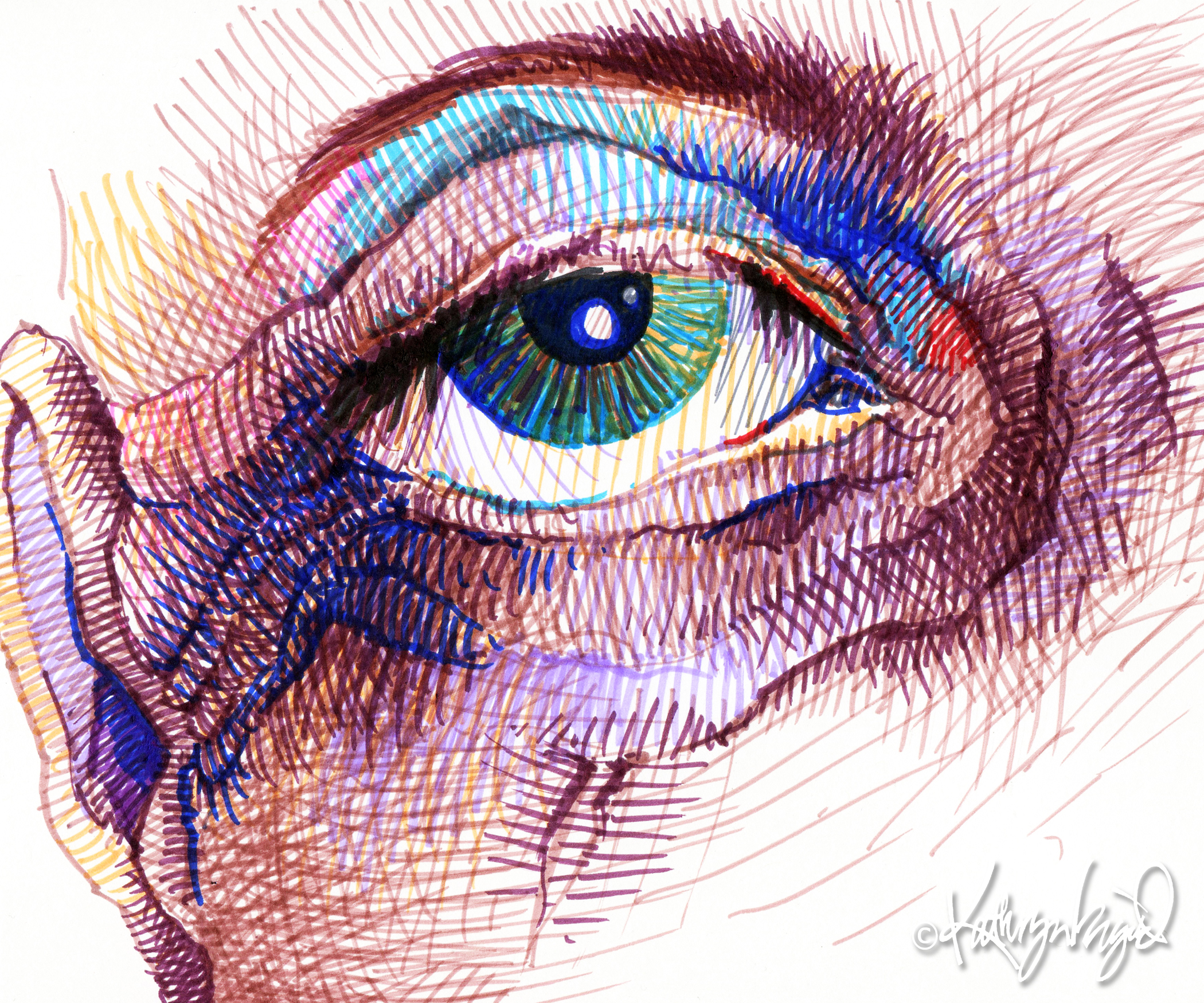
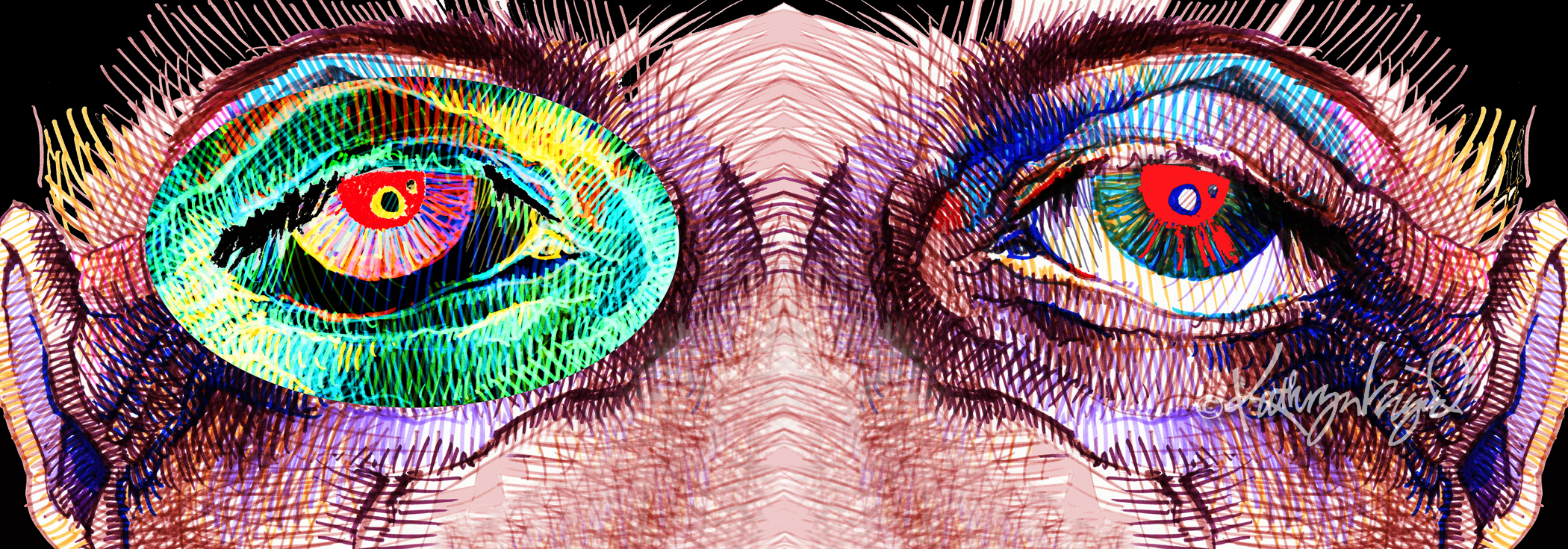
colored markers on paperWhen I post drawings, they almost always require a digital tweak or ten to be clean and sharp enough for putting up on view. Most of the time, it’s merely the need for getting rid of visible dust and scratches or evening out the tone across the piece to more accurately reflect the appearance of the original, stuff like that. Even a direct high-definition scan doesn’t eliminate all of the little oddities.

No doubt there are endless ways to do what I do to the images much more simply and cleverly and efficiently. But having as little technological skill and wisdom as I have, I must content myself with doing in a hundred steps what others can do in ten. At least until I have the time, the money and the gumption to get the necessary education, anyway.

Still, slow and ambling and rambling as I am, I get the occasional urge to mess around with the existing drawing and manipulate it further digitally. Silly, yes, given that it takes me eons to do the first drawing part and a multitude more ages to do anything further via the digital medium. But you know how these things are: inspiration or perspiration, it’s all a command one has to obey once the Muse prods me in that direction. Here’s last night’s drawing (above), followed by the series of phases I put it through today. That is all. For now.digital image

digital image

digital image

digital image

digital image

digital image

digital image

digital image

digital image


All the Colors


When we speak of something having ‘all the colors of the rainbow’ I am certain we don’t quite understand the enormity of such a thing. My sisters and I used to criticize badly designed or tasteless clothing, interiors and the like as being so artificial and clumsy because they were of a ‘color not found in nature’–but then, too, our thinking was far too constrained. For nature, that queen of design, has more colors than can be perceived, let alone understood, by mere human eyes and minds.

She’s a trickster and a lavishly opulent over-doer, is Nature. We are much too small to comprehend the fulness of her range and beauty. What seems like one rather simple thing at first often morphs, as we look and imagine further, into something far different and most likely far more subtle and complex.

I was reminded of this last night when I sat down with a new set of children’s marking pens–the cheap permeable-tip markers that last for about five drawings but cost a tenth of what the ‘professional’ pens do–and began to sketch something leafy. As soon as I began I knew that one kind of green would not make a leaf; no, I knew that all four kinds of green supplied by the manufacturer of this little bag-of-pens couldn’t begin to be sufficient to convey the character of the simplest, plainest sort of leaf-like thing, let alone give a hint of the way light might play across it in different climes, at different times of day. Or how much its appearance must be affected by my own vision, my mood, my expectations.

Our abilities to envision, physical and metaphorical both, are fluid but can never quite keep up with the mysteries around us. And that, my friends, is a fine excuse for forging ahead into the puzzling and problematic and pearlescent thing that is the future . . . .

colored markers on paper

How It Works

In Haiku,

Reality takes

Sudden swerves