No Surprises Here

Digital Illustration from a Photo: Baby Carriage

Kids have an amazingly flexible sense of time. The week at the lake, playing with cousins, is so shockingly short that the suggestion of leaving there provokes crying fits of desperate sorrow over its unbearable brevity. The twenty-minute regular doctor’s appointment, with a quick squeeze from the blood pressure cuff and a thermometer swiftly passed across a healthy forehead, well that might as well have taken ten years, because the same child is now certain she’ll die in a matter of seconds from the prolonged trauma of it all.

But to be fair, isn’t this exactly the way we see time as supposed adults, too? I may not want anyone to catch me whimpering over the end of a holiday or the beginning of a doctor visit, but generally, I’m not less inclined to feel that way than I ever was in youth. The real difference, for adults, is that we have the perspective and experience to recognize the true brevity of our lives within the broad arc of time. We have, if anything, a deeper desire to cling to and attenuate all of the good moments and avoid the bad. It’s not childishness for a kid to abhor pain and sorrow and crave ease and pleasures, it’s an innate wisdom that tells us the clock is ticking.

I won’t tell you to stop wasting your precious time reading my blog posts, no, I am far from that angelic and selfless. But I hope that time thus spent is indeed a refreshment and pleasure, however small. And that, in the larger scheme, it serves to remind both you and me, if gently, to value our limited time of life enough to choose those things that reduce the ills of life and expand upon the joys—for self, for others—forever. Or as close to it as we can manage to stretch.Digital Illustration from a Photo: Carousel and Other Horses

The Curvature of the Earth

You know, and I know, that if one can see far enough to and across the horizon, one can see the curvature of the earth. It’s also common knowledge that this is a perspective hard for the ordinary earthling to achieve.

photoWhat is perhaps a little less often considered is how difficult it can be to find and maintain the smaller perspective of the magical and beautiful in our world and our lives. I think I am fortunate both to realize how incredibly beyond-microscopic I am relative to the broad arc of my home planet and, oddly, how this same unfathomably huge place can hold me in the crook of its metaphorical arm, embracing me with such delicate kindness and comfort and generosity.photoWhen I think on this, I begin to see echoes of the vast rim of the third planet from the sun in smaller and smaller graces curving up right in the heart of the everyday.

Airy-Fairy

graphite drawingPossibilities

I think I have a hankering for things both rich and strange

To the degree that anything I love requires a change

From normalcy into a state you might consider odd

Or simply having no real weight upon the native sod

Of humankind–that is, not kin to mortals and their sort–

And if you find my life herein just makes you give a snort

Of disbelief (maybe disdain), I’ll not call it affront,

But pity you the sad refrain of living such a blunt

And circumscribed existence as mere ‘normalcy’ implies,

While I, adorned in fairy dust, take to the endless skies.


Matters of Perspective


photo

Stormy skies can bring destruction . . . or the rains of growth and promise . . .

I’ve said before, and in ever so many ways, I’m a firm believer that we all live our lives wearing our own very distinctive glasses. By that I’m not referring to the glass-half-full vs. glass-half-empty attitude–but that’s indeed part of the whole idea. It’s about how we see the world through our individual filters.

In a fairly concrete fashion, that means that the quality of my actual eyesight–my acuity, ability to detect and distinguish colors, textures, shapes, depth of field aided by stereo vision, and all of that sort of thing does, in fact, have a profound effect on my world view and how I experience my passage through it in life. As a longtime visual artist, I am dependent upon all of this stuff for my very sense of self.

But I’m also convinced that each of us has a life history that includes our adventures from birth to the present, our nurturing or lack thereof, our environment and resources and social contacts and political influences and educational progression, and that whole reality is so distinctive for each of us, right down to a cellular level, that I can’t quite imagine how even the closest of kin could possibly have identical points of view.

I’ve been reminded of this in the last few days as I’ve been reading the latest Oliver Sacks book on which I’ve laid hands: The Mind’s Eye. Every book of his that I’ve read thus far is, since he’s a neurologist, a humane and humorous thinker, a deeply curious scientist, and a citizen of the world with wide-ranging interests, bound to be an adventure. Given the visual theme of this particular collection of case-studies (including his own discovery of and treatment for an ocular tumor), it is indeed a confirmation of my sense that such complex inventions as human bodies, multiplied by the almost infinite variants those influences I mentioned above can infuse, create and incubate an incredible range of possible ways to see and experience life in this world and whatever we can conceive of beyond it.

Yes, I am enjoying this latest Sacks book as immensely as I have all of his thus far. It’s been rather striking, too, to add to the layers of my own filters, many of which I’ve only come to recognize rather more recently in my life. I have sussed out and confirmed to my own wildly non-medical satisfaction that I am very probably distinctly dyslexic or cognitively ‘different’ in a whole bunch of ways, and having looked at this good doctor’s descriptions of face-blindness, or prosopagnosia, I’ve a feeling that my realization sometime not long past that I might have a degree of face-blindness might well be accurate. I’m certainly no less inclined to believe it since immediately before the book arrived on scene at the local library, I was working in our front yard when a car pulled up and the nice driver called me by name and conversed with me pleasantly until I could identify by her voice, questions and comments that she is the neighbor who lives directly across the street from me. Sigh. Sometimes the ol’ filters do get a little blurry.

More importantly, though, I’m convinced that how we respond to our life experiences and our histories–the choices we make and what we do with what we’re given and who we are within it–those are the truly telling filters. They’re the things by which we’ll be known, be remembered (if we’re remembered), and that offer us ways to define ourselves and our place in the world. So while I’m happy as an artist to play (as you saw in the last couple of posts) with my reality in the artificial world of visual imagery and how I attempt to show others what it’s like to see through my lens, I realize that my moods and attitudes are a part of that process too. Can I get others to understand or accept my point of view? Rarely, if I’m mighty fortunate. Can I help them to see it? More likely, if I work hard. Can I give them happy access to their own filters that might improve their moment or their day? That, I hope, I can do if I am true to the better of my instincts in responding to the world as I know it and expressing, the best that I’m able, with passion and with compassion. With love and joy.

digital painting from a photo

Heavens! What started as a grim and ominous day can become something bright and hopeful . . .


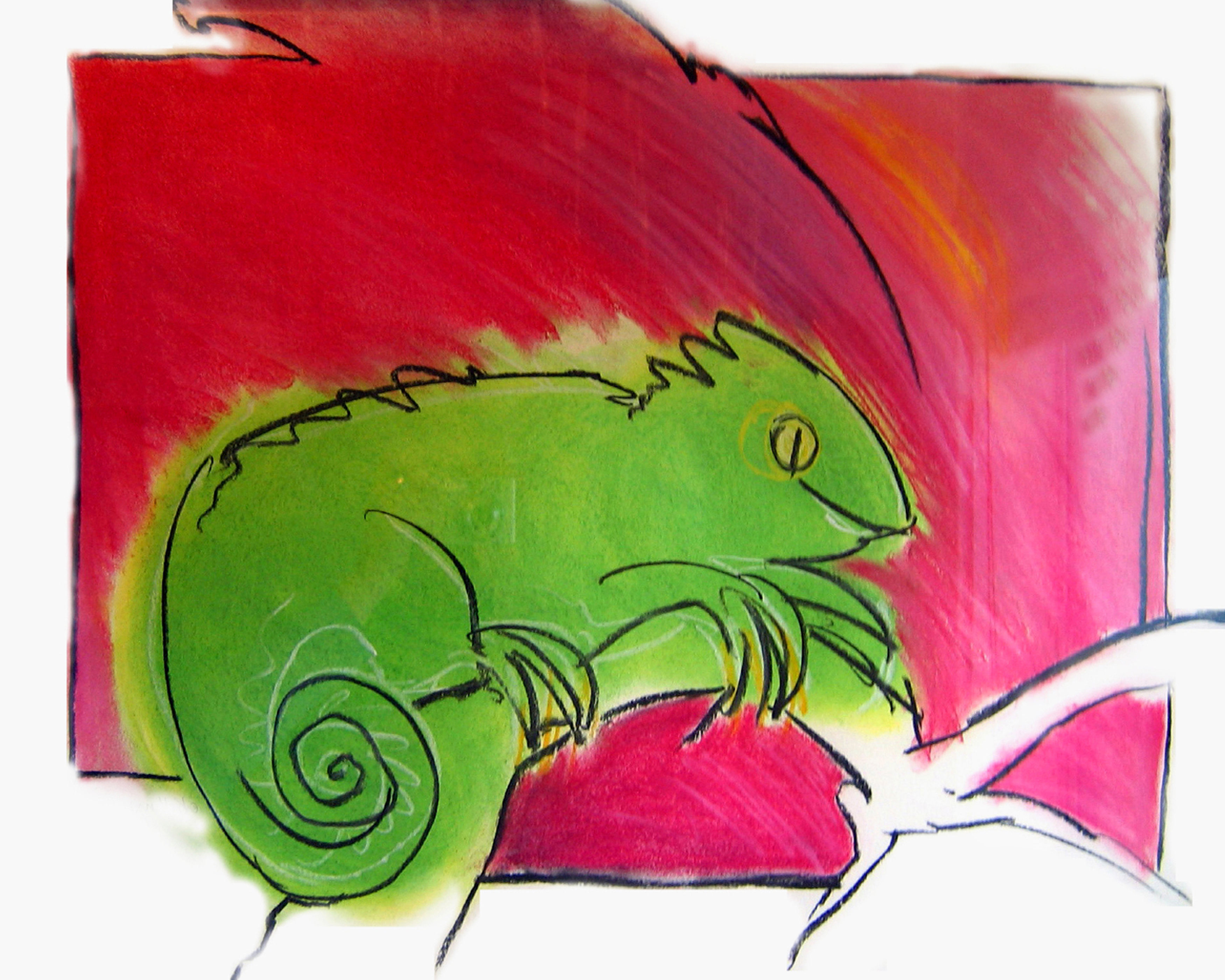
A Little Lizard-y Love

soft pastel on paper

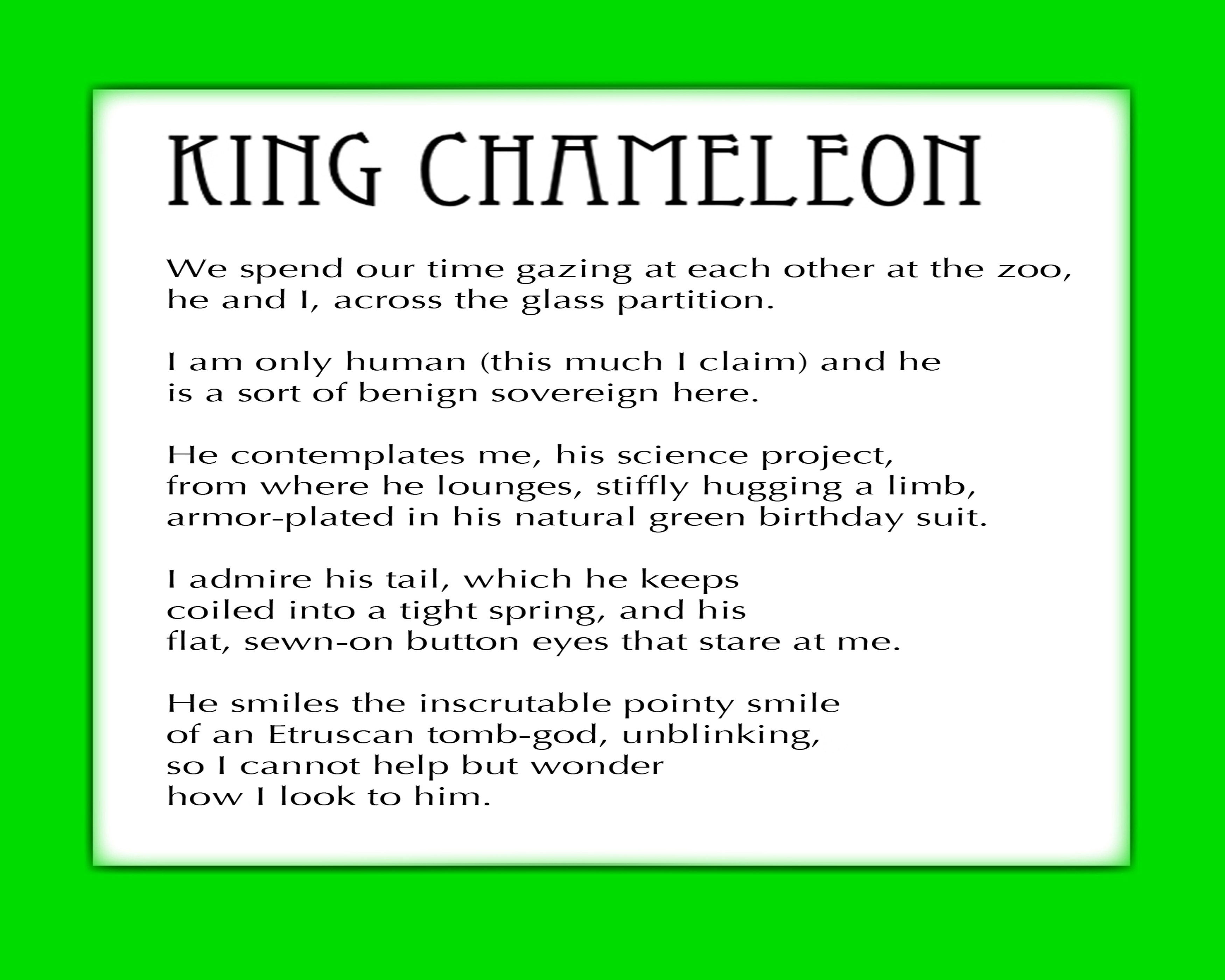
text and typesetting

Ah, Youth!

oil painting, digitizedPerspective–it’s so much a matter of perspective when we assess the situation, isn’t it. My sister’s younger son once had a moment of imbalance and tripped, not quite falling but giving the smallest yelp of surprise as he righted himself. His brother, two years his senior, rolled his eyes and sighed ever so indulgently, ‘Ah, Youth!’

Big brother was four years old.

There’s a lot of value in considering others’ point of view, not least of all when it happens, in the literal sense, to be at the same level as one’s own knees, or the top of the kitchen table. The whole world is remarkably different from such an angle. People treat us differently, expect different things from us, more often require time and patience and wisdom to interpret our words and ideas and actions.

We assume, quite rightly, that the young require this sort of accommodation and flexibility in our conversations and interactions. How much more so, then, should we be willing to see the universe more clearly through another’s eyes if we can consider him equal to us in age, experience, or status. We are all children in other people’s worlds, when it comes right down to it, barely able to see over their windowsills or fence-tops, hardly understanding a word of their language even when the speak, it seems our own. We’re none of us so truly far past two years old, apparently.

Arithmetic, Thou art No Friend of Mine

photoAnd lo, how my thoughts go round and round upon the subject.

It must come as no surprise whatsoever that I am among the multitudinous math-phobes peopling (pimpling?) the world of the creative soul. Why do you think we really all took those arty, wondrous, supposedly “Easy-A” classes, eh? Escape Route, we thought, freedom from the horrors that lie between the covers of every arithmetic text known to humankind. Only to find out we’d been hoodwinked and were expected to know how to disassemble and reassemble an ellipsoidal reflector in under ten minutes and with fewer than two “nonessential” parts left over after completion (what is this word “two”?), or whether one could type 200 words of dazzling script per minute while trying not to be hopelessly hypnotized by Mr. Young’s* blindingly mustard-colored toupee. I was able to accomplish the former task, by the way, but the latter, not quite so fully. However, I only lost consciousness for a split second and did not actually fall off of my chair.

*Name has been changed to protect someone vain’s glabrous secret.

In fact, by taking uni-approved ‘alternative’ courses (“I’ll take the class behind Door Number, uhhh, B, Dave!”) I managed to go all the way from 9th grade algebra, passed mainly by babysitting for the teacher’s kids on the weekends, to grad school without having taken a single other mathematics class. Then I got stuck: first those lousy entrance exams, which are now a blissful blank in my memory bank, followed by Graduate Statistics for Pedagogy, or whatever they called it. Hell, I tells ya! The only thing that saved me was that my older sister had survived the same course with the same prof a year earlier and coached me every cotton picking minute of the way through it. While I wept copious and bitter tears. I squeeeeeeeaked by with the B grade needed to pass the course and ran screaming all the way to graduation. Which commencement ceremony I skipped to go to Mt. Rainier with friends from Australia, because once you’ve paraded down the catwalk in those hot mortarboard and gown get-ups, never mind adding a hotter yet academic hood, on a sweltering summer day, in an auditorium full of people you don’t care to know, to grip that rolled-up piece of parchment that says “Redeem for Actual Diploma at Registrar‘s Office on Tuesday after 4 pm or for a Free Pizza at Gianni’s on Main after 5 pm”–well, once you’ve gone that route there’s really no need for a repeat, is there.

Although come to think of it, skipping The Forced March may mean that I didn’t in fact officially graduate and so taught college for two decades under false pretenses, and what’s not to like about that! In any event, I did finally, truly knock down that last class on the looming list, if without particular distinction or panache.photoMath, though, remained a bane. It was hideously disappointing to realize that a grasp of basic functional math was the only thing that stood between me and, say, a growling, slavering pack of credit card representatives or perhaps the growling stomach of starvation after having demolished the pantry stores by reversing the quantities of salt and sugar in yet another foolproof recipe. On the other hand, it was something of a relief when I finally realized that I was worrying needlessly about something I could never, ever fix. Between my dyslexia (or more accurately in this instance, dysnumerica) and my utter disinterest in getting better at math for the sheer unfathomable pleasure of it, I could see that this was something I should learn to put aside and compartmentalize safely to keep it away from unnecessarily pestering me in my everyday Happy Place.

Not to say that I didn’t have to find some truly inventive ways to do a (cough!) number of things. Balance my bank accounts. Figure out the current time/date in another time zone. Calculate the distance and ETA to work locations. Without GPS and Google Maps, because I do predate plenty of Modern Miracles by a significant margin. Teach drawing students how to draw in two-point perspective. Memorize ridiculous chains of randomly generated numbers to have even the remote hope of regaining access to umpteen kinds of personal accounts, not least of all ones containing personal information or money.

That is where you find me today, where numbers serve only the most rudimentary decorative purposes in my quotidian existence, for the most part (some of them being visually pleasing as abstract shapes, at least), but still occasionally rising up to help me remember my home telephone number so that I can call my more numerically astute husband to solve all of my more knotty mathematical problems. Because no matter how crummy my skills and how limited my knowledge when it comes to things numerical, I have what is for me a far more useful piece of wisdom, which is: one should always have great resource persons to call upon when one lacks the required smarts, information and/or tool handling artistry to accomplish the task of the moment. Stand ready, y’all.photoThe only sort of geometry at which I am expert, apparently, is circular thinking. But look where it’s gotten me thus far!

Viewfinder

digitally doctored soft pastel and colored pencil

Home is located on Cloud Eight.

You will not be the least bit surprised to know that my lifelong residence on Cloud Eight is situated as close as possible to the proverbial Cloud Nine, where all is perfection and the joys of every ideal are quite simply the norm. You may not even be shocked to hear that I have no need, intention or desire to relocate permanently to Cloud Nine. Frankly, I’m afraid that living there full time would blow my gaskets. Too much ecstasy, constant adrenaline and a permanent state of bliss sound dangerously close to hysteria and collapse. Further, I fear that such excess would find some way to become dull, lacking the contrast of subtler and more refined things.

I have no desire for pain and suffering, mind you; I am very well adapted to my happy and near-perfect life, and I am far too un-evolved to handle the demands of a trying existence. I am quite content to be, well, contented. And on Cloud Eight, there are just enough unforeseen twists of the road, moments of sorrow or fear or illness or what-have-you that, when they have passed, become salt: a seasoning valued so highly because in addition to its own flavors it highlights and enhances the other flavors around it. The piquancy and clarity and intensity of joy is only fully possible, I suspect, if one knows a hint of contrast. Maybe that’s just another iteration of my love of black and white imagery.

In the meantime, as I say, goodness and happiness have their own complications, not least of all a jaded or surfeited attitude brought on by over-indulgence. I find pessimism and paranoia dreary and tiresome companions, but a little part of me needs to stand at attention and be alert to their opposites so that I don’t drift along, bleary, blind to the beauty and inspirations all around me. If I fail to see the marvels in my own (albeit somewhat raggedy) garden, the humor in a child’s uninhibited playfulness, the drama and magisterial artistry in a lightning-streaked sky–why, then, there’s no point in lounging around on the everyday cloud most proximal to the place of perfection, let alone taking the occasional jaunt over ‘next door’ for that welcome hit of delirium, is there!

With that in mind, I make it a point to revisit my own environs with a different point of view or a revitalized attitude whenever I can, lest I lose sight of the wonders all around. If I should lack for a blog post idea for a moment, what’s to blame but my own failure to adjust the lens, to improve my focus. To see and revel in what’s right in front of me. I should take every opportunity to pause and refresh my senses, and then I can’t imagine that there won’t always be a new idea, a dazzling insight or maybe just a friendly reminder of how great the seeming old-familiar can be if I let it.

soft pastel on paper

If I tire of the view, I ought to change my perspective . . .

BOING! “Hi, Old People!” BOING!

graphite drawing

Never mind keeping an eye on the little ones, who's watching out for the geezers?

The neighbor kids, that’s who. They’re the ones that always know what’s happening with the ancient people next door. I know because I’m just the pseudo-grownup version of one of those little squirts. I was the one that went over to the big tall wood fence on Ryan Street when I knew Mrs Pipkin was gardening because I could see the top of our dear neighbor’s head from my shrimpy P.O.V., and piped, “Pickens, my mommy says I can play with you!” I can’t confirm at this great remove that I’d actually received such permission, especially given that I suspect, more accurately, that I was approaching my add-on grandma of my own volition–she having proven endlessly patient in answering my blue-sky questions and letting me trail around after her like a little bit of leftover Christmas ribbon.

Let’s face it: children are insightful whether you want them to be or not, and especially adept at providing their deepest insights at the most inconvenient moment possible. Which is decidedly the most entertaining as well as the most hideously dangerous aspect of spending time with persons of the childish persuasion. Witness the uncanny gift mini-people have for repeating, verbatim but utterly out of context, horrendously revealing things that their elders have previously uttered within the hearing of said small persons. There is simply no antidote for having been indiscreet around toddlers and their ilk. Part and parcel of this talent is they are marvelously gifted at cutting through the cauliflower and getting down to gritty reality in record time.

A friend and colleague once related an excellent tale of such insightful youthful efficiency, regarding a long-ago episode one of his cohorts experienced while teaching in the deep south during the era of Civil Rights‘ supposed birth. A Concerned Parent had contacted the school board with a complaint that friend Mr Krapelski was behaving in a fashion incompatible with the intents and aims of the whole Civil Rights concept, and the board felt the complaint warranted a full inquiry. Hurray for the Board; I imagine this sort of follow-through was fairly rare at the time. The approach was simple and obvious enough. Talk to the kids. So the inspectors, amazingly, did. Somebody did recognize the power of children’s keen observation.

They approached the situation with simplicity and no pre-arranged outcomes dependent on ulterior motives, and they posed the obvious questions to the class: “Does Mr Krapelski treat any of you children differently than others? Is Mr Krapelski prejudiced?” And their answer was equally simple and untainted. A pert little fellow raised his hand immediately. “No, sir, he ain’t prejudiced. He hates us all equal!”

I, though a childless person, am well equipped with nine brilliant nephews and one equally dazzling niece, all of whom in their time have provided rich stores of intelligent interpretations of the universe and its workings, from understanding the threat of the backyard swing that ‘threw’ Grandma when she stuck her toe too firmly in the ground under it (“Mormor, det er farlig!” [“Grandma, that’s dangerous!“]) to telling wildly indecipherable stories that despite their incoherence become clear (and hilarious) by way of outsized pantomime and garbled, gagging narration (the best one was about–you won’t be surprised–a gigantic sneeze followed by an even bigger booger).

They taught me about instinctively genius juniors knowing just how to make it possible for Mormor to get back up the long steep hill from the beach if she wanted to walk down there with the family after her back had gone bad (let Tristan, the beautiful husky dog, tow her back up while she held his leash–which he did briskly and without batting a pale blue eye) to why the same grandma should act as Home Base in a closely contested game of Hide-and-Seek (“because she’s the oldest thing in the house!”).

This latter is precisely the appeal of childlike clarity and bluntness, in my book: they recognize that all of us over about the age of twenty are unspeakably, unreachably, unimaginably distant in the mists of antiquity–yet this has a certain cachet with young kids: unlike, say, their teenage counterparts, they admire and respect this very strange quality of Oldness. It’s really weird, and thus somehow kind of piquant and beguiling.

My husband and I thought of ourselves as only moderately advanced in age when we were in the early fifties and just moseying into the forties, respectively. The neighboring kids put that right into perspective. They lived in the house across the fence from our apartment garage, and the young sprats spent a great deal of their spare time and energy bounding around on the trampoline next to that back fence. We could hear them flouncing and giggling almost ceaselessly–enough, perhaps, on its own to make us feel our age a little more keenly–and then one day we paused for a moment when we’d gone out to get in the car.

BOING! The neighbor kids heard our talking, through the fence. They jumped a little harder so they could clear the top of the fence and get a better look over our way. We heard them cackling and turned around. BOINGGG! We grinned. BOINGBOINGBOING!!! The biggest of the kids waved madly and yelled, “Hi, Old People!” And they collapsed on the trampoline, laughing their curly heads off, while we fell about in equal hilarity as we stumbled into the car. That was all the encounter required. Acclamation and affirmation–of childhood silliness, of punctured pompous pretend-adulthood, and of the joy of being whatever age one is, as long as it’s not taken too seriously. Can’t help but rebound from such commentary a lot higher than we were leaping just a little bit before.

Hurray for unfiltered youth! Hurray for the goofiness of happy aging! Getting old, after all, surely does beat the alternative. Especially when there are some junior wildlings handy to keep everything somewhat in perspective.

graphite drawing

<BOING!>