 Old So-and-Sos
Yea, smell that rose!
It’s on the nose.
Not one of those
Who would suppose
That poems, prose,
And speeches’ throes
Must not disclose
Where their heart goes,
I always chose
To stick to those
That told my nose
What was a rose.

Old So-and-Sos
Yea, smell that rose!
It’s on the nose.
Not one of those
Who would suppose
That poems, prose,
And speeches’ throes
Must not disclose
Where their heart goes,
I always chose
To stick to those
That told my nose
What was a rose.
 In addition to the under-appreciated benefits of simply vegetating for rest and personal renewal—the old R&R that current generations seem to forget to practice in our constant race for connectedness and communication and “productivity”—vegetating is a state in which the highly desirable happy accident of inspiration has room to occur. Some inspiring thoughts could even lead to a great invention or contribution to society. Mine, not likely. But if I don’t take the opportunity to allow that creative space, how will I know?
It’s worth the risk, in my view, of fulfilling my destiny as one who will never have the Great Idea. By trying the intentional-vegetative approach, I might surprise even myself. And I’m certain that having a little more time spent as a human plant form is bound to have a positive effect on my general well-being, at the least. Indulge me. Better yet, indulge yourself from time to time.
…but most of us are not only guilty of such misdemeanors but occasionally even get caught with our paws in the pasta. We’re not always major miscreants, but there are times when even the most proper of persons likes to break protocol just a bit. Ah, well, we do so love our naughty little secrets!
 Stolen Away
Too soon, cold sorrow steals from me the light
Of promise, of the hope for growing love
Which I had longed to see his mastery of
Bring him to see such stars divide the night
That he might know it possible that day
Was his as much as anyone’s, and keep
Alive, alight, and not succumb to sleep
As refuge from an endlessly dark way,
But my poor strivings—anyone’s, I guess—
Could never generate the power he
Required to light enough so he could see
In such great bleakness any happiness,
And love and hope, invisible and far
From him as he from me, my distant star.
Clearing the Air
I missed you when you went away,
But if you should come back today,
I will no longer—for my sight’s
Been fixed—I’ve got you dead to rights.
Critics, beware! Some performances are more unpleasant than you ever imagined.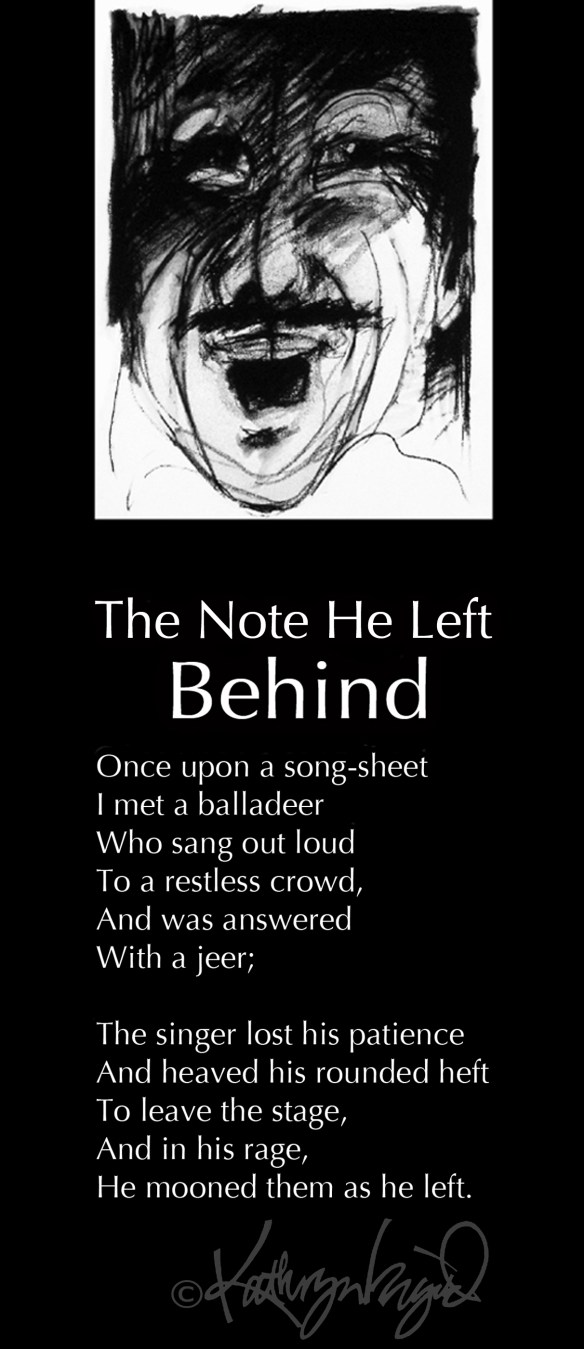


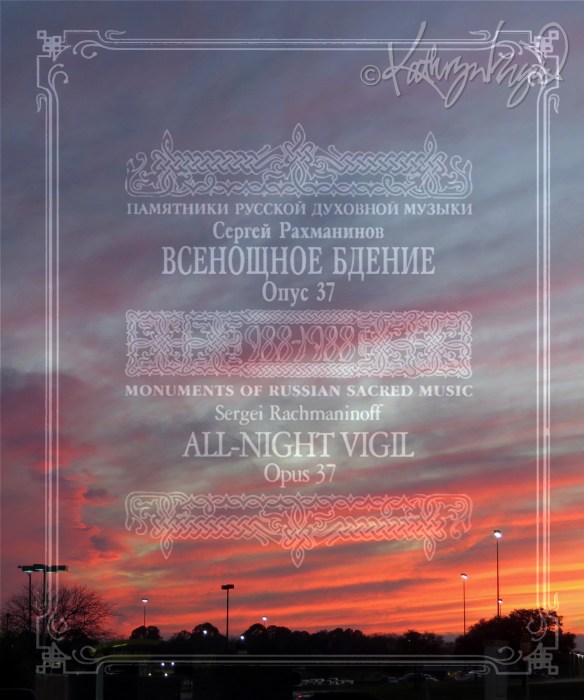
The original ‘our song’ I shared with my true love, because he was in the midst of rehearsing his choir for its performance when we came together—so intensely rehearsing, in fact, that in pretty much the only time I’ve ever known him to talk in his sleep, he whispered dreaming sweet nothings to me in Church Slavonic. Good times!
The expression ‘they’re singing our song’ refers, generally, to recognizing a tune or lyric that carries particular personal weight for a pair or occasionally, slightly larger group of people. It’s our school’s version of Alma Mater, the theme song of our organization, the song that accompanied a memorable first date, first dance, first kiss. Because of its power as a connective tool in communication and in recollection, music is bound to evoke potent responses and pull us into the examination of them, regardless of their current context. I’m one of that lucky class of people for whom music is a pervasive and positive element of my daily life, but I still have some specific favorites not only for what I find appealing about them musically or in their mood, style, and character—and yes, those range pretty widely—but also for the few that stand out in mnemonic and sentimental ways.
There are songs that reconnect me instantly with my childhood, something I suspect is quite a different experience for the younger generations than for mine and earlier ones. Until my youth, childhood songs came not exclusively from radio, films, television, and other distant, anonymous, fixed, or recorded sources but first from the relatives, friends, and teachers who shared them with us and often expected us to sing along. When my family sang in the car on a road trip, it might have sometimes been along with whoever was singing or playing the radio’s pre-packaged tunes, but as often as not it was singing folk songs we’d learned by rote, silly playground songs and game-narrative ones, bits of summer camp songs, rounds, and easily harmonized songs that were popular long before I ever stretched my little pipes to sing. I don’t imagine there’s so much of a lingua franca of family and playground singing not derived from Disney scores and downloads nowadays. There’s lots of delightful and even sophisticated stuff in those, to be sure, but I would guess that there’s a whole lot less that would be in any way distinguishable as historic, traditional, or regional, let along cultural, landmark music that’s just sung for fun anymore unless it’s loaded with undercurrents of market- or message-driven content. Is Mrs. Grady‘s daughter even known, let alone adored, by anyone under a half-century of age anymore?
It’s not strictly old-lady cantankerousness or being prudish, prune-ish, and nostalgic for what may be rose-colored memories that makes me sad for this sort of loss, though there are assuredly elements of those. It’s also a bit of longing for the subtle societal glue that resides in knowing a song: if I spontaneously start to sing an “old familiar lay” under my breath, will there be anybody within earshot who will hear, remember, and join in the song? Are all such endeavors relegated to prearranged flash mobs now? I had a couple of reminders of this urge, recently, and they renewed my quest for an expanded casual-singing culture of the kind that doesn’t require sets, costumes, death-defying choreography, and Auto-Tune.
The first such occasion was, unsurprisingly, in a church setting. Western churches of many sorts are still places where communal singing is common and many songs known to many of the participants by heart. I was at a Protestant church service where, as is typical during communion, the church choir sang anthems and the congregation then sang a hymn or two as well; when the high attendance at the service made communion stretch far longer than expected, the experienced organist got right on the task of keeping the flow going by playing an old hymn. After a few seconds, choristers started softly humming or singing the lyrics along with him, then grew bolder and harmonized, and gradually a number of congregants in the pews were joining in as well. It was really quite sweet, and I certainly thought it perfectly appropriate to the whole concept of a Communal event. But even there, I quickly realized, the truly familiar old hymn couldn’t quite be carried in the old way, because even the choir members clearly only knew one verse by heart, and while it was a lovely bonding experience for everyone, it was fleeting; at the end of Verse 1, a collective dive for hymnals to search for the words (what’s that eponymous first line, again?!), then the resignation to repeat the first verse or fall silent.
Another reminder came in one of the places where such random burst-into-song things do still exist beyond the borders of the performance hall but are perhaps not exercised as often as they used to be: a choral convention. The regional and national gatherings of musicians devoted to choral music—the composing, conducting, rehearsing, singing, performing, and yes, enjoyment of music made for groups of singers—are a great source of education, entertainment, and vivifying energy for me as the partner and follower of a choral musician. And even at these, it’s not as though I hear people breaking into song together, unless they’re rehearsing to perform for each other. Attending an enormous regional musicians’ convention recently, followed ten days later by an equally huge national one, was both exhausting and energizing. And at such events, I don’t often find people gathering to sing together outside of the so-called All Sing sessions, which are of course organized, arranged, led, and regulated nearly as much as any choir’s regular rehearsals.
The point of such conventions isn’t necessarily to build ‘casual relationships’ with singing. But mightn’t it be a fine thing, really? I would guess that the expectation that singing just because, at unplanned moments, with other people, could in fact lead not only to greater interest in and better understanding of more formal choral experiences but also to a more connected social world than social media alone can provide. As the 1971 Coca-Cola advertisement—yes, a commercial jingle—encouraged such idealism and eventually did indeed manage to build into a hugely popular, ex-post-brand-name sing-along song, I [would] Like to Teach the World to Sing. But obviously I can’t do it alone.

This is, in a unique way, truly Our song, because Richard Nance composed it as an anthem for our wedding, and it both became widely popular as an exquisite modern choral piece and remains deeply personal as a gift to my beloved and me from one of our dearest friends.
I Dream the World
I dream the world will learn to sing ‘Til joy suffuses everything—
When peace and happiness abound, I dream a song will be the sound
Most widely heard by every ear Around the globe that longs to hear
A note of kindness, care; of grace, When melody wraps its embrace
Around us like an angel’s wing—I dream the world will learn to sing!
I dream the world will learn to sing And make earth’s darkest corners ring,
Will throw aside all warring ways, Mend brokenness, take up the phrase
That calls to harmony all souls The way a carillon bell tolls,
First, lone and softly, then a pair Joins in, and more, and then the air
Is filled with song, like bells a-swing—I dream the world will learn to sing!
I dream the world will learn to sing And this, the message it will bring:
We must not wait in silent nights, Unsung ’til happiness alights,
‘Til care and kindness, sweetness, peace, Miraculously buy release
And save us from our voiceless state: If we don’t sing, it is too late,
So let our song rise up and ring—I dream the world will learn to sing!
For one wonderfully sweet and lovely woman I know, I struggled to decide what to give her for a token of my respect and affection on her birthday. Then, because she is a superb singer and I, an admirer of her glorious singing, I decided to write her the lyric text for what might—with a composer’s help—become her own sort of theme song someday. For now, it’s simply Bea’s own poem. She said I could share it with you.
For a Lady of Great Beauty
For the song, bouquets of roses
For the day, a joyful start
For the labor, peaceful evenings
For the care, I give my heart—
For the wisdom, inspiration
For desire, a glorious year
For the wish, the starry heavens
For delight, companions dear—
For the sorrows, deepest comfort
For the friendships, never part—
For the moment that I met you,
You resided in my heart.
&&&&&&&&&&&&&&&&&&&&&&&&&&&&&&&&&&&&&&&&&&&&&&&&&&&&&&&&
And since it’s her favorite of my other poems (so far, I hope), I’ll repost the following one. For good measure.

Do not visit The Depth of Doom except as an unbiased observer or high-speed passerby. Trust me, that locale is ever so much funnier when you don’t live there. Then again, hard to appreciate fully unless you’re an escapee. Laugh it up, y’all!
 An afternoon with you
What splendid light comes blazing from the blue
No matter what the promise of the day
When one sweet presence chases drear away:
The prospect of an afternoon with you!
How do you change the climate to such ends
Effortlessly, it seems, with one small grace,
Bringing your cheering spirit to this place
And on its strength, inviting full amends
For every sting of sorrow or of pain,
For any old frustration or regret,
Making the clouds all part, and me forget,
I thought I’d never see such sun again?
All afternoons with you become blue skies
Simply because love shines out of your eyes!
 Art-Colored Glasses