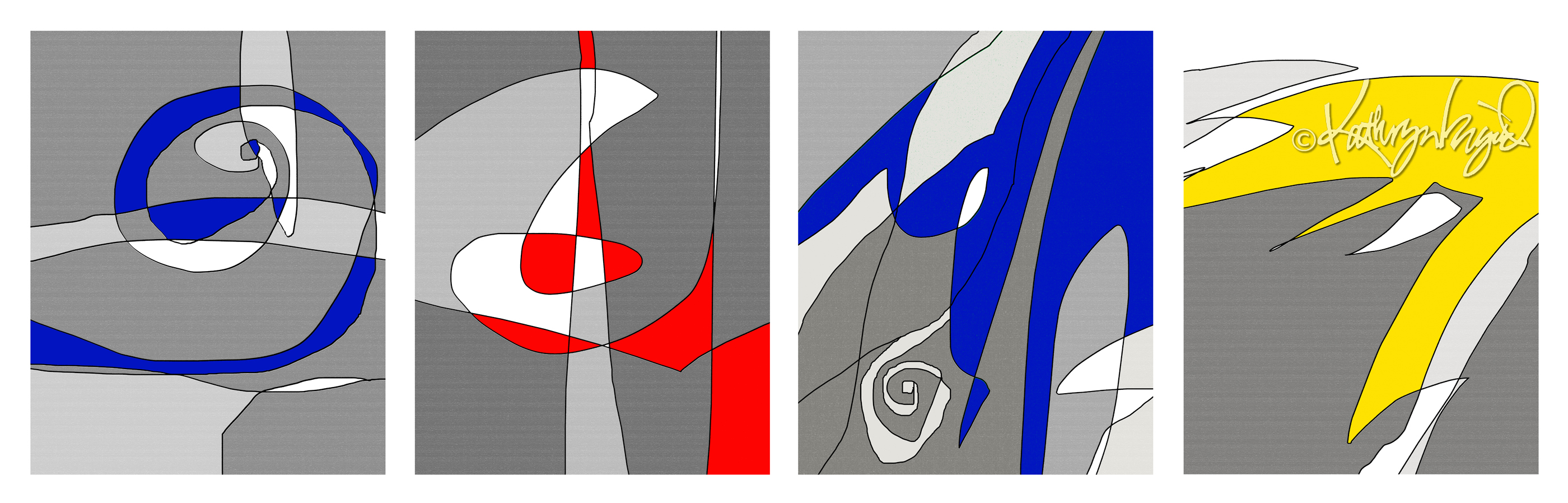
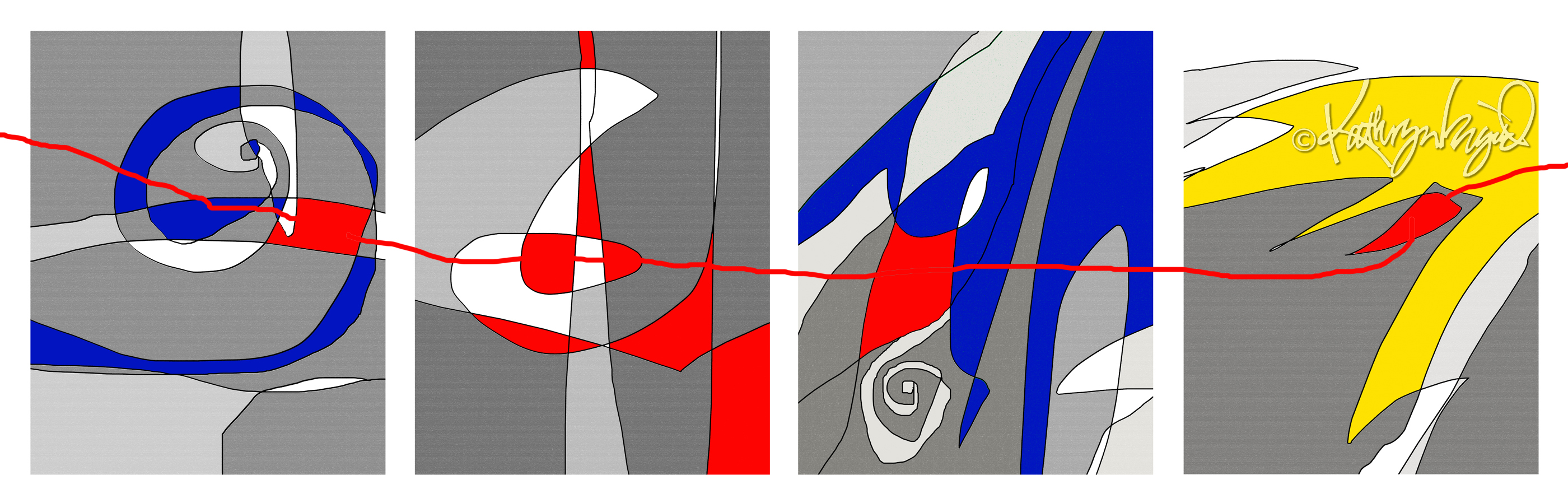
One in a Million

digital illustration

Homage to Popularity

My Distinction

If I should need some camouflage, should want to truly blend,

I’d better watch my persiflage and learn not to offend

By wearing last week’s trendy style, my hair too short or long,

Or failing, yet, to reconcile which Party’s Right (or wrong)

To run the government; which church is favored most by God,

How not to leave you in the lurch when I have been a clod,

Appalling with my social gaffes, faux pas and frightful fouls;

I may accept I’m built for laughs, but using the wrong towels

Or forks or traffic lanes, That Word in company unfit—

I hope I don’t seem too absurd as-is, but that’s just it:

My imperfections, my unique design as Me, are such

As might make me appear a freak if I am Me too much.

But, truth be told, while I may work to fit in with the rest,

I hope you won’t think me a jerk for liking myself best!

I will blend in, keep pace, behave, up to a point, to please,

But lest you think me fashion’s slave, I think it a dis-ease

To seek conformity and bow to other people’s rules

When I’m quite nifty anyhow, and others may be fools.

digital illustration

Fingerprint Beats Homage

Talking at Cross Purposes

digital illustrationMy spouse and I have an intriguing way of discussing our disagreements, and I gather from what I see, hear and read that this is not such an unusual complication but probably more like the norm. We don’t fight about stuff that matters, remarkably, very often at all, being on the same page in our essential beliefs and concerns; if we differ there, we’re pretty comfortable having a rational conversation or two and agreeing, if necessary, to disagree. But the more inconsequential things are where we excel in having our weirdly, even hilariously, convoluted bouts of stubbornly wordy disagreement.

And the vast majority of the time, it’s because of the language barrier. We’re both native speakers-of-English, but it seems we are perfectly capable of saying virtually the same thing to each other in such different ways that each of us hears the other saying essentially the polar opposite. It’s quite miraculous, really. Two seemingly cogent adults, people who know each other rather well after being together for eighteen years and who both know inside that we share the deep core values that make eighteen years together possible, not to mention that we share so many experiences and tastes and interests—and we can’t reason our way out of a paper bag when one thinks the other is remembering something incorrectly or a question has been raised about some puzzling matter of fact.

Of course, I don’t think this is specific to being male-female, age-related, or any other such thing, this is a characteristic of our whole species. It’s a perfect example of how humans talk to each other a whole lot of the time. We think we’re having an epic battle over right and wrong, and both sides of the argument are  looking and hoping for exactly the same outcome, but each of us simply thinks we have put the correct names on the problems and resolutions and the other party is clearly an idiot or heretic until he/she/they will acquiesce and let us superior beings fix everything according to our righteous rightness. Happens in politics and religion and academia and relationships just about equally often. Whether weapons are involved has the most influence over how epic these battles really become, but the basis is hardly all that different.

My beloved and I get in the same ridiculous rut of circular conversation often enough, though neither of us takes it particularly personally or even necessarily sees it as a true argument let alone a danger to our relationship, and it’s easy enough to laugh it off when one or the other of us finally realizes that We’re Doing It Again. But it’s strange that we don’t spot the next episode from afar and simply have a straightforward, rational talk. If the goal or solution is nearly always identical or close enough to it, why do we have to wrestle around so determinedly before coming to that natural conclusion? I can’t guess why we mortal mugs are so quick to waste our energy and peace on pointless posturing, but it’s certainly a collective talent of ours.

I guess I’ll just have to take this opportunity to apologize to my partner for my part in the muddle, and hope I learn to listen—and hear—better. And if anyone with any power or aspirations to power (political, religious, academic, or other) happens to be reading this, would you do me a favor and do the same?digital illustration (B&W)

Röda tråden (The Red Thread)

Röda tråden is the Swedish phrase for connectivity. I learned it from my husband, who in turn learned it during his dissertation studies on modern Swedish choral history, and in a way it’s the perfect encapsulation of what his research revealed: that the astonishingly deep and broad influence of such a small country, in such a short time, on such a large field as Western choir singing and music came about primarily because of the remarkable and unique confluence and joining together of a huge number of events, people, ideas and resources in that little land at the end of the Second World War. As unimaginably terrible as war is on any scale, it’s all the more a testament to connectedness that at the end of one of the largest we’ve known, such good and meaningful and positive elements were all drawn into one significant, beautiful growth spurt in the art of singing together.digital illustrationAs a miniature of String Theory in the arts, this surge of the choral art in Sweden is notable (no musical pun intended) not only because it posits a reasonably substantial explanation for the larger choral sector’s modern expansive development amid the general devastation and struggle following the end of WWII, but also because in doing so it illustrates wonderfully how the intertwining of all sorts of seemingly disparate elements such as safe havens from political unrest and postwar reevaluation of norms, personal and professional relationships and experimentation with new media could come into contact and interact to create a new mode of thinking, acting, composing, teaching and singing. In turn, this is a striking model of how people from distinct cultures, educational backgrounds, economic resources and political systems and of widely varying personalities, unified by the one tiny thread of choral music, could be pulled together into a complicated system that, though still colorfully messy and imperfect, led to a potent common end that has had lasting and marvelous influence for long and fruitful decades since.

I am, of course, grateful on a personal level because this Swedish postwar influence on Western choral culture has not only enriched my husband’s professional and artistic endeavors–not to mention was the basis for his award-winning doctoral dissertation that in turn opened a lot of friendly doors to us both in Sweden–but because it produced so much spectacular music and inspiration for so much more.

digital illustration

Röda Tråden is the Swedish version of the idea that–indeed literally–fascinates so many of us: the connecting thread–that which binds one thing to another. I can think of nothing greater than to spend life seeking the Red Thread that shows us our commonalities and binds all people together as well.

Further, though, I am grateful that such an otherwise inexplicable event as the ‘Swedish Choral Miracle‘ seems to me ample proof that all things and people really are connected. And that through recognizing and making good use of those connections, however, odd or tenuous they may appear, there is hope for new and better songs to be sung everywhere.

If I needed further proof of this, last night’s concert gave it amply. My spouse conducted the combined forces of the Chancel Choir of the church where he’s currently interim choirmaster plus their excellent hired pro orchestra in performing Haydn and Dvorak’s two settings of the Te Deum text as the concert opening and closing, respectively, bookending the extraordinarily lovely and moving Missa Brevis of Kodaly. I came in to sit for the concert among strangers and acquaintances from the church and discovered a friend from another parish sitting across the aisle from me, then learned from one of the choir administrators that a friend of hers in attendance turned out to be a long-ago colleague of my husband’s from another state, and finally went up to greet my guy after the concert and found him speaking with a group of ladies in the front row, one of whom was the wife of a former US president. What brought all of us divergent people together in this moment? Music. Beautiful singing and playing. Chance, kismet, divine intervention. Call it what you will, the slender but unbreakable thread that connects us all drew us into one place for a time of basking in the inscrutably beautiful harmony that is beyond craft, beyond art. That is a concert without peer.

Messengers

I admire real journalists and documentarians. Now, I do think that they are a very rare breed among news-people, the rest of whom are too driven by their corporate sponsors’ and their own biases by a long shot, no matter where on the spectrum of politics, religion, personal philosophy or other conviction they fall, but there are those honest characters who, if they do consistently let their beliefs steer their messages, at least recognize those prejudices and are quite open about them and still manage to give air time to opposing or differing points of view.

Still, the ones I really find compelling are a different sort of message bearers. They are harder to recognize, because they can be quite ordinary seeming mortals or wholly incorporeal, quotidian or fantastical, intentional or entirely, serendipitously accidental in their delivery of important news in our lives. Are they strangers we meet by happenstance and happy crossing of paths, like the townspeople in Germany who saw my older sister and me debarking a train after dark and looking around to orient ourselves? The kind couple approached us, told us that Celle (however lovely) was a very small town indeed and that there were few places for visitors to stop overnight but they’d help us find one, gave us directions and set us on the path to a very cozy little bed and breakfast before disappearing into the dark like a mist.

Are the messengers those outstanding teachers who have acted not only as educators in our lives but also as inspiration, as mentors, counselors, guides and friends? Mrs. Willis, Mr. Cunningham, Prof. Keyes: I salute you! Teachers have done as much to bring light to my life as to the dim corners of my mind over the years, and I am grateful for the news and stories and messages they bring. Are there other beings among us able to protect and direct us without our even being aware of it? Of course there are. Some of them are simply gracious fellow humans whose good deeds and kindness will never be seen or fully known and recognized in our lifetimes, either because we are too dim-witted and self-involved to notice as we should or because they merely do their mitzvahs without fanfare, without expecting or needing any recognition and recompense. These we should imitate and their message should be spread further by our going out in turn to do kindnesses for others and requiring no attention or glory.

And I think that–given how beautiful and rich life can be when we do pay attention–there must be others in our midst too; angels or aliens, I don’t much care what we name them, but there must be Love looking out for us to make even the tiniest good possible, let alone the many graces that fill our days if we only look. Their message, I suspect, is nothing more or less than that we are being well looked after, and our little lives recorded no matter how small they may seem to us.pen and ink

How Quickly We Learn

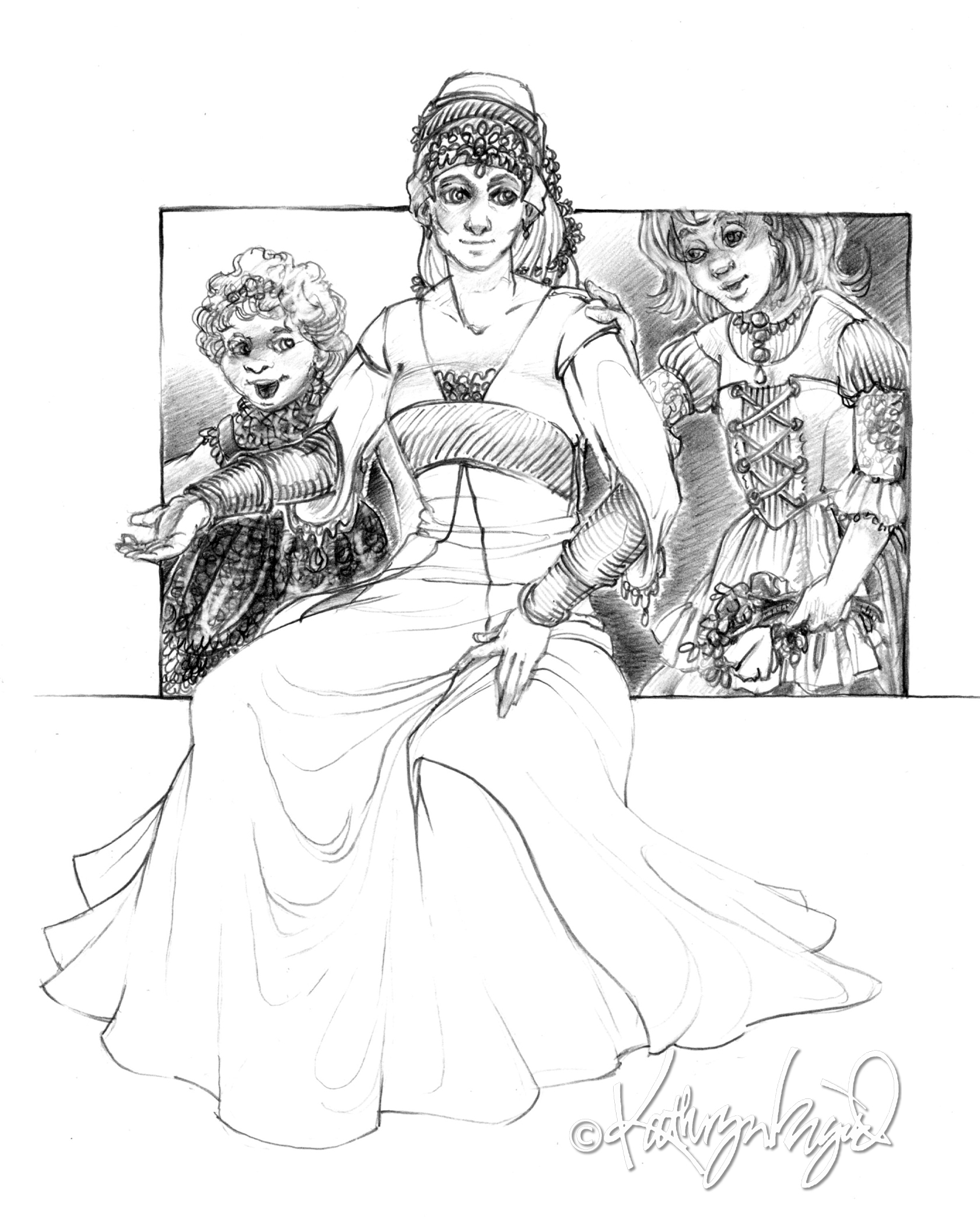
Even when we’re young we pick up clues pretty swiftly regarding what sort of behavior and attitude is expected of us in our interactions with others. As a child, I learned ever so quickly that I am not the boss of anyone else and practically everyone else is the boss of me, and not much has ever changed in that department. Whether happily or unfortunately, depending entirely on your point of view, I also figured out as speedily as most kids do that as long as I behaved in the expected manner when anyone was watching I could get away with a fair amount of far more self-indulgent–if not subversive–ways. Sure does simplify my life!graphite drawingShow of Proper Respect

The Mistress in her jewelry and finery and furs

Thinks everyone should bow and kiss the ground—that’s also hers—

And genuflect before her grand tiara and her mace,

So that is what we tend to do—at least do to her face.digital illustration from a graphite drawingAll frivolous jocularity on the topic aside, however, getting trained by our elders and betters, in particular our mothers, is both more complicated and more happily meaningful for those of us who are blessed with great moms. Me, I’ve got two. The mother who gave birth to me and raised me from my days as an only mildly subversive little sprout into the silly but exceedingly happy big kid you see before you today is worthy of recognition as one of the great teachers not only for giving me a framework on which to hang my sense of right and wrong and general grasp of manners but also the education and freedom and knowledge of being unconditionally loved that enabled me to choose how to build on those foundations as I grew. My second Mom, brought to me courtesy of (her son) my beloved husband, gets credit for instilling the same curiosity and drive in her children and, in turn, for reinforcing in me through her example what it means to be a lively and lovely person who is good company, an active part of the household and community at every turn, and a tireless learner and adventurer who earns her place in those settings with remarkable grace. Whether I can live up to the standards set by either of my Moms remains to be seen, but they certainly give me the tools that should make it possible if anything can.

If it can’t, I guess I’ll have to fall back on my naturally ridiculous ways and just pretend to be better than I am for as long as I can keep up the front. Those of you who are looking for reliably good, sound company, go see Mom W and Mom S. And also my sisters and my sister-in-law, great mothers to their children, and all of those other mothers, who by birth, adoption, random acquisition and teaching, raise better people, who in turn make the world a better place altogether. All of whom I thank profusely not only on Mother’s Day but every day for being such great examples even for those of us who are a little too childish to be motherly examples ourselves. Go ahead, you can say it right in front of me. I’ve learned that much, at least!

‘Social Activist Art’ is *New*, You Say???

drawingA recent New York Times article reminded me that, no matter how I might classify myself as anything but an activist, I have always been one, of a sort. It’s true that I’ve always assiduously avoided conversation, let alone physical action, tied to politics, religion, social policy and pretty much any ‘hot topic’ you can name unless I sensed I was in the safest possible environment to do so–generally, amid a comfy flock of like-minded partisans. The article is chronicling the US uprising of a relatively new breed of American artists and their support systems dedicated to, as the title bluntly states, social activism; the author gives appropriate reference, of course, to the practice being a long-standing one in other parts of the world, but shares the view that it’s still rather fresh and new here on American turf.

I’ll grant that the forms and formats may well have changed, and that there might be a larger collective sense among those who would embrace this title of being dedicated to the purpose more specifically than others, but I will step right out on my own tiny soapbox now and assert that, insofar as art is seen as a form of communication–and this might well include virtually all art except that created and performed in private and without any wish or expectation than anyone other than its maker will know it exists–it is inherently activist. The decision to create something I intend to be art and allow it to be known to others says a whole lot of things about me, the subject of my work, and my general worldview, and if I am allowing others to experience these in the art, assumes that they will respond through and with their own worldviews to it, effectively in a social interaction, whether we converse directly about it somehow or those who have interacted with my art turn around and respond to it in the continuation of their lives.

Who knew I was such a rabble-rouser? But truthfully, even by making those ‘meaningless’ little doodles that don’t turn into full-blown drawings or paintings, I am making something of a statement, am I not? I scribble, therefore I am. By doodling, I am not only using my energy to do that rather than anything else, I am also creating a portal through which my thoughts can emerge; if they turn, via this scrawling, into a concrete idea it may lead to the completion of an artwork expressing it more openly. This, in turn, suggests that I have a thing or two to say and I’m willing for others to hear it, see it, feel it–to interpret it and respond to it, even. I never think of myself as daring, but I think it’s fair to say that letting my inmost thoughts and imaginings be seen and analyzed by others through their own filters is at least a little brazen, if not occasionally foolhardy.

One of my late mentors, Lawry Gold, wrestled with the supposed divide between art and function, and he was anything but shy about being an outspoken activist, albeit a very kindhearted and generous one. He was a boldly countercultural person in a great many ways, and yet he seemed to me to reach the peak of his own overt rebelliousness when he began working on a body of art that was deliberately and unabashedly functional (beautifully art-covered, distinctively designed tables, lamps, clocks and the like) for sale through his gallery agents. This was something I know he enjoyed at least a little as cheery cheekiness to tweak artist snobs who were apparently so benighted they couldn’t accept the marriage of form and function thus, or so rich they could afford to sit around waiting for other equally rich people to buy their non-functional work, no matter what the state of the economy. Besides that these were among his most gorgeous and sophisticated works, to me they spoke of the recognition that art, besides taking so many different forms, speaks to us in many different ways, and that breadth and depth has great value.

At the same time, my friend never stopped making ‘non-functional’ art, because he of all people also had a tremendous desire to communicate, whether it was by visual storytelling in his often humorous, whimsically imaginative artworks or by making a more specific point with his illustrative and symbolic works. And he never hesitated to engage in the discourse that followed anyone’s viewing of his work. He and I had a joint exhibition of our artwork once, and as I was curating and installing the show I objected to one of his pieces that he wanted included, thinking it was not in keeping with all of the others we had selected, and he patiently steered me toward a clearer understanding that it was indeed very well suited; even though I never liked that piece as much as the others, I found that it carried an important part of the ‘conversation’ made up by the whole of the exhibition, and in fact that one interaction changed the way I curated many an exhibition of others’ work in the years that followed.

Ultimately, I see in the creation of art–of any form–an act that if it isn’t in open defiance of the social norms, allows or even invites the examination of and discourse on them. So even though much art is not made, like Lawry’s, to function in an obviously practical way, it all serves a purpose; ‘merely’ being beautiful or compelling may be purpose enough in adding layers of pleasure or relief or catharsis, but many works go far beyond that in opening new vistas to our contemplation, influencing our beliefs and even challenging us to change our behavior. All art is potentially advertisement or propaganda, for good or ill. And if that isn’t social activism, I think my encyclopedia needs some new illustrations.

digital illustration from drawings

Is all art crowd-sourced?

Please Vote Responsibly

You know how much I hate politics. I almost titled this post ‘Friends don’t Let Friends Drink & Vote’, since it seems like a whole lot of people prefer to find a specific agenda that appeals to them on a visceral level and shape all of their votes around it willy-nilly, without either differentiating between candidates that do or don’t have any power to guide said agenda wisely or, worse, without first thoroughly checking their own facts regarding that particular point item of passion. Mostly, I hate that what I see and hear of politics is the brainless ranting of people who hang out at the various extremes, and very little of civil discourse and logical, reasoned thinking. Nothing would please me more than to believe that every person with the privilege of voting would not only do so, but do so after serious thought and careful consideration and with a certain amount of faith that the other voters and their points of view matter, too. But to be quite honest, I think we (at least in America where I’ve observed it in person, but I gather this is so in many other places as well) are mighty far from this my ideal.

So I tend to shy away from all things political as much, as long and as often as I can.

Yet I can’t help but wish, and sometimes a little peep of this pained wishful thinking leaks out visibly or audibly. Especially around election times. At least, given my particular bent, I’ll keep trying to publicly disguise my whines and rants in slightly more lighthearted forms when I get my own political itch.

poem [typeset text]

graphite drawing


The Power of Being Well Behaved

When I was teaching, I thought it useful to devote a bit of the informational materials I handed out at the beginning of every term to basic issues of classroom decorum. The idea that so-called common courtesy has to be taught, not just to children but to all ages, is no less ridiculous than understanding constant the need for training and refreshing what is called common knowledge or common sense. Generations have passed since people saw a need to comment on or complain about the uncommonness of all of these virtues.

More significantly, as a teacher I knew that if I didn’t encourage, if not demand, attention to such virtues in my classroom there was little hope of any other sort of learning happening in there. I’m old-fashioned that way. The silly thing is probably that it was only after leaving teaching that I thought very clearly about how much these attitudes mattered in any and every kind of cooperative venture, not only in the classroom but in the boardroom, the living room, and certainly in the places where politics, religion, health care, social activities and civic progress are in progress. At least, if we want actual progress to occur.

And that’s how my two cents came out as a personalized set of ten ‘commandments’. Ah, well. I’m kind of a megalomaniac, and I did feel the need to keep my eyes on what was happening.pen & ink

THE BIG OL’ HOW-TO LIST

for getting along with Kathryn

I   Come to class unless you are dead.

II   Show up on time. Lectures don’t always begin on the dot of the class-starting time, but if a deadline is stated as “beginning of class, 18 March” and you  arrive one minute late, technically I can tell you that you missed the deadline and so your project is rejected. Flunked. That’s harsh. But trust me, it’s fair. Besides, it’s a safe bet that if the lecture does start on time and you miss part of it, I’m not going to be terribly enthusiastic about repeating myself and your classmates who have just heard the stuff will definitely not be amused to have it reiterated. Be in place, cell phone and watch alarms and headsets off and fully participating in class, and we’ll all get along famously. Hurray for good manners!

III   Bring all assigned materials and have them in ready-to-use position when class starts. Written tests, especially pop quizzes, are uncommon in my classes (they do exist), but notes and written critiques can be required at any time. Be ready. Write down everything, and date it. Even if I don’t say you have to. Then you have documentation of what I told you (and when) if I should change plans inexplicably or you have a question. Also, it makes you look attentive and enthusiastic whether you are or not.

IV   Flattery will get you places. Forget that baloney about it getting you nowhere. You lose nothing by Making Nice with people and attempting to impress them with your admirable and outstanding qualities; they might even enjoy buying into the whole idea. It’s an excellent tool for impressing others, this making them think you find them worthwhile and fabulous. Conversely, the quickest way to turn a potential ally into a pain in the neck is to belittle, ignore, challenge the primacy of, argue with or antagonize her. Diplomacy and tact mean that you can frankly say, “I disagree,” or “what do you think of _____,” and get a respectful hearing. We are only human (if we’re lucky).

V   By the way, if your death prevents your attending class, call and let me know in advance.

VI   If you have big plans, talk to me. It’s possible that your previous experience with and knowledge of this topic mean you can quickly “test out” of the class requirements and go forward into a more challenging and personally fulfilling independent project. If so, let’s work together to get maximum use out of your time and energies.

VII   If you feel out of your depth, it’s okay to swim over to the shallow end and meet with me privately by appointment. Probably all you need is a bit of individual coaching beyond what’s available or comfortable in class time. Of course, if you’ll kindly risk asking the question in class, there are always others who benefit by having their identical question answered, and probably your learning it together will make it simpler.

VIII   Ignorance shouldn’t embarrass you. Holding on to ignorance should. You’re in class, presumably,because you don’t know Everything yet, same as the rest of us.  So ask your “stupid question,” please. Real stupidity is avoiding or refusing to try or doing something wrong because fear of lowering yourself prevented your asking the question that would’ve resolved the problem.

IX   Be patient. Spend the time. Attempt the highest levels of craftsmanship and professionalism. Pay attention to the tiniest detail.

X   Be bold and adventurous. Climb out of ruts. Seek a new perspective on the familiar and become familiar with the alien. Look for connections. Expect the infinite.
Treasure Knows Neither Time nor Place

photo

A memory-driven image by my great-uncle Rolph Bolstad . . .

I have been scanning and digitally restoring a number of photos out of our family’s trove, a heap that resembles the disorganized and neglected stores of many other families. I make a small dent in the stack from time to time, then get distracted by everyday life and often don’t revisit the project for quite a while again. While many of us obsess over parting with beloved memorabilia of any kind, the truth is that the majority of us don’t do much with it when we have it.

All good things are that way, I suppose: love, joy, peace and happiness of both the material and the intangible sorts are seldom given their full respect when we have them, only mourned when we think they’re out of reach. And from what I’ve seen and heard from friends around the globe, this is a foolishness that transcends all sorts of differences and makes us more alike than not–no matter what our location or culture, our beliefs, hopes, and dreams, we all seem to wrestle with this forgetfulness about appreciating what we truly value that we have right in hand, and the minute that we suspect we’re about to lose our grip on those gifts, whether by our own decisions or perforce, we get panicked and become certain that it’s a sign of apocalypse. Surely the end of our own self and sanity, and very possibly, that of the universe as we know it.

I come across that box of yet-to-be-scanned photos from time to time and get a pang: what if I don’t get back to this project before I forget who’s in the photos, where the shots were taken, before the images are too faded or decayed to be rescued at all?

Well, what if?

Honestly, I know full well that it will not be the end of the world. Not even the end of my pleasurable revisiting of those memories–what’s more significant than retaining this flimsy physical repository of memories is whether I use the versions of them in my head and heart while they last (head, heart and memories, all three). Once gone from there, the data held in a picture is only cold, meaningless data after all, and it never contained the warmth and soul of anyone or anything depicted in it. It’s merely a shadow-play version of the husk that is my human form and will no longer be me when I die.

So I’ll keep leafing through these paper and binary mementos of mine as long as it pleases me to do so, remembering mostly that what is seen therein is always more beautifully carried inside me. Change is indeed the only constant, yet in the photograph my great-uncle took, probably in Johannesburg, around sixty years ago there is the ephemeral prototype of the photograph I took in New York less than a decade ago. Fifty years or fifty centuries, it matters little if we learn to respect and rejoice in what remains true and crosses the boundaries of place and time as long as we keep it alive inwardly.

photo

New York City lives in my own memory as much as in a physical place . . . its beauties, like all things loved and valued, lies in me, in others’ hearts, far more than in itself or any image we can conjure of it . . .

Call Me Thomas–No, *Really*


graphite drawingIn some areas of experience, I am admittedly as credulous as a baby, but generally I suppose I tend toward the skeptical. If American political, religious and social rhetoric can’t turn anybody into a skeptic I don’t know what can, but I find there’s plenty of fodder for the mill in endless other realms. ‘The Most Delicious Boeuf Bourgignon You’ll Ever Eat!’ Truly? Then why does your [self-] acclaimed dish look so convincingly pre-digested and taste exactly like I would imagine cheap dog food to taste? (Just so you know, the idea that I’ll never want to eat Boeuf Bourgignon again after yours doesn’t count as its being the best I’ll ever eat.) No such thing as Climate Change? Feel free to run around in your skivvies while half of us are bundling up for the lowest temperatures in forty years and then mummify yourself in a zeppelin-sized parka while the rest of us try to keep a modicum of cool somehow–all I can say is, I learned how to read a thermometer when I was smallish, and the patterns on that alone have changed plenty in my brief time stomping around the planet to convince me that the weather’s different from what it once was.

‘Organic’ food? Great! But know thy USDA regulations–and what many needful things they may well lack. ‘Green’ energy from windmills? Well, yeah, I am fully persuaded that the simple movement of our breathable atmosphere is far more reliable and consistent and predictably present for generations than, say, vintage Pleistocene joy-juice (a.k.a. stinky petroleum-based fuels)–as long as we also keep in mind that there are offsets: the parts for contemporary wind farms are produced and serviced in very few locales yet and are often therefore shipped across the continent by truck–teams of semi tractor-trailer drivers plus guide cars are required for shipping a single giant blade of one of those behemoths several days cross-country–both to their workplaces and to be repaired. Yet I wouldn’t say wind power isn’t one of our better currently available alternatives. I just think the inquiry must be made, and honesty and transparency are useful all along the way.

Question authority? How about questioning everything and assuming nothing!

All the same, none of us is equipped to investigate every single experience, idea or item that comes our way so thoroughly as to fool ourselves we’re magically well-informed. We must assume, trust, take chances and hope or we will surely stultify and die. Not to mention that it’s very easy, especially for those who, like me, have any tendencies toward insularity, NIMBY attitudes, fear of change, anxiety disorders, allergies or eccentricities that don’t fit nicely with the communal norms to simply hole up and hide from unpleasant and unpredictable reality. And when you boil everything down, I find I’m not actually the least bit attracted to being a conspiracy theorist, aggressive activist for or against anything, or to adopting the kind of narrow, mean-spirited and curmudgeonly attitude that I find repellent in other people.

So I may pry a little bit at the lid of the shipping crate to see what’s really inside it or nag you a little to justify your claims that you’ve invented the world’s most astonishing miracle product, but beyond that, I’m content to believe that the universe is generally fairly benign and most of the people in it rather pleasant and honest, after all. Clearly, you needn’t take offense at my insistence on your being straightforward with me and my preferring to be forthright with you, although I still believe in the value of a certain few little white lies, so you’ll never know absolutely whether I do or do not think those summer pants of yours make your backside look like the White Cliffs of Dover.

Meanwhile, you may call me a bit of a Doubting Thomas, or better yet, just call me Thomas, which was in fact the name my parents had reserved for me in case I turned out to be a boy-child. Because, let’s face it, their previous one-child history of producing girls didn’t prove anything, and their doctor certainly wasn’t able to guarantee my girly-tude in those ancient days, so it was more practical to assume that the little Kathryn Ingrid sprout could possibly show up and be a Thomas Lauren instead, or even have the personality of a Katrina (another option they kept open) rather than a Kathryn, whatever that meant. It’s just best to know that we can’t always guess how things are going to turn out and we don’t always know everything, at least unless we do the homework and get lucky. And if it all catches us by surprise, that might not be an entirely terrible thing, either.graphite drawing