Drawing on Your Beginner’s Luck

The nice blogger from Zara–A Writing Story stopped by recently and her post said she is working at starting to draw. I’m delighted to have another person join the ranks of happy visual artists via drawing–a collection of skills that come in quite handy (no pun intended, especially since there are artists who use their mouths or their feet to make artworks) for far more than strictly a pleasurable activity or visual entertainment. Drawing, a foundational skill in all sorts of visual art, is also a means of communication that differs from and can work in wonderful tandem with writing, singing, signing, and any number of other ways of personal interaction and transmission of information. In addition to the practical application of the end product of the process, the practice of drawing itself has great power as a mnemonic device, a tool for problem-solving, and the training of the brain in such useful skills as eye-hand coordination and (as I know from experience) the correlated motor control of working through tremors to achieve refined movements.

But beyond that, as I said to my blogger colleague, the act of drawing has elements of physical pleasure in the mere action of arm and hand and body that can be worth the pursuit, not to mention the mental and/or emotional pleasures possible. The act of drawing as a form of meditation, even without regard to any possible ‘product’, is quite desirable on its own.

As I said to my correspondent, she needn’t be intimidated in the least even if she’s a rank beginner: By even making the effort to learn, you’re worlds ahead of lots of others! A book I often referenced when teaching my beginner students in college was Betty Edwards’ classic Drawing on the Right Side of the Brain–it has exercises that aren’t too hard even for someone who’s never attempted to draw before, and because her focus is on how the brain works in visual activity, she offers insights into the process and possibilities that few others do. There are, of course, innumerable excellent how-to books for those who want to draw, many of them favorites of mine as well, but because of Dr. Edwards’ [then] ground-breaking work in recognizing the character of right-vs-left brain function and how it played out in drawing, I always found her work particularly helpful.

Because drawing can engage so many diverse cognitive processes like this, it can be complicated and overwhelming to know just where to start learning how to draw. As I remarked in my note to my fellow blogger, All of that aside, simply making marks on a surface is the beginning of drawing. Sometimes the least intimidating way to begin is to take a piece of paper, make some totally random marks on it, and then see where that takes you. Even if all it does is make you comfortable making the arm movements for a start, that’s helpful. If, as with most people, you look at it and think ‘that looks like . . . ‘ or ‘that doesn’t look quite right . . . ‘–well, then, you’re already making editorial decisions that can help you move toward drawing the way you want to draw.

The bottom line, if you will, for me is that I feel more alert, more attuned to potential solutions when everyday problems arise, and generally just plain happier when I draw. It’s not because every drawing turns into something fabulous–far from it–but because the process of drawing opens up my brain and spirits in useful and unexpected ways. Many times, my drawing produces nothing more than scratches that are shorthand for bigger and more complex and, I hope, better things to come. But the exercise itself is valuable to me, and a glance back through my sketches can often kick-start me into drawing a work that is more successful than the twenty previous ones.

line drawing

Exploring pattern in a sketch.

line drawing

Playing around with volume.

line drawing

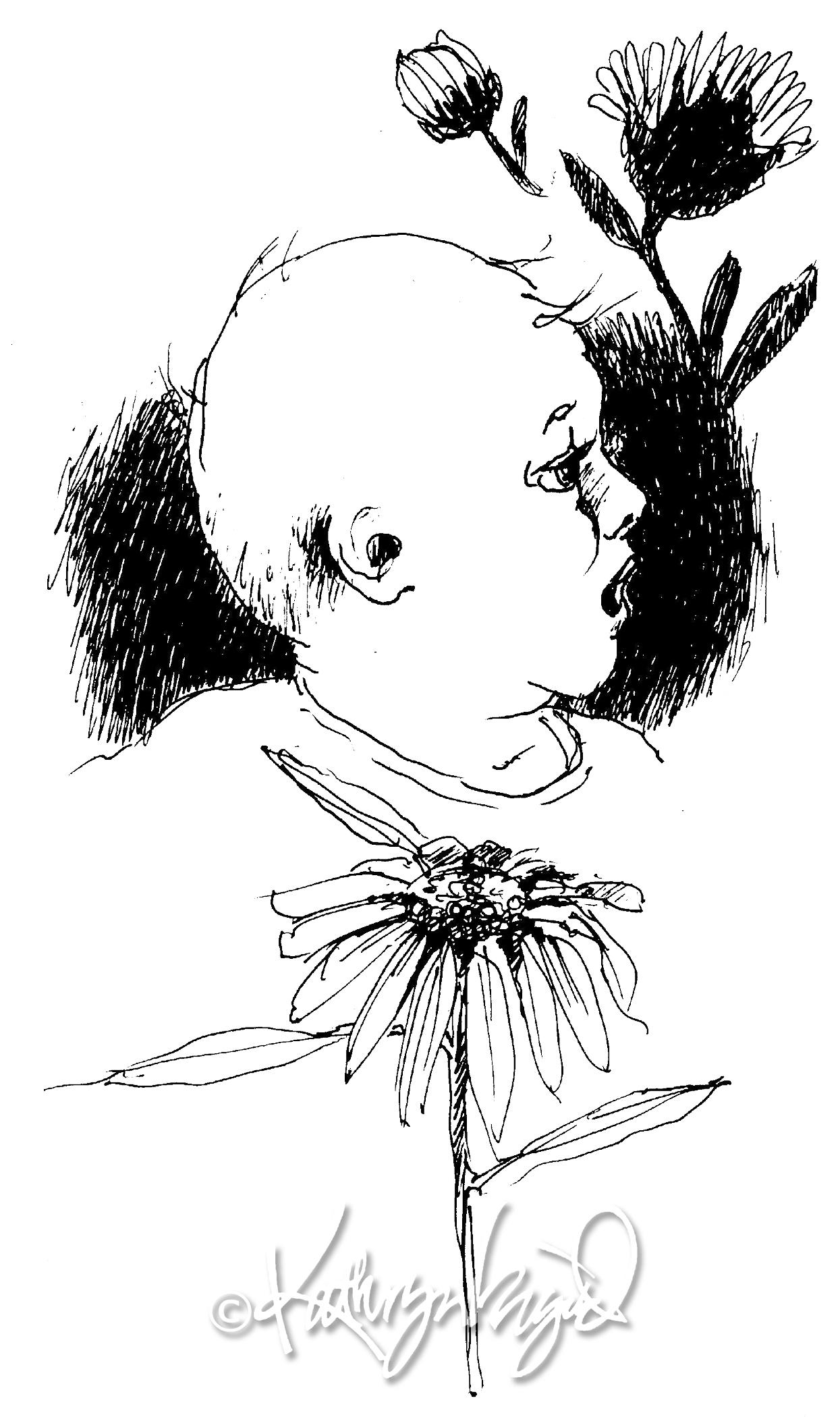
Faces and flowers show up often in my sketchbooks.
line drawing

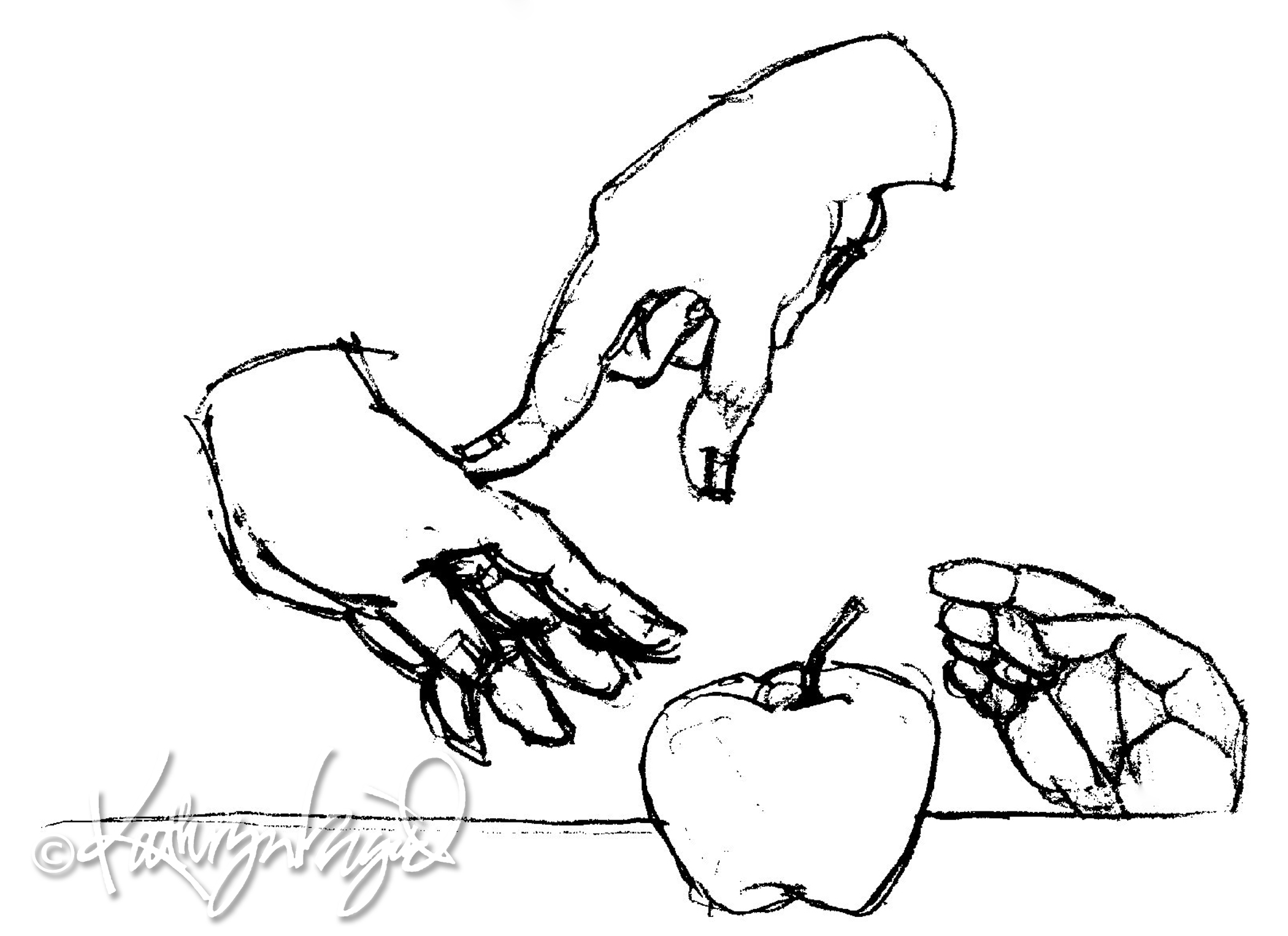
Hands can be pesky subjects, so I play with sketches of them frequently too.

line drawing

Any little vignette that pops into my mind is worth scribbling at least a few times.

Ultimately, whether I’m in gear for serious drawing or just fiddling with a pen or pencil to pass the time, it’s good practice and feels worthwhile. If nothing else happens, at least I have given my brain some thinking-room between the lines and I might figure out what to make for supper, how to cut through the piece of metal that is in the way of my completing a repair in the garage, or who knows–I might even remember where I set down that book I was reading days ago before it ‘disappeared’. It’s doubtful I’ll come up with any Nobel Prize-worthy inspirations while drawing, but then again, if I don’t draw, I’ll never find out!

The Cloche Wins in the Clutch

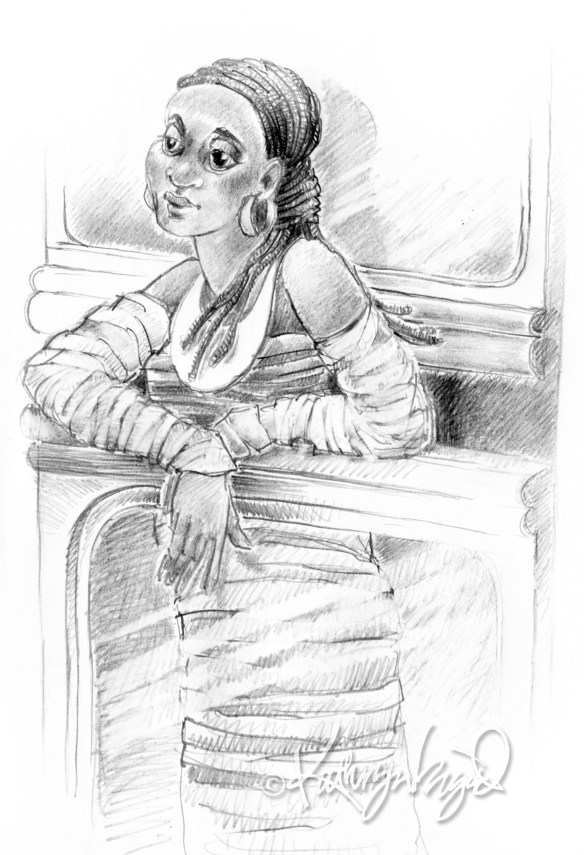
There mightn’t be any reason to connect the hat known as the cloche with the bell for which it’s named, given the resemblance of their shapes. The similarity may end there.graphite drawing Unless you want to make a silly cheap pun and say that the hat kind of rings a bell for some reason.

More productive, probably, to just work on drawing curves by sketching a figure wearing a cloche and simply exaggerating the resemblance a little bit more by simplifying the shapes to an extreme. Whether it’s quite characteristic of my style of drawing or not, it might be that I tend to like drawing curvy forms just because the arm and hand action that creates them is comfortable and pleasing to me when I draw.

The long and the short of it is that practice may make me better at drawing, but it also makes me happy as an activity in itself and for its own sake, and drawing curved forms feels pleasant and encourages me to draw more. And that, if I’m in the mood to draw curved forms, why then, drawing a cloche hat is a handy way to get into the process.

Shallow, I know. What do you expect from a person who makes cheesy puns in public and draws in a particular style merely because it feels nice!


The Center of Attention

When I am making artworks I am the ruler of all I survey. I get to invent my reality and decide how much of it I want to reveal to you, and even (to a certain extent) how I want you to experience this particular reality. I do know that you will bring your own point of view and that my art, this Empress having invented it or not, will tell you a story that exists in its own unique way within your personal context.graphite drawingHowever, like all storytellers visual or otherwise, I still control how much I’m willing to reveal to you of the whole project in the end. Do I give you the ‘whole story’ or choose to share a scene, a snippet, and then let you extrapolate from that to decide what the storyline is in the image, not to mention all of the possible storylines extending beyond the image in every direction? I choose the window; you interpret what you see through it.

In the case of this drawing of a lady with her fat pony, I’d say that a cropped version of the picture gives plenty of information about both characters and their relationship but mercifully deletes some of the evidence of my horribly sloppy parody of equine physiology, something that’s far more painfully exposed in the larger version of the piece. Yes, there I go, showing you my ‘underwear’ again. But don’t you agree that the image is improved, its focus stronger and its flaws somewhat mitigated, by the cropping?

graphite drawingUltimately, of course, I’m still Empress around here. I get to choose whether I’ll show you my process and share my behind-the-scenes action like this, let alone whether an image is finished or not, whether I’m going to use it for a post or not, and whether I’m going to tell a whole large story or a tiny bit of one. It’s good to be the Empress.

Question: What are Saturdays?

My answer: Saturdays are for both horsing around and embracing my dogged pursuits. Laziness and productivity. Rambling and re-energizing. Drawing on my strengths and, well, just drawing.

graphite drawing

Some of Saturday should be for just horsing around . . .

So I’ll try to get a few useful things done (chores: Check! exercise: Check! planning for the week ahead: Checkmate!) and I’ll also relax and indulge in those forays into the fantastic that make all of the useful things possible. What is Saturday to you?

digital collage

. . . and some should be for showing my dogged devotion.


Characteristic Characters

graphite drawingThere have been a few occasions in the past when I thought I would go out into the wide world, metaphorically speaking, and seek my (however tiny) fortune on the strength of my artwork. I happen to think I’m a pretty good artist. Even other, seemingly sentient and sane, people have given me reason to think I’m a pretty good artist in somebody’s eyes besides my own. Not that I would be in the least biased.

So I’ve looked into various ways to ‘put it out there’ [Ed: don’t be ridiculous. NOT THAT!], from looking at DIY publishing, either online or on-demand, of prints of my artworks or of books–I’ve got a whole stack of book pages laid out with my art and writing on a whole slew of topics and themes, all stashed away digitally for Maybe Someday use–to sending hard copy prototypes of said books and artworks to various publishers, galleries, shops and the like to see if they’d be interested in aiding me with their resources. The answer, always, has been No. All who respond with anything other than simple form responses indicate that they, too, think my work is good stuff. But the other universal response is: I’m too hard to ‘package’. After whatever amount of hemming and hawing is required in the instance, the clarification is that my work (usually referring to the visual parts, but written forms have been included as well) varies too much. I’m not same-same-same enough to be marketable, apparently.

I consider this high praise. But it’s rotten for business, as you can imagine. Yes, I’ve sold both speculative and commissioned artworks, but only privately and by word of mouth and for very modest sums and, frankly, none in quite a long time. I’ve had a number of gallery showings, but virtually all ones that I organized myself, paid for from start to finish, framed and installed and lit and removed myself (though as my family and close friends will attest, not entirely without enslaving some of them for some of the schlepping and heavy lifting)–and nearly all of these also garnering me good reviews, when I could get any critics to attend, and lots of enthusiastic appreciation from attendees, but no sales. I’m actually beginning to think they might be onto something, those crazies who sell high-end mansion properties and deal with slow sales by jacking the prices higher and higher until equally crazy buyers consider the places posh enough to capture their highfalutin imaginings and plunk down megamillions of dollars or Euros or what-have-you. Meanwhile, I’m sitting here on my little paper and digital treasure trove of creative wonders and selling occasional copies of them for pennies at Zazzle.com.

The other aspect of the critiques I’ve sought that always seem to end with ‘gosh, you’re wonderful, buuuuuuut . . . ‘ is that the same people who tell me I’m too diversified (if not wholly a dilettante and a flighty fool) for my marketable good often tell me in the same conversations that I have a very recognizable style, so no matter how much my subjects and media and moods vary, they find my work fairly easy to identify. And they say this as though they, too, think that’s a good thing. Can’t say I can untangle how the good seems to be perpetually the enemy of the moneymaking; clearly a puzzle I haven’t solved. Yet.

Until then, I keep doing-what-I-do, plodding along and enjoying the process because if it isn’t making me (or my patient partner) any income, it should at the very least be fun to do it! And I do find that no matter how much my attention wanders or my themes hop around from light to dark, from complex to childlike, from crudely handmade to semi-seamlessly digital, I see more and more the marks of my own nature and personality and style peering out at me from each work. I may draw characters that are as far from my own ‘type’ and experience and even beliefs or prior interests as can be imagined (by me), but each of them ends up being somehow a child of my own making or a member of the larger family of my creative spirit, and that’s pretty good, too, I’d say.graphite drawing

Hand Me That Pencil!

Time to take a few moments here and there to commune with my inner art-monster again. The busyness that takes over at the end of every semester always makes it a challenge to get much done beyond the basic chores and projects that simply get us through the day, and I don’t like to get too far away from regular art-making, so I feel a teensy bit itchy just now. I need to get my hands on some paper and pencils or pens and make something in addition to the photos and digital collages that have been my mainstay lately.

And it will happen. Always does. Patience and urgency, laziness and obsession are all in a little wrestling match inside me most of the time, and each wins occasionally. What really matters in the end is, I suppose that eventually I win. So yes, I’ll be drawing again soon.

Whatever it takes to keep me entertained and happy, don’t you know.graphite drawing

The Mythology of Inspiration

photo

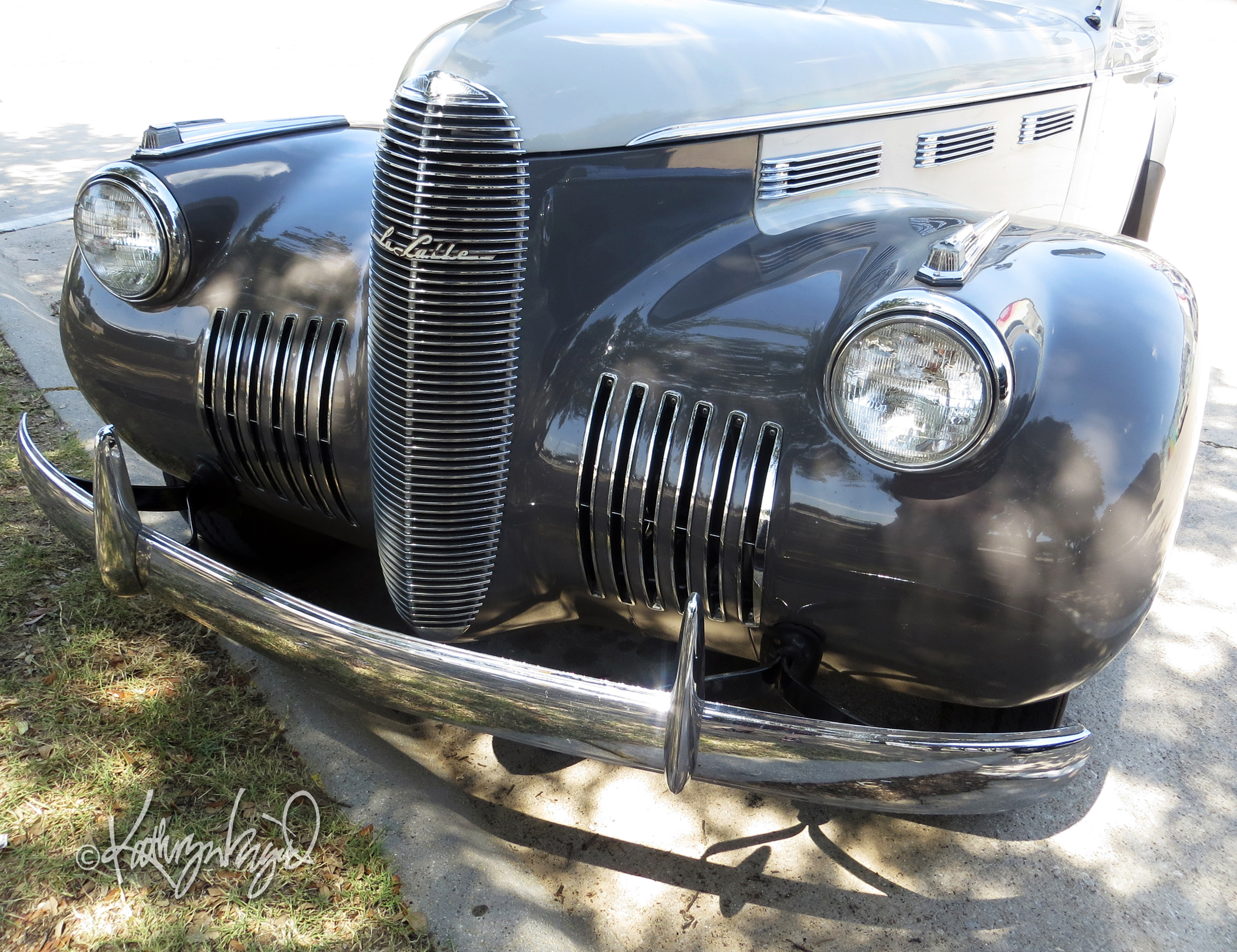
Whatever your vehicle, Ladies and Gentlemen, start your engines!

In another lifetime I was a teacher. Not a fabulous one, mind you, but one who took what I did seriously and did my best to give my students, if not the actual practice that would make them more productive and skillful and happy in their making of art, at least the idea of what might be possible for them and perhaps the instigation of the will to develop over the longer term. Like every other teacher in history, I knew that most of the burden of improvement fell on my students and had surprisingly little to do with what I could or couldn’t, would or wouldn’t, should or shouldn’t give them. And like every other teacher, I heard from my students every excuse in the book about why they would inevitably fail to accomplish any of this, how they were powerless against the forces that conspired to keep them from making the assigned efforts or finishing their work. Having used most of the excuses myself, I had plenty of fuel to argue my case after spending the intervening years (or minutes) rethinking it all as I moved from student status to teacher. And I knew too that I would have to keep re-learning it all as long as I lived, since every teacher is only a different breed of student and Life is the biggest, craziest, toughest and most creatively optimal classroom of all.

So I made up a little page of possible excuses and a smidgen of food-for-thought responses to them–perhaps mostly for my own enlightenment and prodding–that I shared from time to time with my students if they happened to be getting a little too enamored of creating excuses to spend their creativity on drawing, design, writing, painting, studying, researching, making mixed media installations, critiquing or any of the other topics I was attempting to encourage them to learn. Here are a few items from my little list, because I am well aware that I still need to remember them myself and keep trying to blow past them with determination and, I hope, a pinch of wit.

1          GREAT THINKERS THINK ONLY GREAT THOUGHTS

               (and I’m not a great thinker).

If this is true, explain why the Old Masters painted over or destroyed canvases, Einstein was virtually dismissed as a pea-brain by some in his school days and our early experts on astronomy believed the earth was flat.

2          GENIUS IS BORN, NOT MADE.

This may actually be so, but untended and un-exercised, genius has no value whatsoever, and many a great achiever has acknowledged beginning an illustrious career ignominiously and becoming expert through sheer will and work.

3          EXCELLENT IS GOOD, GOOD IS AVERAGE &

               AVERAGE IS TERRIBLE.

               (Corollary: Good is excellent, average is good, terrible is average!)

Creative and inventive people often have a penchant for self-disparagement and perfectionism that leads them (and often others) to devalue work of quality; it’s also a common temptation to simply fall back on the platitude of ‘beauty is in the eye of the beholder’ and accept mediocrity because one is too fearful or lazy to be honestly critical and opinionated.  Accept it and get on with things.

4          IT DIDN’T TURN OUT THE WAY IT WAS SUPPOSED TO.

Oh, come on.  Almost nothing does.  Sometimes it just isn’t finished yet when it seems to have Not Turned Out.  And more often than not, the real result is an improvement on the original plan anyway.

5          IT CAN’T BE DONE.

It’s better to go down in flames of glory, for having tried, than to prove only that  you couldn’t (or just wouldn’t) do it.  And what if it does work?!  Don’t you just love those rare chances to say I Told You So, anyway?

6          ALL THE GOOD IDEAS ARE TAKEN.

            All of the good ones haven’t been invented yet, Silly.

7          I CAN’T THINK OF ANYTHING.

You don’t have to.  Steal ideas all over the place.  Just remember to cite sources, give references, and wherever possible, to thoroughly revise and synthesize things into your own particular combination or version of them.

8          WHY SLAVE TO HAVE IT ALL WHEN YOU CAN SETTLE FOR LESS.

            Perhaps because apathy is as dangerous to existence as the threat of annihilation.

9          IT COSTS TOO MUCH.

Some of the same people who whimper over buying a five-dollar sketch pad and two ninety-nine-cent pencils (two weeks’ supply, say) think nothing of adding four dollars’ worth of popcorn and soft drinks to their seven-dollar movie tickets: that’s Whiners’ Math.  But most art supplies can be hideously expensive, especially for those productive enough to use masses of them.  So it’s a necessary and healthy part of the solution-oriented artist’s life that analogs and alternatives be a constant study.  What can legitimately serve as a substitute for the too-expensive?  Often the product of such inventiveness proves more exciting than the work as first conceived.  Sometimes it’s important to make the commitment to spend the real money for the real thing, too: how serious are you?

10        I’M NOT INSPIRED!

Genuine inspiration occurs ZERO times in the average artist’s life. WHAT!!! Heresy! But truly, if we’re talking spiritual/mystical magic, most must instead rely on a painstaking and passionate process of trial, error, adventure and eventual coalescence to allow artistic completion and quality to arise.  Don’t wait around to be inspired, in case it’s not in the cards: deadlines and opportunities wait for no one.  If you’re the incredibly lucky one inspiration smiles upon, have conspicuous spasms of joy, make feverish use of the favor while it lasts, and get ready to work hard on the next thing when you become a mere mortal again.  We’re lucky enough just to be able to be the real thing, Working Humans.  Don’t knock it.  There’s joy enough in that.

Stay tuned . . .

photo

. . . for being tuned up and ready to roll is more important than knowing where the road will take you . . .


Black & White in a World of Color

digital painting from a photoI was just strolling along and running errands, minding my own business, when I spotted this little twosome toddling along a nearby lawn. The way that they bobbed in unison, then in counter-rhythms, then in unison again, side by side, made me think of piano keys. They were like visual music, these birds, unselfconsciously creating a silent but cheering melody as they made their way across the grass. And they were in sharp contrast, being mainly black and white, to the Technicolor world all around them which suddenly seemed a little dull and plebeian by comparison.

And I thought, that’s how art works for me. It’s not that it’s always spectacular in its showy presence, brilliantly executed or wildly original–just that it strikes me at the right time and in the right way to make me see both the art and its context a little bit differently. It’s one of the reasons that I so love black and white visual artworks, in fact: that the simple removal of the known and expected colors of the subject can make me see the mundane as magical and contemplate the distinct wonders of things that ordinarily I might pass by without noticing. I suppose it would be good if I could learn to do this with a whole lot more of my world a whole lot more often, and perhaps I would refresh my sense of wonder enough to truly appreciate how fantastic ‘ordinary’ life really is.photo montage

What’s in Store

Sometimes even a partial notion will do!

mixed media painting

I told you recently that I was preparing to offer some of my work for sale online, and it’s time for the first revelation. I know that so many of you who read and converse with me here are also artists, writers and other creative people, and thus virtually by default are also (a) somewhat challenged by the technology and know-how of operating in businesslike fashion, promoting and marketing and selling your work; and (b) not exceedingly wealthy, as a result. So I did what I know a few of you, and many other people nowadays do, and turned to an existing, established production/marketing mechanism online and am going to let Zazzle help me with the ‘dirty work’. It means I’ve made a few business choices already, and I will share my thinking with you here because we really are all in this together!

First of all, this is far from a get-rich-quick scheme, not only because this is work I’ve spent most of my life learning to do and producing, but because as a business model it’s even less remunerative than the 30%-off-the-top commission that’s fairly typical among artist representing galleries and agents I’ve known in the past. But I am willing to take a very small amount (in many cases, the standard 10% royalty fee) from a company that will cover the grunt work I’m not willing or able to do myself. That is, of course, if they prove they can and will do it. I chose Zazzle because they have a certain established reputation and track record, easy to use interfaces, and while they are not high-end and going to capture for me any exclusive and wealthy clientele, they produce a decent quality range of products and so far have been very responsive in our interactions. This also makes me feel confident in their interactions with anyone who would come to view and buy my work, and that I can price the work as low as possible so that people like me (many being of the aforementioned impecunious creative sort) can choose from a variety of items that they might actually be able to afford without horrific trials.

I have begun posting my designs to the store fairly recently, but have made an effort to put up a reasonable representation from different sorts of my work: photography, drawing, painting and mixed-media images, and a fair range of topics from the abstract to absurdist, from factual to fantastical. There are a small few images with text (prose or poetry) on them, and many of those offered as prints can be purchased not only in different sizes but on different kinds of paper or even as stretched, ‘gallery style’ canvases, that is, with the image wrapping the sides so that the pieces can be framed but do not require a frame for hanging. I have offered a few of the designs as T-shirts, too, because it’s generally considered a good thing to wear clothes, and if we require clothes, then why not wear ones that aren’t terribly expensive? T-shirts are a pretty affordable option. But I’ve never been fond of wearing anything that advertised someone or some Thing (object or cause or concept)–if I want to promote a cause, I’d rather do it with my own words and my actions than with worn signage. So you will find very few slogans or words at all on the T-shirts, just pictures for the most part. I have made a number of them simple black-and-white images, often using my pen-and-ink line drawings, and I would encourage those who like color to consider getting a set of fabric coloring pens and having a good old time coloring the T-shirts like coloring book pages to suit taste and need. Might be a very fun thing to do with children, in fact, as the T-shirts can be ordered not only in a range of adult sizes and styles but many children’s ones as well.

I’ve configured most designs as the largest print version for which I think they’re suited, but most can be scaled smaller for your smaller space or to be more affordable. As it is, there are a great many prints under $20 a piece, and quite a few under $10, so I hope that a larger number of people can afford them without feeling a terrible pinch. There are a whole lot of other designers and artists represented in Zazzle stores, and a really wide array of objects and items that can be customized with your, my, or others’ designs and images, and I will see if and when I’m ready to branch out further with my own. For now, you should know that there is lots of work posted to Zazzle by someone under the name of ‘artspark’–pretty nice stuff, from the look of it–that’s not mine; I tried a huge number of store name options before finding one Zazzle accepted as not already in use, so I’ll just stick with this one even if it’s a bit close. I titled each of my designs KIW Sparks: [Title] to differentiate a little, hoping that helps.

ArtSparks

Even if you have no interest in–or money for–buying anything, I invite you to spend a little time visiting my work at Zazzle. It can serve, in part, as my online gallery for now, where you can see many of the works I’ve used to illustrate my blog posts, as well as a few artworks you’ve not seen here before, and I am eager to share them all with you. I hope that you, too, are finding the courage to ‘put yourself out there’ artistically and creatively because we have this fine forum among friends in the blog-world and online businesses, because even though it’s generally a tough way to make a living, financially speaking, it’s a glorious way to make a Life.

graphite drawing

I don't know if I can claim to have accomplished anything yet, but I'm at least underway in the process of taming the dragon that is my fear of the business side of the creative life. Hopefully, having chosen Zazzle as my squire, I'll figure out how to battle my way through the whole process more successfully over time!

Art Imitates Life Imitating Art

A little ditty I wrote when teaching drawing classes . . . graphite on black paperAye of the Beholder

Teacher mustn’t be too choosy,

Guiding student artists through

Projects in which they redo

The works of masters from Brancusi

to Vermeer or Frankenthaler

Or da Vinci; every student

Has a vision of what’s prudent

And what fails, as artist-scholar;

Though they may have witticisms

And have skill and wisdom plenty

As artistic cognoscenti,

Few have true twin criticisms–

Expectation must diminish,

Open-mindedness then flourish,

So the student brain can nourish

New great art from start to finish;

This is what the child of three meant

When she said no one had told her

That the Eye of the Beholder

Never met complete agreement:

Genius art is the dominion

Of the Artist, true; and yet, it

Is the critics, I regret it,

Who know Genius is opinion.digital drawing image