Empathy over Courage

Bravery is a rare commodity. Many people who think they’re being brave only dare to do so from within a like-minded group, however small in number, and when they are genuinely in the minority spend more energy on protesting that the majority from which they’re excluded is unfair and unjust than on doing anything useful to change it. It may be true—knowing human nature, often probably is true—that one’s opposition is no exemplar of justice and fair-mindedness. But we’re seldom willing or able, ourselves, to make a cleanly balanced assessment and especially, to act wisely and compassionately on it either. We’re generally convinced that anyone else having anything good means less goodness for ourselves, and that that is a terrible thing.

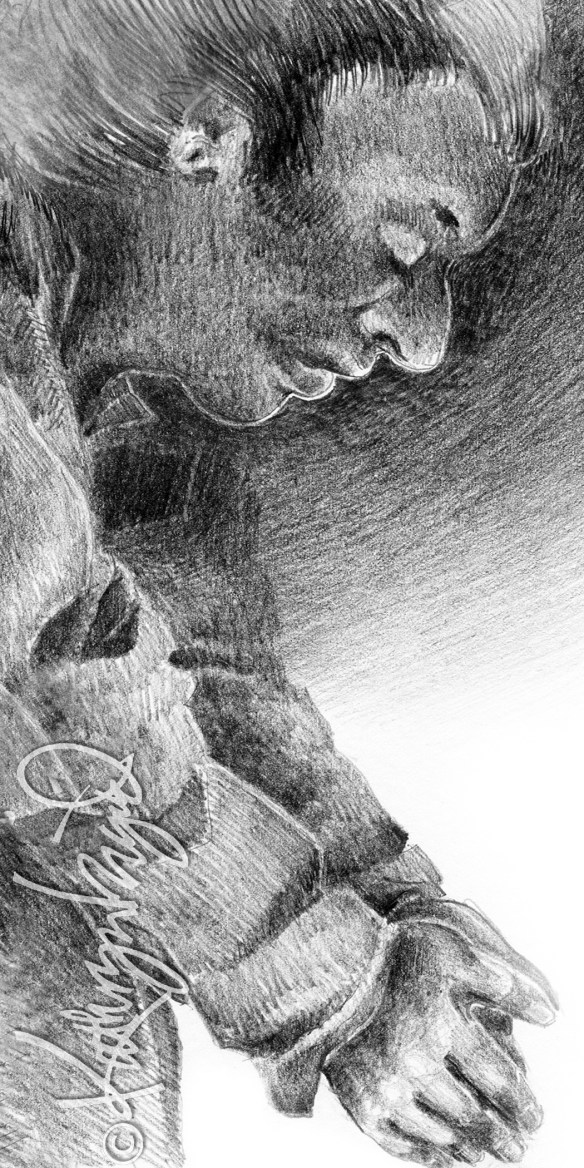
What impresses me more than bravery, real or imagined, is seeing anyone express real empathy for others through their own beliefs, lives, and actions. I tend to doubt that we’re capable of doing or even wanting very lofty things, but I also think that small doses of empathy will go ever so much further than any amount of derring-do and action-figure heroics in bettering the world and the human condition within it. Daring to let another person be richer or more privileged than me or to have the last word, even when I’m fairly sure I’m smarter, closer to correct, or more deserving requires quite a different sort of courage than running into danger in anyone’s defense or their stead.

But treating others with such respect seems to me far more likely than argument and defensiveness, self-protection and fear, to get anyone to trust and respect me in turn. So shines a good deed. The unselfish willingness to accept another person’s reality as valid even when it might cost me something significant is a kind of courage I dream of having, hope to learn.Graphite drawing: Reach Down to Raise Up

Contagion vs. Compassion

“One bad apple spoils the lot.” That creaky aphorism is based on equally venerable experience. Rot is contagious.

Bad company makes bad behavior seem the norm, and we adjust our own standards ever lower accordingly. One or two disheveled houses bring down the values of the others in the neighborhood, and those, in turn, fall into neglect and decay as their owners lose the courage and determination to resist the incredible pull of entropy. What isn’t growth is death.

What leads otherwise good and sane people to fall apart like that? Doubt; fear; despair. These are the hallmarks of contagion: the plague succeeds in felling us not only through its own virulence but because rather than seek its cure with full courage and determination we flee with it hot pursuit, and when it eventually catches up with us, we topple, curl up in the fetal position, and succumb.

The fall of one member of the world community—like Mr. Duncan, who was felled by Ebola in Texas—is a very real and terrible loss for all. The loss of thousands—those dying in West Africa—is indeed a plague and a thousand-fold grief we all must recognize and bear. The response, though, cannot be equally contagious doubt, fear, and despair. That can only make us choose unconstructive, even destructive, responses like blame, xenophobia, retreat, and the neglect of our fellow citizens of the earth. Then, no matter how many or few have been overtaken by disease and disaster, the contagion will have won.Photo: Snakebit

Who’s the Wisest?

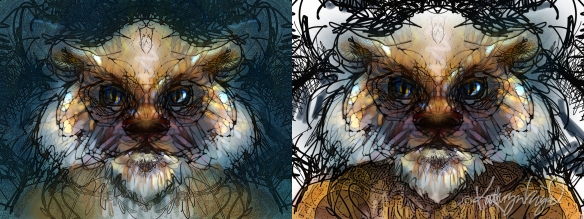
I give myself credit for being smarter than I am. I suspect, given what I see around me in this wild and woolly world, that I am far from alone in the practice. Even owls, a favorite symbol of wisdom, are not likely as perfectly ingenious as we imagine them, but they might still be more intelligent than the half of us.
Digital illustration: The Owl King

The Search Continues

Parsing paragraphs to find

The author’s complete state of mind

Is no more useful than to ask

A Word how it performs its task,

If we assume we’ve read aright

What’s only there in black and white.


The Long and the Short of It

How quickly pass the hours and days

and weeks and months and years,

And yet, how slowly pass our worries,

paranoiac fears;

This is the great conundrum that

presents in mortal time,

And quite enough of food for thought

in one quick, measly rhyme.

Any Old Palace will Do

As self-crowned, self-proclaimed Empress of Everything (mistress of none), I have always enjoyed the ease and luxury due my supposed station. I eat well, travel relatively often, and keep the finest of company. It’s only appropriate that I should also live in the palace of my own choosing, or better yet, in various fantastic palaces in different fabulous parts of the world whenever I happen to be there. Of course, the locales and the company I keep in them determine my level of happiness far more than the buildings and their furnishings do themselves. Isn’t that always the way? No matter how plush it is, a glamorous structure is only a gilded cage if it allows no light of love and adventure into it and no correspondingly venturesome, happy soul out of it.
Photo: S:kt Jakobs

So far I’ve managed to establish my string of palaces remarkably well, along with fulfilling my many other requirements of that life of luxury I don’t necessarily deserve but am quite capable of desiring. I’ve stayed in, lived in, visited, and wandered through many a grand, gorgeous, impressive place. I’ve designed many on paper and in my mind that would knock the socks off of any person who saw them. Yet I still can’t understand the people who look at glorious, showy homes and think only of whether the places would genuinely suit as their own dwellings. If your energies are devoted solely to thinking that “this master bedroom is too small,” all I can think is that your imagination is too small, your life too tightly fitted around what you perceive as Impressive Enough, to allow you to find your palace in whatever motel room or suburban house with one bathroom your life lets you land in at the moment.
Photo: Davenport, Spokane

Many of the palaces I’ve inhabited I have done only as a passerby, a visitor, a tourist. And I have nothing against that at all. After all, wherever I close my eyes to sleep, even the most cramped bedroom with a creaky, narrow, deeply bowed bed where the very middle of the mattress is the only almost-level spot to rest, I can turn it into any one of the palatial places I’ve visited, or continue to invent my own. The roof I am under is irrelevant in determining the luxury of my existence, so long as it’s safe and not lacking a place to lie down without breaking anything (furniture or me; I prefer to keep both intact) and not hideously cold or hot or wet. In my dreams, I remain Empress, and there I can build and inhabit the most astounding of palaces if I choose to do it.

As such, I am also constantly grateful for the many wonderful places I’ve visited, stayed,  and/or lived, and especially for the extensive ranks of friends and family and acquaintances who have through their immense kindness consistently supported my ability to live—and feel—like royalty.

Be Very Afraid. If You Really Like that Sort of Thing.

I have neither the knowhow nor the tangible resources for filmmaking, but if I did, I think my concept of the perfect horror movie subject would be the infamous occasion of Black Friday. As we Americans approach the national holiday I like the most of them all, Thanksgiving, I think with a shudder that Black Friday’s grim shadow lurks just behind it.
For if I have a tender feeling for the holiday that not only marks the anniversary of my first date with my soon-thereafter life partner and makes me immensely thankful for that gift but also marks the national celebration of gratitude in general, I have an almost antithetical feeling about the retail frenzy that follows it. The former only throws the latter into higher, less flattering relief.

I love shopping, don’t get me wrong, but I hate being told how and when to do it, and what or whom for, and to what magnificent extents. I dislike being so easily manipulated by commercial ploys and plugs as it is, and the stink of desperation mixed with hyperbolic greed on Black Friday becomes overwhelmingly off-putting to me.

Digital illustration

What makes us turn into beasts when we get a whiff of the hunt? When a crazy sale is advertised, do I become predator or prey? Or should I just pray?!

There are obviously large numbers of people who are not only comfortable with the event but energized and entertained by the spectacle and Olympian scaled enthusiasm packed into the post-Thanksgiving shopping extravaganza. I wish them all happiness and success in it. For myself, the greatest pleasure will derive from managing as successfully as I can to not even know it’s happening and staying immersed in the afterglow of my most overtly grateful time of year. Accomplishing that will be yet another reason for me to give thanks.
If I need any diversions during my quiet hideout from Black Friday, I can always work on a script for a rollicking thriller film with plenty of retail rowdiness and gruesome greed. Coming soon to a theatre near you!

Foodie Tuesday: Medium Rare

I know all thoughts hereabouts turn to turkey at this time of year, but not everybody (even the meat-eaters among us) craves turkey, whether they’re celebrating Thanksgiving or not. Why ever eat something that you’re not wild about or hungry for just because tradition seems to dictate it? You’re free to be just as thankful for a fabulous steak dinner as for a roasted turkey, especially if you consider how little our modern image of Thanksgiving turkey dinners probably resemble the original feast they’re meant to commemorate.

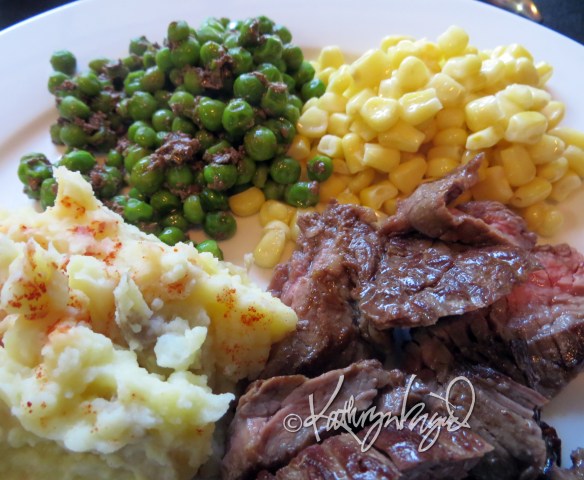
And a good steak needn’t be a terribly rare thing. I used to avoid serving it not out of dislike but because I was sure it was too hard to prepare it nicely. Somewhere along the line, fortunately, somebody set me straight on that. If I can heat a pan to just slightly over medium high heat and own a timer, there’s not much excuse for being fearful about it.Photo: Medium Rare

What I learned was so simple that it seems laughable, but then that’s how I operate in the kitchen. This self-educated cook has a doofus for her teacher. Here are the incredibly easy things I learned to do that make steak dinner—with a fairly perfectly medium rare steak in the midst of it—a possibility simple enough I don’t hesitate anymore.

Let the steak be the star. Get the nicest quality cut you can afford for the occasion, at best a well-marbled 1 to 1-1/2 inch (2-3 cm) thick grass-fed beauty; pat it dry, coat it liberally [no matter what your political leanings] with salt and coarsely ground black pepper, or a spice rub if that’s your wish, and let it sit a few minutes absorbing that seasoning while you heat up your heaviest skillet on a middling-hot flame or burner. I love my cast iron skillets best of all for doing steaks. Melt a big dollop of good fat to coat the already fabulously seasoned skillet, and when it’s rippling with heat (but not smoking), gently lay in those steaks. One massive one that almost fills the pan can of course be cut up afterward for sharing, or several smaller ones put in together; just make sure that whatever’s in there has room—if it’s crowded in the pan it’ll steam rather than sear. That would be sad.

When the skillet has been made hot enough for the fat to shimmer in it and the steak is in place, expect it to act like a slightly irritable cat: that steak and the frying fat will hiss and spit a little. You might want to stick a splatter screen on top if you’re fussy about stovetop cleanliness, but it’ll wash off easily enough later if you don’t care in the meantime. What fat should you use? Avocado oil is great, if you can get your hands on some, as it has a high smoke point; for straight-up beefy flavor, you can hardly beat clean beef tallow, but it’s not too common to have that on hand (I keep the skimmed fat from my bone broth for such things at times); bacon fat is a flavorful alternative. Ghee or clarified butter is probably my favorite. Whatever you choose, I recommend something with a high smoke point to give you the ability to get a good, caramelized sear on the exterior of the steak without turning the inside of your house into a smelly barbecue pit full of tarry smoke.

But enough about heat and smoke and fat! The steak, still, is your starring player. What to do with that loveliness? Not much. Leave it alone! When it’s in the skillet, let it sit and sizzle completely untouched for about 4 or 5 minutes. The bottom edge should show you just a hint of the beautiful dark brown crust building below, and you’ll flip it over and do the same thing. The next thing you do is: some more Nothing. When you get a whiff of that superb, incredibly tempting scent of beef perfection as both sides have browned gloriously, you will want to stick your fork right into it, but don’t. Wait. Take the steak out of the skillet and let it rest on a warm plate for at least five or ten minutes while it finishes cooking from residual heat, and reabsorbing the juices that will all run right out of it if you cut into it too soon.Photo: Skirt Steak
When you think you have suffered enough, wait thirty seconds more, and then you can pounce on that steak. While I’m waiting for my steak to be ready, I distract myself to prevent premature steak attacks. I deglaze the pan with a splash of Jack Daniel’s black label tastiness and a smack of salted butter, as often as not, to pour every bit of remaining goodness back onto the steak with a lagniappe of kindness. I make sure the salads, sides, and other accoutrements of the meal are all at table and all ready to play their supporting roles to the marquee meat. If all of that hasn’t kept me in check for quite long enough, I’ll just have to risk it, because I’ll have been sniffing the air like an unchained werewolf, and y’all had better get out of my way now and settle down to your own plates of steak and we’ll all be safe and happy, at least until the next full moon. Or steak dinnertime.
Unnaturally Lightfooted

We’ve long since established that I can’t dance. I couldn’t dance well enough to stay in a second-grade dance class; heck, I couldn’t even be trusted to remember whether we were supposed to show up wearing tights with our tutus or not, for the class picture before the big recital. Though it’s only fair to give myself credit for having been obsessed with the ugliness of our getups to such an extent that I forgot the part about the stockings, and I promise you, they were hideous costumes.

But you also know that I am enamored of beautiful dancing of nearly any kind, if allowed to watch it from a safe distance. So I think I can be forgiven for letting others take to the floor in real life and only doing so in my imagination and, occasionally, in my poems. I think any creature, real or imagined, that can dance beautifully deserves my attention and admiration (as long as it wears the correct tights with its tutu).Graphite drawing: Swinging Dragonflies


Text: Waltzing

A Faraway Look

Daydreaming is amazingly useful. No matter what teachers and bosses and impatient parents may have said over the years (never to me, of course, wink-wink), that pleasant fugue state of seemingly purposeless internal wandering is where a great deal of terrific, very purposeful invention and problem-solving happens. It takes us to inner regions where we are unencumbered by rules, editing, and logic, and can let the what-ifs of experiment and hope play together until, sometimes, they produce brilliant results that endless hours and years of study and labor might never have fostered. How can we expect to engender anything grand if we don’t aim for the seemingly impossible?Photo: Faraway

Consistent study and labor are, of course, quite necessary if we are to be able to even conceive of what exists and how we intend to alter it; to begin with no facts, no tools, no notions of probability or potential will inevitably leave us puzzling fruitlessly for ages before we ever approach a fantastic and outlandish idea, let alone a useful one. But once the seeds have been sown, we can’t assume that there would be no purpose in additional time and imagination spent on divining what to do when they begin to grow as well. The dreamers of the world have nurtured at least as much meaningful and helpful stuff as the mere scientists and scholars and brawny-brained geniuses have done, but with less hoopla, and it seems to me that we should be wary of working too hard to bring fantasists down to earth too soon.Photo: Fruition

Assume, when you see me in an apparently abstracted slide toward the comatose, that I am in fact inwardly journeying toward a dazzling insight or earthshaking invention or two, and leave me in peace. I shall emerge, in due time, bearing the harvest of this grand exploratory trip. Or at least I’ll have had a refreshing nap. I’ll happily leave it to you to determine the value of the difference, if any, between the two eventualities.

What Wounds can Teach Us

Cut

Skin, though as taut as rawhide, and as strong,

Still splits under a jagged, cruel knife,

Opens its jaws to scream a gout of life

As blood that would atone and end the wrong—

But wounds, no matter what the cause or source,

Cannot withhold their sorrows or their rage;

Injustice must be shouted off the stage,

So bleed they without pity or remorse—

Break, then, both skin and soul, and sear the heart

Of any who is cognizant of pain;

Who cries for justice and can’t sleep again

‘Til order is restored as at the start—

What’s done cannot be undone should a scar

Reveal the fragile creatures that we are.Digital illustration from a photo: What Wounds can Teach Us

Through Winter’s Window, Dimly

Photo: Light Looks In

Change of Season

Between the rain spells, when the sun is glinting onto rose and road
The youthful smells of spring are hinting that ahead the broken code
Winter left in seed and scion will reveal its inner life,
Where what had appeared as dying wakes again with newness rife.
Open eyes and open windows! Let indoors the fresh new air,
Breathing in what melts the snows and pushes out all winter’s cares.
So renew the self and senses and embrace the growth and light
Breaking down all old defenses, setting earth again aright.