Ever Heard of Foodie Thursday?

Well, now you have.

It’s been a busy autumn chez Sparks. No excuses: in the flurry, I flat-out forgot to put up my food post on Tuesday. Sigh. I didn’t stop being food-obsessed, just being on schedule. So here we go, better late than never. I would give you a big silly grin, but yeah, my mouth is full again. Photo: Blue Bouquet

What I meant to say on that long-ago-seeming-day-which-was-Tuesday, was that I do like this time of year in particular for its masses of officially sanctioned excuses for partying. There are of course the big national and international celebrations of things spanning from Halloween/All Saints/Dia de los Muertos to Thanksgiving, Diwali, Christmas, Hanukkah, and the various New Years; in my family, five out of the six of us have winter birthdays as well. It’s not that my family and I are in any way averse to celebrating with a good meal, a party, or any other excuse for eating and drinking good stuff at the drop of a hat, but it’s extra nice when nobody else questions the need for such an occasion either.

My parents upped the ante this winter by both entering the glorious ranks of octogenarian excellence, so since my three sisters and I don’t all live close to them anymore, we’d long since all agreed it made sense to look toward next summer (2015) for a family get-together to mark their ascensions to this great new height. All the same, nobody in our clan has any respect for leaving an excuse for a party just lying there unused. So Sisters 1 and 3, who do live near Mom and Dad in Seattle, helped them plan a big party on Mom’s birthday weekend so that our parents could have their local siblings, nieces and nephews, and a few special friends together. I made up the digital invitations, since I could do that from my remote location, and because I’ve long done such design tidbits for family events as a way to be involved when I couldn’t otherwise be on hand to participate. But our Seattle sisters did the yeoman’s work on the whole thing.

We kids did up the ante a little, though. Sister 4 and her husband sent an email to the other three of us a couple of months ago, announcing that they had bought plane tickets to fly over from Norway for the November party and surprise Mom and Dad. We sisters were surprised, too! My husband, with three concerts and more rehearsals to conduct on either immediate side of the party date, couldn’t get away, but with a batch of saved air miles, I could, so I planned to fly up from Texas and join in the fun. Once all of our tickets were bought and the wheels set in motion, the real challenge was not only to see if there were any small things 4 and I could do from our bases of operation but to see if we and our partners could keep a secret for seven or eight weeks, a dubious probability at the best of times with our talkative bunch.Photo: Pink and Green Bouquet

We did. We let one of Mom’s sisters in on the secret so that she could help get our parents in the right place at the right time when the day arrived, and my spouse’s parents knew, because they were invited too, but despite a couple of close calls, nobody slipped up irrevocably. Part of the larger plan, once we’d decided to add in this surprise element, was that there would be an immediate-family-only lunch on Mom’s actual birthday at Sister 3’s house. Dad, Mom, Auntie and Uncle, and sisters 1 and 3 were to have a nice, low-key luncheon date to mark the day and wrap up any last-minute details for the bigger open house party the next day.

Sister 4 and her husband and I flew into Seattle on Thursday the 6th. It was wonderful to have a reunion of the four sisters, our first in at least a couple of years, and to convene a few other members of the immediate family—3’s husband and one son, with the other son flying in from college on Friday—that night and to laugh up our collective sleeves over our plot. In keeping with the family tradition of combining food with fun, this first evening was spent at 3’s house, slurping bowls of a beautiful, creamy winter sweet potato, kale, pasta, and sausage soup (based on Martha Stewart’s recipe) while taste-testing a couple of good single-malts the Norwegian contingent had picked up on a duty-free spree en route.

On the 7th, Mom’s birthday, we got lunch ready and in the oven and fridge and then spent a little while nervously skulking past curtained windows to escape any unexpectedly early arrivals’ discovery, and as the parental entourage at last approached, three of us ducked into the back bedroom, where we giggled like little kids and perched on the bed to avoid making the creaky hardwood floor give away our presence. Auntie got Mom settled into her favorite armchair so we wouldn’t have to explain her absence at the next day’s party as the result of an aneurism, and we finally strolled out to say Hello to our startled parents. Their faces remained in virtually the same blankly surprised expressions for a fairly lengthy, attenuated moment.Photo: Mom's 80th Birthday Lunch

Lunch broke that spell. We feasted on marvelously simple steak, lemon-dill oven-roasted salmon, salt-baked potatoes, green salad with a fresh blend of herbs and creamy lemony dressing, green beans, and buttered peasant bread. Classic, delicious, and with a handful of their kids on hand to help, an easy way to feed our parents well on a meaningful day. We worked a bit more on the details of Saturday’s open house event, but 1 and 3 had covered all bases so thoroughly that we were all able to make an early evening of it and rest up for the main event.

Sister 3 had found a wonderful venue, a community center run by the parks service in a beautifully renovated vintage power station right next door to the church where our dad had grown up. All five of Mom’s siblings and Dad’s only sib, his brother, and all of their partners, were on tap to come. So did some of the sibs’ kids, and even a handful of grandkids joined the gang; with the friends who came, we totaled just over fifty in attendance. We saw many relatives we’d not seen in years, many of them as surprised as our parents at seeing us there like long-distance apparitions. I think I can safely say that the party was everything Mom had wanted, that Dad was also happy, and that we all felt pretty chuffed at pulling off a great success, especially at not blowing the surprise.Photo: Birthday Buffet

But again, food was central to the grandness of the day, and once more, that was thanks to the wise planning and [literally] tasteful choices made by our Seattle sisters. The buffet spread’s main dish stars were ginger beef and sweet walnut prawns from our favorite local  Chinese restaurant, accompanied by a wide range of finger foods and sweets, many of them bought ready-made from various shops and stores. We had just about enough food on hand to feed 250 guests. So we kept up that family tradition, too. And we all left the tables full and fulfilled.

Who knows what we’ll get up to next summer. Only sure that it will include much eating and drinking. And probably lots of childish giggling and telling secrets, which I think are a mighty nice lagniappe for the whole meal, whatever it is.
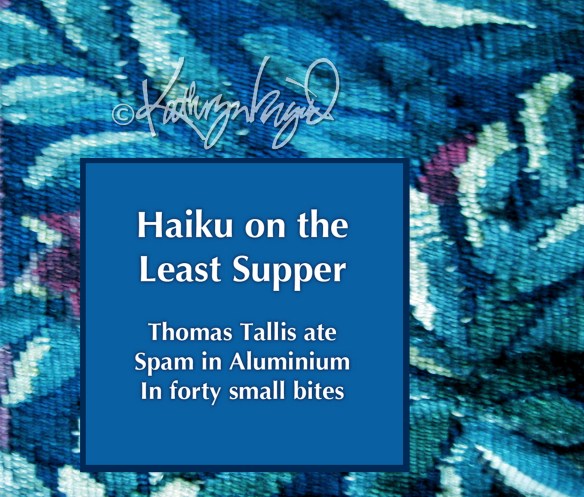
Early Music for Breakfast

Digital illustration + text: Haiku on the Least Supper

If you haven’t already crossed paths with Thomas Tallis‘s landmark Renaissance motet Spem in alium, I highly recommend it. It’s a truly astounding piece of European music history, representing the confluence of the political and artistic competition for primacy in that time period; it’s believed to have been composed as England’s answer to Italy’s Alessandro Striggio‘s own, earlier 40-part motet, or possibly to Striggio’s 40-60 voice mass. I’m no musician, but I’ve learned, mostly through witnessing a few performances of the Tallis by different groups led by my husband and his colleagues, just what a feat this piece really represents.

While the creation of Striggio’s works for 40 and more independent voices is amazing in its own right, the 40-part motet he wrote specified that the voices be doubled instrumentally. That is impressive enough. For my fellow non-musicians, think of it this way: a typical piece of music for a mixed choir requires singers to perform different notes and lines of music, often at the same time, so that what is heard is not one single series of notes, one after the other the way we sing by ourselves, but layers of notes that become deeper and more distinctive expressions of the words being sung. Instrumental doubling means that some or all of the vocal parts are supported by one or more instruments “singing” the same notes at the same time. This can intensify the effect of that singer or section’s line, and it can sometimes also help a less skilled singer or choir stay on target with the line.

In any event, the more typical choral works tend to have soprano, alto, tenor and bass voice parts, or singing lines, (or some combination of those) and generally, not more than eight or perhaps twelve different lines intermingling at once. Anything more than that means that every singer in a moderate-sized choir is responsible for knowing and performing his or her own notes, on pitch, at the right moments, and with exactly the right loud-soft dynamics and flow at every point throughout the piece. Being in a choir is a thrill; being in a good choir is a real intellectual and artistic and even physical challenge.

What makes the Tallis Spem so incredible is that it comprises not only forty individual, fully independent singers’ voices all singing their own distinct parts of the song, but indeed, doing so entirely unaccompanied. Every one of the singers has to be spot-on at all times without the support of either a fellow singer or any kind of instrumental doubling. If one singer goes off the rails, there’s the possibility that others will be thrown off of their pitch, timing, or even their place in the whole work. It could well lead to a musical train wreck. Think you’d be intimidated by doing this? I think any sane person should be!

But it’s powerful stuff, when it’s well done. I’ve had the privilege of hearing this feat beautifully accomplished by singers surrounding me in a cavernous cathedral space, and by singers standing onstage in a modern performance hall with a carefully engineered acoustic. I’ve experienced it in art galleries where Janet Cardiff‘s intriguing installation of forty high fidelity speakers on stands are placed in a circle in the otherwise rather bare room, each playing in synchrony the recording of one of the singers in a performance of the Tallis, so that one can stand outside the circle or in the center of it surrounded by the speakers, or can move to stand at one individual speaker at a time, getting entirely different effects depending upon which part of the score is being performed and where one stands in relation to the speaker playing that part.

No matter how it’s done, once you’ve gotten a little of the idea how this piece of music intertwines voices that seem at first to be operating without a clear relationship but then, more and more, to be converging into a meditative, chant-like, layered song, it is quite mesmerizing. There are some recordings and performances out there on CD, iTunes, and YouTube worth a listen, and if you get the chance to visit the Cardiff installation, called simply Forty-Part Motet, do it. Best of all, of course, is if some fine choir nearby offers a live performance that you can attend. It’s rather haunting and ethereal, and made all the more impressive by the knowledge of its complex origins.

Meanwhile, I have given you this bite-sized humorous meditation on the work. A haiku seemed the ideal vehicle for acting as either commentary on or antidote to a choral masterpiece so complicated and virtuosic. And I sort of wonder if, in the process of composing this grand work, Mr. Tallis had any chance to stop for rest or was so deep in concentration that he barely had time to do the Renaissance equivalent of opening a tin of luncheon meat and dining directly from it, pen and parchment in one hand and dripping Spam juice on the other. Thankfully, it doesn’t appear that this effort of his was entirely detrimental, let alone leading to his personal version of the Last Supper, since he went on to compose other fine works up until nearer his death some fifteen years later.

Eau de Toilette

Image

Digitally altered photo + text: Canned Applause

Mental Featherweight

Photo: Featherweight

Text: Ex nihilo ad nauseam


Digital illustration from a photo: I'm a Featherweight

Deep Sea Wishing

Digital illustration: Psychedelic PstarfishPsychedelic Pstarfish

Seems sillier than psyllium to sing of starry seas,

Yet so the ocean’s silken shore’s sufficient proof of these

That sparkling in such shady deep, something is sure to gleam

In stunning stellar specks and sparks in that submergèd stream,

So sing we sweet and shining songs of starfish as we wish

Upon the evening star to see a firmament of fish

Adrift in a Skiff

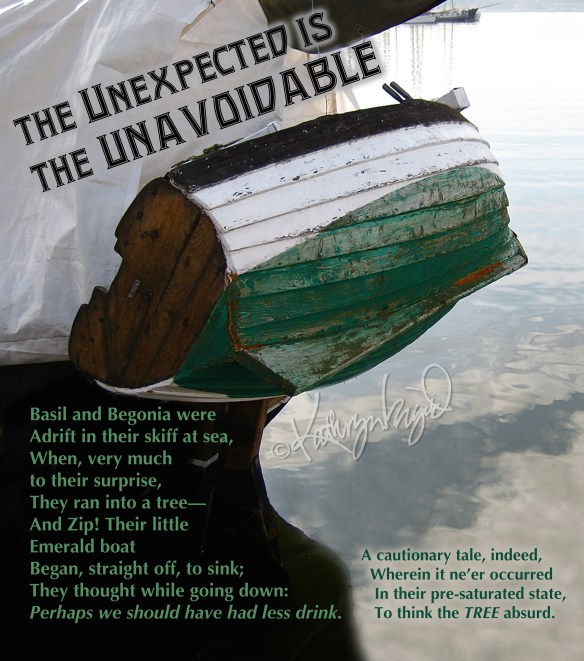
Some things simply can’t be planned, foreseen, or avoided. The impossible is surely one of those things, and I happen to know that the impossible happens amazingly often. At least, in my part of the universe.Photo + text: The Unexpected is the Unavoidable

The Great-Greats

Naming things is an endlessly fascinating and complicated way of creating and better understanding our relationships with them. Different cultures have even devised quite distinct ways of classifying and identifying the kinships within them, to the extent that families and relations in the different cultures affect the very ways people interact and consider themselves connected, responsible for each other, and much more.Photo: Great Great Grandparents

One of the appealing (or appalling) quirks, depending upon one’s view, of the American traditions of familial identification and the names given them in English is the way we use the word Great to specify layers of distance from ourselves. This photo, for example, is of one of my sets of great- and/or great-great grandparents (my maternal grandfather’s forebears), if I am not mistaken, and there is much to pique my curiosity in this image.

First, of course, is the question of whether I have identified them correctly at all. But then, in what ways—besides the nominal—were they great? Clearly, being among my ancestors is an easy in to that category. [Ba-dum-tsssssssshhhhhh!]*

Seriously, though, what distinguished these people? Safe to assume, from what little I do know of my relatives in Norway, these two lived on a small farm, and they worked hard. I mean, incredibly hard, by my standards. I’m inclined, actually, to think that the gent is my great grandpa and the lady next to him is his mummified mum, but having seen many a portrait from that era whose subject I was shocked to discover was eons younger than I’d have imagined, I can’t be sure. If this is a couple, I am extra, extra glad I have such a lazy and comfortable life. I may be no spring chicken, but I like to think that people will be able to tell whether or not I’ve already died, and when it does occur, won’t be able to make work boots out of my hide without tanning it further.

This could be the great-grandfather who was a tinsmith. A pretty skilled one, at that. The hands I see here could easily be tough enough to have put metal in its place. As for the farming, what little I’ve gleaned [enough with the shtick! I’ll try to behave myself]* from the various family stories and photos indicates that my family were subsistence farmers, growing what produce would feed their own households or be swapped with neighbors for  further goods, and raising enough sheep and goats, chickens and cattle to keep them in meat, eggs, hides and bones as needed. Agrarian life, until more recent decades, was generally a far more solitary and jack of all trades kind of existence. My grandmothers, great and otherwise (and I can only assume all of the neighbor women of this ancestress’ approximate vintage) did such work as probably made them all look equally leathery.

I would like to think that the sober, if not condemnatory, expressions in the photo sprang from the typical problem of holding still for the interminable exposure time a photograph required in those days, not to mention doing so while squinting in the sunlight. But I also suspect that a combination of that hardscrabble life of theirs and the grimly perdition-obsessed brand of religion to which many of my relatives have subscribed means that these two generally took life mighty seriously as well. They probably didn’t see so much to joke about or room for fun and games in their daily lives.

What I can safely assume about my relatives still gives me some hope. Obviously, they knew enough about how to survive and yes, thankfully, to procreate, that I am here generations later to tell the tale. I consider my existence a fine thing. Although they weren’t either wealthy or showy, they are dressed in well made, tidily kept clothing and lo, my mustachioed male relative even sports a watch chain, so theirs was not, even from the perspective of my privileged and cushy life, a torturous life of pure privation. So I don’t feel enormous existential guilt for their suffering. But I’m not inclined that way like they might have been, anyhow.

My late Norwegian relatives lived and labored in a landscape and climate rather like where I grew up in the American northwest, so I know that even if their daily work was hard they did it surrounded by beauty and nurtured in a mostly benevolent natural environment. They raised children who were able to go out in turn into the wider world and make their ways, eventually finding own their paths, making their own livings, and raising their own families, and eventually crossing many mountains, borders, and seas. I think all of this a fine, if modest, sampler of human existence with [dang it, I just can’t help it!]* relatively little grand tragedy or overblown drama. Most of all, I am glad that the long-gone beings who posed for this rather inscrutable image contributed to the production of a line of pretty good folk, culminating in my immediate family. That’s greatness enough for me, and makes me very thankful indeed. Happy Thanksgiving, my friends.

Horsepower

Photo + text: Horsepower

Photo + text: Downtown Manners

Murder, Mayhem, & Malicious Merriment

Drawing + text: Murder Mystery

Drawing + text: Thinking of You, Darkly

Foodie Tuesday: Swim for It

If left to my own devices to raise or, more difficult yet, forage and hunt for all of my food, I’d soon enough be a non-meatatarian. I haven’t the patience or the skill for any sort of animal husbandry, nor the remotest chance of outsmarting anything sentient in order to catch it. But despite my pitiful showing as a junior fisherman alongside Gramps in days of yore, I think I could pull myself together enough to learn how to fish and forage the sea enough to keep my love of seafoods at least occasionally treated. Good protein, too.
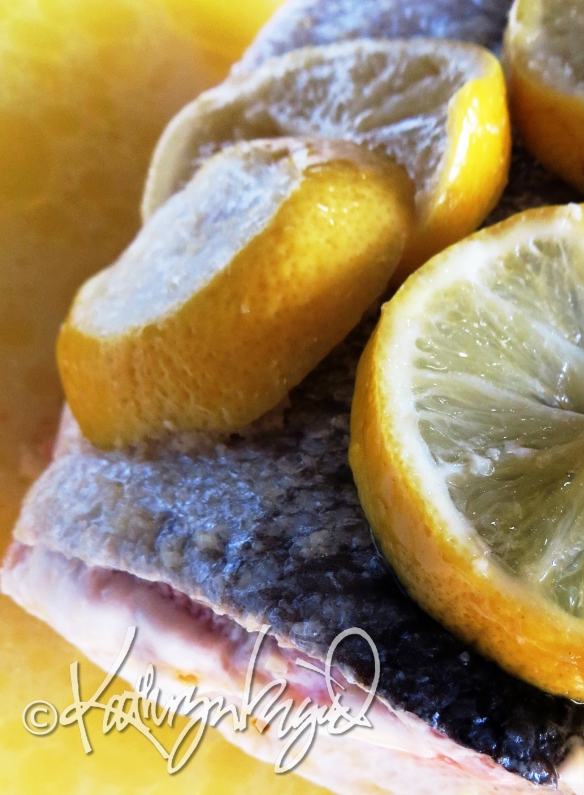
Photo: Salmon Champagne Evening

Sometimes I am happy enough to have a rather plain fried, roasted, baked, steamed, raw, or poached piece of fish. When it’s pristinely, spankingly fresh and sweet, fish should probably not be made too fancy. Why mask perfection? At most, a dash of fresh herbs or a little zip of some lovely masala ought to be plenty of interest to vary the day’s meals. Even I have been known to identify and safely pick and consume wild sorrel, which is an excellent companion to fish in modest amounts. And of course, there’s nothing friendlier with a piece of salmon than citrus or ginger root or plain black pepper, if the foraging can extend as far as a grocery store. One thing I do think well worth the [negligible] fuss if I’m preparing salmon with its skin is to sear it, lightly salted, in butter or a high smoke-point oil before I cover its pan to finish cooking it through on cooktop or in the oven, because crispy salmon skin is delicious and its crunch a wildly beautiful complement to the velvety tenderness of the flesh. Once my palate was introduced to this marvel, I wondered how I had managed to enjoy salmon so much, so often, without having known what I’d been missing. Salty, slightly fat, salmon-flavored, and crispy? How could I not love it!
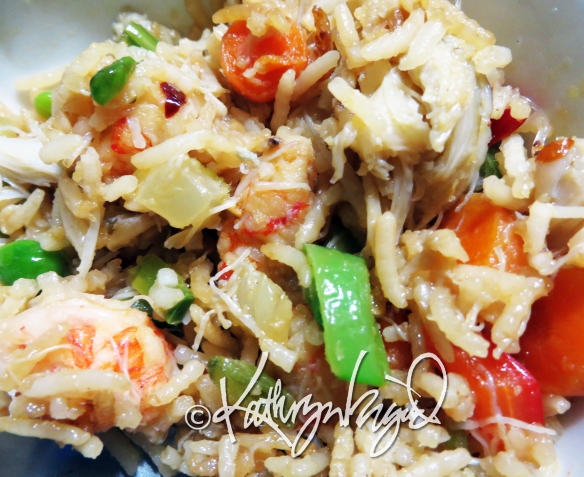
Photo: See Food

Of course, there are innumerable other outstanding ways to enjoy and indulge in seafood, if one does happen to have access to plenty of other ingredients. Seafood fried rice is one very flexible, quick to fix, and reliably delectable way to enjoy such things. Salmon in bite sized pieces, for one seafood treat, goes quite well with the contrasting grains of rice, lovely with rich that’s been cooked in either broth or coconut water or milk and filled with a delicate confetti of diced celery, carrots, onions, bell peppers, or peas, whether shelled or in sugar snap or snow pea form. But as you can see in the accompanying photo, I enjoy, along with salmon or other kinds of fish, those admirable insect imitators the crustaceans. Hardly anything, sea-based or otherwise, is more enticing in fried rice than crab (naturally, I vote for Dungeness first, every time), lobster, langoustines, or shrimps of various sizes. I would guess that some tiny, tender clams might be more than acceptable in this sort of dish as well, but truthfully, I doubt I’ll ever get quite that far, as long as any of the usual suspects are available. Never say never.

Meanwhile, back at the fried rice, I am still an old Occidental renegade when I make it, cooking it much too slowly for a wok-master’s taste and throwing in whatever I have on hand and am in the mood to eat, from the aforementioned vegetable ingredients, crisply sautéed, to seasonings like Tamari or soy sauce, citrus juice, fresh or candied or pickled ginger or ginger syrup (or all four, as I am an unregenerate ginger fiend), honey, shallots, and/or chile pepper flakes. All of these cook in gently, over low heat, while I’m stirring in an egg to scramble into shreds, and then letting the rice slowly develop a good crust amid copious lashings of fat—coconut oil, avocado oil, ghee, whatever I have on hand. All of this, until I can’t quite wait any longer. Must keep that seafood delicate and fresh. Until I can devour it, anyway.