Sunny with a Chance of Starlings

So, we’re driving along a local stretch of highway and I see clouds gathering in the wide blue stretch of the sky. But as we get closer, the clouds move oddly; they ebb and flow like rivers, collect tightly into spotty black pools, move around in magnetically collected groups from one hayfield to another, and expand again into writhing, twisting masses that make accordion-like progress from the highway shoulder to the grassy median. Birds. Masses of starlings having a communal day-trip in search of dinner.
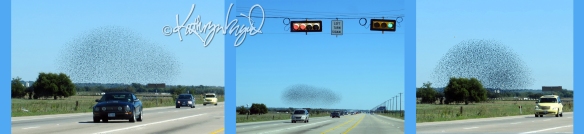
Photo montage: Sunny with a Chance of Grackles

I know that they do this because of instinct and hunger and, perhaps, seasonal urges. I’ve read a little about the scientific studies indicating that a murmuration of birds flying and flocking this way has something to do with an only partially understood sensory operation or mechanism that allows the movement of one bird to affect up to six or seven concentric layers of proximal birds, and the resultant ripple effect to make the wonderfully flexible yet ultimately collective movement of such groups possible without the birds’ all exploding from the general formation into random isolation. All of this, indeed, is based on consistent and controlled observation by far more educated ornithological experts than I will ever be.

But it has a certain charm, for me, to simply keep imagining the birds peppering the sky as clouds, as mobile lakes, as little pieces of sky-high impossibility. Delight finds me, even on the highway under billowing masses of winged wonder. I’m quite happy to imagine that the whole purpose of such behavior on the starlings’ part is to amuse and please and amaze me, just me, specifically. Until a scientist can prove to my satisfaction that the truth is otherwise, I’ll stick to that. No need to spoil such a good thing with too much reality.
Nighttime & Shadows

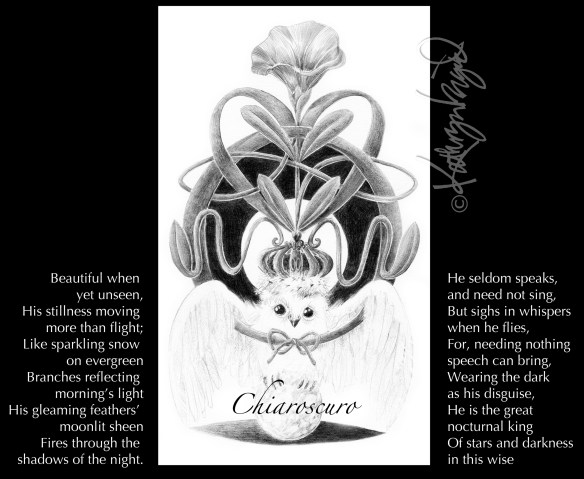
Graphite drawing + text: Chiaroscuro

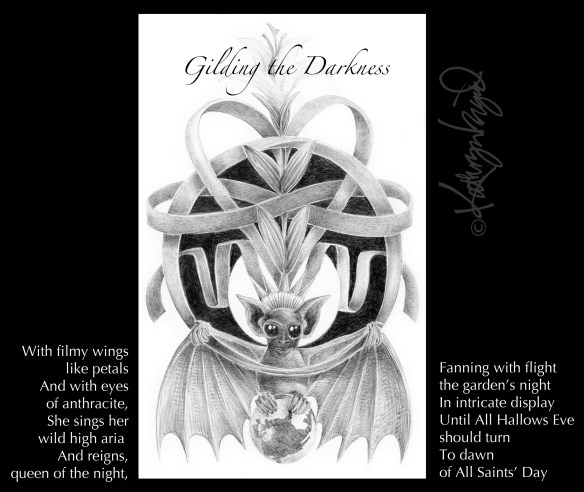
Graphite drawing + text: Gilding the Darkness

The Seasonless Sea

Photo: The Seasonless SeaOpen water. The image in my mind is rarely of swimming there; growing up on a northern section of the Pacific Ocean’s edge, I knew of the sea as a place for wading and the rare venture to splash in a bit farther than ankle-deep, but also as bitingly cold, rocky, and full of sharp shells and ethereal but menacing jellyfish. A lake, while it might be at least marginally warmer, held in my mind multitudes of the same creatures that live in children’s closets and under their beds, but wetter and slimier and without a single door or mattress to deter their finding and nastily clinging to every immersed cell of my body. Rivers were icy highways relentlessly pulling me into the thick of their mad traffic unless I had oars with which to do battle against the current. Open water was, for me, always best admired and appreciated from docks and bridges, boats and beaches.

But, as my mind has always been willing to venture into places my body had no intention of visiting, I also know oceans and lakes, rivers and streams, as realms of inviting mystery and magical adventure. Under the surface of every body of water, there are endless natural beauties and curiosities of wildly diverse sea creatures and aquatic gardens, landscapes of great magnitude and delicate detail, and biological wonders that rival the most fantastic notions of primordial soup. There are also, for me, equally magnificent and splendid worlds of the fantastic. I see, in my mind’s eye, tremendous tales of adventure and romance and daring and delight all over in the rippling, dappled light below the surface. Every sighting of a coelacanth, of gulper eels and viperfishes, confirms my belief in the literally outlandish contents of the oceans’ depths.

I understand that from a climatic and biological viewpoint, open water is of course affected by and dependent upon seasonal changes. It’s perfectly logical that, metaphorically, a sea change should refer to a significant transformation or metamorphosis. That the seas themselves undergo tremendous changes as the weather and tides and time pass over them has potent enough impact on the realities of this world; what the seas do, in turn, to anything while it is immersed in them adds to that alchemical appearance. Ariel’s song reminds us that what is embraced by the ocean’s depths becomes one with the ocean in profound ways. The possible applications of such a metaphor are so numerous and so thought-provoking that I could probably write a thousand posts about those alone, but the effects of existing immersed in open water are the ones that lap up against my attention and flow through my imaginings the most often, so it is on those shores I will continue to do my wandering and beachcombing.

Best place to find mer-people and coelacanths: open water. In the seas of my fantasies, there are no seasons. I will always be able to dive deeply among mysterious and wonderful events and creatures in my dreams.

Lounge Around the Jungle

Image

Digital illustration + text: Loss of Loafing Limb

10 Terrible Words that Shouldn’t Exist in Any Language

Digital text-illustration: 10 Terrible WordsOne person who hates is a Weapon of Mass Destruction. One who cares and shares? Perhaps the only antidote.

As I recently said to my friend Maryam: poverty—both of concrete, material resources like food and shelter, and of intellectual and ephemeral resources (education, spiritual enrichment, the arts, community engagement, etc)—seems to me to be perpetrated and perpetuated more by selfishness than by an actual shortage of any of those resources. The rich and powerful always want more riches and power, and what they do have makes them able to afford and acquire more and to keep their feet firmly on the backs of the have-nots. Plenty is never enough. The resulting imbalance is as old as history, and rotten as ever. Only those who will speak up and resist entrenched inequities and injustices will have any hope of making change.Photo montage: Wolverine & Badger

The badger and the wolverine have a reputation for being among the most tenaciously savage brutes of all the mammals. Yeah, Honey Badger even has his own meme to show for it. But let’s be honest: no beast of earth, air, or sea has a capacity for vile, rapacious cruelty rivaling that of the human animal. Even creatures of the natural enmity of predator and prey compete, fight, kill, and are sated. They have little apparent ideation of hatred and war to match people’s. A wolverine or badger will fight to defend, or to kill for food, but unlike the human, doesn’t seem inclined to attack indiscriminately outside of its primal needs for safety, shelter, and food; when the skirmish is done as efficiently as possible and the need assuaged, the sharpest of tooth and reddest of claw among them doesn’t do an end-zone dance to celebrate its pleasure in winning but will usually depart the scene or go to rest for the next time of need. The remaining food and shelter and other resources stay in place for whatever creature comes next, hunter or hunted, cousin or not.

Can we humans not learn from such a thing? I’m pretty sure that if we destroy each other and ourselves in our constant self-righteous, self-congratulatory belief that we deserve everything we can get our hands on, Honey Badger won’t be the only creature that doesn’t care.

Crashing through the Snow

Few things are as visibly expressive of joy as a dog bounding excitedly through deep snow. Except, possibly, a whole bunch of dogs, plus a whole cadre of little kids, leaping, tunneling, floundering, grinning, and generally exploding their way through the same drifts.
Digital illustration: Snowflake

The problem with being an adult human is that we become so conscious of our creakiness and increasingly inflexible bodies, so obsessed with the dangers of having an infarction while shoveling or being speared in the forehead by a forty-pound icicle from the eaves, so hung up on our supposed decorum and dignity, that we stop risking not only true dangers but the possibility of gleefully tipping arse-over-teakettle into a billowing heap of powdery snow. It’s really too bad, because an occasional tumble from the pedestals we prop ourselves on, a momentary reminder of our own foolish frailty, and a smart whack on the overly fixed sense of reality is well worth a little bruising on ego and elbow. It might just teach us a renewed appreciation for the beauties of snow and nature. Why, if one were to be exceedingly incautious in the event, it might even turn out to be fun.

Tiger Time

If you remember anything about primary school (and I do, if little) you hopefully have a few memories of one or more of the fantastic sort of teachers who were the virtual equivalent of extra aunties and uncles and grandparents, but neatly spun into the form of educators whose wise teaching made you learn things without even knowing you’d worked at it, and want to learn things you hadn’t even known you wanted to know just because they were such fine pedagogues that they made it seem possible, if not easy.

You undoubtedly also have a memory or two of teachers who were quite the opposite. My personal least-fave was the third grade teacher who had no compunction about excoriating and humiliating a student in front of the rest of the class regardless of the infraction or any of their previous achievements or behavior, even cracking a yardstick onto desktops to make a point when she was het up, regardless of whether there might be some small knuckles in the way of the stick. At the very same time, she apparently thought it perfectly logical and beneficial to ‘level the playing field‘ and make all students feel they could accomplish something in her class, lest the PTA or school board think her not supportive and informative enough, and this she would do by sitting and doing the weakest students’ homework for them.

I knew nothing of this until one time when I was the unlucky receptacle for her ire, having failed a penmanship test in the first weeks of school because that school required students to learn cursive writing in the end of the second grade and the one in another state where I had spent my second grade did not. Had she asked us all to sing a song in Spanish, I might have been the star of the class, because my second grade teacher Mrs. Mosqueta let us learn a little elementary Spanish from one Señor Ybarra, who taught by the ultra-newfangled medium of televised classes, and I don’t think my new classmates in Illinois had yet had access to such magicks themselves. But there I was, little miss Goody Two-Shoes, who had never gotten anything but perfect scores because I was too prim and much too afraid to not do my homework to the nth degree—if I had any actual training or homework to prepare in the event—flunking my attempt to make Pretend Cursive when that mean lady in her sausage-casing dress didn’t even ask whether I’d ever been trained to write that way. If you think I still sound remarkably bitter about such a small thing from so long ago, well, I probably ought to let it go but I tend to enjoy my little revenge fantasies more than is entirely good for me.Digital illustrations + text: Tiger TimeThis is all in jest, of course. I wouldn’t be so cruel as to want to give any poor innocent tigers indigestion.


The Love that Dare Not Bark Its Name

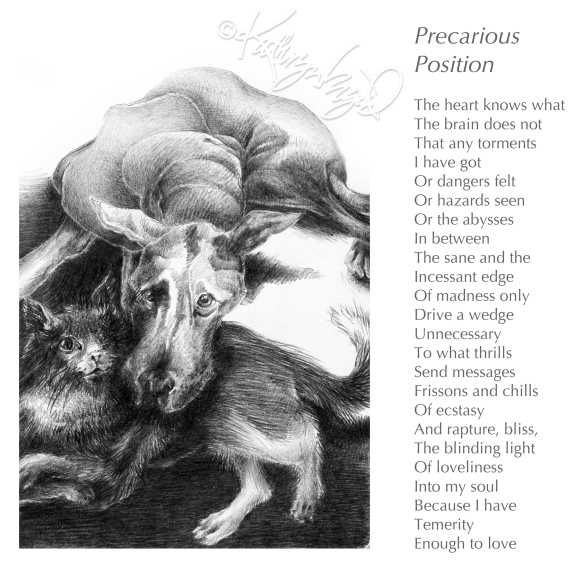
We all know that there are certain kinds of thrills that are worth the risk, that the forbidden fruit can taste sweetest when it’s a chocolate sneaked from Mom’s birthday gift selection (not that I would know anything about any such thing from my youth!), the extra hour out past curfew when one thinks one’s parents are out of the house, the bouquet picked from a neighbor’s flowerbed en route home from grade school. And there’s no doubt that some are drawn to romance most powerfully when it is risky, when it defies convention, when it defies logic. Is anyone really immune to the lure of breaking with tradition, just a little?Graphite Drawing + Text: Precarious Position

Contagion vs. Compassion

“One bad apple spoils the lot.” That creaky aphorism is based on equally venerable experience. Rot is contagious.

Bad company makes bad behavior seem the norm, and we adjust our own standards ever lower accordingly. One or two disheveled houses bring down the values of the others in the neighborhood, and those, in turn, fall into neglect and decay as their owners lose the courage and determination to resist the incredible pull of entropy. What isn’t growth is death.

What leads otherwise good and sane people to fall apart like that? Doubt; fear; despair. These are the hallmarks of contagion: the plague succeeds in felling us not only through its own virulence but because rather than seek its cure with full courage and determination we flee with it hot pursuit, and when it eventually catches up with us, we topple, curl up in the fetal position, and succumb.

The fall of one member of the world community—like Mr. Duncan, who was felled by Ebola in Texas—is a very real and terrible loss for all. The loss of thousands—those dying in West Africa—is indeed a plague and a thousand-fold grief we all must recognize and bear. The response, though, cannot be equally contagious doubt, fear, and despair. That can only make us choose unconstructive, even destructive, responses like blame, xenophobia, retreat, and the neglect of our fellow citizens of the earth. Then, no matter how many or few have been overtaken by disease and disaster, the contagion will have won.Photo: Snakebit

Who’s the Wisest?

I give myself credit for being smarter than I am. I suspect, given what I see around me in this wild and woolly world, that I am far from alone in the practice. Even owls, a favorite symbol of wisdom, are not likely as perfectly ingenious as we imagine them, but they might still be more intelligent than the half of us.
Digital illustration: The Owl King

The Search Continues

Parsing paragraphs to find

The author’s complete state of mind

Is no more useful than to ask

A Word how it performs its task,

If we assume we’ve read aright

What’s only there in black and white.


The Long and the Short of It

How quickly pass the hours and days

and weeks and months and years,

And yet, how slowly pass our worries,

paranoiac fears;

This is the great conundrum that

presents in mortal time,

And quite enough of food for thought

in one quick, measly rhyme.