The Love that Dare Not Bark Its Name

We all know that there are certain kinds of thrills that are worth the risk, that the forbidden fruit can taste sweetest when it’s a chocolate sneaked from Mom’s birthday gift selection (not that I would know anything about any such thing from my youth!), the extra hour out past curfew when one thinks one’s parents are out of the house, the bouquet picked from a neighbor’s flowerbed en route home from grade school. And there’s no doubt that some are drawn to romance most powerfully when it is risky, when it defies convention, when it defies logic. Is anyone really immune to the lure of breaking with tradition, just a little?Graphite Drawing + Text: Precarious Position

Empathy over Courage

Bravery is a rare commodity. Many people who think they’re being brave only dare to do so from within a like-minded group, however small in number, and when they are genuinely in the minority spend more energy on protesting that the majority from which they’re excluded is unfair and unjust than on doing anything useful to change it. It may be true—knowing human nature, often probably is true—that one’s opposition is no exemplar of justice and fair-mindedness. But we’re seldom willing or able, ourselves, to make a cleanly balanced assessment and especially, to act wisely and compassionately on it either. We’re generally convinced that anyone else having anything good means less goodness for ourselves, and that that is a terrible thing.

What impresses me more than bravery, real or imagined, is seeing anyone express real empathy for others through their own beliefs, lives, and actions. I tend to doubt that we’re capable of doing or even wanting very lofty things, but I also think that small doses of empathy will go ever so much further than any amount of derring-do and action-figure heroics in bettering the world and the human condition within it. Daring to let another person be richer or more privileged than me or to have the last word, even when I’m fairly sure I’m smarter, closer to correct, or more deserving requires quite a different sort of courage than running into danger in anyone’s defense or their stead.

But treating others with such respect seems to me far more likely than argument and defensiveness, self-protection and fear, to get anyone to trust and respect me in turn. So shines a good deed. The unselfish willingness to accept another person’s reality as valid even when it might cost me something significant is a kind of courage I dream of having, hope to learn.Graphite drawing: Reach Down to Raise Up

Who’s the Wisest?

I give myself credit for being smarter than I am. I suspect, given what I see around me in this wild and woolly world, that I am far from alone in the practice. Even owls, a favorite symbol of wisdom, are not likely as perfectly ingenious as we imagine them, but they might still be more intelligent than the half of us.
Digital illustration: The Owl King

The Search Continues

Parsing paragraphs to find

The author’s complete state of mind

Is no more useful than to ask

A Word how it performs its task,

If we assume we’ve read aright

What’s only there in black and white.


The Long and the Short of It

How quickly pass the hours and days

and weeks and months and years,

And yet, how slowly pass our worries,

paranoiac fears;

This is the great conundrum that

presents in mortal time,

And quite enough of food for thought

in one quick, measly rhyme.

Unnaturally Lightfooted

We’ve long since established that I can’t dance. I couldn’t dance well enough to stay in a second-grade dance class; heck, I couldn’t even be trusted to remember whether we were supposed to show up wearing tights with our tutus or not, for the class picture before the big recital. Though it’s only fair to give myself credit for having been obsessed with the ugliness of our getups to such an extent that I forgot the part about the stockings, and I promise you, they were hideous costumes.

But you also know that I am enamored of beautiful dancing of nearly any kind, if allowed to watch it from a safe distance. So I think I can be forgiven for letting others take to the floor in real life and only doing so in my imagination and, occasionally, in my poems. I think any creature, real or imagined, that can dance beautifully deserves my attention and admiration (as long as it wears the correct tights with its tutu).Graphite drawing: Swinging Dragonflies


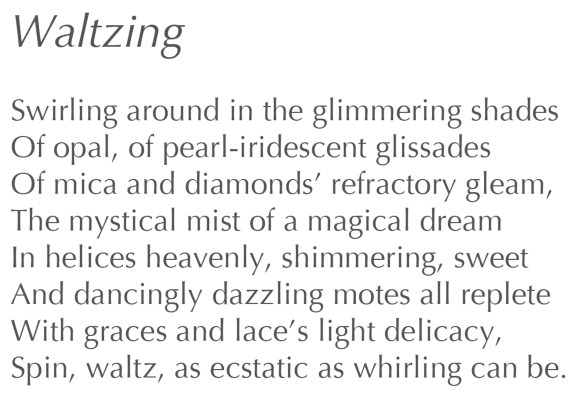
Text: Waltzing

Early Music for Breakfast

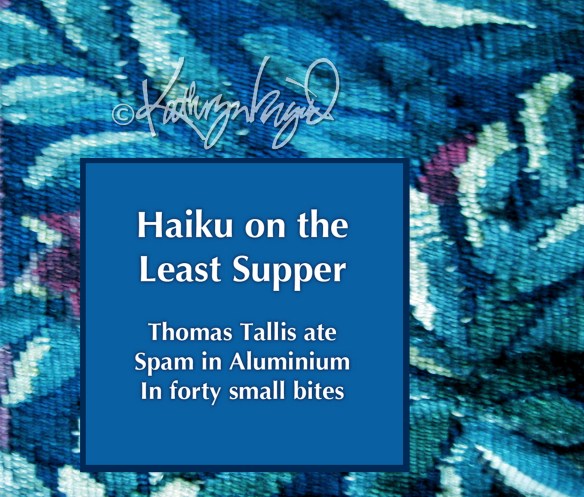
Digital illustration + text: Haiku on the Least Supper

If you haven’t already crossed paths with Thomas Tallis‘s landmark Renaissance motet Spem in alium, I highly recommend it. It’s a truly astounding piece of European music history, representing the confluence of the political and artistic competition for primacy in that time period; it’s believed to have been composed as England’s answer to Italy’s Alessandro Striggio‘s own, earlier 40-part motet, or possibly to Striggio’s 40-60 voice mass. I’m no musician, but I’ve learned, mostly through witnessing a few performances of the Tallis by different groups led by my husband and his colleagues, just what a feat this piece really represents.

While the creation of Striggio’s works for 40 and more independent voices is amazing in its own right, the 40-part motet he wrote specified that the voices be doubled instrumentally. That is impressive enough. For my fellow non-musicians, think of it this way: a typical piece of music for a mixed choir requires singers to perform different notes and lines of music, often at the same time, so that what is heard is not one single series of notes, one after the other the way we sing by ourselves, but layers of notes that become deeper and more distinctive expressions of the words being sung. Instrumental doubling means that some or all of the vocal parts are supported by one or more instruments “singing” the same notes at the same time. This can intensify the effect of that singer or section’s line, and it can sometimes also help a less skilled singer or choir stay on target with the line.

In any event, the more typical choral works tend to have soprano, alto, tenor and bass voice parts, or singing lines, (or some combination of those) and generally, not more than eight or perhaps twelve different lines intermingling at once. Anything more than that means that every singer in a moderate-sized choir is responsible for knowing and performing his or her own notes, on pitch, at the right moments, and with exactly the right loud-soft dynamics and flow at every point throughout the piece. Being in a choir is a thrill; being in a good choir is a real intellectual and artistic and even physical challenge.

What makes the Tallis Spem so incredible is that it comprises not only forty individual, fully independent singers’ voices all singing their own distinct parts of the song, but indeed, doing so entirely unaccompanied. Every one of the singers has to be spot-on at all times without the support of either a fellow singer or any kind of instrumental doubling. If one singer goes off the rails, there’s the possibility that others will be thrown off of their pitch, timing, or even their place in the whole work. It could well lead to a musical train wreck. Think you’d be intimidated by doing this? I think any sane person should be!

But it’s powerful stuff, when it’s well done. I’ve had the privilege of hearing this feat beautifully accomplished by singers surrounding me in a cavernous cathedral space, and by singers standing onstage in a modern performance hall with a carefully engineered acoustic. I’ve experienced it in art galleries where Janet Cardiff‘s intriguing installation of forty high fidelity speakers on stands are placed in a circle in the otherwise rather bare room, each playing in synchrony the recording of one of the singers in a performance of the Tallis, so that one can stand outside the circle or in the center of it surrounded by the speakers, or can move to stand at one individual speaker at a time, getting entirely different effects depending upon which part of the score is being performed and where one stands in relation to the speaker playing that part.

No matter how it’s done, once you’ve gotten a little of the idea how this piece of music intertwines voices that seem at first to be operating without a clear relationship but then, more and more, to be converging into a meditative, chant-like, layered song, it is quite mesmerizing. There are some recordings and performances out there on CD, iTunes, and YouTube worth a listen, and if you get the chance to visit the Cardiff installation, called simply Forty-Part Motet, do it. Best of all, of course, is if some fine choir nearby offers a live performance that you can attend. It’s rather haunting and ethereal, and made all the more impressive by the knowledge of its complex origins.

Meanwhile, I have given you this bite-sized humorous meditation on the work. A haiku seemed the ideal vehicle for acting as either commentary on or antidote to a choral masterpiece so complicated and virtuosic. And I sort of wonder if, in the process of composing this grand work, Mr. Tallis had any chance to stop for rest or was so deep in concentration that he barely had time to do the Renaissance equivalent of opening a tin of luncheon meat and dining directly from it, pen and parchment in one hand and dripping Spam juice on the other. Thankfully, it doesn’t appear that this effort of his was entirely detrimental, let alone leading to his personal version of the Last Supper, since he went on to compose other fine works up until nearer his death some fifteen years later.

Deep Sea Wishing

Digital illustration: Psychedelic PstarfishPsychedelic Pstarfish

Seems sillier than psyllium to sing of starry seas,

Yet so the ocean’s silken shore’s sufficient proof of these

That sparkling in such shady deep, something is sure to gleam

In stunning stellar specks and sparks in that submergèd stream,

So sing we sweet and shining songs of starfish as we wish

Upon the evening star to see a firmament of fish

Murder, Mayhem, & Malicious Merriment

Drawing + text: Murder Mystery

Drawing + text: Thinking of You, Darkly

Tastebud Ticklers

Image

Drawing + text: Delicious Delirium

They were Just Talking

Digital illustration from a photo: They were Just TalkingI listen to the mourning doves that coo and call in the shadows nearby and think that they do indeed sound ineffably sorrowful. The low, guttural sounds they make seem to my ear quite melancholy and, no matter how musical, to convey a kind of tragic news that makes me wonder just what it is that they say to one another. In my mind, they are exchanging the saddest of sad information, a litany of lachrymose lugubriousness.

In addition, I fear that I don’t give them enormous credit for wit and intellect, so if you’ll pardon the expression, I suspect that what conversation they do have is probably akin to what we American human-types sometimes call pidgin English—any actual content of worth being marred by the lack of intelligible vocabulary and syntax. But, to paraphrase what someone wiser than I has also said, if pigeons are the arbiters of intelligence in the same way that we humans are when we assume ourselves to be the wisest and brightest beings in creation, then all other creatures will by default be found wanting. No wonder the pigeons deign to unload their critiques on the heads of our celebrated effigies in the park.

The truth, I imagine, is that mourning-dove conversation is no less and no more wise and scintillating than our own, at least in the context of pigeon society. Heaven knows that anyone who translated my quotidian chitchat into ‘pigeon English’ would probably be violating the Columbiformian (I just made that up from their Latin name, thank-you-very-much) Geneva Conventions by boring them to death with my inanity and my extreme dull-wittedness when it comes to where to find the best yucky trash to eat, how to maintain the pecking order in the flock, or why one must always look for the shiniest surface on an automobile for proper deposition of one’s automotive excretions. So no matter how tragic the tone of the mourning-doves’ vocalizing sounds to a mere humanoid like me, it could be that they were just discussing their plans for world domination and the swell soirée with which they intend to celebrate it.Digital illustration from a photo: They were Just Talking 2

Keeping Watch with Love

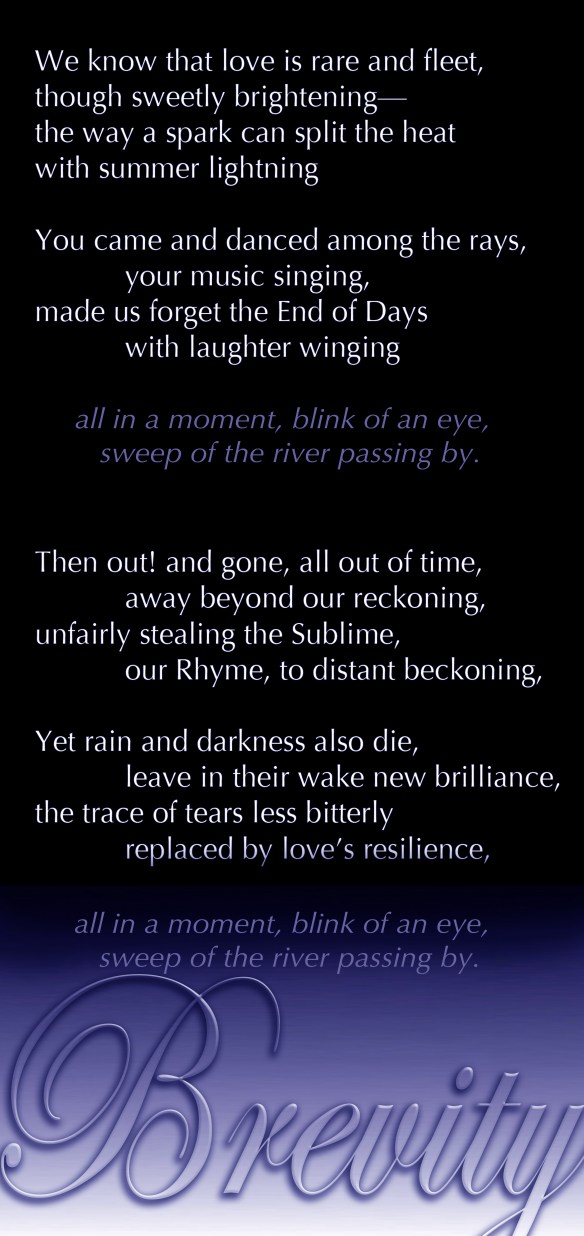
Text: BrevityJust because there are designated days (All Saints, Memorial Day, Defence Day, Anzac Day, Volkstrauertag, Poppy Day) for recalling those we’ve lost doesn’t mean in any way that we restrict our respectful, loving and admiring remembrances to those days. Those whom we hold in our hearts remain there, living or not, forever. That’s our path to peace.Digital illustration from a drawing + text: May We All Rest in Peace

The guarantee that we will die, and that all of those we hold dear will die too, means we will do best by finding ways to embrace and recall, most of all, the good and the uplifting things from their lives and ours, and expand on such things for the sake of our finest predecessors’ honor, if not our own.