The Large and the Small of It

The depths of Space carry miraculous sparks of inspiration at a seeming infinity of levels.digital collage

A couple of years ago my husband was conducting a concert of choral works all, in one way or another, exploring the idea of Space, and he asked me to provide projected images that would act as a visual companion to the music. Since the centerpiece of the concert was to be a selection of movements from Estonian composer/astronomer Urmas Sisask’s ‘Gloria Patri‘–wonderfully meditative, somewhat minimalistic yet still quite melodic music which was to be accompanied by photographs taken through the Hubble telescope, I was given a clear starting point for the collection of visual images. The good people of NASA willingly agreed to let us use any Hubble images we liked, without any constraints and at no charge, so my task was to find the images I thought best suited the music at all points, edit them (some extensively, some less so) in order to fit the format of the projections, and collate all of it into a pre-arranged program that I could manually ‘play’ as the concert was performed. Looking for, and then through, hundreds of Hubble images was a bit of a project in itself; reformatting and resizing, digitally ‘cleaning’ and grouping and ordering them proved to be a little more weighty. But it was a pleasurable and energizing project all the same, staring at the stars and constellations in all of their miraculously varied glory. ‘Gloria Patri’ indeed!digital collageGoing forward to work out images for the rest of the pieces on the docket for this program, I was moved by both the enormity of the Hubble’s scope and our own galaxy’s tininess within the vastness of space to think that it would be wonderful to explore those strange dissonances and harmonies that occur in the known world, microscopic to massive, blurred by our limited vision and knowledge and delicately detailed by our constant finding of new facts and ideas in all of it. So for the other pieces in the concert’s repertoire, I sought out images that would complement each other yet emphasize the astounding range of contrasts in our spatial existence, from the granular to the grand. Pollen and planets might in fact have more in common than we can imagine, if we stretch our thinking just a little. Snowflakes and stars might be merely opposite ends of a spectrum that transcends dimensions, scale and vision.digital collageI was reminded throughout this process not only of my minuteness in the great spectacle of existence, but also of how fantastically treasure-filled that existence is, from the level of the subatomic to things and thoughts so massive that the Hubble telescope and all of its exponentially larger generations of offspring may never quite be able to encompass the enormity of it all. If I ever think I’m running out of ideas, I only need to remember this one exercise in humility and happiness, and I should be able to break out of my stasis as a flood of newly sparked inspirations stream like comets out of me.

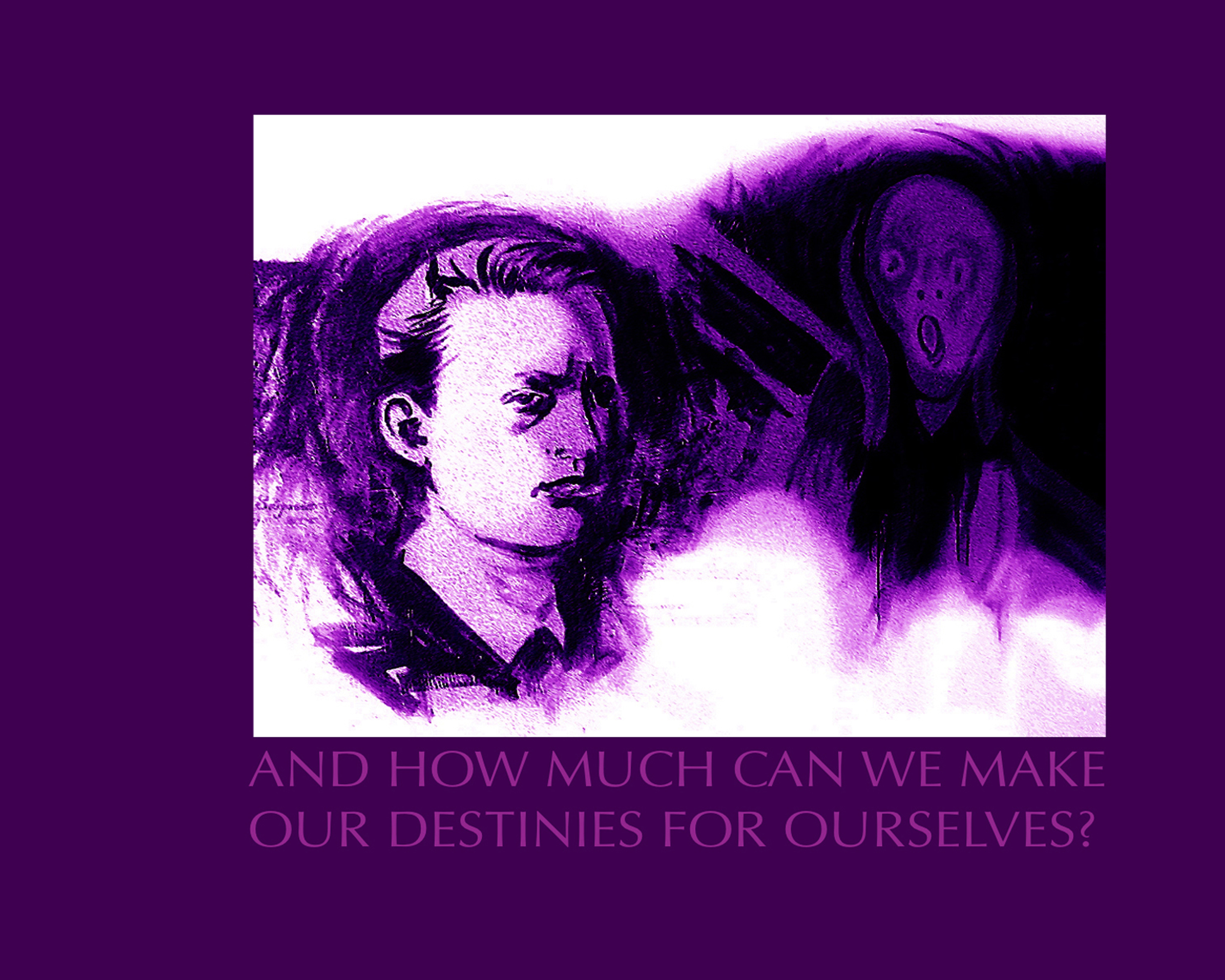
Maybe not Captain of My Own Destiny, but at Least I’m on the Crew

mixed media on canvasboard + textWhen I was a young artist-in-the-making, it irritated me to no end that people who saw my interest in art and knew of my Norwegian roots often instantly assumed that I was a big fan if not acolyte of Edvard Munch, Norway’s best known artist. Besides that my knowledge of Munch’s work was pretty nearly limited to ‘Skrik‘ (‘The Scream’) and what little else I’d seen even in passing was not at all to my taste, I took it as an insult and a frightfully narrow-minded view of my potential. And that, my friends, was the capper, because it implied that I was not in charge of my own future but predestined by my ancestry to be a pale imitation of somebody I wasn’t particularly fond of or impressed by in the first place. I was jolly well going to go my own way and choose my own muses and inspirations and, most of all, I was absolutely not going to be told what to do and when and how to do it by some ghostly abstract borne in my bloodstream.

As a very fortunate young pilgrim, I did manage to get to the Old Country and spend a little time rooting around my ancestral stomping grounds during my undergraduate studies. I got to meet and spend time with my great-aunts and various other relations and visit the house my grandfather helped build for his elder sister, our Tante Anna, and the family farms–the sylvan Ovidsland property with its tidy white house and taller red barn set in among the slender birches, and the more remote summer pastures of Eitland, a smaller and more rustic place on land with a sweet little lake for fishing up dinner. I was able to see the headstones of relatives long-gone, outside the little church where many of the family had attended services for many an age, and walk paths and travel roads where many of them had trod and ridden for ages before that.

oil on panel

Eitland, painted by an unknown family member or friend in the early 20th century.

It was a rich and rare opportunity to both visit the places of my family’s past and to live among my Norwegian family in their current places and way of life, something that few people get the chance to do and that I will treasure for as long as I live. Because it did change me, and change my point of view. It may seem strange, but some of the greatest change happened in completely unexpected ways; I was not especially surprised, though quite pleased, that getting to know family I had not known before and see the world from which my grandfather in particular emerged to live in the States (my other three grandparentsancestors all came from other parts of Norway, where we had less constant and present contact). But I never imagined that simply setting foot in the country of my ancestors would move me as it did. I could never have begun to imagine that I would be so struck, feel such a palpable and somehow heart-wrenching connectedness on standing in front of the amazing Oseberg ship in the Viking Ship Museum of Oslo–but I was; I did.

And I was truly astounded to discover, when I–a little reluctantly, perhaps–went with my sister to visit the Munch Museum that I not only found Edvard Munch’s work much more technically impressive and more profound, his life story and the stories that gave life to and were expressed in his work more impressive and thought-provoking than I had ever dreamed I would allow, but indeed, there was a lot more that I found simply compelling and even, startlingly, appealing. First of all, the guy could draw. He could paint, make prints, tell stories. He was, dammit, gifted and actually worthy of the attention. How very annoying of him, really. Because then I had to come back and re-think what I was doing a little bit. Was it so terrible to reflect something of our however-peripherally-common ancestry in my own work?

I had, if anything, a new appreciation for how much I didn’t wish to emulate his life, with the illness and suffering that marked life for and around him. But to take, as he did, what life presented and put it through the same filters of self and vision and thoughtfulness and surrealist whimsy and passion–that might be precisely what could make me more, dare I say it, myself as an artist. Who knew.

So by the time I set about making the collection of artworks for my master’s degree exhibition, it was an amusing ‘closing of the loop’ to find quite a number of people observing the works in preparation and in the finally installed show coming back to that same old observation that had used to frustrate me so. ‘Has anybody ever mentioned how much your work is reminiscent of Munch’s?’ It was even amusing to me to realize that, though the subjects might stray from his, though the media were sometimes decidedly different and the techniques concomitantly skewed to fit them, and though most of these viewers had no inkling of my ancestry, apparently there was a little something making its way up from my roots to the surface of my art.

Somewhere along the way I had also started to grow up a bit and begun to figure out that we all, inevitably, have less control over our own destinies than we fancy we do, and that that’s not inherently a bad thing–that life will always surprise us and challenge our grand plans and hopeful dreams and carefully charted paths. That the very things we can’t predict or control help to guide and shape us into things we might never have imagined we could plan or wish to do or to be. I guess I just took a longer and more convoluted route to letting my little commonalities with my fellow Norwegian artist Edvard show through; being dead, he could spare the time to wait for me to catch up. And once I got comfortable with the idea of seeing a hint of him in the mirror, I didn’t feel like screaming anymore either.digital painting from an acrylic painted original

A Mockingbird Appears

photoWhen ideas and inspiration have ceased, at least for the time being, to well up from the inside, it’s a mercy that the wide world contains so many and will hand them to me if I keep my senses ready enough. I often find myself too distracted by the busyness and pedestrian chores of the workaday world to see the magical other dimensions right within my reach, and need some helpful pricking from a sight or sound or scent as I pass through to remind me to open up the eye and ear and heart and take advantage of the universe’s generosity when it’s poured out so liberally right within my grasp.photoI walk in a haze of dully daily thought, lost to the world of rich and rare delights I’m walking in, when suddenly a mockingbird appears and turns its bright eye on me and seems to contemplate how absent I must be to almost pass it by when it’s quite nearly underfoot. In that shining eye a world reflects in which the other me is wrapped around with blooms, with drifting clouds sailing across a broad blue sky; with jasmine-scented breeze, with mist as the sprinklers spring to life, with happy shouts from a handful of little playing school kids passing me, looking for miracles of their own everywhere because they are yet too young to have forgotten them so foolishly as I have done. When the bird takes to its stripe-blazed wings and dives back into the air, my thoughts begin to follow and fly with it again: I am awake once more to flight and tune in to the rippling, rolling variations of its song as it rises to the trees, and soars above, and makes me remember that I am in a world full of wonder, if I will only let it fill me again.graphite drawing

Gleaming Afternoon

While I would soar, would gladly fly

Wide, in an arc across the sky

Whose dome of hotly burnished brass

Encompasses at every pass

The great wild height of atmosphere

That would engage to hold me here,

I can, eyes shut and spirit wide,

Pierce heaven to the great Outside.

Rodents on the Run

graphite drawing + textgraphite drawing

Moments of Music


graphite drawing + textgraphite drawing + text

Doodle Bug

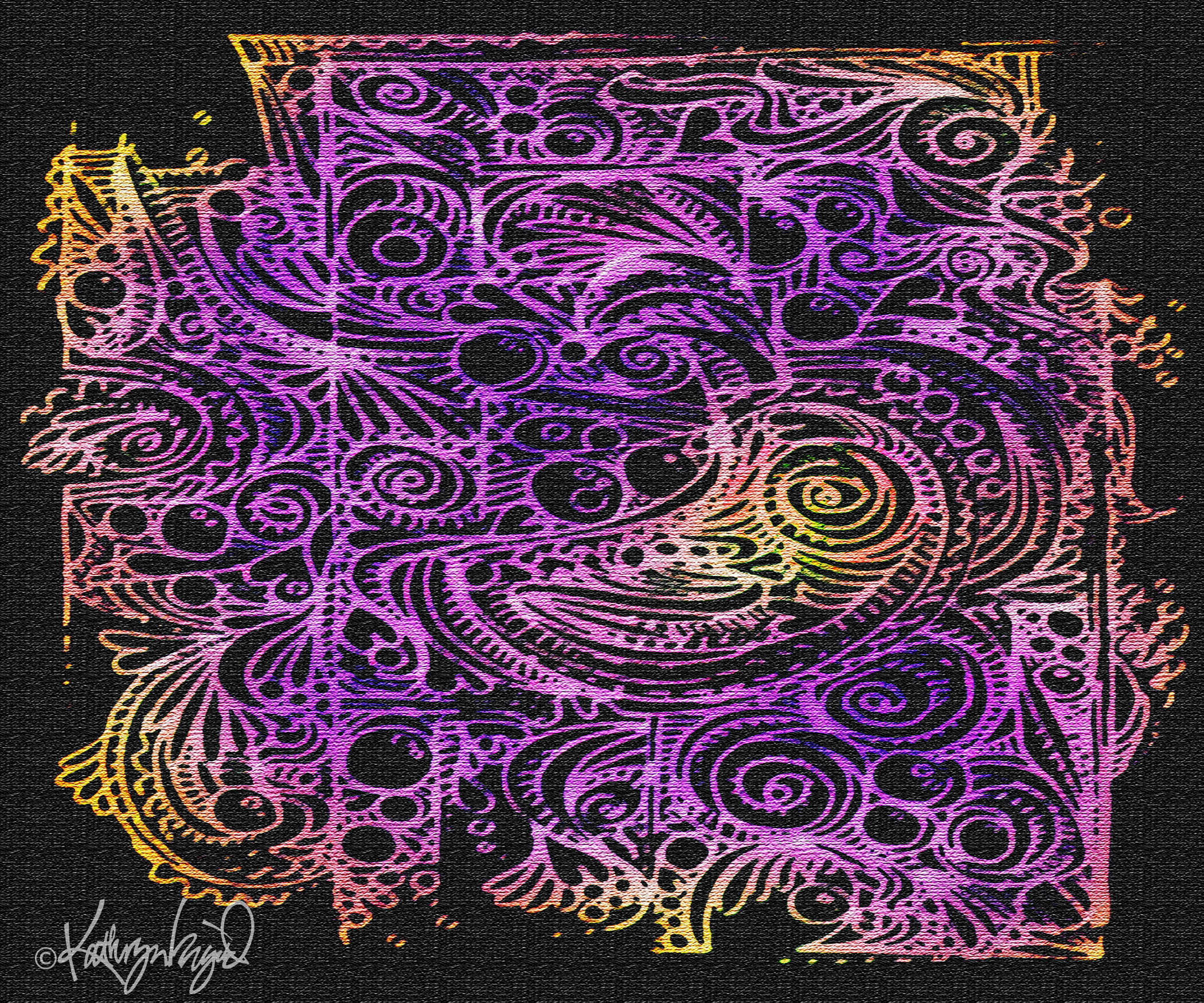
pen & inkI would like to state for the record that I am not, nor have I ever been, to my knowledge, an actual doodlebug, either zoologically or as a rolling or flying vehicle, a dowsing rod, or a method of seismic activity tracking. Not that there’s anything wrong with any of those. And it’s probably safe to say that my garden and numerous dimly lit corners of my home are probably full of living and dead pill bugs (what we used to call potato bugs when I was growing up), and I confess to thinking it highly amusing that these creatures are in fact tiny crustaceans that live right in my house and look like–indeed, are scientifically named after–armadillos. House Armadillos or Domestic Crustaceans, either way kind of weirdly cool in my estimation.

But I digress.

What I am is one of the many humanoids prone to doodling. And that’s not a bad thing, either. Doodling (or randomly scribbling on whatever is handy, usually a cocktail serviette or textbook or office paperwork or top-secret legal document, depending upon one’s status and age and current supposed activities) often leads, though many a grade school teacher would vigorously deny it, to thinking. And on occasion at least, thinking is not an entirely bad thing.

Whenever I’m struggling to get a piece of writing, a drawing, or frankly, any other project underway, there are few motivational tools that compare with doodling. The serendipitous or random mark that merely records a purportedly thoughtless and pointless motion of the hand can sometimes come to resemble an actual Something, and well, Something almost always leads to Something Else. In drawing as in life, just getting in there and starting, whether I’m ready or not, is the best way to potentially get anything done. Who knew!

Today’s doodle is brought to you by my propensity for turning many of my scribbles and scrawls and squibs and squiggles into things that resemble simplified linear paisley patterns or rosemaling, or any number of other folk design traditions. Once I get going on them, I find it meditative to a degree just to follow the whimsical path of inserting repetitive forms and line treatments, geometries and organic outgrowths of the marks, until I’ve filled much of the available space. Many of these folk-like, repeating elements become almost a trademark doodling style that might be as identifiable to some as my handwriting. Though, hopefully, more legible. And while the doodles don’t necessarily lead to specific or pictorial drawings in and of themselves, they do lend themselves neatly to a more relaxed and receptive state of mind in which those more concrete thoughts and ideas can indeed begin to insert and assert themselves usefully. And that can lead to different sorts of drawing, whether more topical or more sophisticated or more directed. Or not! The inspiration is in the action.digital painting from a P&I drawing

Today I was led by the doodling, not to a different drawing entirely, but to scanning it and playing with it digitally, first layering colors all over the place, then digital textures, then altering the proportions of the image, and lastly, stitching the resulting mash-up into a larger grouping of four copies of the same image arranged in a pinwheel fashion and then stretched, skewed, cut-and-pasted, and electronically stamped into a fabric-like whole that uses the same idea of the initial doodles repetitions-with-evolutionary-changes so that the end product still seems to appear quite handmade, as it’s not symmetrical or fully even from side to side or top to bottom. Now, if I were to take that square and repeat it, even if I turned it 90 degrees each time, for example, it would finally become more machine-made in appearance as well as manufacture. But that’s just mental doodling right there, isn’t it, because I could further alter the combination every single time I ‘copied’ it.

Which illustrates exactly what I was talking about as characteristic of doodling. One thing does lead to another, as long as we bother to do the initial one thing.

That said, I suppose I should get up from my desk and go forth to do a few individual things that might lead to getting some other essential things done around here. Cheerio!digital image from a P&I drawing

Blueprints for the Romance of Place

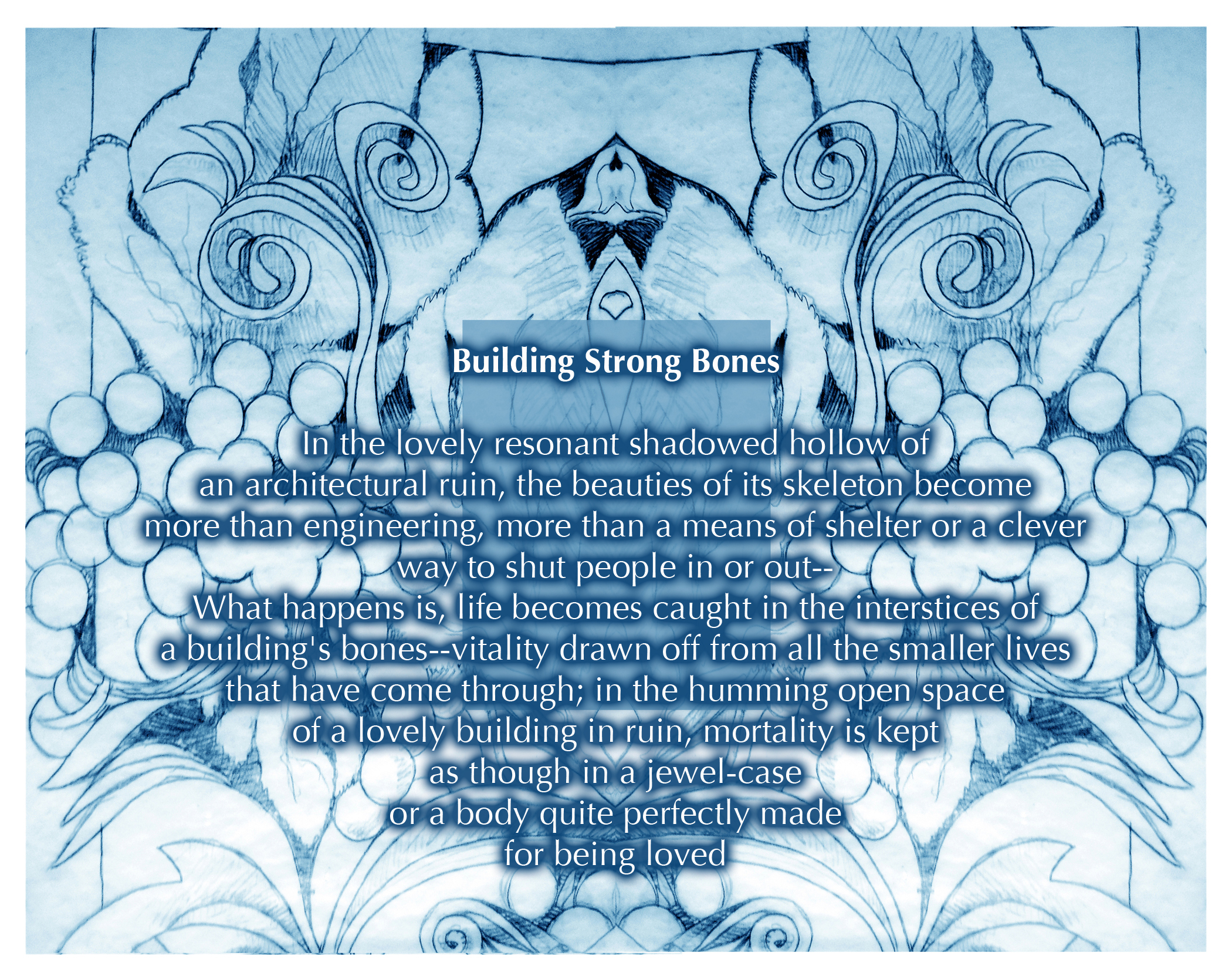
digital artwork + textBuilding Strong Bones

In the lovely resonant

shadowed hollow of

an architectural ruin,

the beauties of

its skeleton become

more than engineering,

more than a means

of shelter or a clever

way to shut people

in or out–

What happens is

life becomes caught

in the interstices of

a building’s bones–

vitality drawn off

from all the smaller lives

that have come through;

in the humming open space

of a lovely

building in ruin,

mortality is kept

as though in a jewel-case

or a body quite perfectly made

for being loveddigital painting

North


The depth of the lake cannot be guessed


Its shimmering silicate glacial glow


With turquoise mask screens what’s below


In filtered glimmer, thought at best


To be just deep enough to hold


Beneath the frigid upper glass


Down in its centermost crevasse


Something mysterious, so old


It’s passed from memory and ken


And only surfaces when stars


Come showering down as red as Mars


To call it upward once again


Communing with its antique kin


For roaring moments in the night


Before the day dawns turquoise bright


And glassy water closes in


Once more its inexpressive glow


A wall of silence ageless, stern


And secretive, where none can learn


What lives those fathoms down below


Invitations to Dance

watercolorDancers I: Bend Sinister

Leaning back into a dire S-curve

And turning, twisting out of grace,

Finding cruel existence takes

Her to a meaner, coarser place,

She rebels against the tide

That pulls her downward, scrapes her soul,

And makes a revolutionary

Spring to leave the great Black Hole

Of wounded spirit, tortured love,

To swim back into something sweet—

This is the mandate of the dance:

To win by keeping on her feet

watercolorDancers II: Conjuror

Under a spell of loveliness

She leans, she curls, expands;

She falls against the strong caress

Of gladness, in the hands

Of magic greater than herself,

And when the spell is done,

There is no darkness, loneliness

Or sorrow; she is one

With every boundary, with joy,

With having been set free

From all constraint; the dance has won

Her to infinity

More of My Imaginary Friends

graphite drawing + textgraphite drawing + text

Sunflowers

It’s too soon to find them in bloom. They’re mostly two feet tall at best, thus far, and not nearly ready to flower. And the sky is overcast today. Quite grey and a little bit dark. Any sunflowers would be hard pressed to find the sun and smile at it.

The thing about sunflowers is, they believe in the sun even when it’s not visible. I do, too.pen & ink