Urbanity

There is a huge difference between the merely impressive and the expressive when it comes to modern cities. Rotterdam, once one of the glories in the European architectural crown, was bombed to dust in WWII and, given the poverty of post-war resources, was rebuilt in the following decades as a horrifyingly soulless, boxy blot of concrete on the face of the Netherlands. There is no comfort in knowing that the firestorm that destroyed the city was probably not planned as it happened but resulted from a perfect storm of another kind in miscommunications; the horrors of war are a long testimony to the potential for such devastation. In any even, it took Rotterdam ages to be revitalized into the place of energy and beauty that it is today. Why? What made it such a heart-stopping graveyard of a place when it had once been full of life and loveliness, and how could it ever come back to be something gracious and potent again?

There is no obvious single word that can express the massive destructive toll the bombing took on that city; annihilation is perhaps a close approximation, since it’s clear even from faded photos that the thoroughness of the attacks left very little evidence there had ever been a Rotterdam. I find it nearly impossible to imagine even when staring at proof. When my spouse and I visited the city for a conference even less than fifteen years ago it was still a sad shadow of its former glory, still dominated by 1950s-vintage blocks of affordable and utilitarian harshness that made me want to scream when I saw them in juxtaposition to the few tiny remnants of the beautiful architecture that had once filled the place.

The main reason that Rotterdam is beautiful once again, and that many other cities have, and some have never lost, such beauty is simple: architectural thought and distinction. Building what is cheapest and easiest to construct is a poor solution to lack of structure anywhere. Places that have never experienced the ravages of war, urban decay and other forms of damage and neglect in such extremes can retain the beauty and patina of urbane culture in their urban settings far more easily. Take Boston, Massachusetts, a city that has seen its share of ups and downs over time, but as one of the older cities in a young and generally untouched-by-war country, still has many of its older–even oldest–and most prized, elegant, distinctive buildings. Despite the expected problems of social unrest, economic up- and downturns, spots of urban blight and misdirected city planning that Boston has faced like any modern city, the knowledge that the architectural strengths it does have are worthy of protecting and preserving means that it was built as more than mere indoor space in the first place and that the character of the structures has as much value in shaping the city’s identity as do its great denizens.photoIt should be obvious to those of us wishing to see all of the world housed and sheltered in humane and useful structures and towns and cities that simply throwing up whatever is cheapest and most readily available is hardly more useful, in the long term, than just plain, well, throwing up on people. If we want others to live educated, healthy and therefore productive and admirable lives, we can’t stuff them into trash bins of buildings that, even if they don’t collapse under their own flawed ugliness, will never encourage their occupants and users to flourish. If we don’t intend to fill others’ lives with the vomitous garbage we ourselves would reject and flee, we must find ways to make good, practical, appealing design a mandate and not an afterthought or an unaffordable dream.

That approach not only makes living and working in tolerable shelter possible but nurtures the human spirit and pushes us all to better ourselves, our cities and our world. photo

Twists of Fate

It shouldn’t surprise me, as little sense of direction as I have and as seldom as I have an inkling where my path is leading, that I end up in some weird and completely unpredictable spots at times. Take the time I was at a luncheon with the queen and king of Norway. It’s entirely safe to say that they forgot the occasion right about the minute their motorcade zipped off with its Secret Service escort to ship them back to the White House for their next performance. Having lunch with a bunch of foreign academics, even if it’s coupled with getting a doctoral degree (Queen Sonja was receiving an honorary doctorate for her humanitarian work) and having a permanent outdoor sculpture dedicated in your honor is so yesterday. Like that kind of stuff doesn’t happen to royals every day of the week. I, on the other hand, don’t have that sort of thing occur very regularly in my life and found the events of the day pretty memorable.

photo

(Left to Right: King Harald V and Queen Sonja of Norway; Pacific Lutheran University President Loren Anderson; Gene and Esther Grant, donors; the Rev. David Wold, Bishop and university board Chairman; li’l ol’ me, sculpture designer; David Keyes, professor and chief fabricator of the sculpture; Frank Jennings and other assorted faculty and board representatives. That’s the sculpture, Generations of Oak, behind me.)

It was amusing to take part in the bizarre hoopla that takes place when an assembled group of citizens in a country that takes itself far too seriously as being above such things as royal-worship (erm, Have you not looked into the mirror, O nation of celebrity-slavish fools?) gets a chance to suck up to the high and mighty of another nation. To experience the hilariously artificial and probably pointless stiltedness of security instruction from our friends the Feds; to shake hands with other humans who have been designated super-important and wonder why they would bother to shake hands with me–or, admittedly, I with them–and to hear all of the earnest speech-making and watch the well-meaning maneuvers; all of this was really educational indeed. That it was so for me in the context of the university where I taught was certainly not lost on me. I almost felt like I should get some undergraduate credit in sociology or anthropology for being involved in my little way.

But I’ll admit that most of all, it was entertaining to realize that through no particular virtue of my own I had once again stood in a spot that others might envy and reaped unearned rewards that would remain in my memory-book for a long time to come. Just call me Lucky.

Hot Flash Fiction 9: Shall We Table It for Now?

digital illustrationThe lovely lady Alexandra wears a perfect pair of gleaming white kid gloves; for tea, we all sit in perfect posture and pose with poise, making our astute and marvelous and dreamlike commentary, our remarks about seemingly innocuous and polite ideas and topics far above reproach; the lady Alexandra is so ideal and beautiful and perfectly correct and her kid gloves so white, her manner of nibbling on the fresh strawberries so flawless, her tea so perfectly hot and sweet, I’d like to lean across the lace tablecloth and smash her like a roach.

Enlightenment

photoGetting smarter is a lifelong thing, in and out of school–for the fortunate and attentive.

Me, I’m sad at the end of every school year. Those students and colleagues of my husband’s who have become such a big part of our lives and are now graduating or moving on to other jobs or retirement are about to disappear from immediate view. Even the ones who remain close with us after relocating are now to be infrequent contacts rather than the people we happily run into in the hall on a casual basis. I get lonesome for them even before anyone leaves.

The lovely inverse of this, happily, is the ingathering of ongoing and new compatriots as the school year is once more underway. New faces, new voices and new personalities are integrated into the weave of the community and once again it becomes the rich underlay of the year, the pleasant buzz of the bass line, the light up ahead growing ever so slightly brighter as the weeks and months pass and we travel through them.

It’s funny that I sort of forget this changing of the guard between times. Between my years as a student myself, the nearly two decades of my own teaching, and the time spent observing my husband and his colleagues at work, you’d think I would be so irrevocably inculcated with the cycles of the academic and concert seasonal years that I would have a sort of song of it playing internally at all times. In real life, though, I am not so consistently observant.

It’s only when I am right in the moment of it that I recognize what is such a piquant part of my emotional life and I mark these transitions. It’s in these times, in fact, that I most benefit from my spouse’s longtime practice of getting his choirs and groups to sing or play through transitions. In music, this helps performers to internalize a multi-movement piece as a whole and not be stuck performing it as a disjointed, choppy conglomeration so that it loses its sense as a unified entity. It helps a song avoid sounding horribly like a bunch of unrelated anecdotal verses interrupted by further disconnected refrains that act more like speed bumps than gateways between the events of the expedition.

In life, I’m working to find the balance between living and operating while fully engaged in the present, letting that part always be led by the best of the past, and moving toward the best of what is yet to come. I know I’m enjoying the present verse immensely even though some of the singers, players, conductors and teachers of the last semester have moved on to other places and joined in other songs, and I expect that the current moment will lead to yet more marvels of music and camaraderie. I just need to pay attention, follow the score, and be ready whenever a bit part is offered, because I keep humming along in the background and every passage tends to be more illuminating than the last.photo

Foodie Tuesday: Keep Us Company

photo

Rice and wheat crackers with cheddar dip and salsa; carrots, jicama, olives, watermelon and lime wedges, to zip up any of it that’s in need.

Shared companions at their best help to strengthen individual relationships.

This is true of people, any great net of friends and acquaintances woven, knit and spun together making the two people at their center-most intersection better through their support. It’s true, too, of meals, where the cast of side dishes and sauces, condiments and accompaniments all work together to make the main dish better and more interesting than it would be on its own, and make a standard entrée a standout, distinctive and more memorable for the occasion.

Now, when these two instances of the supporting cast making the show coincide, things can be tons of fun. As on our latest anniversary, for example. We enjoy our twosome time immensely, and are glad to celebrate at any excuse, but we’re not sticklers for specific dates or rigorous traditions. So when our anniversary lined up with a rare opportunity to gather with a houseful of students, we merged our various celebratory plots into one plan.

Dinner for any more than four people is inevitably served buffet style when I’m in charge; besides my preference for informality, I like people to be able to sit at tables for ease of dining, and while I can make that happen for up to a couple dozen in our contiguous living, dining and kitchen spaces, it doesn’t leave much spare room for elbows, let alone heaps of serving dishes, on said tables. So it’s easier to concoct big-batch comestibles in big-batch pots and pans and let the guests scoop up platefuls of their own design at will.

This time, the centerpiece of the meal was my lazy version of carnitas, one of my pet make-ahead foods for carnivores, surrounded by a range of things that could keep the vegetarians, the allergic and the whatever-averse all reasonably well filled.

photo

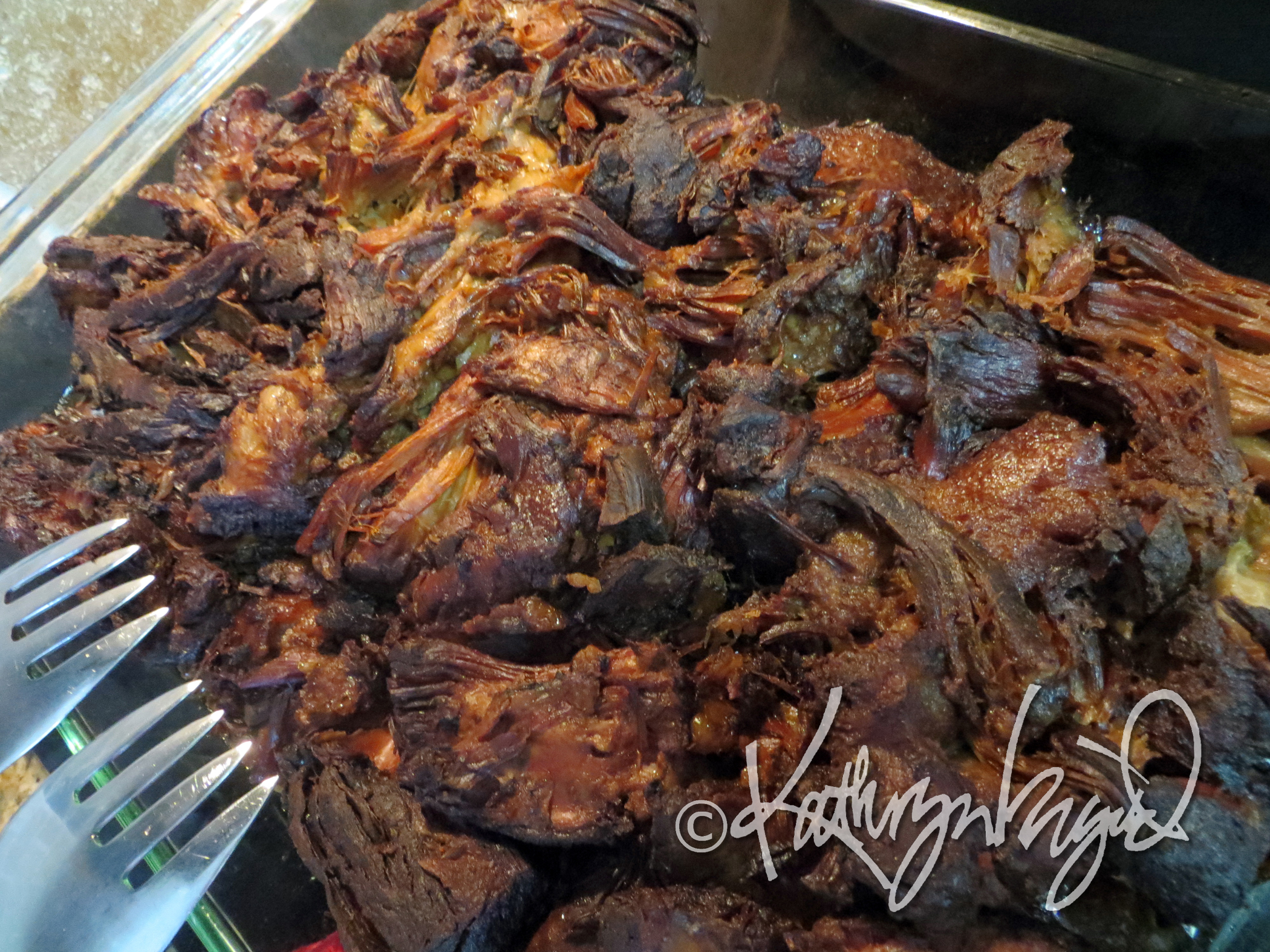
The center of attention. Get those edges crispy!

Carnitas de Señora Loca

Take one big, fat-marbled haunch of a pork roast, cut it if/as needed to fit in the slow cooker, and tuck it in for a nice long soak, at least overnight and longer if possible. Its bath should be comfortably Tex-Mex in character: cumin, powdered garlic, chipotle powder or a canned chipotle en adobo, and, if you’re in the mood, some stick cinnamon, all to your taste; equal parts of Mexican [cane sugar] Coke–in my slow cooker, the measure is one individual bottle, orange juice, beer [I generally use either a Mexican beer like Modelo or Corona, or a Texan one like Shiner or Lone Star. I probably should give Armadillo Ale a try, since it’s a new brew produced right here in town. If I want to go wheat-free, I’ll use hard apple cider]. And one more ingredient in equal quantity: lard. Don’t be squeamish; if you’re eating pork, bathe it in the fat with which it was originally designed to be flavored and enriched, preferably great quality leaf lard, expertly prepared. There are plenty of good cooks around who are willing to go to the fuss of rendering their own batches of top-quality lard, but since I have access to grass-fed goodness of that sort I can’t imagine why I should.
A while before serving time, strain the falling-apart pork out of the liquid into a large baking dish, shred it, and put it in a hot enough oven to crisp the top layer, removing it for a toss and redistribution a couple of times so that there are plenty of nice crispy bits throughout but keeping watch to keep the meat generally very moist. Skim most of the fat from the reserved liquids and cook them down to reduce for a sauce while the meat is crisping.
Then pile a bunch of carnitas on your plate and surround it with loads of other food. Eat.

photo

Carnitas and all the fixings.

Don’t forget some coleslaw when there’s shredded meat, whether BBQ style or otherwise; the two are simply good friends for a good reason. The version of the day had sliced almonds, black and white sesame seeds, and a light lemon vinaigrette with a dash of honey. See, addicted as we are, I can sometimes vary slightly from my standard sushi ginger flavored creamy coleslaw. The creamy dressing, whether made with mayonnaise or yogurt or sour cream in its dressing, would’ve added elements not all vegetarians like, so I wanted to keep an option or two open. Cheese dip for the vegetable crudites was not going to allow such a thing, including not only the grated sharp cheddar and Parmesan cheeses but also an equal mix of mayo and sour cream, along with a pinch of cayenne and a dash of bacon-flavored salt), and I had asked ahead and was pretty sure I didn’t have any true vegetarians, let alone vegans, coming that day, only lighter meat eaters.

photo

Slaw, of course. Always a good choice, but wait–how to choose its style remains…

Since the non-meatatarians in the crowd might otherwise have been stuck with just salad and fruit, vegetable, cracker sorts of foods, I did make up a big batch of rice without my typical inclusion of homemade bone broth, substituting homemade vegetable broth for the occasion. I credit myself with making a pretty dandy broth, no matter what the kind, so no one was shortchanged in the equation, I hope.

photo

Corn salad. What, you need more?

The last side dish leaned back toward the savory and did include a little mayonnaise: corn salad made with fresh kernels of sweet corn, diced tomatoes and avocados, and for those who wished, crisp bacon pieces to sprinkle on top. You know me: if a passel of pork is a good thing as the main dish, why not more pork alongside it?

Besides, it seemed in keeping with the whole theme of the event, that of the constellation surrounding the centerpiece enhancing the latter’s goodness, that our friends enhanced our day, and therefore our happiness, by sharing the time and the meal with us.

Friendly Dragons

photo montageLight Armor

Not everything that’s fierce is cause for fear,

for strength in a good cause is great indeed,

but not intended to make others bleed;

rather, to shield the weak and persevere

Against all odds, to seek the distant grail,

to lead the way when battle’s all around,

and when it’s won, to hold the conquered ground,

protecting treasures fragile, sweet and pale;

For guardian angels, pioneering, brave

adventurers and stalwart friends in stress,

must keep their fiercest watch and always dress

full-armored, so prepared to shield and save

Us humbler beings and what we hold dear;

Not everything that’s fierce is cause for fear!

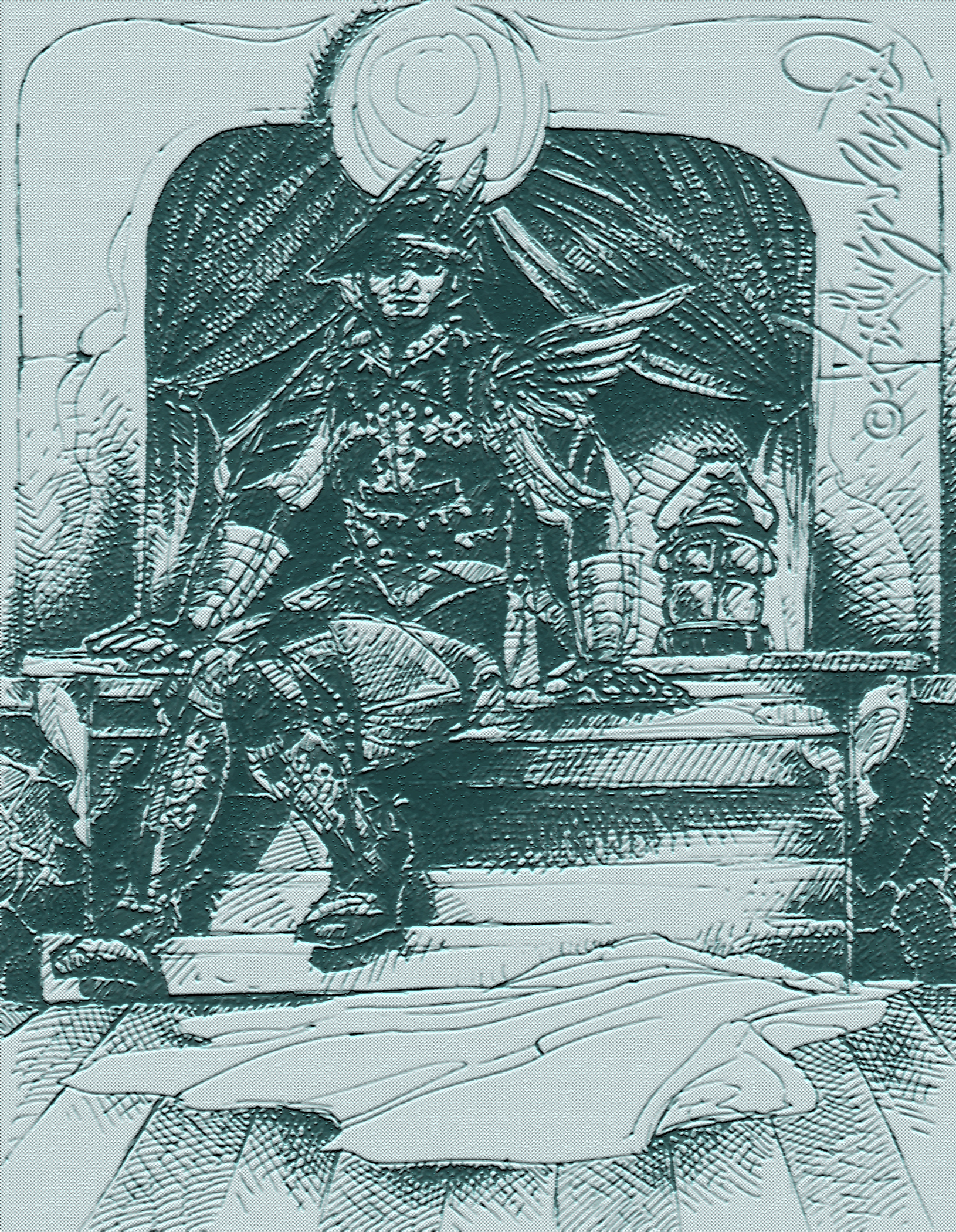
digital illustration from a P&I drawing

See? I told you they show up unexpectedly; just after I gave you this messenger in another post, I got the idea for today’s sonnet.

My Relationships are an Open Book

photoA recent Wall Street Journal article about couples finding the re-jiggering of their relationships around retirement quite complex amused me a bit. The general theme of the article was that most modern retirees, those from in-home jobs and those from outside employment, come from a world where they have established fairly separate-but-equal lives and find it a challenge to spend so much more time directly with each other, doing things together. I’m so happy that my partner and I are not like most. In my book, there’s no need to be that different in retirement if you’re secure in your pre-retirement life. I’m pretty sure, in fact, that we won’t face nearly the same sorts of questions or find many of them nearly so daunting as this newspaper item intimates they could be. Despite a hectic daily life, we apparently live together like retirees already in some ways. After all, modern retirees are among the busiest, most active class of people I know.

There are a number of reasons I don’t worry about our transition. Working as we both have in art-related fields (and both of us in academia and elsewhere), where schedules and projects and income and venues and so much more have always been in flux, means that we’ve both dealt with fallow times, whether job-induced or voluntary, wherein we were responsible for directing ourselves and choosing what to pursue next and when. That means each of us has taken the lead occasionally in having the more fixed schedule, project, income or venue and left the other either more freedom or more angst about how to fill the void for the moment. We are both artists, yes, but of slightly different sorts (his the musical kind and mine the more visual/verbal); these don’t compete or conflict with each other, so no ego is at stake should either of us be hung up on that kind of thing, but rather our artistic views are complementary; both draw on similar resources of effort, inspiration, creativity and skill, so we can speak the same language even when the details differ widely. As it is, our core life-values are pretty similar, so we don’t have much reason to go far afield for purposeful or enjoyable conversation. We have a whole library of possibilities from which to choose.photoWe have, in fact, worked side by side. Not only did our relationship start when we taught in next-door buildings at university, but I was already good friends with and had even collaborated with some of his colleagues on combined recital/art show projects, a sort of classical-based performance art, perhaps. As members of the same faculty, my future partner and I ended up at plenty of the same meetings and events over time, while both still having our own tracks of need and interest. Since our pairing, I have had the privilege of collaborating with him artistically as well, and his music provides a great deal of the soundtrack, live and recorded, of my life, working or otherwise, while he lives at home and work surrounded by my art and reads my writing. We are lucky in simply relishing time together, whether to Do Things or do nothing at all in companionable silence.

But we are neither conjoined twins in tastes and wants and needs nor dependent on each other for a primary sense of identity. He inhales reads books as quickly and easily as though it were breathing, and I labor through them; his reading ranges from professional interests to serial mysteries and thrillers and more, and mine, when my dyslexia forbids the time and attention required for favorites like SJ Perelman with his dazzling wordplay, or Charles Dickens and Robertson Davies, is devoted more to blog articles and short-form works; I read and write fairly constantly, but it’s a slow-moving river indeed. My Foodie Tuesday posts here will tell you that our preferences in dining also differ widely, if not wildly. Sometimes it’s tricky finding a meal at home that will satisfy both of us equally, given the limitations of our common subset. As for movies, he’d happily be in a theatre watching the latest offerings on the big screen, but he opts to stay home with me where I’m not troubled by the overwhelming noise and the overpowering intensity of on-screen action that were intolerable to me in my anxiety-ridden days and remain somewhat unappealing even now. He still watches a lot of stuff that I have no interest in watching or even hearing, but then I’ve learned that an evening in front of our own big screen makes a great time for me to install a good pair of earplugs, rev up my trusty pencil to draw or my computer to work on blogging, photo editing, magazine proofreading and correspondence. I still get to spend time in his company and swap intermittent witticisms with my favorite companion, and we both get to do what’s more appealing to each of us.

I realized long ago that I have a different attitude about relationships in general than many others, and I know that my attitude differs greatly from my own when I was younger as well. Now that I have a number of years of marriage under my belt (no comments from the cheap seats about ‘love handles’!) I am even more baffled by the people who harp on about what constant hard work relationships and marriages are and how difficult it is to keep them operational. Seems to me that if they’re consistently hard work, they’re not really relationships other than perhaps in the form of a slave/master sort. If it’s really high maintenance, it’s a job, not a relationship. Any that are one-sided because of abuse or complete conformity or any other sort of enforced imbalance cease to be viable or valid in my eyes. Only when both parties have something to contribute that is genuinely respected and appreciated by the other does it seem purposeful and potentially joyful, and if neither of those aspects is in the equation for any length of time at all, it is based on something far different from a relationship in my book.

At the same time, if we thought in perfect synchrony and had no differences of opinion or thought or preferences, it seems to me there would be no point in the relationship either. It would be pretty much the equivalent of marrying oneself, and idea that is both ridiculous and more than a little creepy. Narcissism is inherently the inverse of relationship-ready.

Apropos of this: both my husband and I had spent a fair amount of our adult lives single (he, divorced and I, unmarried) when we first dated, and both of us were fairly certain that we would remain single for the rest of our lives–and most importantly, both of us were okay with that idea. We were whole, functioning, socially active, happy individuals with full lives and immersed in relationships with great companions of all sorts. We think it’s part of what made us ready to slide into a life partner, love relationship with very little adjustment at all. Our cosmic crash into each other was instead a landing beautifully cushioned and protected by the remarkable net of many of those other relationships of ours, almost as much as by our personal contentment, mutual attraction and shared interests. Seems to me entirely noteworthy that a strong and happy relationship was founded on and remains supported by a network of other relationships.

This, too, is significant in protecting us from the dangers of too much intermingling of lives in retirement. We already share a lot of time together that we really love. And we already share so many great friends and loved ones that it’s far from essential that all of the newly acquired ones be mutual. He knows and enjoys the company and support and good humor of plenty of friends and colleagues, many of whom I know only as names or email-senders or office acquaintances or voices on the phone, and I have my own contingent of blog friends, expedition companions, collaborators and mentors as well. If every part of life were spent together, what would we have to talk about at the end of the day?

There are so many aspects of our marriage that make it pretty easy for me to avoid worry about what-ifs when retirement comes, I almost feel guilty. But not! I appreciate that we like to do things together as often as we can, daily, hourly, and that we have a life that allows us to take advantage of it. When we worked in side-by-side buildings in years past, it meant we could meet for lunch or stop by each other’s offices or for any number of other excuses quite conveniently; now, when I’m homemaking and blogging, I have the flexibility of schedule to take the shuttle over to the campus where he now works and grab a quick supper somewhere nearby with him before a tightly scheduled evening recital or concert, or sit in on a rehearsal of one of his choirs, or tidy up his files before sitting down to write and draw while he studies a score for the next choral-orchestral extravaganza. If I’m able to get a job again, I’d like to make sure that it still allows space for our interaction, however different that will be, because we really do value time spent together, however it’s spent.

If that makes ours a little unlike the average relationship approaching retirement age, I’m just sorry for all of those out there making up the bulk of the average, let alone any who remain under the mark for any reason. I’d much rather be novel in this respect.photo

Messengers

I admire real journalists and documentarians. Now, I do think that they are a very rare breed among news-people, the rest of whom are too driven by their corporate sponsors’ and their own biases by a long shot, no matter where on the spectrum of politics, religion, personal philosophy or other conviction they fall, but there are those honest characters who, if they do consistently let their beliefs steer their messages, at least recognize those prejudices and are quite open about them and still manage to give air time to opposing or differing points of view.

Still, the ones I really find compelling are a different sort of message bearers. They are harder to recognize, because they can be quite ordinary seeming mortals or wholly incorporeal, quotidian or fantastical, intentional or entirely, serendipitously accidental in their delivery of important news in our lives. Are they strangers we meet by happenstance and happy crossing of paths, like the townspeople in Germany who saw my older sister and me debarking a train after dark and looking around to orient ourselves? The kind couple approached us, told us that Celle (however lovely) was a very small town indeed and that there were few places for visitors to stop overnight but they’d help us find one, gave us directions and set us on the path to a very cozy little bed and breakfast before disappearing into the dark like a mist.

Are the messengers those outstanding teachers who have acted not only as educators in our lives but also as inspiration, as mentors, counselors, guides and friends? Mrs. Willis, Mr. Cunningham, Prof. Keyes: I salute you! Teachers have done as much to bring light to my life as to the dim corners of my mind over the years, and I am grateful for the news and stories and messages they bring. Are there other beings among us able to protect and direct us without our even being aware of it? Of course there are. Some of them are simply gracious fellow humans whose good deeds and kindness will never be seen or fully known and recognized in our lifetimes, either because we are too dim-witted and self-involved to notice as we should or because they merely do their mitzvahs without fanfare, without expecting or needing any recognition and recompense. These we should imitate and their message should be spread further by our going out in turn to do kindnesses for others and requiring no attention or glory.

And I think that–given how beautiful and rich life can be when we do pay attention–there must be others in our midst too; angels or aliens, I don’t much care what we name them, but there must be Love looking out for us to make even the tiniest good possible, let alone the many graces that fill our days if we only look. Their message, I suspect, is nothing more or less than that we are being well looked after, and our little lives recorded no matter how small they may seem to us.pen and ink

Foodie Tuesday: Half Baked Ideas

photoAlthough I know that sometimes it’s nicer to avoid stuff that we like but can’t have, when I’m not able or supposed to have something either for a period of time or ever but I really enjoy it, I can find comfort in fixing it for others. So, under a directive to avoid both flours and most sugars and yet invited to a potluck, what did I want to bring? Cookies. I didn’t really want to just show up with an armful of nothing but store-bought treats, because it wouldn’t involve any hands-on fun or creativity, but it was as usual too hot to want to stand around the oven’s radiant dragon-breath all through the midday.

Solution: fill and fiddle with ready-made cookies.

So for the UNT Collegium Singers’ choir party I bought a batch of sugar cookies, some also-ready-made filling and icing and decorating goodies, and grabbed a few things around the kitchen and got going.

photoOne bunch of the cookies I treated as traditional iced sugar cookies. Thankfully, as I’m anything but a pastry chef, I’m utterly skill- and experience-free in creating traditionally iced sugar cookies, so mine are distinctly individualistic, though perhaps far from artful. Hey, they’re decorated with love. University of North Texas green and white love.photoAnother number of the cookies were made into salted vanilla creme sandwich cookies. The scraggly would-be letters on top of those were brushed on using and ‘ink’ of just vanilla bean paste mixed with food glitter and food coloring. The filling is just another ready-made cookie filling, sprinkled with a tiny pinch, in each sandwich, of crunchy Maldon sea salt.

photoThe other sandwich style cookies were filled with a spread of–you guessed it–ready-made lemon curd, with a dose of ginger juice stirred into it. I used the remainder of the lemon-ginger curd, mixed with more edible glitter and food coloring and a quantity of powdered confectioners’ sugar and piped it into some free-form treble clefs to top those cookies.

Opportunity to have vicarious dessert meets low-maintenance approach. Works for me!

Another Totentanz

digital illustrationTo Rest in Peace

Alas! for shadows carve my collarbones

and misery is lapping at my heels;

Death’s machinations turn, wheels within wheels,

and grind me for its grist between cold stones–

And yet, as dust-dry as I turn, breath blooms

persistently, a torture to my soul

when I had rather be devoured whole

and go on into Peace’s empty rooms–

Still, here I stay, lie atomized, forlorn,

forgotten on the fringes of what life

and loves I knew once, when my days were rife

with possibility as a new morn–

Let me die now, not live without a chance

of altering this endless Totentanz.

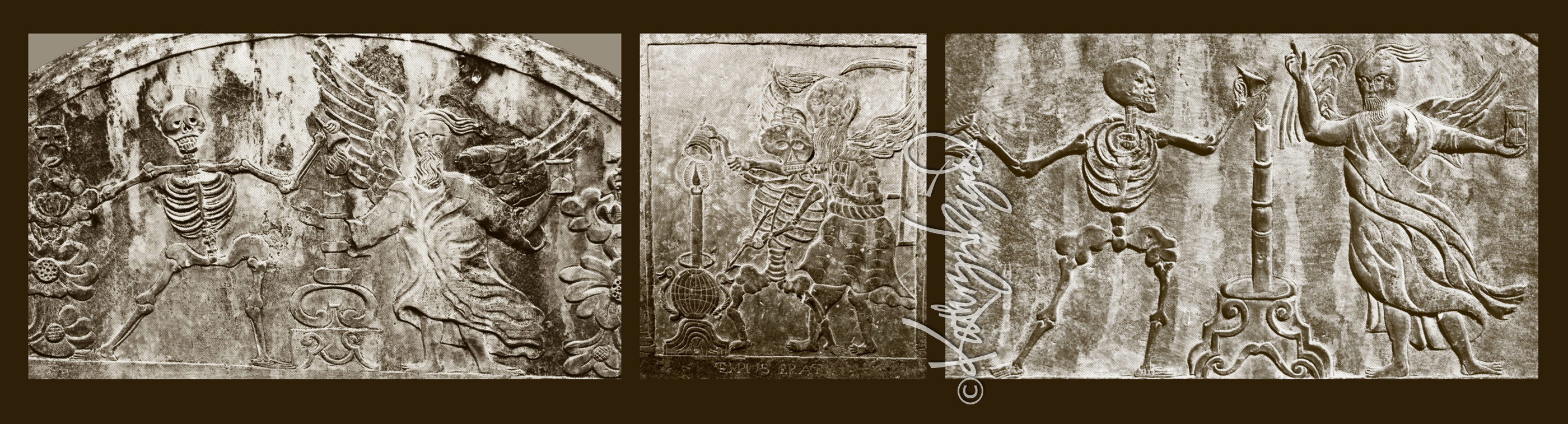
Lest you think me suffering myself, or pessimistic, I assure you I am alive and well. It’s just that I have seen many others struggle with prolonged and pitiful end-of-life dramas and was reminded this June when I saw the beautiful antique gravestones in Boston of how different things are now, when we have such nearly unbelievable powers to keep ourselves alive for tremendously long lives but have lost touch with when it’s acceptable or even desirable not to do so. If our skills for ensuring or encouraging genuine quality of life are far outstripped by our skills for lengthening it, what does that say about us? Generations removed from our forebears, whether in Boston or elsewhere, who knew much more primitive medicine, greater physical dangers, irreparable injuries and the concomitant shorter lifespans we have apparently long since forgotten, do we know how to accept death as a natural end to life and treat dying as a passage to be eased to the fullest extent instead of forbidden?