A Little Something for a Friend

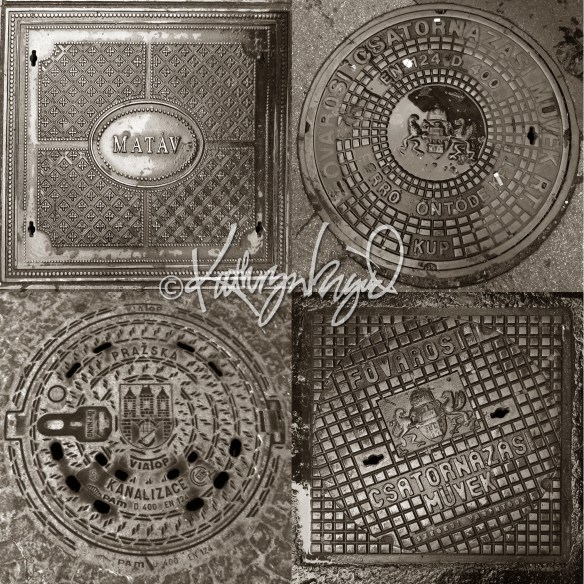
Photo Montage: Manhole Covers 1I discovered quite some time ago that the admirable proprietress of a photography blog I enjoy very much, inte fan gör det det (I’ll let you look up the translation, you non-Swedish-speakers, for your own amusement) shares my affection for many things that escape attention from lots of others. Among those oft-overlooked everyday objects are the steel caps that separate cars and pedestrians and the like from whatever dwells in the underground infrastructure: manhole covers.Photo montage: Manhole Covers 2

Some of these utilitarian items are made without much regard for their aesthetic potential but even so, manage to become rather special and interesting by virtue of the patina of age and use. On top (no pun intended) of that, there are many manhole covers deliberately designed to be special and interesting and aesthetically pleasing. I don’t much care what the original intent of a manhole cover’s design happens to have been, as long as part of the purpose was to keep me from falling into the sewer.Photo: Manhole Covers 3

But it does beg the question, for me, of why, outside of emergencies, one shouldn’t make every single thing one makes as beautiful as it can be. Maybe I should simply be content that so many things, like manhole covers, can become beautiful through use and time. After all, that’s what I would like to be able to do, myself. Ah, perhaps that is precisely what is at play in the manufacture of a manhole cover; it is made expressly to become beautiful through use and years. Perhaps, indeed, I’ve stumbled onto a cosmic truth, and we mortals are also designed with that in mind. I suppose I’d better get busy!Photo: Manhole Covers 4

Beginning with the Very First Night

Digital illustration from a photo: Slide into NightFrom Darkness to Stars

Those distant notes of smoky, sighing dusk

That underlay and raise the early moon

Draw mystery from earth, as if its musk

Were growing far too fecund, far too soon,

To lie a moment longer there in wait

And hide the heart of what was made for strength,

The time when reinvention is so great

It imitates Creation, and at length,

Renews its potent primacy and grows,

Becomes, designs, accelerates, empow’rs

All who would build, each being here that knows,

The inspiration of the nighttime hours—

So break the stars of newness in the night

To bring from utter darkness brilliant light!Digital illustration from a photo: From Darkness to Stars

Better Put the Best Face I Can on It

Acrylic on paper: Silliness as Substitute BeautyComing up empty? Never! Well, okay: sometimes. That’s closer to the truth. I’ve managed to put up three years’ worth of daily blog posts thus far without missing too many beats, but do I have the occasional day of blanking on what I think would be of interest for me to write about, draw or photograph, and post. Outright brilliance would be a stretch for me on the best of days, and on many, it’s just good old showing-up-and-working that gets the job done.

Pretty much the way life works everywhere, isn’t it.

I get up and brush my teeth and take a shower and get dressed, and there’s no guarantee I’ll look less like a goofy, sleepy person than I did a half hour earlier. Some days, it’s flat-out worse, especially if I have to be up before about 9:30 in the morning. But I’m still me. I’m still going on to have a day, to do my writing and picture-making, do my household tasks, go to events, whatever the calendar demands. I’m always planning to have a really good day, if at all possible.

So whatever the agenda, I choose to give it my best, pretend (if I have to) that all is swell in the world, and see if I can’t do something myself to make it as good a day as I’m wanting. We can’t all be pretty all of the time, so I like to let my imagination offer me some fun alternatives to perfection and prettiness, and then the day has a better chance of hitting the happy mark.Acrylic on paper: Sneaking Up on Greatness

It Speaks to Me

What attracts us to certain artworks? Whether book or stage production, painting or photograph, dancing or theatre, singing or instrumental music, there has to be something with which we can connect for the work to have any meaning for us as individuals.Photo: Book of Languages

Some of those connections are obvious: an author with whose philosophy or politics I tend to agree is more likely to produce a book or script I enjoy than one whose beliefs are wildly different from mine; if I favor a specific style or period or medium, I’ll probably always find the works within them resonating in my heart more often than those from unfamiliar or less loved types.Photo: Familiar Passages

Other attractions might be more tenuous or less overt. I read a whole lot online nowadays, both factual and fictional, but I still enjoy reading magazines and books, and there is no digital substitute quite yet for the fine roughness of antique paper pages in my hands and the musty scent of old books.

Shadowy Façade

digitally doctored photo

There are endless supplies of guides on How To do something-or-anything; I’m more concerned with How Not to Do It. Much of the how-to tutorials seem aimed more at giving us a gloss of respectability in the subject, a sort of facade of excellence, than actual, practical depth. Expertise is, obviously, a relative thing, after all. It’s not all that hard to be considered an expert in or at something that is very rare or an extremely new discovery or invention: lack of exposure guarantees that few can have mastery. A whole lot more, however, is skill or knowledge that takes a dedicated effort to master to any level of real expertise.

My greatest expertise, if I can be said to have any, is probably in the category of performing ‘filler’ duties in most of the activities I try. Work as I may, I’m not likely to become great at most, and I seldom find learning anything all that easily or swiftly done. Being naturally lazy, I’m even less often found pursuing new knowledge and skills with great rigor and vigor just for their own sakes. So at best, I tend to end somewhere in the middle of the pack. I like to think of myself as the necessary delineator between the great and the mediocre.

All silliness aside, this seems to me an age in which we, collectively, have lost our appreciation for true expertise. Maybe it’s my imagination, but I get the sense that somewhere between the assumption that a speedy dash through Wikipedia will provide all the wisdom we need on any topic and our fascination with outliers—finding the novelty of savants and overnight sensations far more exciting than hardworking earned-doctorate intelligence—and the sense of entitlement our privileged modern existence gives us, we lose touch with the value of elbow grease and passion.

I wasn’t born either brilliant or extraordinarily gifted, and I’m not ashamed of that. But it’d be a pity to go to my grave without having tried to improve on what few bits of intelligence and invention I do have. If I manage to do my best in the present and keep moving toward an elevated horizon, I may not change the world for the better by a single degree, but I will certainly have bettered myself and I might have the slightest chance of shedding a little light around me as I go.

Looks like I’d better get moving!

Blowing through the Wild Grasses

Weed or wildflower? Messy or naturalized? Everyone has an opinion, and they often differ distinctly on the same little plant or plot. Part of the pleasure of good company will always be in its variety and the interest that it brings to life. Gardening tastes are very much in that vein.

Digital illustration: Wild Grasses

As a sometime gardener, however amateur, I can think of few styles of landscaping that I don’t find appealing and attractive in their own ways. I admire the near-perfection of elaborate, formal palace gardens and magnificent, fountain-filled parks with their follies and allees. I am fond of a rustic campfire-side bramble patch, punctuated by straggly hydrangeas run wild, down by the lakeside. There is both soul refreshment and eye appeal for me in a delicate Zen garden with bonsai, laceleaf maples and a barely rippling koi pond.

When it comes to my own gardens, I tend to walk just a little farther on the wild side. I hate to fiddle and fuss at length with the hard labor of a garden. I greatly prefer the genteel pleasures of the design of the garden, and perhaps the occasional artistic pruning to shape a rhododendron or sapling tree. But I’m not so wild about back-breaking rock picking and digging; I moved from incredibly rich but equally rocky volcanic glacial till of western Washington to the cement-like red clay of Texas, both places where putting a one-gallon root ball into the ground requires a pickaxe.

My first garden was an exploration of the beauties of cottage style gardening. Washington, temperate and moist, was ideal for a grand assortment of bulbs, flowering shrubs and cutting flowers, so I had profuse blooms and constant green with little effort. The traditional cottage style allowed me to squeeze a massive amount of lively growth into a normal city house lot, and the more I wedged into the ground, the less room there was for volunteer and invasive plants. Weeds had a tough go of it there, so it wasn’t especially hard to keep ahead of them.

There are plants I don’t invite to my parties. Much as I enjoy and admire most, I’m no friend of those pest plants that choke out others, cause massive allergies, or stab at me with cruel thorns, or those that threaten entire ecosystems, mine or others’. Good riddance to misplaced English Ivy, kudzu, poison oak and wild blackberry canes. Conversely, one of my particular favorite garden options is to find ways to encourage native plants to thrive. The more a plant is suited and accustomed to its environs, the more it will grow and be healthy and attractive and weed-proof.

Texas has reinforced that love in my aggressively. It’s a harsher climate than the Pacific Northwest’s in which I now garden, so what I plant and tend must needs be up to surviving and flourishing in those more demanding circumstances—or die. Even desert plants don’t necessarily have what it takes, since north Texas can still get true freezes in winter, and occasional snow, hail and ice. This last winter, a relatively mild one, still killed off a lot of specimen agaves and prickly pears and even cut some mighty oaks down to size.

I’m finding that the area’s status as an extension of the country’s central prairies may be the key to what will survive and grow here long term. When anything will grow, that is. I’m tending to my little wildflower meadow out back, to see if I can’t reintroduce something a little more self-sustaining than those long cultivated but seldom successful hard turf lawns that were popular in our area and surrounded our house when we bought it. Even better than the wildflowers, I’m finding, will be the ‘amber waves of grain’ I seeded in  among the wildflowers, the native prairie grasses.

Prairie grasses have some of the deepest, toughest and most tenacious root systems of any type of plants, and along with the leaves that sway in every breeze, often creating symphonies of susurration, they go to seed in many attractive ways. So I really am enjoying ‘sowing my wild oats.’ And Little Bluestem, Fountain Grass, Weeping Lovegrass, and many more. My backyard creatures will enjoy them, and their varicolored, many-textured attractions will beat any struggling, forced lawn that ever tried to eke out a living where its native cousins once roamed free.
Spaceships, Time Machines, Bicycles

Photo: One for the RoadWhen I think about it, I’m amazed at how many modes of transport exist. Contrary to the fantasies popular in the middle of the past century, we’re not all traveling in levitating cars and being atomized and reassembled on opposite sides of the world. But it’s still fiction-worthy stuff that emerges when I realize we’re within reach of fully self-driven cars and can already travel at light speed, drive under the sea, and fly to the moon and, yes—more importantly—back again.

Fiction, however, has always outstripped real-world progress, as well it should. If we don’t imagine it first, how can we build it? If we didn’t travel thus in dreams, what chance would there be of our ever doing so in life?

I have invented an item or two in my time, but my ingenious machinations have never yet been realized in concrete form, at least those unrelated to my art. Still, I hold dear the idea that ideation is the necessary precedent of exciting discoveries and meaningful inventions. As silly as they may seem, then, I’m unlikely to quit developing my odd creations of the imaginary sort.

Who knows what journeys might someday spring from them?Digital illustration from photos: Time Machines

On the Surface

Photo: Leaded GlassAmong the many ways we find our way through the world, ways we make sense out of what we experience, and navigate through life, there’s what we can see and feel on the surface of things. It’s easy to speak disparagingly of these things that are shallow as inherently lacking in spiritual depth or value, too, but that’s an unfair assessment to attach automatically to everything.Photo: Follow the Glazed Brick Road

In practice, it takes but little tactile variation on surfaces to warn us, for example, not to grab nutmeg graters and 60-grit sandpaper hard in the soft palms of our hands, or expect to get a grip on a slippery fish without difficulty. Even the simplest human, once taught to recognize it, respects the distinctive visual patterns on a Diamondback rattlesnake from a safe distance. Conversely, we learn quickly enough the appeal of what we can recognize as soft, dense fur and sleek satin that invite our touch, and admire the enchanting graces brought to a garment by lace, to an elegant chair or door by skillful carving.Digital image from a photo: Embroidery

What we see and what we feel teach us how to interact with and respond to our environs. It’s not always a bad thing to need to rely on even snap judgements about things based on their surfaces. That, after all, is where an enormous amount of the beauty, utility and comfort that attracts us to them in the first place resides.Photo: A Bit of Paisley

And I must remind you that I like all of you, too. But don’t worry. I’ll keep my hands to myself.Photo: Dazzling Metal

The Genie is Out of the Bottle

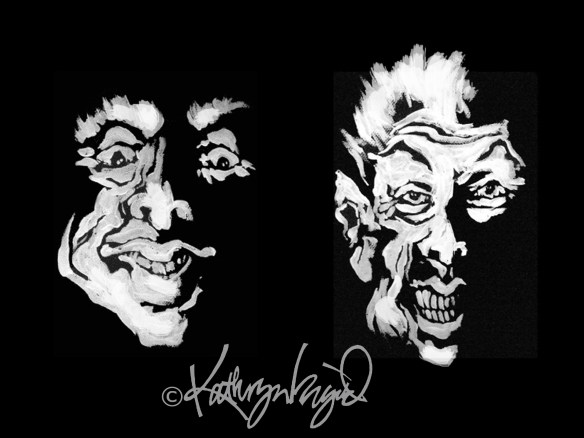
Digital illustration (BW): Grinning Genie 1It would be hard to imagine a person who is less the early adopter than I am. Newness frightens me even under the best of circumstances, and I am intimidated beyond words at the idea of trying to learn anything. Worst possible example for anyone’s edification when it comes to scholarship, growth, adventure, futurism, daring, and tireless commitment to progress of any sort. I’m the one you’ll find huddled somewhere in the shady corner as far back of the starting blocks as I can manage to be, while everyone else is already sprinting gleefully into the turn.

Chalk it up, pretty succinctly, to fear. My self-diagnosis, summing up my own observations and experiences with the insights of better educated therapist and doctor supporters over my lifespan, is that the recipe made by my own ingredients of personality, health, situation and resources tends to combine into a person who’s timid and easily defeated. Add a dollop of laziness to my already potent blend of anxiety, dyslexia and other perceptive and receptive oddities, and my lack of physical strength and grace, not to mention of any sort of courage, and you get an unwillingness, even a very stubborn one, to set foot into new territories, whether actual or metaphorical.

Still.

When I feel I can experiment safely and without anyone else observing me at work, I may occasionally delve into something new with a surprising (to me, at least) sense of play and eagerness. Though I’ve resisted the idea of learning to use any new forms of technology, at least until they’re far from new anymore on a general scale, even these can be both useful and entertaining if and when I finally get up the gumption to try them. So here I am, finally, fiddling around with the iPad as an artistic medium. On our recent week’s jaunt to Puerto Rico, the iPad provided a convenient way to reduce the weight and size of my baggage from the old laptop I have lugged around for the last five years, and while I found it slightly irksome to peck at the tiny integrated keypad on it to write posts, it did work for that, and as long as I used newly made images or ones in my stream of digitally stored photos, I could plug in illustrations as well. Photos taken on my iPad or iPhone do not impress me much, and I find both a bit awkward to use at this point. But with a new set of digital drawing/painting toys, I’m distracted from any such photographic and textual shortcomings by the process of teasing out the secrets of each art-related program.Digital illustration: Grinning Genie 2

Once introduced to this plaything, of course, I loosen up and lose my inhibitions gradually. Knowing that after years of such untutored play with various iterations of Photoshop, I still only use a hundredth of the possible functions and tools it offers—and those, probably, in wildly incorrect and inefficient ways—I can only imagine that there will be exponentially more things I can learn and do, as well as fail to learn and do, with these newer tools and toys. But at least I’ve managed to wiggle my recalcitrant self into trying them, for a start.Digital illustration: Grinning Genie 3

What’s Inside

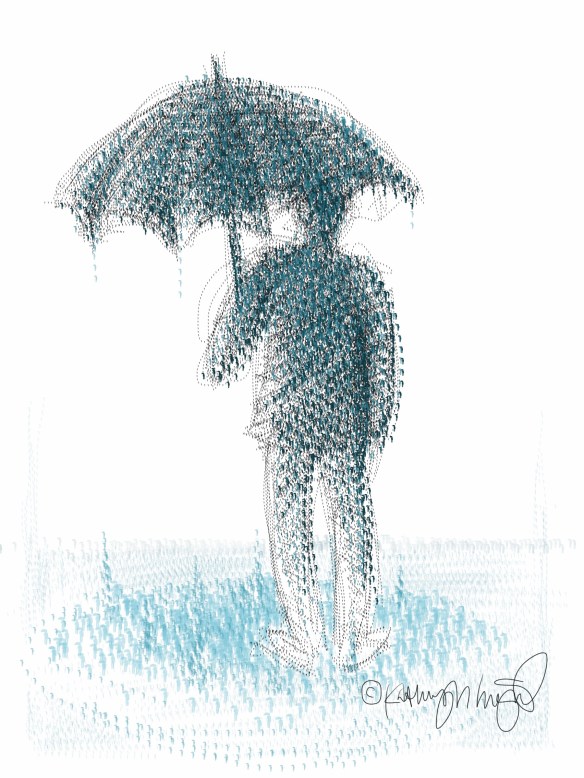
While fiddling around yesterday with one of the iPad drawing apps I’ve been testing, I found, among the many options for textures with which I could draw, this repeating image of a person holding an open umbrella. I’ve done what were essentially pointillist artworks or, at least, a rudimentary and fingerpainted version thereof before, but not in a long time; this little stamp-like thing seemed to offer a fine opportunity for doing something similar, and taking it in a meta-drawing direction, the idea of which amused me, added yet another layer of entertainment. I am, you know, easily amused.

And of course, the first things that came into my silly brain the moment I saw the image were frivolous references. First was It’s Raining Men, followed in swift succession by Rain Man, I Made It Through the Rain, and Singin’ in the Rain, and on it went. Ultimately, I decided to make a simple reproduction of the original image with which I was drawing into the drawing itself, and not even vary it hugely. It seemed oddly satisfying to make the drawing merely an expansion on its parts, and see what that produced.

As I drew, I sensed that this is a concrete representation of what often happens in my art-making: I begin with a mark or two, or materials or media, of what might be quite random sorts and see what I can both literally and figuratively draw out of them. The parts can tell me what the whole should be. It’s my own form of forensics or archaeology, in which I find little objects and clues that, if I’m on my game and all is going well, will help me to discover and reveal the whole that lies within them.Digital illustration