What has been and will always be…

Photo: In the DistanceYou have forgotten my name.

My face is familiar, but you’re not sure in what context it belongs. Am I from a magazine cover, or someone from your healthcare team, or am I your firstborn child?

What was it we were discussing there a moment ago? It floated away in mid-sentence, along with the coffeepots and suitcases that just now floated by the window. Never mind, we’ll talk about it again sometime soon. And again, and again. We may not ever reach the end of the sentence anyway, since so many things, unmoored, float by the second-story casement while we’re sitting here.

We sit here a great deal now, indeed, because you’ve forgotten that you can walk. Once in a while you stand up, out of the blue, and stroll to the hall and stand there, pondering, until someone at the nurses’ station twenty steps away sees you, strides down to your room, and swings your wheelchair over to where you sit back down in it without noticing and ask, Are we on the way to My House?

The answer is always Yes.

When I come to see you, yesterday is millennia ago and you’ve missed me in the long years since I saw you then. If you speak, it’s of the more recent yesterday when you were newly out of school and first in love, and you speak in the present tense of how you expect a visit at any moment from those you knew—now dead. If you speak at all.

Often, in silence you look out that second-story window to see the world projected from behind your eyes. Whenever you turn to the room it’s as though I’ve just arrived. And you still can’t remember quite how you know me or why you can’t put a finger on my name.

You tell me a garbled but elaborate tale about someone with my other parent’s name, your late spouse’s, who according to you has just run off with your (also dead) best friend from school and they’re now shacked up in Tahoe, a place you’ve never been. Then you’re silent again, perhaps thinking further on these events so vividly real in the new world of your mind, never finding it improbable though that school-friend moved to the East Coast years before you’d ever met your One True Love.

Later in the week, their names have been bestowed on two tiny stuffed koalas that arrived clipped to the stems of a small bouquet that was sent last winter when you had had your sixth, or was it your seventh, minor stroke. See? I can’t remember now, either.

But over these last few years, it’s come to matter less. I stopped correcting you, only after much futile and agitated foolishness on my part. It took me too long to learn that. It took me too long to learn that Denial was a river that would only drown me, while you might float along with much less sorrow if I let you go wherever it is you need to go. I learned to agree with you no matter how odd the claims, and to remember at last that my reality is hardly the only one; perhaps it’s not even the truest one, at that. After all, wasn’t it you who allowed these possibilities in me when I was very young?

Yes, I recognize it now, though you cannot. When I was small—in days that even I can’t recollect—you agreed with my outlandish claims and played along when I imagined things. It wasn’t purely to amuse me and encourage my imagination, but you knew, as parents do, that it was real enough to me. When it mattered, you’d agree, and they you’d carry on with the action of Real Life, sheltering me from its harsher blows and steering me around the dangers calmly as we’d go. I talked my nonsense and you were there to set me back on my feet when I forgot I’d started learning how to walk.

I couldn’t always remember right from wrong, let alone the difference between pretending and what was real. You remembered it for me so I could live comfortably in those spaces in between where most of us exist a lot of the time when we are small and the boundaries are still so permeable. I’m just learning, now, to find my way back in and visit with you there. And you, forgetting that I’ve lost my way, lead me, without the need to try, because we’re headed Home. Yes, we are. The answer to that is always Yes.Photo: Other Planes

For Grandma, who dwelt in the alternate universe of Alzheimer’s for a few colorful years before wandering out of this plane forever.

Ambivalence

I am of two minds so much of the time! They might both be on the minimal side, whether you’re talking quantity of Thoughts or quality, but they don’t agree with each other as often as I might like. Often enough, they’re not even on speaking terms, despite living in the same brain-pan. Sigh.

One side of me is always excited about the next big thing, the newness and adventures just around any given corner, and the other is nagging me about how unprepared I am for it. One side laughs easily, sings in the car, and opens doors just to find out where they lead, and the other is dragging her heels to stop the impulsive and ready-for-anything side from falling off cliffs or forgetting her keys. And I’ll bet you the rest of the (ostensibly) adult world has the same duality, to varying degrees.

I can’t fix it, and maybe I shouldn’t even try. After all, the ability to temper daring with reason or cheery nonchalance with logic is often useful, if not life-saving. But I can’t help wishing at times that I could just shut the Hall Monitor side up for a bit and let the wild child have free rein, leaving fear and pragmatism behind, if only for an hour or so.

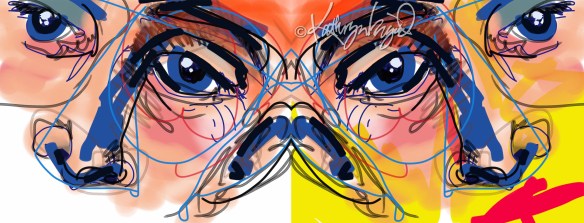
Don’t you?Digital illo: Ambivalence

Sunlight and Shadow

Photo montage: Sun & ShadowThe last few weeks of unaccustomed rain serve as the perfect reminder, if I should need one, of how quickly change is upon us at all times and in every way. Stormy weather and lower than average temperatures notwithstanding, the volatile fluctuation between cloud and clarity, bursts of sunlight and swiftly falling curtains of darkness, wind and rain, continue to amaze me.

The visiting children in our house right now confirm in their own way that the weather is not the only source of constantly astonishing change. The three year old swings between sleepy and energetic, bored and fascinated, sober and delightedly giggling as if sprinkled with fairy dust. Her one year old sister, teething, fusses for a while in frustrated pain, not wanting to be placated—wanting relief instead—until her naturally irrepressible sunny nature wins out and she breaks into a grin like the sun bursts through those nagging, lagging clouds.

Here, the forecast has switched from yet another week of storms to one of sunshine, and that sounds welcome at the moment. But if the weather pivots suddenly again, no worries.  Sun shines more brightly in contrast to deep shadows anyhow.

Death and Perfection

My friend said to me not long ago something that got me thinking about death, specifically about the way that love and other relationships are affected by it. What I was thinking about was, mainly, that until any of us dies, we not only cannot but perhaps should not be perfect; if it were possible, what would be the point of continuing? I hear people talking, often enough, about how there might be people alive today who will live to be 150 years old, perhaps even twice that, and my immediate reaction is Why?! Is there really so much important stuff any one of us is going to accomplish in two or three of our current life-spans that we ought to crave living several lifetimes?

I certainly have no desire to live extra long if it means that I will have to get another job or six in order to afford it, and retire, if I’m lucky, when I’m 215 years old. Or if it means that I outlive whole swaths of people I have liked or loved or admired and have to struggle to make friends over and over again. Or, most especially, if it means that my slow-aging compatriots and I live in a world full of people who can survive all sorts of diseases and previously life-threatening injuries, but not necessarily with a very desirable quality of life, or worse yet, we exist like crammed masses of crawling and buzzing insects in an ever-decreasing amount of space relative to our numbers, scrabbling and battling for resources that couldn’t possibly expand to enrich all of us, let alone with any sort of fair distribution or generosity. If the current chatter ever gets a whole lot more encouraging about the long-lifers spending equal attention and energy on making the world more peaceable and the people in it healthier, kinder, happier, more generous, and a whole lot wiser, then I might consider living “forever” of greater interest.

My friend’s comment also prodded me to think about how death has affected my own life and the relationships within it. To revisit the many what-ifs about whether I could be better than I am, had I cherished and understood my long-gone relatives and friends more wisely and profoundly. About whether I can still garner the strength and intelligence to improve if I pay attention to the lessons I did learn, or maybe can still learn, from them. Certainly, I have wondered enough times what my life’s sojourn, and I within it, would have looked like if various loved ones had lived longer, not to mention how different the whole world could have been. Something in me always eventually rebels at that thought, however sorrowfully, for there is a large part of me, too, that knows how easily I become fixed in my thinking about even living persons I know and forget to reevaluate our relationships, to renew my commitment to them. And I know very well that those who have died remain perpetually frozen ever after in the way that I perceived them and our living interactions. It’s so much easier to be a devil or a saint when you’ve ceased living and can never again do or be anything new to change the balance of the known and the imagined.

And this path of contemplation returns me, of course, to wondering whether it will matter especially to anyone else that I did exist. I have no children to carry on my genes in a direct line, for better or worse. Most of the people who fill my days, no matter how valued in the present time, will continue on their life paths and I on mine, and the majority of us will lose contact and even forget each other, and that is natural enough and no terrible thing, either. But when my dust rejoins the remaining carbon of this known planet, will it matter?

And will I live in memory as devil or saint, or simply and satisfyingly, as an ordinary mortal being, fixed, perhaps, in the amber of another person’s memory just as he or she knew me and never more or less? I can’t answer. I don’t need to answer. I’ll go the way of all living and dying things. I will mingle my dust with all of my fellows’, and with everyone who has gone before or after us, and if any spirit lingers on, may it be—for all of us—the best that is remembered, and the rest forgotten and trodden into our survivors’ own life paths, going wherever they, in turn, may go. If the mountains of our remains raise them up any higher, then so much the better that we both lived and died.Photo: Enfold Me in the Green

Enfold Me in the Green

Enfold me in the green breast of the earth

And gently speak my name with love once more,

Then turn and take your way to what’s before

You now, that all the world will know your worth

As I was blessed to know it in my time—

That hand, unstinting in its tender care,

The scent of rain around you everywhere,

Your slightest whisper in my ear sublime—

That now you’ll speak to other waiting ears.

For now I sleep; let earth be the embrace

To keep me kindly in my newer place

While yours will others bless in coming years.

I thank you, now I need no more the sun

That shall be yours until your day is done.

Too Soon

Photo: Blurred by TearsStolen Away

Too soon, cold sorrow steals from me the light

Of promise, of the hope for growing love

Which I had longed to see his mastery of

Bring him to see such stars divide the night

That he might know it possible that day

Was his as much as anyone’s, and keep

Alive, alight, and not succumb to sleep

As refuge from an endlessly dark way,

But my poor strivings—anyone’s, I guess—

Could never generate the power he

Required to light enough so he could see

In such great bleakness any happiness,

And love and hope, invisible and far

From him as he from me, my distant star.Photo: Sorrowful

I’m in the Support Group for “I Can’t Help being Human” (Part 2 of a 3-part series)

Disclaimer: I’m no doctor, therapist, counselor, or genius. If this post about hope in the midst of depression and anxiety and related mental-health experiences is in any way true for you, know that it might be uncomfortable to read in the first place, but much more importantly, that reading it will not, cannot save you from your troubles. What you need is not a word of empathetic support from a fellow mortal with related experiences but genuine professional help, just as its what I needed first. Come back and visit me if and when you’re ready. If you don’t have any such problems, hurray for you! And read on anyway, because you might be able to help another person if you know better how she or he is living. Everyone’s truth matters, even when we don’t agree with or share it.

♥♥♥♥♥♥♥♥♥♥♥♥♥♥♥♥♥♥♥♥♥♥♥♥♥♥♥♥♥♥♥♥♥♥♥♥♥♥♥♥♥♥♥♥♥♥♥♥♥♥♥♥♥♥♥♥♥♥♥♥♥♥♥♥♥

Digital illo from a photo: Depression & Anxiety Cloaked the GardenI’ve recently met a new friend who is dealing with levels of anxiety and depression that sound like where I stood about a decade ago. It makes me both sorry for her struggles and incredibly glad I don’t have that same weight to carry consistently anymore myself. Depression and anxiety, especially the kind of chronic or recurring stuff, both work differently for everybody I know who deals with them, but one characteristic that I see pretty universally is that they can’t be cured or solved purely by smart practices. Real anxiety and clinical depression are inherently opposed to logic. They flatly refuse to listen to reason, and that is what makes us feel afraid, angry, useless, and without options.

It doesn’t help that some people who have never dealt with similar things can be ignorantly dismissive and believe that if we just shut up, pull up our socks, and get over ourselves all will be right in the world. I may know a perfect solution to my mental health problems, or a whole slew of solutions, and be able to imagine myself accomplishing the rescue flawlessly in my mind, but even if the means to that end is sitting less than an arm’s length from me I don’t have the clarity, will, or energy to make like a Nike commercial and Just Do It, not even if I sit staring at the conveniently available means all week long. Another classic and frustrating aspect of deep depression is that it saps us of energy, strength, and will to such a degree that we’re robbed of both clarity and the drive to do what we long most to do, even for the sake of those we love most dearly. It’s no wonder depressed people feel useless—they have been robbed of all of their power and hope, and worst of all, the culprit lurks right inside and can’t seem to be evicted.

When one’s brain or biochemistry can’t process the facts of the situation in sensible ways, the natural instinct is to curl up in a fetal position and hide from everything/one, including oneself. For me, when I’m in the middle of an acute anxiety attack or even a period of general anxiety, my rational brain can still assess the present situation quite neatly and spell out all of the logical explanations—what I could do to solve what’s making me anxious, and why I would be perfectly safe to just let go all of that discomfort—but I’m immobilized by anxiety instead and only feel more afraid, sick, confused, and as a bonus, tremendously guilty for “not taking my own good advice.”

It sounds, frankly, ridiculous to anyone who’s never experienced it, and even to me when I’m not stuck in an attack. But it’s the reality, and it’s awful. It has absolutely nothing to do with whether your life is good, with whether you’re smart, lovable, or desirable, or are surrounded by supportive people or wealth or any other grand resource you can imagine; you can have all of those things in abundance and still fight depression and anxiety. I have had a great life, with very few major causes for even normal kinds of sadness (you know, those well-known major stressors like the death of a loved one, changing jobs, moving to a new home, and so forth), yet when I finally ‘crashed’ with clinical depression in my 40s, I learned that I had probably had not only previous periods of severe depression in my life but also chronic anxiety all of my life. The lack of obvious causes or catalysts for the existing state in an otherwise pretty charmed life only further confirmed my doctor and therapist’s diagnoses—in my case, of an inherent chemical imbalance that various “triggers” simply helped bring to the surface periodically and that, over time, became harder to manage without both counseling and medication.

This may all be TMI for a non-sufferer or casual passerby, but I think it helps explain a few rather useful things. Again, these are my own thoughts and experiences, not yours. Only you can find your way through them.

Those who do experience various forms of mental illness are far from alone. I happen to believe that mental health, along with all sorts of other aspects of personal health and identity, is not merely a ‘spectrum’ of states or conditions, but a cloud of them, a thick and rich matrix in which each of us is created. That in any one person, his, her, or my place in all of the matrices of physical and mental health, skills and interests, sex identification, attitudes and beliefs, and the many other aspects of humanity that make us our individual selves shifts gradually but constantly, however the pace may vary from one time or characteristic to another. If I multiply all of the changes within one such self-identity matrix by how many different matrices of personality can make up the whole and how much they are likely to shift their Me point of intersection over a lifespan, it seems entirely probable that everybody hits the occasional crossroads of whatever for them qualifies as less than prime mental health and well-being.

I’m a firm believer in daring to ask for help, whenever/wherever you possibly can, starting with your counselor and/or doctor; find better suited ones, if the ones you have aren’t helpful! I know as well as anybody how near-to-impossible it is to ask for help, and it doesn’t matter if the reason is insecurity or lack of self-worth or sheer tiredness. It’s just that I also know that my life and sanity have been saved more than once by those little moments of supreme effort it took for me to humble myself and crawl toward help. I could sit around singing infinite maudlin verses of ‘Nobody Knows the Trouble I’ve Seen‘ or, as I always tended to do, wear a mask of pretension that everything was just spiffy, but no matter how much anybody else loved or cared about me, they couldn’t read my mind—how I expected them to when I couldn’t read it myself, I don’t know—so nothing would have happened if I hadn’t just let go of all my ‘should’ ideas and asked.

Treatments vary just as much as bodies’ and minds’ uniqueness differentiates us. It’s hard work to find strategies that help us individually, but it’s the only path I’ve seen whose light at the end of the tunnel isn’t that of an oncoming train. Somebody else’s quick fix or longterm “cure” isn’t necessarily what will serve my needs. I love life in a whole different way nowadays than in my earlier years, thanks to stumbling into and muddling through the process of finding what was best for my situation.

It is a lifelong process, make no mistake. For me, it means I will probably always be on medications in addition to checking in with my doctors occasionally. One of my doctors opened my eyes about this, first overcoming my resistance to medicinal intervention by explaining to me how much the current varieties differ from earlier forms of antidepressants and their ilk in terms of long-term safety and efficacy, and then keeping close watch to insure a good ‘fit’ for me.

On one visit, I asked the doctor whether, feeling so much healthier and better, I should start weaning myself from the medication. “How do you feel?” she asked. “Great!” “Do you want to feel different from ‘great’?” [Me, grinning and shaking my head NO.] “Then why would you stop taking your medication?” Duh. “Come and see me if things change for the worse.” Ten years later, I noticed I was slipping and feeling the old, familiarly dark fears and discomforts creeping in on me and suffusing my sense of self. My current doctor—we’d moved to another state, meanwhile—agreed I could add incrementally to my current dose. Barely ten days later, back to my New Normal. My sense is that depression and anxiety, like alcoholism, are states of imbalance that aren’t curable but can and may be managed over time with consistent care.

I understand very well the resistance to meds that comes from feeling like one has lost a certain amount of emotional depth or dulled some personal distinction when medicated. Yes, I have experienced deep, and superb, lasting joys from my earliest years when not in the abyss, and sometimes I do think that my emotions since ‘entering recovery’ might be slightly duller in general than before, but I would not trade a single second of what I have now as a healthier person for that tiny, shiny bit of edge, if it really is gone. Once the right meds kicked in for me, and it wasn’t instantaneous, I knew that I was my REAL self in ways that I had never, ever experienced before: able to feel normal pain, fear, sadness, or worry without the absolutely constant sense that they would never pass or that each one meant sure disaster.

I could ride in a car without the conviction that every other car approaching mine was aimed directly for me. I’d always known, objectively, that they weren’t, but I couldn’t stop that irrational inner sense from warning me endlessly that they were. I could now plan to meet a new person and not have to spend a number of days before it feeling physically ill and crying and being sulky and short-tempered because I was so terrified of meeting her. If I tried to learn or do a new thing and didn’t get it perfectly on the first try, it wasn’t an indictment of me as a human but a teachable moment of setback.

Now, when I shed tears, they’re not in the uncontrollable flow of incurable grief but born of a sadness that even in its midst I know will abate in time. Or, thank goodness, they’re sometimes tears of joy. Because not only is my life still good, now I can genuinely feel it. I wish the same for all people. It’s why, as an avowed non-expert, I still feel responsible, compelled, to answer when asked out of the darkness, ‘Is there anyone who knows me?

More tomorrow, friends…

For Guiding Us All

We learn how to live, in many ways, mostly by accident. But those of us who learn to live well, whether as better scholars, more skilled laborers or artisans, or simply as more loving and kind and generous and good-hearted people—that growth and knowledge is gained best of all through the care and guidance of those who serve as our teachers and mentors. Parents and relatives can do this, friends and neighbors and co-workers. We who are most fortunate of all have many such positive influences come into our lives and help to shape us and bring forth our best selves.

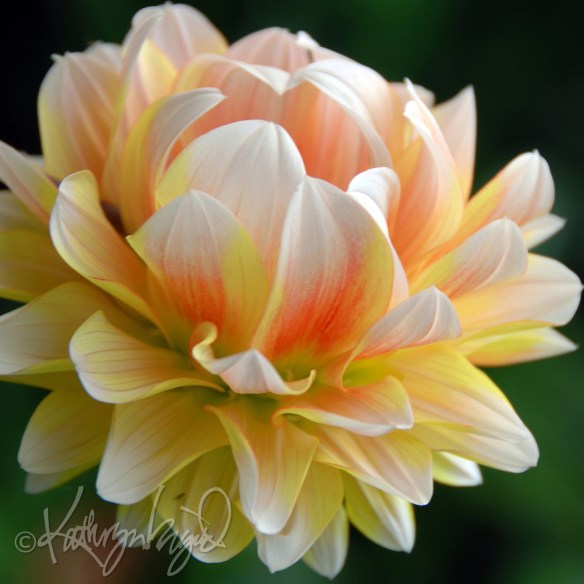
And those who are best at being this sort of careful, patient, challenging, and giving tutors in one other person’s life tend to be so naturally inclined to raise up the best in anyone within their reach that they serve as mentors to many, regardless of any plan or intention. We who have been the beneficiaries of this largesse owe a debt of gratitude, and perhaps too, our own best efforts to pass the gifts along to another circle of influence in the great, rippling pond of our connectedness, to a further acre or two of young and beautiful growth that waits between today and our own eventual horizons. Life is brief, and best enriched in its short seasons by propagating mutual help and guidance. I am thankful to have been gifted with a number of superb guides and examples, friends and mentors, in my own life. May you all be as well.Photo: A Dahlia for Neil

Bright Dahlias

The autumn came too soon, and left a pallor on the pretty paint

of those tall dahlias that you had nurtured faithfully, their saint;

It turned them into shadows of

themselves too soon, shadows of love…

Frost cut them down and took them in its bony hands to steal their dance

the graces you had tended there so tenderly, by circumstance,

From shoot to bud to blooming beds,

by stealthy ice that bowed their heads…

And you saw early autumn, too, too soon—were bit untimely by

the frost and plucked from gardening, the sun still in your sky-blue eye

Made winter’s sparkling snowy air

of beauties we were loath to spare…

Yet all this theft you had foreseen, and readied us to stay and tend

bright dahlias, each, our own; to go on gardening, and so amend

Our sorrows in your still-wide gaze

by passing on your gentle ways…

The rich inheritance you gave still grows like dahlias among

us all, your heirs, and in their turn, those we raise up as happy young

New imitators of your gift

for singing to give hearts a lift…

In loving memory of Neil Lieurance, and with deep and abiding gratitude for the treasure that is a true mentor in any life.


Art in the Middle of Dying

Digital illo + text: Angels DescendingThere’s little in the world that gives more meaningful respite from earthly trials than art. Those sorrows and struggles that range from the brutality of human weakness and evil to the most monstrous of natural disasters have no true cure, no end. Safe to assume that they have existed since long before recorded history, and will outlast the lives of any of us now present. But art—a painting, a dance, a song, a story—in its turn outlasts, too, the horrors and madness of the darkest time. What exists in the background, dwells in the underground, during suffering and oppression, so strong that it cannot be extinguished, and both records the terrible event and defies it? Art.

If we learn anything from our history, it should include the knowledge that any threat to eliminate or suppress art by force or merely by neglect and dissolution is a time when we should most avidly practice our defiance of oblivion. When it is bleakest, we should dance most wildly and gracefully; when dark, sing boldly and sweetly; when empty, we should fill the void with thought and challenge it with beauty. The blank Nothing may not mock us into meek obsolescence if we refuse to silence our passion and surrender our dreams.

Revival

My subject in today’s poem is identified as a woman, but mainly because the pronoun ‘her’ fit the text that was already emerging in the sonnet. In my heart, the subject is meant to honor all of my friends and acquaintances [regardless of persuasion] who have battled, or are still battling, their way up from the abysses of fear, anxiety, depression, abuse, or any form of personal darkness, whether inwardly generated or externally imposed. What you have done, and are doing, is powerful. What you can do may be more than you, or I, or anyone can possibly yet imagine. Continue your journeys upward, my friends. Sing from the branches of the Tree of Life for a change. Newness can be a beautiful thing!

From Her Grave

Arising from the heart of silent night,

the poignant voice of one whose singular

accomp’niment was always, only, her

own shadow, takes the unaccustomed flight—

Ascending, she now meets the morning sun

and hears at last a sound she’d never heard;

the brilliant singing of a splendid bird,

a song that chases shadows, ev’ry one—

And hers, along with all the shadows, flies;

now wakened, she is free to wholly shed

her residence in shade among the dead

and fly up, singing gladly, to the skies—

So freed, she dares to trust her new-fledged wing

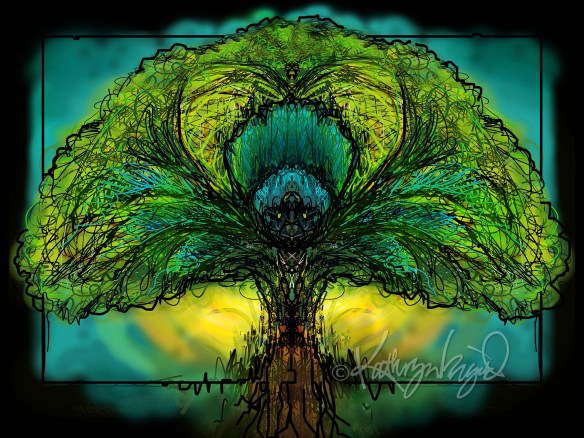
to raise up others from their dark to sing.Digital illustration: Yggdrasil, the Tree of Life

A happy, healthy and hopeful New Year to everyone!

Contagion vs. Compassion

“One bad apple spoils the lot.” That creaky aphorism is based on equally venerable experience. Rot is contagious.

Bad company makes bad behavior seem the norm, and we adjust our own standards ever lower accordingly. One or two disheveled houses bring down the values of the others in the neighborhood, and those, in turn, fall into neglect and decay as their owners lose the courage and determination to resist the incredible pull of entropy. What isn’t growth is death.

What leads otherwise good and sane people to fall apart like that? Doubt; fear; despair. These are the hallmarks of contagion: the plague succeeds in felling us not only through its own virulence but because rather than seek its cure with full courage and determination we flee with it hot pursuit, and when it eventually catches up with us, we topple, curl up in the fetal position, and succumb.

The fall of one member of the world community—like Mr. Duncan, who was felled by Ebola in Texas—is a very real and terrible loss for all. The loss of thousands—those dying in West Africa—is indeed a plague and a thousand-fold grief we all must recognize and bear. The response, though, cannot be equally contagious doubt, fear, and despair. That can only make us choose unconstructive, even destructive, responses like blame, xenophobia, retreat, and the neglect of our fellow citizens of the earth. Then, no matter how many or few have been overtaken by disease and disaster, the contagion will have won.Photo: Snakebit