All Kinds of Music

Drawing/painting illo: Three ComposersIn my head, there is music. Mostly, it’s a rambling, meandering thing without much form or direction, just a little ditty that my subconscious seems to hum to itself along the journey of the day. Once in a while, it’s an earworm, some tune or phrase caught in the soundtrack of my brain and put on long-term Repeat because I heard it or remembered it recently and didn’t have another thing to replace it with soon enough. Often, when I’m drifting off to sleep or marking time while I wait for something to happen, there’s a sort of internal theme song of mine, a mere snippet of a melody that might be a simple part of a Bach invention or might just as well be something of my own invention inspired by Bach or some similar composer, a line that becomes more or less complicated, turns from something slightly Baroque to a more Classical seeming style for a bit and then becomes a very plain little row-your-boat kind of canon before returning to its silent corner to wait for my next moment of internal quiet. On rare occasions, there might be words attached or an obvious external source of whatever song seems to have sneaked and snaked its way into my frontal lobe for a lope or two around my one-track mind.

Yet I have not the gift of composition. When I think about it in a more determined and purposeful way, I have all sorts of ideas about how I would probably set a particular poem or story text of mine if I did have compositional skills, how I might voice the piece or what instrumentation I think would be just right for the words and ideas therein. But it would be helpful, if I really intended to do any such a thing, if I had the slightest notion whatsoever of music theory or how to read a score (let alone write one), of what certain instruments can and cannot do, and whether the human voice is actually capable of making the sounds that might be required of such a project.

I am ever so glad that there are composers in the world capable of carrying a musical idea to magnificent, magical fruition. I sincerely doubt that any of them would set any text, mine or another’s, in just the way that my moseying mind seems to believe it would—for good or ill—and that is the way the universe operates. Each of us has skill sets and desires and training and passions that make us better, or worse, fitted for the tasks and arts that we imagine to be useful or pleasurable, and each has limitations even on our own abilities to recognize where we will excel and when we might fall short. What a wonderful thing it is that, though I’m not a composer myself, there are excellent composers who can and will set my words to their own music, because after all, choral music is one of the most clearly collaborative of activities anyway.

What a wonderful thing it is that, though I will most likely never master bringing what rings inside my skull out of it in an intelligible way, let alone anything like the one I imagine in its internal incubator, somebody out there is busy penning loveliness and longing, drama and dreams, that will carry their music forth into the hearts, minds, and ears of a waiting world’s humming silence.
Transitory or Transitional

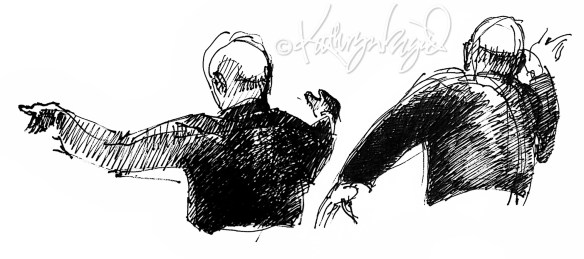
Pen & ink drawing: Transitory or TransitionalMy spouse, in his combined capacities as a natural-born teacher and a lifelong curious learner himself, is constantly reading, studying, talking shop with others both in and out of his field of music, and cogitating inwardly and through his writing about ways to grow and improve. I am neither a born teacher nor as dedicated and skillful a learner as he is, but I have, I think, grown a fair amount in my appreciation of what quantities and depth of effort it takes to improve oneself, let alone help others to improve themselves, in any chosen course of study. One of the things that intrigues me is that, as in so many areas of life’s experiences, the macro and the micro aspects of learning and, in turn, teaching, always ebb and flow: it takes a multitude of tiny pieces of knowledge and/or effort to make any significant larger ones, and the large ones must generally be reduced to smaller and more manageable parts in order to be changed, eliminated, or simply learned, as well.

In a day’s rehearsal for an upcoming concert, it’s marvelous to see and hear what occurs as a major composition is broken down into its component parts and those parts studied and practiced and rehearsed in detail, bit by bit, but also to realize that the individual parts have no beauty or meaning unless also studied in the context of the whole. Fixing one small phrase or chord at a time can be a portion of the improvement process, but if that’s all that happens, then the performance will never have any cohesion or sense of drama but will forever remain a collation of essentially separate and unrelated atoms that happened to be sounded in the same room on the same night. Playing or singing through transitions—the places where one phrase or larger idea in a composition ends and the next begins—is a way in which my conductor husband helps his choirs, orchestras, and other performers to experience and express the whole of the story more convincingly themselves, and thus bring an audience into the flow of the work as well.

Music is a wonderful vehicle for individual experience of the aesthetic, emotional, artistic, and ephemeral aspects of existence, and as such is a grand gift. But when it becomes a communal, communicative experience rather than only an isolated solo, it has incredible power for building relationships between people, ideas, cultures, lives. When it is a bit of a song, hummed or played on the street, in the car, at work in the kitchen, it can cheer or soothe, feed or please; when it is a performance of a major musical work in concert, in a musical or opera, an oratorio or a middle school end-of-year concert that has many participants and has been labored over with passion by all of them through a string of intense rehearsals, its power is magnified and resonates for a long, long time to come. It’s as though the practice of singing or playing through the transitions from one passage to another of that single composition has expanded into life, letting the dissonances and harmonies, the threads of meaning and the ecstatic shimmer of aural beauty, all remain in the air and in our spirits long after the last notes have gone silent, carrying us through the transition from art into life with renewed depth and purpose.

Solo after Dark

If you’ve ever heard Miles Davis play, this needs no explanation. If you haven’t ever heard his music, whether you were lucky enough to catch it live or, like me, have only known it through recordings, it’s time you listened. Get a recording, turn it on, and turn off the lights or just close your eyes. And listen. Because.

Digital illo + text: I can Hear It from Miles Away

Gotta Lotta Brass, Ain’t He

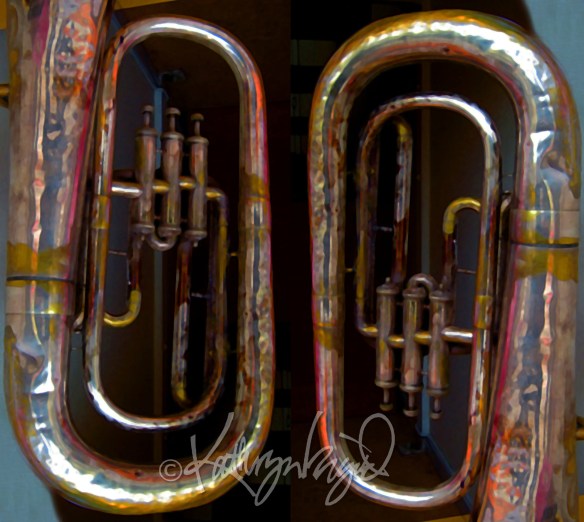
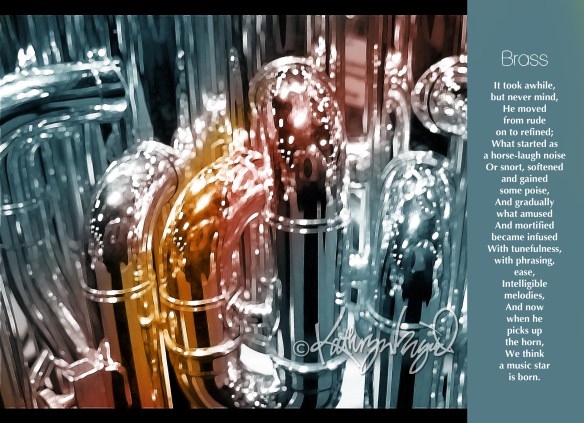
Digital illustration from a  photo: Feel Free to Horn InThank goodness parents and neighbors have the blessed invention of earplugs to get them through our first attempts at singing and playing instruments. I can honestly say that after at least five years of piano lessons, fifteen of singing in choirs and ensembles, and over eighteen of being married to a professional musician, I am still unable to read music properly, barely being able to follow a score when more able musicians are doing all of the singing, playing, and conducting. After enough years of dealing with Spasmodic Dysphonia, I’m not even very dependable for singing a note very tunefully on cue. But, as it’s said, I’ve still got decent ears. So I, too, own earplugs. Just in case. And I apologize, retroactively, to everyone who didn’t have them handy when my noisemaking might have required such intervention.Digital illustration from a photo + text: Brass

Butterflies Dance, Too

Photo + text: If Butterflies could Dance

Digitally painted photo: Cosmic Butterfly

All Together Now

One of my favorite vocal coaches is fond of characterizing people who focus on their own singing to the point of losing track of and/or sticking out from the rest of a performance at inappropriate times as expressing their “individual enthusiasms.” I’m doubtful I would be as tactfully euphemistic. We’ve all seen and, more importantly, heard concerts where one unplanned solo ended up hijacking the whole event, and it’s hard to forget what was so frustrating and embarrassing about it for the other performers and the audience and even harder to remember all of the probably fine or even excellent things that were supposed to be the stars of the day.

The same is true, naturellement, outside of musical performances as well. Our individual enthusiasms lead us to speak out of turn, act squirrelly in the middle of serious events, blurt out exceedingly inconveniently unfiltered thoughts, and generally act like little kids at the best of times. At worst, they make us deeply uncivil, unwilling or unable to negotiate, and self-centered to the point of implosion. Or, more often, explosion. This world does not need my opinion, unless I’m willing to get the rest of the passionate populace to engage in the conversation and collaboration that will make it needful. And in that case, they’ll quite generally be on board with my enthusiasm already and there will be little to negotiate.

None of this means that everyone should think and act in lockstep. What a horrific idea! Most of the great performances of our time are not solos, even those that feature soloists, but rather collaborations with the entire cast, crew, production staff, and audience, at a minimum. The deliberate and thoughtful give-and-take of everyone performing his and her part to the very best level possible is what creates the ideal of harmony, even in times when fruitful dissonance is desirable to throw that harmony into beautifully sharp contrast. Music is obviously full of grand examples of this stuff, but so is life in general. The sorrows and hardships, if they are carefully shared burdens, throw the joys and pleasures into higher relief, and the larger song of human experience continues to grow in beauty.

Photo montage: In the Works

Instead of throwing a spanner in the works, why not find ways to make them run more smoothly together for a more harmonious performance?

Celebrate Anyway

Christmas day means nothing at all to a whole lot of the world. Even some fairly devoted Christians are either skeptical about the accuracy of modern guesstimates of when the historical person Jesus appeared on earth or, in some cases, just plain weary of the commercial kidnaping of Christmas as a secular holiday. Beyond that, there are innumerable people and nations so impoverished or endangered as individuals, as communities, or as entire regions of the world that the last thing they can afford to pay attention to is an arbitrarily set date for recognizing anything as a reason for joy and revelry.Photo: Cymbals

There are no gladly clashing cymbals, no brass choirs trumpeting their huzzahs to the skies, no parades or packages, masses or meditations that can fill the void in hearts and homes oppressed by war, famine, disease, hatred, or inner turmoil. The very thought of happiness and reverential bliss, if it can even pierce the noise and violence, the stress and terror holding such people hostage, seems hollow and artificial. Goodness and light are as distant and unimaginable as the most ridiculous fiction.
Photo: What a Lot of Brass

These sufferers deserve to have their sorrows and their pains lifted from them, obliterated by any and all who dare to change history. No one knows better than I that not everyone has the strength and wherewithal to be so bold in action. But if we cannot do so with our physical labors, we must do so with our hearts and minds, our words, our plans, and our constancy in spirit. One voice at a time, one solitary note sung by a tiny, quavering voice, is the only way to begin moving toward a day when others, also one by one, will join and build to a worldwide song of peace. Only when we direct our every breath toward healing, harmony, and hope will the song come fully alive. Every atom of our being will whisper, speak, sing, and shout until the whole of humanity rings with echoing gladness.
Photo: Stringed Instruments

One moment’s pause, one hour of cease-fire, one hospital patient or lost child or elderly neighbor rescued for one single part of a day at a time makes space for the sound to bloom. We need to make room, and lest the horrors should return to fill the void, we must fill it up instead with songs of hope and joy and celebrate any way we possibly can. The other voices will someday, if we sing for long enough, follow.

Music is in the Air

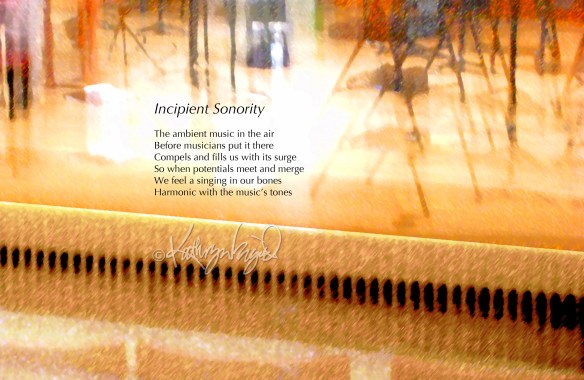
There’s no doubt in my mind that there is more to sound than just the stuff, however notable, that vibrates on my eardrums and sends messages to my brain. My lack of ability to interpret subsonic information the way that whales and elephants and other creatures can do doesn’t mean that I am completely insensible to them. I’ve had enough experience with not consciously hearing but still knowing there’s something significant happening in my environment that I can truly appreciate the astonishing sensitivity so many animals have to the ways that the universe is sonically alive and active around them.

That’s part of what is so compelling about music to me: that it is a further layering of these forces in ways that transcend what’s strictly scientifically explainable in order to move the heart and shape the soul. The very atoms around me can make me shiver with joyful and eager anticipation of the sonic adventure that is to come, while I wait for the performance to begin. As music engulfs me, I feel more alive, more literally attuned to all of existence.Digital illustration from a photo + text: Incipient Sonority

Photo: Celli

Early Music for Breakfast

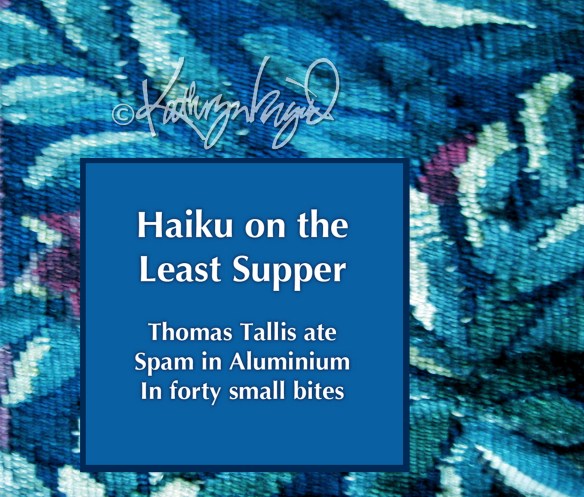
Digital illustration + text: Haiku on the Least Supper

If you haven’t already crossed paths with Thomas Tallis‘s landmark Renaissance motet Spem in alium, I highly recommend it. It’s a truly astounding piece of European music history, representing the confluence of the political and artistic competition for primacy in that time period; it’s believed to have been composed as England’s answer to Italy’s Alessandro Striggio‘s own, earlier 40-part motet, or possibly to Striggio’s 40-60 voice mass. I’m no musician, but I’ve learned, mostly through witnessing a few performances of the Tallis by different groups led by my husband and his colleagues, just what a feat this piece really represents.

While the creation of Striggio’s works for 40 and more independent voices is amazing in its own right, the 40-part motet he wrote specified that the voices be doubled instrumentally. That is impressive enough. For my fellow non-musicians, think of it this way: a typical piece of music for a mixed choir requires singers to perform different notes and lines of music, often at the same time, so that what is heard is not one single series of notes, one after the other the way we sing by ourselves, but layers of notes that become deeper and more distinctive expressions of the words being sung. Instrumental doubling means that some or all of the vocal parts are supported by one or more instruments “singing” the same notes at the same time. This can intensify the effect of that singer or section’s line, and it can sometimes also help a less skilled singer or choir stay on target with the line.

In any event, the more typical choral works tend to have soprano, alto, tenor and bass voice parts, or singing lines, (or some combination of those) and generally, not more than eight or perhaps twelve different lines intermingling at once. Anything more than that means that every singer in a moderate-sized choir is responsible for knowing and performing his or her own notes, on pitch, at the right moments, and with exactly the right loud-soft dynamics and flow at every point throughout the piece. Being in a choir is a thrill; being in a good choir is a real intellectual and artistic and even physical challenge.

What makes the Tallis Spem so incredible is that it comprises not only forty individual, fully independent singers’ voices all singing their own distinct parts of the song, but indeed, doing so entirely unaccompanied. Every one of the singers has to be spot-on at all times without the support of either a fellow singer or any kind of instrumental doubling. If one singer goes off the rails, there’s the possibility that others will be thrown off of their pitch, timing, or even their place in the whole work. It could well lead to a musical train wreck. Think you’d be intimidated by doing this? I think any sane person should be!

But it’s powerful stuff, when it’s well done. I’ve had the privilege of hearing this feat beautifully accomplished by singers surrounding me in a cavernous cathedral space, and by singers standing onstage in a modern performance hall with a carefully engineered acoustic. I’ve experienced it in art galleries where Janet Cardiff‘s intriguing installation of forty high fidelity speakers on stands are placed in a circle in the otherwise rather bare room, each playing in synchrony the recording of one of the singers in a performance of the Tallis, so that one can stand outside the circle or in the center of it surrounded by the speakers, or can move to stand at one individual speaker at a time, getting entirely different effects depending upon which part of the score is being performed and where one stands in relation to the speaker playing that part.

No matter how it’s done, once you’ve gotten a little of the idea how this piece of music intertwines voices that seem at first to be operating without a clear relationship but then, more and more, to be converging into a meditative, chant-like, layered song, it is quite mesmerizing. There are some recordings and performances out there on CD, iTunes, and YouTube worth a listen, and if you get the chance to visit the Cardiff installation, called simply Forty-Part Motet, do it. Best of all, of course, is if some fine choir nearby offers a live performance that you can attend. It’s rather haunting and ethereal, and made all the more impressive by the knowledge of its complex origins.

Meanwhile, I have given you this bite-sized humorous meditation on the work. A haiku seemed the ideal vehicle for acting as either commentary on or antidote to a choral masterpiece so complicated and virtuosic. And I sort of wonder if, in the process of composing this grand work, Mr. Tallis had any chance to stop for rest or was so deep in concentration that he barely had time to do the Renaissance equivalent of opening a tin of luncheon meat and dining directly from it, pen and parchment in one hand and dripping Spam juice on the other. Thankfully, it doesn’t appear that this effort of his was entirely detrimental, let alone leading to his personal version of the Last Supper, since he went on to compose other fine works up until nearer his death some fifteen years later.

Deep Sea Wishing

Digital illustration: Psychedelic PstarfishPsychedelic Pstarfish

Seems sillier than psyllium to sing of starry seas,

Yet so the ocean’s silken shore’s sufficient proof of these

That sparkling in such shady deep, something is sure to gleam

In stunning stellar specks and sparks in that submergèd stream,

So sing we sweet and shining songs of starfish as we wish

Upon the evening star to see a firmament of fish