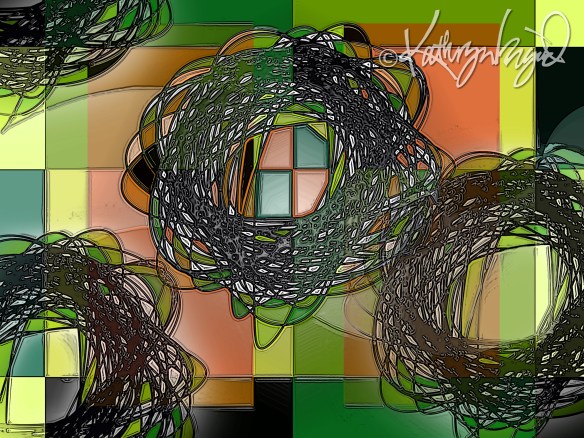
A world of contrasts lies between the powerful opposites among all the colors we can see. In the space between those beautiful extremes, between the flame of orange and the deep sea of indigo, between scarlet and emerald, is where we can begin to take the measure of our understanding of the visible world. And in the knowing, we can rejoice in the wideness of the visible world that resides between late-night violet and the dazzling yellow of daffodil petals newly sprung, between scarlet and emerald.
Category Archives: Thinking Aloud
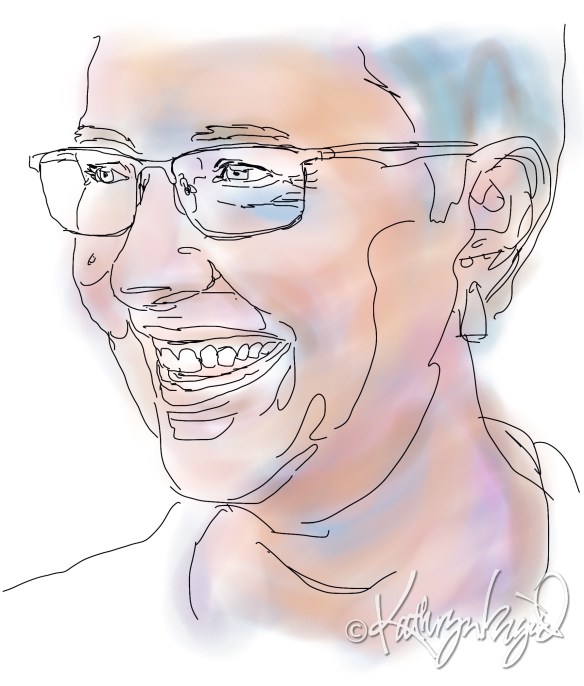
Selfie of the Day
A marvelous post I read yesterday by the amazing Joseph P. Kanski at his blog Implied Spaces—illustrated with his simply spectacular images, each of them in its unique way a self-portrait—mused on the whole topic of self-portraiture and autobiography, considering what the artists and authors in question are choosing to reveal or conceal, to present or pretend. Every time we interact, or for that matter, fail to or choose not to interact, we are making statements. Some of us are constantly focused on, and perhaps occasionally obsessed with, the verity or clarity of what we present to the world.
People in hiding are not limited to refugees and criminals on the run. Many of us assure ourselves that we are being thoughtful, mindful, when we speak and act, yet there are so many more delicate and subtle bits of identity emanating from us at all times that it would be utterly impossible to control every iota of sensory information we convey, never mind how others in all of their complexity are receiving and interpreting the whole. Regardless of the natural intent most of us have to reinforce our own ideals and wishes, we tend to speak volumes in the myriad ways we present ourselves to the world. The challenge to be true to ourselves only increases with maturation and self-knowledge as we grow and age.
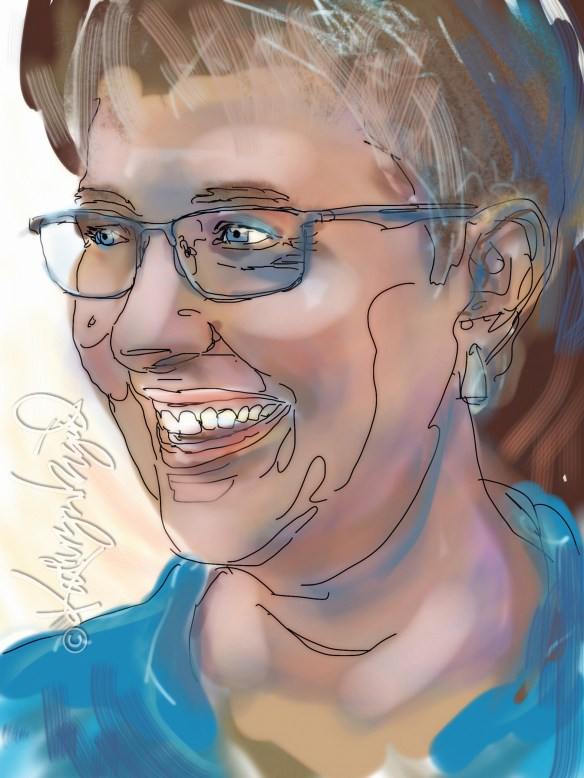
In the present culture of self-revelation, this is, as Mr. Kanski observes, a time when any and every image we present is widely and rather permanently available to be seen and interpreted by ever-increasing numbers, most of whom we will never come to know in any true sense. No time like the present, then, for reevaluating what those revelations are, can be, or should be, according to our own estimation. My hopes and fears inevitably become more visible or available for speculation in every self-image that I offer, so perhaps I shall just see how close I can get to telling my story the way I want to tell it.
My latest: Selfie, 2.0.
Please Don’t Misapprehend My Apprehension
One of my greatest worries is, and always has been, the fear of being misunderstood. Not in the sense of “poor me, I’m an unappreciated genius,” but as in dreading that anyone would think I was saying a bad or mean or insensitive thing when I think I’m doing quite the opposite. This is not an unfounded or inexperienced kind of fear, either. For all that I am so verbal-cum-verbose and try hard to craft my thoughts into words fittingly, I find that the things that matter most to me, especially in moments of intense feeling, become far more difficult to express exactly as I’d wish, and I grow either dumb with the weight of my fine intentions or simply scrambled in what I blurt out in the moment.
Even when I believe I’m at my most cogent and persuasive, I often find I’ve stepped firmly on the tender feelings of those whom I would least wish to offend, and while I am heartily sorry for that and try to be honestly mild and penitent in my responses if they tell me I’ve put my foot wrong, I can’t always undo the hard feelings I’ve inadvertently engendered. Sometimes it’s because I’m left in the dark: even those with whom we’re close can be too wounded or unsure of how to respond and will never tell us we’ve struck a nerve; they might go off silently, nursing their hurt without letting us make amends. Some, too, will bite back at what they consider an affront, but then disappear in a dust-cloud of hasty retreat before I can rephrase to say what I had really meant, apologize, or, in the rare cases when we cannot see eye to eye no matter what, say with due respect that I don’t harbor any ill-will but beg to differ. That, at least, assumes neither of us is a villain or an ignoramus but that our sincere efforts have led us to quite different conclusions. Silence cannot explain, clarify, forgive, or ask for forgiveness, and it certainly cannot open the ears that have been stopped up by anyone’s fixed assumption of my guilt.
And most of all, it can’t allow me to learn from my mistakes, when I fail to convey what I’ve tried so hard to convey. That’s what keeps me awake too late and too long, fussing over the wording of what should, perhaps, have been an easily stated idea or even a passing thought, because I convinced myself, whether through experience or through overwrought and paranoid worrying, it was going to give somebody—anybody—the wrong idea about me.
And there is where I finally spot the heart of the real problem: it’s not all about me, much as I josh about being the center of the universe or pretend that I’m so important. Every other person in the world will never be on the same wavelength I am, not in the things we believe, in the ways we think about them, or perhaps especially, in the ways we express them—or try to do it. And every other person in the world is not going to agree that what I think respectful or complimentary seems that way to them. To expect that kind of universal acceptance is folly; to wish for it is vain; to stay up past my bedtime trying to achieve it is merely asking for trouble.
Surrendering to the plain fact that my imperfection is bound to meet up with others’ occasional misapprehension of my meaning is not total capitulation. But as it might mean I get a better night’s sleep, I do think it worth a try.
Flowering Quietly
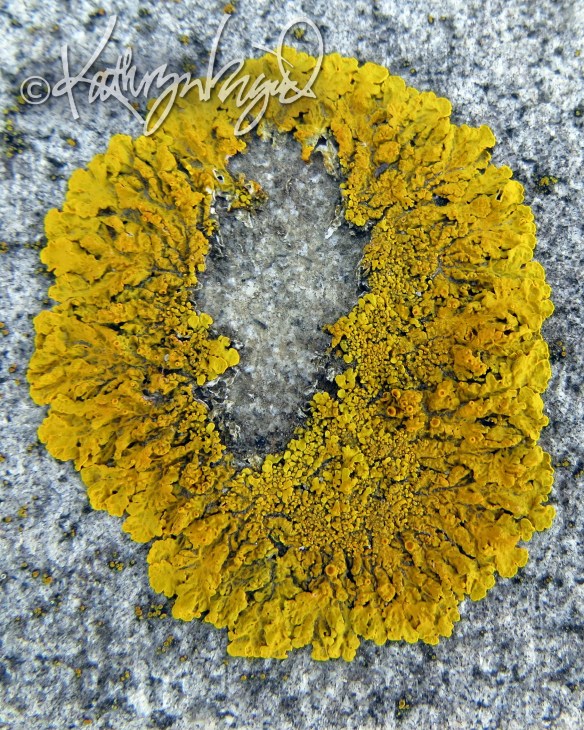
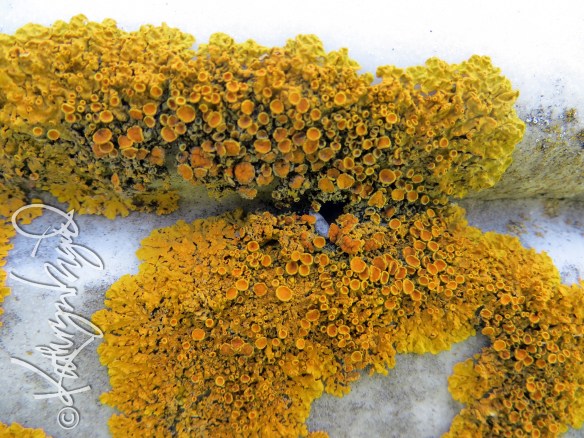
The faintest, mildest, least-noticeable of all things can still have tremendous impact. Take lichens, for example: the most wonderful of flowers, even gardens, on a microscopic scale. Strong enough to wear down stone itself over time, but so delicate and dainty and fairylike that they are rich and glorious even in their seeming fragility.
A Lone Bird
Solitude is not always lonesome; it can be a deeply joyful place of peace and calm. It can be an inward-looking, melancholic sweetness tinged with nostalgia or the cosmic silence in which every breath becomes a prayer. To be alone in the worldly sense never denies the possibility of a welcome, comforting Other presence, or the awesome sweep of knowing that reassures, despite all challenges, that one has a place in the universe, however small.
Formless in the mist, obliterated by dark and storm, or shut from sight by suffering or fear, the things that ordinarily create a sense of normalcy or rootedness may not be gone, but in the state of being all alone, anyone can become convinced she is alone, and that solitude is a burden or a punishment. But in the stillness, too, is the possibility of deeper thought, of slipping into a state where the good and the powerful and the blessed things that fill the spirit—when there are fewer distractions of person-place-or-thing to prevent it—well up and are renewed.
The Road Not Taken Might be Full of Potholes
A dear friend reminded me this week, with a wistful note from the University of Whatsis, just what it’s like to have a massive struggle with your direction and purpose when you’re still young enough not to have done so umpteen times and more, and recognized the inevitability of the Next One. Now that I’m older, if not necessarily any wiser but definitely more experienced, I can say with a certain amount of commitment that my credo may be morphing into “if at first you don’t succeed, fail, fail again.” Therein, much to my surprise, I have learned to find a better recipe for progress than in the mere trying. I wouldn’t know what my artistic successes looked like if I hadn’t first figured out how it looked when my art, or my life as an artist, sucked.
I don’t know if what she’s experiencing is anything at all like my first semester of grad school, but I was not at all confident I’d made the right choice, let alone that I had the necessary chops, when I was having my first major critiques, evaluations, mini-showings, and so forth. YIKES. It all freaked me out pretty seriously. But then I had the peculiarly wonderful personal-lightbulb moment of thinking (I seem to recall this actually happening in the midst of a big end-of-quarter or -semester evaluation in private conference with my main teacher/mentor, but I could be conflating events) that, if things weren’t working at all this way, then I would just force myself to start from scratch and do as much differently as I could possibly do.
No more black and white for now, I decided, despite being addicted to plain graphite drawings; all full-color. No more small scale; everything as gigantic as I could afford the materials and workspace to do. No more fussy detail and slowpoke timidity; be fast, loud, bold, loose, and reckless. Away with the still-life! Time to go all figurative, which I’d avoided like the plague. Down with pacing myself! Stay up for ages and do two, three, ten works at a time, even to the point of pinning up a long wall full of sheets and running from one to another and back again. I worked as fast as I could, using every material and medium I could scrounge up anywhere, gessoing over every image that I found unsatisfying immediately and reusing the paper/board/fabric from which it had been erased. I drew left-handed and I drew two-handed. I used dirt and food to draw with, and my works filled up both my trash cans and my portfolio. My teacher thought I’d gone nuts. My work was unrecognizable. I was unrecognizable, even to myself.
But I lost so much of my fear of failure in that burst of activity. If I made forty works for every one I’d agonized over before, then now I had thirty-nine extra chances to get it right, or at least, better. And simply by working more and faster and with so much less self-criticism in the moments of the making, I did get better.
I didn’t get perfect, and I didn’t go sailing through the rest of grad school, let alone life, nor will I, without continuing to have plenty of self-doubt episodes and artistic flatliners and emotional meltdowns along the way. But believe me, those have all lessened in number and intensity, and I have, after each of them, greater faith that the present moment of frustration and gloom and disappointment is not the end of the road, but just a big ol’ pothole in it. Some of those potholes may give me real artistic/creative flat tires or even a broken axle. But so far, I keep potting along and finding that what the potholes are often doing is just slowing me down enough to notice a side road or alternate route I’d not otherwise have noticed. I’m still a work in progress, always will be, but if I’m open to change and challenge in this, there’s good ahead.
When the Dust Settles
People of all kinds of philosophical leanings readily resort to apocalyptic talk nowadays. We like hyperbole, to be sure. If it isn’t some version of some religion or other’s end times, it’s anything from worldwide economic collapse to irreparable ecological disaster. And, of course, any and every one of the dire predictions could prove true.
But focusing on that sort of stuff, let alone organizing one’s life around it, is my idea of a lousy substitute for real living. The largely Pollyanna flavor of my credo doesn’t preclude my being at least passably realistic about the world and its tribulations, and there are some things about which I am as pessimistic and removed from sanguine comforts as can be, but since I can’t change them, I know that they either will or won’t end at least my world, my life; if that’s the case, it won’t matter one iota to me, now, will it? And if I survive, well then, that’s a whole different kettle of fish.
That’s the concern I think worth entertaining: What comes after the End of All Things? If I exist after what I thought was going to end all of my joys and riches, my struggles and concerns, either by destroying every atom of them or by killing me, then that would seem to be the plan, the attitude worth cultivating. I may have little to offer my fellow survivors beyond a sheepish high-five of shared amazement at our not being wiped out along with all other matter, but perhaps if there is more than one of us still standing after the firestorm or implosion or celestial sneezing fit that has massacred everything and everyone else, we can pool our resources and find other surprising pleasantries besides that we just plain aren’t dead yet. I’m betting on that particular scenario, given the relative utility of such thinking in comparison with stocking up plots and devices for scrabbling to continue to exist in a smoking hole of what was once a world. That one I’ll happily leave to darker and less benevolent thinkers, as I can only imagine living among them would kill me quickly enough anyhow. And I do think you know what I mean.
Speeding Along
Here I am, moving along at speed again. Feels kind of like we’ve all been sucked into the vortex of time and will get spat out who-knows-when and who-knows-where, and in the meantime it’s one heck of a wild ride. But you know, it isn’t boring! I’m just glad I have such good company for the journey among my friends and loved ones. If you do happen to know where I’m headed, please just give me a little nudge in the right direction so my lack of a compass doesn’t get me in too much trouble. Thanks!
Death & Jellyfish
Continuing with parts of the last two days’ topics, I was reminded while writing those posts not only of the vastly varied wonders of my wanderings this past summer but also of the way that they all tend to reinforce my natural inclination to fall into pensive abstraction, thinking of how I fit into this gargantuan scheme of things. Abstractions of all kinds are so prevalent in nature as it is…the marvelous patterns and textures, repetitions and variations everywhere lending themselves to a sort of meditation that, for me, affords space for deep rumination on the grand existential questions as well as the minute beauties within them.
While my species has tremendous tendencies to be wasteful, it seems to me that nature wastes nothing, unless you count the prodigious extravagance of miraculous beauty that often seems to serve no special adaptive or functional purpose. For instance, a live jellyfish undulating through the sea has, simultaneously, the remarkable power of its sting to stun or kill much larger and stronger creatures, but is so delicate and ethereal in appearance that one could easily imagine it a mere soap-bubble, shattered by the slightest atom of touch or breath. A dead jellyfish, washed ashore, may well retain something of that bubble disguise until it has begun to desiccate, and still have some mysterious touch-me-not danger to it; a dead jelly in the kitchen may become food for yet other creatures, chefs and diners who know something beyond its tissue-thin and vaporous appearance. But until it is cooked to the point of becoming somewhat opaque, it also retains an astonishing, magical interior that’s visible through its transparent and translucent outer layers, a living artwork of curlicues and tangled tendrils, pulsing, fluttering threads and striae of rich, delicate color.
What all of this makes me think is that if I, too, am a work of nature, then perhaps I may allow myself to harbor the ambitious hope of being transcendent in the same simple, elegant ways that other creatures are. If I am not spectacular in life, going about my business in this little part of the universe with undistinguished and plodding ways, then at least I will dream of what I can eventually become in death. As I disintegrate and return to the slight molecules of my primeval parts, I would like to think I can renew some other portion of the natural order, feed new beauty with my humble dust. If I can go to my last sleep with this possibility in my heart, I will go willingly, and gladly ready to fade myself to nothingness; what follows will surely be a new kind of joy. It’s the nature of things.
Inventor, Invented
I was thinking about how I used to see the world through my designer goggles. You know, the way kids see what is and think of it in terms of how terrific or terrible they find it, and what they would do if they were The Boss and could make it exactly to their specifications. Yeah, you know: just as adults do. I still never visit a city or park, or sit in any room, without redecorating it or rebuilding it entirely, to have greater comforts, improved functionality, and superior beauty. All according to my standards, of course.
But as a kid, I got a running start at this by scrounging up every bit of interesting scrap and oddity I could find, and taking my current collections and organizing them into bookshelf-filling houses, costumes for characters I made out of other scraps, or perhaps imaginary landscapes into which I could mentally insert any stories I wanted to create. And, unlike some, I never grew out of it. I have always been surrounded by enablers who have not only permitted but even fed and encouraged my addiction to playing with reality. How would I remake the universe in which I live? I don’t know my plan in its entirety yet, but I am always, always working on it.