Full Speed Ahead—Facing Backwards?

Digital illo: Backward-ForwardJittery Janus

A slight, but real, absurdity is troubling my mind:

If something is in back of me, it’s fronting my behind—

Or is it backing up my front? It’s weakening my pride

That heads or tails I can’t make out, so coin flips must decide

Whether what’s aft is yet before, ahead or what’s astern,

Or I’m too turned around and backward-brained to ever learn

If what’s before my very eyes affronts my front or back;

Please, someone, sort it, or I think I’ll have a heart attack,

For hid behind this placid front, behind the back of me,

Yet also forward of my back, where, sadly, I can’t see,

This sad conundrum irritates and pesters me, alack,

For I’ve no way to know what’s going on behind my back.

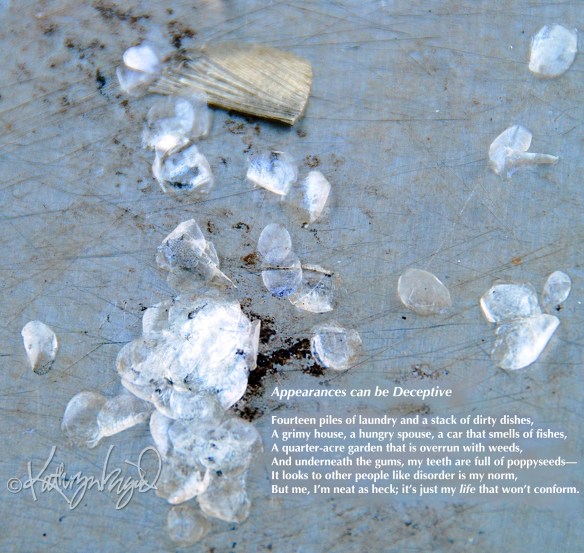
Creeping Up Appearances

Image

Photo + text: Appearances can be Deceptive

All Features Great and Small

Homemaking and decorating, housekeeping and DIY, major construction and minor tweaks: these are the things that turn a building into a true home. It might be as humble as a tiny apartment in a crowded part of town or an expansive villa, or even a palace or a tent, for all of that, but until it is arranged the way that makes the residents feel safe and comfortable enough to want to retreat there from the wider world, it’s just a space, and once it has been nested in the way that makes the residents feel not only that comfort and safety but also a sense of identity within it, it’s genuinely Home, and will remain so whether anyone moves away from it or not.

I’ve said before that I feel amazed and fortunate beyond words to have lived in regions, cities, neighborhoods, and especially Homes that embraced me in those ways over my whole life thus far, and where I have always been allowed or encouraged to express my own wishes and ideas to help me fit into them as well. And that is an incredible gift. But you also know that I can never resist personalizing “my” spaces, improving them where I can, and being extra-happy if I can do that on the cheap.

Photo: Garage Tidying

A clean, functional garage doesn’t have to look like a magazine cover, glamorous and pristine enough to lick, but when even the empty boxes (that whole left corner, plus everything behind the removed and stored interior doors on the right, for example) are in order and clean-ish, it makes all of my daily life a bit better.

Keeping a moderately clean and tidy house is the easiest way to accomplish that sort of thing, in my view. Relative wealth or poverty has less to do with how comfortable and beckoning a place is, for me, than whether anyone takes care of it, takes comfort and even some pride in it. Occasional massive cleanups of my garage (when I have one) so that I can not only park any vehicles I own in it, not just in the same neighborhood, but store what I don’t want in the house of my tools and supplies and even find them when I need them, that helps to make the place home.

For a small example, I need go no further than the kitchen and a look at an object I’ve been using about once a week for many years: my slow cooker. The first I had is long gone, but this model has been around for nearing two decades, I guess. It’s not the newest or fanciest model, but it still looks fairly decent, at least when I give it a major scrubbing, and it still works with impressive reliability. Unlike my creaky old oven, this little appliance is so dependable that I can confidently leave it on the low setting for a couple of days at a time, only checking to be sure that it sits where if it did sputter or overheat it has nothing overhead to damage and my big enameled-steel broiler pan underneath to catch any small volcanoes. Neither of which has ever happened, but still. The heavy crock insert is still, astoundingly, un-chipped and good-looking in its black glazed ruggedly handsome way, enough so I can haul it to the table without transfer to a different serving dish.

The one part that finally died this last year is so small that I was loath to replace the whole rigmarole for want of “a nail”—but I wasn’t about to spend huge amounts of my time hunting for such a little replacement part, for a probably obsolete model anyway, so on the day that the former lid handle literally dropped off in my hand, the hardware corroded through after years of various kinds of steam attacking it, I made a quick-fix with a wooden spoon and a piece of string. Better than scalding my hands while my soup stock was evaporating into thin air. But of course, that wasn’t going to last. When I finally did get time to go through my hardware, the obvious solution was stainless steel with rubber gaskets: stainless, to avoid the previous corrosion problems for as long as possible, and rubber, because the lid itself is glass and the steel, especially bolted under pressure, would put it at high risk of shattering. Like a similar glass pot lid had done the very first time I used a very expensive pot. Insert angry-face here.

Photo montage: Stainless Steel & Rubber

Hardware-store replacement for a pot handle: not just a little life-hack but a useful reminder not to overcomplicate things.

The little fix, though hardly an aesthetic thrill, seems to do the trick perfectly well, so as long as the electrical innards of the cooker hold up, there will be broth and sauces to fill my homely home with slow-cooking perfumes and our bellies with well-integrated nutrients.

A bigger problem in our household was that while we had lived for so many years near family members with bigger houses and the visiting relatives and friends had always stayed in those places, whether with us or without, once we moved across the country it was clearly time to return the favor and see that there would be welcoming space for overnight guests chez nous. The space itself was easy to finagle, both in our rented house of the first year here and the place we’ve now owned for five years, but putting in a comfortable and versatile bed for the intermittent users without breaking the bank was another issue entirely. We had our old slatted bed frame, nothing fancy but perfectly adequate (once I did some serious shoring-up of the flimsy joinery that had suffered a bit over the years of use and house-moving), but mattresses are so expensive!

For a while, I used an air mattress on the platform of the bed, because those are, after all, much cheaper and generally better made than those with which I’d grown up, and the slats are designed to be used without box springs. But after the night when Mom and Dad Sparks had slept (very little) on a mighty ridiculous slope because one end of the mattress had sprung a slow leak, it was definitely time to find a better solution there, too. Turns out, I did. I made a Bed Sandwich. Or a sandwich bed. Whatever it is, we’ve had a number of guests offer to move in with us. Or pack up the bed and haul it home with them.

It’s a hodgepodge of a bed and looks decidedly lopsided and goofy. The Princess who was so sensitive she could detect that irksome Pea under a mass of mattresses would undoubtedly turn up her royal nose at the very idea of reclining upon such an odd-looking conglomerate bed. But our visitors, from those of a certain vintage with replacement body parts and dodgy spines to youngsters who do daily yoga and could go ziplining in their sleep, seem to love how it feels so much that they feel at home in our guest room, and that is my idea of a good DIY project. I’ll bet even the Princess would be willing to give the bed a try, if persuaded by those reviews.

Photo montage: Bed Sandwich

From slatted bed frame, through a series of offbeat layers, to a humble-looking bed that guests don’t want to leave, the Bed Sandwich is one of my most successful homemaking DIYs thus far.

What’s the secret? Nothing fancy. Layers. The bottom layer is, literally, pieced together hunks of 6″ thick foam rubber, old camping mats, that I’ve had for years, assembled into a queen-sized mattress shape and held together with old cotton bedsheets, several layers of them to be sure none of the foam rubber falls or is squeezed out. The middle layer is the one that cost real money, back in the day: when we bought our master bedroom mattress, a very expensive and entirely-worth-it natural latex behemoth, we’d invested in a mattress topper, three inches of natural wool encased in a beautifully hand-stitched natural cotton cover, that was cushy and comfortable, but as it turned out, also a little less smooth and level than I typically like. I bought a memory foam topper for our bed and put the cotton-and-wool one on the guest bed. On top of that, I decided to put a memory foam topper as well, and it works both for additional padding and to smooth out the middle layer’s wavy surface further. Evidently it works. The bottom foam rubber layer, together with the slatted platform of the bed, is firm enough to support those who prefer or need a firm mattress, and the middle and top layers of padding seem mighty popular with both firm-mattress fans and those who just want the bed to give them a big hug all night long.

I am more content both because our guests seem to sleep very well, and I sleep better knowing that they do, especially since I have my sweetheart handy to give me a big hug all night long. Did I mention that as another thing that really turns a domicile into a home?

Going Viral, Part 2: The End of Civilization as We Thought We Knew It

Digital illo from photos: Self-Destruct Mode

Self-destruct mode is easy. Living wisely is hard.

While I’ve been having my tawdry fever-dream worries about unequal health care and expanding populations competing for dwindling resources amid name-calling politicians, suspicious citizenry, and fearful doomsday announcers, there are plenty of other aspects that nag at me as parts of the larger knotty problem. (Aside: is it knotty of me to point that out in the first place?) How do we reconcile the desire for a well-balanced, healthy, safe, educated, and relatively comfortable populace with those ever growing numbers?

This planet is finite. I hear highly educated people saying that we have both the brain power among the best of our species to make our equally finite natural resources capable of stretching to serve the needs of the whole world’s population. I hear some of these same bright lights claiming that the potential is here and now ready to enable humans to live far longer than the current average. I’ve no delusions of mathematical or scientific adequacy, let alone grandeur. But my limited powers of discernment and logic make me skeptical of the veracity and practicability of these claims; even more so, dubious of their desirability. Explain to me why I’m supposed to be so excited to live 300 years.

I’m not too enthralled with the idea of outliving many of my beloved family, friends, and favorite connections, whether the latter are places or experiences that eventually become outmoded or impossible for any reason. Not crazy about having to expand my thinking to find ways to occupy and better myself for not just decades but tens of them. And where’s the appeal in living a zillion years if I have to work three-quarters of a zillion to keep myself in milk and cookies? I have little faith that the American Social Security system will sustain me through the span of a now-typical life in comfort, let alone the attenuated sort being proposed. Where is the food, water, shelter, and acreage necessary to support more of us for so much longer going to be found? If I don’t die for lack of some such thing, will I languish in boredom until I wish I could die? No, really, I’m asking.

If even a sizable handful of humans live that long, I’m inclined to think their wish for such expansive longevity has less to do with all of the additional goodness they can shower on the world and its inhabitants than with how much more they believe the world and all of its inhabitants can do for or give to them. If even a couple of those millegenarians succeeded, I don’t imagine them skipping around the globe and tossing vials of AIDS cures like rose petals out to the milling crowds of children who have been born infected, or composing chorales so mystically entrancing that everyone in earshot will suddenly burst into united song and lay down their enmities, forgotten for eternity. I have more of a pessimistic image of them spending their length of days and years figuring out ways to acquire, win, or steal more, to hoard more, use more, and waste more—without being called to account for it all. Oligarchy is the longest socioeconomic tradition I can discern in human history, and I don’t think any opportunist able to spend more years perfecting that pursuit would likely be inclined to do otherwise. In fact, I would guess that those best able to push their way first in line to receive the treatment and support it will take to live 300 years will already be wealthier than the vast majority.

So what might we get? A rebellion from the planet’s resources themselves, perhaps, like the accelerated depletion of space for the competing needs of farming, manufacture, and residence that outstrip the miniaturization and optimization of those physical systems. What happens is not inevitably so, but historically speaking, it’s typically competition and division. Somebody wins, and more somebodies, both human and other, animate and not, lose. And, also in the long historical tradition, it’s the rich and privileged who win and the poor and disadvantaged who lose. No matter what you think of Darwin and evolution, by the way, there’s plenty of recorded and even remembered history to demonstrate that riches and privilege are no more a guarantee of moral fitness and communal palatability than poverty or lack of resources ever proved that one was inherently rotten or nasty.

Do we just lie back and let chance decide everyone’s fate, with a good shove from the encouraging hand of whoever can afford it to favor their own interests? Sounds to me like a good starter recipe for fomenting an increased appetite for eugenics and eventual genocide. I would hope that we could learn to prefer a taste for a good, balanced stew of self-restraint, collective and collaborative work for the widest benefit, compassion for the weak, and the kind of independence that’s less about cache-building and stockpiling and fortresses, more about how each of us can supply more of our own needs without denying  others’, and how one person’s brilliance can be harnessed to shed light on the widest possible sectors of life.

If we’re too preoccupied with how to get other people to conform to our beliefs and ideas, how to keep our Stuff safe from anyone else using or benefiting from it, and how to make more room for more and better Stuff solely for ourselves, none of this is going to happen. I tend to think that few of us who are safe and well-fed and educated and privileged spend enough mindful time recognizing that we are so only because of all the other living beings who work and sacrifice to make it possible. I can’t fix basic household plumbing. I can live without it, I expect, but probably only until I start to get too cold, hungry, scared, ill, weary, or lost to manage one more trip to the nearest stream for semi-safe drinking water or one more trip to a quiet spot where I can relieve myself far enough from the same drinking stream. I can’t find my way from my own front porch to where my spouse works without constantly consulting GPS, so getting from home to the nearest place I could safely forage for food not tainted by the traffic and household waste of suburbia would be quite the stretch indeed, especially on foot. I rely on so many others to keep me alive and functional that I can’t even wrap my brain around the gap between my abilities and the comfort in which I live, and I suspect that most other middle-class persons, never mind the much-maligned One Percenters, would struggle in the same way.

Seems like an opportune point in our history to pause and reflect on why it is not only a benevolence but a necessity that we do our best to feed, clothe, educate, heal, and make very good friends indeed with the rest of our kind, and perhaps most of all, those we too easily forget to think of as our kind at all. We’ll pay for the privilege one way or another. I, for one, would rather do so by choice and with the hope of friendship as its basis than by force and in fear, knowing that I have stepped on too many backs on my way upward to have hope of anything in the end besides a very, very long fall.

I’m feeling better already, just thinking about it.

Going Viral, Part 1: The Texas Sore Throat Massacre

Digital illo from a photo: Going ViralI’m sorry if I breathed on you. I was unknowingly the “I” of the storm. Patient Zero. One hand on the door knob; ten thousand infected. The maker of monsters, incubator for incubi. Thankfully, I have not yet come across a single one of my hundreds and thousands of contacts throughout this winter who was evidently poisoned into illness through contact with me. I never had any of the usual indicators of being contagious during the whole time I had my various and numerous waves of feeling lousy: no fever, no evidence of strange-colored, pungent crud emerging from anywhere in or on my person…unless you count the slightly hallucinatory character of my thoughts in their natural state. My doctors, when I finally saw them, didn’t seem to think I had been particularly dangerous.

So I wasn’t quarantined. I didn’t get hermetically sealed in a makeshift NASA bubble-style ICU. I didn’t even get quite miserable enough to go to the doctor with my complaints until about ten days ago, despite having felt uncharacteristically unwell so many times through the winter, when I generally manage to go the whole year without suffering more than, at most, one cold. I just dragged myself around with a wan little, pasted-on smile.

But here’s the thing: that’s how Bad Stuff can get passed around. Not every little germy critter that sneaks its way into our bodies, even in this very knowledgeable, clever day and age, is necessarily that easy to spot, let alone to treat. Just because modern medicine can recognize so many more diseases and injuries and conditions than previous generations knew doesn’t mean that every medically trained person everywhere would recognize even the majority of them quickly and easily, never mind how unlikely any of us commoners are to notice and understand them ourselves. So for all I know, while I thought I was being the appropriate combination of careful for others’ safety and stoically dedicated to keeping up my own commitments during the whole fun winter, I might as well have been opening the door to unleash Pandora’s Pandemic. I might have been Typhoid Mary the Second.

Let me be clear about a couple of other things, too, though.

First, I grew up thinking that the nickname of Mary Mallon was as good an epithet for a vile and deliberate criminal mastermind as any. But in more recent years I’ve had reason to revisit that idea and wonder if she mightn’t possibly have been as much victim as villain, after all. The current political climate of preferring divisive self-righteousness and sniffy dudgeon on all sides of any issue about all of the evils perpetrated, always, by Them, not Us, makes it remarkably hard to establish and enforce any policies that do any genuinely positive things to make societal problems any better—poverty, education and healthcare being always top of the list. They’re always somebody else’s fault and everyone else’s problem. I can easily imagine a modern plague getting the better of this entire country as much because we refuse to cooperate with each other and pay attention to some basic survival instincts and practicalities as because anything were especially virulent or unusual.

If we refuse to converse and cooperate, we have no one to blame but our own desire not to be subservient to any greater good. The law of unintended consequences visits its ugly repercussions on us all at times, and most of all when we are busy wishing everybody who isn’t in our happy little 100%-shared-view groups would just stay quiet and out of the way.

Reality works quite differently, as history should have taught us all long ago. If, for example, (a) we don’t provide health care for the indigent/impecunious and (b) they become ill but must find some way to pay for health care, then (c) those able to do so will continue to work when ill. They have no other clear way to pay bills, feed families, and get tasks done than to do the work themselves as always. If (d) the only kinds of work that marginalized populations tend to be able to get are in servitude, then (e) their work will most often be in service work like hourly hire positions as housekeepers, janitors, maintenance workers, food service employees, day laborers, child care workers, and personal health assistants in private homes, nursing care or rehab facilities, and hospitals.

That’s right: if we don’t take care of the poor unless they pay, they will continue to work as long as they can drag themselves there, and the work they do is often both the lowest paid—where, as a bonus, it takes longer to earn enough, while sick, for their own care—and the highest social contact-oriented in all of society. If we want to be truly Dickensian, we can repeat the Typhoid Mary solution as well and imprison the ill to keep them from working; at least in that instance, we can make the choice to either care for that new prisoner or risk his/her infecting the prison population, which again in Dickensian terms could “decrease the surplus population,” but of course containment will remain an ever-growing issue, if the prisoners are dying in droves and the staff either succumb or, more likely, refuse to return.

Meanwhile, let’s just imagine, as some folk are inclined to do, that the majority of the poor anywhere are illegal immigrants and layabouts who only take jobs away from natural-born citizens and live as criminals by choice. We certainly wouldn’t want to either train and motivate any natural-born citizens who are layabouts to do any of these highly desirable jobs that have been stolen from them or, perish the thought!, educate and give incentive to both groups. Thankfully, we have a whole crew of people in many sectors of the political realm working hard to see that there’s plenty of money allocated to such progressive and humane and productive activities as developing larger PACs and private donation coffers to better control election results, and keeping business strong in the blessed US economy by letting larger and larger mega-corporations swallow up dwindling independents until they resemble nothing so much as a snake that has snacked on a water buffalo. I know that I, for one, am greatly relieved that we are nationally so opposed to monopolies, or I might mistakenly think they were popping up by the dozens. It’s also comforting that the same herd of politicos of all stripes have among their numbers plenty who think that the best way to finance such boons to humanity is to cut budget waste in areas like state funded universities, social services, and other massive boondoggles like universal health care. Clearly, educating, mediating, and healing larger groups of people to interact and live in good health, productivity, and harmony is an evil conspiracy.

You could say that feeling unwell makes me, unlike the hardworking poor, prone to lying around and getting irritable, misanthropic, pessimistic, snarky, and critical of the state of this so-called Union. I certainly won’t argue if you accuse me of thinking we’re a lot of selfish, under-informed, entitled rich people and a counterbalance of too many people who can’t support themselves and their families with the paltry resources left for them after the top feeders have had their fill. If, as some social commentators and economists and even scientists claim, the concept of surplus population and limited resources is a fallacious or at least far from inevitable construct, since we theoretically have the brain power to make what already exists on this planet into resources and better distribute them, then I can think of few better, more immediate, or more visible places than health care, civility, and education in which to begin this process. And I can’t think of any valid excuse for anyone who believes in the value of a single human being not believing in the potential value of each human being and thinking all worthy of the effort. Good citizenship and care for others should not be a partisan Issue.

Knowing thus full well that we’re all capable of being stupid, lazy, entitled, paranoid, or just plain bad (just read or listen to the news, if you’ve somehow forgotten this), I still don’t think we should just assume that anyone is any or all of those. Isn’t it better to encourage and defend kindness, generosity, trust, humility, respect for differences, and joy in our commonalities?

Even I, at my most crabby old complainer moments, think it worth a try to do better. To be better. I would hope others might think me worth the effort.
Hordes of Hoards

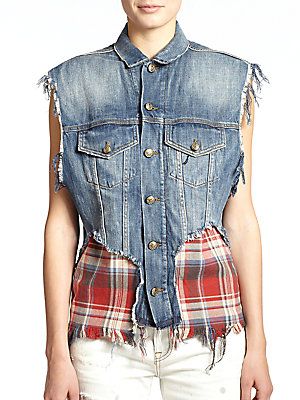
I just had some heartwarming reminders of how wealthy I am and how rich most of us are, without even thinking about it much of the time. First, there was this odd item I came across on a fashion/shopping site that startled me. “R13 Denim & Plaid Combo Vest.”

Saks Fifth Avenue Photo: R13 Denim & Plaid Combo Vest

Photo from Saks Fifth Avenue online: R13 Denim & Plaid Combo Vest.

Available at Saks Fifth Avenue for $695. Yes. Now, imagine this: one could buy a denim shirt + a plaid one at the local thrift store for a combined hundredth of the price (yes, it can still be done, with relatively little hunting), tear off the sleeves and lower portions of both, layer them together, and give the remaining $680+ to the poor, many of whom can’t afford a single one of the thrift store shirts. If a few people who wanted to buy the SFA garment did the latter instead of, or even in addition to, buying the Saks combo for themselves, what might the world look like then? Better dressed at more price points, I’ll wager. My personal taste would argue for not doing any of the ripping and faux-aging of clothes, as I live a life wherein my clothes get naturally beat up more than quickly enough for my taste, but that’s irrelevant to this train of thought.

Am I declaring Saks Fifth Avenue or people who shop there terrible? Certainly not. For one thing, I know plenty of people of moderate-to-massive wealth who are incredibly thoughtful and generous in their philanthropy, regardless of how they spend on themselves. Today I have been wearing a brand name denim dress, still in pristine condition, that I bought at one of the aforementioned thrift stores for $5 USD several years ago because someone well-to-do enough to own and no longer need it donated it while it was still in great shape for further use. Even major businesses, those often characterized as heartless, soulless, and solely dollar driven, can be usefully attentive to the needs of the larger world at times, and if they didn’t make those large amounts of money in the first place, how would they give away any such amounts of largesse?

Am I ranting against materialism because I despise wealth or hate acquisitive people? Far from it. If you’ve been around this blog for more than two minutes, you know I’m a highly dedicated magpie myself, loving Things and Stuff, and sometimes, the shinier and more pointlessly beautiful the better. Nature herself is great at promoting such things, and if you can open your eyes and mind to the view, even the urban ‘wasteland’ or the middle of a massive landfill can offer amazing perspectives on color, texture, pattern, and any number of other sensory attractions that comprise what a person might perceive as beautiful and even useful. But why should it all be consigned to the landfill, then, or just as sadly, to hidden stashes and caches of forgotten junk in our homes and offices and storage spaces? One person’s trash, as it’s said….

On top of the commercial reminder I fell upon today, my friend Switters recently put up a couple of fantastic posts about dealing with the aftermath of getting, keeping, and trying to part with large quantities of the Stuff of life, and I was moved to revisit my own experiences of that process. His commenter Jenny’s recommendations are outstanding. I’ve done most of what she suggests myself, and with great success. Somewhere along the line I imagine I’ve posted about it here, too, but it’s never an outdated topic among us rich folk, we who have anything more than barely enough. And I have learned—most importantly, for me—that decluttering and reviewing my belongings and responsibilities is an ongoing process. I’ll never stop needing to ‘rinse and repeat‘ periodically so that the big buildup never gets overwhelming for me. My original successful foray into the practice has made every subsequent one that much easier and more desirable.

I did learn from my mother and other influential family members and friends that no matter how high the sentimental value of a Thing, it’s increased rather than diminished by use. If Mom had kept her best china and silver like untouchable trophies for Special Occasions only, I’d have been terrified of using them, and I would have missed out on innumerable events that gave them additional mnemonic value through my own experiences. So what if a plate gets chipped or a sterling spoon gets bent? That in itself may add story, character, and relevance to the object. Otherwise, it’s just taking up physical and psychic space while waiting for Specialness that might never happen. So the Venetian wine decanter here holds mouthwash right now, because it comes off of the shelf where I forget it that it even exists to occupy the bathroom counter where, if I’m honest, it’ll get seen and enjoyed much more: every morning and evening at the least.

Photo: Venetian Mouthwash Decanter

The great Venetian Mouthwash Decanter!

Being a highly visual person, while decluttering I’ve clung particularly to the strategy of documentation-before-disposition and photographed—digitally only, to avoid adding photos to the Stuff already requiring management (talk about Unintended Consequences!)—every little thing in great detail, preferably ‘in situ‘ or as I remembered loving or using it most, before parting with it. What I discovered: out of the hundreds, maybe thousands, of things I’ve given away or sold or discarded in the years since my first great household purge, I can think of literally two or three that I’ve ever subsequently missed, let alone replaced. The latter, upgraded, of course. I can barely remember any times I’ve even actually looked at those memory-jogging photos. Knowing that they’re available should I become wistful is enough. For a sentimental softie like me, that was a shocker. Definitely a lesson well worth learning.

A peripheral item that turned out to be helpful to me is my recollection of what meant a great deal to me in years past: my grandmothers were both dedicated to the idea that anything they wanted us grandkids to treasure, they gave us when they were still around to tell us the stories and help us appreciate the context, so that there was a much greater chance we’d invest equivalent interest in their beloved belongings. I don’t even still own all of those items; much as I appreciated the gifts, it was the interaction that gave them the most meaning, and so the memories are the most significant part of the package. Any of those things that were part of that kind of transaction I in turn passed along to treasured people—niece, nephews, beloved friends, neighbors, and former students who became family—with the same story attached, and my own layer of the experience added on. The delight with which these are received is the center of the gift, and makes it irrelevant if they are, in turn, passed on to yet other dear ones, because the items become connectors of history and community that far surpass the inherent value of any of the objects.

That was the bottom line, for me. The realization that what I have loved most in any object is its emotional content and its connection to important people and events in my life makes the keeping of the objects less necessary than the honoring of the love they’ve contained. I will continue to buy, accept, and bear the caretaker burdens of Things. But I think it’s safe to say that the collection will continue to be more sharply curated, limited, and specialized with the passing of time and changes in my values and occupations, too. I have found that some of the beauty in objects arises from their not having cost much or taken a lot of care over the years. I love having my drawing and writing tools organized and readily available, but I don’t much care to store them in lead crystal vases and leather-bound boxes. A clean soup tin does very nicely. And in a pleasing nod to magpie-ism, tin cans are shiny. For the double win.

Photo: Shiny Objects Holding Other Objects

Shiny objects holding other objects. Bonus points.

A Moment of Silence for…

…its own sake. Yes, because despite the huge number of worthy causes these days for which we’re encouraged to meditate for a mere moment, there are few causes more worthy than the good health and well-being that a brief pause for meditation in peaceful silence can help renew in any of us. There is so much need for our attention and efforts to be devoted, and in far larger and more frequent doses than an occasional moment of silence, to vast numbers of those worthy causes.Photo: Hermana's Hideaway

But nobody is fully prepared and equipped for even the least significant observation of those more meaningful causes’ pauses unless we permit ourselves, yes, even require ourselves, to rest and restore our own spirits. Part of my renewal and joy comes, to be sure, from surrounding myself with wonderful people just as I am able to do here. And another, very important, part comes from being able to step back, to lie low for just a little bit, and to be very, very glad that there’s room and time and silence available for me to bask in and be better able to cherish and rejoice in your good company. And to think about what little I can attempt to accomplish before the next such little escape.Photo: Secretive

Big Hairy Deal

It’s bad enough to have a monkey on your back, but when it keeps returning, that’s another sort of trouble. I’d call it a Boomerang-utan.Digital illo from a photo: Boomerang-utan

I don’t know how chronically ill people manage to keep their sanity, but I know that many do. I am far too wimpy and impatient and irritable to imagine just how I would do such a thing. Having had something I suspect is like an underlying infection this winter that meant that instead of the typical one-or-none quantity of winter colds I ended up with three or four successively worse ones, ending (I hope!) in the latest one that arose from my strep throat and morphed through a head cold on into intensified allergies that I had not even known I had, I got a teeny, tiny taste of the miniature germ-monster version of chronic disease. Every time I thought I’d knocked the junk out of my system for good, wham! It reemerged.

Unlike more saintly persons’, my reaction was to become just that much more irritable and old-lady-ish and self-absorbed than usual. Yikes. If any good can be said to have arisen from the adventure, it is that I had some quality time to focus (as much as I was able to do any such thing) on some thoughts that have been lurking in my mind quite a bit lately about health, aging, and the health care systems of this country and others as they relate to an ever-growing and ever-aging world population. Far from solving the problems of generations past, we seem to be expanding upon them and adding to them exponentially while not devoting anything like a proportionate quantity of attention to improving our use of limited resources in caring for our selves, let alone for the world community.

It’s nothing to monkey around with, I assure you. But all wise-cracking aside, I will share some few of these thoughts further with you in a near future post or two. Meanwhile, I am virtually swinging from the trees with happiness at having emerged relatively unscathed and, I sincerely hope, freed from the ongoing attentions of any neck-hanging apes of the illness-related kind as I move onward again. May more people the world over have such good fortune.

Does My Big Backside Make My Brain Look Small?

I know, I know. There are those who might suppose that I actually think through my hindmost end. Most of those persons, undoubtedly, have observed my fine work here at the blog. I like to think that I’m a little more versatile than that. Sometimes. I do not take offense at the idea that my thinking is frequently similar to that of personages sometimes known in the vernacular as “ass-hats”—not a reference, mind you, to millinery designed for Equus africanus asinus—my thoughts can be odd at the best of times. But of course, I would consider it indelicate to accuse any donkeys of thinking as weirdly as I do.

What seems objective to one may be objectionable to another, though the object, to both, might be to subvert overt subjectivity.

See that? I did it yet again, didn’t I.

Is there an intersection or interaction between fact and fiction—or is the connection only full of friction? Can’t say.

But goofy or not, my thoughts are here. And so, my silly friends, are You. Now who’s the nutty one, eh?Digital illo: Butt Thinking Makes It So

Careening toward Excellence

Digital illo from photos: Psycho-Zydeco 1There is no chance, however infinitesimally remote, that I will ever be perfect in any way. Olympic scores of 10 notwithstanding, I suspect that quantifiable perfection is beyond human reach altogether. My reach, however, I can guarantee unequivocally will remain ever short of the absolute.

And I make no apologies for it. Argue the possibility for human outliers if you will, I am no such exemplar.

This doesn’t excuse a perpetual state of lying down on the job. Corpses are already better at that task than we are while still alive, no matter how expertly lazy. And you know that I do speak as a highly skilled practitioner of that art. Not being a corpse, just yet, thank you. Laziness.

I also know, however, that from play, serendipity, accident, and even out of the occasional non-life-threatening disaster can come growth and inspiration. We improve more by learning from our mistakes than from thinking, “Nailed it!” and settling comfortably into what we hope is an easy formula for repeating the success. This, however counterintuitive it may seem, gives me hope.

Perhaps as I go bouncing through life in my random, attention-deficit-slanted, cheerily inefficient way, I may well stumble upon my better self, eventually. Don’t look for me in the Hall of Fame, let alone among the stars. But if my fine intentions and a healthy dose of good fortune should, like mythic planets, align at some heroically splendid place and time, you can certainly find me in the shining company of the wonderfully, luckily contented.Digital illo from photos: Psycho-Zydeco 2