Peaceful Shadowland

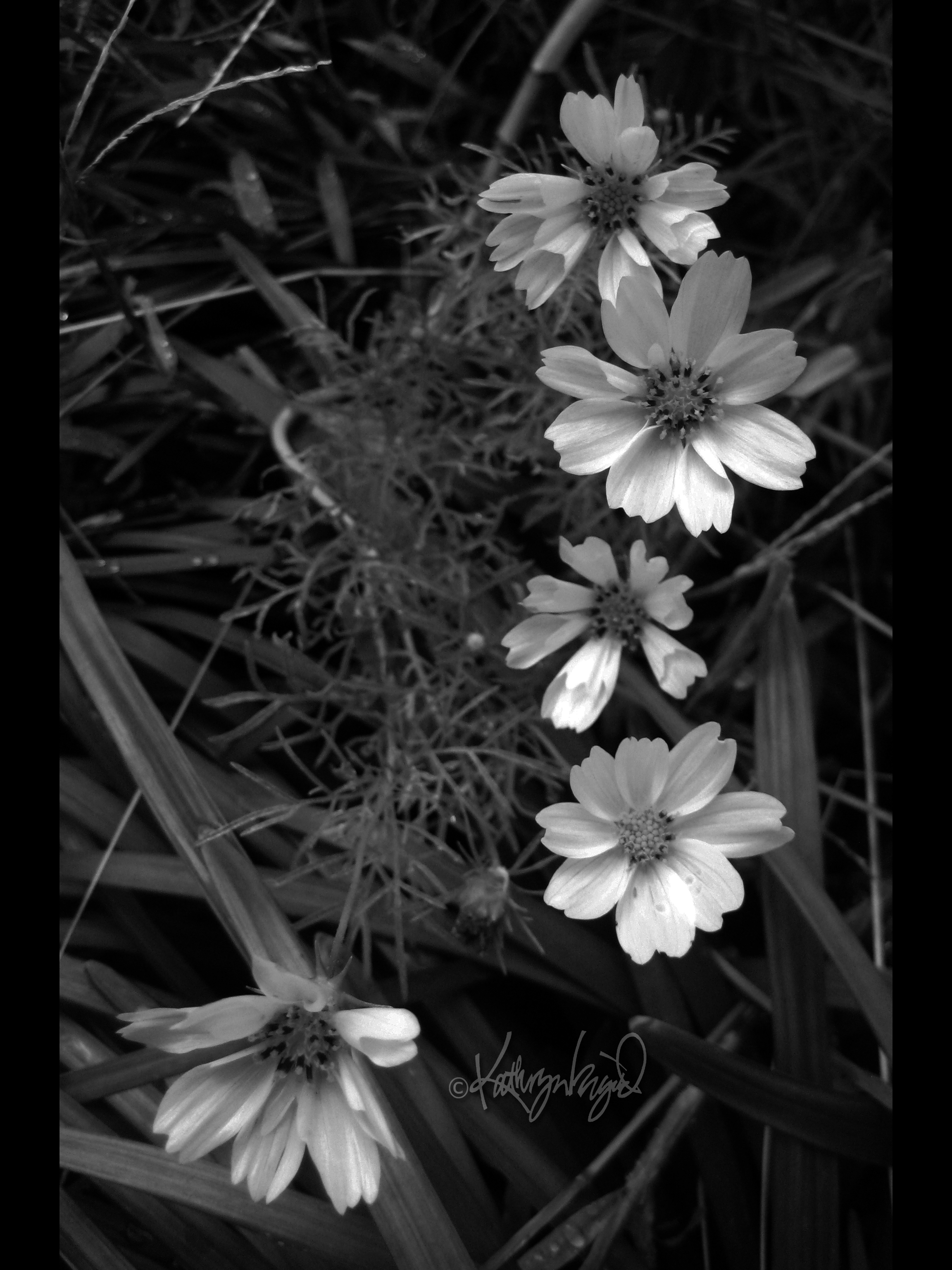
Fall and Winter have a stealthy benefit that’s often overlooked. They lend themselves, more than the ebullience and exuberance of Spring and Summer, to a sort of calming melancholia, to meditation and contemplative times. In Autumn and wintertime, the chaos of the world can be lessened and untangled without the palisade thrown up by the warmer seasons interfering with the endeavor.photo
In part, it’s simply that we are increasingly encouraged by colder and often less amenable weather to stay indoors. Indoors, where the hearth beckons, where our books lie in wait, where our writing tools stay safe from the tempests outside. Indoors, where it’s easy to keep a cup of tea or coffee or cocoa hot and handy while we spend the hours tending to those tasks of repair and renovation that have lain unnoticed when the longer days of sunlight kept pulling us away. The birds flit south and abandon their choir-lofts around the house and the other creatures begin to line their dens and curl up under porches with greater urgency, leaving the airwaves to the less inviting, darker sounds of passing traffic on wet pavement and wind whistling down the fence lines, sounds that urge us to follow our instincts and the local wildlife to seek shelter and keep quiet while the forbidding cold and darkness of the ‘off seasons’ roar through town.

photo

But there’s another great appeal to Fall and Winter, another aspect that captures the gentler and more introspective angles of the imagination, and that is the way that these seasons strip away their frills and wash out any fripperies that might distract us from the most basic parts of our existence. It’s the way this time of year seems to contract not just the length of its daylight hours so that we see things dimly, palely and in lengthening shade and shadows, but even the spectrum of visible color, which becomes thin and subdued in the leanness of winter light. The water recedes from the fruits and flowers and stems of summer’s abundance and leaves them slightly parched and leads them to bend and fall. The slightest breeze, now colder, finds us clutching at our lapels and jamming our raw hands as far into pockets as they can go.photo

In this beautiful world, with the color rapidly draining out of memory, the stillness of hiding and hibernation weighing us into lassitudinous introversion, and the brisk chill of frost settling around our ears and shoulders like lead, we can at last let go of the impetus to run and shout and do, if only for the joy of rediscovering what waits in the seasons of shadow. We can see the world in a sort of refined simplicity if we let ourselves. We can take these moments of clean-slate clarity to listen to our innermost selves for a bit and sort out what does and doesn’t really matter in the grand scheme of our lives. And we can go to sleep knowing that when the glad excesses of Spring and Summer return we will see them through new and more appreciative eyes and perhaps, yes just maybe, even find that in the midst of all that bloom and warmth and celebration we may long for the stringent joys of Fall and Winter once again.

The Lens of Revelation

Discovery and learning don’t always have to come at the expense of laborious study and practice. Sometimes they are handed to us by the magician-teachers who simply tell us exactly what they have done, lifting the curtain and letting us see what’s behind it and in the works from beginning to end. That, at least, is how the learning starts for many of us. Certainly for me. I have been gifted, over the many years of my life, in which I was, am and will be a student forever, with a number of such generous teachers.

I can only return the favor as far as my skills and wit allow, but I hope I’m at least skilled and sharp-witted enough to make it worth a few other people’s while. Of course, the plain facts don’t complete the education by a long shot–the study and practice parts have to follow to make it stick and create anything useable out of it. What you do with the information, as they say, is what completes the equation. But isn’t it fun to share our little secrets, to let each other peek at what’s behind the facade of polish and confidence and see what we can make of it?

Herewith, another little set of iterations digitally made to convert a black and white graphite drawing into a full-color digital illustration.

graphite drawing

Once again, I begin with a plain graphite drawing, scanned and very lightly cleaned to remove dust specks and make the scan match the original. I wish I had made the ‘lens’ look more curved or somehow indicated its thickness better so that there was a more logical reason for the eye behind it being moved that far from its expected location, but then I remember that this is, after all, an utterly nonsensical and *not* logical creature-person. Next drawing, perhaps. For now, I’ll play with the cards I dealt myself.

graphite drawing + color test

To begin the digital part of the process, I just did my usual small test of whether injecting color into a black and white original might bring out some useful or interesting aspects of the character (both the humanoid one and the character of the drawing).

graphite drawing + digital color painting

Why not. What if I isolate a larger area and keep the illustration black and white but with the lens area being in full color? Hmmm. That could work. I ‘paint’ in the color, layering it bit by bit and erasing bits to add highlights or even out the application of the colors.

graphite drawing + digital color painting

Strangely, I find that having only the lens area colored flattens out the image a little more than I expected. I think this might be in part because the color has reduced the contrast and visible texture of the graphite strokes. Maybe I’ll just add a bit more color over the other parts of the drawing. No, not quite enough, I’d say. So I add a Photoshop filter of ink lines to emphasize the drawn textures and contrast more deeply with the coloring.

digital illustration from a graphite drawing

Well, here I go again. I can’t resist adding color to the whole image. I think it balances the image better. But I’m married to the idea of letting the part seen through the lens be the only richly ‘full color’ part–the True Self, if you will, seen through this lens. So I decided to keep what wasn’t part of the lens itself or seen through it mainly monochromatic; a sepia tone for the face seemed in keeping with the sort of Steampunk creature’s vintage-yet-otherworldly quality. And then, of course, the face was flattened a bit by the color too, so I added the inky filter to that as well. And here we are. A day of tweaking and monkeying around with the drawing that took me a few days to draw, and here we are. On to the next project, my friends. Hope you find something compelling to do, too, even if as with mine, your projects only lead to more projects. Because that’s what happens when we share our ideas: they proliferate. Granted, some of them grow up to be really weird characters all on their own, but they do proliferate. Revealing, as they do, further parts of *our* character through *their* lens.

Rainmakers

Now that super storm Sandy is mostly past, those in the wake of the destruction are left to dig out from under all of the mayhem. As all natural disasters do, Sandy left behind not only massive damage brought on by the high winds, flooding, snow, fire and explosions that were part of the storm and its immediate effects but a whole swath of financial, social, political, logistical and definitely not least of all, emotional and personal damages that will take years to be mitigated, let alone resolved. Besides the losses of life and health that are such obvious costs of a massive storm ripping through, we all know–those who have been through this grinder before, anywhere in the world most especially–that there are innumerable other things once held dear that have been slashed away in a few hours’ time and many of them will never be recovered.digital painting from a photo

The homes blown down, stripped away by violent waters, or burned were filled with people and lives and the Stuff of those lives–in many cases, all gone. The businesses closed for a few days, often in crucial periods of their peak season, are eclipsed by those whose doors, if they still physically exist, will close forever and by the many owners and employees and customers who will have to find other resources for making a living or acquiring the services and goods they count on to shape their ordinary lives. They will all find, as my spouse said very quietly to me when I came down the stairs to find him waiting palely on the 11th of September in 2001, that ‘the world as we know it has changed.’digital painting from a photo

But we also know from long experience that disasters, whether natural or human-made, can bring unexpected goodness trailing in their wake. The immediate selflessness and generosity and heroism shown by those who rush into the maelstrom to save others and who pull the stricken into their waiting arms of safety and warmth and shelter and healing are, when we others take a lesson from their shining examples, only the first wave of light and hope to follow the darkness and despair. If we all, whether by the nebulous but potent means of offering support in our hearts, minds, prayers, and invention or by the more concrete ways of donating, digging, driving; of building stronger buildings to replace those lost, remembering those who have died with forward-looking perpetuation of their virtues, and taking up whatever tools we have to recreate a more closely knit community that can expand exponentially to bring in every person with every need and every gift that can fill that need–then every storm is not an irremediable horror and every battle is not the one that will end safety and sanity forever. We are bigger than the storms. We can be the rainmakers who rise up out of ordinariness and even destruction to build something real and new and extraordinary.

You’re Not Afraid? You *will be*!

digital collage

The Jitters

Remember the years when we were young

And captive among our babysitters?

Sheer terror would reign with its horrid thrill,

The unspeakable chill we would call the Jitters.

Under the bed or under the house,

A mouse isn’t safe when the Jitters gleam

Reptilian fangs and rhinoceros horns;

O! The scorns we would risk to release a scream!

Anything dark and anywhere doored

Could harbor a horde of Jittery creeps;

They hide under blankets and lurk behind stones:

The wrack in the bones that never sleeps.

Do I hear the wind? Did you hear an owl?

Or was it the howl of the restless dead?

The moan of a sailor just as he drowned?

All around are the sounds of the things we dread.

That flickering light! The curtains a-moving,

And both of them proving that something is near:

We’d writhe in our agonies, plagued by deceptions

And all the perceptions of what we fear.

This, you remember, was life with the Unknown,

And all of the fun known as children was moot

Whenever night fell or a stranger came calling;

Appalling how it never stopped its pursuit.

Now deep in adulthood, responsible, sane,

We scoff at the pain of those gibbers and twitters,

Yet get us alone, in a vulnerable state,

And sooner or late, we succumb to the Jitters.digital collage + text

Endless Falling

A whisper in the gloaming just pre-dawn
A shiver or a prickling on the neck
A flutter of the eyelid, quick, then gone
And hope of any sleep is now a wreck

Above me in the dark are broken dreams
Above my brow an icicle of fear
Above the awful emptiness, the screams
In silent agony are all I hear

And under all this brittle disarray
And under skin and in the bone and soul
And under some enchantment, night and day
I know this wickedness will eat me whole

Against the dangers present in this fright
Against the door of Death I’ll knock tonight

Foodie Tuesday: Last Suppers and Beyond

I Loves Ya, Cupcake!

I kiss your cherry-colored lips

And suddenly, straight over flips

My heart in loping, loopy leaps

As sugared-up as Mallo Peeps

Get kids at Eastertime to fly,

As ice cream piled on apple pie

And candy canes in cocoa make

Our livers strain, gallbladders quake,

Arteries cringe and capillaries

Bloat, collapse, and the Tooth Fairy’s

Rounds expand a hundredfold

When molars instantly grow old.

You get my drift: one little kiss

Of your sweet lips can lead to this

Extreme, near-paralytic dose

Of dearness, loveliness, and close-

Encountered expiration date,

But loving you is surely fate,

My cupcake, my delicious sweet,

And death of it the final treat.


graphite drawing

If one’s not careful, trimming one’s waistline can lead to wasting away. There’s an art to eating well, after all. What you eat can kill you, but what you don’t eat can, too. What to do?! Think I’ll just lie down here in this quiet spot in the graveyard . . .

The Great Equalizer

Willowy or wallowing?

Slinky or obese?

Ma likes the taste of salad greens

And Pater thrives on grease.

What’s odd is, their cholesterol

And blood pressure and weight

Don’t seem to correspond at all

With anything they ate.

I can’t quite comprehend how one

Eats lard, the other, toast,

And both don’t change; I guess

Food matters little

To a ghost.

Inquisition & Desolation *

digital collage

Inquisition

Her lipstick was of fiery red,

Her mane wild copper, and her nails

Lacquered in scarlet by which pales

The rouge of which the pious said

Was made civilization’s end,

And surely, in her crimson silk

Cut down to there, she and her ilk

Wore carmine on that downward trend

That would someday blood’s red require

As she and they leapt in that fire

In meantime, sanguine all were those,

This ruby dame and all her kin,

And painted red from cloak to skin,

Until the bloom wore off the rose

And in wine-tinged despair, demise,

They fell in desperate gasps for breath,

Plagued by their past like some Red Death

Infected them; to their surprise,

This day their bad blood did require

They leap in that eternal firedigital collage

Desolation

Way out west of Petaluma,

Where the streetlights cease to go,

Only weeds and broken concrete

And barbed wire in one hard row

Braiding up the roadside grasses

In a knotted wind-strung quirt

To whip out and give ten lashes

To the devils in the dirt

There are houses still beyond here,

Long abandoned, though, and shot

Through with rust and melancholy

And dead dreams long since forgot,

And one tough and stringy lady

Hanging on by fingernails

To a past she can’t remember,

Out here where the flat wind sails

* Today’s post is brought to you by:   Zombies! Now 100% Recycled!

Happily Haunted Houses

graphite drawing

Her Monument

In a strange little homestead lit by electric light

is a passing builder’s fancy floating in the neon night;

the spirit of the artisan flits by, nocturnal blue,

and shoots the moon by swooping through the ashes in the flue;

she drifts in starry glimmerings beyond the crooked room

where comet dust is settling on the folly of her tomb. O,

let lie the tools of wisdom where your little homestead rises,

and cry Hurrah! for moonlit nights

and foolish enterprises.

Moth Mythos

Moths have a potent duality of effects on me: they attract and repel with just about equal force. On the one hand, there is their Victorian opulence of velvet wings and ostrich-feathered antennae and their widely looping sweeps of flight as if borne effortlessly on air currents themselves rather than lofting on and above them under power. They can look like jewels tossed into the air or, as hawk moths can sometimes do, trick the unwary watcher into thinking they’re bright, buzzing hummingbirds on the wing.

On the other hand, that sort of squishy, bloated, heavy softness of moths’ bodies and their voracious appetites for things I’d rather have kept to myself (dry goods in the pantry, tender leaves in the garden, and favorite fine woolens) fills me with nervousness that makes the revulsion they inspire in horror stories utterly plausible to me. I can’t help but remember the sweltering summer night when I was young and my family, having been out for a happy holiday evening, stopped at the local gas station to refill the bottomless tank of our giant station wagon; since it was so sweltering, we all piled out of the car to go into the tiny, grubby cashier’s hut where an electric fan was humming and, having an uneasy sense of something untoward behind me, I turned around to see a veritable dust storm of fat moths, attracted by the shop’s fluorescent lights, throwing themselves in spongy, flapping frenzy at the glaring glass until it was almost opaque with their wing-scale dust. Oh, yes, and the fabulously nasty short story ‘The Cocoon’ (John B. L. Goodwin) has never quite left my subconscious mind (awake or asleep) once I read it a few decades ago.

On top of all this, I married a guy who had once had a small moth fly into his ear, get caught and frantic, and instead of finding its way out, worked its creepy, fluttering way right down to beat against his eardrum until a doctor could eventually get the creature out of there. Enough said. I can still look, at times, with a certain dispassionate interest and think of moths as intriguing bits of scientific wonder and visual astonishment, and then I must quickly look away again and reassure myself that there’s not something truly wrong with them. I did at least decide to write a little bit to see if, in the incident of the attack on my husband’s ear, I could imagine the experience from the moth’s point of view.digital painting from a photo

Labyrinth

I crawled the narrow halls in

Darkness ever deepening,

Thinking I might find some clear way through

But too tightly fitted in, too close,

No chance of going back or backing out,

No scent I could recognize to bring me

Back to the distant shore,

No vision, not a speck of spectral light to give

A guide around those curves crepuscular, those turns

Winding ever more toward claustrophobia, to where

The heat was growing more intense, the sound

Of a pulsing drum seeming to speak of waves, making

Me dream the ocean lay ahead—but behind me, in

The now impenetrable night, some Thing, a dragon

It seemed to me, began to drown the liquid lure

Of the drumbeat ahead with its own more frightful,

Louder noise, and then to scrabble wildly at me

With its terrifying claws, at which it seemed

The labyrinth must finally swallow me and

Draw me down into its fatal end—but then—

In a turn of events that was quite shockingly detached

From any turns my path had made

Thus far, the whole puzzling place tipped

Over on its side—there I lay, too fixed

In the halls’ constricting ways to turn and follow or

To roll, and the sea broke forth on me at last, a rush

Of saline waves tearing upon me, heaving me out

Of where I’d wedged, and in a cataract, sent me

Blasting right back through all the sightless turns

Of that preternatural dark, shot me with my sodden

Useless wings back into blazing day where I

Could lie, quivering faintly in my long-lost world,

Deciding whether it was time to die or time

To spread my fragile wings and see

If there was any life left in them.

Musick has Charms

The charms of music can, indeed, soothe the savage breast–and it can bring the terrible savage right out of the calm breast just as well. It’s a power that few can resist, love the music or not; it gets under the skin and slides on into the soul. The marvels of music are not, as you know, unknown to me and yes, I have been both incited and soothed at various times by it.

But I haven’t lived the life of total immersion. That is, as are most fully engulfing passions, left to the titans of the art. Not necessarily people known and celebrated by a large and laudatory world, indeed, but those who, whether in that pop-culture celebrity way or from deep in the dark of the behind-scenes action or somewhere in between have shaped history in whatever bold or subtle way their particular art could do.

I said I was going to be a bit dark and Halloween-ish these days, but I was reminded that this day deserves a different kind of recognition, being a memorable date of another kind altogether: the birthday of one of those titans of musical arts aforementioned. So you get a break from my grimmer humors while I bow to a great musician and a lovely man.pen & ink drawing

My husband, you ask? No, I would surely call him both as well, but I refer just now to one of the musicians who helped pave the way for my spouse, inspires him in his work, and befriended him both professionally and personally in ways that made it more possible for my partner to be quite the accomplished musician and artist that he himself is. I’m talking about the man sometimes known as the godfather of Swedish choral music, Eric Ericson.

He is celebrated by far more than just his family and friends, more even than his numerous choirs’ members and his almost countless students, because he stood at the center of an almost unbelievable burst of musical art flowering in the little Scandinavian nation of his birth and spreading throughout and beyond Europe quite immediately after World War II, sooner than it should have happened by rights except that his own country remained neutral and mainly untouched by the physical depredations of the war, and enough so that a number of outstanding leaders in culture took refuge there during and after the war, creating a remarkable hothouse where those fertile minds could put their restless art to work, and often did so together.

He is celebrated also because, as one of the central figures in this new bloom of music, he helped to shape the whole modern state of choral music, both in the church and in secular circles, in Sweden and to foster its wide spread via his own work and travels, via that of his artistic and intellectual partners and rivals and colleagues, and especially via the many, many young musicians that between them they all trained and sent off into the wide world. Their collective influence, expanding at the virtual rate of plant cell division and sending tendrils around the globe, is a rich and vital gift that will long outlive them all.pen & ink drawing

Thankfully, Eric Ericson, for one, is going to give that theory a run for it, as he has attained more than ninety years already himself. And his artistic offspring will undoubtedly keep the music sounding and growing for a very long time too, and for that I am happy and grateful indeed. We who love choral music today owe him thanks.

With that, I will say that the gracious and generous kindness that he and his dear wife have shown on a personal level to both my husband and me makes me as glad as anything to think of him on this day with great admiration and fondness. I hope that every note I have seen him conduct, heard him play on the piano while conducting and discussing the finer points of music or listened to him hum under his breath as he recollected another bit of his own fascinating and incredibly complex history as a musician will linger in the atmosphere for many years yet to come, and that in turn, no matter where on that spectrum of artistic or intellectual accomplishment any one of the rest of us happens to perch, we too will make our own kind of music echo happily in the hearts of all those whose lives we touch.

Happy birthday, Eric Ericson, may the music you hear always soothe and delight you.pen & ink drawing

I Don’t Mean to Scare You, But . . .

Even though Halloween itself has never been a huge event in my life, you may, just possibly, have noticed a rather dark tinge to my humor (if such a thing exists) that pervades the year regardless of its official celebrations. So I’m hardly above taking advantage of the approach of a publicly sanctioned excuse for some of my own cheap brand of funereal jocularity. I plan to shower you with gloomy silliness as the holiday nears, so if you’ve any fearful tendencies, pull up the covers and plug your ears.digital illustration from a photo + text

A Grackle
May cackle

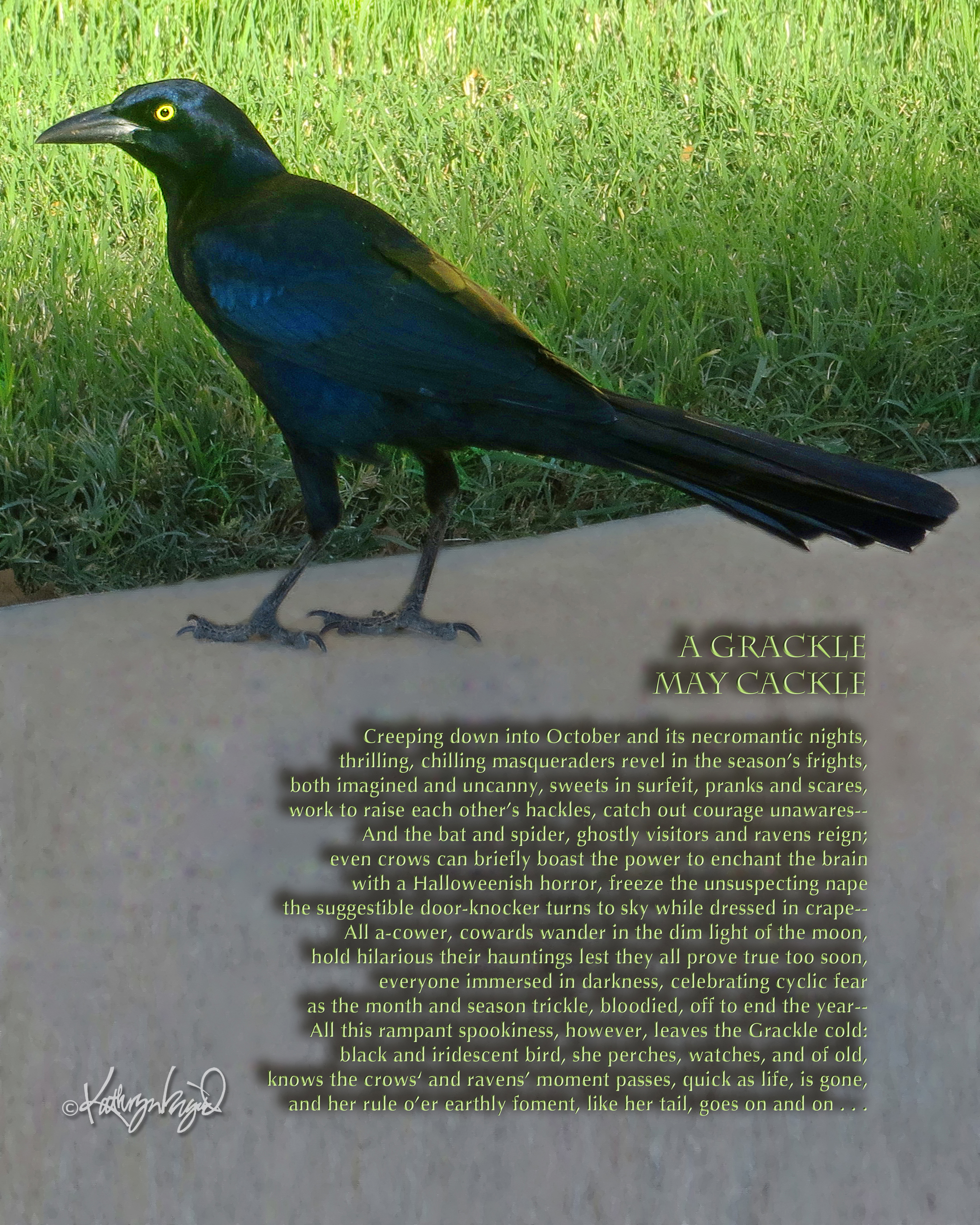
Creeping down into October and its necromantic nights,
thrilling, chilling masqueraders revel in the season’s frights,
both imagined and uncanny, sweets in surfeit, pranks and scares,
work to raise each other’s hackles, catch out courage unawares–
And the bat and spider, ghostly visitors and ravens reign;
even crows can briefly boast the power to enchant the brain
with a Halloweenish horror, freeze the unsuspecting nape
the suggestible door-knocker turns to sky while dressed in crape–
All a-cower, cowards wander in the dim light of the moon,
hold hilarious their hauntings lest they all prove true too soon,
everyone immersed in darkness, celebrating cyclic fear
as the month and season trickle, bloodied, off to end the year–
All this rampant spookiness, however, leaves the Grackle cold:
black and iridescent bird, she perches, watches, and of old,
knows the crows‘ and ravens’ moment passes, quick as life, is gone,
and her rule o’er earthly foment, like her tail, goes on and on . . .