Writing, Wandering, Wondering, and World Peace

I dream of being a better writer and artist. Of being a lyricist or maybe even librettist. Of taking many of my designs for furniture, clothing, sets and costumes, building materials, architectural elements, jewelry, inventions, and any number of the other concepts that constantly float around in my skull into the realm of actual production and use. Oh, yeah, and I dream of World Peace, too. Really.

Some people dream of simply having a healthy child with the average odds of survival and success in an average-length life. That was not my dream, but I know that it’s one shared by millions, not least of all by the author of an outstanding blog, The Hartley Hooligans. Gwen is always a superb writer and a tremendously insightful amateur sociologist-cum-psychologist with a wicked sense of humor. She outdid herself in one recent post. It’s a spectacularly beautiful meditation on how, in general, to live life boldly, fully, and richly. The article is ostensibly aimed at mothers or parents of special needs children (the author is mother to two profoundly ‘challenged’ kids and one who’s not), but I realized as I was reading it that it’s perfect advice for anyone, anywhere. (Note: Unless you’re a self-employed home-dude like me, reading The Hartley Hooligans may occasionally prove NSFW! But never, never dull.)

I don’t ordinarily publish anything that I didn’t write or illustrate myself, but in writing, supposedly, to the parents of special needs kids, Gwen offers insights so universally applicable to any of us who find ourselves with different realities than we had fantasized or expected in life, I think others should hear her uniquely graceful, bracing, hilarious, and touching take on the how-to and why-not of holding fast to our hopes and keeping up with the business-busywork tasks that make them possible.

For myself, I just substitute for her discussion of [special needs children] with the concept of any deeply felt, long-held dreams that I’ve felt unable to achieve or too intimidated or ill-equipped to accomplish, or have thought would be forever out of my reach for any reason.  I replace her talk about [doctors and caregivers] with those advisors and companions of any kind whom I assemble to support me in my life. The advice this wonderful, earthy, real woman gives on how to make the most of any situation; to give myself permission to be human, not superhuman; to credit myself with what I do accomplish and build on it; to surround myself with real, two-way relationships of love, respect, challenge, and support; and to make the most of everything I have with gratitude, is inspiring and pretty priceless.

I’m not one for sharing others’ work on my blog often, but this really spoke to me in a direct way that I think is far more broadly applicable than the already impressive comfort and wisdom of its intended point. I suspect we can all learn from it, so I feel compelled to share it here. Enjoy.

Many heartfelt thanks to Gwen for permission to share this epically useful, sane, marvelous insight of hers with my friends here in Bloglandia!

Digital illo from a photo: Everyday Superheroes

What do superheroes look like? Ordinary people who believe, and persist. No masks and capes required. Halos optional.
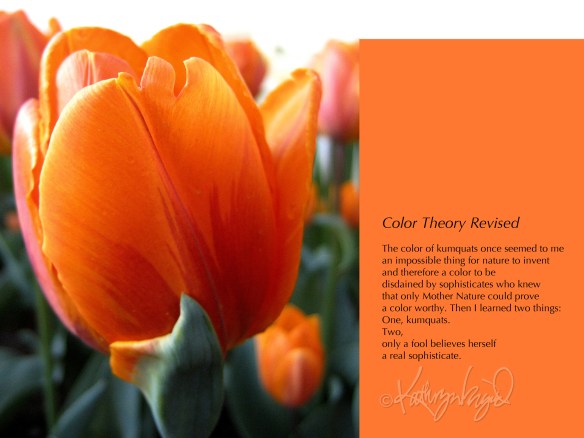
A Philosophy of Orange

Photo + text: Color Theory Revised

Photo montage: Odes to Orange

Midnight’s Butterfly

Image

Drwg + text: Night Wing

Hard Living

A short meditation on difficulties and those who help each other survive them. Guardians and heroes aren’t always so imposing and impressive in appearance. Angels do seem to exist among us in disguise.Text: Amelioration


Digitally altered photo: Angel of Mercy

Angels of mercy come in all shapes and descriptions.

Colorful Language

Photo: A Constellation of Mysteries

Color is just one of the infinite constellation of mysteries that make up my world, my life. What looks like nothing but the fabric of my black corduroy pants has a surprising amount of what looks like non-black color in it when I look very closely. A bit of digital exaggeration and enhancement to bring out the colors I see either heightens the illusion or tells me, once again, that color is far more than meets the eye!

I’ve been taught that color, or at least our perceptions of it, might be manageable. As an artist, I try my best to take advantage of that possibility. But I know my limitations. Even rather experienced and advanced color theorists in this day and age come up against problems with explaining and understanding precisely what color is and how it acts, despite knowing the differences between additive and subtractive mixing, knowing how the retina and brain perceive and communicate color ideas to us, or knowing how the environment and context of what we see affects our perceptions of color.

What does it really mean if I say that Black is a construct that represents the absence of color and White, one representing all colors combined? Or if I tell you that an orange is, well, orange, but in deep shadow it might appear brown or black, or light yellow? Or that humans have white or black or red skin! What gives a single one of these concepts any credence at all? Color, it seems to me, is a matter of faith as much as of science—like so many things we think of as immutable Fact in our little universe. What both science and faith seek to explain, it seems to me, is beyond the scope of human understanding no matter how brilliantly we study and how majestic and divine our inspiration would appear. What is all around us is supremely complex and beautiful and, to my mind, needs no understandable explanation to be so glorious.

No matter what color it is.

Good Night, Sleep Tight. All Right?

Last night, crabby me; lucky me, maybe, because it was for a good cause, but I did not enjoy the sleep study. I was getting tested for sleep apnea, though both the doctor and I suspect it’s more likely new allergies are the impediment to my night breathing and sleep. It was genuinely interesting to have the nice and friendly technician, Mohammad, explain to me all that was being monitored as he wired me up (dang! A perfect Selfie op missed!), including not only my breathing and pulse oxygen levels and heart rate but also limb motion for possible restless-leg syndrome, and EEG to see whether I have any detectable brain activity at any time. Unlikely, as you all know.

But I also wasn’t supremely keen on driving a half hour on our yucky under-construction-ripped-up-everywhere freeway to the lab and back—in an incipient thunderstorm on the return—for a wonderfully UN-restful 9:30 pm-5 am “sleep” that probably totaled about 5 hours of actual unconsciousness. For a person who craves 9-11 hours at a minimum (also a reason for the apnea testing), not my idea of restful. Getting awakened in the pre-dawn dark and effectively kicked out of the house is not my favorite thing even when I know it’s to take off for a fabulous vacation! This morning, of course, in addition to knowing I was going to have a very short night, I was freezing under a skinny blanket with the ceiling fan helicoptering madly over my head, and was told to stay on my back the whole time, too, my least common or favored sleeping position in the first place. I sure hope I’m right about not having apnea, ’cause then I don’t have to go back next week and do this again but with a night breathing Apparatus being fitted.

Although it was almost worth it all to get home and look in the mirror while I washed up and see what looked like humongous globs of snot here and there in my hair. Good thing the scalp sensors are glued on with water-soluble stuff!!! Something sort of like the old-fashioned butch wax my spouse and many of his pals used to groom their flattop haircuts when they were kids. Scrub, scrub, scrub. The body sensors were attached with a more typical bandage adhesive, so they just left grimy circles of a suction-cup sort here and there on my shoulders and legs. So many remembrances of my special time. Here’s to this being a one-time thing.

Needless to say, back home at 6:30 this morning, I washed my snotty hair and piled right into my own bed for another 5 hours, my actual night’s sleep. And then took a 2 hour nap late in the afternoon to top it off. Don’t want to be too tired to sleep through the whole night tonight, no matter how clear my breathing is. I have priorities, you know.Digital illo: Sleeping Beauty

Foodie Tuesday: Do Not Refuse to Enthuse

Does my post title confuse? Bemuse? Please, friends, excuse. My moment of enthusiasm is not meant to give you a contusion, it’s only about infusion.

Photo: Infusion Effusion

For my infusion effusion: nope, not a solo meatball, but a tea ball full of flavoring goodies.

Putting flavor into liquid without leaving the flavoring agent in it any longer than necessary (or desired) is what one does when one is longing for a spot of tea or a cuppa joe, but it is surprising how seldom we remember the option when cooking. Cooking, as I do, for a mostly anti-veggie person, I find that he objects less to things that have been cooked into a dish or sauce until they’re visibly indiscernible and mild in flavor, so sometimes it’s also nice to infuse the food with flavors but not leave the actual flavoring agent in it at all, so as not to distract my partner from his appointed dining.

Making a mild variant of Tom Kha the other day, then, I used a tea strainer for the green stuff and a few other tasty Thai ingredients, knowing that I could pull out the solids when the liquid was seasoned enough by them. A base of homemade bone broth mixed with coconut milk and a bunch of home-ground curry powder is easy enough to throw together when those are all in the fridge, freezer, and/or pantry, as is almost always the case here, curries being as favored as they are in our house. I filled the tea ball fairly full of my various secret-agent Thai flavors: lots of minced fresh ginger and varying smaller quantities of Thai basil and cilantro leaves, lemongrass, red pepper flakes, and I would usually add kaffir lime leaves too, but had run out. In addition, I poured in a little lime juice (to substitute for that last ingredient) and some Tamari. Sometimes it’s fish sauce, sometimes Tamari.

Photo: Flavor Bomb

Strange looking, perhaps, but also strangely tasty.


I put some chunky diced carrots and celery and mushrooms into the broth along with the tea ball and the other liquids and simmered them all until they were cooked to my liking, keeping the heat on a very low simmer for a fairly long time. At the end of the process, it’s so easy to toss in, as I did, a big handful of langoustine tails to finish cooking them. Also great as a plain vegetable dish, with tofu (though I’m supposed to limit soy, because of my thyroid meds), with prawns or cubed chicken. Lastly, though it’s hardly a strict adherence to Tom Kha traditions, I do like to either serve the soup like a sauce over rice or add bean threads or, as in this instance, rice noodles.

So easy, so flavorful, so flexible. And such a dish, in turn, infuses my senses with all kinds of pleasant memories, going back to my first tastes of southeast Asian foods, most notably the feasts prepared by my fabulous Thai roommate and girlfriends when we were all in college together. Delicious. Yes, the memories, of course—and the food, too!Photo: Tom Kha Variant

Between Worlds

Photo: Not the Last RainThis strange new climate we’ve been experiencing in north Texas lately, never mind on the west coast where drought has reentered the vocabulary for the first time in eons and the northeast where winter and massive storms have ruled in a newly lengthy way, makes me think I’m on another planet. Or perhaps a parallel reality. Whatever it is, it seems a bit surreal and decidedly unfamiliar.

In the last number of days we’ve had more rain, more thunder-and-lightning, and more windstorms—even a small tornado or two touching down not far from our home—than many past years have seen altogether locally. We’ve driven along what are normally pastures and meadows and bone-dry fields and low runoff gullies and seen what looks like  it should have the iconic airboats of the southern swamps speeding through: trees and brush sticking out intermittently from extensive marshes where we’ve only ever seen dry land. The phenomenal density and lushness of the grasses and trees, wildflowers in rampant carpets blooming for weeks on end instead of days, and swarms of early insect madness all explode around us in unprecedented extremes.

Then, today, a brilliantly sunny, rather hot, almost cloudless day; it was exactly as I would expect here in a typical mid-May. The rosebush behind the kitchen, shorn before the last storm of its spectacular but doomed bucket full of blooms lest they be beaten to death by the ongoing rain and hail, decides to pop out a couple of fireworks to celebrate the sun’s return. The birds are sunning themselves on every branch and power line as though to soak up rays as quickly as they can. The local lawn crews dash madly from house to house.

Because the weather forecast says we should expect about 7 or 8 days, at least, of rain and thunderstorms to begin again tomorrow.

And isn’t that the way things go? We decide we know how the world will operate, how we expect life to move forward, what we will do within it, and immediately we are given a firm reminder that nature will do as it pleases, that change is inevitable, and that we are small jots on the map of history. The sun will blast its way through a wall of weeks-long storming and then the storms will drop their dousing movable sea back down over the landscape for another round. We make our predictions and forecasts and duck and weave to move through it all as best we can guess we should, and it all changes again.

For now, I am content to adopt a wait-and-see attitude. All of it is rather exciting and surprising and even, welcome. And there’s nothing I can do to stop change. So I’ll just enjoy the weird phenomena as best I can, soak up the rain and then stop and smell the roses between times again when the opportunity arises.Photo: Not the Last Rose

Scream It Like You Mean It

Digital illo: B&BIf you’ve never experienced the almost ferally visceral adventure of hearing a performance where the formally clad male chorus belts out the lyrics of each work, each man in perfect time with what would ordinarily be his voice part (first tenor, bass, baritone, etc), but screaming so loudly that there’s no discernible key singly or altogether—then you’ve never heard the Finnish performers known as Mieskuroro Huutajat (Screaming or Shouting Men). In their performances, even the most famous and familiar songs are deep mysteries to be unmasked gradually by focused—if slightly frightened—listeners. If you haven’t had the Shouting Men experience, however, you might still have had such a hair-raising listening adventure in a supposed concert or rehearsal. Many an ordinary choir has its moments of being involved in an almost unbearable shout-fest.

Sitting in the back of a hard-surfaced rehearsal space packed with a mass choir in prep for the famously big and bombastic Beethoven Nine‘s ‘Freude, schöner Götterfunken,’ with a chorus of big-voiced collegians full of energy and enthusiasm, no less, could conceivably deafen you. Or drive you mad. ‘Ode to Joy‘ becomes almost insufferably opposite to joyful, the choral equivalent of being carpet-bombed, if the singers haven’t already been subject to a goodly quantity of training prior to your visit.

The recent evening where the latter experience reminded me of the aural dangers with which such rehearsals can be fraught was, thankfully, not that group’s first foray into the depths of the piece. They had worked past the awkward or tuneless point of flogging notes and were more focused on nuances of the sound in various parts of the composition where phrasing and textual emphasis begin to be more significant than learning individual notes or when strictly turning the volume ‘up to eleven‘ is the goal. Now it was time to be subtler, to learn why Ludwig van Beethoven or the text’s poet Friedrich Schiller might have chosen a particular word, or what singers in the rehearsal might need to be prepared for when they were handed off in a week or two to the symphony conductor who would lead the public performances. And, of course, it was time to be untying some more of the knots in the choir’s German pronunciation.

Getting the sounds of the language right and even, sometimes, appropriate to a period in history when the language was significantly different from the present version, if that’s when the composition was written, always makes as much improvement in the overall sound of a piece as getting the notes right. Most composers’ works are heavily flavored as much by the natural vowel and consonant sounds and rhythms of their textual languages as by their personal compositional styles and languages. If you’re singing in German but your first language is English or Korean or Spanish or Chinese, as is the case with most of these students, that can take some serious learning and practice.

On the night in question, the big Beethoven rehearsal was followed in less than a half hour by a full concert performance of another massive German choral classic, the Johannes Brahms ‘Ein deutsches Requiem.’ This piece was performed by the most advanced and experienced of the university’s choirs, with even bigger voices among them, in the main concert hall of the campus. That group was, of course, at the end of its whole rehearsal period of work on the Brahms, and was in concert dress and on stage in the far finer and more refined acoustics of the performance space. Attending audience members would hardly think about it, most of them not having just sat in the foregoing rehearsal, but despite the potentially deeper well of experience among the singers, their later stage of preparation, the improved acoustic, and the attentive state of the choristers that arises in performance mode, the problems and possibilities remained pretty much the same. If the German pronunciation was any less accurate, the pitches any less solid and informed, the changes in meter and volume any less clear, precise, subtle, and graceful, there could still be the risk of concert attendees being deafened or merely battered about the head by the cacophony. You might not always think of concert attendance (especially outside of death-metal arena performances) as being dangerous, but there it is.

As a favorite opera educator was fond of saying, practice and preparation could mean the difference between Bel canto (beautiful singing) and Can Belto (a humorous American coinage meaning, roughly, I Can Shout). The zone between these two can be remarkably small when the music is as grand-scale, powerful, and emotionally charged as Beethoven and Brahms’s superb works. No matter which the piece, far better that both performers and audience leave feeling joyful than near to needing their own requiems sung. Yelling “songs” can be an interesting stunt (and one I have experienced in a small and resonant space with that chorus of Finnish gentlemen blaring away at me), and it’s often a state that must be visited sometime during the preparation of a major choral work, too. But unless the goal is actually having listeners’ heads explode, it’s ever so much better that everyone does his and her preparation diligently until the big sounds, even in rehearsal, are not constantly terrifying but in fact mostly soul-stirring. Nice when we can save the shouting for a good standing ovation’s “Bravissimi!” at the end of the concert.Digital illo: Can Belto

In fond memory of our dear James Dale Holloway, who was known to exhort his singers to “never sing louder than Lovely!”

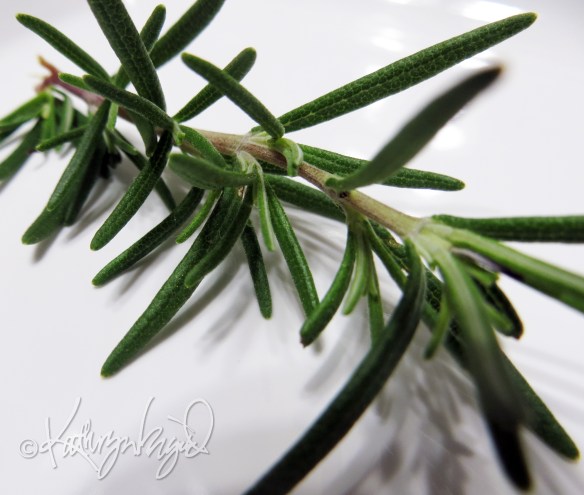
Rosemary, that’s for Remembrance

Photo: RemembranceBecause its distinctive and elegant, resinous perfume and flavor are so potent, the herb rosemary is intimidating to use. Hyper-sensory persons like my spouse can be reluctant to choose dishes when they detect a larger presence of herbs, and this beauty is among the most extroverted and easy-to-spot on that list. It can overpower extra delicate ingredients if used heavy-handedly.

But, like many accomplished and self-assured characters, when this fabulous herb is showcased to its best advantage, it’s the life of the party, the belle of the ball. With such a unique, recognizable scent and flavor profile, it’s easy for me to see how it would be the obvious choice as a symbol, and indeed, stimulant, of memory. Whenever I pass a rosemary plant I am compelled to stroke its incense-laden leaves, their odorous stickiness seeming to hold my hand in a reciprocal grasp. I inhale a long, deep draught of that alluring oil and am transported hither and yon in time and space. Of course, I was thinking about this unusually potent attraction when I wrote about the garden just last Tuesday.

Then, last night, I was reminded of how long the name has had a special resonance for me as well. My email held a little note informing me that my great-aunt Rosemary had just arrived at my blog as a subscriber, and without the aid of any herbal catalyst to take me there, I was transported back in time to when I first remember her, when I was very young and small. This Rosemary, too, has always had for me great beauty both inwardly and outwardly, not least of all because she was kind to little me and my siblings and our young cousins and friends and, especially, to my great-uncle, but also because she was eagerly intelligent, thoughtful, and full of quiet strength.

My great-uncle, her husband and companion of so many years, died just recently, and I can only imagine what a sea change this makes in her life. It’s a strange thing when relatives we have rarely been near in person for great lengths of time, whether the distance was one of miles, ages, life paths, or a combination of these as in our case, die. My great-uncle’s sister, my grandmother, left this world in an entirely different way, having been usurped by Alzheimer’s some years before she died and thus becoming a wholly different person than the one I’d known, while still living in a place where I could manage to see her occasionally without crossing the country. Two different sorts of separation, but in both instances, the person I knew from my youth had effectively been removed from my sight and my daily life for a long time; yet when each died, I was surprised to find I experienced the loss afresh. I suppose it’s partly being able, now, to mentally return to the place and conditions in which I felt I knew them best. Memory, yes, it is a strange and magical thing.

No more icebox cookies while reading in Grandma’s living room, or watching her crochet her perfectly aligned tiny rows to make the best potholders on earth while we visited. No more leafing together through Uncle Ralph’s gorgeous black-and-white photos of a full life and all of our relatives looking ever so much younger and more mysterious and glamorous in them, or hearing him discuss anything from nature’s beauty to what was on the table to psychology with avid, probing attention. Heaven knows there are enough quirks in our extended family to have kept his keen and trained mind busy with this last topic to the degree that I can only imagine it will continue to entertain him equally in the afterlife. He’s probably our there having a good laugh over my having said so.

But as for Rosemary, both the herb and my great-aunt, the preciosity lies, not just in the beauties of memory but also in being stalwart, graceful, and remarkably unassuming for such strong and lovely creations. It is truly good to reconnect with and be blessed by those gifts. One chapter of the story ends and a new and sweet one begins.