Sin Boldly, Fail Dramatically

Anyone who knows much about the instigation of the Protestant Reformation knows that its leadership was not enacted by prim and prissy sorts. Martin Luther, besides being quite the rabble-rouser in the event, loved his beer, offended the all-powerful Church that was his employer and effectively, his owner, and married a rebel nun, with whom he had six children. His being credited with advocating that fallible humans should ‘sin boldly’ rather than live in denial of their mortal failings and inability to produce or buy redemption comes as little surprise in light of this life history. But in all of this there’s also more than a tiny hint of very useful everyday advice as well: thinking ourselves capable of perfection tends to stand in the way of getting anywhere close to it. Making mistakes is the only real way to learn and improve. Practice doesn’t make perfect, it enables us to get closer to our ideal of it and, if we’re really smart and lucky, to change and improve our concepts of perfection.photoOur failures do tend to cling to us. There would be no name for Schadenfreude, not even an inkling of its existence, if it weren’t for our feeling relief in and even reveling in, others’ mistakes and disasters; the more public their occurrence or exposure, the better chance of their (sometimes literally, in this digital age) going viral. But for every ninety-nine spectacular pratfalls, there is one person who, by dint of dusting herself off and jumping up with agile alacrity to redo the test and win the day, makes the fall look like a flashy prelude to a show-stopping grand finale that everyone will envy rather than ridicule. What makes this person enviable is not perfection but the ability to rise up from the ashes with new wisdom and determination, both gained from what was probably a whole series of dazzling falls in the process. Even more desirable is the one who manages to let us all in on the secret, admitting fallibility and mortality from the start and leaving the curtain wide open so that we can revel in the learning process with her before she ever hits the stage, can learn from her mistakes. This is a kind of brilliant generosity I have always admired.photoRisk. Taking risks means you will have bumps and bruises to ego and, possibly also, body. Taking none guarantees you will have a dull life and probably, a colorless soul. Worthwhile risks might conceivably include real danger: one can take chances that cost money, job, power, relationships, physical injury–life. More often, they will cost a measure of pride, and that’s something nearly all of us can afford to lose (and some probably should offload a ton or two of it). A policy I developed for myself when I was in college and such a fearful ninny that I would hardly have survived my undergraduate years let alone moved forward in any other part of life if I hadn’t finally forced it on myself, was to accept that whether I believed it or not in the moment, whatever it was that scared me probably wouldn’t kill me. Sounds silly to all who know how minor were the things that held me in utter terror, but the fear was real even if the danger was not. The adjunct rule I decided to apply to this idea was that if It (the risk of the moment) did kill me, it certainly wouldn’t bother me anymore.photoI may have worded these rules in a slightly tongue-in-cheek mode, but I conceived of them as an actual, practical reassurance that anything life hands to me I ought to be able to handle sufficiently. And that hey, if I don’t end up managing quite that well every time, I’ll make some meaningfully big mistakes, learn from them, and do better the next time. I’ve learned that I can’t be humiliated unless I allow myself to be–in truth, it’s strictly an internal experience when you really boil it down, and there’s nothing that says anyone or anything can force me to feel mortified if I refuse to do so. If I make enough mistakes along the way, I’ll get better and smarter to the degree that I’m unlikely to deserve anyone trying to humiliate me anyhow. Being wrong doesn’t necessarily mean burning because I’m flushed with embarrassment, let alone guaranteed burning in Hell; letting it get to me and not taking the opportunity for growth from it is the true error.

From the Bottom of a Well

digital illustrationThere are wells whose bottommost dark can hardly be imagined, let alone reached, abysses hidden in all of us that emit no light and rarely give up answers. There are parts of each of us that we can scarcely understand ourselves. Places in which no one else seems able to make sense of us. It does not diminish us, singly or as a species, but it makes living life a greater and more delicately convoluted adventure at every turn.

For me, this means that I need to find the positive in an assortment of inner oddities and personal distinctions that most often remind me of their presence in random, unpredictable and even annoying ways. The unusual synaptical dances that cause me to read upside down, backwards and sideways instead of the particular direction in which my peers and comrades read make me a very slow reader since texts around here are designed with the literate majority in mind. But I think that reading things four times through just to make sense of them does sometimes immerse me more thoroughly in the text if I let it, and it can help turn a mere reading requirement into a commitment. Drawing, when my hand tremors are being pesky, demands that I become more than ordinarily focused and deliberate as well. There are lots of frustrating nuisances that can be turned into usable stuff with enough thought and effort and patience and, well, acceptance.

I still have a mighty tough time scraping up that attitude, though, when it comes to getting a handle on anxiety. That, my friends, is my bête noire. Most of the time I work around it fairly well. My medication and years of learning coping skills and the support of family, friends and health professionals have made much of my anxiety mostly manageable, especially the social anxiety that long made it a near impossibility to meet new people or have conversations with any. But there’s this lousy aspect that keeps on lounging around in my psyche and popping out like a jack-in-the-box at the most inopportune times without so much as a how-d’ye-do, and I have yet to discover a single upbeat way to dress it up and take control of this fiendish pop-up and its ghoulish torments.

The particularly loathsome aspect, to me, is how utterly ridiculous and tiny my personal bane appears to my rational mind, yet how entirely paralyzing its power remains over me whenever it rears its nasty clownish head. It’s not especially complicated to explain, just seems impossible to me to solve; the parts of social anxiety that I’ve never been able to undo or conquer thus far have to do with any kind of business or personal transaction that seems to me to have any chance of including a need for me to request or require help of any sort. Add to that my continuing pointless yet persistent horror of using a telephone or communication forum of any kind for those needy purposes, and it’s a peculiarly potent combination of fears that can keep me from getting the littlest and quickest things done for days or weeks on end while I try to summon the nerve to move forward with them.

Sometimes I can persuade myself over a long enough period to make the call or write the email or knock on the door to ask for information, make a transaction, or schedule an event, and sometimes I just remain stuck in the grip of that inertia that neither solves the problem nor lets me forget that I am in its power. And believe me, I know how abysmally foolish any attempt to explain my terrified reluctance to any sane person sounds: it sounds beyond childish and outlandish to me. But that rational part of me has very little sway over my phobias, so only once in a wildly long while do I get up the courage to do that unbelievably little thing that others can, and I should be able to, do without batting an eye.

The good news, and yes there is plenty of it to get me through the day, is that I have lived a good long time visiting the bottom of this particular and soggy well without losing my ability to see the light up at the top end of it or even to experience a truly happy life by keeping my trips down there as separate from the rest of my existence as I know how to do. And strangely, I have found that the same rain of frustrations, frights and fears that occasionally pelt down the well around me can also lie at my feet like a watery mirror, reflecting enough of my better self to remind me to come back up into the brighter world and leave my fears behind. Even if I have to wait for the rising tide of it to carry me back up and out of there for respite.digital illustrationMeanwhile, I can remember that having Spasmodic Dysphonia tends to make me not merely a prisoner of my halting speech but also more conscientious about conserving, preserving and rehabilitating my voice. More importantly, it gives me yet greater admiration for those who use their voices in extraordinary ways, both those with SD or other speech anomalies (i.e., Diane Rehm and James Earl Jones) and those without (Angela Meade, Colin Balzer, Morgan Freeman). And while I may not have perfect pitch or infallible hearing, there’s nothing notably wrong with my ears. Sometimes I even suspect that being at the bottom of a well gives me a better appreciation for good acoustics!

Timid Creatures that We Are

photoUncertainty of Heart

Amid most fond expressions of affection, endless love,

Devotion and determination to be stewards of

These sentiments and feelings, is that little nagging voice

That tells us it would not be so if we had any choice,

Because we are perfidious by nature, roaming, weak,

And fearful of commitment to degrees we cannot speak,

And paranoid, on top of it, that others are the same,

And so we speak our pretty vows and play our little game,

Attempting to convince ourselves as much as other folk

That our desires and adoration aren’t some flimsy joke—

The shocking Surprise Ending to this tale is that at death,

Some of us finally realize upon our final breath

That all of it was true, and that our hearts were so inclined;

Too bad we take so long, we fools, to see that we have lived as blind.photo

There are No Words . . .

photo

photo

photo

photo

photo

photo

photo

photo

photo

photo

photo

photo

photo

photo

photo

photo

photo

photo

photo

photo

photo

photo

photo

photo

Night Needs No Dreams and Dreams Need No Night

Magic happens whether supernatural beings or prestidigitators are present in the event or not. Marvels of every kind are present in the everyday and the ordinary if we only know where to look and how to see. Who are we, mere mortals, to question the existence of the miraculous or to doubt that it plays a role in the large and the small parts of our lives or that we, in turn, play our parts in it?photoWhy should we always second-guess the truth of the impossible, I wonder? Isn’t that notion so perfectly strange that it absolutely must be correct? How can we accept our own reality and yet fail to acknowledge the beauty and oddity and outrageous loveliness of all Otherness? Really, how?photoWhen night falls, sometimes we sleep; when we sleep, we may well dream. Nothing requires it, though, or guarantees that this is the natural sequence, the absolute pattern of things. No more do we know for certain that day brings wakefulness or waking, sanity.photoAll I can say for certain is that reality is far broader and deeper than I in my small, individual way can ever quite hope to comprehend–and probably than I would want to know, even if I could. It’s the mystery, the unknown and unknowable that makes life so piquant and our human places in it so poignant, after all. If it weren’t for the puzzles and conundrums and outlandishness that fill the spaces between the usual and expected bits of life, what glints of peculiar joy would decorate our dreams?

Go on now, let me go back to sleep.

Let Us Drink to the Lady

Tasting Danger

She made us cocktails, bright and cold and brilliantly tasty

And nearly great enough to save all humankind,

Though possibly we could, in slurping them, have been less hasty,

For Thursday, carelessly it seems, she lost her mind.digital artwork

Foodie Tuesday: Fork It Over

photoThe stick-up artist and the greedy eater alike may demand that someone should ‘fork it over‘ or relinquish the object (monetary or comestible) of affection, and that, at speed. But besides cramming edibles into one’s mouth, the fork can serve a number of other useful purposes in the kitchen and at table. Not least of these commendable actions is the release of air. I shall leave it to your imaginations to determine whether some excessively greedy fressers mightn’t do well to have the fork impale them directly and thereby release some of the pent-up methane or other dangerous-to-diners gases, but there are some ways to use a fork for more benign and neighborly expulsions of atmospheric pressure.

photoThe first is to pierce pastry before baking, so that heated air inside or underneath a pastry layer can escape during the process without tearing or exploding the baked goods and their contents throughout the oven or, more excitingly yet, onto unwary bakers lifting said goodies out of the oven. My mother, famous for making what I still believe is arguably the best pie crust in the universe–always exquisitely flaky and golden and crisp and fragile, never soggy or tough–blind baked crusts without ever using pie weights, and only pierced them thoroughly with a fork before the baking. Crust made this way will indeed rise up like an egotist’s inflated chest, but only before those little vents disperse the steam and let the pie crust relax back into the pan just as it should. As far as I’ve been able to ascertain, the added benefit of this approach is that when a filling is added that will bake further in the crust, it leaks into the piercings a little and caramelizes there, both stabilizing the crust and adding a little candy crunch to the pie. In the same way, venting the closed top crust of the pie with a fork before baking it keeps the dough from ballooning explosively (oh, the joy of spurting jammy fruit juices around like candy lasers!), and again, from holding in unwanted moisture that can defeat attempts to have a splendidly juicy pie interior without compromising the extravagant crispness of its crust.

photoBut enough about pie for the moment, I’ll get back to that soon enough, as you’d guess. I always tend to come back to desserts, don’t I.

photoMeanwhile, piercing other foods for pressure-control purposes is pretty effective too. If you happen to like baked or roasted squashes, root vegetables and tubers, I hope you’ve been informed in good time that pricking the skin sides of them before exposing them to high heat is a helpful way to avoid reenacting the demise of the Hindenburg. One of these many dreamy dishes made with the help of the humble fork: Baba Ghannouj.

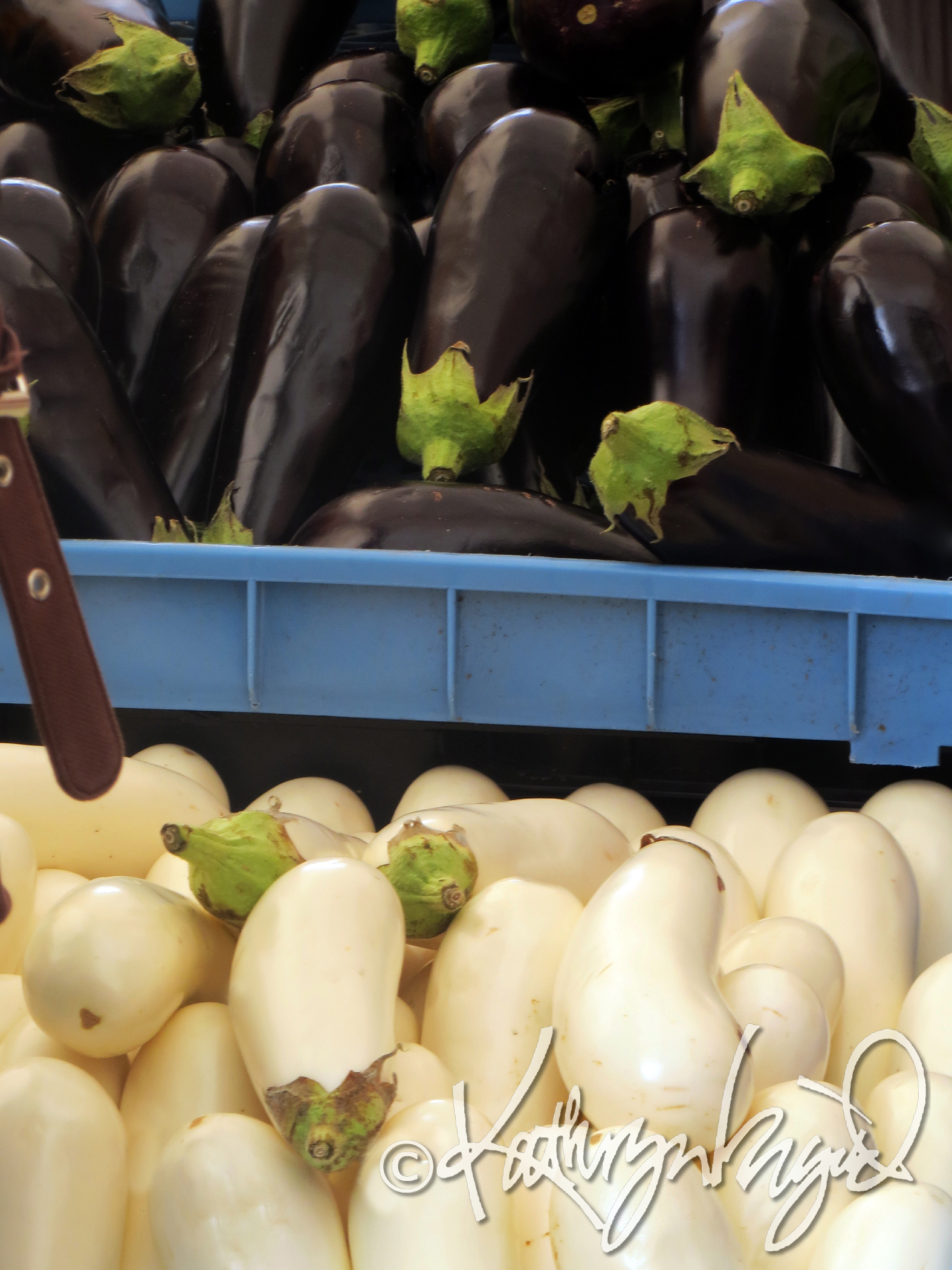
This venerable meal-starter dip or spread is not much beyond roasted eggplant, crushed or pureed and well seasoned. But, like many classic dishes from around the world, that is an egregious oversimplification of the subtlety, complexity and variability of the concoction. What remains true is that it’s mighty tasty. My personal combo for it would be less garlicky or oniony than some, mainly because of how my kitchen palette has changed since my life became linked with Mr Spouse’s, but also because my personal palate followed suit and, further, because I think heavier, more intense flavors like those, if overused, can mask more subtle and delicate ones. I submit to you a version of it.

photoBaby Baba Ghannouj

Eggplant (1 large), tahini (4 tablespoons), preserved lemon (1/2, diced), fresh lemon juice (2 tablespoons), lemon zest (grated peel of 1 whole lemon), cumin (1 teaspoon or more), olive oil (4 tablespoons) and roasted garlic (1 heaping teaspoon).

If you can, blacken and blister the eggplant’s skin over open flame and then roast it to softness in the oven. For this, preheat the oven to 375ºF/190ºC. If you haven’t flame roasted the eggplant, cut it eggplant in half, lay it on a baking sheet or pan greased with olive oil or lined with a silicone sheet, and pierce its skin all over with a fork before roasting it. Roast until it’s well softened, about 20 to 30 minutes (check with gentle pressure occasionally; you can use the back of the fork for that), and finish by blackening the skin under the broiler.
When the eggplant’s soft, rub off its skin. Needn’t be perfect; bits of blackened skin will heighten the smoky flavor of the Baba Ghannouj. Put the flesh in a bowl, along with the rest of the ingredients, and mash it all up together with the famed fork. Serve garnished with a further drizzle of olive oil, toasted sesame seeds, and a sprinkling of thyme, or a toss of za’atar.

A New Day

A beautiful rarity changes everything around it. The appearance of the exquisite anomaly transforms all proximal life into a sweeter reality. I have seen occasional scissor-tailed flycatchers since moving here, but these marvelous creatures clearly love to fly, and that means the sightings are fleeting and I am seldom fortunate enough to see them, let alone agile enough to record the moment photographically. But after constant misfires and long stretches of not seeing the pretties at all, I finally got my moment. Besides making me euphoric, it felt epiphanic.photoWhat if, I thought to myself, I could become like those lovely birds? Is it possible for ordinary people to be the beautiful rarities that break through mundane reality enough to spark others’ anomalous joy? Of course we can. It’s not easy, to be sure. But if we can be stirred so deeply by pretty little long-tailed birds, by an intricate mathematical equation, by a magnificent ocean wave, or by a rusty gate creaking open to a secret courtyard, why then, an act of kindness bestowed on a stranger or a smile lighting up a dark moment for a friend might in fact be just enough. And more might be better.photo

Unfinished in Perpetuity

digital artworkWork Forever in Progress

Hundreds of lines later,

I have nothing to show

except if you count

a sense of accomplishment in having

been faithful to a commitment, in having

persisted steadily in the face of the

unseen and unknown, in being

somewhat soothed by the simple

process of having given a little

heart and soul to something

simply because I could.

However I came to exist,

I think I might be a little bit

the same kind of puzzle myself,

imperfect and utterly incomplete,

but nicely so, for all of that–

nicely, because,

after all, I am working my way

toward being something at last,

and whether I have

an encompassing purpose or not,

I have at least

begun to Be . . .digital artwork

A Concert with a Wedding Attached

Seventeen years ago today I got married. And as all of you who have visited this blog with any regularity know, when I got together with the man who became my husband, spouse, best friend, partner and daily companion, I gained a world of music. Of course, music was a big part of my life already and distinctly a contributing factor in our getting together in the first place; I worked in the university art building, right next door to the music building, and spent plenty of quality time there going to concerts, meeting with friends and all of that sort of happy thing, and when the nice Director of Choral Activities asked me if I’d be willing to help spiff up the aging auditorium for the annual Christmas concert festivities I gladly said yes. That was only the first time I made banners for an occasion of collaborative fun with that nice DCA man. Less than eight months later I was making bunches of banners to fill up a church nave for our wedding.scanNo surprise that, since under friendly pressure from them we gave up on the attractive idea of eloping and just having a party with our family and friends on our return, we decided that the best alternative was to have a celebration with lots of music and just party all the way through the event. Turned out it was easy to do so.scanAssembling our wedding’s participants was easy-peasy. Relatives and friends from work, home life and church lined up and pitched in as planners, greeters, acolytes, reception hosts and much more. Clergy? Well, as the daughter of a bishop I didn’t have far to go to hunt up someone to marry us. The church’s lead pastor presided and Dad officiated, and a dear sweet retired pastor friend served as lector. Witnesses? Having three sisters, I had no problem lining up a team; Richard’s backup was easy to arrange as well: his sole brother, our mutual beloved friend Jim, and Richard’s colleague and partner in choral crime, also named Richard (Nance). Musicians were easiest of all for us to arrange, unsurprisingly.scanWe had an outstanding pickup choir of students and members of Richard’s choirs, past and present, and friend-colleagues playing horn and singing the processional solo. Jim, getting in some exercise during the service, was organist as well as standing up for us. That, as well as having helped us plan the whole service and choose its music, and set one of my texts to music for our congregational hymn. Richard N, besides joining the altar party, pitched in (no pun intended) musically as well, conducting the choir for us in a lovely collection of pieces capped by the premiere of the exquisite anthem he composed for the occasion (now a best seller for Walton Music!).scanYes, this is a brag post. Happily, all true.photoHappy Anniversary, my Love.