Moth Mythos

Moths have a potent duality of effects on me: they attract and repel with just about equal force. On the one hand, there is their Victorian opulence of velvet wings and ostrich-feathered antennae and their widely looping sweeps of flight as if borne effortlessly on air currents themselves rather than lofting on and above them under power. They can look like jewels tossed into the air or, as hawk moths can sometimes do, trick the unwary watcher into thinking they’re bright, buzzing hummingbirds on the wing.

On the other hand, that sort of squishy, bloated, heavy softness of moths’ bodies and their voracious appetites for things I’d rather have kept to myself (dry goods in the pantry, tender leaves in the garden, and favorite fine woolens) fills me with nervousness that makes the revulsion they inspire in horror stories utterly plausible to me. I can’t help but remember the sweltering summer night when I was young and my family, having been out for a happy holiday evening, stopped at the local gas station to refill the bottomless tank of our giant station wagon; since it was so sweltering, we all piled out of the car to go into the tiny, grubby cashier’s hut where an electric fan was humming and, having an uneasy sense of something untoward behind me, I turned around to see a veritable dust storm of fat moths, attracted by the shop’s fluorescent lights, throwing themselves in spongy, flapping frenzy at the glaring glass until it was almost opaque with their wing-scale dust. Oh, yes, and the fabulously nasty short story ‘The Cocoon’ (John B. L. Goodwin) has never quite left my subconscious mind (awake or asleep) once I read it a few decades ago.

On top of all this, I married a guy who had once had a small moth fly into his ear, get caught and frantic, and instead of finding its way out, worked its creepy, fluttering way right down to beat against his eardrum until a doctor could eventually get the creature out of there. Enough said. I can still look, at times, with a certain dispassionate interest and think of moths as intriguing bits of scientific wonder and visual astonishment, and then I must quickly look away again and reassure myself that there’s not something truly wrong with them. I did at least decide to write a little bit to see if, in the incident of the attack on my husband’s ear, I could imagine the experience from the moth’s point of view.digital painting from a photo

Labyrinth

I crawled the narrow halls in

Darkness ever deepening,

Thinking I might find some clear way through

But too tightly fitted in, too close,

No chance of going back or backing out,

No scent I could recognize to bring me

Back to the distant shore,

No vision, not a speck of spectral light to give

A guide around those curves crepuscular, those turns

Winding ever more toward claustrophobia, to where

The heat was growing more intense, the sound

Of a pulsing drum seeming to speak of waves, making

Me dream the ocean lay ahead—but behind me, in

The now impenetrable night, some Thing, a dragon

It seemed to me, began to drown the liquid lure

Of the drumbeat ahead with its own more frightful,

Louder noise, and then to scrabble wildly at me

With its terrifying claws, at which it seemed

The labyrinth must finally swallow me and

Draw me down into its fatal end—but then—

In a turn of events that was quite shockingly detached

From any turns my path had made

Thus far, the whole puzzling place tipped

Over on its side—there I lay, too fixed

In the halls’ constricting ways to turn and follow or

To roll, and the sea broke forth on me at last, a rush

Of saline waves tearing upon me, heaving me out

Of where I’d wedged, and in a cataract, sent me

Blasting right back through all the sightless turns

Of that preternatural dark, shot me with my sodden

Useless wings back into blazing day where I

Could lie, quivering faintly in my long-lost world,

Deciding whether it was time to die or time

To spread my fragile wings and see

If there was any life left in them.

So Much Better than the Alternative

photoPatina

I know I’m rough around the edges, what with age and wear and rust,

But I like the character antiquity imparts; it must

Seem strange to you who have such beauty, youth and grace, you smooth of skin,

Bright of eyes and freshly laundered whippersnappers–my sole sin,

If sin I have, is being ancient and well-lived and storied; still,

I think your sympathies will shift as you get older. And you will.

If you don’t, rough luck, poor suckers, and I pity you the trust

You had in your youth and beauty, come the day you too will rust.

Better to have aged and crumbled, to have faltered, dim and grey,

Than to croak and to have tumbled. ‘Old’ beats ‘finished’, I would say.photo

A Latter-Day Goddess

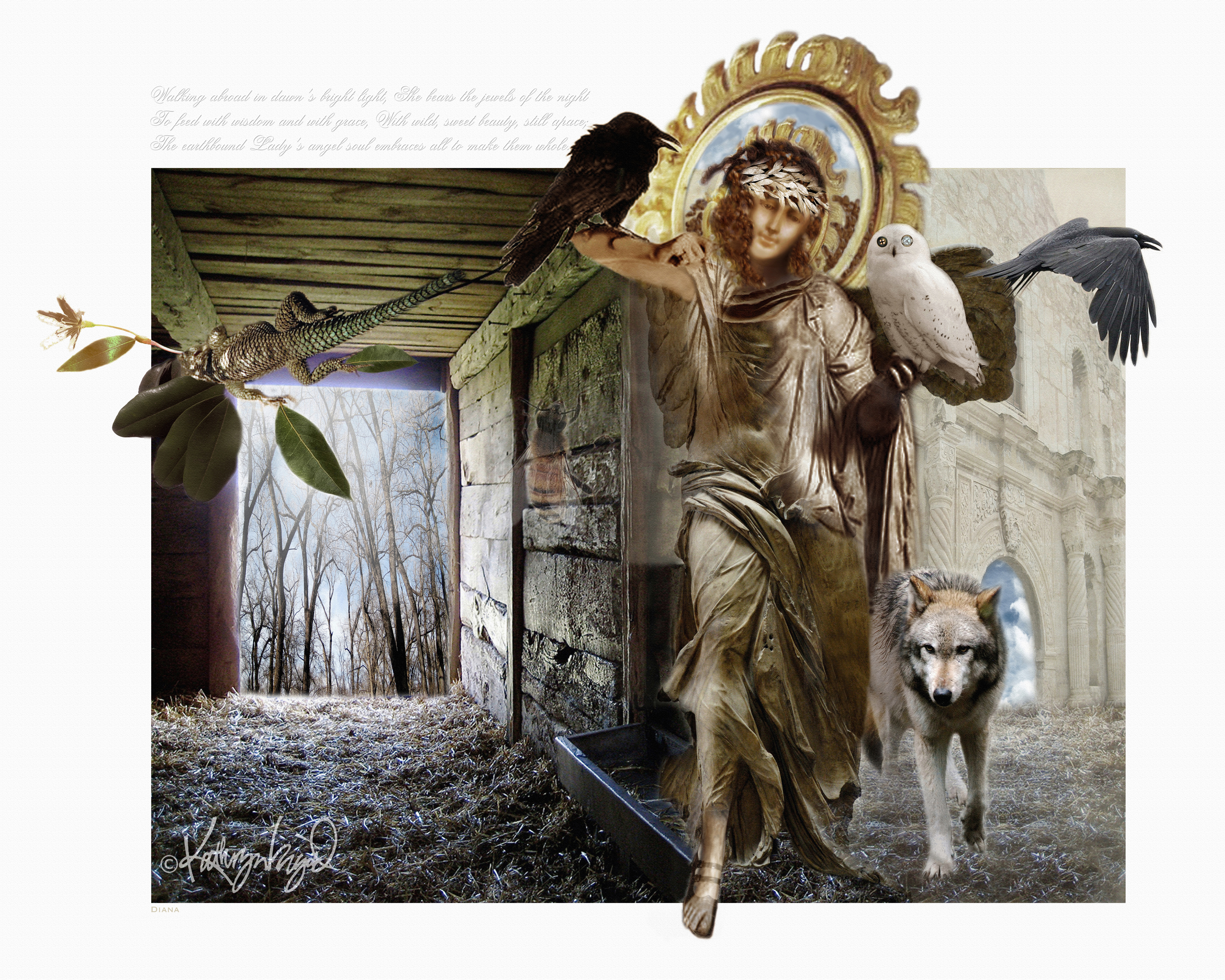
Diana

Walking abroad in dawn’s bright light,

She bears the jewels of the night

To feed with wisdom and with grace,

With wild, sweet beauty, still apace,

The earthbound Lady’s angel soul

Embraces all to make them whole.digital collage

Her Moment of Respite

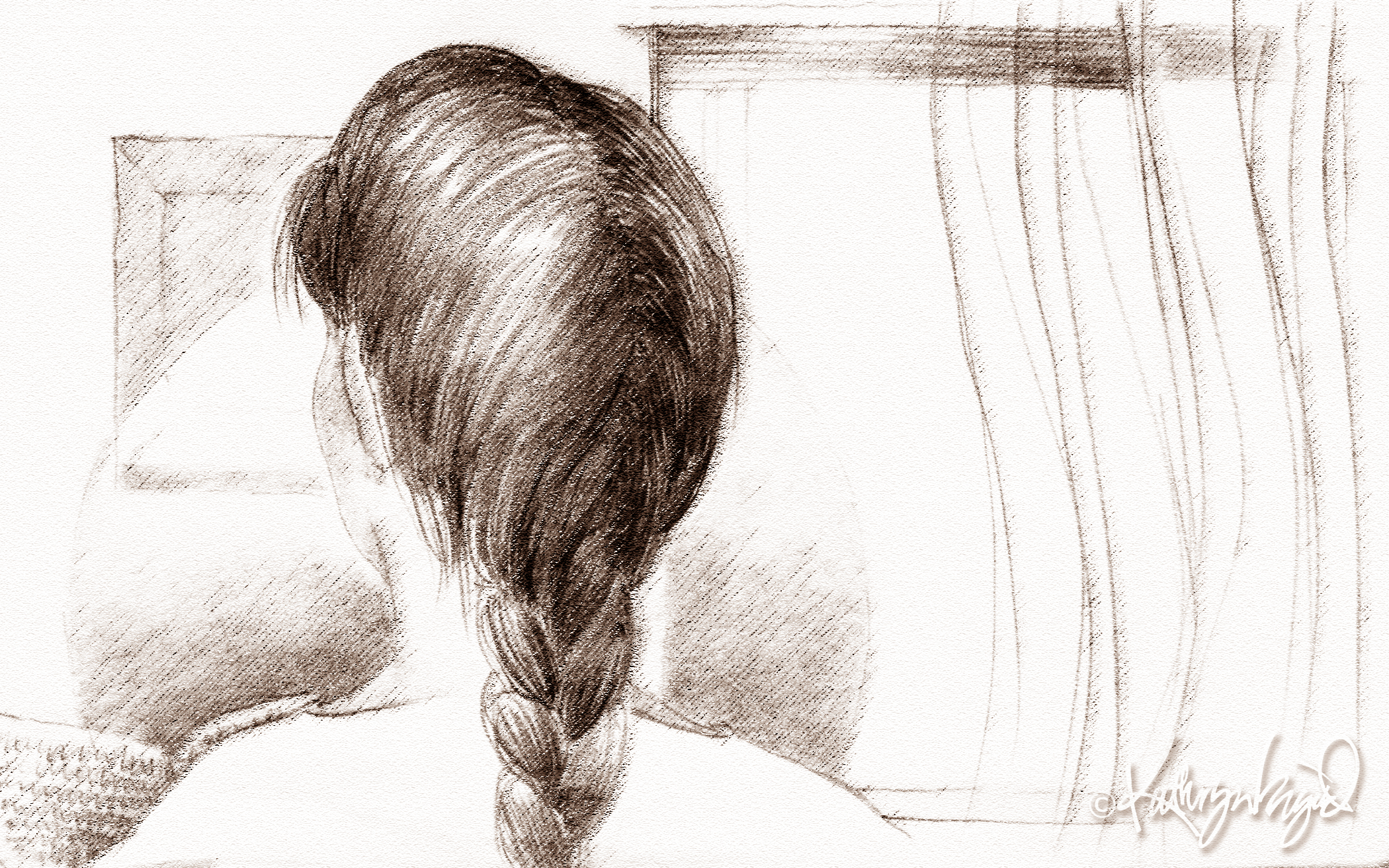
graphite/digital illustration

Reading

A heavy braid of brown-black hair

Coiling over her shoulder frames

The mourning dove-brown collarbones

That rise and fall in subtle flight

As she breathes, sitting back there in such quiet repose

As if to lend some grace to that so humble vase of white

Field lilies at her side, and when she turns

The antique pages of that favored book,

She spares a moment’s look to watch the lilies catch

The kitchen windows’ waning light

Just as the late-day sun tips in

Behind those distant trees to

Chase the night

Happy Birthday, My Sweet

Between us, my husband and I have nine outstanding nephews, all of whom we adore. We have one niece. She was born 22 years ago today. Any questions? digitally painted photoGoddesses Beware

My dearest darling, grand, almighty,

So surpasses Aphrodite

In each nuance womanhood

Considers lovely, fine and good—

And never mind what men prefer,

All being ten times more in her—

digitally painted photoWhat panegyric can I make,

What genuflections, what grand hymns

Of obloquy, as evening dims,

Shall I sing for my niece’s sake?

Is there a form of worship deep

Enough to compass the extent

Of family greatness, heaven-sent,

We mortals are so blessed to keep?photo

You have a Lovely Forehead

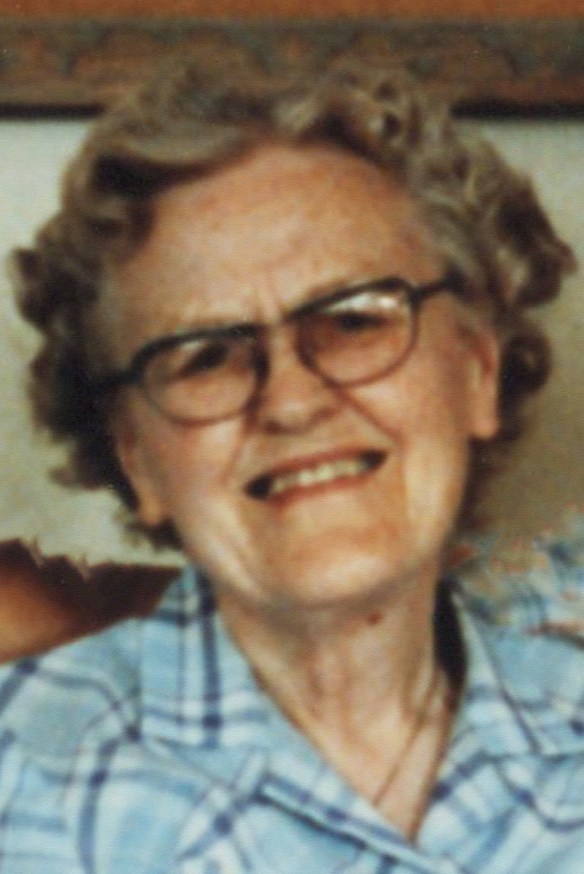
photoI was Auntie Ingeborg’s favorite great-niece. Of course, that’s potentially a less impressive achievement if you happen to know that each of my three sisters were her favorite great-niece, our father was her favorite nephew, his brother was her favorite nephew, and so on, ad infinitum. Potentially less impressive, I say, but not at all so in reality if you happened to know Auntie Ingeborg. Because she had a peculiar talent that is very rare indeed among humans: the capacity to make every individual she knew into her absolute favorite. It was completely sincere, unforced, and unquestionably real, and we never doubted it, any of us Favorites.

Auntie had a perpetual delighted smile and an endless twinkle in her eyes and rosy cheeks just made for children to pat affectionately, a lap that was always at the ready for clambering kids to pile on and around for stories, and a genuinely exotic store of entertainments few aunties of any sort can aspire to offer. But by popular standards of style and glamor, you’d never have given her a second glance. She found a perfectly prim schoolmarm look in simple crepe dresses and orthopedic shoes that suited her right down to the ground, and once she established that as her comfort look I don’t recollect her ever deviating from that significantly in the remaining decades of her life. She certainly wasn’t a magazine cover model, with her rather crooked teeth, and with her heart-shaped face accented just a touch too far by her under-bite. But that radiant smile, those softly blushed cheeks, and those merry blue eyes showed off the ethereal beauty of her heart to perfection, so I never once thought of her as ordinary at all. And she most certainly wasn’t ordinary.

Auntie had skills, talents, powers and exotic resources that no one could have guessed on first meeting her. First off, she lived in an apartment, quite the exotic concept to little kids raised in American suburbia. It was already a well-worn building of that vintage that had all sorts of wonderful creaks in its hardwood floors and hallways, a cage-style elevator that was just about the most mystical contraption I’d ever seen and carried us slower than a kid carries his books to school on Exam Day. And it had a Murphy bed. One of those fantastical metal monsters that stood on end, hidden in a closet, by day and pivoted out to unfold down at night.

But also during the daytime, as we learned, it stood guard in front of Auntie’s toy chest, an old and very slightly musty trunk filled with even older and rather odd and very delightful toys, including one of the earliest versions of a small robot I can recall, a little metal man that, when the key on his side was wound, began to walk stiff-legged across Auntie’s carpet in a cheerfully menacing zombie sort of way as the sharp little metal spikes that protruded through the soles of his metal feet would push out to raise up each one alternately from the rug. It was the sort of toy that would never be allowed by modern parents and other legal experts, because the foot-spikes were incredibly sharp and the metal was hard-edged and undoubtedly the paint on it was full of lead, and we loved to play with it almost endlessly.photoThere were other bits of magic and mystery stashed in the toy box, to be sure, not least of them that we quickly learned to dig into the box thoroughly on arrival, and as quickly as we could wrestle the bed far enough on its pivot to release the box to us, to find the box of Barnum’s Animal crackers that Auntie happened to have hidden along with the toys in there. Those who grew up eating them tend to agree that they are fairly insipid of flavor and texture, but the fact that they came in a charmingly decorated little box that looked like one of Barnum’s mythic circus train cars, full of exotic beasts, and it had a string handle on it for carrying around with us as we played with the toys and we got to dole out the little biscuits at our own leisure from the little wax paper lining inside the box–why, this was the stuff of dreams!

In truth, the toy box, though it was the object of our beeline in the door on arrival, was not the most crucial of entertainments at Auntie’s–that status was Auntie’s alone. For, as a lifelong grade school teacher, she knew how to amuse and occupy the caroming minds of wriggly kids about as well as anyone on earth ever did. She quizzed us about our wide-ranging and rarely accurate knowledge on any number of topics, showing more genuine interest and enthusiasm than any such conversation with miniature humans deserves, she played her old upright piano and sang silly songs and very old hymns, and best of the best, she would let us all pile up around her as she told fascinating folk tales, the finest of which were accompanied by her making pencil marks on her paper tablet to illustrate the path the story’s protagonists took from one episode to the next, the drawing of which ended quite miraculously in a picture of something–perhaps a giant vegetable with a person who lived in it looking out its window, or our favorite, a cat whose tail curled in a wild spiral that ended both the tail and the tale.photoShe was no specimen of the more refined social graces that might be expected by a more patrician crowd than her circle of family and friends. Physical or athletic grace was clearly not her great gift any more than it’s mine–when we moved the Christmas tree into the middle of the room to join hands and circle it singing old Norwegian Christmas songs, as was our sometime tradition, Auntie managed not once but in two different years to bump into and topple the decorated tree. I’m not even absolutely certain that the second time could be credited entirely to her, because it’s not as though there wasn’t the previous experience to tell my father, for example, that we could consider just doing that little ritual on one of the days when Auntie was celebrating at another relative’s house. But given that no one was harmed in the event and that we all had an excellent laugh not only on both ‘tipsy’ occasions (no, Auntie was not–only the tree was) but for all the years since as well, he can hardly be faulted if he did suspect a repeat in the offing. Auntie, as it was, laughed harder than any of us.

Auntie’s driving history, too, had certain mythic qualities to it, ending when she was at least in her eighties and still chauffeuring needy Old People (some of them undoubtedly much younger than herself) to the doctor’s office or the grocery store or church, or to where she taught English as a Second Language to immigrants for a very long time. The beginning of her automotive life was illustrated for us by the awe-inspiring story of the day that my father, then a high school student, came home after classes and found Auntie reclining on the family couch in a somewhat dazed state, from whence she plaintively asked if her nephew would mind going out to retrieve her car, which she had left at the neighbors’. He was puzzled as to why she hadn’t, evidently, brought it along with her all the way to his parents’ house, until on arriving at said neighbors’, he could see that her slightly skewed understanding of the operations of centrifugal-vs-centripetal force in driving had resulted in her cutting the corner of the street, jumping the neighbors’ front rockery, and landing the car in the midst of the garden border under their front window. It is unclear how, precisely, he was able to successfully remove the automobile from its highly artistic position in the neighbors’ front yard, but apparently this did occur, as did eventual restoration of the yard’s normal, more vegetal, aspect. Auntie’s driving was somewhat tamer after that, though occasional indications of her earlier style did leave us all wondering over the years how it was that she never seemed to get in any further accidents, or even get a police citation, out of all her miles on the road, an outcome for which we were all profoundly thankful.

It may be presumed that among other things, the lovely lady we knew alternatively as her self titling of Jog-along Julie did indeed keep on moving through life at a steady pace but because she had so many commitments to her teaching at school, community and church locales and to her watchful companionship of nearby friends, she didn’t need to drive very far when she did drive.

She was, after all, far too busy taking care of and cheering up a multitude of others, writing letters prolifically to family far and near, and reading–to herself and to others as well. Any birthday or holiday was almost guaranteed to be celebrated with the gift of books, and she can certainly claim much credit for how much her nieces and nephews of all ages learned to love a good story not only at her knee but in the pages of the books she doled out to us. Every story, even the books of silly rhymes and jokes she shared with us, may have had some subtext of educational purpose, given Auntie’s lifelong commitment to teaching, but we knew in addition that the central theme was simply how much she loved us.

She constantly made sure to say something supportive and complimentary to everyone, even on days when and to people with whom it was quite a stretch. When we sisters reluctantly sent her the dreaded school portrait photos that we always thought were hideous representations of who we were rather than what we hoped and wished we looked like to others, she would tell us how marvelously sweet and attractive we were, without fail. When one sister sent the photo that she hated most to reveal to the light of day (because she despised how far she had her hair pulled back on the occasion, thinking it made her face exceedingly exposed) Auntie wrote to her with great kindness that she had ‘a lovely forehead.’ Nothing could, for us, more simply and clearly have illustrated how gifted Auntie was in finding beauty in us even where we felt most flawed.

Though she seemed so fixed in time by her perpetual uniform of the schoolmarm look, by her continuity in writing letters, sending books, telling stories to the youngest members of any party, and driving, albeit more slowly, the Old Folk she knew to their appointed rounds, Auntie finally did actually grow old and die. But of course, even her funeral was occasion for us to hear her piping voice cheerfully chirping out how amazing and fantastic we all were. The relatives who gathered to plan her memorial service were suitably impressed to compare notes and discover yet more of her Favorites among their number. And the whole day of togetherness not only confirmed that her love was what we all had in common, but was filled with laughter at the same old stories of Auntie’s antics, and the warmth of her boundless thoughtfulness and selfless kindness toward all and sundry in the family and in the whole wide world.photo
I’m So Worth It

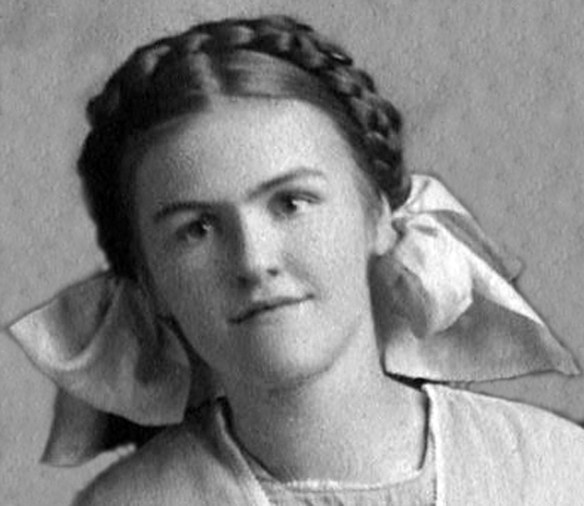
I’ve never understood the horror some people have of others knowing their age. Among other things, it requires endless forms of subterfuge and denial, from falsifying mere statements of age to all of that domino-like cascade of phony documentation and historical records that must be juggled over time–though, according to those claims, that will have stood quite still. In more extreme cases, it leads to a compulsion to alter oneself to fit the imagined character of the mythical preferred age. I find lots of highly stylized and generalized and ‘flawless’ dolls unappealing, weird and creepy, and ever so much more so, living beings who have had themselves altered by cosmetic means (temporary or, in extremis, surgical) to be less age-appropriate or individual.

Yes, I do understand the urge to fit in, to be accepted. But perhaps my having felt, most of my life, that I look pretty average and ordinary–none of me either bad- nor good-looking to any extreme–makes me inured to the pain of those who think themselves terribly, awfully out of sync with others in appearance. Certainly I know that there are many who have had external reinforcement from thoughtless or cruel others that they are unattractive or unfit or otherwise unacceptable. That is one true form of ugliness: bullying. Demeaning and hate-fostering and belittling are as terrible in their way as any forms of torture, because they scar the soul just as effectively as physical abuse scars the body and spirit. And that can make anyone feel old ahead of time.

But when it comes to the simple and petty desire to deny the years spent on earth or the effects of living a full life on one’s body, skin and hair, I still don’t quite get it. I watch those hair-coloring commercials where fabulously primped and preened models assure us that those smart enough, like them, to use X brand are obviously grand and wonderful enough to warrant the expense of that harmless form of self-adornment “because I’m worth it.” Well, good on you! But it so happens that I think I’m worth just as much with my own dull dishwater brown hair sprinkled with hard-earned threads of white. Plastic surgeons are always eager to inform me that I could be smooth, cellulite-free, and have perfectly formed chin, nose, breasts and cheekbones if I’d only let them perform their magic upon me. In addition to my having seen a long parade of walking evidences to the extreme contrary, or at least extremely contrary to my own tastes, I am shockingly content to have a mole practically right in the middle of my face, one ear far lower than the other, shoulders of quite different sizes, stubby hands, remarkably pasty and slightly sallow skin, a couple of scars from clumsiness and carelessness, and–oh yeah–quite the growing collection of wrinkles here and there upon my entire personage.

Get used to it. I’m a used vehicle. I’ve driven this body through a lot of history, which, if not remarkably rough or exotic, takes its toll in bits and pieces, softening up that muscle tissue which once was a tad more taut, stiffening the formerly flexible joints, adding a few pounds here and a lot of freckles and spots there, and all of the other signs of ordinary aging. Beyond beating, as it’s said, the alternative, growing older has some distinctly positive aspects to it in my view, not least of them that I know, like and respect myself and my finer features far more than I appreciated such things in younger years. I am finite, yea, even slithering down the slope of the latter part of my life, and I will die. Before then, I plan to live it up.

And if that shows in my greying, thinning hair, my spotty memory (which was always a hair more colorful than reality anyway) and my thickening waist and glasses, my slowing reflexes and my ever speedier increase of dithering and forgetfulness, so be it. If it shows in my increasingly complex network of wrinkles, why then Good on Me. Literally. I earned all of these insignia of my fine, me-sized-adventure filled life, and if they make me look less than smooth and perfect and doll-like and youthful and conventionally beautiful, I don’t mind one tiny bit. I certainly never liked ironing anyway, and I earned the right to savor my wrinkles just as they are.graphite drawingP. S. I was born in 1960, and I still have hopes of getting a whole bunch older than I already am, if all goes well.

White Velvet and 24 Karat Gold

Morning doesn’t always bring peace. Sorrow may linger, grief that is not wiped away by night or sleep or even tears.digitally doctored photo

Beauty, though, can help approximate the sense of peace, help me to recollect a meditative, even if it’s melancholy, calm. This, too, brings some small measure of what I remember as true peace, and lets me know that the capacity remains. In possibility is hope. In hope is rest. In rest, I can let go, if just for now, the troubles of the hour.

A cloudless dawn has its own quiet way of pouring out benevolence that, if not cure, brings respite of a kind and momentarily distracts the heart from its dull void. At the morning’s break, low-lying mist pools, thick and velvety, swirling so slowly in its densely silver gleam, it seems to be a lake–indeed, a mystic lake where it would be no great surprise to see that shimmering arm emerge that bears Excalibur.

Along the horizon creeps that cottony blue, transforming first to palest violet, then rose, then saturated orange, and finally, shooting sun-flares so bright and dazzling they blind when they reflect from glass sky scraper walls, pillars of wholly molten gold blazing beacon-sharp against the now bright-cobalt sky. Silhouetted there, a hawk perches on its lamppost throne, surveying all as if to say, I’m looking out for you. Let go of worry; I will see that all’s as it should be. And with a sweep of his unfolded wings, plunges off the lamp into the broader light of day.digitally doctored photo

As the Evening Blooms

There are moments when one simple thing–the appearance of its shadow under a boat in a clear lake, kids on the playground chanting a silly song, the smell of potatoes roasting in the oven as you walk in the door at the end of the day–stops you in your tracks with a pang of intense gratitude. You’re filled with wonder that something you may have seen or heard or felt a thousand times before can suddenly arrest you and fill you with such an unmitigated thrill. Your internal sky clears, and you remember how it felt to believe without question in today, in tomorrow.

digital imageOne of the situations that is most able to evoke such potent magic for me is that sweet transitional time when dusk is just about to fall. I’ll be going along the road on the way home, and the peculiar slant of the light makes every color twice as brilliant and saturated as it ought to be, and the clarity of the view seems to intensify so that I feel certain if I looked I could see individual grass-leaves at a hundred yards, maybe even the gossamer lacewing perched on a single blade. I open the window of the car and think that the robin warbling its evensong could be two miles distant and I would hear it just as sharply in its unimpeded clarity, maybe even a hundred miles. Have I fallen into a miracle myself? Become some sort of supernal being?digital painting

No, but at this hour and in this light, the new, dense tapestry of wild spring greens lining the side of the road becomes a moment closer to the perfection of heaven’s glow and I feel as though I myself might just take wing. As the evening starts to fall, this glow is rich with grace and filled with dreams of coming good and present hope. And along with every little else, I know that this beautiful glorious nothing of a thing will happen another time, and not when it will come or what it means, only that life is loaded up with marvelous moments of sweet and poignant joy.

High Baroque in Low Places

Craftsmanship is not one of my greater strengths. I credit myself so far as to say that I have a pretty good eye for fine craftsmanship. But when it comes to my own work, I’m impatient, short of attention, and lazy enough that I’m always that dilettante rushing through to get the job done and hoping it’s enough to hang together as long as needed. Until the homework is graded; until I can hire a professional to come and do the job properly; until I have escaped notice as the maker of said shabby construct.digital photocollageI have an honest recognition of the limitations of my skills, I think, if it is perhaps slightly magnified by my lack of gumption toward improving them in numerous areas. I could argue that I’m doing my part to support true craftsmen in their arts by not competing with them unduly, but anyone would see through that excuse, I’m afraid. Still, I am awed quite genuinely by the beauty inherent in passionate craftsmanship, whatever the cause. I love the artistry of beautifully handmade or hand-finished objects, whether they are intended as art or meant as humble functional things, everyday items that we might pass over in their daily use but for the marvels of their refinement and Fit.photoI’ve long been equally taken with the ridiculousness of both badly designed and foolishly impractical objects that were intended to be functional. Perhaps it’s the extreme contrast they have with fine craftsmanship. It’s silly enough to make something that by virtue of its careless design does not or cannot accomplish that for which it was meant, but often that very malfunction is trumpeted by the sheer ugliness or oddity of the object: one can see by simply looking at it that it won’t work or will be seriously flawed. It takes no time or effort to amass quite the collection of weirdly inept designs, from Patent applications right on up to the failed products remaindered and forlornly dusty on store shelves, and one can be endlessly entertained by the verbal autopsy of such strange husks from top to bottom–gadgets and gizmos meant to do so many unrelated tasks that they were too obviously cumbersome and ill-integrated to accomplish a single one of them. And dressed up in badly applied finishes of bizarre colors probably in hopes of distracting the customer from all other evident failings, but only drawing attention to the inherent cheapness and outlandish impossibility of their ever working as promised.

But there are so many things of the opposite sort that I think it’s too easy for us to gloss over what’s right in front of us or under our very fingertips as beautifully conceived and crafted objects worthy of our admiration for both a thing and its maker. Yes, it’s natural to admire the loveliness of the bow made for a Baroque Violin or the delicate carving on a lute, for a painting or sculpture or print made with evident and painstaking care. But it ought to be equally impressive to any of us when we pick up a dinner fork that is perfectly weighted and fits smoothly in the hand, to eat a marvelously tasty meal that has been made with such loving attention that the addition or removal of any tiny thing would be superfluous to its elegance–even if that meal is a profoundly rustic stew.

When we sit in a chair, do we notice not only how pretty, how well suited it is to the general character of the room, but also how the height of the arms supports our elbows just so and the curve of its upholstered back is designed to magically adjust to the lumbar spine of each individual sitter? Do we ask ourselves, Who made those helicopter blade fittings so exquisitely that after sixty years the contraption not only still flies the way it was made to fly but is a supremely wonderful geometric confluence of sweetly fitted parts, a sculpture of its kind, as well? Do we remember to look at the window sashes on that old house and be moved by how the intensely focused care of their making has enabled those ancient wooden single-pane mullioned windows to keep the home’s dwellers snug through 150 winters and summers?digital photocollageI hope that I, for one–as poorly equipped as I am myself to create that kind of grandeur in simple things, and too impatient to strive for better as often as I should–will always take the time at least to pay homage to the real craftsmen and women among us. To notice the attention to detail and graceful touch that they have applied to rebuilding stone porches, stitching a brocaded lining for a coat, painting a portrait of an old woman because her lined face is marked with history and pain and beauty and not because she is famous or has the money to pay for a portrait. To say Thank You to those who have made something fine and elegant and Right simply because it was what they were compelled to do.