Foodie Tuesday: I Think in Food

digital photocollage

Some of these things are not Food like the others . . . (sing along with me, now) . . .

digital photo

Don't cry, Darling, it's only an onion . . .

I think in food.

The synesthesiac is infinitely more poetic,

dreaming every waking thought into links

of lovely chain bridging the senses

in one graceful catenary arch of a deep synaptic sigh:

lemons taste triangular; music glows first purple,

then exquisite blue: radiant, gradient skies of blue.photo

I could change it all to solid gold, yet I? I Sigh.

Yes, I too, am given to magical flights, and yet

they all lead, every thought, each sense,

each memory and every moment of experience

is all, forever,

food.photoToday’s episode of Foodie Tuesday is brought to you by my new chia pet:

Mocha Chia “Tapioca

And yes, the quotes are intentional and not Air Quotes, because there’s no actual tapioca involved but this dish tastes remarkably like it, which in my book is an excellent thing, despite having more nutrients and fiber than its textural cousin. I started my recipe, of course, by stealing from a number of similar magazine and online recipes and monkeying around with it to the degree that I think I can safely say it’s all mine by now.

All I did was mix 2-1/2 cups of almond milk (store-bought), 1/2 cup of chia seeds, a pinch of salt and a couple of tablespoons of Splenda sweetened (“sugar-free”) vanilla syrup of the kind sold for coffee and soda sweeteners. I stirred it all together and put it in the refrigerator to soak overnight, stirring a couple of times to break up the clumping and keep the chia seeds suspended in the liquid so they could all get their nice little fattening-up chances. Before the final stirring, I heated up another 2 tablespoons of vanilla syrup in the microwave until good and hot and then melted about a tablespoon of instant coffee crystals (decaf–what I have on hand just for flavoring baking, really), plus four sections of a Hershey’s Special Dark chocolate bar (about two big chomps’ worth, if you’re like me!) into it, stirring until it was smooth. Lastly, that mocha soup got stirred into the Tapi-Chia, if I may coin a word, and dished up for serving. As you can see, it got a bit of candied orange peel and a sprinkling of freshly zipped orange zest to finish, and I must say those went down a treat with the mocha-licious chia pudding. Will I do this one again, you ask? Oh, yes I will. Too easy to both prepare and eat not to consider it a keeper.photo

Nuclear Winter Descends on the Kitchen

I am so not that blogger. You know, the one who makes stupendous, dazzling, dream-fulfilling, frenzied dance inducing deliciousness every time I enter the temple of cookery and take skillet in hand. The artiste-de-cuisine whose documentation of each morsel of impending salivary serenity is preened and primped into further gleaming gloriousness and photographed more glossily than a phalanx of supermodels in swimsuit season. The doyenne of dining, the poet of pumpernickel, the queen of quenelles, writing elated paeans to the plate that stimulate the appetite and soothe the spirit simultaneously, every word a twinkling, perfectly faceted gem of gustatory wisdom and love.photoSee, what my heart is cooking and what my hands and brains are genuinely capable of producing are not necessarily identical in nature, not wholly synchronous. I start out with a perfectly innocent yellow capiscum, intending nothing more sinister than to slice it into tidy segments and give it a friendly saute in a spot of sweet butter, and I think to myself, Why, that’s a mighty pretty bit of golden sunshine! I really ought to take its portrait. And sometimes it cooperates moderately well, and at other times it becomes something of an extended exercise in abstract thinking to even discern that the resulting portraiture is indeed of a sweet pepper, and a rather tasty one. It refuses to be anything other than a poor defenseless bell pepper mauled malevolently by bad knifework and lying listless, awaiting its ultimate destruction in a frying pan. I mean well, really I do.photoThere was, for example, an incident the other day involving an attempt to make (for the first time in a verrrrrry long time, mind you) crepes for supper. I wanted to make them without flour, since I’m making a sincere effort to battle an addiction to wheat and offset the unkindness it seems to do to my stomach. So to the eggs I added only a splash of cream to thin them a bit, a pinch of salt and a touch of vanilla for depth of flavor. So far, so good. But of course, not having made crepes in eons, I made the first one so far too thick that it morphed quickly into a leather-thick omelette of unwieldy proportions and promptly subdivided into continental shapes and semi-detached crevasses when I attempted to force it to wrap around the roast-chicken chunks anyway. The second was more successful, but given that the crepes were already going to be fairly huge and there were only two of us coming to the table, I’d only made enough batter for two crepes, so one remained a geographical disaster area when plated.

It’s hardly the worst sin I’ve committed in the cooking realm, but even the vegetable-mushroom medley in herbed tomato cream sauce being lapped over the top and sprinkled with shredded mozzarella to melt couldn’t exactly disguise the rocky profile of the crude assemblage underneath. Ah, well! It tasted fine enough that (given the huge portions) chopping up the remainder in a little casserole with some added tomatoes and more sprinkled mozz and cheddar to melt in made a perfectly serviceable (and actually, prettier) pseudo-lasagna for brunch the next day. I keep reminding myself that aroma and flavor, not good looks, must always remain the chief arbiters for the biters of the dish.

photoBut I can’t help but judge a dish on its beauty, still, and neither do any others unless they’re genuinely starving. Christmas Day’s standing rib roast of beef (above) was as tender and juicy and flavorful as any I’ve made, and in fact the gravy was a delicious simple reduction of beef juices and Cabernet finished with a bit of butter, but they didn’t impress with their devilishly handsome appearance as much as they might have done if I’d more intelligently plated the meat on top of the sauce, especially in the company of such homely looking side dishes as sweet coleslaw and brown-butter mashed potatoes. Presentation remains elusive, and capturing it on camera even more so. I must continue to learn!

Meanwhile, back at the oven, there are more serious disasters, ones that if compounded one with another and another as they were last week for some infernal reason beyond my ken, verge on apocalyptic. The centerpiece of one such Perfect Storm of kitchen failures was the day in which I managed to mis-set two crucial cooking elements at once. The end result of the first was that the wrongly timed egg boiling created not the expected hard-boiled eggs (a simple enough thing!), not even soft-boiled eggs mind you, but implosive mutant mush that was unsalvageable and decidedly unpalatable and went straight from kettle to compost in a trice. I was relieved that the Dutch oven finishing its long time in the sauna at least held a nice batch of broth that had been simmering overnight–that would cheer me up–relieved, that is, until I discovered that I had apparently jostled the lid out of place the night before and left just enough gap that not only did the liquid all vanish in a beautiful cloud, it left behind such a blackened, smoking pile of bones and charred vegetables and meat bits that I not only had to chisel out what I could and soak the pot for two days, continuing the excavations until I could scrub it back to a recognizable enamel surface, but I could also literally not photograph it at all. It was the perfectly even black of deep outer space, offering not a single change in surface that could reflect the light required by a camera lens for recognition. The smoke released when I opened the pot took days to clear from the house, and the only upside I can think of is that the pot was too tough to die despite its trial by fire.photoSo any time you are feeling a little blue, a little inadequate as a chef or depressed as a foodie, take heart. I have not only managed in spite of myself to keep self and fellow diners alive and un-poisoned for all of these years, even without resorting to the antique cure-all elixir waiting on the apothecary shelf, but have even occasionally risen above my faults and produced some memorably tasty, yes, even prettily presented, treats that people who didn’t even owe me money complimented. I’d show you the best of them and preen a little, but documentation still remains my weakest suit, and of course there’s that perpetual problem where the really good stuff gets eaten before you can say Photo Op! and dash for the camera. Later, perhaps. Dig in!

Foodie Tuesday: Nothing Freaky about Frikadeller

Kjøttkaker, as they’re known in my Norwegian-descended (and oh, how far we can descend!) family, or frikadeller, as the Danes and some other ‘cousins’ of ours call them, are simply and literally seasoned ground (minced) meat cakes. My husband finds them strange because they aren’t cozied up inside a hamburger bun, since that’s pretty much what the patties are, though usually on a slightly smaller scale. He finds it equally strange to serve them without a nice tomato-based sauce over the top of some beautiful fresh pasta, since again, they’re pretty much meatballs too, though usually on a slightly larger scale. And they certainly aren’t meatloaves, being far too teensy to serve sliced to anyone without smirking at the sheer silliness of it, though it might be worth it just to watch their expressions, while you counted out five peas per person alongside the meat and baked one fingerling potato for each. In any case, it’s really no surprise that these little dandies should suffer an identity crisis on this side of the pond.

Truth be told, said spouse isn’t a huge fan of ground meats outside of some favorite places where they commonly lurk, as in the previously mentioned hamburgers, or as meatballs in pasta sauce, or in a nicely spicy taco filling. The texture isn’t all that appealing to him without some distracting vehicle or accompaniment. I will have to continue on my search for some other alternatives or just know that any kjøttkaker cooked up around here are all mine for the munching. Hmm, was I thinking there was anything wrong with that scenario? How ridiculous!

Because I do like a nice chopped meat treat of one sort or another occasionally. So I made up a batch the other day. These are no more than a lightly-mixed blend of equal parts ground beef, veal and pork (about a half pound each, I suppose) with a couple of eggs to bind them and boost their nutrients a bit, some salt, black pepper, smoked paprika, ground coriander and a nice toss of shredded Parmesan for a touch of textural variety. I oven-baked them (in bacon fat, because I’m a flavor-holic), having made a big enough batch to freeze a bunch and have a few left in the fridge for weekday meals in the short term. Then I stuck the ones headed for supper into the skillet where the side-dishes were waiting, so all would arrive together hot at the table.photoWhile the patties were roasting, I’d cooked up a nice big batch of crimini mushrooms in butter and my homemade bone broth, set them aside and lightly cooked some nice thin green beans in the fat of the pan, and then layered it all back up together. While the vegetable portion of the program rested a moment, I’d taken the meat patties out of the oven, poured off the fat and scooped up all of those nice meaty drippings into a little container where I whipped them up with some heavy cream. The drippings were already plenty well seasoned and nicely condensed by their medieval-hot-tub adventures in the oven, so I had Instant Gravy of a kind you’re not likely to find in a packet of powdered whatsis on your grocery’s shelf. Which is to say, rich and flavorsome enough even for the likes of me.photoAll I added at table were some nice little fresh tomatoes to add a bit of color both to the plating and to the palate, a brightener welcome alongside the warmth and savory goodness of the rest. A little shot of sunshine is always welcome, whether in the kitchen or on the grinning face of someone happily gobbling up what’s served for supper.photo

Foodie Tuesday: Keeping the Tank Full Makes Me Thankful

Let’s just say I’m not the most compliant or enthusiastic when it comes to trying to eat what I think I ought to eat. It’s not that I don’t love eating practically everything–it’s that I do–limiting my choices to what’s right at the moment seems amazingly hard to manage when I’d rather just eat what I feel like eating, in the largest possible quantities and whenever I’m so moved. Sadly, this is what gradually moves me toward the zaftig and less ‘peep show’ sexy than that of a Marshmallow Peep. While its High Season of springtime is ever nearer on the calendar, I don’t really fancy being the latter shape no matter how popular the treat is with other people as sweet-toothed as I am. In fact, I’d have nightmares about being chased around by lust crazed Sugar Zombies in a yellow snowstorm. The very thought!

So I’m going to see if I can’t reduce my carbohydrate footprint, so to speak, and eat things that stay with me in a more kindly manner, that is, in the form of longer-lasting energy and higher nutritive value and deeper savory satisfaction. Frankly, I’m not as worried about fats as I am about the quantity and quality of sugars I’m capable of packing away and have no real need of, nutritionally. So pardon me while I butter myself up, as long as I can learn to more nearly kick the carb habit.

Today I went for an easy start: steak and eggs, Tex-Mex style. I put a couple of cuts of steak in the Sous Vide cooker last night just before bedtime, and when we got going (at our respective times) today, each of us had a piece of medium-rare beef to sear off in the skillet when we were ready to eat. I browned mine in butter and while it rested momentarily on the plate, deglazed the skillet with some of the bone broth from the last batch, handily waiting for the summons from the fridge, and while the broth cooked down to a thin gravy I poached an egg in it. I topped it with a little gussied up salsa: I often buy a jar of Pace Picante Chunky salsa–a pretty mild type–and stick-blend part of it with a (yes, one) chipotle en Adobo, mixing all together for a slightly smoky kick. Then a spoonful of sour cream (didn’t have real crema on hand) and a spiff each of smoked paprika and some lovely crunchy Maldon sea salt flakes, and immediately stuck my fork in and got to work.

photo

I'm just a Steak and Egg sort of cowgirl, I guess . . .

Thankfully, such a hearty brunch (I won’t lie to you about when I got up) holds up well when it comes to that Work thing, so I’m contentedly looking toward a 7 pm supper with nary a twitch. Well, okay, there is that completely hunger-unrelated humming in my candy molars . . .

Foodie Tuesday: The Element of Surprise

One of the particularly attractive things about learning of a new cuisine or recipe is the way that it can introduce unexpected ingredients to mind and palate. Things that seemed commonplace or familiar are suddenly tinged with mystery, filled with puzzles and questions never before imagined. So much recombinant mischief can be made when a new ingredient–or a new use for one I thought I’d known–comes into play.

photo

Tomatillos

I’ve long known the delights of tomatillos. Salsa verde is a pleasurable variant of that endlessly flexible family of Mexican sauces best known in their tomato form, hot or cold. Usually made with chopped or pureed tomatillos in combination with onion, jalapeños, chiles, cilantro and whatever additional spices or lime juice the maker uses for her trademark blend, salsa verde brings a slightly lemony brightness of flavor and a zing of lively green to the plating of whatever magnificent assemblage of Mexican cuisine is in hand. As I love putting fruits of various kinds into my salsa cruda (or pico de gallo, the rough-cut raw and chunky form of salsa) for the bright, colorful, juicy and distinctive twists they can introduce to the party. Fruits are such glorious foils for spicy and savory foods that their addition has been popular for far too long for even a venerable geezer like me to credibly claim credit for pretty much any such combination. This is certainly a great reason to love tomatillos in spicy salsas.

The big surprise, for me (again, blame it on my innocence; blame it on my lack of smarts; blame it on the bossa nova) is that it turns out green is not the only color in which tomatillos ripen. So I bought these seeds for purple tomatillos, too, in high hopes of having an eventual opportunity for making some groovy purple salsa cruda. So cool! Unfortunately, the weather fairies of Texas had a little different slant, this summer, on the whole project and the poor little tomatillo plants, purple and green, couldn’t quite make it to full ripeness while being simultaneously strangled by drought. Pity. But one day I will make it happen. Then you can look for me to side my grilled salmon with a nice salsa cruda compounded of purple tomatillo, fresh peach, jalapeño, cilantro, lime juice and jots of salt, pepper, cumin, cinnamon. Fingers crossed!

photo

How nutty is it that I didn't know people could make and use acorn flour!

There are so many other magical goodies around in the meantime, things not so seasonally sensitive perhaps, that there’s no worry about going hungry while waiting. Flours, for one. Asian, Native American and other foodies have already known for eons that acorns can be a source of jellies, cooking and baking, not to mention much-needed nutrition in times of scarcity. Me, I had no idea that acorn flour is useful for so much in the non-squirrel kitchen. But now I’ve acquired a small stash of the stuff so I can remedy my ignorance soon. Yes, acquired–bought–I have no intention of being so marvelously industrious as is required for the long and involved process of soaking out the tannins and preparing the acorns for consumption when I don’t even know how successfully I’ll use the flour, let alone how compellingly palatable the results will be. Time and experimentation will tell. Promise I’ll keep you posted!

On the heels of that particular discovery, of course, I went off on an alternative-flour tangent and hunted for others of interest. I’ve done a bit of baking with almond flour before (almonds ground up, but not so far as to be turning into almond butter, a whole other sort of ingredient altogether and tasty and useful in its own right) and coconut flour as well, and both are godsend finds for one who’s wanting to reduce or eliminate grain-based flours for any reason in cooking and baking. I certainly like that they’re both mild enough in flavor to work for innumerable purposes and are able to be adapted to a large number of functions in different recipes. The next surprise flour that popped up on my radar was mesquite. Say, what??? Making flour from the leguminous seeds of the nearly unkillable weed tree that drives ranchers ’round the bend with its tire-puncturing spines and water-hogging monster tap-root? Well, proponents say mesquite meal has a nutty, “sweet, earthy taste with notes of cinnamon, molasses, and caramel”hard to argue with the allure of that. Needless to say, I look forward to seeing what can come of such a distinctive sounding ingredient.

photo

A rose is a rose is a remarkable herb . . .

Consider the rose: what has long been one of the most favored flowers, universally admired for its varied beauty, perfume, and rather astonishing adaptability to climate and environs is being celebrated as the herb of the year this very year. Rose water, candied rose petals, rose hip tea, rose petal preserves, classic Turkish Delight–the list of rose-based foods has been building over centuries and only adds to the popularity of this queen of flowers. But most of that sort of thing was far outside the ken of a girl growing up in modest middle-class America, and didn’t really attract my attention until I was well into adulthood. Even then, I learned that as delicious as the rose is, a little can go a long way. So as I was contemplating my angle for this post and thinking about how fascinating it could be to yet discover previously unimagined ways to invite the rose to the dining table and began to contemplate what numinous form that idea might take. What did I do? Like any culinary detective-wannabe of the modern age, I Googled, of course. I typed in “rose as herb” and there before my very eyes appeared a handy page trumpeting the rose as Herb of the Year 2012. You call it lazy detective work, I call it kismet. Po-tay-to, po-tah-to. –Say, wouldn’t sweet potatoes be interesting prepared with a faint infusion of rosewater, some white pepper and a bit of fresh goat cheese whipped in? Or is that all old hat and I’m just showing off my ignorant bumpkin-osity once again? Never mind, I’m going to get me some of that Herb of the Year and have some fun. Ladies and gentlemen, spoons up . . .

Foodie Tuesday: It Makes Me Hungry Just Reading about It: Food for Thought

Julia Child. Jeffrey Steingarten. Ruth Reichl. Anthony Bourdain. Jane & Michael Stern. Calvin Trillin. MFK Fisher.colored pencil on black paper

Whether you have a Pavlovian reaction of immediate salivation when you hear any of those names (or get an instant craving for a perfectly prepared Pavlova), or you are filled with horror at the mere mention of them, you probably recognize that these are all persons associated with food, and specifically, with writing about food. For good or ill, they have collectively made a deeper impression on the palate of every would-be foodie in the Western world than any of us can even guess–even those of us that know little of the specifics of these individuals’ writings and gustatory opinions. Because the modern world does hold art criticism with a certain sort of reverence not usually associated with the arts themselves (obviously, those who determine the ostensible value of art must be much smarter and more reliable than those who merely make the stuff), and chases after those things that the most influential critics tell the world it should desire, or reviles that which they tell us we should fear or disdain. And where our tastes go, there go our wallets also. Soon to be followed by every shopkeeper and purveyor of ingredients and/or ideas related to said tastes. It’s the way we’re wired.

What attracts me to any of these, or other food writers, is that when at their best, each of them speaks not only with a truly distinctive and individual voice–but also writes as much about the context of the food as to give me a deeper and more delicious sense of its place within its cultural surrounds, in history, in each writer’s personal history, in the sciences of cookery that led to its development. Every bite we eat is potentially not only a small barrier between us and starvation but also is fraught with danger (want to talk about all of the discoverers of what wasn’t safe for human consumption?), full of potential for making memories that outlive and outlast every scholarly hour any of us ever spent on Serious Pursuits, and able to make or break meaningful relationships. We find, and lose, ourselves in what we eat and when and how and why we eat it, and these writers all carry that weight with such authority and finesse at times that there’s as much heartbreak in the description of a tender stalk of asparagus, as much ethereal joy in the coddling of one little egg, as though one were reading the great philosophers, the kings and queens among novelists. Oh, wait: all of those have also waxed wildly poetic on food from time to time; it’s how they connect with the rest of us too.

That this relationship between the ordinary and extraordinary can so blur at its own boundaries is precisely because food has such life-and-death power over us all and because we seek it, when we can, for its own allure.

So I am thankful, not only on a Foodie Tuesday but whenever I pause for such thought, that there have long been people who loved food enough to prepare and eat it–and to talk about it, study it, and yes, write about it well. Sometimes reading good food writing is almost like the actual eating of it; more often, it makes me desirous of both eating and knowing more of it. My parents and relatives and friends have trained me up in certain ways of cooking and eating, and the larger world offered numerous expansions on the ideals of both. And the great and good among food writers and critics and historians have pushed my horizons further in every direction. When I set out to put food on the table (or just directly into my mouth), it is most often done with a current of those thoughts they have inspired in me running through every move I make and every ingredient I take in hand.

I think, as a result, of how I first knew of various simple elements of cookery: ingredients, techniques, recipes and menus. Then I think of how I might wish to recombine them in the present moment. Who should be present. What is best suited to the occasion. How I wish to assemble it all. And off I go.

Spare ribs were an infrequent but welcome treat when I was growing up–infrequent because Mom’s method was of the boil-then-broil variety, a slow simmering on the cooktop in water or broth followed by oven roasting to finish with a bit of higher heat for caramelizing the glaze. I doubt that I ever requested her recipe for the ribs because I was too daunted by the amounts of time and labor required to want to fuss with any such thing. Ever so much later, here I am making them too, but with enough of a boost from kitchen rocket science to simplify them to a point where even Miss Lazybones is willing to make the (much more modest) effort, knowing that the ribs will turn out tender and juicy no matter what else I do with them.

My process, then, is simpler than the description of it will sound, and the ingredient list is flexible and easy to decide as well. I have (I believe I mentioned before) that dream-machine of lazy cooks, my home sous vide appliance [not a compensated endorsement but yes, I really do like it!]. It’s about the size of a very small microwave oven and even lives on our kitchen counter between uses because I have the luxury of a great expanse of countertop workspace. Sous vide cooking is the method of putting vacuum-sealed packets of food (plus, if desired, seasonings of various kinds) in a temperature-controlled water bath and letting the bath do pretty much all of the work except for final browning or caramelizing. I have a kitchen vacuum sealer, also a fairly pricy but mighty handy appliance as it allows for good freezer-proof packaging of meats and vegetables so they don’t spoil as quickly, and with the food-safe wrappings means that I can even put pre-seasoned packets directly from the freezer into the sous vide machine if I allow enough time for the frozen food to come fully to the correct internal temperature and stay there for the right amount of time.

The water bath cooking method is as old as the hills, really, though in olden times it required much more elaborate and ingenious ways of wrapping the immersible foods and a constant vigilance over the cooking temperature of the water bath that yours truly would never dream of undertaking. Sous vide mechanisms with automated water circulation and temp control can even be home-built by the mad-scientist sort of kitchen enthusiast. Me, I was gifted with a ready-made beauty by my kindly spouse. It cost quite a chunk of change, as you’d imagine, but the payoff for him is worthwhile, I think, when I actually endeavor to make such previously tiresome things as a rack of perfectly fall-off-the-bone baby back ribs.photo

Baby, Come Back to Me Ribs

[Special equipment: a food vacuum-packing machine and a home sous vide setup]

1 Full rack of well-marbled pork ribs

Spice rub

Butter

Barbecue sauce

I slash the rack of ribs in half and vacuum-pack the halves separately so that I can nestle the two together, thus making a small-shoebox-sized batch of meat that can fit comfortably into my sous vide and still be surrounded by water. For prep, I put each spice-rubbed* half-rack into an open vacuum bag with a pat of butter, then seal the packets closed, fit the two together snugly, and keep them in the fridge until start-up time. The evening before Rib Eating Day, I’ll immerse the conjoined twin packs in the sous vide. I use the machine’s handy printed cooking guide to choose and set the temp for a mere hair-above-minimum ‘ideal’ for ribs, and let them slowly melt into juicy morsels overnight. About a half hour before mealtime, I take the now soupy-looking packets out of the water bath, open the bags carefully over a sauce pot and drain all of the extra juices into it for boiling down into a nice quick base for the barbecue sauce, and while that’s heating up, very delicately (as they’re now falling apart) dress the rib racks with some of the prepared barbecue sauce** and put them, in a 9×13″ or larger baking pan, under the broiler to brown them nicely for serving. Watch out for burning! When they look and smell enough like candy that you can’t wait any longer, grab them out of the oven and rush them to the table. Hopefully, everything–and everyone–else has been gathered on or at the table beforehand, so it’s all ready to go. Eat ribs with your hands, and become outlandishly messy. Wear your worst old clothes, because if you’re not all painted elbows-to-eyebrows in barbecue sauce by the end of the meal, you’ve definitely done something wrong. This is barbecue, after all. [If you eat these in summertime y’all can go out and run through the sprinkler afterward to wash up.]

Ribs go down wonderfully with a wide range of goodies. I like a Kansas City or Memphis-style rub and sauce (slightly spicy, sticky and sweet), so mine tend to be as follows:

* Spice rub: salt and black pepper; brown sugar; ground cloves, cinnamon, allspice, ginger, garlic powder and cayenne.

** Barbecue sauce: we love Corky’s (from Memphis, no surprise) regular sauce, so if I have some on hand I may well use it straight out of the bottle, just adding the concentrated meat juices I’ve cooked down. If I’m making my own BBQ sauce, I concoct something in a similar vein, using dark molasses, ketchup, tomato puree, the same spices as in the rub sans sugar, and usually some citrus juice (orange is great) and a splash of whiskey to coat the ribs for browning, and to blend with the meat juices for serving.

Side dishes: at our place, it’s likely you’ll see coleslaw and corn (creamed, on the cob, or cooked kernels of super-sweet corn are all pretty hard to beat); buttery mashed potatoes, fresh peaches and watermelon . . . of course, any good Southern side dishes are pretty perfect with ribs: a mess o’ greens (would that I had the late great Raydell’s delectably classic recipe!), biscuits or soft rolls with butter, grits, beans cooked down almost to disappearance with salt meat. Big ol’ pitchers of sweet tea. Some sweet potato pie or lemon cake to finish. Ohhh, my stomach is growling now. I’d better read me some good foodie scripture right away before I lose my soul. Help me, blessed Calvin Trillin! Save me, saint Mary Frances Kennedy Fisher!colored pencil drawing + text

Foodie Tuesday: Nothing Sexier than Proper Mise en Place

photo

Ready for mirepoix-making?

Let’s face it, I’m as predictable as romantic comedies when it comes to many things, not least of all, choosing the path of least resistance when fixing food. If there’s a shortcut to the shortbread, lemme at it. If there’s a snappier way to trim snap peas, I’m on board with that. But if there’s one thing I know is worth any amount of trouble, it’s prep. It’s not glamorous, I’ll grant you, and sometimes gets mighty tedious, especially when there’s a sizable party or elaborate meal on the horizon. But there is nothing that makes the rest of the time in the kitchen more tolerable, even enjoyable, than having the best of mise en place at my fingertips.

I did my time as a house painter, back in the misty distance, and I learned tout de suite that there was no substitute for careful first steps when it came to a fine finished product; I spent some time laboring backstage and behind the scenes in theatres and found that what’s seen when the curtain’s rung up is about a thousandth of what’s been and being done for the production. Of course, my conductor husband works in a discipline where the inexperienced concert-attendee would be wildly off base to think that all performers do is get up onstage and wave arms or pipe on musical contraptions or flap tongues. Even if they have an inkling that rehearsals are necessary, they haven’t imagined the tiniest increment of blood, sweat and tears that went into a performance. And I’m fairly certain I haven’t come across any other field in which that doesn’t generally hold true. What goes on before-hand is such an essential and formative part of what comes out of the proscenium or oven that sometimes I think we’re guilty of assuming everyone would just plain intuit that. We need to tell the inexperienced what a beautiful thing is that dull seeming preparatory work, what glorious jewels are the salt-cellar and oil bottle and dishes of neatly diced Tasso and shredded Reggiano and chiffonaded basil.

Even the finished dish may not look particularly artistic, unless it’s something generally far more designer-iffic than what I’m likely to produce at my board, but it is an infinitely greater pleasure to prepare and serve food that was made easier to prepare and serve by having arranged for good mise en place in good time. There’s both the initial set of ingredients and tools that ought to be at the ready, and then there’s the lineup of Parts that precedes the final plating for presentation, and both serve to wonderfully streamline the efforts.

photo

The cranberry-mandarin-maple relish that will add a note of piquancy to the Thanksgiving plate is nothing much to look at, but will add its own essential character to the plate . . .

Part of the effectiveness and pleasure of mise en place for a visual obsessive like me is that it allows me to ‘paint’ with the food, whether in creating the individual dishes or in building the presentation, modest though it might be, by considering not only all of the flavors and practical characteristics of the ingredients but also their colors, shapes, visual textures and other attributes that can contribute to the integrity and–God willing–deliciousness of the whole.

So this is why, on the Tuesday before Thanksgiving, I’ve been brewing broth for gravy, concocting relishes and garnishes, butterflying the turkey and brining it (tomorrow it bathes sous vide, Thursday gets its high-roast crunch on!), roasting potatoes so that they will make heavenly light mash despite the added gallons of cream and pounds of butter, and all of that other ‘peripheral’ stuff. It’s not much to look at, to be sure, but I think I’ll manage to get a pretty fair showing out of it all eventually, because I’m laying the groundwork and setting the foundations first. Amen, let’s eat!

photo

That's it for today's sage advice.

Foodie Tuesday: In a Froth over Broth

How do I love broth? Let me count the ways.
photoSo versatile and so flexible an ingredient, it’s surprising that broth should be so UN-intimidating, so simple to concoct once you get the hang of it. After all, it’s water and flavorings simmered together for a nice long party in the hot tub, nothing more really. I’m extraordinarily simplistic when it comes to broth: if it ain’t easy to brew and full of tasty smooth liquid-gold goodness when it’s done, it ain’t gettin’ made in my kitchen. It ought to have a nice dose of nutrients beaming out of its depths as well, but I’m not getting any meters and test strips and laboratory lunacy involved to prove my point; if the ease is easy enough and the soup is slurpy enough, my litmus test is satisfied.

Every time I slide the old slow cooker off its shelf and out to start the party going, I clutch at my heart to still the palpitations of happy-tude. Because somewhere along the line, this kitchen commitment-phobe who dreaded attempting to prepare anything that looked complicated and fussy and mysterious discovered that while a good broth may require a certain amount of attention and a couple of brief periods of semi-assiduous activity over a couple of days (!), it doesn’t have to be scary and impossible, even for me. And hooray, it doesn’t have to follow a persnickety recipe full of esoteric ingredients either.

Good soup-secret factoids I’ve learned:

1 – Don’t think too hard. The more I muck about with a Plan in the kitchen for anything, the more I tend to want to give up.

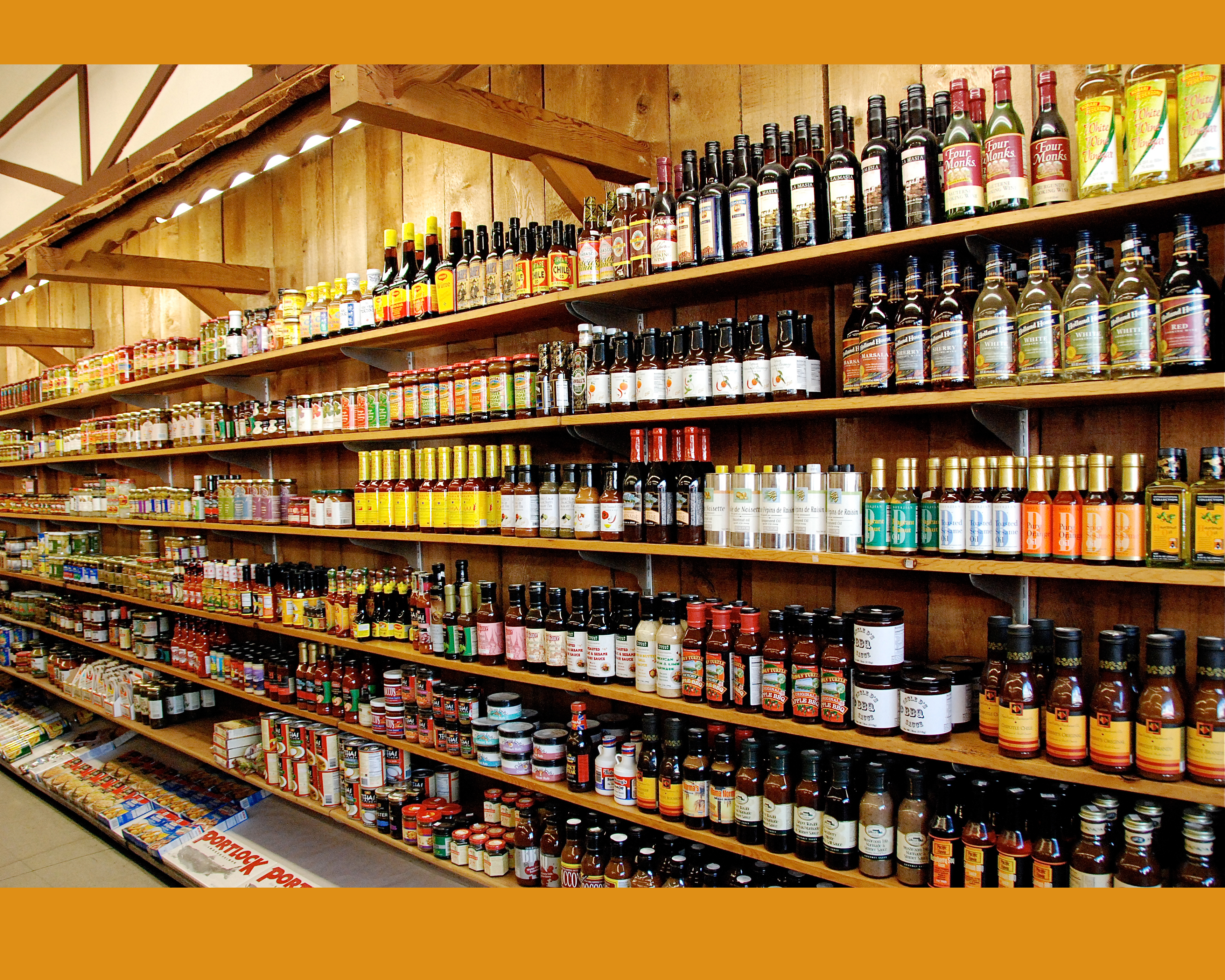
2 – Use good ingredients. Don’t cook with anything you wouldn’t be willing to eat as nearly unadulterated on its own as is safe or any booze or juice you wouldn’t be caught drinking on purpose. That age-old wisdom is handed down from the earliest generations of cooks precisely because it’s True and it works.

3 – Choose tools that work the way you want them to and keep the techniques as uncomplicated as possible. Good broth can be made without much real skill, I’ve learned, so don’t go and make it more daunting than necessary.

4 – Let the ingredients, tools and time do the work for you as much as possible.

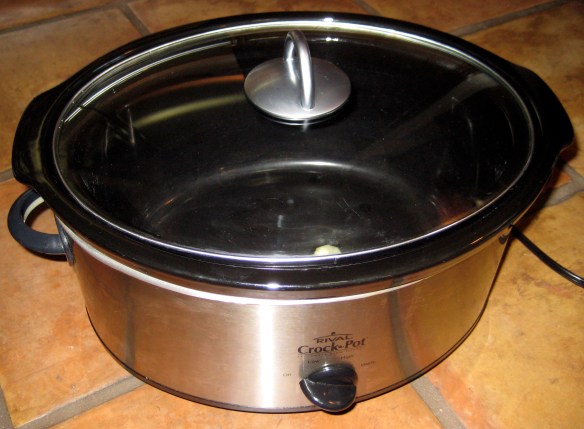
I use a Crock-Pot®, because it’s the slow cooker I happen to have and I like it. I’ve had it for about a decade and it puts up with all of my kitchen monkeyshines without breaking a sweat. Okay, that’s a complete fib: slow cookers tend to “sweat” profusely inside; it’s part of what they’re designed to do. Mine has a see-through (except for that condensation) glass lid and a removable stoneware lining that lets me soak all of the evidence away after whatever I’ve wrought in my cooking frenzies.

The rest of my broth-making arsenal is basic as can be. My 10×14″ Pyrex® casserole baking dish (not seen here–it was in use elsewhere during today’s modeling photo-shoot) to put bones and/or vegetables in for roasting before the big simmer starts. Tongs and a sturdy spoon for tending and fishing around in the broth contents once in a while if needed, and a sturdy cooking spider (this 6″ diameter baby works great for my purposes). Our old pasta strainer cook pot, lined with a flour sack dish towel, is the perfect way to finish the broth straining once the cookery is done.
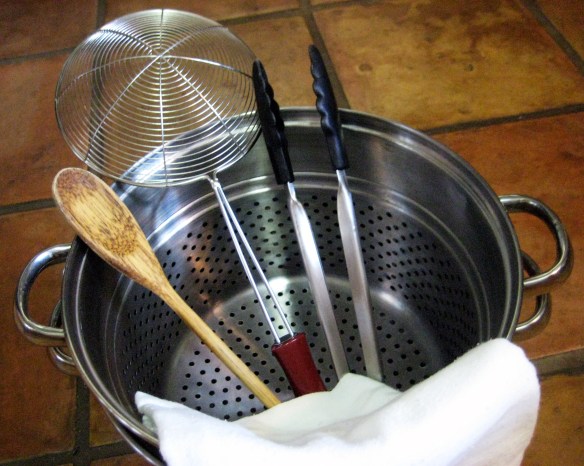
photoThe ingredients of my broth parties are variable. A basic vegetable broth from my kitchen is likely to be nothing more complex than the classic aromatic combination of carrots, celery and onion, with seasonings dictated by my mood and the intended uses of the broth (mmmm, shall I go southeast Asian this time? Head for something more Spanish and gently tuck in some saffron at the end? Throw in some fruit?).

Seafood broth starts with the same aromatics and gets whatever shellfish parts–yay, I get to say exoskeletons, because it’s correct and such a cool word!–I can get my paws on thrown in along with the available vegetal treats. I’m not entirely open-minded when it comes to the veg that gets added to broth blends, because there are some (cruciferous culprits, I’m looking at YOU, for example) that will take over the pot the minute they get a chance and you won’t taste anything else. No matter how much I like broccoli, I’m saving it for Cream of Broccoli soup where it can show off all it wants without being a pest, but otherwise I’m a segregationist lest there be a liquid coup d’état.

Roasting almost anything before simmering it in liquids, thanks to the ethereal effects of caramelization or Maillard reaction, is a great way to enrich and intensify the flavors of the brew, so if there’s time to do a medium-heat roast beforehand, it’s always a dandy addition. And since that process is so ridiculously simple, it’s one there’s no reason to avoid.

How I roast this stuff: scatter coarse chunks of tasty ingredients in a big flat pan (the aforementioned Pyrex, in my house), season them with a light sprinkling of good salt and black pepper and a spritz of some delicious fat (coconut oil, olive oil, butter, lard, bacon drippings–whatever the mood requires that happens to be on hand), and stick it all in the oven at around 350 degrees Fahrenheit until it smells irresistible and looks as pretty as a roasted-goodies picture should look. What to roast: aromatic vegetables, root vegetables, sturdy mushrooms, and/or any protein supplements headed for the pot. That shellfish armor, some hunks of not-very-tender meat or just bones from the same birds or beasts that are destined to be the centerpiece–they can all benefit from a bout in the tanning bed. If some of it browns nicely before the rest, pull it out earlier and throw into the cauldron to get a head start simmering.

photoAll of this takes far longer to tell than it does to do.

So. Pre-roast whatever you want browned. Then you load up the slow cooker with the browned goods, vegetal parts, and seasonings, cover it all with water and/or white wine (red almost always overpowers the flavor too much for mere broth), throw in another knob of butter or other fat if so moved. Me, I’m almost always moved to add fats, okay? Then Let. It. Cook. No need to fiddle with it again for a very long time. I usually let my broth simmer for a whole twenty-four hours and get all of the flavor and life I can out of the meat, bones, vegetables and seasonings I’ve corralled in my concoction.

Dedicated vegetarians, I accept your choice, but please allow me to differ; while I relish good vegetarian dishes any time, I also respect and admire quality seafood, poultry and meats that are simmered down to their essences in broth. I cook mine so intently–but not, I insist, intensely, as that would kill their flavor and defeat the purpose of this slow ritual–that often the heaviest beef bone in the pot will break into several pieces when I begin the straining process by shoveling out the solids with my spider. Waste not; taste’s in the pot.

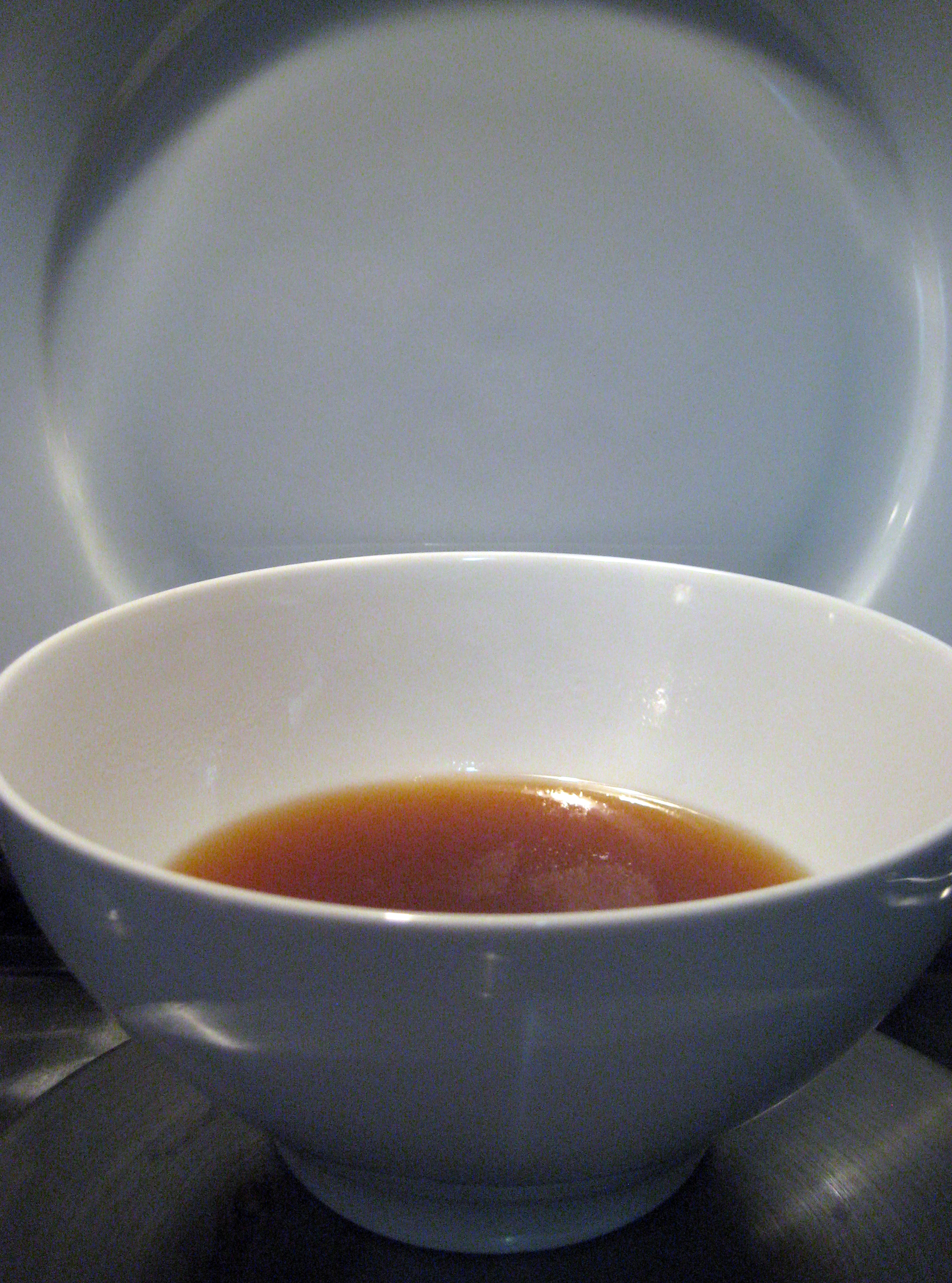
I cannot emphasize enough how little it matters to me to do the constant-skimming, water-changing, pot-cosseting stuff that I’m sure has perfectly meaningful and scientific reasons for being done by so many expert chefs. I can’t be bothered, because when I finally do strain out my broth and let it cool and chill it overnight and pull off the fat cap, I haven’t got any leftover grunge I won’t happily glug down plain or in a recipe. I have clear, rich, smiling, shimmering soup stuff that straight out of the fridge wiggles like a happy dashboard hula doll from all of the natural gelatin in it, soup that has rich, deep flavor from the roasting and the combination of delectable ingredients, and especially from the long sensual spa treatment melding it all together, and that I personally think has benefited greatly from not being pestered or treated with distrust. I’m not above poking the spoon in about once every two hours during daylight to slightly rearrange the parts and just make sure everyone gets an equal soak, not to mention to let a little of that intoxicating steam float around the house, but otherwise I’m all about letting the low heat and long time do their thing without interference from moi.

My general favorite broth combination these days is as follows:

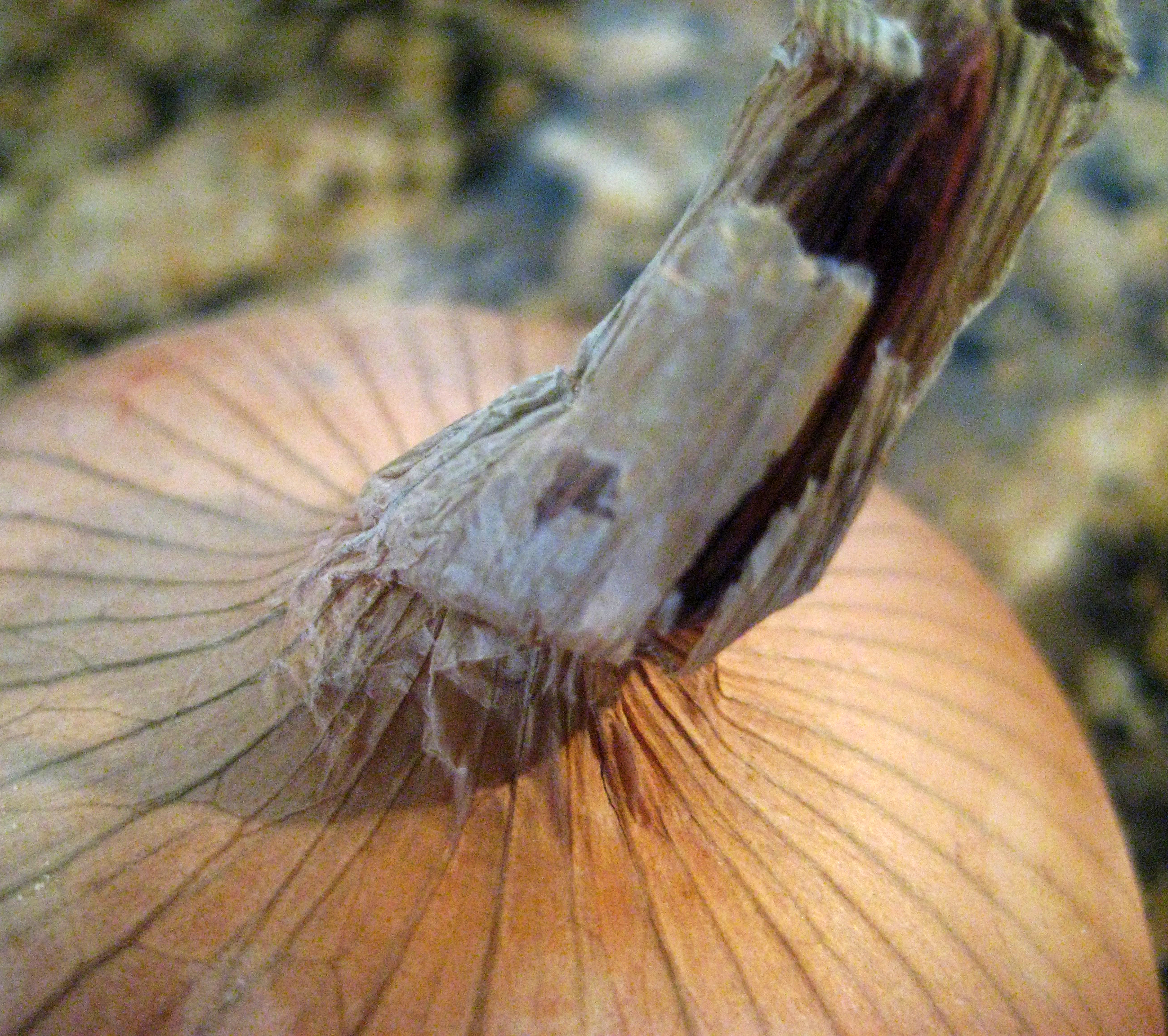
Yellow onion, skin and all. Sweet onions are too soulless for soup. Sorry, sweet onions!

Carrots and celery, washed but not peeled or trimmed.

Beef: shanks, oxtail, short ribs, marrow bones, and all of the trimmings from steak dinners that got set aside in the freezer for Broth Day. Chicken: the picked carcass of last week’s roast chicken, plus a piece of fried chicken that didn’t get et at the picnic on Saturday, also all rescued from freezer purgatory. Beef and poultry are great as soloists, but together they rock the house. Just sayin’.

A small palm-full of black peppercorns, several good bay leaves, a big sprig of thyme, about a half-dozen whole cloves and a half-teaspoon or so of whole allspice. Sometimes a stick of whole cinnamon. I never add salt at this phase, since the roasted stuff was lightly salted, the meats were seasoned for their previous meals, I don’t (yes, I confess it right here in front of God and everybody) bother to use unsalted butter, and I concentrate this brew all too well to get anything but seawater if I’m adding further salt incautiously.

[Sometimes I add a knob of grassy pastured butter at this point. Because it’s insanely delicious. If I don’t put it in the pot I’m tempted to just eat it anyway, so better in the broth than in me. Maybe.]

Lop everything into approximately 2″ rough hunks. Neatness doesn’t count. Fill the cooker loosely up to the max-fill mark and then fill in the nooks and crannies with liquid. Set it a-simmer and wait for the angels to come and alight on the kitchen counter in anticipation of the unveiling lo these many hours later.

photo

We All Love Woobibe

photoChildren pretty much love food and love to eat. Grownups are great at over-thinking them out of it: ‘Ooh, that’s too peppery, you won’t like it, Jimmy!’ ‘Oh, no, Suzie can’t have oysters; they’re too strange for a four-year-old’s taste!’ ‘I’m pretty sure Elmo is allergic to that stuff, ’cause he made a face when he tasted it the first time, so we’ll be sure to keep him safely away from it!’ Not to mention, ‘Are you kidding, let that six year old have truffles shaved onto her pasta???’ And then we wonder why “kids are such picky eaters”. Duhhh.SilverpointThe natural curiosity and openness of children should be encouraged (okay, up to a point, Lord Copper), and the people I’ve known with Good Eaters in the family simply tended to let nature take its course and give their kids whatever opportunity and exposure they could. Setting an example goes so much further than any amount of teaching and preaching. That goes not just for eating but for learning about all aspects of food, from its historic and cultural origins to how it’s raised and prepared, and how the young’uns themselves can participate in the process. The more the exposure is filled with fun and delight, the better the odds for success.

That’s how one of our nephews discovered when he was quite little that he loved the taste of that marvelous vegetable with the poisonous leaves whose super-acidic stalks have been used raw in traditional Chinese pharmacology as a laxative: rhubarb. Fortunately our nephew was, as were most of us, introduced to rhubarb, or “woobibe,” as he called it, not in its medicinal form but in its delectable sweetened-and-cooked form that tames its acid, and so fell immediately in love with the changeling vege-fruit. He admired it so much that he got his grandmother to get him started cultivating the stuff, which he still does, happily. [Yes, that’s some of his beautiful rhubarb below.]photoIt just so happens that I’m a big ol’ fan of rhubarb too. I adore it in sauce, pie, jam, tapioca pudding, chutney, and roasted and candied and simmered, and-and-and. But then, I grew up surrounded by not only good cooks but very much in the midst of people who respected and enjoyed and gave thought to and were grateful for their food. All of which made me the fan-girl I generally am in my medium-old age. Happy places to be, both the medium-old age and the fandom.SilverpointYou up-and-comers, middle-agers and glorious geezers all–and of course I consider myself to be each and every one of those as well, depending upon the moment–I bid you to take such comestible comeliness as the magnificent rhubarb, the sizzling hot pepper or the tantalizing truffle with all of the seriousness and happy enthusiasm they deserve. Especially when the kids are watching.

Rhubarb-Beetroot Chutney [Not bad at all as a relish for nice fat stuff like a scrumptious grilled cheese sandwich or a hunk of juicy grilled salmon or buttery seared lamb chops.]

Combine approximately equal amounts of peeled and cubed fresh beets,  1″-cut fresh rhubarb pieces, and sugar with just enough water to start the sugar melting a little, plus a couple of whole cloves and a cinnamon stick and a tiny pinch of salt. Bring it all up gradually to a simmer and then let it cook gently over low to moderate heat for a nice long time until it melts and thickens together. Pull out the cloves and cinnamon stick, and puree all the goodness into a nice mash. Keep cooking if it isn’t jammy enough. Adjust to your own exquisitely fine-tuned personal taste and enjoy.

Now, please don’t fuss with this “recipe” any more than absolutely necessary; only if it’s really rather easy and fun to make does it taste appropriately yummy. Extra bonus points if you bring a nice small person or two along for the preparation and savoring, because you will have a happy fellow diner for life. You’re welcome.