Litanies

I have a gift for complaining. I’m known to bemoan the unsatisfactory in any element of life that irks me at the moment, and seldom run out of topics. Why, I’ve been heard to complain about other people who complain too much.

One might almost assume I didn’t have a really excellent life. One would be wrong in that. I’m just curmudgeonly sometimes.
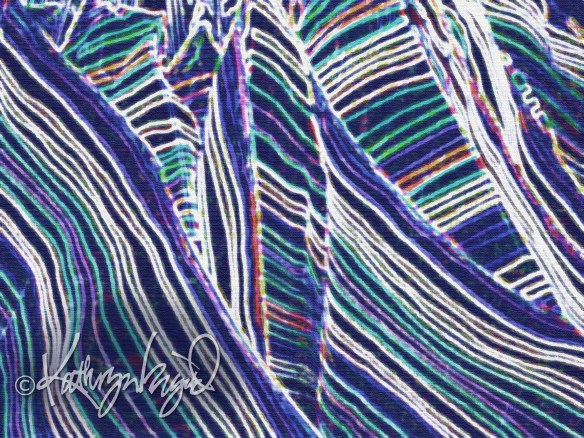
Digital illustration from a photo: The Fabric of My Life

You might think I’d carry my umbrella every single day, the way I can gripe about how imperfect life is, but when I leave my bumbershoot half-folded like this to dry after a real rain, I’m reminded that things are often better than they seem…

I like to think I’m not framing my dissatisfaction as criticism and fault-finding, believing myself too pious and generous for such finger-pointing when I know I’m imperfect myself, but of course, any notion of imperfection implies fault or blame at some level. Therein lies evidence of my fault in this insidious pastime.

So I’m working on letting my Pollyanna side dominate better. I can play my own version of her Glad Game and attempt to divine the positives in the situation and keep my attentions there instead of on the downside. I don’t think it healthy, overall, to put too Panglossian a gloss on things and lose touch with reality, but whatever their relative literary merits I suspect young Pollyanna is the more practical of my fictional companions. Instead of pretending that rotten stuff is good, she exhorts us to see what is good and use that to enlighten and change the rest.

Being grateful for what is fine and admirable and sweet is an invitation to imitate it and to use the power of such goodness to defeat the rest. Time spent in recitation and recognition of joys and strengths is never wasted.

Photo: A Tip of the Hat

…It’s much better to give a tip of the hat to what is actually fine and dandy in life, and be glad of it!

Yet More Advice-to-Self

text

text

digitally doctored photo

If You can’t Say Anything Nice, Why Not . . .

We love to gossip and tell tales behind each other’s backs, don’t we. Of course, the public attitude is generally to decry such inhumane and ungracious behavior and to vilify those who allow themselves to be caught acting on it. Even those of us who shamelessly mock others for being unlike us don’t really like to admit we engage in such naughtiness. In fact, many of us are quite adept at picking on people for being precisely like we are and doing exactly the same sort of, well, picking.

It may just be that we need to reevaluate the whole way we approach such things. Being in conversation and community doesn’t mean we have to spend our energies on acting like those stereotypical meddlers we like to decry, which is of course precisely what we’re doing in decrying them. How much better to spend our energies and attentions together on positive and good things, like finding common ground, sharing what we admire and respect about each other and learning fine and meaningful and joyful things from and with each other. That leaves little room for interfering with other people’s ways of doing, being and living. We can sit around chattering and nattering with impunity when the intent is to be kind and thoughtful, and without worry when we’re not creating any sort of reasons for anyone else to be critiquing us either.

Improbable as it all may seem, we all know from experience that there are good and happy and positive things to be discussed and done and that there can be just as much pleasure in them as in exercising our Schadenfreude instead.graphite drawing

Art Imitates Life Imitating Art

A little ditty I wrote when teaching drawing classes . . . graphite on black paperAye of the Beholder

Teacher mustn’t be too choosy,

Guiding student artists through

Projects in which they redo

The works of masters from Brancusi

to Vermeer or Frankenthaler

Or da Vinci; every student

Has a vision of what’s prudent

And what fails, as artist-scholar;

Though they may have witticisms

And have skill and wisdom plenty

As artistic cognoscenti,

Few have true twin criticisms–

Expectation must diminish,

Open-mindedness then flourish,

So the student brain can nourish

New great art from start to finish;

This is what the child of three meant

When she said no one had told her

That the Eye of the Beholder

Never met complete agreement:

Genius art is the dominion

Of the Artist, true; and yet, it

Is the critics, I regret it,

Who know Genius is opinion.digital drawing image