Know Thyself

digital montageA Map of the Interior

What lives inside my busy brain is far from France, the hills of Spain,

the Rio Grande, or the coast of Ireland, and yet almost

each single time I step inside, I see my thoughts roam far and wide,

as though the moment they begin, they light a universe within,

a place nobody else can sense, and yet it’s palpable, immense

and potent as no state on earth; this is my place of greatest worth.

If in your mind you travel, too, I hope the countries that are You

are equally enchanting, wide, and vivid, and that there inside

you find as you grow older, more great places that you can explore—

and if in old age we forget all else, we’ll have one journey yet

to places fond not left behind, the inner reaches of the mind.

Raised Eyebrows

There have been many times when people looked upon me with raised eyebrows, if not utter disbelief. I am, of course, not only accustomed to it but somewhat proud of it, being an artist. If I never surprised or seemed a little off-kilter to anyone I would think it called into question my credibility as an inventive person altogether. So I’m happy to report that my assessment by others has been heavily salted and peppered with expressions of doubt, disdain or possibly, diagnoses of delirium.oil pastel drawing 1988The artwork above (four feet high, for your contextual reference) came from a period in my artistic development wherein I might have been forgiven for thinking there was a form of communicable facial paralysis among my contacts that left them all perpetually wearing masks of such disbelief. I had meandered through the three years following my undergraduate commencement, while working for my uncle’s construction company, barely producing a discernible body of small artworks the while, and still had opted to go off to graduate art studies. I had made a pitiful showing in my first quarter of work there, simply extending the slow, unproductive approach I’d had during the previous three years to cough up a tiny handful of pleasant but utterly unimpressive artworks without any particular evidence of having been changed or challenged by my reentry to the educational environment. But after the embarrassingly lackluster critique session that closed that quarter, I was perhaps uncharacteristically motivated to break out of the doldrums and sail in a new and more daring path, in hopes of visiting uncharted territories of worth.

Changing my approaches to media, techniques, subject matter, scale and speed, I found, all contributed to my discovering new sides of my artistic self. I became in some ways quite the opposite of the person I’d been previously in the studio, and while I never lost my love for the various characteristic media, techniques, etc, etc, that had defined my former self, I certainly never regretted having broken the mold I’d set that self in so firmly. An inordinate number of options and opportunities previously hidden from me by my insular fear and ignorance and self-imposed narrowness of intent and expectation suddenly seemed both possible and appealing, and I have continued to gallop around after them with abandon, sometimes with a hint of obsession and often quite tangentially, so I’ve grown to simply expect the raised eyebrows around me and relish the thought that they mean I’ve not settled too far into my former predictably fixed self again.

That, I think, is encouragement enough to keep me moving forward.

Not Just Another Pretty Face

At some level, most of us—no matter how disdainfully we might pretend to look upon those Others who obsess over appearances—wish to be thought beautiful. We want to fit in with others, to belong in the pack, to be loved.photoOf course, we know that even those who do fit in do so if and as the hierarchy of the pack allows. We are put in our places and told who we are, where we belong, what we’re supposed to be doing, and why we should accept that fate as though it were a natural law. After all, we tend to believe that nature is fact-driven and therefore we, who are mere specks in its vastness, must play our little roles as prescribed in the absolutes of existence. We sit here and take it. In many ways, that’s a useful approach to life, because, well, nature does drive a lot of what is and what happens, and bucking that can be counterproductive or even quite dangerous. And worse, perhaps, such refusal to accept the norms others have agreed upon as right and correct and natural puts us on the fringes and at risk of rejection. Someone along the way is sure to reject the rebel or misfit. Someone will think I’m unfit or, yes, Ugly.photoIt’s a wonderful thing to remember that besides all of the weird and dangerous and unpleasant and otherwise negative possibilities in stepping outside of the normal and expected course of events or refusing to be other than myself in order to seem to fit in better where I really don’t, there are also a vast array of glorious and splendid maybes waiting out there for me to dare to reach for them. Much of what is good and beautifully new in the world happens because one person dared to think, do, and exist differently from the pack, the mass of ordinary people, and brought about an increment of change. How wonderful if I can shed my fears, my need for conformity borne of desire for universal acceptance, and become ever so slightly more notable, one little nth more dazzling, than I was when I was only hoping to be like all the other creatures that I knew.

Things I Used to Know

In olden times, when I was young and Apatosaurs snacked on the treetops, I knew stuff. I’ve forgotten more since then than most sentient beings learn in a lifetime, although in fairness to them and to my own addled and limited brain capacity, much of that was only memorized and not really understood or applied. And what little I have learned or known has mostly long since been reduced to dribbles and scribbles and other forms of rubble.

digital illustrationI once knew how to ice skate and roller skate. Not particularly well, mind, but I could stay upright and toddle around a rink or lake without breaking ice or ankles, which for a person of limited grace and less skill is good enough. I could ride a bike, row a boat and climb a tree. I read books intended to make me smarter and ones intended only to amuse me, and a fair bunch that had the possibility of doing both simultaneously. I sang in every section of a choir that would let me in, played the piano poorly but enthusiastically, and learned about four chords on the guitar from Dad.

Much of this is gone, forgotten or so rusty that it would be somewhere between horrifying and laughable, or possibly both, if I were to try my hand at any of it now. And I’m not proud of that. But I’m not too worried about it, either, nor am I ashamed. I’m probably not all that different from most people when it comes to such things. I wouldn’t mind, though, if the opportunity arose to revisit any of those things and I discovered that (a) it’s true what they say about bike riding coming right back as though I’d never left off the practice, and (b) everything else I’d ever once loved doing would come back as easily as zipping around on a long-neglected bike. Before all the rest of me freezes over, as it were.

I also used to know how to leave the house without much thought of what lay outside its doors or worry over what I was to avoid and/or accomplish before returning to its safety. I had a firm grasp of many, many things that didn’t matter in the slightest in keeping the earth rotating properly or making my part of consumerism fully sustainable, let alone in achieving and maintaining world peace. As a supposed grownup, I learned to worry and fuss a great deal over that sort of stuff, even (or especially) when I knew full well I hadn’t any hope of challenging my born impotence in these matters.

But one thing I have learned as an adult that is remarkably useful–assuming I can keep it in mind, an increasingly slippery endeavor as I age–is that no individual human ever did really have any control over anything of this great importance. Occasionally, one of our kind manages to break through the barriers or even simply to fall into a solution by being in the right-or-wrong place at the right-or-wrong moment, but most of us are not able, alone, to learn or do anything much more complicated and meaningful than reading or singing or ice skating. And most wonderful of all, I’ve learned that that’s okay. It’s important to care, and to do and be the best that I can, but it may be equally needful that I grow wise enough to stop banging my head against any brick wall that practice has taught me will never actually budge and, yes, be content that I made the effort, not carry around pointless guilt that I’m not killing myself with further useless striving and angst.

As much as I loved ice skating when I was young and owned skates, and lived near a park where I could use them in winter, I don’t feel terribly cheated that decades later I’m fairly certain I couldn’t even remember how to skate. I’m happy to hang up those old blades and let someone newer and nimbler learn how to ice skate, and finally to get old enough to forget it too, in turn. The world itself will probably continue turning, with or without us.digital illustration

Foodie Tuesday: Wine, Dark & Light

photo

Close observation magnifies everything, both the good and the bad.

One day in the wine aisle of the local store I had occasion to observe a striking study in contrasts.

As I drifted along in search of a couple of bottles for an upcoming dinner party, I couldn’t avoid overhearing two twenty-something guys as one told the other quite volubly that he was hoping he could fine a lawyer good enough to negotiate him out of Resisting Arrest charges if he pleaded guilty to the Driving Under the Influence charge. There were a whole slew of reasons I was horrified to hear this conversation. First of all, it was yet another example of the loss of social inhibition that saddens and frustrates me these days; how is it acceptable to discuss personal, legal, private matters in normal tones and in great detail in a public place like a grocery store?

I was privy, however unwillingly, to details like the confessor’s noting his level of drunkenness as having been so profound that three hours later when he was having blood tests in the hospital he was still unable to speak clearly, and his friend’s commiseration for apparently having had a similar experience. What I did not overhear, not once, was any indication of regret, remorse or contrition. This was all discussed pretty much in the same manner as they might have recounted a tedious everyday hassle at the office. No sense anywhere in this that the guys themselves could’ve been killed or maimed, or property been damaged or destroyed, let alone that they had opted to put everyone in their proximity at the same risks by choosing to get behind the wheel.

photo

Of course, when seen so clearly, some things, and people, turn out to be just a bunch of drips.

Talk about, no pun intended, a sobering time.

But I drink alcohol, too. It’s just that I find the idea of drinking past where it’s for taste into where the drink starts making my decisions for me repugnant. I drink specifically to taste.

So it was a startling, and rather refreshing, change of pace when the offending fools finally vacated the aisle and I was approached by a very gracious young woman who asked me politely for advice to a neophyte on choosing red wines. Her adorable toddler daughter sat cheerily and peaceably in the shopping cart throughout what turned into a fairly lengthy conversation, because of course I was suddenly acutely aware of all sorts of questions I’d not considered in a long time. It seems that this lady had a companion who was encouraging her to broaden her horizons and join him in his enjoyment of red wines, and she was accustomed only to cocktail liquor. That’s admittedly a pretty big leap for a palate, whether you’re used to straight vodka or mixed drinks with it as an ingredient.

What could I say that would be of any use to her at all?

photo

Wine choosing is so hard to learn. Is it *true* that eggs and wine are *always* terrible companions?

Start, yes, with the idea that wines have enormous range in terms of flavors, intensities and affinities–there can be something for nearly every taste and occasion. This, coupled with the personality of wine being perhaps even more of an acquired taste than fruity, herbal or spicy cocktails even when those are made high-octane with something like vodka, is hugely intimidating. Wine snobs do nothing to dispel the fears, with their wacky vernacular of nose and legs, drinkable cement and tar and leather, and huffiness toward anyone drinking anything not Serious or trendy enough.

Finally I did think to tell her that the only really useful and non-terrifying way I’ve learned about red wines other than over a long, long time is to turn to that friendlier set of ‘experts’, those who have an interest in selling you wines. I rarely think of salespeople as my first choice for information resources, but in the (pun intended, this time) case of wine merchants, their vested interest in selling their wares and further, in making them appealing and accessible to a wide audience, makes them a bit more willing and artful educators on the subject than experts who have only themselves to please.

photo

I mean, sheesh, there are so many red wines; what on earth is my ideal one to drink with a grass-fed skirt steak?

That’s what moved me to tell the nice lady not to risk her hard-earned cash on bottle by bottle experimentation but to seek out the local venues that offer wine tastings. A series of sips, and any amount of snob-sanctioned spitting that it takes to keep sanely sober and free of swallowing swill, is a far quicker way to get a hint of what one actually likes than any other.

Get thee to a wine tasting! My palate is far from sophisticated, but I’ve learned enough over time about what I do and don’t enjoy in wines that I can choose–red or white or any other color, still or bubbly, dry or sweet, or distinct in any other way–with some confidence that I’ll enjoy what I taste. One good glass at a time. Meanwhile, don’t forget to read, too. Not only can articles and even wine labels themselves tell you a lot of useful stuff you might find helpful in your search for deliciousness, as any of you reading this blog would undoubtedly know, being veteran web researchers, there are now a huge number of online resources devoted to oenophilic wisdom.

Most importantly, trust yourself and do what suits you. You might find, after all of the effort and education, that wine is simply Not Your Thing. Why on earth waste time and money (and, potentially, healthy sobriety) on something that doesn’t suit you! You may very well find, if you do like wines that the wines you enjoy most aren’t those that the critics and suave sophisticates admire and tout. If so, feel free to come slumming with me. I’m sure I have a bottle or two in my tiny collection that would make any expert swoon with horror, yet I am more than content to keep sipping at what I like because I like it. And I have been through a few wine tastings, done a bit of reading, and spent plenty of adult years getting the experience that has taught me what I do like, and that it’s perfectly okay to like what wines I like and drink them, no matter what anyone else thinks. Including having a cocktail or beer instead, if that’s my mood.

photo

Two drink-related things I *am* pretty sure about involve salt: 1, avoid that hideous abomination purporting to be ‘cooking wine’ that is really just cheap vino with salt added to it (as wiser folk have admonished, if it ain’t worth drinking, it ain’t worth cooking with it); 2, salt can, conversely, be quite friendly with tequila or beer if applied properly. See also: Margaritas, Coronitas…

Graceful Phrasing

digital illustration from photosFrom my privileged perch in the corner of rooms where music is being studied, rehearsed and discussed, I hear all sorts of interesting and enlightening things on the musical topics at hand. Also, plenty of stuff that goes right straight over the top of my pointy head. After all, I’m hanging around with a bunch of scholarly and often exceedingly experienced musicians, and they’re speaking their own language, one that has jargon and concepts far beyond the reach of someone who took five years of childhood piano lessons and a few voice lessons, all without ever actually learning to read music. My poor teachers had no idea how far in over their heads they were in taking me on, but I must assume that most of them figured out my scam of ‘play [or sing] it for me so I can hear how it should be done’ so I could learn it by ear in lieu of figuring out why the notes never seemed to be where they were supposed to be in my fancifully dyslexic internal designs. In any case, I rarely hear musicians talking without getting off course myself a few (million) times along the way.

It’s not all that different, for me, from sitting in on a conversation between those speaking, say, German, Swedish or Norwegian, Spanish, French or Italian: if I already know the theme of the present discussion and a few of the key words, and can suss out the attitudes of the participants to the topic, I may be able to follow the conversation in a vague, generalized way, and nod yes or no on occasion with pseudo-intelligent accuracy. But could I actually participate in the talk? No, don’t make me laugh! Contribute anything meaningful? Not an atom of a chance!

All the same, the musical musings I overhear have a certain advantage as far as I’m concerned, since the discussion of music necessarily entails terminology (not least of all, the Italian words and phrases that are the lingua franca of score study and rehearsals), and to the quickest and clearest way to describe something musical on the fly is often to simply burst into song on the spot.

How one conducts or performs the phrasing in a musical work does a lot to determine not only its flow from beginning to end, but how text, textures, colors, sonorities, melodies and meanings may be enhanced or diminished, heightened or made more subtle. The way one phrases a discussion of music in front of a non-musician can, as I’ve found, affect how much she understands what’s being said, suggested or sung as well. Ultimately, I find that many such opportunities for listening in not only enhance the eventual performance but also my enjoyment of the preparations for it, which can stand alone as entertainment or, who knows, even education.

And if it sounds mellifluous and marvelous along the way, the invitation is almost always accepted, even by this ignorant listener. Just as when I listen to entirely unfamiliar songs and performances and sometimes take quite a while to warm up to them, hearing chatter among real musicians of any level gradually helps me to learn a bit of the way that they approach their work and play and to understand their still-mysterious language. I may not know much, but I know that there’s a lot to learn to like!digital illustration

Crawling & Leaping

photoDo or Die

I am not brave, not big and strong, and change gives me the creeps,

But when the moment comes along, my crawling turns to leaps,

Because my innate sense of time and self and hope, my drive,

My dreams and aspirations, climb and make me feel alive–photoSo much so that I can’t keep still, must jump right up, arise,

And spring to action, and I will push onward to the skies,

For all that lies ahead is unknown, hid, but what may be

Is great and magical and fun, is grand and wild and free–photoIf I don’t take that daring chance and forge ahead at speed,

How will I, short of happenstance, find anything I need,

Or grow, improve, achieve, emerge? How can my sorrows sleep?

I know I’d best just fight the urge to crawl, and rather, leap!digital illustration from a photo

Anachronisms

There are advantages to being out of sync with the known, the planned and the expected. Nothing new, of course, can ever happen if someone or something doesn’t step out of line. Creativity and growth can only take wing if we allow anomalies and anachronisms. Learning doesn’t happen without forward movement and its inevitable mistakes.

So once in a while there has to be the duckling hatched in autumn or the crazy idea hatched at three a.m.

Great things are timely no matter when they occur.digital illustration

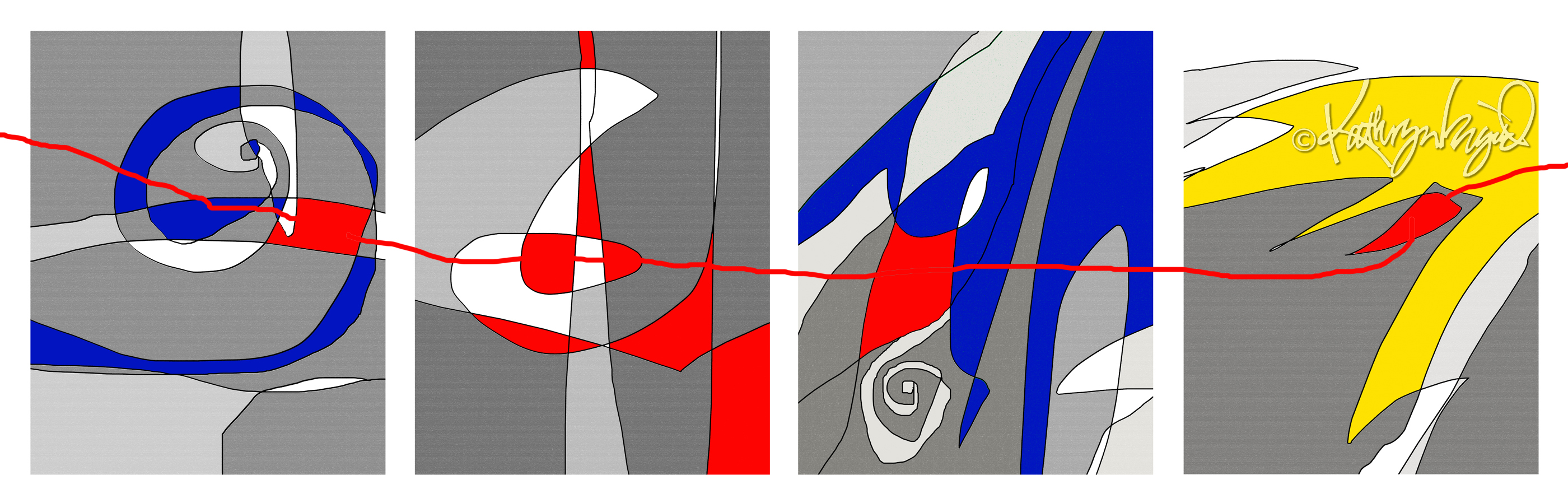
Röda tråden (The Red Thread)

Röda tråden is the Swedish phrase for connectivity. I learned it from my husband, who in turn learned it during his dissertation studies on modern Swedish choral history, and in a way it’s the perfect encapsulation of what his research revealed: that the astonishingly deep and broad influence of such a small country, in such a short time, on such a large field as Western choir singing and music came about primarily because of the remarkable and unique confluence and joining together of a huge number of events, people, ideas and resources in that little land at the end of the Second World War. As unimaginably terrible as war is on any scale, it’s all the more a testament to connectedness that at the end of one of the largest we’ve known, such good and meaningful and positive elements were all drawn into one significant, beautiful growth spurt in the art of singing together.digital illustrationAs a miniature of String Theory in the arts, this surge of the choral art in Sweden is notable (no musical pun intended) not only because it posits a reasonably substantial explanation for the larger choral sector’s modern expansive development amid the general devastation and struggle following the end of WWII, but also because in doing so it illustrates wonderfully how the intertwining of all sorts of seemingly disparate elements such as safe havens from political unrest and postwar reevaluation of norms, personal and professional relationships and experimentation with new media could come into contact and interact to create a new mode of thinking, acting, composing, teaching and singing. In turn, this is a striking model of how people from distinct cultures, educational backgrounds, economic resources and political systems and of widely varying personalities, unified by the one tiny thread of choral music, could be pulled together into a complicated system that, though still colorfully messy and imperfect, led to a potent common end that has had lasting and marvelous influence for long and fruitful decades since.

I am, of course, grateful on a personal level because this Swedish postwar influence on Western choral culture has not only enriched my husband’s professional and artistic endeavors–not to mention was the basis for his award-winning doctoral dissertation that in turn opened a lot of friendly doors to us both in Sweden–but because it produced so much spectacular music and inspiration for so much more.

digital illustration

Röda Tråden is the Swedish version of the idea that–indeed literally–fascinates so many of us: the connecting thread–that which binds one thing to another. I can think of nothing greater than to spend life seeking the Red Thread that shows us our commonalities and binds all people together as well.

Further, though, I am grateful that such an otherwise inexplicable event as the ‘Swedish Choral Miracle‘ seems to me ample proof that all things and people really are connected. And that through recognizing and making good use of those connections, however, odd or tenuous they may appear, there is hope for new and better songs to be sung everywhere.

If I needed further proof of this, last night’s concert gave it amply. My spouse conducted the combined forces of the Chancel Choir of the church where he’s currently interim choirmaster plus their excellent hired pro orchestra in performing Haydn and Dvorak’s two settings of the Te Deum text as the concert opening and closing, respectively, bookending the extraordinarily lovely and moving Missa Brevis of Kodaly. I came in to sit for the concert among strangers and acquaintances from the church and discovered a friend from another parish sitting across the aisle from me, then learned from one of the choir administrators that a friend of hers in attendance turned out to be a long-ago colleague of my husband’s from another state, and finally went up to greet my guy after the concert and found him speaking with a group of ladies in the front row, one of whom was the wife of a former US president. What brought all of us divergent people together in this moment? Music. Beautiful singing and playing. Chance, kismet, divine intervention. Call it what you will, the slender but unbreakable thread that connects us all drew us into one place for a time of basking in the inscrutably beautiful harmony that is beyond craft, beyond art. That is a concert without peer.

My Relationships are an Open Book

photoA recent Wall Street Journal article about couples finding the re-jiggering of their relationships around retirement quite complex amused me a bit. The general theme of the article was that most modern retirees, those from in-home jobs and those from outside employment, come from a world where they have established fairly separate-but-equal lives and find it a challenge to spend so much more time directly with each other, doing things together. I’m so happy that my partner and I are not like most. In my book, there’s no need to be that different in retirement if you’re secure in your pre-retirement life. I’m pretty sure, in fact, that we won’t face nearly the same sorts of questions or find many of them nearly so daunting as this newspaper item intimates they could be. Despite a hectic daily life, we apparently live together like retirees already in some ways. After all, modern retirees are among the busiest, most active class of people I know.

There are a number of reasons I don’t worry about our transition. Working as we both have in art-related fields (and both of us in academia and elsewhere), where schedules and projects and income and venues and so much more have always been in flux, means that we’ve both dealt with fallow times, whether job-induced or voluntary, wherein we were responsible for directing ourselves and choosing what to pursue next and when. That means each of us has taken the lead occasionally in having the more fixed schedule, project, income or venue and left the other either more freedom or more angst about how to fill the void for the moment. We are both artists, yes, but of slightly different sorts (his the musical kind and mine the more visual/verbal); these don’t compete or conflict with each other, so no ego is at stake should either of us be hung up on that kind of thing, but rather our artistic views are complementary; both draw on similar resources of effort, inspiration, creativity and skill, so we can speak the same language even when the details differ widely. As it is, our core life-values are pretty similar, so we don’t have much reason to go far afield for purposeful or enjoyable conversation. We have a whole library of possibilities from which to choose.photoWe have, in fact, worked side by side. Not only did our relationship start when we taught in next-door buildings at university, but I was already good friends with and had even collaborated with some of his colleagues on combined recital/art show projects, a sort of classical-based performance art, perhaps. As members of the same faculty, my future partner and I ended up at plenty of the same meetings and events over time, while both still having our own tracks of need and interest. Since our pairing, I have had the privilege of collaborating with him artistically as well, and his music provides a great deal of the soundtrack, live and recorded, of my life, working or otherwise, while he lives at home and work surrounded by my art and reads my writing. We are lucky in simply relishing time together, whether to Do Things or do nothing at all in companionable silence.

But we are neither conjoined twins in tastes and wants and needs nor dependent on each other for a primary sense of identity. He inhales reads books as quickly and easily as though it were breathing, and I labor through them; his reading ranges from professional interests to serial mysteries and thrillers and more, and mine, when my dyslexia forbids the time and attention required for favorites like SJ Perelman with his dazzling wordplay, or Charles Dickens and Robertson Davies, is devoted more to blog articles and short-form works; I read and write fairly constantly, but it’s a slow-moving river indeed. My Foodie Tuesday posts here will tell you that our preferences in dining also differ widely, if not wildly. Sometimes it’s tricky finding a meal at home that will satisfy both of us equally, given the limitations of our common subset. As for movies, he’d happily be in a theatre watching the latest offerings on the big screen, but he opts to stay home with me where I’m not troubled by the overwhelming noise and the overpowering intensity of on-screen action that were intolerable to me in my anxiety-ridden days and remain somewhat unappealing even now. He still watches a lot of stuff that I have no interest in watching or even hearing, but then I’ve learned that an evening in front of our own big screen makes a great time for me to install a good pair of earplugs, rev up my trusty pencil to draw or my computer to work on blogging, photo editing, magazine proofreading and correspondence. I still get to spend time in his company and swap intermittent witticisms with my favorite companion, and we both get to do what’s more appealing to each of us.

I realized long ago that I have a different attitude about relationships in general than many others, and I know that my attitude differs greatly from my own when I was younger as well. Now that I have a number of years of marriage under my belt (no comments from the cheap seats about ‘love handles’!) I am even more baffled by the people who harp on about what constant hard work relationships and marriages are and how difficult it is to keep them operational. Seems to me that if they’re consistently hard work, they’re not really relationships other than perhaps in the form of a slave/master sort. If it’s really high maintenance, it’s a job, not a relationship. Any that are one-sided because of abuse or complete conformity or any other sort of enforced imbalance cease to be viable or valid in my eyes. Only when both parties have something to contribute that is genuinely respected and appreciated by the other does it seem purposeful and potentially joyful, and if neither of those aspects is in the equation for any length of time at all, it is based on something far different from a relationship in my book.

At the same time, if we thought in perfect synchrony and had no differences of opinion or thought or preferences, it seems to me there would be no point in the relationship either. It would be pretty much the equivalent of marrying oneself, and idea that is both ridiculous and more than a little creepy. Narcissism is inherently the inverse of relationship-ready.

Apropos of this: both my husband and I had spent a fair amount of our adult lives single (he, divorced and I, unmarried) when we first dated, and both of us were fairly certain that we would remain single for the rest of our lives–and most importantly, both of us were okay with that idea. We were whole, functioning, socially active, happy individuals with full lives and immersed in relationships with great companions of all sorts. We think it’s part of what made us ready to slide into a life partner, love relationship with very little adjustment at all. Our cosmic crash into each other was instead a landing beautifully cushioned and protected by the remarkable net of many of those other relationships of ours, almost as much as by our personal contentment, mutual attraction and shared interests. Seems to me entirely noteworthy that a strong and happy relationship was founded on and remains supported by a network of other relationships.

This, too, is significant in protecting us from the dangers of too much intermingling of lives in retirement. We already share a lot of time together that we really love. And we already share so many great friends and loved ones that it’s far from essential that all of the newly acquired ones be mutual. He knows and enjoys the company and support and good humor of plenty of friends and colleagues, many of whom I know only as names or email-senders or office acquaintances or voices on the phone, and I have my own contingent of blog friends, expedition companions, collaborators and mentors as well. If every part of life were spent together, what would we have to talk about at the end of the day?

There are so many aspects of our marriage that make it pretty easy for me to avoid worry about what-ifs when retirement comes, I almost feel guilty. But not! I appreciate that we like to do things together as often as we can, daily, hourly, and that we have a life that allows us to take advantage of it. When we worked in side-by-side buildings in years past, it meant we could meet for lunch or stop by each other’s offices or for any number of other excuses quite conveniently; now, when I’m homemaking and blogging, I have the flexibility of schedule to take the shuttle over to the campus where he now works and grab a quick supper somewhere nearby with him before a tightly scheduled evening recital or concert, or sit in on a rehearsal of one of his choirs, or tidy up his files before sitting down to write and draw while he studies a score for the next choral-orchestral extravaganza. If I’m able to get a job again, I’d like to make sure that it still allows space for our interaction, however different that will be, because we really do value time spent together, however it’s spent.

If that makes ours a little unlike the average relationship approaching retirement age, I’m just sorry for all of those out there making up the bulk of the average, let alone any who remain under the mark for any reason. I’d much rather be novel in this respect.photo