Foodie Tuesday: When Baking Gives You Lemons…

You should find it dazzlingly obvious by now, if you’ve been visiting here for more than a week, that I am not a Baker. Exactitude is a form of patience that I lack, so much so that following a recipe to the letter—an important characteristic of baking’s central processes, whereby the necessary chemical and physical elements are able to perform their required duties and make the food do the particular tricks it’s supposed to do—is impossible for me, or close enough to it. As a consequence, I have made many, many baked goods that were not entirely, well…good. So many dishes that should have been light and fluffy come out more suited to supporting a truck while a mechanic fiddles about underneath it. What could and should have been moist and dense is instead frequently crumbly and dry and better designed in texture to use as kitty litter than as dessert, despite pleasant enough flavors. [Disclaimer: if you think this is an admission that I have eaten actual kitty litter, you have either greater faith in my scientific daring or even less in my common sense than I deserve.] Disappointing, these results, but enlightening, if I pay enough attention. Sometimes even remediable. There may be hope for me yet.

Maybe that’s why I don’t stop meddling with what should be fairly straightforward recipes. I trust that, at least some of the time, what doesn’t turn out best on first effort might be rescued by a further experiment or two.

This winter I was given a gorgeous, huge, tree-ripened lemon. My friend hand-carried it from her mother’s garden a couple thousand miles from here, and it was so big and juicy and magic-laden and perfect that I wouldn’t dream of letting it go to waste as a mere additional squeeze on dinner’s salad or a piece of fish. I sliced it thinly; not very evenly, because as I have surely mentioned before, my knife skills are less than impressive, but I gave it a go, and I did slice it fairly thinly. Then I layered those slices with cane sugar in a tight-fitting jar and filled all of the remaining space with plain, high-octane white alcohol (vodka, probably) and let it sit for a couple of months, just giving it a shake or tip once in a while to get the sugar to melt in and absorb and the lemon flavor to be intensified. When I opened the jar last week: Elysium! A rush of deeply floral, lightly sweet and highly lemony perfume bursting from the jar with the reassembled fruit in it. A whiff made for fainting over, if one breathed it in long enough. A liqueur not to be spent lightly, either.

I’d had this fancy, for a while, to try my hand at making some sort of citrus-cornmeal torte. I’ve read recipes for various kinds, particularly olive oil enriched ones from Sicily that sounded uniquely tempting, and decided to give my own version a try. Oranges and/or lemons, olive oil, corn meal. Not too sweet, not too bland. Just honest and refreshing. Sigh. None of the recipes I found was precisely what I thought I was salivating for at the moment, though. I still wanted moist and slightly dense texture, almost a steamed pudding character. What to do, what to do…. Of course: experiment, again. Knowing that baking still requires some commitment to precision, I did as I always do and turned to a tried-and-true basic recipe of somewhat similar character and substituted this for that and these for those. What resulted was not precisely what I’d had in mind, but not too shabby, either.

Photo: Lemon Cornmeal Torte

When I inverted the torte out of the springform pan, I broiled it briefly to finish coloring and caramelizing the lemon slices. If you have one of those dandy little brûlée torches, have fun with it. I don’t recommend an acetylene welder, however, unless you’re baking in your foundry.

Lemon Cornmeal Torte (Take One)

Preheat oven to 450°F/232°C (or whatever approximates those temps in your oven). Mine, as I’ve mentioned numerous times, is old and unreliable, so I must needs watch it like the vultures watch I-35.

I decided to use my springform pan. I lined it, inside and out, with heavy aluminum foil because, given the experimental nature of all of this, I was a little worried about leaks and other non-ingredient surprises. Not to mention that that uppity oven of mine might explode in a fireball or something. Probably wasn’t necessary, in the event, but still. On with the recipe:

I mixed about 3-4 T melted butter with an equal amount of cane sugar and spread it in the bottom of the pan, and then laid the lemon slices out across that syrup base.

Combine dry ingredients with a fork or whisk: 3 cups cornmeal, 1 tsp baking powder, 1 tsp baking soda, 1-1/2 tsp salt, 1-2 tsp ground cardamom, 1 T citrus zest. Since I’d macerated the Queen Lemon, her zest wasn’t fit for the task anymore, so I grated the peel from a couple of the clementines I had on hand.

In a separate bowl, beat together the wet ingredients. [These are where I think I would have done well to go a slightly different path.] I combined about 2-3 Tablespoons’-worth of flavorings from the following: liqueur from the preserved lemon, fresh lemon juice, and ginger syrup. I added enough buttermilk to the flavor mix to equal 2 cups total. [In retrospect, I would have bumped the flavorings’ amount to a full half cup and used 1-1/2 cups of the buttermilk.] Whatever the eventual “design” of the recipe, on this occasion I rounded the wet ingredient list with 1 cup orange juice, 2 large eggs, and 2/3 cup fine extra-virgin olive oil. I suspect I could well have added another egg at the time with good success, too, but I didn’t. We shall see!

Combine the wet ingredients with the dry and stir until mixed. Pour the batter in the pan over the lemon slices, set it in the oven, and bake just until set, the center not quite visibly moving anymore when you bump the pan, somewhere around 35-40 minutes.

Served with a very lightly sweetened whipped cream, it was pleasant and tasted of spring. But it wasn’t quite what I was craving, just yet. I wanted brighter, juicier lemon flavor and yes, this torte was still on the fragile, crumbly side. Onward, I say! The next day was good enough for reevaluating and rethinking. And rebuilding. That night we’d had a table-full of guests, but there was also another cake, so both desserts stretched beyond our needs. That left me, on the next day, with half a torte, or more accurately, a big quart bowl brimming with lemon-ish torte remnants. Make a trifle with the remaining whipped cream? Perhaps. But it wouldn’t fulfill my fancy, still, of that zingy, moist dessert I was imagining. Instead, I made:

Photo: My Pudding ReTorte

Even a tasty steamed pudding is often not so much to thrill the eye, so I served this little dish of mine with a puree of fresh strawberries in orange juice and a sprinkling of black sesame seeds just for the jazz of it. Less elegant looking than the original version, more zingy to eat.

Steamed Lemon Pudding (My Re-Torte)

I put the torte crumbles, sliced lemon topping and all, into my food processor with not only the almost-equal amount of leftover whipped cream but also a very hefty splash of lemon juice and three large eggs, and blended everything into a new, thicker batter. I poured it into a greased, covered casserole and steamed it until, again, it was just set. [It could easily steam in your oven or pudding steamer in the traditional way, but with my oven being so recalcitrant, I opted to steam it, covered, in the microwave instead.]

Photo: Rose Explosion

Roses *and* primroses: those pale tissue-pink sweethearts on the lower right are my first real crop of the dainty wildflowers since I seeded them two years ago in my backyard mini-meadow. Yay!

When I let it cool to room temperature, that iteration of lemon-cornmeal dessert proved to be more what I’d had in mind all along. It was just about the texture of a good Christmas pudding, but of course more seasonally fit in both color and flavor for what we did when my visiting friends returned for our afternoon coffee: we sat on the patio and spooned it up while sipping, chatting, gazing at the explosion of roses, and enjoying one of the nicest bits of outdoor-friendly weather we ever get in these parts.

Foodie Tuesday: Zombies, & an Old Lady with Good Bones

Zombies are still surprisingly popular these days, considering their poor (or, at best, wildly over-eager) social skills. The current crop of them was, impressively, a resurrection of many previous generations’ versions of the species, which means that they are not just returned from the dead, but returned from being returned from being dead. Or something like that.

In my kitchen, I am mostly nicer than a zombie-master, intending only good things to happen via my culinary experiments. But no matter how kindly my purposes, sometimes I am an unintentional bringer-of-doom. Many are my fellows, I’m sure, but perhaps fewer are those who will admit to stumbling around the cooktop in their experimental work, lest they be accused of attempted poisoning or any such mean-spirited rubbish. Sometimes I’m even dumb enough to try to revive the dish that had already failed, which I suppose makes me guilty of the same sort of resurrectionist hubris that has brought about many a modern-day pop-cultural scene of zombie-apocalyptic grocery shopping. At least I don’t attempt to feed the second variation of my experiments to anybody else before carefully being my own lab volunteer. But I hate to be wasteful.

Photo: Who's been Messing with My Cooktop?!

*”WHO’S BEEN MESSING WITH MY COOKTOP?!” roared the Giant. There was silence in the wreckage, for the Zombies had eaten the Cook—along with her only semi-successful Spätzle as a side dish, because her tiny brains alone were clearly not filling enough to assuage their ravenous collective hunger.

So when I made that recent jiaozi whose dumpling dough was less than perfect, I couldn’t resist trying to rescue the remaining dough. It was, honestly, closely based on other cooks’ supposedly successful versions of gluten-free pasta doughs, so I figured my inability to achieve a particularly shining success with the same wrapper recipe was more a matter of practice or tiny ingredient tweaks than anything more serious, and sought to revise the dough just enough to make it noodle-worthy. An added egg did, in fact, help it to have much more of the texture and malleability that I’d want in a pasta dough, although it was still just loose enough that unless I added further flour I couldn’t hope to roll it out in thin sheets. So I thought about thicker noodle variants and opted to give this dough a try as Spätzle, since those tiny schwäbische Schätze (southern German gems) aren’t rolled out before cooking. Indeed, the dough went through my grater rather handily (if extremely messily*), cooked at a good speed in my boiling broth, and floated up as light, petite, pale golden dumplings, just as I’d hoped.

They even tasted quite lovely, straight out of the steaming pot and doused liberally with browned butter and a sprinkling of grated cheese (I used Parmigiano-Reggiano for its added nuttiness). But tasting them ahead of time like this, as well-meant a prophylactic measure as it was, did mean that I would have to reheat the mess yet once more, and alas, even the most gently handled of pastas simply couldn’t survive another round of stasis-and-revivification. Sometimes the dead remain dead. The last reheating left me with buttered paste rather than pasta, and the only effect of adding the egg to the dough was, ultimately, to leave me with egg on my face. Ah, well. Of such mini-disasters are legends, or at least jokes, made. The joke’s on me.

Photo: Tasted Okay at First

Thankfully, the Cook had inadvertently saved the world by cooking dumplings that tasted okay at first but quickly became unpleasantly cement-like in the Zombies’ remaining innards and turned them all into stony statues of their *former* Former Selves. And so the Apocalypse was averted, and simultaneously, a glorious, artful monument in statuary made to commemorate the moment of this, the world’s rescue. You’re welcome.

Don’t get me wrong: being an old enough geezer (“lady” might be a stretch) to want to get the most out of my grocery money and cooking efforts isn’t always a bad thing. I’m ancient and experienced enough, in fact, to know that I should occasionally admit defeat and throw out the last of that failed dough. Chalk it up to been there, tried that wisdom.

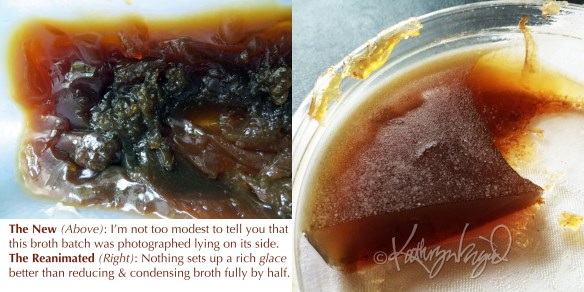
Other forms of wisdom are well worth the earning in the kitchen, too. Like, when there’s a fresh batch of bone broth cooking, a really, really fabulous batch made with my usual ingredients plus both chicken feet and beef feet that did indeed come out of the slow cooker as rich, glossy, and jellied as the most beautiful classic aspic of my dreams—but there’s still a pint of the last batch in the fridge, rather than bolt or toss the latter, I simmer it down and get an equally gorgeous reduction for sauce base and soup enhancement. I added some dry sherry before cooking it down. Just for fun. Oh, and a little sweetness. This little tub of wondrous demi-glace is good enough to melt for a beautiful finishing sauce for anything savory that isn’t vegetarian, just as it is.

Photo montage: The Broth Brothers

But another old-lady bit of kitchen witchery that more people should know and respect nowadays is that, while minimal cooking of vegetables can preserve more of their original nutrients, not to mention textures and colors, than boiling them to mush in the fashion of days long past—or as though they’d started cooking back then—softer veg is not nasty. Gentle handling is the difference. Some good Southern cooks in the US have not entirely forgotten and forsworn the low-and-slow glories of vegetables simmered for ages in bacon grease or butter, and any culture that values its stews, dutch-oven artistry, and slow cooker magic, for example, retains something of this truth.Photo: The Softer Side of Vegetables

So for a recent lunch with a couple of friends, I opted to carry on these traditions at both levels, piling up a batch of bite-sized cauliflower, carrots, and celery in my trusty small Pyrex covered dish, put a knob of browned butter and a quarter-cup of said demi-glace, still jellied, on top, and steamed the lot gradually in the microwave into lightly softened submission. For the finish, I stirred the vegetables, topped them with a piquant garnish “salad” I’d made earlier and refrigerated, a mix of preserved and chopped green olives, pimientos, black olives, and mushrooms. I added a generous sprinkle of Parmesan shreds, and let the dish heat one last bit before serving. Old-fashioned vegetable happiness. With a deep undercurrent of old-fashioned cooking from a rather old-fashioned person.Photo: Old Fashioned Covered Dish

Foodie Tuesday: The Gingerbread Woman

The scent of cinnamon drifting out as I open the door invites me to plunge inside, but I can’t help taking my time. A deep, slow breath: cinnamon, nutmeg, allspice. Ginger. A smack of icy air throws my collar up around my ears and gives me the final push to dash inside, the storm door slamming behind me.

Gingerbread.Photo: Gingerbread 1

Mama loves us. The school board thinks it better we all traipse home, damp and frost-speckled, through the sidewalk maze of shoveled snow than that we stay snugly tucked into the school with a sack lunch, and we kids complain at the bitter wind and the icy ground. Slipping sidelong into the snowdrifts isn’t as fun when we still have the slog back to afternoon class ahead, wet and miserable, blue around the nose and chin or not.

But some lucky few of us have the respite of bath-towel-wielding mothers, a pair of dry socks hanging over the back of the chair, and on top of it all, a homemade lunch waiting for us at home. Lunch with gingerbread. Sweet, so hot from the oven that clouds of spice envelop us at the threshold. So hot that even after we’ve gobbled our sandwiches and soup to get to it, the layer of homemade applesauce on top can’t keep the uppermost layer of whipped cream from melting faster than those last snowflakes in our hair.

Gingerbread. Mother’s love and blessed relief from the cold winter’s day all wrapped up in a helping of almost unbearably delicious goodness. Sigh. Back to school. Repeat. Maybe there will be enough gingerbread left over for after supper, if we hurry home fast enough.Photo: The Gingerbread WomanMy Own Gingerbread with Rum Caramel

Preheat oven to 350°F/177°C.  Blend dry ingredients gently with a whisk: 2 cups [gluten-free, in my case] flour, 1 cup packed brown sugar, 1 cup granulated sugar, a scant 1 1/5 tsp baking powder, 1/2 tsp baking soda, spice mix [2 T ginger, 1 tsp cinnamon, 1/4 tsp each cloves, nutmeg, and white pepper, + 1 hefty pinch each cardamom and salt]. In a saucepan, melt 3/4 cup coconut oil and add to it 1 cup molasses, 1/2 cup whole milk yogurt, and 1/2 cup dark rum (cane sugar cola, root beer, or ginger ale is a great non-alcoholic alternative), warming just until thoroughly blended. Add 3 large eggs and beat them in well, tempering the wet ingredients if the warmed ones are still at all hot so the eggs won’t curdle. Combine the wet and dry ingredients and pour into a heavily greased and floured (I used cocoa powder mixed with cinnamon, to keep from building up any unseemly white dust blooming on the finished goods) cake or loaf pan, cupcake tins, or a combination of these, allowing plenty of space for a bit of rising as the batter bakes.

For small portions like the cupcakes, start with no more than 18-20 minutes’ baking; larger batches like a Bundt pan can be checked later, allowing up to nearly an hour for full baking. Check occasionally, removing them from the oven when they seem nearly done; a very little under-baking keeps them nicely sticky and gooey, good cousins to the Britons’ glorious Sticky Toffee Pudding.

While I’m on the subject of toffee, there’s nothing at all wrong with the idea of a caramel kind of topping to accompany a nice, intensely spicy gingerbread like this. So I made some Rum Caramel Sauce: in a nonstick saucepan, I cooked together, until melted, 1 cup brown sugar (again!), 1/2 cup browned butter (I’d just made up a nice big batch of my beloved beurre noisette), 1/4 cup dark rum (see above note for non-alcoholic versions), plus a touch or two of cream to thin it as desired at the last. Terrible stuff; you wouldn’t like it at all. May I have your serving of it?

Lastly, of course, if one is feeling particularly indulgent-and-when-am-I-not, it’s good to top all of this with a heaping spoonful of cream whipped up with lots of vanilla and dark maple syrup. The resulting calorie-free, eternal-life-conferring dessert met with approval at snack time, after dinner, in the late evening, and for breakfast. So you can expect that my friends and I will be outliving all of you. Or at least, dying contented. I didn’t get any no-thank-yous when I offered thirds, anyway. As I’m sure my mama never did, back in the old days of snowy trudges and school lunches.

Foodie Tuesday: Yummy Bugs

I am neither an avid gastronomic adventurer of the mad-scientist or TV food show host variety nor a very tough customer when it comes to things creepy, crawly, and wriggly occupying my kitchen, let alone my dinner plate. But since I do love eating a fairly wide variety of foods and I read about them enough to stumble on a few I’m more than willing to try along the way, I find occasion to be reminded that many of the things I do like or love to eat and drink might just be as strange and off-putting to others as their regional special treats or foods, especially those born and developed over generations of poverty, hunger, privation, and desperation can seem to me. Both times and people in them change, and so do our tastes, as a result. If I were to have a time machine, my first inclination might not be to hop in and create world peace, but to dash off to a fortuitous point in history that’d suit my greedy appetites, like perhaps the era when lobster was considered throwaway food to the rich and worthy only of a pauper‘s table.

Because, after all, my Southern countrymen are not wrong in revering a diet full of tasty crayfish, also known as crawfish, crawdads, or among some Southerners, mudbugs. And the latter nomenclature is perfectly apropos: I find crawfish delicious, too, but when I think about it, I’m well aware that crustaceans, some of my very favorite foods, are indeed also arthropods, just like crickets and grasshoppers, I realize that I might be exceedingly silly in my selective squeamishness about eating insects that are popular in many other cultures and cuisines. So much meaning lies in the tiny spaces between name and nation, between  attitudes and recipes and what we’re used to seeing on a plate. Yes, I am very happy I can buy bags of crawfish tails, ready to put into Étouffée or gumbo or perhaps just cleaned and piled on buttered bread with a squeeze of lemon juice and washed down with a cold beer, even though I can look right there in the heap of cooked crawfish and see perfectly clearly that I am about to serve and devour a bag of bugs.

Photo: Crawfish Tails

Calling mudbugs Bugs doesn’t change that they’re highly edible crawfish protein. That little white “smile” in the lower right corner is the thawing tail meat of one such insect of the sea, and a mighty edible one at that.

I’ve told you how obsessed I can be with the very thought of all sorts of magnificent sea treats that have the obvious connection with their land-borne arthropod cousins: classic northeastern lobster rolls, Dungeness crab in virtually any available form, tempura prawns, San Francisco style Cioppino loaded with crustacean charms, Steak Oscar, Vietnamese shrimp rolls. My eyes almost roll back in my head as I swoon the minute I get thinking of such glorious stuff.

None of it has to be especially fancy, either, though I’m still a little iffy about eating the bugs of the aquatic world raw, let alone their turf-tied relatives. Unless and until you convince me you’re a five-star sushi chef or an aboriginal expert in your local insect cuisine, I will still tread lightly around these treats. But a quick roast, simmer, or—often my favorite with the smaller fellows, as it can make even their exoskeletons not just crispy enough to eat but quite delectable as well—deep fry, and suddenly what I was inclined to swat away as a nuisance might have me stalking it with equal vigor. The arthropods themselves don’t often require complicated prep, merely great care in avoiding unintentional eating of the cartilage and other bits that are either too hard to bite or to digest. Steam. Pick apart. Eat.

Photo: Nekkid Prawns

Dry ice certainly adds to the drama, but really, is there much nicer than sweet, sea-fresh, naked prawns?

So I devote more of my attentions to figuring out just which fantastic vehicle I crave for giving full reverence to their tender and fresh attractions, which altar is the one on which I’ll lay their treasure before I eat. Cooked and chilled entirely naked [yes, the seafood, people], with a mere squeeze of lemon or a nip of cocktail sauce to highlight them? Piled high on a grilled cheddar cheese sandwich? Gracing a bracing Louis salad (so wonderfully easy at home)? Or one of the perpetual best and most over-the-top fatteningly satisfying, mac and cheese with name-your-crustacean-favorite?

Last week, the latter was the choice of the day, so that I could serve dinner to a roomful of friends who were all arriving at different times and I could keep the meal mostly warm with all of the comings and goings but it didn’t have to stay sizzling hot. Somehow, macaroni seemed apropos anyhow, for a table with an international crew of diners passing around both dishes and jokes in a variety of languages. I base my macaroni and cheese recipe on the ever-fabulous Amy Sedaris‘s paean to arteriosclerosis, because it’s ridiculously yummy and quite flexible, but also given its flexibility, it’s never exactly her recipe either.

In my house, it means that to my al dente pasta I add equal (large) amounts of Monterey Jack cheese, which I did have on hand; a good sharp cheddar (Tillamook extra sharp white, my go-to choice); a buttery, very mild but also smoked cheese (sometimes smoked Gouda, but smoked fresh mozzarella, this time). Along with the vast quantity of butter and other dairy—mine: 1 part heavy cream, 1 part whole milk yogurt—in the mix, I add several eggs to bind it all a bit better. Then I throw in the seasonings. Amy’s is generally an unseasoned casserole except for salt and pepper; mine has a combination of my perennial favorite, smoked paprika, plus ground mustard, a good grating of fresh nutmeg, and a little cayenne pepper. Once I’ve grated the cheeses, stirred in the eggs, cream, and yogurt and the spices, I spread it all in a big glass casserole dish and sprinkle the top with grated Parmesan cheese and heat it slowly at a low temperature in the oven until the top just begins to brown.

A very handmade dish, since my most effective food processor is a pair of clumsy tools at the ends of my arms. All of that intensive cheese grating, at least, worked off enormous quantities of calories so I wouldn’t have had to worry about the wickedly high number of them in the dish. Of course, mac and cheese is a completely calorie-free entrée, as everybody knows. Just ask any self-respecting insect you happen to find swimming in the residual butter at the edge of your plate. I’d let you test mine for proof if the seven of us hadn’t wiped out the entire quantity in no time flat. Even the bugs couldn’t get there faster.

Photo: Macaronic Bugs

Clockwise from top left: warm mixed crabmeat and crawfish tails, baked macaroni and cheese, smoked Texas sausages cooked in hard cider, green beans, and carrots and celery steamed in white wine and dill.

Foodie Tuesday: Purple Pudding

Post-winter craving happens. Everything seems to have been a little monochromatic and bland comfort oriented for a while, and suddenly I have the urge for something bright, wild, exuberant. Even in my eating. Colorful stuff.

Photo: Grape Expectations

Yes, I do know that green grapes are not Concord grapes, nor purple. But I liked this photo of mine and its purple background better than any picture I had on hand of Concords, so use your imagination. Wink-wink.

It doesn’t take much to make a richly rewarding, intensely violet (but not violent), dessert. What’s not to like about a Purple Pudding! Two vibrant purple ingredients: grape juice (2 cups of dark purple Concord + goodness) and a big heap of fresh or frozen blackberries (1 pound or about 4 cups). Add in a couple of essentially colorless ingredients. Some dried tapioca (6 T of the instant or ‘minute’ variety) and some elderflower syrup (1 cup). The process is equally easy. Put the blackberries and syrup together in a (nonstick) saucepan and bring them to a boil, stirring all the while. Once this is boiling, turn down the heat and keep it simmering until it’s reduced by about half. Fabulous jam! Soak the tapioca in the grape juice for at least 5 minutes—or, if you’re preoccupied with lots of other things like I was, overnight!—and then bring it to a full rolling boil, stirring constantly. Remove it from the heat. You can easily mix the two juicy gems together, grape and blackberry, at this point and serve it as one dish, whether hot or (as I like it) chilled, or you can serve them separately and let people spoon up whatever blend of the two they prefer.

And, if one would like it to add just a little kick, a splash of elderflower liqueur goes down nicely in it as well. But only a tot. I’ll admit that I was strongly considering using a bold red wine for part or all of the liquid in either portion of the recipe, but I decided this would take the dessert in a boozier direction than even I wanted. The fresh, lively flavors of the purple fruits should dominate, and the added attractions be lightly applied. Robust and vivid. Edible ‘dotted Swiss‘ textured by the tapioca bits and the blackberries. Light and happy. Seriously refreshing, playfully simple. Mighty tasty.Photo: Purple Pudding in Two Movements

Why would I make this? Because I’m craving something fruity besides citrus and other wintry imports by now. Frozen berries can do the trick pretty neatly, if well-preserved. And blackberries are a decidedly delectable choice at any time. Their flavor has long seemed to be marvelously complemented by elderflower and rose, for some reason, so as I have the former on hand in a couple of quenching forms, it seems destiny to combine these friendly flavors. The bumpy texture or the blackberries is also amusingly paired with the softer bits of bumpy texture in good old tapioca pudding. And aren’t grape juice and blackberries both supposed to be superfood-ish-ly antioxidant and Good for Me? Surely, yes, as they make me wildly happy.Photo: Vividly Violet

Foodie Tuesday: The Not-So-Great Pretender

Unskilled as I am at so many culinary things, my well-intentioned fakery in attempting to prepare favorite treats from various delicious cuisines is not only highly unlikely to ever be quite accurate in its representation of the real deal but also just plain goofy and messy. I apologize to any purists out there, but I’m not above stealing ideas from everywhere I’ve ever found foods to love. And often, putting my own twisted twist on them, too. Perfect accuracy may, after all, be slightly overrated.Photo: Korean BBQ

After a recent delicious trip to a Korean BBQ house here in north Texas, I got good and hungry for a host of tasty Asian-inspired treats I hadn’t had in a while. I particularly wanted to revisit a recipe I hadn’t made by hand in many, many years: Jiaozi, or potstickers. And of course, I wandered off on my usual tangents. Making the wrapper dough wasn’t my best skill even when I was supervised by my teachers in my Chinese language, culture, and cuisine workshop back in college, and I had it in mind to attempt a gluten-free version on top of that, this time around, so instead of getting a nicely malleable dough in which to wrap the filling and practice my dumpling pleats—the one part of the wrapping that I was reasonably good at doing, thanks to Mom’s early training of me in the arts of tender lefse dough handling and pie crust edge crimping—I got falling-apart dough that was more easily squeezed around the filling in highly abstract, squishy-squashy little dumplings.

Pretty, they were not. I will attempt to revise the dough with the addition of egg binder next time and report back. But I got my poor little raggedy jiaozi to hold together just enough to fry and steam them, and the ingredients were at least agreeable enough to taste passable in the event, so I will keep trying. Meanwhile, I give you these little wounded stegosaurs:Photo: The Homeliest Jiaozi

The Homeliest Jiaozi this Side of the Yangtze

Make jiaozi wrapper dough: 3 cups gluten-free all-purpose flour + 1/4 tsp salt + 1 1/4 cups cold water [+ 1 egg, probably, for future reference]. Knead well into a nice elastic dough, wrap and refrigerate to rest for a minimum of 30 minutes.

Make filling: cook 1/2-1 cup minced meat (I used lamb this time) with 1 T minced fresh ginger, 1 tsp finely grated lemon/lime zest, 1 tsp minced fresh jalapeño, 1 handful sugar snap peas sliced crosswise into small rings, 1/1 rib celery (minced), 1 tsp minced shallots, good splashes of Tamari, rice vinegar, and dry Sherry, and a small splash of toasted sesame oil. Drain and cool the mixture slightly.

Divide the wrapper dough into 60 pieces, starting work with 1/4 of it at a time and keeping the rest chilled until ready to prepare dumplings. Roll each little piece into a ball and then into a flat circle, about 3″ in diameter. Put a small spoonful of meat filling on the wrapper, pull the sides into a half-moon shape around it, and gently pleat the curved edge, sealing it with water, egg wash, and/or a fork’s tines. Or, if your dough behaves like mine did, pull it up around the filling and squeeze the sorry-looking little objects into submission.

Pour a little cooking oil (I used avocado) into a large, flat pan, place the dumplings curved side up in the oil like little half-moon sailboats with just a little space between them, and put the pan on medium heat. As the bottoms of the jiaozi begin to brown, pour a little broth or water over them (just about 1/4″ or so), cover the pan, and let them steam gently for a few minutes to firm up, watching that the heat doesn’t get too high, or the liquid will cook away completely or break the dumplings into mush. At this point, the jiaozi can be refrigerated in a covered dish to be finished later. I put mine in a microwave-proof small casserole that still allowed them to sit on their flat bases in one layer, pouring the remaining steaming liquid over the top, so that I could finish steaming them and, if needed, crisping their little bases, when I was about to serve them for lunch the next day. Or you can, of course, keep on with the steaming and crisping for immediate eating.

Serve them hot, with a saucy little blend of Tamari, vinegar, and a few hot pepper flakes or added crushed fresh ginger on hand for dipping them.

Foodie Tuesday: Mashed for a Mashup

Beans can be fun. Yes, they can be slightly dangerous in their propensity for aftershocks, if you will, but with reasonably careful preparation they offer a great deal of variety in flavors and textures, a filling and hearty sense of substance, and a decent nutritional punch, all in a bunch of mighty little packages. Fond as I am of rather wide-ranging cuisines, I am also bound, then, to enjoy good leguminous dishes. But I’m not endlessly open-minded about them. I don’t get much pleasure from things that are mealy, mushy, and morose, and when beans are handled too cavalierly by cooks, they can be reduced to such states rather easily. Why eat anything too bland, too woody from undercooking, too dull and lifeless from overdoing, or otherwise characterless, when in fact beans are such a fine medium for carrying a host of vivid flavors and come in such a rainbow of colors, shapes, and sizes?

All of this being said, I’m also a fan of one of the less stylish preparations known to bean-eating humankind, the ubiquitous mash of frijoles refritos or refried beans. This may be, as you’d guess if you’d read no other posts of mine than a single recent Tuesday one, due to the oft-practiced method of making refritos taste best by jamming as much lard into the pot of them as is physically possible, along with the musky goodness of cumin and other Mexican or Tex-Mex seasonings. But it’s also a pleasing kind of mash, having both the thick porridge character of many so-called comfort foods (nursery food texture is clearly a consistent preference among these) and the occasional happy surprise of the un-mashed, unabashed little pearls of un-crushed beans here and there.

Another pleasurable bean dish that’s full of rustic old-school goodness is the American classic of Boston baked beans, the virtual equivalent of candied beans, which also hold an unsurprising attraction for a devoted sweet tooth like mine. Traditionally, the well-loved Boston version of them contains salt pork and molasses, and I happily went with a similar theme when preparing yesterday’s side dish, but then I got to ruminating upon the aforementioned treat and wondered if the two recipes mightn’t make a nice partnership, as well. Turns out that there’s a Boston in Texas, too, in case that excuses me. So off I went, concocting my bean dish of the day…and enough extra for another two meals or so.

I’d par-cooked a batch of mixed beans recently, for starters. I combined equal parts dried kidney, pinto, and black beans, soaking them in several batches of water (each one successively cold, brought to a boil, cooled, rinsed, and replaced) over a stretch of hours before the final simmer to near-doneness. One portion of the beans went directly into a big batch of beef chili my spouse and I had prepared together that day; a large portion of the legumes went into the freezer for future uses; the last quantity was saved in the refrigerator in its own unseasoned juices for today’s preparation. And the latter was pretty easy to fix, with those beans already lying in half-cooked wait for the occasion.Photo: Boston, Texas Beans

Boston, Texas, Beans

Before the beans came into the picture, there was the salty-sweet sauciness to get under construction. I chopped about a generous half-pound of bacon into pieces and cooked them over medium-low heat with a big handful of brown sugar (my molasses source), a small sprinkle of smoked salt, and a couple Tablespoons of butter. Yes, extra salt and extra fat. Beans to come, cooked without any seasoning or fat, you know. Me: fat, salt, sugar. Yes. Deglazing, as the bacon began to crisp, with about 1/2 cup of good Texas bourbon. Once that all got good and syrupy and semi-crisped, I added the beans and their liquor, (about three cups) stirred everything to mix, and got in there with the potato masher, leaving some beans more or less intact. Let the whole pan sit, covered, at a low simmer until dinnertime about a half hour later. Served hot, it satisfied nicely after a busy afternoon for both of us diners.

In the event, it was a bit on the dry side for my ideal, but not too dry to be enjoyed with some plain smoked sausages cooked in white wine, dipped in a touch of mustard, and served with a side of juicy sweet Clementines. Given the slight dryness, however, I added a big dose-si-do of sweet BBQ sauce and a splash of water before sealing the remaining two meals’ worth in a zipper bag for refrigeration, and I’m sure I’ll get this little handshake-across-state-lines dish on speaking terms with further entrees in the days to come. Cooperation is a good thing, and the ever-flexible ingredient beans are nothing if not good citizens in the kitchen.

Foodie Tuesday: American Pizza Party

When company’s coming and it’s not supposed to be a fussy occasion, I’m not going to be one of those hosts slaving in the kitchen and trying to pretend perfection. I would much rather spend my energies on getting edible, uncomplicated food on the table and either being with the guests or, as was the case the other night, getting out of the way of my spouse’s dinner meeting so I could enjoy reading in peace while I ate my own dinner in the other room. The people in attendance at the dinner meeting could talk business and be casual and not concern themselves with etiquette or entertaining me—or I, them—and I could even relax a bit after fixing dinner.

Pizza, in the American style, is an easy choice on such occasions. This time around, I didn’t have any guests requiring any particular dietary care: no gluten-free needs, no vegans, no special religious occasions being observed, and so forth. I didn’t have any unusual worries about any formalities. Simplicity and ease of serving were a bigger deal than being distinguished or fancy in any way, and setting up so the meeting group could take care of their own food and drink once it was served was the obvious solution. Around here, that means being able to eat without utensils if we like, and helping ourselves when we want more. Pizza. Drinks. Fruit and vegetables already cut up and served cold, with a couple of dipping sauces in case anybody wants. Lots of paper towels or serviettes or cloth napkins, whatever’s available.

Did I mention pizza?Photo montage + text: Pizza Party

And while I could fiddle around and make homemade crust, I’m kind of too old and lazy for that anymore. Horrifying, I know. You can shun me. Or you can enjoy making your own pizza crust, or hey, just join in and buy store-bought dough and save yourself a little time. I won’t even judge you if you order delivered, ready-made pizza. I just got in the mood to do my own toppings this time. So that was the only fuss I made. I let the grocery store do all of the fruit and vegetable peeling and cutting and plating in those chintzy little plastic trays, and was quite content. The pre-made pizza dough bought from the refrigerated case at the store was good enough for me, and one of the guys at the meeting even asked me if I had made it, and I didn’t lie. Credit where it’s due.

For the veg, a dip made of blended cottage cheese and whole milk yogurt (equal parts or so) seasoned with dill, thyme, salt, and smoked paprika, and a pinch of cayenne. For the fruits, a sauce of caramel—brown sugar melted in butter, with a pinch of salt, and in place of the usual cream, more yogurt. And a big hit of good quality cinnamon, for this batch. Mixed nuts and individually wrapped candies and chocolates. Cold drinks. Good friends and colleagues, and big ideas floating all around. Satisfying sustenance.Photo: Pizza Buffet

Foodie Tuesday: Are You Growing a Mustache, or Is That Chocolate on Your Lip Again?

Photo: Spiced Chocolate Power Pudding

With sprinkles. Because, Sprinkles. You have to ask?

If you’d told me years ago that I would become such a chocolate addict, I’d probably have snorted and chortled my way right onto the floor. I always found it okay, but if given a choice would undoubtedly have chosen any number of other flavors as my preference over chocolate. So I’m still occasionally a little bit surprised at myself and my evolution into a veritable chocolate fiend.

Be that as it may, practically every time I put up a dessert or sweet-related post on this blog, it seems to include chocolate in some form or other. Why resist, eh! There are worse compulsions to have.

Spiced Chocolate Power Pudding
Beat 4 eggs thoroughly and set aside. In another bowl, set
1 avocado
1 ripe banana
1 splash lemon juice
Pinch of salt
1/2 teaspoon pure almond extract
1 teaspoon ground cardamom
2 scoops vanilla whey protein powder
Mash them together thoroughly! In a saucepan, pour
2 cups whole milk
Heat just until steaming.
Melt in 1/4 cup coconut oil and
5 ounces chocolate (I used Ibarra Mexican chocolate).
When it’s all melted together smoothly and
back to steaming (not scorching) temperature,
pour it in a thin stream and stir it carefully into the eggs.
Put this blend back in the saucepan and stir it constantly
over medium-high heat until it thickens.
Let it cool to room temp. Mix the egg blend and the
avocado mixture thoroughly and refrigerate the total until
well chilled and set. Overnight is good.
Deliciousness abounds.

Foodie Tuesday: Salivating

Photo: Sprightly ApplesAs part of the perpetual human inclination to long for what is impossible, I suppose it’s no surprise that in the midst of one season I am frequently hungry for whatever is furthest out of season. When summer’s blistering and swelter have long since worn out their welcome, I think with great fondness of weather cold enough not only to cool my overheated brain to a slightly more manageable temperature but also to encourage the peak production of root vegetables with which to make those satisfying soups and roasted dishes that give a welcome tot of inner warmth to body and soul. In springtime, the autumn’s pears and quinces seem so remote as to have been but a beautiful fever dream of seasons past.

And though winter is short and blunt in north Texas most of the years I’ve spent living in it, it isn’t long dropped toward freezing before I think what a joy it would be to have weather balmy enough to require something cool and liquid, or just bursting with juicy freshness, to cheer my fainting spirits. Mostly, this is merely a sorry reflection of my lack of maturity and patience with whatever is present on the table or in my life. But perhaps it’s also possible to place a little of the blame on some of the first-world realities of the modern era. Indoor climate controls make winter ever so much drier than it was in my soggy single-pane-windowed youth. The normal chill of wintertime is confused in my body and household by a central heating system, never mind by old lady hot flashes, and the vast improvements in food packaging, shipping, and storage mean that I have access not only to fresh, picture-perfect produce that is nothing like currently in season where I live but just arrived on store shelves there from a country where it is at its peak growth. I can buy freeze-dried or frozen goods that are sometimes fresher and more flavorful on being prepared or reconstituted in my kitchen for having been processed so quickly at the point of harvest than any such things often were right in their natural local peak years ago.Photo + text: Juicy

My tastebuds and dietary inclinations care nothing, still, for seasonal propriety. So if I can get something preserved—old-school, as jams and canned goods and classic charcuterie, or flash-frozen on a factory ship in mid-ocean—that’s able to be prepared in ways making it as tantalizing and palatable as the fresh-harvested stuff, you can bet I’ll be indulging. Today, sitting in a blower-heated space at elevation and looking out at drizzles of snow, what should my wandering mind and salivary mechanism conspire to make me wish for most fondly? Some juicy, dazzlingly bright tasting fruit. Thank goodness for being a spoiled twenty-first century citizen. It doesn’t hurt to make a dish that will assuage both the out-of-sync wish for cool, juicy refreshment and any appropriately wintry hopes for a good tummy warmer.

Baked Apples with Raspberry-Rose Snow

Clean and core fresh, crisp apples. When I don’t have a cylindrical fruit corer on hand, I will opt to use a melon baller and just work my way through each apple sphere by sphere until I’ve tunneled through it and removed stem, blossom and seeds. Lacking a melon baller, I will use a narrow-bladed knife. You can leave the blossom end of the apple intact to keep it from leaking its filling during the baking, or you can make an edible “stopper” out of dried apple pieces, a handy way to give your diners a treat without any inedible parts. Set the prepared apples aside for the moment.

Make a paste, of whatever proportions please you, using marzipan (since there’s such a long tradition of wonderful commercially made marzipan, I feel no obligation to make my own, but if you want homemade, have at it), seedless raspberry jam (ditto), cream cheese (or labneh or goat cheese), a tiny pinch of salt, a dash of cardamom, and some elderflower cordial. Fill the apple tunnels with this goodness.

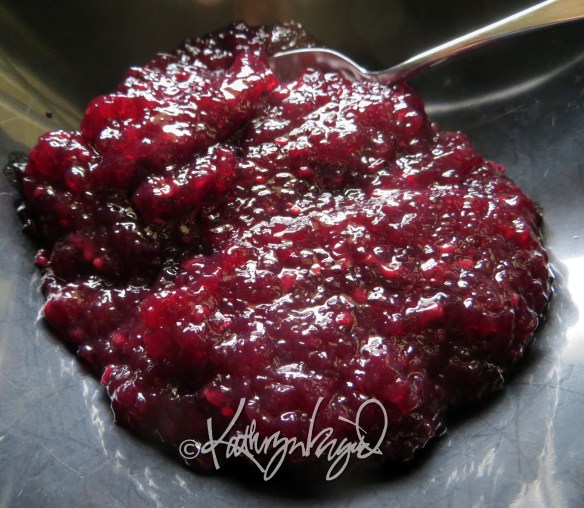
Put the apples into the buttered ramekins (individual) or casserole and bake them just until softening. About a half hour at medium-high heat (375°F/190°C), give or take a little, will do. While they’re baking, take a small handful of beautiful frozen raspberries per apple, crush them into their individual arils (gently enough to make pretty little dots rather than a messy mash), and stir in a dash of rosewater. Stick them back in the freezer that way until the moment before serving the apples, when you’ll sprinkle them over the top as a cool, burst-of-winter-sun contrast to the heat and creamy juice of the apples. And a tiny reminder of what fresh-from-the-garden goodness is like in other seasons.

Photo: Raspberry