All Together Now

One of my favorite vocal coaches is fond of characterizing people who focus on their own singing to the point of losing track of and/or sticking out from the rest of a performance at inappropriate times as expressing their “individual enthusiasms.” I’m doubtful I would be as tactfully euphemistic. We’ve all seen and, more importantly, heard concerts where one unplanned solo ended up hijacking the whole event, and it’s hard to forget what was so frustrating and embarrassing about it for the other performers and the audience and even harder to remember all of the probably fine or even excellent things that were supposed to be the stars of the day.

The same is true, naturellement, outside of musical performances as well. Our individual enthusiasms lead us to speak out of turn, act squirrelly in the middle of serious events, blurt out exceedingly inconveniently unfiltered thoughts, and generally act like little kids at the best of times. At worst, they make us deeply uncivil, unwilling or unable to negotiate, and self-centered to the point of implosion. Or, more often, explosion. This world does not need my opinion, unless I’m willing to get the rest of the passionate populace to engage in the conversation and collaboration that will make it needful. And in that case, they’ll quite generally be on board with my enthusiasm already and there will be little to negotiate.

None of this means that everyone should think and act in lockstep. What a horrific idea! Most of the great performances of our time are not solos, even those that feature soloists, but rather collaborations with the entire cast, crew, production staff, and audience, at a minimum. The deliberate and thoughtful give-and-take of everyone performing his and her part to the very best level possible is what creates the ideal of harmony, even in times when fruitful dissonance is desirable to throw that harmony into beautifully sharp contrast. Music is obviously full of grand examples of this stuff, but so is life in general. The sorrows and hardships, if they are carefully shared burdens, throw the joys and pleasures into higher relief, and the larger song of human experience continues to grow in beauty.

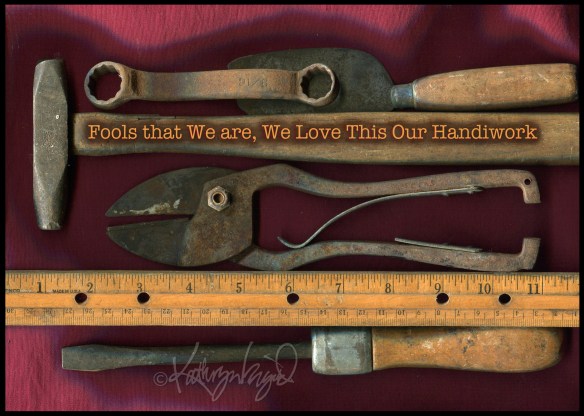
Photo montage: In the Works

Instead of throwing a spanner in the works, why not find ways to make them run more smoothly together for a more harmonious performance?

I Made It Myself!

Funny, isn’t it, how proud we are of things we think we have accomplished, no matter how silly and shoddy they may turn out to be. As often as not, we are the engineers of our own destruction; whether we stubbornly and hubristically fail along with our ridiculous doings and inventions or not is sometimes a matter of mere luck and circumstantial adventure.

Digital illustration from a photo: I Made It Myself

Digital illustration + text: Engineers of Folly

Industrious

My nature is just about the polar opposite of industrious. If there were a way to recline and remain immobile and mentally inactive without being in a completely vegetative state while still getting through daily life, I would probably have discovered it by now, but I manage to keep alarmingly close to it in spite of all urgings toward better things.
Photo: Skansen Factory

I have tremendous curiosity about and admiration of those who are, conversely, hard workers and the wonderful machinery that represents and supports them in their labors. But I have never progressed far beyond the stage of admiring these ‘rude mechanicals‘—human and otherwise—in the abstract. To me, they remain alien and magically artistic yet quite incomprehensible. Only when contemplated in the stopped state required for rest, repair, and refueling do they even register in my mind as real.
Photo: Red Engine

I will always admire and be immensely grateful for those people who do the work of the world, who keep it chugging on all cylinders and, indeed, invent and craft the machinery that does the chugging. I could not enjoy this life of privileged repose and ignorant ennui if it weren’t for being carried by the very machinations of these titans. I bow at their feet in humble gratitude and respect.
Photo: Vintage Helicopter

And while I’m down here curtseying, I notice that the floor looks quite comfortable and inviting indeed. If you should need me later, come back and look for me where I’ve stretched out on the rug in a slackly indolent heap. Don’t make too much noise, though, for I may be dreaming happy dreams of gears turning, flywheels whirring, and motors purring, and it would be a shame to interrupt them with actual action.

10 Terrible Words that Shouldn’t Exist in Any Language

Digital text-illustration: 10 Terrible WordsOne person who hates is a Weapon of Mass Destruction. One who cares and shares? Perhaps the only antidote.

As I recently said to my friend Maryam: poverty—both of concrete, material resources like food and shelter, and of intellectual and ephemeral resources (education, spiritual enrichment, the arts, community engagement, etc)—seems to me to be perpetrated and perpetuated more by selfishness than by an actual shortage of any of those resources. The rich and powerful always want more riches and power, and what they do have makes them able to afford and acquire more and to keep their feet firmly on the backs of the have-nots. Plenty is never enough. The resulting imbalance is as old as history, and rotten as ever. Only those who will speak up and resist entrenched inequities and injustices will have any hope of making change.Photo montage: Wolverine & Badger

The badger and the wolverine have a reputation for being among the most tenaciously savage brutes of all the mammals. Yeah, Honey Badger even has his own meme to show for it. But let’s be honest: no beast of earth, air, or sea has a capacity for vile, rapacious cruelty rivaling that of the human animal. Even creatures of the natural enmity of predator and prey compete, fight, kill, and are sated. They have little apparent ideation of hatred and war to match people’s. A wolverine or badger will fight to defend, or to kill for food, but unlike the human, doesn’t seem inclined to attack indiscriminately outside of its primal needs for safety, shelter, and food; when the skirmish is done as efficiently as possible and the need assuaged, the sharpest of tooth and reddest of claw among them doesn’t do an end-zone dance to celebrate its pleasure in winning but will usually depart the scene or go to rest for the next time of need. The remaining food and shelter and other resources stay in place for whatever creature comes next, hunter or hunted, cousin or not.

Can we humans not learn from such a thing? I’m pretty sure that if we destroy each other and ourselves in our constant self-righteous, self-congratulatory belief that we deserve everything we can get our hands on, Honey Badger won’t be the only creature that doesn’t care.

PessimOptimism

Graphite drawing: Self-Inflicted“Prepare for the worst but hope for the best.” It’s part of my credo, I guess, and may well have been aided in its development by doing those hilariously futile duck-and-cover atomic bomb drills of the Cold War era. And the air raid drills—we lived in a Ground Zero area near several military bases, strategic coast, and a handful of Nike missile sites in those days—fire drills, earthquake drills, tsunami drills, and later when we lived in the midwest, tornado drills. You’d think we’d all have grown up incredibly paranoid after such stuff in childhood. But I think that besides being remarkably resilient, kids use logic on such daily puzzles far better than they remember how to do when they hit adulthood and have been taught their prejudices, and are much more easily distracted and blinded by grey areas.

I don’t remember ever believing that crouching under a flimsy little wood-and-steel desk would save me even from the shrapnel of shattering windows and imploding walls in the event of an attack or large-scale disaster, particularly since I imagined the desk itself would become shrapnel along with everything else in the atomizing roar of a bombing. Little and naïve though we were, we had gleaned hints of the enormity of such things from our beginning school studies of the world history of war (skewed to our own culture’s view, of course); no matter how grownups think they’re shielding kids by sanitizing and limiting the information the wee ones are allowed to see and hear, children are quick to notice the blank spaces where redacted information interrupts the flow of facts, and no adult is more curious than a child to hunt for clues as to what was redacted. Frankly, if there really is any use for an institution like the CIA in this day and age when practically anyone can find out practically anything with the aid of easily accessible tools like the internet, cellular phone, and, apparently, privately owned drones, along with all of the more traditional tools of spy-craft, I suggest that the crew best equipped to uncover any facts not in evidence would probably be a band of children all under the age of about twelve.

Meanwhile, we still have large numbers of people who think it prudent to withhold or skew the information passed along to not only kids but even fellow adults, giving out misguided or even malevolent half-truths or remaining stubbornly silent and in full denial about things considered too dark for others’ knowledge. And what do we gain from this? Are there truly adults among us who still think that even smallish tots can’t quickly discern the differences between a fable or fairytale, no matter how brutish and gory it may be, and the dangers and trials of real-world trouble? Does delusion or deception serve any purpose, in the long run, other than to steer us all off course in search of firmer, more reliable realities?

As I just wrote to my dear friend Desi, it seems to me that the majority of humans always assume a fight-or-flight stance in new or unfamiliar circumstances before allowing that these might be mere puzzles to decipher, and more importantly, we assume the obvious solution to be that whatever is most quickly discernible as different from self IS the problem. Therefore, if I’m white, then non-white is the problem; if I’m female, then male. Ad infinitum. And we’re generally not satisfied with identifying differentness as problematic until we define it as threatening or evil. This, of course, only scratches the surface—quite literally, as the moment we get past visible differences we hunt for the non-visible ones like sexual orientation, religious or political beliefs, and so on.

Unless and until we can change this horribly wrongheaded approach on a large scale, we’ll always have these awful problems, from petty playground scuffles right into the middle of the final mushroom cloud. The so-called justice systems of the world are set up and operated by the same flawed humans who make individual judgements, so the cycle is reinforced at all levels. Sometimes it truly makes me wonder how we’ve lasted this long.

Can we learn from kids? The younger the person, the more likely to blurt out the truth, whether it’s welcome or not. The subtleties of subterfuge are mostly wasted on children, who unless they’re engaged in happy storytelling for purposes of amusement and amazement, would rather be actively puzzling out the wonders of life than mucking about in search of evasive answers and duck-and-cover maneuvers. We might gain a great deal by reverting a little to a more innocent and simplistic view of the universe, one that blithely assumes that others are not always out to get us, that direness and doom aren’t lying open-jawed around every blind corner, and that the great powers of the internet and cell phones might just as well bear cheery tidings of goodness and kindness, and drones be removed from deployment as spies and weapons to work instead at delivering birthday presents to friends and packets of food to hungry strangers.

I’m not fooled into thinking any of this is easy to do, any more than any savvy kid would be, but I’m willing to believe it’s possible if more and more of us will commit to such ideals.
Empathy over Courage

Bravery is a rare commodity. Many people who think they’re being brave only dare to do so from within a like-minded group, however small in number, and when they are genuinely in the minority spend more energy on protesting that the majority from which they’re excluded is unfair and unjust than on doing anything useful to change it. It may be true—knowing human nature, often probably is true—that one’s opposition is no exemplar of justice and fair-mindedness. But we’re seldom willing or able, ourselves, to make a cleanly balanced assessment and especially, to act wisely and compassionately on it either. We’re generally convinced that anyone else having anything good means less goodness for ourselves, and that that is a terrible thing.

What impresses me more than bravery, real or imagined, is seeing anyone express real empathy for others through their own beliefs, lives, and actions. I tend to doubt that we’re capable of doing or even wanting very lofty things, but I also think that small doses of empathy will go ever so much further than any amount of derring-do and action-figure heroics in bettering the world and the human condition within it. Daring to let another person be richer or more privileged than me or to have the last word, even when I’m fairly sure I’m smarter, closer to correct, or more deserving requires quite a different sort of courage than running into danger in anyone’s defense or their stead.

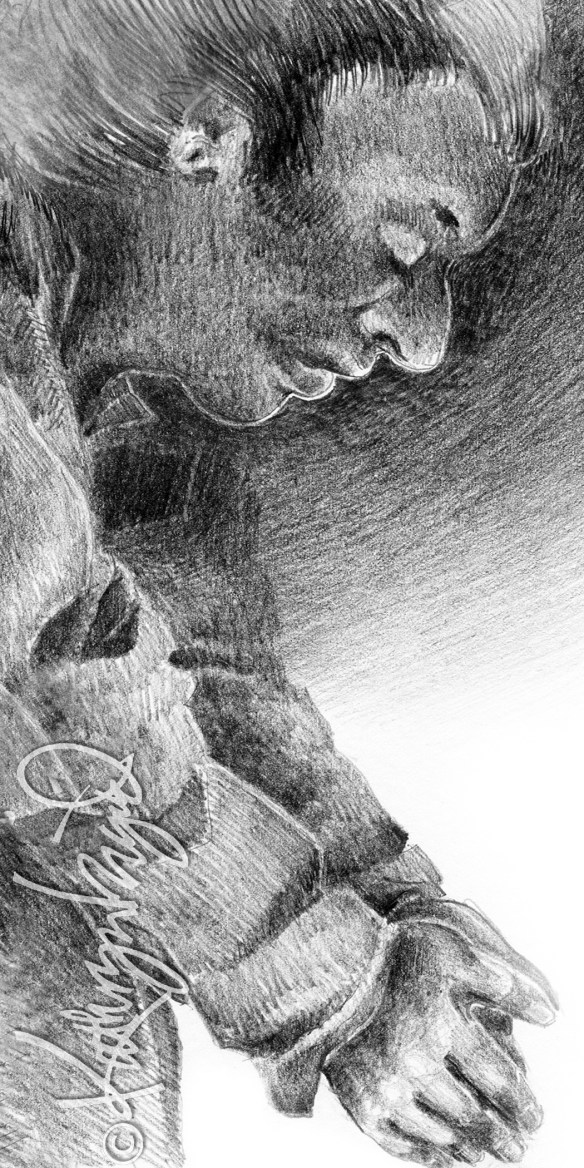
But treating others with such respect seems to me far more likely than argument and defensiveness, self-protection and fear, to get anyone to trust and respect me in turn. So shines a good deed. The unselfish willingness to accept another person’s reality as valid even when it might cost me something significant is a kind of courage I dream of having, hope to learn.Graphite drawing: Reach Down to Raise Up

Who’s the Wisest?

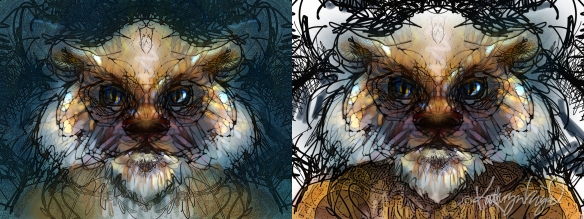
I give myself credit for being smarter than I am. I suspect, given what I see around me in this wild and woolly world, that I am far from alone in the practice. Even owls, a favorite symbol of wisdom, are not likely as perfectly ingenious as we imagine them, but they might still be more intelligent than the half of us.
Digital illustration: The Owl King

The Search Continues

Parsing paragraphs to find

The author’s complete state of mind

Is no more useful than to ask

A Word how it performs its task,

If we assume we’ve read aright

What’s only there in black and white.


The Long and the Short of It

How quickly pass the hours and days

and weeks and months and years,

And yet, how slowly pass our worries,

paranoiac fears;

This is the great conundrum that

presents in mortal time,

And quite enough of food for thought

in one quick, measly rhyme.

Any Old Palace will Do

As self-crowned, self-proclaimed Empress of Everything (mistress of none), I have always enjoyed the ease and luxury due my supposed station. I eat well, travel relatively often, and keep the finest of company. It’s only appropriate that I should also live in the palace of my own choosing, or better yet, in various fantastic palaces in different fabulous parts of the world whenever I happen to be there. Of course, the locales and the company I keep in them determine my level of happiness far more than the buildings and their furnishings do themselves. Isn’t that always the way? No matter how plush it is, a glamorous structure is only a gilded cage if it allows no light of love and adventure into it and no correspondingly venturesome, happy soul out of it.
Photo: S:kt Jakobs

So far I’ve managed to establish my string of palaces remarkably well, along with fulfilling my many other requirements of that life of luxury I don’t necessarily deserve but am quite capable of desiring. I’ve stayed in, lived in, visited, and wandered through many a grand, gorgeous, impressive place. I’ve designed many on paper and in my mind that would knock the socks off of any person who saw them. Yet I still can’t understand the people who look at glorious, showy homes and think only of whether the places would genuinely suit as their own dwellings. If your energies are devoted solely to thinking that “this master bedroom is too small,” all I can think is that your imagination is too small, your life too tightly fitted around what you perceive as Impressive Enough, to allow you to find your palace in whatever motel room or suburban house with one bathroom your life lets you land in at the moment.
Photo: Davenport, Spokane

Many of the palaces I’ve inhabited I have done only as a passerby, a visitor, a tourist. And I have nothing against that at all. After all, wherever I close my eyes to sleep, even the most cramped bedroom with a creaky, narrow, deeply bowed bed where the very middle of the mattress is the only almost-level spot to rest, I can turn it into any one of the palatial places I’ve visited, or continue to invent my own. The roof I am under is irrelevant in determining the luxury of my existence, so long as it’s safe and not lacking a place to lie down without breaking anything (furniture or me; I prefer to keep both intact) and not hideously cold or hot or wet. In my dreams, I remain Empress, and there I can build and inhabit the most astounding of palaces if I choose to do it.

As such, I am also constantly grateful for the many wonderful places I’ve visited, stayed,  and/or lived, and especially for the extensive ranks of friends and family and acquaintances who have through their immense kindness consistently supported my ability to live—and feel—like royalty.

Be Very Afraid. If You Really Like that Sort of Thing.

I have neither the knowhow nor the tangible resources for filmmaking, but if I did, I think my concept of the perfect horror movie subject would be the infamous occasion of Black Friday. As we Americans approach the national holiday I like the most of them all, Thanksgiving, I think with a shudder that Black Friday’s grim shadow lurks just behind it.
For if I have a tender feeling for the holiday that not only marks the anniversary of my first date with my soon-thereafter life partner and makes me immensely thankful for that gift but also marks the national celebration of gratitude in general, I have an almost antithetical feeling about the retail frenzy that follows it. The former only throws the latter into higher, less flattering relief.

I love shopping, don’t get me wrong, but I hate being told how and when to do it, and what or whom for, and to what magnificent extents. I dislike being so easily manipulated by commercial ploys and plugs as it is, and the stink of desperation mixed with hyperbolic greed on Black Friday becomes overwhelmingly off-putting to me.

Digital illustration

What makes us turn into beasts when we get a whiff of the hunt? When a crazy sale is advertised, do I become predator or prey? Or should I just pray?!

There are obviously large numbers of people who are not only comfortable with the event but energized and entertained by the spectacle and Olympian scaled enthusiasm packed into the post-Thanksgiving shopping extravaganza. I wish them all happiness and success in it. For myself, the greatest pleasure will derive from managing as successfully as I can to not even know it’s happening and staying immersed in the afterglow of my most overtly grateful time of year. Accomplishing that will be yet another reason for me to give thanks.
If I need any diversions during my quiet hideout from Black Friday, I can always work on a script for a rollicking thriller film with plenty of retail rowdiness and gruesome greed. Coming soon to a theatre near you!

Unnaturally Lightfooted

We’ve long since established that I can’t dance. I couldn’t dance well enough to stay in a second-grade dance class; heck, I couldn’t even be trusted to remember whether we were supposed to show up wearing tights with our tutus or not, for the class picture before the big recital. Though it’s only fair to give myself credit for having been obsessed with the ugliness of our getups to such an extent that I forgot the part about the stockings, and I promise you, they were hideous costumes.

But you also know that I am enamored of beautiful dancing of nearly any kind, if allowed to watch it from a safe distance. So I think I can be forgiven for letting others take to the floor in real life and only doing so in my imagination and, occasionally, in my poems. I think any creature, real or imagined, that can dance beautifully deserves my attention and admiration (as long as it wears the correct tights with its tutu).Graphite drawing: Swinging Dragonflies


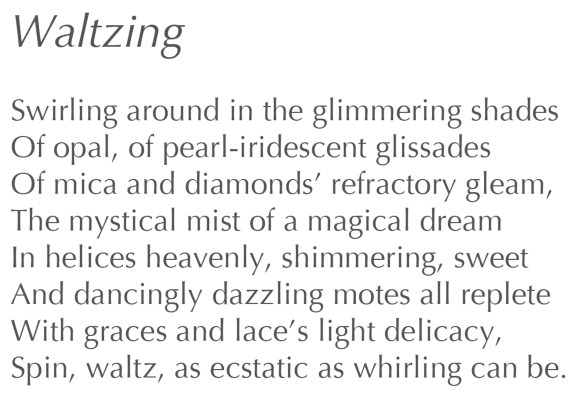
Text: Waltzing