Miss Ella Says

Among her treasured recordings of Harold Arlen gems, Ella Fitzgerald gave her distinctive verve to the admonition to Get Happy, and even a retrograde curmudgeon would be hard-pressed, hearing her clarion call, to resist the call. I think this is a great time of year to succumb to the great Miss Ella’s invocation. Listening to her sparkling voice, her incredible vocal agility, and her superlative interpretive artistry is Spring tonic to me, no matter when.

Let me just keep this snappy for today and add my voice, unimpressive as it may be, to hers to call everyone within earshot with a wide-open invitation to rejoice in whatever is available on the day. Live in the moment, yes. Sing at the top of your lungs, yes! Be glad and generous and gleeful with and through whatever you can possible find in the day, make of the day, and grow out of the day, oh yes indeed. You can ignore me, but if you listen to her, I think I can promise that you’ll find it mighty hard to ignore that glorious and welcome summons.Digital illo: Miss Ella Calls

Dark Times in the Theatre

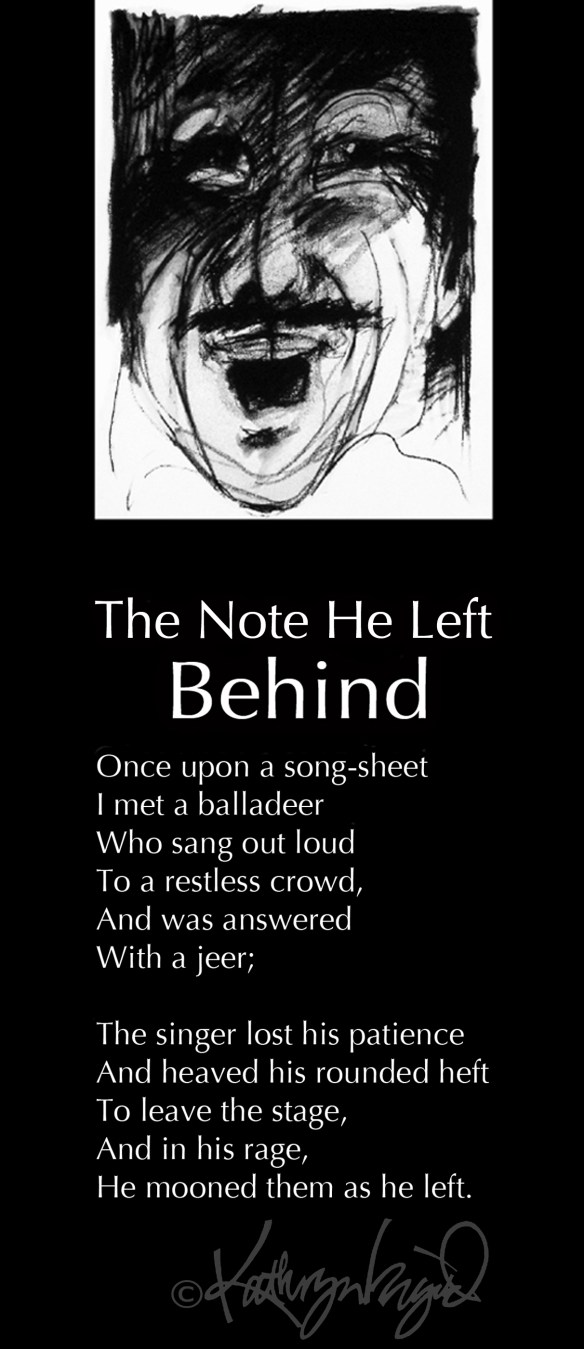
Critics, beware! Some performances are more unpleasant than you ever imagined.Charcoal drwg + text: The Note He Left Behind

Photo: Haunted Theatre

Text: Intermission's Emissions

Singing Our Song

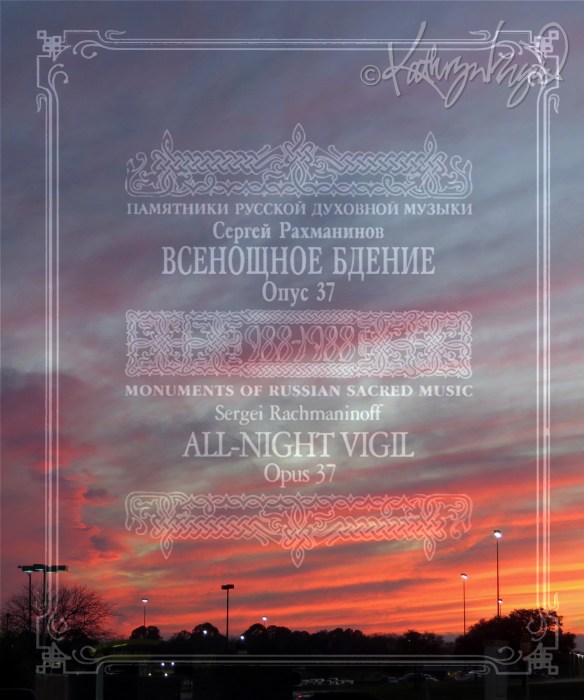
Photo + score cover: Singing Our Song: Rach Vigil

The original ‘our song’ I shared with my true love, because he was in the midst of rehearsing his choir for its performance when we came together—so intensely rehearsing, in fact, that in pretty much the only time I’ve ever known him to talk in his sleep, he whispered dreaming sweet nothings to me in Church Slavonic. Good times!

The expression ‘they’re singing our song’ refers, generally, to recognizing a tune or lyric that carries particular personal weight for a pair or occasionally, slightly larger group of people. It’s our school’s version of Alma Mater, the theme song of our organization, the song that accompanied a memorable first date, first dance, first kiss. Because of its power as a connective tool in communication and in recollection, music is bound to evoke potent responses and pull us into the examination of them, regardless of their current context. I’m one of that lucky class of people for whom music is a pervasive and positive element of my daily life, but I still have some specific favorites not only for what I find appealing about them musically or in their mood, style, and character—and yes, those range pretty widely—but also for the few that stand out in mnemonic and sentimental ways.

There are songs that reconnect me instantly with my childhood, something I suspect is quite a different experience for the younger generations than for mine and earlier ones. Until my youth, childhood songs came not exclusively from radio, films, television, and other distant, anonymous, fixed, or recorded sources but first from the relatives, friends, and teachers who shared them with us and often expected us to sing along. When my family sang in the car on a road trip, it might have sometimes been along with whoever was singing or playing the radio’s pre-packaged tunes, but as often as not it was singing folk songs we’d learned by rote, silly playground songs and game-narrative ones, bits of summer camp songs, rounds, and easily harmonized songs that were popular long before I ever stretched my little pipes to sing. I don’t imagine there’s so much of a lingua franca of family and playground singing not derived from Disney scores and downloads nowadays. There’s lots of delightful and even sophisticated stuff in those, to be sure, but I would guess that there’s a whole lot less that would be in any way distinguishable as historic, traditional, or regional, let along cultural, landmark music that’s just sung for fun anymore unless it’s loaded with undercurrents of market- or message-driven content. Is Mrs. Grady‘s daughter even known, let alone adored, by anyone under a half-century of age anymore?

It’s not strictly old-lady cantankerousness or being prudish, prune-ish, and nostalgic for what may be rose-colored memories that makes me sad for this sort of loss, though there are assuredly elements of those. It’s also a bit of longing for the subtle societal glue that resides in knowing a song: if I spontaneously start to sing an “old familiar lay” under my breath, will there be anybody within earshot who will hear, remember, and join in the song? Are all such endeavors relegated to prearranged flash mobs now? I had a couple of reminders of this urge, recently, and they renewed my quest for an expanded casual-singing culture of the kind that doesn’t require sets, costumes, death-defying choreography, and Auto-Tune.

The first such occasion was, unsurprisingly, in a church setting. Western churches of many sorts are still places where communal singing is common and many songs known to many of the participants by heart. I was at a Protestant church service where, as is typical during communion, the church choir sang anthems and the congregation then sang a hymn or two as well; when the high attendance at the service made communion stretch far longer than expected, the experienced organist got right on the task of keeping the flow going by playing an old hymn. After a few seconds, choristers started softly humming or singing the lyrics along with him, then grew bolder and harmonized, and gradually a number of congregants in the pews were joining in as well. It was really quite sweet, and I certainly thought it perfectly appropriate to the whole concept of a Communal event. But even there, I quickly realized, the truly familiar old hymn couldn’t quite be carried in the old way, because even the choir members clearly only knew one verse by heart, and while it was a lovely bonding experience for everyone, it was fleeting; at the end of Verse 1, a collective dive for hymnals to search for the words (what’s that eponymous first line, again?!), then the resignation to repeat the first verse or fall silent.

Another reminder came in one of the places where such random burst-into-song things do still exist beyond the borders of the performance hall but are perhaps not exercised as often as they used to be: a choral convention. The regional and national gatherings of musicians devoted to choral music—the composing, conducting, rehearsing, singing, performing, and yes, enjoyment of music made for groups of singers—are a great source of education, entertainment, and vivifying energy for me as the partner and follower of a choral musician. And even at these, it’s not as though I hear people breaking into song together, unless they’re rehearsing to perform for each other. Attending an enormous regional musicians’ convention recently, followed ten days later by an equally huge national one, was both exhausting and energizing. And at such events, I don’t often find people gathering to sing together outside of the so-called All Sing sessions, which are of course organized, arranged, led, and regulated nearly as much as any choir’s regular rehearsals.

The point of such conventions isn’t necessarily to build ‘casual relationships’ with singing. But mightn’t it be a fine thing, really? I would guess that the expectation that singing just because, at unplanned moments, with other people, could in fact lead not only to greater interest in and better understanding of more formal choral experiences but also to a more connected social world than social media alone can provide. As the 1971 Coca-Cola advertisement—yes, a commercial jingle—encouraged such idealism and eventually did indeed manage to build into a hugely popular, ex-post-brand-name sing-along song, I [would] Like to Teach the World to Sing. But obviously I can’t do it alone.

Photo + score: Singing Our Song: Nance 'Seal'

This is, in a unique way, truly Our song, because Richard Nance composed it as an anthem for our wedding, and it both became widely popular as an exquisite modern choral piece and remains deeply personal as a gift to my beloved and me from one of our dearest friends.

I Dream the World

I dream the world will learn to sing ‘Til joy suffuses everything—

When peace and happiness abound, I dream a song will be the sound

Most widely heard by every ear Around the globe that longs to hear

A note of kindness, care; of grace, When melody wraps its embrace

Around us like an angel’s wing—I dream the world will learn to sing!


I dream the world will learn to sing And make earth’s darkest corners ring,

Will throw aside all warring ways, Mend brokenness, take up the phrase

That calls to harmony all souls The way a carillon bell tolls,

First, lone and softly, then a pair Joins in, and more, and then the air

Is filled with song, like bells a-swing—I dream the world will learn to sing!


I dream the world will learn to sing And this, the message it will bring:

We must not wait in silent nights, Unsung ’til happiness alights,

‘Til care and kindness, sweetness, peace, Miraculously buy release

And save us from our voiceless state: If we don’t sing, it is too late,

So let our song rise up and ring—I dream the world will learn to sing!

All Kinds of Music

Drawing/painting illo: Three ComposersIn my head, there is music. Mostly, it’s a rambling, meandering thing without much form or direction, just a little ditty that my subconscious seems to hum to itself along the journey of the day. Once in a while, it’s an earworm, some tune or phrase caught in the soundtrack of my brain and put on long-term Repeat because I heard it or remembered it recently and didn’t have another thing to replace it with soon enough. Often, when I’m drifting off to sleep or marking time while I wait for something to happen, there’s a sort of internal theme song of mine, a mere snippet of a melody that might be a simple part of a Bach invention or might just as well be something of my own invention inspired by Bach or some similar composer, a line that becomes more or less complicated, turns from something slightly Baroque to a more Classical seeming style for a bit and then becomes a very plain little row-your-boat kind of canon before returning to its silent corner to wait for my next moment of internal quiet. On rare occasions, there might be words attached or an obvious external source of whatever song seems to have sneaked and snaked its way into my frontal lobe for a lope or two around my one-track mind.

Yet I have not the gift of composition. When I think about it in a more determined and purposeful way, I have all sorts of ideas about how I would probably set a particular poem or story text of mine if I did have compositional skills, how I might voice the piece or what instrumentation I think would be just right for the words and ideas therein. But it would be helpful, if I really intended to do any such a thing, if I had the slightest notion whatsoever of music theory or how to read a score (let alone write one), of what certain instruments can and cannot do, and whether the human voice is actually capable of making the sounds that might be required of such a project.

I am ever so glad that there are composers in the world capable of carrying a musical idea to magnificent, magical fruition. I sincerely doubt that any of them would set any text, mine or another’s, in just the way that my moseying mind seems to believe it would—for good or ill—and that is the way the universe operates. Each of us has skill sets and desires and training and passions that make us better, or worse, fitted for the tasks and arts that we imagine to be useful or pleasurable, and each has limitations even on our own abilities to recognize where we will excel and when we might fall short. What a wonderful thing it is that, though I’m not a composer myself, there are excellent composers who can and will set my words to their own music, because after all, choral music is one of the most clearly collaborative of activities anyway.

What a wonderful thing it is that, though I will most likely never master bringing what rings inside my skull out of it in an intelligible way, let alone anything like the one I imagine in its internal incubator, somebody out there is busy penning loveliness and longing, drama and dreams, that will carry their music forth into the hearts, minds, and ears of a waiting world’s humming silence.

Transitory or Transitional

Pen & ink drawing: Transitory or TransitionalMy spouse, in his combined capacities as a natural-born teacher and a lifelong curious learner himself, is constantly reading, studying, talking shop with others both in and out of his field of music, and cogitating inwardly and through his writing about ways to grow and improve. I am neither a born teacher nor as dedicated and skillful a learner as he is, but I have, I think, grown a fair amount in my appreciation of what quantities and depth of effort it takes to improve oneself, let alone help others to improve themselves, in any chosen course of study. One of the things that intrigues me is that, as in so many areas of life’s experiences, the macro and the micro aspects of learning and, in turn, teaching, always ebb and flow: it takes a multitude of tiny pieces of knowledge and/or effort to make any significant larger ones, and the large ones must generally be reduced to smaller and more manageable parts in order to be changed, eliminated, or simply learned, as well.

In a day’s rehearsal for an upcoming concert, it’s marvelous to see and hear what occurs as a major composition is broken down into its component parts and those parts studied and practiced and rehearsed in detail, bit by bit, but also to realize that the individual parts have no beauty or meaning unless also studied in the context of the whole. Fixing one small phrase or chord at a time can be a portion of the improvement process, but if that’s all that happens, then the performance will never have any cohesion or sense of drama but will forever remain a collation of essentially separate and unrelated atoms that happened to be sounded in the same room on the same night. Playing or singing through transitions—the places where one phrase or larger idea in a composition ends and the next begins—is a way in which my conductor husband helps his choirs, orchestras, and other performers to experience and express the whole of the story more convincingly themselves, and thus bring an audience into the flow of the work as well.

Music is a wonderful vehicle for individual experience of the aesthetic, emotional, artistic, and ephemeral aspects of existence, and as such is a grand gift. But when it becomes a communal, communicative experience rather than only an isolated solo, it has incredible power for building relationships between people, ideas, cultures, lives. When it is a bit of a song, hummed or played on the street, in the car, at work in the kitchen, it can cheer or soothe, feed or please; when it is a performance of a major musical work in concert, in a musical or opera, an oratorio or a middle school end-of-year concert that has many participants and has been labored over with passion by all of them through a string of intense rehearsals, its power is magnified and resonates for a long, long time to come. It’s as though the practice of singing or playing through the transitions from one passage to another of that single composition has expanded into life, letting the dissonances and harmonies, the threads of meaning and the ecstatic shimmer of aural beauty, all remain in the air and in our spirits long after the last notes have gone silent, carrying us through the transition from art into life with renewed depth and purpose.

Solo after Dark

If you’ve ever heard Miles Davis play, this needs no explanation. If you haven’t ever heard his music, whether you were lucky enough to catch it live or, like me, have only known it through recordings, it’s time you listened. Get a recording, turn it on, and turn off the lights or just close your eyes. And listen. Because.

Digital illo + text: I can Hear It from Miles Away

Butterflies Dance, Too

Photo + text: If Butterflies could Dance

Digitally painted photo: Cosmic Butterfly

All Together Now

One of my favorite vocal coaches is fond of characterizing people who focus on their own singing to the point of losing track of and/or sticking out from the rest of a performance at inappropriate times as expressing their “individual enthusiasms.” I’m doubtful I would be as tactfully euphemistic. We’ve all seen and, more importantly, heard concerts where one unplanned solo ended up hijacking the whole event, and it’s hard to forget what was so frustrating and embarrassing about it for the other performers and the audience and even harder to remember all of the probably fine or even excellent things that were supposed to be the stars of the day.

The same is true, naturellement, outside of musical performances as well. Our individual enthusiasms lead us to speak out of turn, act squirrelly in the middle of serious events, blurt out exceedingly inconveniently unfiltered thoughts, and generally act like little kids at the best of times. At worst, they make us deeply uncivil, unwilling or unable to negotiate, and self-centered to the point of implosion. Or, more often, explosion. This world does not need my opinion, unless I’m willing to get the rest of the passionate populace to engage in the conversation and collaboration that will make it needful. And in that case, they’ll quite generally be on board with my enthusiasm already and there will be little to negotiate.

None of this means that everyone should think and act in lockstep. What a horrific idea! Most of the great performances of our time are not solos, even those that feature soloists, but rather collaborations with the entire cast, crew, production staff, and audience, at a minimum. The deliberate and thoughtful give-and-take of everyone performing his and her part to the very best level possible is what creates the ideal of harmony, even in times when fruitful dissonance is desirable to throw that harmony into beautifully sharp contrast. Music is obviously full of grand examples of this stuff, but so is life in general. The sorrows and hardships, if they are carefully shared burdens, throw the joys and pleasures into higher relief, and the larger song of human experience continues to grow in beauty.

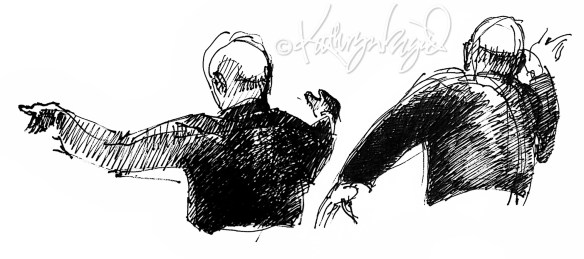
Photo montage: In the Works

Instead of throwing a spanner in the works, why not find ways to make them run more smoothly together for a more harmonious performance?

Celebrate Anyway

Christmas day means nothing at all to a whole lot of the world. Even some fairly devoted Christians are either skeptical about the accuracy of modern guesstimates of when the historical person Jesus appeared on earth or, in some cases, just plain weary of the commercial kidnaping of Christmas as a secular holiday. Beyond that, there are innumerable people and nations so impoverished or endangered as individuals, as communities, or as entire regions of the world that the last thing they can afford to pay attention to is an arbitrarily set date for recognizing anything as a reason for joy and revelry.Photo: Cymbals

There are no gladly clashing cymbals, no brass choirs trumpeting their huzzahs to the skies, no parades or packages, masses or meditations that can fill the void in hearts and homes oppressed by war, famine, disease, hatred, or inner turmoil. The very thought of happiness and reverential bliss, if it can even pierce the noise and violence, the stress and terror holding such people hostage, seems hollow and artificial. Goodness and light are as distant and unimaginable as the most ridiculous fiction.
Photo: What a Lot of Brass

These sufferers deserve to have their sorrows and their pains lifted from them, obliterated by any and all who dare to change history. No one knows better than I that not everyone has the strength and wherewithal to be so bold in action. But if we cannot do so with our physical labors, we must do so with our hearts and minds, our words, our plans, and our constancy in spirit. One voice at a time, one solitary note sung by a tiny, quavering voice, is the only way to begin moving toward a day when others, also one by one, will join and build to a worldwide song of peace. Only when we direct our every breath toward healing, harmony, and hope will the song come fully alive. Every atom of our being will whisper, speak, sing, and shout until the whole of humanity rings with echoing gladness.
Photo: Stringed Instruments

One moment’s pause, one hour of cease-fire, one hospital patient or lost child or elderly neighbor rescued for one single part of a day at a time makes space for the sound to bloom. We need to make room, and lest the horrors should return to fill the void, we must fill it up instead with songs of hope and joy and celebrate any way we possibly can. The other voices will someday, if we sing for long enough, follow.

Music is in the Air

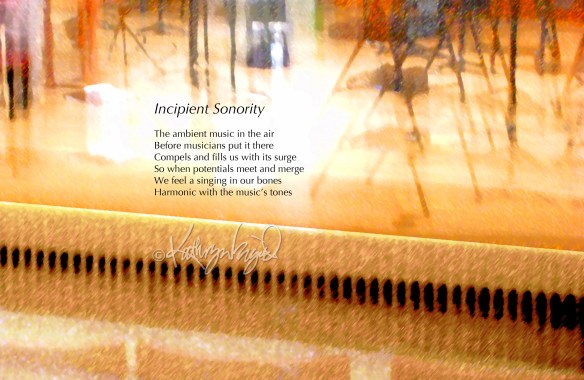
There’s no doubt in my mind that there is more to sound than just the stuff, however notable, that vibrates on my eardrums and sends messages to my brain. My lack of ability to interpret subsonic information the way that whales and elephants and other creatures can do doesn’t mean that I am completely insensible to them. I’ve had enough experience with not consciously hearing but still knowing there’s something significant happening in my environment that I can truly appreciate the astonishing sensitivity so many animals have to the ways that the universe is sonically alive and active around them.

That’s part of what is so compelling about music to me: that it is a further layering of these forces in ways that transcend what’s strictly scientifically explainable in order to move the heart and shape the soul. The very atoms around me can make me shiver with joyful and eager anticipation of the sonic adventure that is to come, while I wait for the performance to begin. As music engulfs me, I feel more alive, more literally attuned to all of existence.Digital illustration from a photo + text: Incipient Sonority

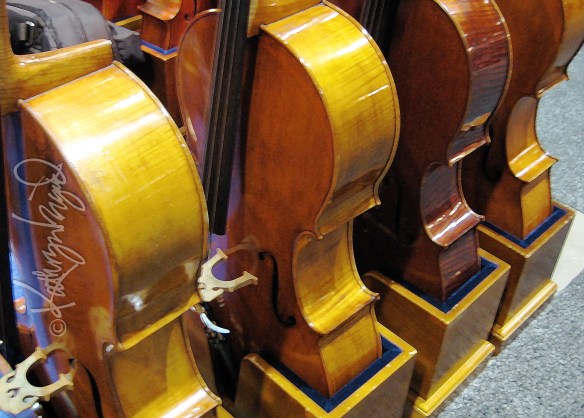
Photo: Celli