Reverence for Beauty

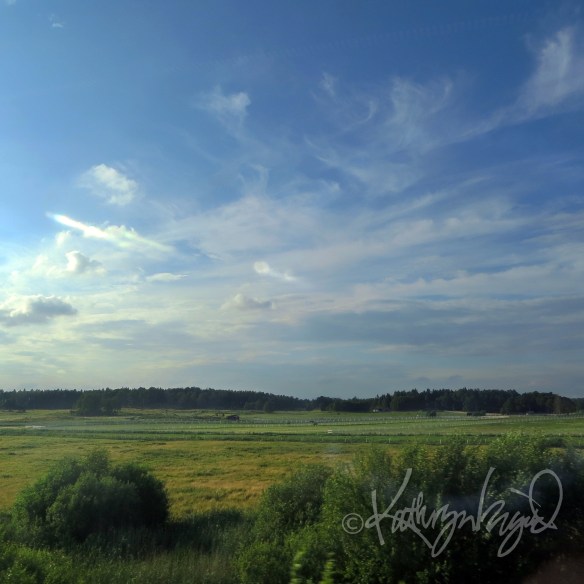
Photo: Blissful NothingnessThe whole of nature has its ways of reflecting perfection, when we take that momentary pause in which we can step back to appreciate such things. Even, as I posted yesterday, in death there is room for new life; out of captivity, freedom. In silence, I come to better appreciate the small and unobtrusive ways, not just the large, noticeable ones, in which sound enriches my world: water burbling down a ditch, breeze-stirred grasses, bees that sing soft love songs to their golden pollen treasures. In stillness, I relish each breath and every tentative movement as the wind kicks up a little and sets the empty park swings in motion again. Out of wintry darkness and overcast days, I more consciously embrace a bright afternoon and its combed, silky clouds.

In a moment of quiet reverence, I, too, can reflect such perfection better and am made more whole and beautiful.Photo: A Brilliant Day

Wake, Awake!

Today, a nearly perfect day of blue and gold and bracing new-leafed green, demanded that it be enjoyed from outside the house. We, my darling chauffeur-companion-partner and I, obeyed. We went to the park.Photo: Pollinators at Work

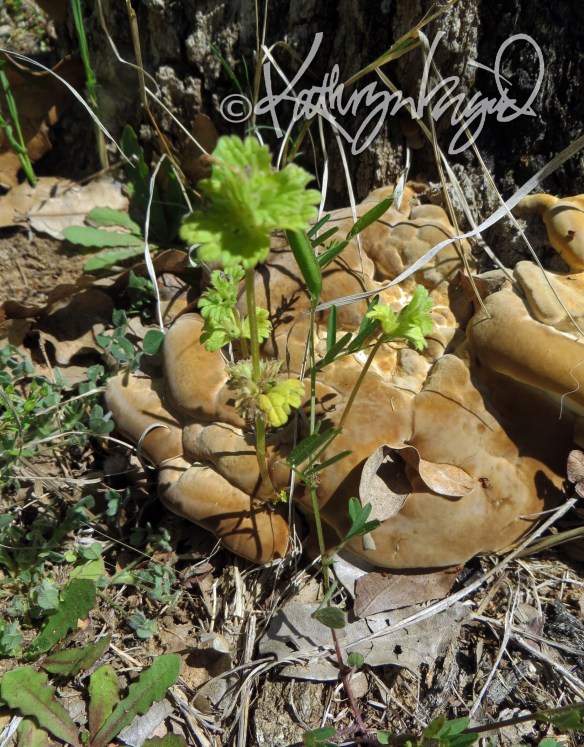
Being in a massive park, but one zoned as a number of separate and more intimate places  devoted to strolling, picnics, camping, horseback riding, fishing, and the like, we found no shortage of pleasant places to revel in the marvels of a sweet north Texas spring day. Tiny, starlike rain lilies leaping up from the sleepy clay shine like miniature suns but are even more sweetly pretty, somehow, when they’re nestling little pollinator insects. The swell of tree fungus at the base of a stump is pierced by the skyward plunge of a dainty but strong sprout of new growth from the cut tree.Photo: Sprout & Fungus

And in the short, wooded path at the park’s entrance, where the last years’ drought has compromised the forested patch of this little zone to the point where a careless spark or a small lightning strike blackened the undergrowth and seared the feet of the pines, the leaf-mould blanketing the path is whispering with scurrying insects. Dragonflies zip, crickets hum, and a flurry of minute emerald beetles flashes across the shadows into the warm sunlight on the piney dirt in search of other green things to dedicate to the extension of their fleeting little lives.Photo: Shiny Green

Renewal and refreshment are all around at this time of year, even in those parts of the hemisphere not so visibly on the brink of bloom. The very knowledge that the season of change and growth is near gives us a little nudge, when we let it, to remember that we, too, might be capable of change and growth. We, too, might bloom, with just a touch of faith and effort.

Darker than Dark

Digital illo from a photo: Black ButterflyEclipse

It all began with the erasure of

All memory, of thought and hope and care,

Of sight and sound and sense, and of the air,

Removal of all faint belief in love—

A chrysalis unsealed its crystal door,

Wherefrom emerged a brittle wingèd thing

That slowly pulsed the veining of its wing,

Searching for light and heat that came no more—

And, lastly, drew upon the black’ning sky

To fill its velvet wings, opaque, a most

Mysterious angel, butterfly, a ghost,

Then spread that inky cloak and sprang to fly—

And so was blotted out the sun and moon

And ev’ry ounce of life at highest noon.Digital illo from a photo: Black Wing

Sunny with a Chance of Starlings

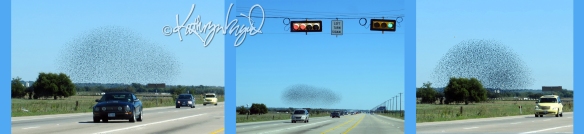
So, we’re driving along a local stretch of highway and I see clouds gathering in the wide blue stretch of the sky. But as we get closer, the clouds move oddly; they ebb and flow like rivers, collect tightly into spotty black pools, move around in magnetically collected groups from one hayfield to another, and expand again into writhing, twisting masses that make accordion-like progress from the highway shoulder to the grassy median. Birds. Masses of starlings having a communal day-trip in search of dinner.
Photo montage: Sunny with a Chance of Grackles

I know that they do this because of instinct and hunger and, perhaps, seasonal urges. I’ve read a little about the scientific studies indicating that a murmuration of birds flying and flocking this way has something to do with an only partially understood sensory operation or mechanism that allows the movement of one bird to affect up to six or seven concentric layers of proximal birds, and the resultant ripple effect to make the wonderfully flexible yet ultimately collective movement of such groups possible without the birds’ all exploding from the general formation into random isolation. All of this, indeed, is based on consistent and controlled observation by far more educated ornithological experts than I will ever be.

But it has a certain charm, for me, to simply keep imagining the birds peppering the sky as clouds, as mobile lakes, as little pieces of sky-high impossibility. Delight finds me, even on the highway under billowing masses of winged wonder. I’m quite happy to imagine that the whole purpose of such behavior on the starlings’ part is to amuse and please and amaze me, just me, specifically. Until a scientist can prove to my satisfaction that the truth is otherwise, I’ll stick to that. No need to spoil such a good thing with too much reality.

10 Terrible Words that Shouldn’t Exist in Any Language

Digital text-illustration: 10 Terrible WordsOne person who hates is a Weapon of Mass Destruction. One who cares and shares? Perhaps the only antidote.

As I recently said to my friend Maryam: poverty—both of concrete, material resources like food and shelter, and of intellectual and ephemeral resources (education, spiritual enrichment, the arts, community engagement, etc)—seems to me to be perpetrated and perpetuated more by selfishness than by an actual shortage of any of those resources. The rich and powerful always want more riches and power, and what they do have makes them able to afford and acquire more and to keep their feet firmly on the backs of the have-nots. Plenty is never enough. The resulting imbalance is as old as history, and rotten as ever. Only those who will speak up and resist entrenched inequities and injustices will have any hope of making change.Photo montage: Wolverine & Badger

The badger and the wolverine have a reputation for being among the most tenaciously savage brutes of all the mammals. Yeah, Honey Badger even has his own meme to show for it. But let’s be honest: no beast of earth, air, or sea has a capacity for vile, rapacious cruelty rivaling that of the human animal. Even creatures of the natural enmity of predator and prey compete, fight, kill, and are sated. They have little apparent ideation of hatred and war to match people’s. A wolverine or badger will fight to defend, or to kill for food, but unlike the human, doesn’t seem inclined to attack indiscriminately outside of its primal needs for safety, shelter, and food; when the skirmish is done as efficiently as possible and the need assuaged, the sharpest of tooth and reddest of claw among them doesn’t do an end-zone dance to celebrate its pleasure in winning but will usually depart the scene or go to rest for the next time of need. The remaining food and shelter and other resources stay in place for whatever creature comes next, hunter or hunted, cousin or not.

Can we humans not learn from such a thing? I’m pretty sure that if we destroy each other and ourselves in our constant self-righteous, self-congratulatory belief that we deserve everything we can get our hands on, Honey Badger won’t be the only creature that doesn’t care.

Sailing Ahead, Wherever That May Be

The only time I’ve ever been on a sailboat was to sleep. There’s a great Tall Ship converted into a youth hostel in Stockholm where my sister and I bunked for a couple of nights on our college gallivant across western Europe. [Which hostel appears to have been recently renovated, and very nicely, if any of you should be interested.] While there may have been the faintest of motion rocking us to sleep in our on-board berths, I doubt it replicated very accurately the sensation of actual sailing. My next opportunity was during graduate school when I got a fan letter (one of the very few in my life, as you can imagine!) from a stranger who’d liked a gallery art installation I made so much that he offered to take me out sailing to the nearby islands. I don’t think there was anything predatory about him, but besides my still having a grandiose case of social anxiety in those days, there is the fact that the art show in question was entirely a walk-through, life-sized illustration of an espionage thriller; while I am doubtful that was his inspiration, I didn’t take him up on the offer.
Photo: Adrift on the High Seas

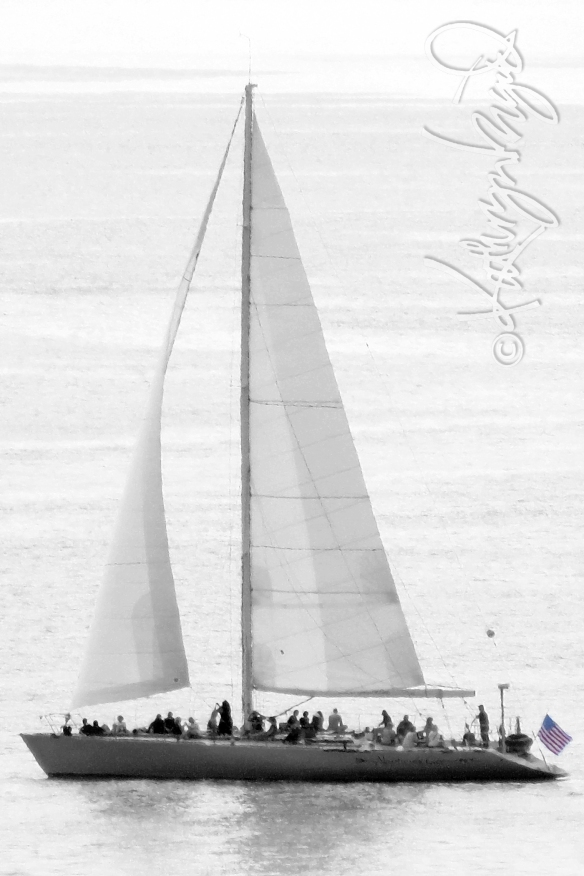
But whenever I see a sailboat, I do think it’s a beautiful representation of a genteel form of freedom that captivates my imagination all the same. Yes, I know plenty of tales of grueling trials on the high seas, no matter the size of the craft; even some of my close friends and relatives have such stories to tell, thankfully, having survived them. And I know, too, the old joke about testing one’s real interest in boat ownership by dressing up in a rain slicker and standing under an ice-cold shower for a couple of hours while flushing hundred-dollar bills down the toilet. But I also know that a vast number of people who could jolly well choose to spend their money and time on less demanding, safer, and far less expensive pastimes still choose boating. There’s clearly a strong pull to counterbalance any such negatives.

I, too, have spent some happy times on boats, just not sailboats. As a coastal kid, after all, I grew up thinking time spent on the ferries was as much pleasure and sightseeing as it was commuting or transport. I have been fairly miserable on a North Sea ferry in stormy seas while I was recovering from the stomach flu, but it did not so permanently scar either my psyche or my stomach lining that I didn’t look forward to the next time I got to be on a slow boat cruising along the shore, or perhaps best of all, in a rowboat or canoe, dipping the oars or paddle in with the rhythmic soft splashing that accompanies my reveries.
Photo: All Ashore

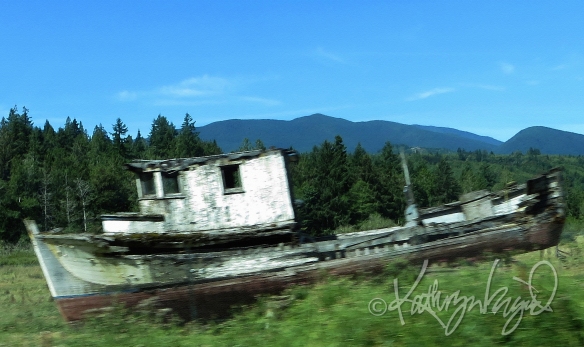
Living far from any natural body of water as I do these days, I am beached like an old craft whose hull is no longer seaworthy. But like those old boats I see, dry-docked on the beach or alongside the tumbledown barn or in a weedy field, I keep in my soul a firm and loving memory of every good time spent with the waves rocking me softly from below, telling me stories of their own and inviting me forward, ever forward, wherever that might take me.

Who’s the Wisest?

I give myself credit for being smarter than I am. I suspect, given what I see around me in this wild and woolly world, that I am far from alone in the practice. Even owls, a favorite symbol of wisdom, are not likely as perfectly ingenious as we imagine them, but they might still be more intelligent than the half of us.
Digital illustration: The Owl King

The Search Continues

Parsing paragraphs to find

The author’s complete state of mind

Is no more useful than to ask

A Word how it performs its task,

If we assume we’ve read aright

What’s only there in black and white.


The Long and the Short of It

How quickly pass the hours and days

and weeks and months and years,

And yet, how slowly pass our worries,

paranoiac fears;

This is the great conundrum that

presents in mortal time,

And quite enough of food for thought

in one quick, measly rhyme.

Unnaturally Lightfooted

We’ve long since established that I can’t dance. I couldn’t dance well enough to stay in a second-grade dance class; heck, I couldn’t even be trusted to remember whether we were supposed to show up wearing tights with our tutus or not, for the class picture before the big recital. Though it’s only fair to give myself credit for having been obsessed with the ugliness of our getups to such an extent that I forgot the part about the stockings, and I promise you, they were hideous costumes.

But you also know that I am enamored of beautiful dancing of nearly any kind, if allowed to watch it from a safe distance. So I think I can be forgiven for letting others take to the floor in real life and only doing so in my imagination and, occasionally, in my poems. I think any creature, real or imagined, that can dance beautifully deserves my attention and admiration (as long as it wears the correct tights with its tutu).Graphite drawing: Swinging Dragonflies


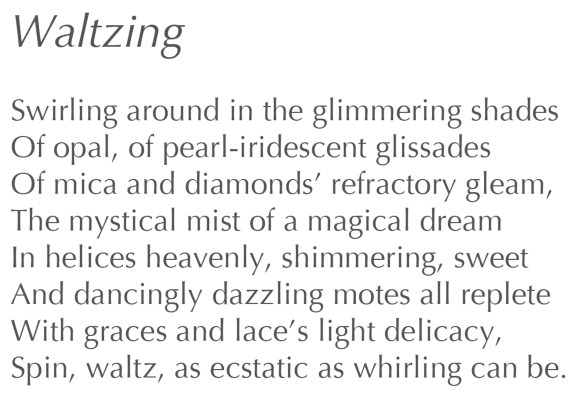
Text: Waltzing

Through Winter’s Window, Dimly

Photo: Light Looks In

Change of Season

Between the rain spells, when the sun is glinting onto rose and road
The youthful smells of spring are hinting that ahead the broken code
Winter left in seed and scion will reveal its inner life,
Where what had appeared as dying wakes again with newness rife.
Open eyes and open windows! Let indoors the fresh new air,
Breathing in what melts the snows and pushes out all winter’s cares.
So renew the self and senses and embrace the growth and light
Breaking down all old defenses, setting earth again aright.

The Great-Greats

Naming things is an endlessly fascinating and complicated way of creating and better understanding our relationships with them. Different cultures have even devised quite distinct ways of classifying and identifying the kinships within them, to the extent that families and relations in the different cultures affect the very ways people interact and consider themselves connected, responsible for each other, and much more.Photo: Great Great Grandparents

One of the appealing (or appalling) quirks, depending upon one’s view, of the American traditions of familial identification and the names given them in English is the way we use the word Great to specify layers of distance from ourselves. This photo, for example, is of one of my sets of great- and/or great-great grandparents (my maternal grandfather’s forebears), if I am not mistaken, and there is much to pique my curiosity in this image.

First, of course, is the question of whether I have identified them correctly at all. But then, in what ways—besides the nominal—were they great? Clearly, being among my ancestors is an easy in to that category. [Ba-dum-tsssssssshhhhhh!]*

Seriously, though, what distinguished these people? Safe to assume, from what little I do know of my relatives in Norway, these two lived on a small farm, and they worked hard. I mean, incredibly hard, by my standards. I’m inclined, actually, to think that the gent is my great grandpa and the lady next to him is his mummified mum, but having seen many a portrait from that era whose subject I was shocked to discover was eons younger than I’d have imagined, I can’t be sure. If this is a couple, I am extra, extra glad I have such a lazy and comfortable life. I may be no spring chicken, but I like to think that people will be able to tell whether or not I’ve already died, and when it does occur, won’t be able to make work boots out of my hide without tanning it further.

This could be the great-grandfather who was a tinsmith. A pretty skilled one, at that. The hands I see here could easily be tough enough to have put metal in its place. As for the farming, what little I’ve gleaned [enough with the shtick! I’ll try to behave myself]* from the various family stories and photos indicates that my family were subsistence farmers, growing what produce would feed their own households or be swapped with neighbors for  further goods, and raising enough sheep and goats, chickens and cattle to keep them in meat, eggs, hides and bones as needed. Agrarian life, until more recent decades, was generally a far more solitary and jack of all trades kind of existence. My grandmothers, great and otherwise (and I can only assume all of the neighbor women of this ancestress’ approximate vintage) did such work as probably made them all look equally leathery.

I would like to think that the sober, if not condemnatory, expressions in the photo sprang from the typical problem of holding still for the interminable exposure time a photograph required in those days, not to mention doing so while squinting in the sunlight. But I also suspect that a combination of that hardscrabble life of theirs and the grimly perdition-obsessed brand of religion to which many of my relatives have subscribed means that these two generally took life mighty seriously as well. They probably didn’t see so much to joke about or room for fun and games in their daily lives.

What I can safely assume about my relatives still gives me some hope. Obviously, they knew enough about how to survive and yes, thankfully, to procreate, that I am here generations later to tell the tale. I consider my existence a fine thing. Although they weren’t either wealthy or showy, they are dressed in well made, tidily kept clothing and lo, my mustachioed male relative even sports a watch chain, so theirs was not, even from the perspective of my privileged and cushy life, a torturous life of pure privation. So I don’t feel enormous existential guilt for their suffering. But I’m not inclined that way like they might have been, anyhow.

My late Norwegian relatives lived and labored in a landscape and climate rather like where I grew up in the American northwest, so I know that even if their daily work was hard they did it surrounded by beauty and nurtured in a mostly benevolent natural environment. They raised children who were able to go out in turn into the wider world and make their ways, eventually finding own their paths, making their own livings, and raising their own families, and eventually crossing many mountains, borders, and seas. I think all of this a fine, if modest, sampler of human existence with [dang it, I just can’t help it!]* relatively little grand tragedy or overblown drama. Most of all, I am glad that the long-gone beings who posed for this rather inscrutable image contributed to the production of a line of pretty good folk, culminating in my immediate family. That’s greatness enough for me, and makes me very thankful indeed. Happy Thanksgiving, my friends.