Foodie Tuesday: Savory, then Sweet

Dinner and then dessert. That’s the way I was raised, and I think a zillion other people had the same, despite the urge most children I know have always had to eat dessert first–and possibly, to stop there. Now that I’m wonderfully old, I can do that, and don’t hesitate to indulge now and then. But along with my well-known love for combining the sweet and savory together, whether it’s merely by adding a bit more salt to desserts or it’s designing a meal to have a wider range and greater balance between the savory and the sweet, there are plenty of times when a semblance of conformity to the old norm is perfectly satisfying to both my empty stomach and my sweet tooth.photoThere is much that I love about the simplest of meals, not only because it pleases me that they’re easy to prepare but because they also allow–nay, invite–the savoring of their few and uncomplicated parts. A chicken-and-noodles dinner, for example, can be barely more than those two ingredients and fill me comfortably and contentedly. Chunks of roasted or baked or fried chicken tossed in with fresh fettuccine that has been cooked in rich chicken broth (this time until the broth was thickened to sauce, but other times, just as a dandy bowl of chicken & noodle soup) need little but a helping of vegetables or two alongside and they become both welcome nourishment and a little trip down memory lane. My hunger is sated and I am reminded of many a happily simple meal gone by.

But then I succumb, more often than not, to thinking that if this meal is a little like those my mother made, why then it ought to end in dessert as well. And as citrus so complements chicken in nearly any guise, why not make a citrus dessert to follow a chicken dinner? I could certainly opt for the ever-lovely lemon bars that brighten many a table, yet I am not exactly known for coloring inside the lines when it comes to an entire menu, so on the most recent chicken-noodle dinner occasion, I took a slight deviation from that norm. I made what you could callphotoSimply Lime-Coconut Bars

[I took my first cue from a recipe for ‘instant’ lime curd made in a Vitamix so I could skip the slow and attentive cookery most curd recipes require. Our household blender is nothing so sophisticated–or expensive–as a Vitamix and doesn’t reach that machine’s level of heat, but since I was using the curd mostly for these cookie bars where it would subsequently be baked (and because I have no fear of eating raw eggs anyway), I went ahead with the blender I have. Needless to say, besides my alteration of the process I changed the ingredients to the point that you’re now getting my recipe, not that lovely published one I found elsewhere.]

Lime-Coconut Curd (Makes 6 servings.Theoretically.)

In the blender, whiz 3 whole eggs until frothy, adding ½ cup sugar + 1 hefty pinch of salt and ½ teaspoon of vanilla as you go; add ½ cup melted, very hot coconut oil in a thin stream, followed by a stream of ½ cup fresh lime juice, and keep blending it until it’s good and smooth or you think your blender and you will both swoon from overheating.

Set the curd in the refrigerator if you’re taking very long to prepare the rest of the cookie bar recipe, but if you’re like me, it’ll already be in the fridge from a couple of days ago when you made a double batch and spooned out a few helpings of the curd, plain, to snack on between times. As one sometimes must do. And I think you do know what I mean. Meanwhile, let us return to our cookie bar recipe.

Lime-Coconut Bar Cookies

[I am told I will be a complete failure as a human being if I don’t add the curd to a warm, just-baked crust layer, so I conform to the Rules at least that far. And I lined the bottom of the 9″ x 13″ pan with a single piece of baking parchment so that I could easily lift out the bars when ready.]

photo

Okay, I can’t resist adding a dash of additional crunchy salt on top some of the time. Whether I eat them in any particular order or together, I do love both the savory and the sweet.

To make the crust, blend 1 cup flour (I used gluten-free flour), 3/4 cup coconut flour, 2/3 cup confectioners’ [powdered] sugar, 1/4 cup cornstarch, 3/4 teaspoon salt, 1/4-1/2 teaspoon ground cardamom and 1/4-1/2 teaspoon almond extract. Cut 3/4 cup [yes, really! What, you think I’d lie about adding lots of good fat?] of cold salted butter into this dry mix until it becomes a crumbly, sandy blend and then press it evenly into the pan. Refrigerate this for 30 minutes. Preheat the oven to your equivalent of 350°F [as you know, my oven has its own ideas about what that means, so I adjust accordingly]. When the crust has chilled, pop it into the oven for about 20 minutes or until it’s beginning to brown lightly. Out of the oven it comes. Reset the oven to 325°F, stir up the curd

, spread the curd over the crust, and pop the pan right back into the oven, for about 20 minutes or until the curd has set when gently touched. Almost done, now. Turn off that oven of yours before you forget, let the pan cool on a rack for about another half hour, and then you can take a quick swipe around the perimeter of the bars with a knife tip to loosen any stuck things before lifting them out in their parchment sling. These, like any citrus curd topped bars, are pretty to serve with a final dusting of powdered sugar on top, but any you’re saving for later should get dusted directly before serving, as it’ll absorb into the bars in the meantime. If, however, you’re going to devour the entire pan in one sitting, who am I to blame you? Powder up, my friends. Life is short and dessert is long-awaited.

photo

Or there could be pomegranate and pistachio, for a change . . .

The second time around, I decided to try the bars with a little north-African influenced twist: substituted salted, roasted pistachios (ground to flour) for the almond flour in the crust, decreasing the added salt to 1/2 teaspoon; made the curd with pure pomegranate juice and butter instead of the lime juice and coconut oil, and because the curd wasn’t quite as bright in either flavor or color as the original recipe, made a little layer of zing from 1/4 cup each of pomegranate juice and ginger preserves, pureeing them together completely and softening a tablespoon of gelatin in them to thicken slightly, and finally topping the bars with whole pistachios and a dusting of powdered sugar and edible glitter for a dash of, well, dash. Messy, yes. Edible? Oh, yes. You people do know how I like my variations on a theme! And if we’re going to have dinner first, then I’m not opposed to two desserts to make up for the waiting . . .
Foodie Tuesday: Clean Hands and a Cooked Chicken


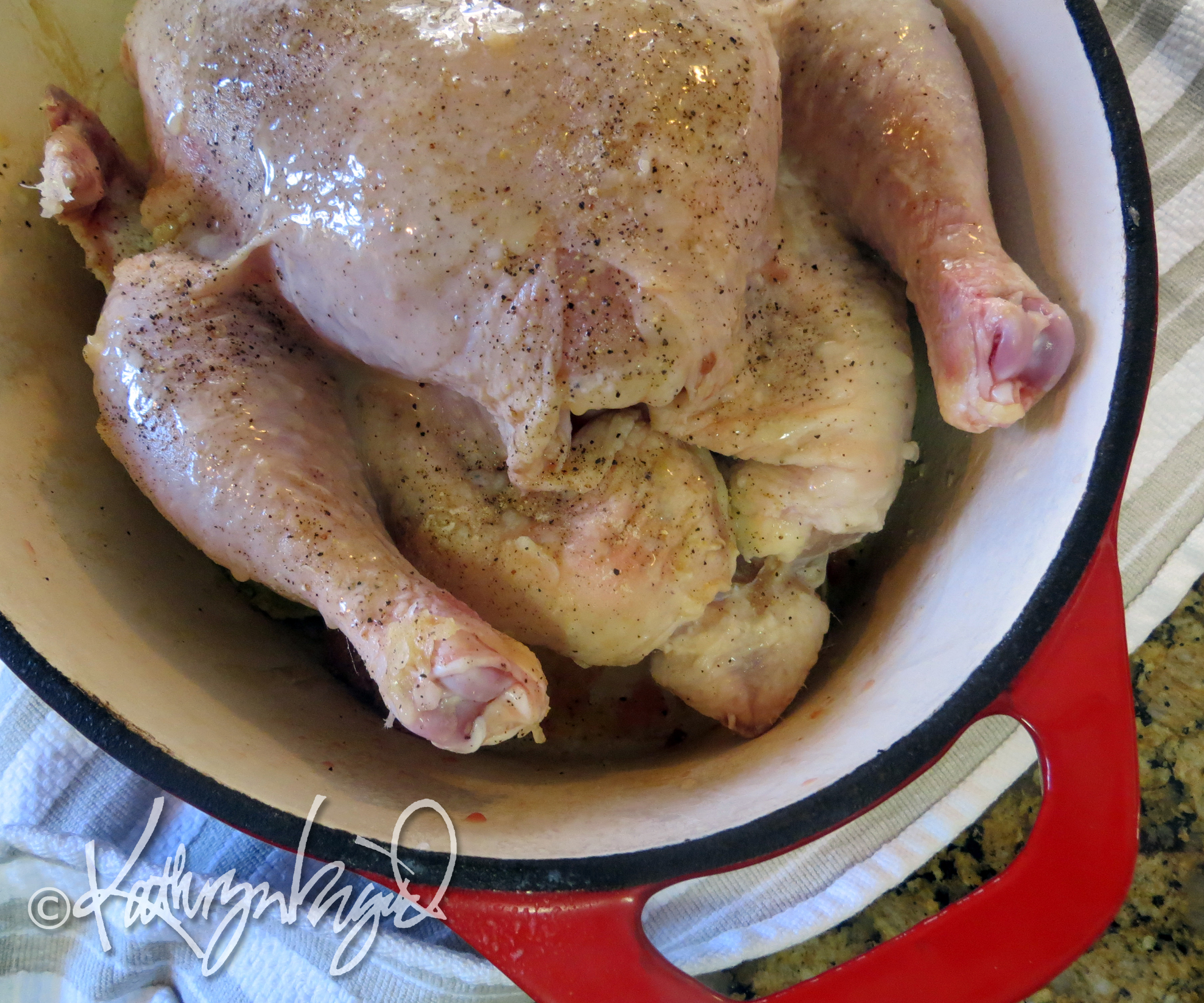
photoNo fingers must be licked for chicken to be considered notably delectable. Still, being no stickler for any particular sort of manners, I am not averse to slurping at any remnants of good food stuck to my fingers no matter what they are or, possibly, where I am. And I find that some of the appeal of eating chicken is that it lends itself to an enormous range of edible iterations that are a pleasure in the making, in the dining, and in the finger-licking aftermath of it all. Chicken plays such a lovely supporting role to any number of costars among the pantheon of possible flavorings and ingredients that it’s never difficult to imagine yet another wondrous way to enjoy a chicken dish. Add to that the potential for re-imagining the chicken in numerous follow-up dishes if there should happen to be any left over from dinner, and you’ve got one fine, fine companion in the kitchen.photoOur friendly chicken on this occasion, a handsomely fat-breasted creature of purportedly wholly organic origins (and who am I to argue), was gently consigned, in a Dutch oven larded with a generous quantity of sweet pastured butter, and wearing a good dusting of homemade lemon salt and pepper, to lie on a bed of neck and giblets, celery chunks and quartered limes that suspended it above the cupful or so of white wine pooled underneath. The oven, set at about as low a temperature as it could sustain below the mere warming of its interior light could generate, brought the chicken up to moist-cooked interior temperature over a long, slow afternoon before being brought out from under its protective lid for browning under the broiler at the last moment. Not the fast food version of ‘finger-lickin’ good’ but rather a lengthily slow-cooked bit of tenderness that deserves hand-cleaning after the fact all the same.photoThe simple sequel to this supper can come from any number of inspirations. On the latest occasion it was pairing the chicken with some crisp-tender hash browns, along with warming some leftover marinara sauce, butter-cooked mushrooms and herbs together to create a facsimile of Chicken Parmigiana. Rather than create the breaded cutlets in the traditional style, I simply layered the slices of moist chicken next to the potatoes, spooned on some mushroom marinara, sprinkled on some shredded Parmigiano, and melted the cheese just a little to round out its flavor. Far from the heights of authentic Italian culinary art, but let me tell you, it wasn’t hard to eat all the same. Might be having some again soon, since there’s still more of that nice chicken that I cut up and popped in the freezer after roasting it the other day. Of course, I could veer off toward some Tikka Masala . . . or chicken noodle soup . . . or quesadillas con pollo. photo

Foodie Tuesday: Once Cooked for Eight Equals Four Times Prepped for Two

photo

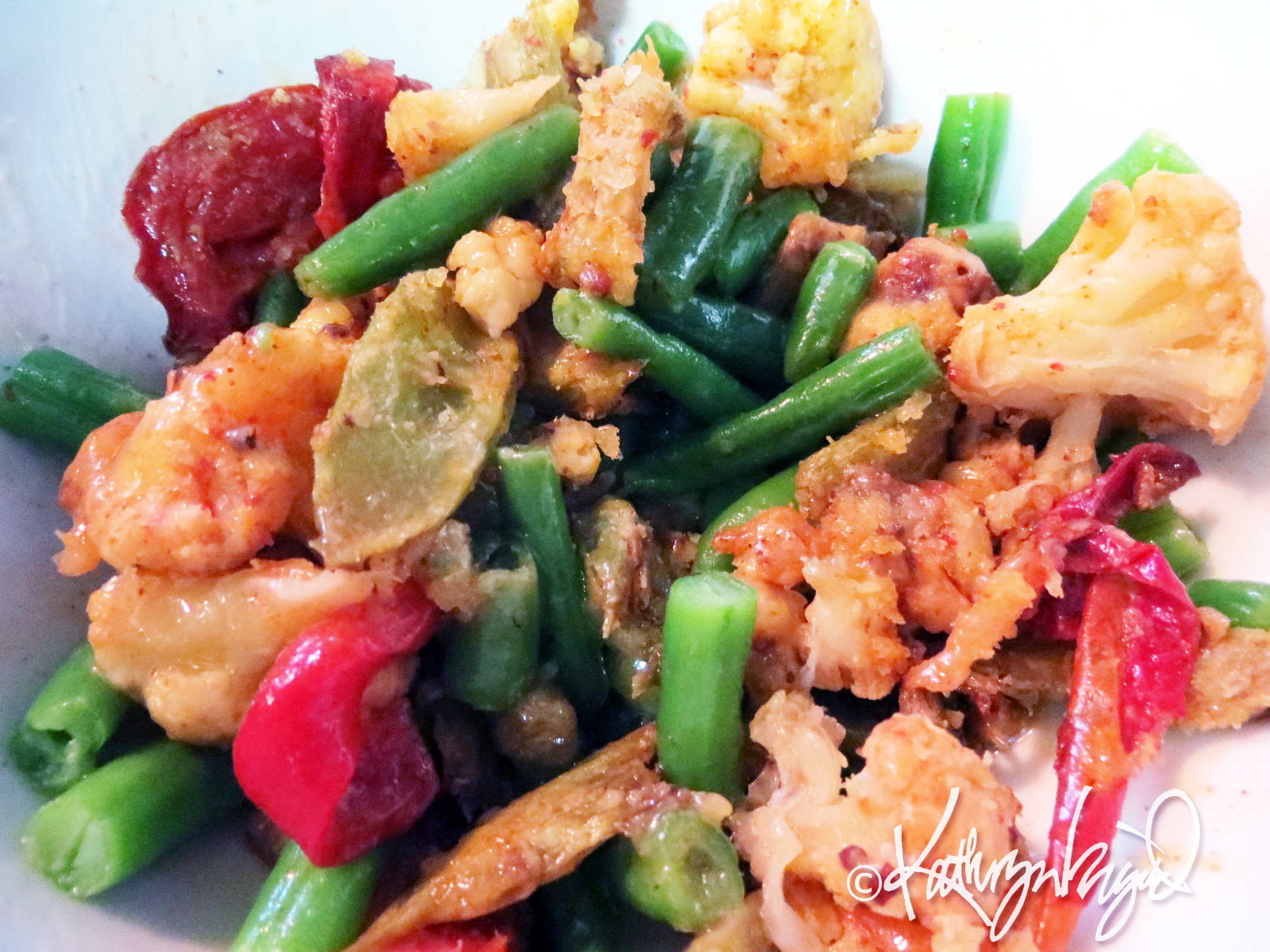
Roasted cauliflower and red capiscum, sautéed celery, steamed green beans–what do they have in common? A new ‘recipe’ for dinner’s vegetable dish, apparently . . .

The complication, if there is any, of having a household of two (or one) is that so many foods, dishes and meals are easier to prepare in larger quantities than are appropriate or even desirable for a single meal. It’s very easy, if planning isn’t finely tuned, to have things spoil and go to waste before we’ve plowed through them at our own pace. The upside of this very problem, though, is that if I do plan reasonably well (and have a little luck as a side dish) I can make several meals out of little more than one prep.

I do this, in part, via the method of complexification and conglomeration. The one or two elements remaining after one meal get combined with each other, with some new element or ingredient from the next meal’s intended menu, or both. Yes, it’s quite possible and even sometimes preferable to simply repeat a dish as-is, especially if it’s already its own elaborate concoction. But often, things seem a little less tired and tiresome if they appear in new guises each time so as to stimulate the palate, if not the imagination. So the small amounts of leftover vegetables from lunch and dinner the last couple of days may find themselves married in a new mixed-veg medley with a little sauce or seasoning that helps them play together as nicely as possible and suddenly, they’re not just two spoonfuls of This and a handful of That but an actual, sort of, recipe.

photo‘Mains’–the central or focal items on the meal’s menu–are seldom hard to incorporate into some new iteration of a main dish. Even when they have already been prepared with a hard-to-ignore or -disguise sauce or presentation, they can find new playmates on the plate next time they head to the table. Roasted chicken, for example, whether homemade or grabbed ready-roasted on a busy day as one flies through the grocery store, is a truly marvelous ingredient when it comes to flexibility. Once seasoned or sauced distinctively, it can pose a slightly more complicated puzzle for renewal, but even then, if the dish is well liked once it’s pretty likely to be popular on a second visit.

So the chicken, whether it was already dressed in the satay-like peanut sauce–I took a shortcut with a pre-made one this time–or not–we liked it well enough to use the same pre-made sauce at the second meal even though it was not already on the chicken–can be reincarnated as a different dinner altogether simply by changing its context. One day, it’s served with a very simple wedge salad dressed with citrusy vinaigrette and a tangle of Pad Thai style rice noodles seasoned lightly with rice vinegar, a squeeze of lime juice and a splash of soy sauce and sprinkled with black sesame seeds.

photoNext day’s ‘satay’ is served with butter-steamed green beans, fresh cold apple slices and fried rice made from–yes, you guessed it–the fridge stash of jasmine or Basmati rice previously cooked up in broth and now pan-toasted until almost crisping with Persian lime olive oil, soy sauce, a touch of raw honey and a handful of chopped sushi gari (pickled ginger, if you somehow haven’t yet noticed, is one of my favorite seasonings for practically everything!). A sprinkling of white sesame seeds, just for a little visual contrast with yesterday’s offering, and there’s Chicken Pseudo-Satay 2.0 ready to be eaten.

And while there’s certainly nothing that says dessert is a required part of every meal, some of us kind of think of it as a specific food group, so even for dessert it’s nice to have some fine ‘recyclable’ ingredients for whipping up something to finish the day’s eating nicely. One of the things that very regrettably can go to waste far too often in a small household is fresh produce, and when I’ve a beautiful batch of fresh fruit on hand I can’t bear to think it will spoil before we can reasonably eat it all. So a large ‘find’ of sweet fresh strawberries, though it was far too great a quantity for two people on the day it was at its peak, got cleaned, sliced and frozen until the other day when it beckoned to me, siren-like, and I blended it thoroughly with a little whole-milk yogurt, splashes of vanilla and rosewater, a tiny pinch of salt and a bit of honey, poured it into a flat sealable container and froze it until it became a brightly fruity semifreddo or granita of sorts for later consumption.

photoNo matter what the small tidbit, most leftovers that are not on the edge of spoiling really do beg for a kindly reinterpretation before we give up on them. Once I get fully in my Friendly Frankenstein mode and think hard about how to zap new life into worthwhile remaindered ingredients, it’s only a matter of letting the locals trade their pitchforks for dinner forks and we can all remain good friends without fear of monstrosities. Good eating!