With a Full Heart

graphite drawingA Song of Farewell
Ends Only the Beginning

A fond farewell should only end the start
Of what emerged from nothing to become
Much greater than its origins, a home
For all that’s good and gracious in the heart–

What had begun in silence has grown deep
And richer than imagining could guess,
A tapestry of joy and tenderness,
A score of blended notes that time will keep–

Whose voices came together first in this
True confluence of sound and sweet accord
Cannot again move aught but closer toward
Such harmony as, now it’s found, is bliss–

For in love’s benedictory refrain
Awakens what all hearts must sing again.

graphite drawing

With gratitude to all at the Episcopal Church of the Incarnation, Dallas, Texas,
and especially to the choir, for welcoming us so kindly during this past year.

Kathryn Sparks
August 2012

Interludes: Songs for Dancing

digital painting from a photoSounding

In the hands of a master

The melody played so sweetly runs

Like a playful rivulet down the hall

Spilling an invitation to

Light-footed dancing, to

Birds chittering along, to light

Flickering between the window blinds

To call all of us down the passage

To bathe in its cool musicdigital painting from a photo

All our Loves

All our friends are singing

In the chorus on a Saturday

And though I know they will be fine

And sing it well, I have to say

That hearing all our friends ring out

In chorus is more complex still

Than polyphonic harmonies

And counterpoint, and what we will

Be loving best and savoring

On the occasion, likely, is

The sheer delight of soaking in

That all these loves are mine and his

Here in Music-land

photoWhile our neighbors, housesitters, et al., languish in the rain and heat back home in north Texas, we are enjoying the gentle zephyrs of coastal breezes, California-fresh seafood, and the retro-rrific air of counterculture that still wafts about in the refined west coast air of Berkeley. More than that, we are reveling in the good company of my spouse’s musical compatriots: his Collegium Singers from the university, many longtime instrumentalist and singer and arts administrative friends from all over, and fellow enthusiasts attending the Berkeley Early Music Festival. The Collegium crew sang, appropriately, like angels in their concert this morning, performing the Victoria Requiem they’ve been refining with such jewel-like precision and sweetness that I wouldn’t be surprised if the dead had resurrected just to listen in, had it been a true funeral service. Instead it was exquisitely meditative and left me–and clearly, the rest of the audience–feeling newly alive.

photophoto

It’s lovely enough to be back on the Left Coast and greeted with such stellar weather, to have my first glimpses of Berkeley’s laid back, live-and-let-live pleasures as a city, and to be in yet another university town where the average walk down a street takes me past representatives of countless countries and cultures, avidly breaking down the latest puzzle of physics or chattily discoursing on the political influences on the contemporary literature emerging from central Africa. It’s a delight to see (yes, and eat) classic dishes from France, Thailand, India, and almost any other culinary heaven imaginable, all within a quarter mile’s stroll of each other in the heart of town. And it’s unspeakably fine to smell the familiar resinous breath of the redwoods, firs, pines and cedars, to see olive trees and palms and Strelitzia reginae and succulents cheek-by-jowl with purple rhododendrons and lawns full of tiny English daisies. California. It’s been a while.photo

The musical immersion is as marvelous as always at festivals and conferences devoted to the art: the rehearsals, the post-concert critiques and deconstructions among friends and colleagues, and hearing fabulous pieces old and new is so invigorating. Heard in concert this afternoon was a vocal-instrumental ensemble that included in its quintet a dear former student of my husband’s, as marvelous a person and musician as ever, and among the works the group performed that were new to me were a pair of certainly not new (ca. 13th century), stunning anonymous compositions from the Montpellier Codex that simply took my breath away. Everything old is new again. Not least of all my amazement at the beauty and variety of music out there in the depths of the melodic pool whose surface I’ve barely begun to skim.photo

The other charms of Berkeley are many, including some of the most outstanding examples of nineteenth century American architecture anywhere. We took a short side trip on our first day in town to stop in and see the superlative work of Julia Morgan, perhaps best known as the designer of Hearst Castle, that monument to extravagant American ego, but to my mind better represented by the Berkeley City Club, a more refined and slightly more restrained palace of culture originally meant to house and host the many women’s clubs of the city. Every inch of the place speaks of thoughtful attention to detail and the cultivation of gentility. Signs of Berkeley’s longtime perch on the front edge of tech development and IT culture are everywhere, too, from storefront displays of vintage technological hardware that seem remarkably antiquated and quaint for being relatively recent iterations of what we now consider so commonplace. The constancy of the city’s citizens in bucking any idea that feels imposed or compulsory is still seen in the posters plastering every flat surface to promote individual choice, dedication to intellectual pursuits and challenges to anything that smacks of dull pedantry or legalism.photo

There was much more marvelous music this evening and will be tomorrow. Today alone, there were concerts at 11 am, 2:30, 4 and 8 pm–with a Heinrich Schütz reading session led by my husband sandwiched in between. Oh, and lunch with another wonderful former student. I can certainly guarantee there will be plenty more enthusiastic eating, drinking, visiting, strolling and happy wool-gathering in the sun as we idle (or dash) along on the way to the next event. For now, a brief pictorial and a wish that everyone who loves music may have an opportunity to attend some such grand events in their own places and times.photo

The Large and the Small of It

The depths of Space carry miraculous sparks of inspiration at a seeming infinity of levels.digital collage

A couple of years ago my husband was conducting a concert of choral works all, in one way or another, exploring the idea of Space, and he asked me to provide projected images that would act as a visual companion to the music. Since the centerpiece of the concert was to be a selection of movements from Estonian composer/astronomer Urmas Sisask’s ‘Gloria Patri‘–wonderfully meditative, somewhat minimalistic yet still quite melodic music which was to be accompanied by photographs taken through the Hubble telescope, I was given a clear starting point for the collection of visual images. The good people of NASA willingly agreed to let us use any Hubble images we liked, without any constraints and at no charge, so my task was to find the images I thought best suited the music at all points, edit them (some extensively, some less so) in order to fit the format of the projections, and collate all of it into a pre-arranged program that I could manually ‘play’ as the concert was performed. Looking for, and then through, hundreds of Hubble images was a bit of a project in itself; reformatting and resizing, digitally ‘cleaning’ and grouping and ordering them proved to be a little more weighty. But it was a pleasurable and energizing project all the same, staring at the stars and constellations in all of their miraculously varied glory. ‘Gloria Patri’ indeed!digital collageGoing forward to work out images for the rest of the pieces on the docket for this program, I was moved by both the enormity of the Hubble’s scope and our own galaxy’s tininess within the vastness of space to think that it would be wonderful to explore those strange dissonances and harmonies that occur in the known world, microscopic to massive, blurred by our limited vision and knowledge and delicately detailed by our constant finding of new facts and ideas in all of it. So for the other pieces in the concert’s repertoire, I sought out images that would complement each other yet emphasize the astounding range of contrasts in our spatial existence, from the granular to the grand. Pollen and planets might in fact have more in common than we can imagine, if we stretch our thinking just a little. Snowflakes and stars might be merely opposite ends of a spectrum that transcends dimensions, scale and vision.digital collageI was reminded throughout this process not only of my minuteness in the great spectacle of existence, but also of how fantastically treasure-filled that existence is, from the level of the subatomic to things and thoughts so massive that the Hubble telescope and all of its exponentially larger generations of offspring may never quite be able to encompass the enormity of it all. If I ever think I’m running out of ideas, I only need to remember this one exercise in humility and happiness, and I should be able to break out of my stasis as a flood of newly sparked inspirations stream like comets out of me.

A Mockingbird Appears

photoWhen ideas and inspiration have ceased, at least for the time being, to well up from the inside, it’s a mercy that the wide world contains so many and will hand them to me if I keep my senses ready enough. I often find myself too distracted by the busyness and pedestrian chores of the workaday world to see the magical other dimensions right within my reach, and need some helpful pricking from a sight or sound or scent as I pass through to remind me to open up the eye and ear and heart and take advantage of the universe’s generosity when it’s poured out so liberally right within my grasp.photoI walk in a haze of dully daily thought, lost to the world of rich and rare delights I’m walking in, when suddenly a mockingbird appears and turns its bright eye on me and seems to contemplate how absent I must be to almost pass it by when it’s quite nearly underfoot. In that shining eye a world reflects in which the other me is wrapped around with blooms, with drifting clouds sailing across a broad blue sky; with jasmine-scented breeze, with mist as the sprinklers spring to life, with happy shouts from a handful of little playing school kids passing me, looking for miracles of their own everywhere because they are yet too young to have forgotten them so foolishly as I have done. When the bird takes to its stripe-blazed wings and dives back into the air, my thoughts begin to follow and fly with it again: I am awake once more to flight and tune in to the rippling, rolling variations of its song as it rises to the trees, and soars above, and makes me remember that I am in a world full of wonder, if I will only let it fill me again.graphite drawing

Gleaming Afternoon

While I would soar, would gladly fly

Wide, in an arc across the sky

Whose dome of hotly burnished brass

Encompasses at every pass

The great wild height of atmosphere

That would engage to hold me here,

I can, eyes shut and spirit wide,

Pierce heaven to the great Outside.

Moments of Music


graphite drawing + textgraphite drawing + text

Magical Night & Mystic Day

photoEnchantments

One night I stood upon the green

And every nightingale a-wing

Stopped in the linden trees to sing,

A perfect choir though all unseen,

Encircling in the meadow’s crown—

Night-blooming flowers ‘round my feet

Reflected moonglow, and their sweet,

Sweet breath rose up as stars fell down

In meteor showers to earth because

Its beauty was so great, so dear,

They longed to draw the night sky near

To all this peacefulness that was—

And while I stood upon that lawn,

Aching with joy, with ecstasy

As sharp as ice and flame in me,

I woke full wide, and it was dawn.photo

The day that came up in that place

Made all the green-wood hum and quake

With quivering for pleasure’s sake,

At seeing the full sun’s clear face,

Yet, basking in the softest fall

Of constant rain, as mist, to fly

In colored arcs across the sky

And shower prisms on us all—

The birds of day joined in that hymn

And coaxed the foxes to the green,

Contented beasts not often seen

In sun, and as I stood, a slim

Grey foal came, too, and nine or ten

Of rabbits, and the beasts all danced,

And I stood still, transfixed—entranced—

And blinked my eyes, and it was night.digitally painted photo

Lullabies and Parallel Universes

photoI have said that music transports me to Other Places. Indeed, all art has that potential for me, for internal travel. It’s one of the great joys of art. As I write this, I’m listening to a live broadcast of this evening’s concert from the Swedish Radio Choir‘s (Radiokören, or RK) concert, one that travels particularly far and wide–and deep–in my heart and mind for a whole lot of reasons.

The note from chief conductor Peter Dijkstra:

Tonight at 1930h I’m doing a concert, live on Swedish radio SVT2 and on Webradio (http://sverigesradio.se/sida/default.aspx?programid=3989, at least in the US) , with the Swedish Radio Choir and Orchestra with an ‘alternative Passionprogram’:
Ligeti – Lux Aeterna
Bach – BWV 12 Weinen, Klagen, Sorgen, Zagen
Poulenc – Stabat Mater
Highly recommended!!!!

Right at this moment, the radio host is interviewing Maestro Dijkstra, and hearing both of their voices, I feel almost as though I’m in the concert hall watching them chat onstage, myself. I’m quite sure I recognize the lady’s voice as that of the same well-spoken broadcaster who interviewed my husband when he was conducting on that same stage at Berwaldhallen at this time of year a few years ago for RK’s Vårkonsert, or Spring Concert. Peter Dijkstra had fairly recently signed on as RK’s chief conductor at the time, and was in town part of the time rehearsing the choir; it’s amazing how quickly the miles disappear when we hear familiar voices or sounds–and the Radio Choir’s distinctive choral sonorities are certainly a part of that equation for me, as well. Their recordings have been for decades among those most widely recognized worldwide for consistently outstanding quality and depth in an incredible range of literature.photo

So here I sit, listening to music sung by a beloved choir and conducted by a truly fine, familiar conductor, and despite being at my desk in my own house, I am traveling to worlds and galaxies far beyond the view of my window. The György Ligeti piece is a perfect vehicle. It’s best known for being that magical, eerie and ethereal sound heard in the famous scene of approach to the monolith in Stanley Kubrick‘s seminal film 2001: A Space Odyssey, and on a personal level is memorable and imaginatively inspiring even more directly because I have heard a couple of groups conducted by my spouse, in both rehearsal and concert, of this famously difficult piece. Each time, the piece itself transforms the performers as they work to ‘get inside’ and master it, and in turn is transformed by their performances, by the acoustic and atmosphere of the place where it’s being sung, and by the expectant and electric energy of audiences who are constantly challenged and awakened by its dramatics, both distinctive and subtle.

Johann Sebastian Bach and a great many of his works are widely familiar to audiences all around as well, and both in spite and because of their very familiarity bring us to an array of places remembered and imagined each time we hear them sung or played. The more famous and oft-played a composer’s works, the more variants we’re likely to come across in style and interpretation, in levels of technical expertise and period accuracy, and especially in the performances’ potential for transportation. I find it profoundly intriguing to see and hear how deeply performers can immerse themselves in the math and mystery, the dancing joy and bottomless grief and resounding laughter and historical drama of Bach, and to experience the accompanying journeys offered to me as a listener. I go to places of Biblical and Apocryphal history, yes, but also to more abstract aspects of the music and the texts: to dark forests and sunless night, and to soaring starry space; to drought-quenching fountains and streams; to realms of green and warm and welcoming respite and meditation.photoThe Stabat Mater of Francis Poulenc, in his characteristic tonalities and performed here with exquisite power and emotional richness (and with a supernal soprano soloist’s voice soaring over the top of the intense and wildly beautiful waves of the choral singing) pulls us into a specific story, but is nonetheless large enough in its musical generosity to allow visions of many other places and states of being. This, too, is a strength of music and of outstanding moments of swimming in it–that it allows us to transcend what is and see, hear and feel what may be.

Music can fill me with passion, and it can also empty me so completely of passion that it lulls me into the abyss of restful peace where I feel nothing can touch me at all.

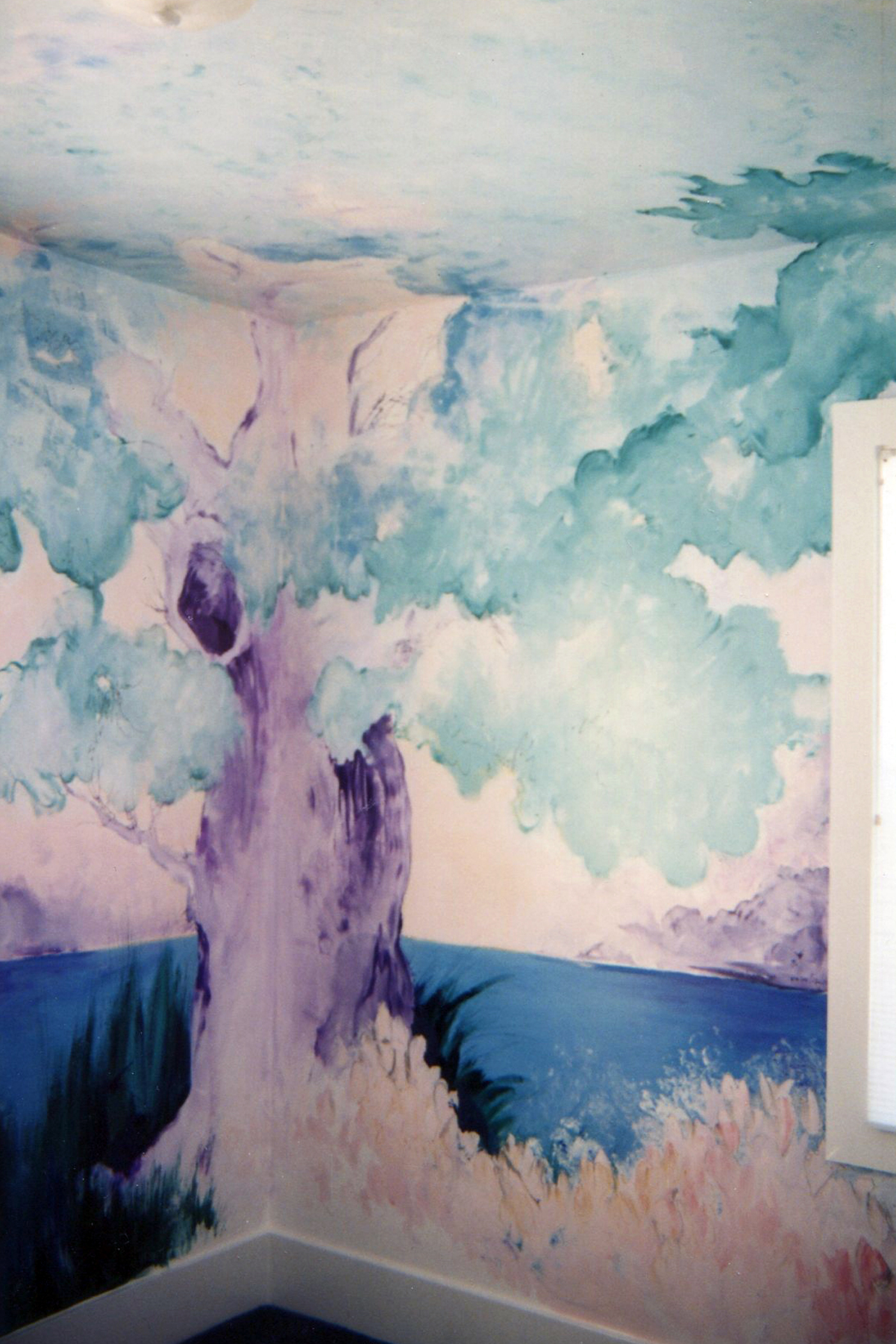
The images in this post are not based on any of the music in this program at all but rather are documentation of one of the small worlds I myself created a little while (well, a teenager’s lifetime) ago. I wanted to make a place that would act as a safe haven, fantasyland, and visual lullaby for the baby boy my sister was carrying. More than seventeen years later, our younger nephew his brother still has the same little woodland clearing in what’s now his room and seems not to be overly anxious to erase it under a more sophisticated or grown-up paint scheme and decor. So I suppose that perhaps it still offers for him adequately what I myself will never grow too old or mature to want: transportation to other places and planes, times, spaces, moods, hauntings and hopes and happiness. I hope that the luminous-paint stars that I sprinkled on that bedroom ceiling still light up after the lamps are turned off at night.photo

Lily of the Valley

photoOne of the rituals of fending off the dregs of winter’s chill is to linger in the hothouses and aisles of flower shops and every place that stocks us up with ideas and plants as we rejuvenate the landscape for the year. A splash of heated color draws the eye; the flash and gleam of leaves caught in each little draft pulls us in, from some pale-margined broad-leafed plant off to some lacy other. The faint sound of their fluttering evokes both sylvan breeze and birdsong and reminds us, beyond those, of springs and fountains drawn to life as winter thaws.

Perhaps the most evocative and pleasing sense that spring and summer lie in wait somewhere not far at all: perfume–the heady redolence that wafts from hyacinths and jasmine blooms, from sweet Viola odorata, from each little honeyed heart that says that life will soon return to earth. One of my favorites for sheer intensity and unstained loveliness of scent is Lily of the Valley–those clean, brilliant bells that cloister in the moss and keep their meditative calm a little secret ’til I’m close enough to catch their drift and see their whiteness glinting in the green. It may be, too, that breathing that intensity of air when these petite white satin blooms nod in the breeze calls up an atavistic searching in my blood. I start to hear that most beloved of Swedish songs (forgive me, my Norwegian forebears–but we were still ‘run’ by our cousins the Swedes until we parted ways in the early 20th century) resonating somewhere in the distance of earth’s slow axial turn, tolling in a sweetly sorrowful voice the tale of the grieving Lily King. Spring is like that–pierced with the lingering poignancy of winter’s deadly grip, but with an insistent, gorgeous urge to let earth be reborn; no matter the loss, the sorrow and the bygone things, to carry forward with what perfumed sweetness it can find.

The Romantic Nationalism that has periodically gripped the music world and produced such pleasures as David Wikander’s exquisite melody for poet Gustav Fröding’s Kung Liljekonvalje is that way too: longing for the old, but wanting something new raised up in it, like the rebirth that comes with spring. Sorrow and joy can mingle then, glowing with possibility and pain, with hesitation and with hope.

The text is sorrowful but evocative, I think, of the intensely bittersweet beauty of the Lily of the Valley; it isn’t hard to see how this must have captured the dark imaginings of many a Northerner in a Romantic frame of mind. I’ve included a translation of my own, meant not as a literal one but rather an attempt to understand something more of the character of the tale and perhaps, indeed, how it grew out of dreaming over the bowing bells of a tiny blooming thing, searching in its ice-white blossoms for promises of better and brighter things.

Kung Liljekonvalje                                  King Lily of the Valley

Kung Liljekonvalje av dungen                  King Lily-of-the-Valley’s in the green-wood,
Kung Liljekonvalje är vit som snö             King Lily-of-the-Valley, who is white as snow,
Nu sörjer unga kungen                            The young king now mourning his maiden,
Prinsessan liljekonvalje mö                      Princess Lily-of-the-Valley, in woe

Kung liljekonvalje han sänker                  King Lily-of-the-Valley now lowers                  
Sitt sorgsna huvud så tungt och vekt      His heavy head so burdened with grief
Och silverhjälmen blanker                       And on his silver helm gleams the sunset,
I sommerskymningen blekt                      Pale dusk that can bring no relief

Kring bårens spindelvävar                       Round her cold bier the cobwebs are woven,
Från rökelsekaren med blomsterstoft       And hang from censers flow’r-filled & spent,
En virak sakta svävar                               Their frankincense drifting down slowly,
All skogen är full av doft                          The forest all filled with the scent

Från björkens gungande krona                From birches’ swaying crowns to their bases,
Från vindens vaggande gröna hus          From winds that rock the green-wood’s home
Små sorgevisor tona                                Small tunes, songs of sadness and mourning
All skogen är uppfylld av sus                   Fill all of the woods as they roam

Det susar ett bud genom dälden             And rustle as wind through the glen; find
Om kungssorg bland viskande blad       The King all cloaked in whispering leaves
I skogens vida välden                              As full sorrow falls on the wood-world,
Från liljekonvaljernas huvudstad             The whole of the Valley still grieves . . .P&I drawing

Oceans of Music

photoRecent weeks have seen our household in full music immersion. The casual observer or fly on the wall might be rather skeptical of the claim, when our home–other than occasional brief bursts of singing from my partner’s office while he’s studying a score–is, if anything, more silent than usual. That’s simply because the music is mainly taking us both elsewhere. And thanks to our practice of managing a one person/two places of employment, one car household economy by means of my sometimes chauffeuring him between gigs and staying through on the sidelines when possible, I get to share in the musical inundation.

It’s no surprise that a conductor, especially one who works in one of the largest university music programs on the continent and therefore has colleagues and students almost beyond the counting who offer musical rehearsals and programs well worth our sharing from morning until late every day right alongside and overlapping his own, would be so surrounded by sound. The Anglican church where he’s currently serving has, in addition, the average Sunday in which the choirs he conducts will sing anthems, Psalms and liturgical service music at two full morning Eucharistic services and one Evensong. All of this is, in fact, hardly unique among conductors, many of whom like him also do guest conducting, clinics and lectures and all of the adminis-trivia that accompany choral, educational, ecclesiastical and institutional operations everywhere. I’m still often astounded at what he manages to do, not only logistically but with continued thoughtful musical scholarship and grace.

And always, always, I am moved to gratitude that I’ve had the incredible good fortune to link my life with his, this person whom I not only like and love but also admire immensely for his integrity, artistry and good humor. On top of all this, I get to Go Along for the Ride and listen to it all.

So as things have gained momentum on the calendar chez nous (as they do cyclically in every household), I have been privileged to bathe in oceans’-worth of music to please my ears, to challenge my thinking, rejoice my heart, soothe my sorrows, ease my weariness, shake my complacency, and rock me gently on sonic waves of peace and beauty. I could do with a little more of that household silence, not to mention free time or sleep, and we can safely assume my spouse would welcome these ten times as eagerly. But I can’t think of what I’d willingly cross off the list from among what we’ve been hearing in the last number of weeks.

I always love listening in on rehearsals, whether with groups my husband’s conducting or otherwise, in part for the wonderful music I hear and in large part because, as a non-musician myself, I can enjoy nearly any music more if I’ve not only listened to it a few times to become more familiarized but, especially, if I’ve gotten a sense of what the singers and/or players are being told about the work–its origins, history, style, particular complexities, and so forth–and are being asked to do with it musically and interpretively. Each group of artists converges at an entirely different point in time in the performing arts, each and every time they rehearse or perform, because in addition to gradually improving or changing skill levels and building affinities with the works in question, they each bring different degrees of their daily condition with them for the occasion: health, attitude, and the news of the last hour may color a performance and endanger or enrich it accordingly. All ages and levels of skill and experience and passion can have ‘off’ nights onstage or, conversely, magically exhilarating moments of unsurpassed attunement, somehow, with the universe.photo

I love actual performances, too, of course, where the high drama of potential crash-and-burn or apotheosis resides in every second of the concert, the recital, the act. The power that emerges from the performers nerving themselves and plunging wholeheartedly into the moment is a splendid spectacle and can transport us all to other places and planes. Not having the performance skills myself (nor the will or self-confidence to develop them as necessary), I am all the more aware of what’s at stake and how nearly incredible it is that great things come out of the effort so often. And, of course, that much more appreciative that there are those who can and will share such gifts with the rest of us.

What the last weeks have brought have included a huge range of such gifts. There was an outstanding high school choir whose fine conductors invited my husband to do an evening’s clinic with the singers on literature they’re preparing for a choral competition. Such joy and energy and responsiveness filling the room! Then, some of his sopranos and altos from one of the university choirs singing the lovely and yes, alluring ‘Sirènes‘ of Claude Debussy as guests on a university orchestra concert, calling all of us listeners to wreck our souls on the dangerous promontories of their imagined seashore. Two performances of the uni Symphony Orchestra in a showcase of some of the school’s powerhouse players, including a recently acquired, fabulous violinist who gave a mesmerizing performance of the Allegro moderato of Tchaikovsky‘s violin concerto (Op. 35) each time–once on campus, then at the Texas Music Educators’ Association conference 5 hours’ road-trip south, where if I weren’t musicked up enough lately I certainly could (and did) dive in among the over 25,000 musicians in attendance at the convention.

There was a delightful performance by a doctoral conducting student with his recital choir. Lots of rehearsals and warmups and services with the church choirs, including lovely works by William Byrd, Morten Lauridsen, Gregorio Allegri. Rehearsals with the university Chamber and Collegium (early music) choirs going on as always, and new ones beginning with the combined singers from Collegium and Dr. Jerry McCoy‘s outstanding A Cappella Choir whom my partner was preparing for performances of George Frideric Handel‘s oratorio ‘Theodora‘ under the baton of Maestro Graeme Jenkins of the Dallas Opera, along with the university’s Baroque Orchestra. Ash Wednesday was a road-tripping adventure, with the two of us working at home in the morning, heading to Dallas for him to warm up and conduct the choir in the noon Ash Wednesday service at the church, dashing back to the university for his afternoon Chamber Choir rehearsal, then back to Dallas for the 6 pm service and a following weekly choir rehearsal before going home back north for the night. But oh, so much lovely music sandwiched in between car races!

That was followed by Thursday and Friday nights’ ‘Theodora’ performances–3 hours of ecstatic music about agonizing trials, or good old life-and-death oratorio drama of Handel’s best sort–and then, yesterday’s Metropolitan Opera broadcast of ‘Ernani’, which I told you about in last evening’s post. Squeezed between concerts and rehearsals, a few pauses while at home spent on listening to a Canadian rock CD (yes, pretty listenable!) I just got as a comp for letting the musicians use my art for their CD cover, and especially on stealing bits of time to revisit our nephew’s punk band Honningbarna when I can. Upcoming is, oh, just more of the same: more beautiful liturgical music-making at the church; more rehearsals, recitals, and concerts at school and in town; another major musicians’ conference; the Dallas Symphony Orchestra, opera at the university and perhaps the One O’Clock Lab Band (the university’s top, Grammy-nominated Jazz ensemble), if we can somehow manage the time for it. Holy Week services (about 8 in 5 days, counting only the ones my husband’s conducting). More of the same.photoAnd yet it is music: never quite the same thing twice, nor the same experience of it. Always powerful, always waking up parts of me that I may have forgotten or not even known were there to be awakened. A constantly changing stream of sound-waves that in turn, become oceans of music to buoy me up, toss me around, pull me in, and carry me far, far away.