Julia Child. Jeffrey Steingarten. Ruth Reichl. Anthony Bourdain. Jane & Michael Stern. Calvin Trillin. MFK Fisher.
Whether you have a Pavlovian reaction of immediate salivation when you hear any of those names (or get an instant craving for a perfectly prepared Pavlova), or you are filled with horror at the mere mention of them, you probably recognize that these are all persons associated with food, and specifically, with writing about food. For good or ill, they have collectively made a deeper impression on the palate of every would-be foodie in the Western world than any of us can even guess–even those of us that know little of the specifics of these individuals’ writings and gustatory opinions. Because the modern world does hold art criticism with a certain sort of reverence not usually associated with the arts themselves (obviously, those who determine the ostensible value of art must be much smarter and more reliable than those who merely make the stuff), and chases after those things that the most influential critics tell the world it should desire, or reviles that which they tell us we should fear or disdain. And where our tastes go, there go our wallets also. Soon to be followed by every shopkeeper and purveyor of ingredients and/or ideas related to said tastes. It’s the way we’re wired.
What attracts me to any of these, or other food writers, is that when at their best, each of them speaks not only with a truly distinctive and individual voice–but also writes as much about the context of the food as to give me a deeper and more delicious sense of its place within its cultural surrounds, in history, in each writer’s personal history, in the sciences of cookery that led to its development. Every bite we eat is potentially not only a small barrier between us and starvation but also is fraught with danger (want to talk about all of the discoverers of what wasn’t safe for human consumption?), full of potential for making memories that outlive and outlast every scholarly hour any of us ever spent on Serious Pursuits, and able to make or break meaningful relationships. We find, and lose, ourselves in what we eat and when and how and why we eat it, and these writers all carry that weight with such authority and finesse at times that there’s as much heartbreak in the description of a tender stalk of asparagus, as much ethereal joy in the coddling of one little egg, as though one were reading the great philosophers, the kings and queens among novelists. Oh, wait: all of those have also waxed wildly poetic on food from time to time; it’s how they connect with the rest of us too.
That this relationship between the ordinary and extraordinary can so blur at its own boundaries is precisely because food has such life-and-death power over us all and because we seek it, when we can, for its own allure.
So I am thankful, not only on a Foodie Tuesday but whenever I pause for such thought, that there have long been people who loved food enough to prepare and eat it–and to talk about it, study it, and yes, write about it well. Sometimes reading good food writing is almost like the actual eating of it; more often, it makes me desirous of both eating and knowing more of it. My parents and relatives and friends have trained me up in certain ways of cooking and eating, and the larger world offered numerous expansions on the ideals of both. And the great and good among food writers and critics and historians have pushed my horizons further in every direction. When I set out to put food on the table (or just directly into my mouth), it is most often done with a current of those thoughts they have inspired in me running through every move I make and every ingredient I take in hand.
I think, as a result, of how I first knew of various simple elements of cookery: ingredients, techniques, recipes and menus. Then I think of how I might wish to recombine them in the present moment. Who should be present. What is best suited to the occasion. How I wish to assemble it all. And off I go.
Spare ribs were an infrequent but welcome treat when I was growing up–infrequent because Mom’s method was of the boil-then-broil variety, a slow simmering on the cooktop in water or broth followed by oven roasting to finish with a bit of higher heat for caramelizing the glaze. I doubt that I ever requested her recipe for the ribs because I was too daunted by the amounts of time and labor required to want to fuss with any such thing. Ever so much later, here I am making them too, but with enough of a boost from kitchen rocket science to simplify them to a point where even Miss Lazybones is willing to make the (much more modest) effort, knowing that the ribs will turn out tender and juicy no matter what else I do with them.
My process, then, is simpler than the description of it will sound, and the ingredient list is flexible and easy to decide as well. I have (I believe I mentioned before) that dream-machine of lazy cooks, my home sous vide appliance [not a compensated endorsement but yes, I really do like it!]. It’s about the size of a very small microwave oven and even lives on our kitchen counter between uses because I have the luxury of a great expanse of countertop workspace. Sous vide cooking is the method of putting vacuum-sealed packets of food (plus, if desired, seasonings of various kinds) in a temperature-controlled water bath and letting the bath do pretty much all of the work except for final browning or caramelizing. I have a kitchen vacuum sealer, also a fairly pricy but mighty handy appliance as it allows for good freezer-proof packaging of meats and vegetables so they don’t spoil as quickly, and with the food-safe wrappings means that I can even put pre-seasoned packets directly from the freezer into the sous vide machine if I allow enough time for the frozen food to come fully to the correct internal temperature and stay there for the right amount of time.
The water bath cooking method is as old as the hills, really, though in olden times it required much more elaborate and ingenious ways of wrapping the immersible foods and a constant vigilance over the cooking temperature of the water bath that yours truly would never dream of undertaking. Sous vide mechanisms with automated water circulation and temp control can even be home-built by the mad-scientist sort of kitchen enthusiast. Me, I was gifted with a ready-made beauty by my kindly spouse. It cost quite a chunk of change, as you’d imagine, but the payoff for him is worthwhile, I think, when I actually endeavor to make such previously tiresome things as a rack of perfectly fall-off-the-bone baby back ribs.
Baby, Come Back to Me Ribs
[Special equipment: a food vacuum-packing machine and a home sous vide setup]
1 Full rack of well-marbled pork ribs
Spice rub
Butter
Barbecue sauce
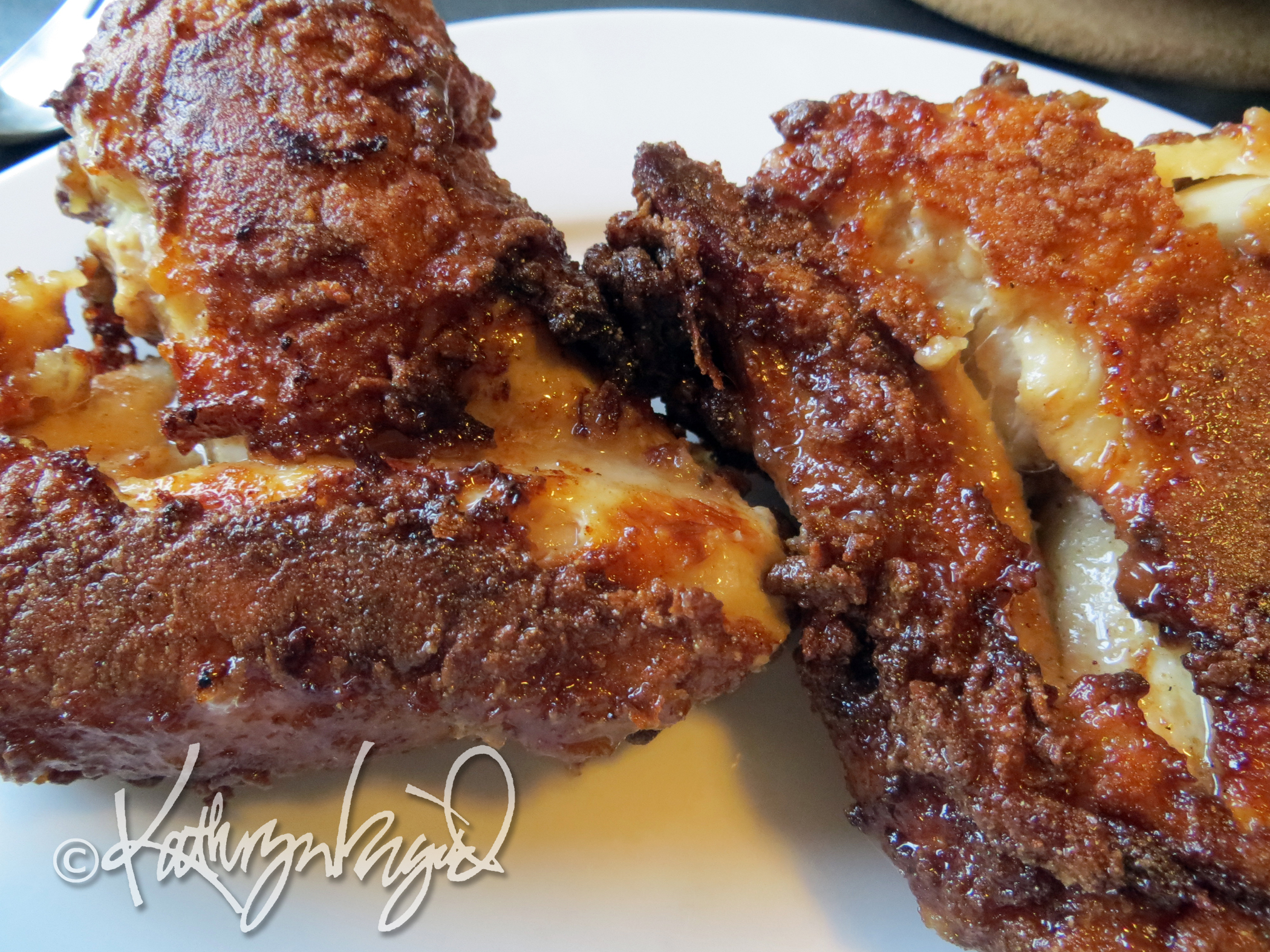
I slash the rack of ribs in half and vacuum-pack the halves separately so that I can nestle the two together, thus making a small-shoebox-sized batch of meat that can fit comfortably into my sous vide and still be surrounded by water. For prep, I put each spice-rubbed* half-rack into an open vacuum bag with a pat of butter, then seal the packets closed, fit the two together snugly, and keep them in the fridge until start-up time. The evening before Rib Eating Day, I’ll immerse the conjoined twin packs in the sous vide. I use the machine’s handy printed cooking guide to choose and set the temp for a mere hair-above-minimum ‘ideal’ for ribs, and let them slowly melt into juicy morsels overnight. About a half hour before mealtime, I take the now soupy-looking packets out of the water bath, open the bags carefully over a sauce pot and drain all of the extra juices into it for boiling down into a nice quick base for the barbecue sauce, and while that’s heating up, very delicately (as they’re now falling apart) dress the rib racks with some of the prepared barbecue sauce** and put them, in a 9×13″ or larger baking pan, under the broiler to brown them nicely for serving. Watch out for burning! When they look and smell enough like candy that you can’t wait any longer, grab them out of the oven and rush them to the table. Hopefully, everything–and everyone–else has been gathered on or at the table beforehand, so it’s all ready to go. Eat ribs with your hands, and become outlandishly messy. Wear your worst old clothes, because if you’re not all painted elbows-to-eyebrows in barbecue sauce by the end of the meal, you’ve definitely done something wrong. This is barbecue, after all. [If you eat these in summertime y’all can go out and run through the sprinkler afterward to wash up.]
Ribs go down wonderfully with a wide range of goodies. I like a Kansas City or Memphis-style rub and sauce (slightly spicy, sticky and sweet), so mine tend to be as follows:
* Spice rub: salt and black pepper; brown sugar; ground cloves, cinnamon, allspice, ginger, garlic powder and cayenne.
** Barbecue sauce: we love Corky’s (from Memphis, no surprise) regular sauce, so if I have some on hand I may well use it straight out of the bottle, just adding the concentrated meat juices I’ve cooked down. If I’m making my own BBQ sauce, I concoct something in a similar vein, using dark molasses, ketchup, tomato puree, the same spices as in the rub sans sugar, and usually some citrus juice (orange is great) and a splash of whiskey to coat the ribs for browning, and to blend with the meat juices for serving.
Side dishes: at our place, it’s likely you’ll see coleslaw and corn (creamed, on the cob, or cooked kernels of super-sweet corn are all pretty hard to beat); buttery mashed potatoes, fresh peaches and watermelon . . . of course, any good Southern side dishes are pretty perfect with ribs: a mess o’ greens (would that I had the late great Raydell’s delectably classic recipe!), biscuits or soft rolls with butter, grits, beans cooked down almost to disappearance with salt meat. Big ol’ pitchers of sweet tea. Some sweet potato pie or lemon cake to finish. Ohhh, my stomach is growling now. I’d better read me some good foodie scripture right away before I lose my soul. Help me, blessed Calvin Trillin! Save me, saint Mary Frances Kennedy Fisher!







 Art-Colored Glasses